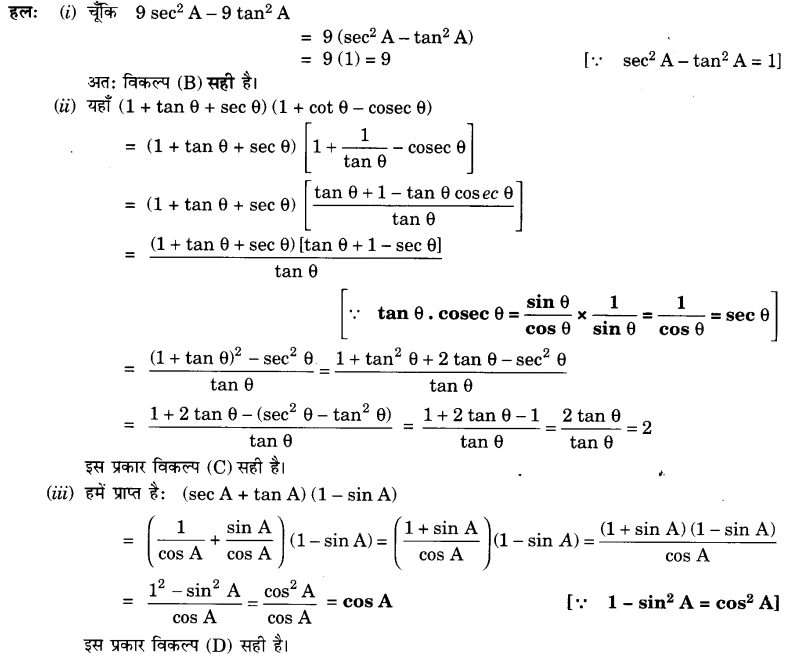
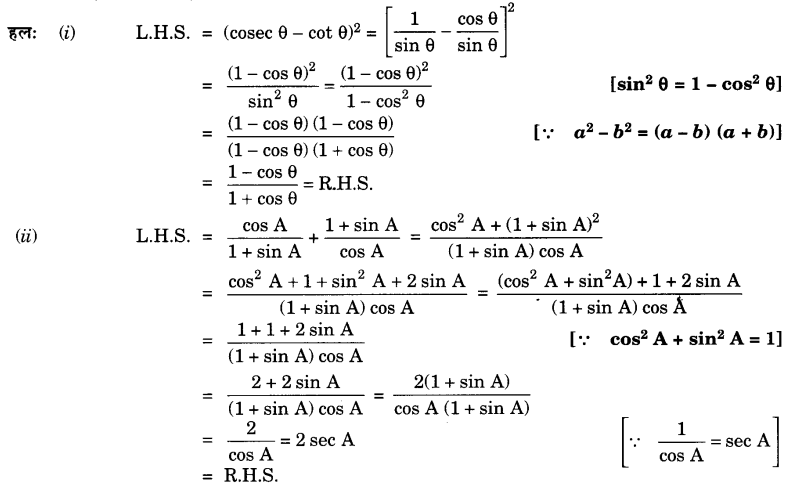
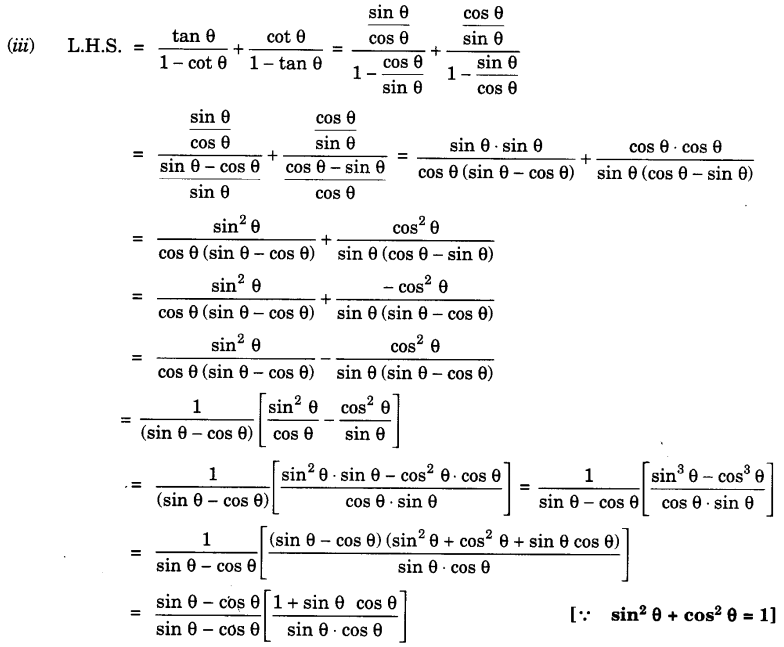
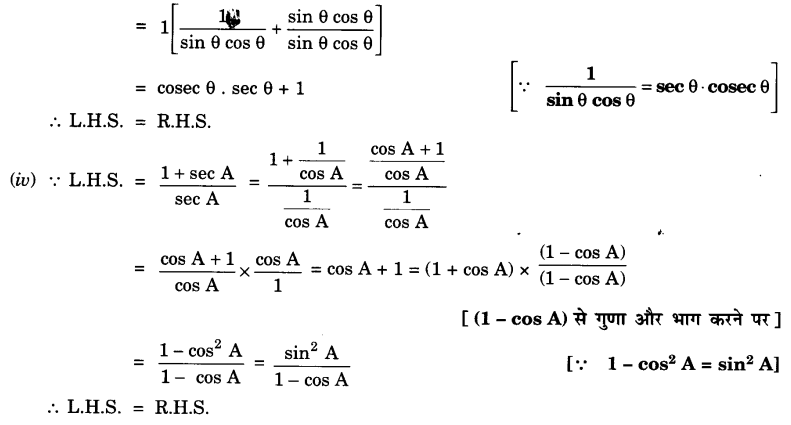
UP Board Solutions for Class 10 Maths Chapter 8 Introduction to Trigonometry

UP Board Solutions for Class 10 Maths Chapter 8 Introduction to Trigonometry

These Solutions are part of UP Board Solutions for Class 10 Maths. Here we have given UP Board Solutions for Class 10 Maths Chapter 8 Introduction to Trigonometry.

प्रश्नावली 8.1 (NCERT Page 200)

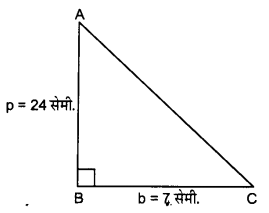
प्र. 1. ΔABC में, जिसका कोण B समकोण है, AB = 24 cm (UPBoardSolutions.com) और BC = 7 cm है| निम्न लिखित का मान ज्ञात कीजिए :
(i) sin A, cos A
(ii) sin C, cos C
हलः
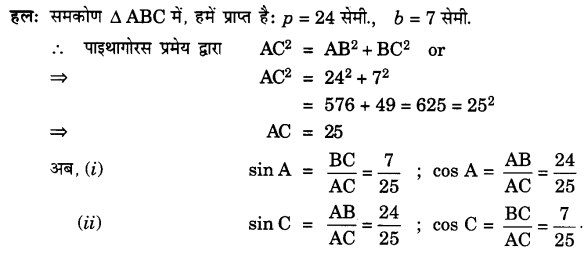
UP Board Solutions for Class 10 Maths Chapter 8 Introduction to Trigonometry page 200 1
UP Board Solutions for Class 10 Maths Chapter 8 Introduction to Trigonometry page 200 1.1

UP Board Solutions

For more information about NCERT Solutions Class 10 Maths in English medium.

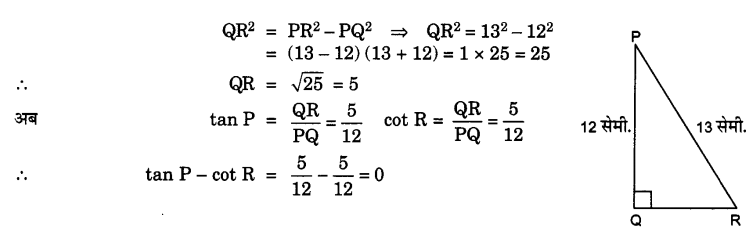
प्र. 2. आकृति में, tan P cot R का मान ज्ञात कीजिए|
हलः
एक समकोण ΔPQR में, पाइथागोरस प्रमेय का प्रयोग (UPBoardSolutions.com) करने पर हमें प्राप्त होता है।
UP Board Solutions for Class 10 Maths Chapter 8 Introduction to Trigonometry page 200 2

UP Board Solutions

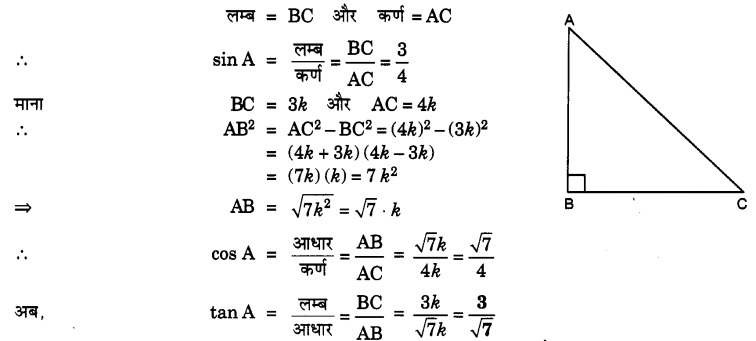
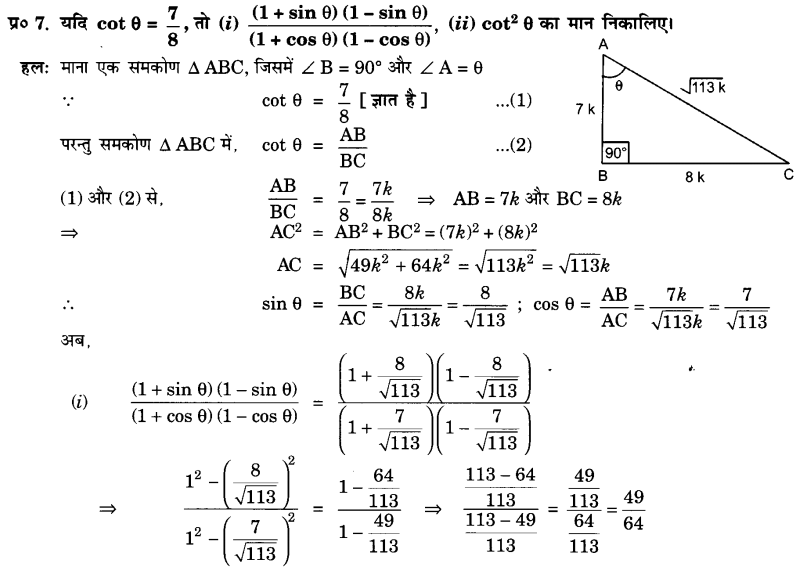
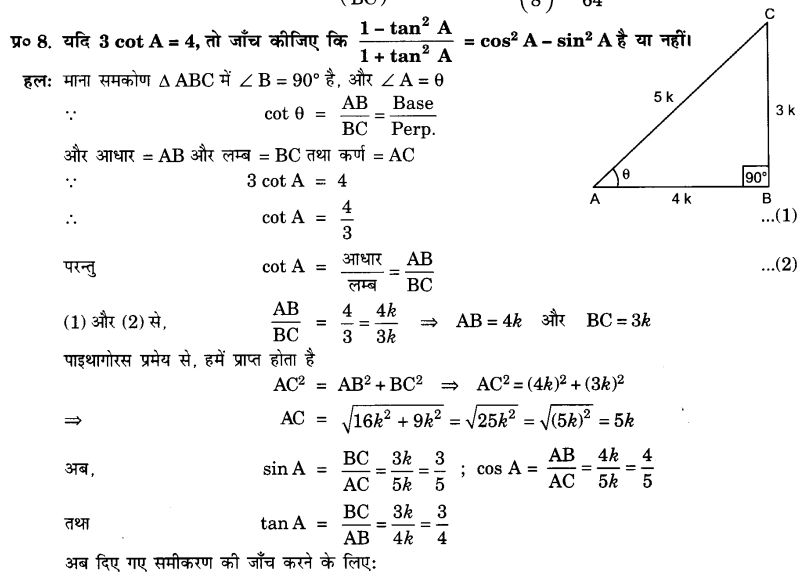
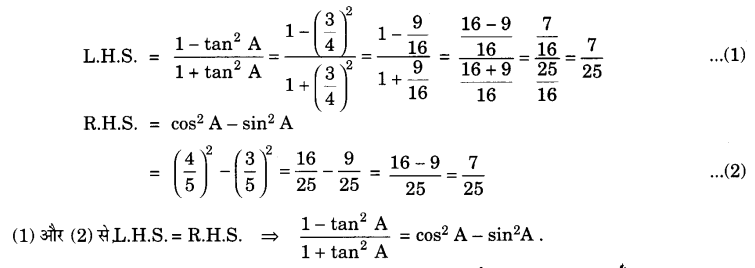
प्र० 3. यदि sin A = [latex]\frac { 3 }{ 4 }[/latex], तो cos A और tan A का मान परिकलित कीजिए।
हलः एक त्रिभुज ABC लें, जो कि B पर समकोण है। इससे हमें ∠A (UPBoardSolutions.com) के लिए प्राप्त होता है कि
UP Board Solutions for Class 10 Maths Chapter 8 Introduction to Trigonometry page 200 3

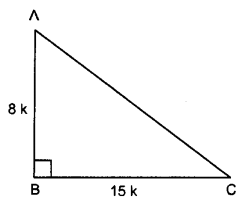
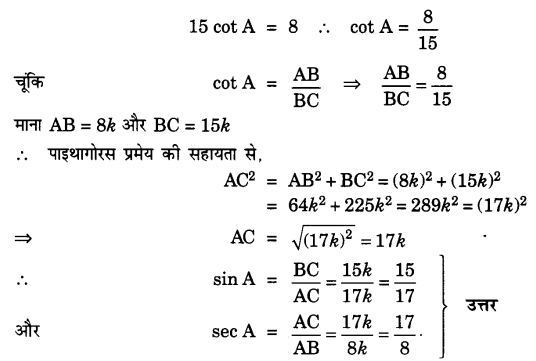
प्र० 4. यदि 15 cot A = 8 हो तो sin A और sec A का मान ज्ञात कीजिए।
हलः माना समकोण ΔABC में, हमें प्राप्त है।
UP Board Solutions for Class 10 Maths Chapter 8 Introduction to Trigonometry page 200 4
UP Board Solutions for Class 10 Maths Chapter 8 Introduction to Trigonometry page 200 4.1

UP Board Solutions

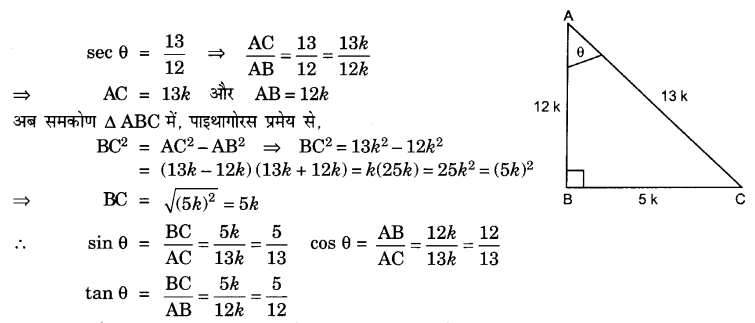
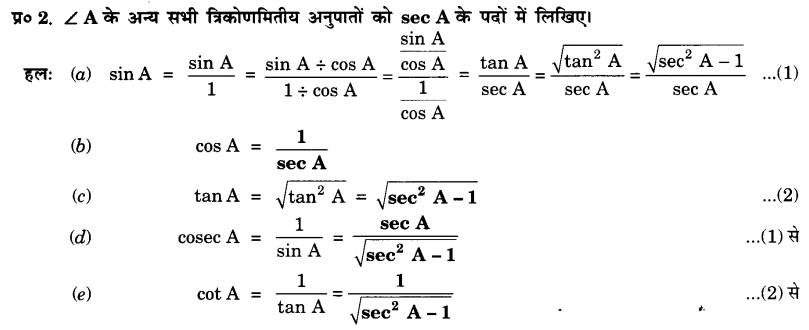
प्र० 5. sec θ = [latex]\frac { 13 }{ 12 }[/latex], हो तो (UPBoardSolutions.com) अन्य सभी त्रिकोणमितीय अनुपात परिकलित कीजिए।
हलः माना समकोण ΔABC में ∠B = 90° माना, ∠A = θ और
UP Board Solutions for Class 10 Maths Chapter 8 Introduction to Trigonometry page 200 5

UP Board Solutions

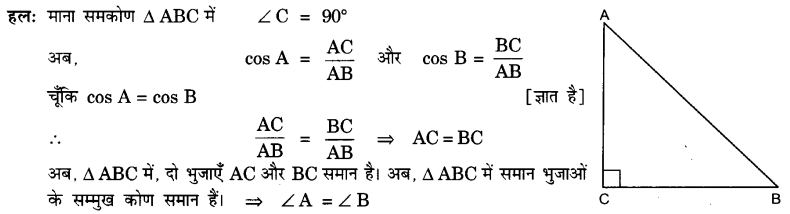
प्र० 6. यदि ∠A और ∠B न्यून कोण हो, जहाँ cos A = cos B, तो दिखाइए कि ∠A = ∠B.
UP Board Solutions for Class 10 Maths Chapter 8 Introduction to Trigonometry page 200 6

UP Board Solutions for Class 10 Maths Chapter 8 Introduction to Trigonometry page 200 7

UP Board Solutions
UP Board Solutions for Class 10 Maths Chapter 8 Introduction to Trigonometry page 200 7.1

UP Board Solutions for Class 10 Maths Chapter 8 Introduction to Trigonometry page 200 8
UP Board Solutions for Class 10 Maths Chapter 8 Introduction to Trigonometry page 200 8.1

UP Board Solutions

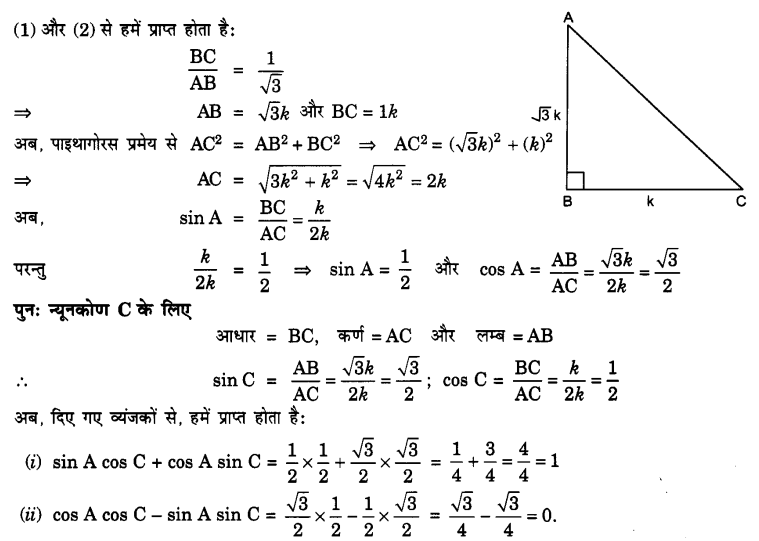
प्र० 9. त्रिभुज ABC में, जिसका कोण B समकोण है, (UPBoardSolutions.com) यदि tan A = [latex]\frac { 1 }{ \surd 3 }[/latex], तो निम्नलिखित के मान ज्ञात कीजिए:
(i) sin A cos C + cos A sin C
(ii) c0s A cos C sin A sin C
UP Board Solutions for Class 10 Maths Chapter 8 Introduction to Trigonometry page 200 9
UP Board Solutions for Class 10 Maths Chapter 8 Introduction to Trigonometry page 200 9.1

UP Board Solutions

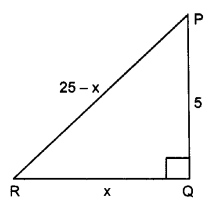
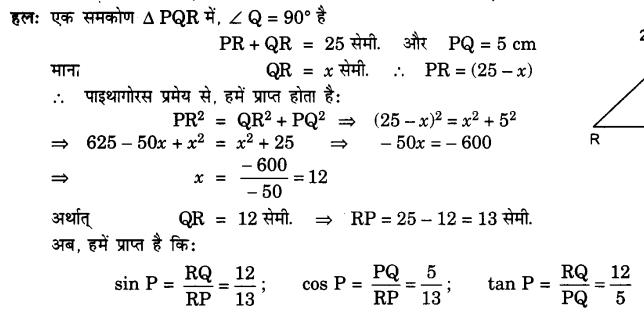
प्र० 10. ΔPQR में, जिसका कोण Q समकोण है, PR + QR (UPBoardSolutions.com) = 25 सेमी. और PQ = 5 सेमी. है। sin P, cos P और tan P के मान ज्ञात कीजिए।
UP Board Solutions for Class 10 Maths Chapter 8 Introduction to Trigonometry page 200 10
UP Board Solutions for Class 10 Maths Chapter 8 Introduction to Trigonometry page 200 10.1

UP Board Solutions

प्र० 11. बताइए कि निम्नलिखित कथन सत्य हैं या असत्य। (UPBoardSolutions.com) कारण सहित अपने उत्तर की पुष्टि कीजिए।
(i) tan A को मान सदैव 1 से कम होता है।
(ii) कोण A के किसी मान के लिए sec A = [latex]\frac { 12 }{ 5 }[/latex]
(iii) cos A, कोण A के cosecant के लिए प्रयुक्त एक संक्षिप्त रूप है।
(iv) cot A, cot और A का गुणनफल होता है।
(v) किसी भी कोण 8 के लिए sin θ = [latex]\frac { 4 }{ 3 }[/latex]
हलः
(i) असत्यः [चूकि, समकोण त्रिभुज में कर्ण के अतिरिक्त अन्य दो भुजाओं का अनुपात 1 के समान या असमान हो सकता है।]
(ii) सत्यः [ cos A का मान सदैव 1 से कम होता है।
[latex]\frac { 1 }{ cos A }[/latex] अर्थात् sec A का मान 1 से सदैव बड़ा होता है।]
(iii) असत्यः [cosine A को संक्षिप्त रूप ‘cos A’ होता है।]
(iv) असत्यः [अकेले ‘cot’ का कोई अर्थ नहीं है। cot A एक ही त्रिकोणमितीय अनुपात होता है।]
(v) असत्यः [का मान 1 से अधिक है, जबकि sin 8 का मान 1 से अधिक नहीं हो सकता]

UP Board Solutions

प्रश्नावली 8.2 (NCERT Page 206)

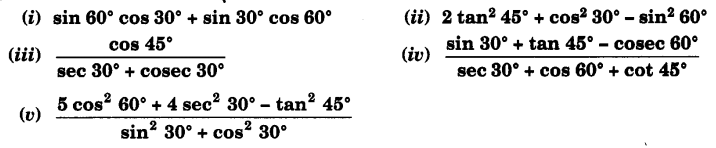
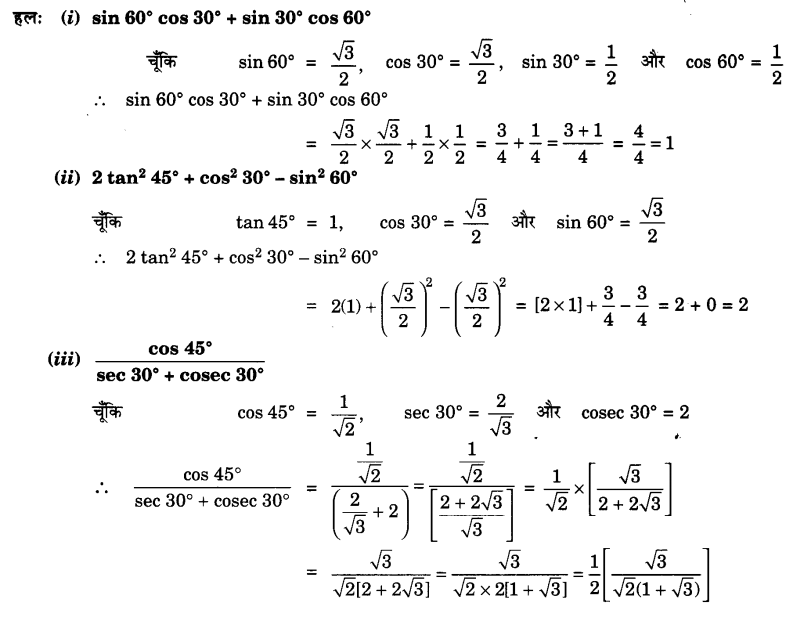
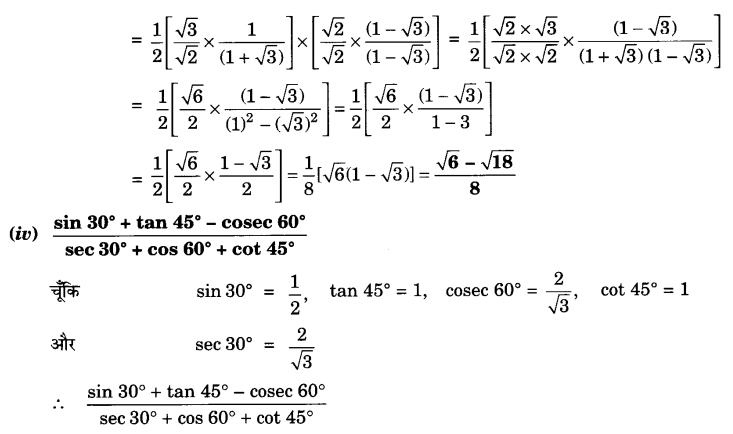
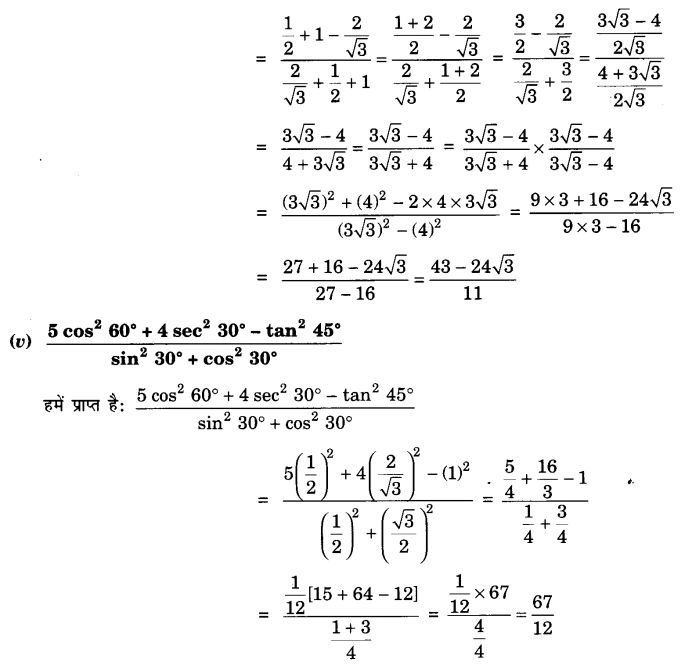
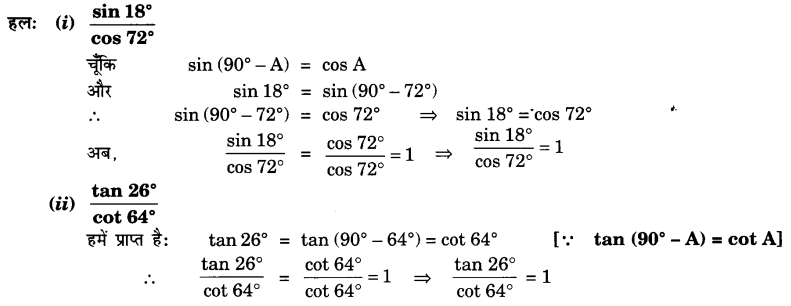
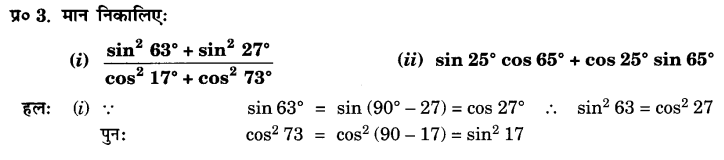
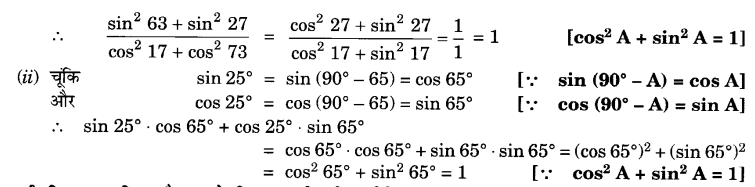
प्र० 1. निम्नलिखित के मान निकालिएः
UP Board Solutions for Class 10 Maths Chapter 8 Introduction to Trigonometry page 206 1
UP Board Solutions for Class 10 Maths Chapter 8 Introduction to Trigonometry page 206 1.1

UP Board Solutions
UP Board Solutions for Class 10 Maths Chapter 8 Introduction to Trigonometry page 206 1.2
UP Board Solutions for Class 10 Maths Chapter 8 Introduction to Trigonometry page 206 1.3

UP Board Solutions

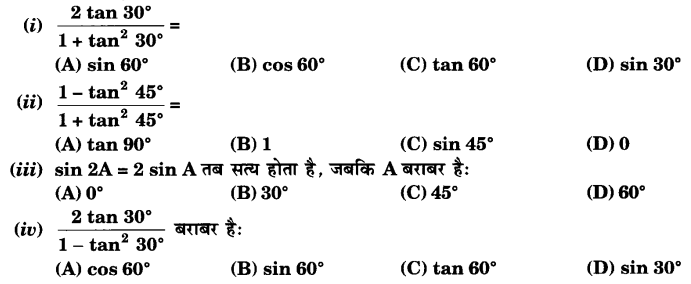
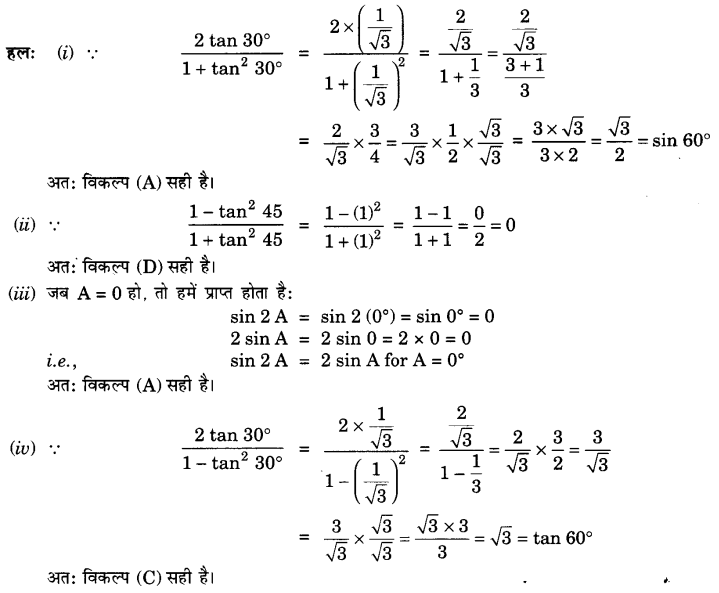
प्र० 2. सही विकल्प चुनिए और अपने विकल्प का (UPBoardSolutions.com) औचित्य दीजिए :
UP Board Solutions for Class 10 Maths Chapter 8 Introduction to Trigonometry page 206 2
UP Board Solutions for Class 10 Maths Chapter 8 Introduction to Trigonometry page 206 2.1

UP Board Solutions

प्र० 3. यदि tan (A + B) = √3 और tan (UPBoardSolutions.com) (A B) = [latex]\frac { 1 }{ \surd 3 }[/latex]; 0° < A + B ≤ 90°; A > B तो A और B का मान ज्ञात कीजिए।
हलः तालिका से, हमें प्राप्त होता है:
tan 60° = √3 …(1)
चूंकि tan (A + B) = √3 [ज्ञात है] …(2)
(1) और (2) से, हमें प्राप्त होता है।
A + B = 60° ………(3)
इसी प्रकार,
A B = 30° ………. (4)
(3) और (4) को जोड़ने पर, 2A = 90° ⇒ A = 45°
(3) में से (4) को घटाने पर, 2B = 30° ⇒ B = 15°

UP Board Solutions

प्र० 4. बताइए कि निम्नलिखित में कौनकौन सत्य हैं या असत्य हैं। कारण सहित अपने उत्तर की पुष्टि कीजिए।
(i) sin (A + B) = sin A + sin B.
(ii) θ में वृद्धि होने के साथ sin θ के मान में भी वृद्धि होती है।
(iii) θ में वृद्धि होने के साथ cos θ के (UPBoardSolutions.com) मान में भी वृद्धि होती है।
(iv) θ के सभी मानों पर sin θ = cos θ
(v) A = 0° पर cot A परिभाषित नहीं है।
हलः (i) माना
A = 30° और B = 60°
L.H.S. = sin (30° + 60°) = sin 90° = 1
R.H.S. = sin 30° + sin 60° = [latex]\frac { 1 }{ 2 } +\frac { \surd 3 }{ 2 } =\frac { 1+\surd 3 }{ 2 }[/latex]
L.H.S. ≠ R.H.S.
कथन “sin (A+ B) = sin A + sin B” असत्य है।
(ii) चूँकि “जब θ का मान 0° से 90° तक बढ़ता है तो sin θ का मान 0 से 1 तक बढ़ता है।”
दिया गया कथन सही है।
(iii) चूँकि “जब θ का माप 0° से 90° तक बढ़ता है, तो cos θ का मान 1 से 0 तक घटता है।”
दिया गया कथन असत्य है।
(iv) माना θ = 30° है।
तालिका से हमें प्राप्त होता है: sin 30° = [latex]\frac { 1 }{ 2 }[/latex] और cos 30° = [latex]\frac { \surd 3 }{ 2 }[/latex]
sin 30° ≠ cos 30°
अतः दिया गया कथन असत्य है।
(v) तालिका से हमें प्राप्त है: cot 0° = अपरिभाषित
अतः दिया गया कथन सत्य है।

प्रश्नावली 8.3 (NCERT Page 209)

प्र० 1. निम्नलिखित का (UPBoardSolutions.com) मान निकालिएः
UP Board Solutions for Class 10 Maths Chapter 8 Introduction to Trigonometry page 209 1
UP Board Solutions for Class 10 Maths Chapter 8 Introduction to Trigonometry page 209 1.1

UP Board Solutions
(iii) cos 48° – sin 42°
हल: cos 48° – sin 42°
⇒ sin(90° – 48°) – sin 42°
⇒ sin 42° – sin 42° = 0
(iv) cosec 31° – sec (UPBoardSolutions.com) 59°
हल: cosec 31° – sec 59°
⇒ sec (90° – 31°) – sec 59° [ cosec q = sec (90° – q) ]
⇒ sec 59° – sec 59° = 0

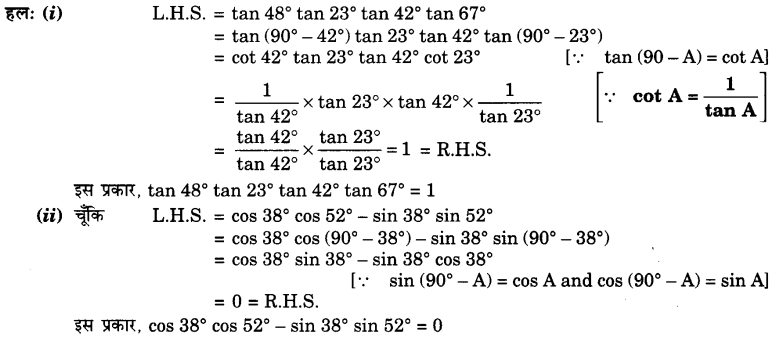
प्र० 2. दिखाइए कि
(i) tan 48° tan 23° tan 42° tan 67° = 1
(ii) cos 38° cos 52° – sin 38° sin 52° = 0
UP Board Solutions for Class 10 Maths Chapter 8 Introduction to Trigonometry page 209 2

UP Board Solutions

प्र० 3. यदि tan 2A = cot (A – 18°), जहाँ 2A एक (UPBoardSolutions.com) न्यूनकोण है, तो A का मान ज्ञात कीजिए|
हल: tan 2A = cot (A – 18°),
⇒ cot (90° – 2A) = cot(A – 18°)
दोनों पक्षों में तुलना करने पर
⇒ 90° – 2A = A – 18°
⇒ 90° + 18° = A + 2A
⇒ 3A = 108°
⇒ A = 36°

प्र० 4. यदि tan A = cot B, तो सिद्ध कीजिए कि A + B = 90°
हल: tan A = cot B दिया है |
⇒ tan A = tan (90° – B)
तुलना करने पर
⇒ A = 90° – B
⇒ A + B = 90°
Proved.

प्र० 5. यदि sec 4A = cosec(A – 20°), जहाँ 4A एक न्यूनकोण है, तो A का मान ज्ञात कीजिए|
हल: sec 4A = cosec(A – 20°)
⇒ cosec (90° – 4A) = cosec(A – 20°) [sec q = (90°- q)]
तुलना करने पर
⇒ 90° – 4A = A – 20°
⇒ 90° + 20° = A + 4A
⇒ 5A = 110°
⇒ A = 22°

UP Board Solutions

UP Board Solutions for Class 10 Maths Chapter 8 Introduction to Trigonometry page 209 6
UP Board Solutions for Class 10 Maths Chapter 8 Introduction to Trigonometry page 209 6.1

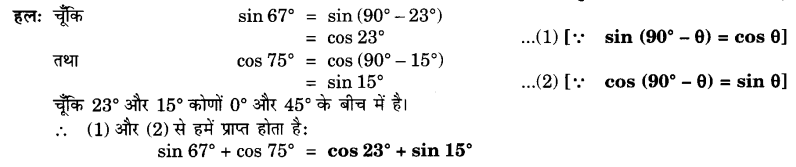
प्र० 7. sin 67° + cos 75° को 0° और 45° के बीच के कोणों के त्रिकोणमितिय अनुपातों के पदों में व्यक्त कीजिए|
UP Board Solutions for Class 10 Maths Chapter 8 Introduction to Trigonometry page 209 7

UP Board Solutions

प्रश्नावली 8.4 (NCERT Page 213)

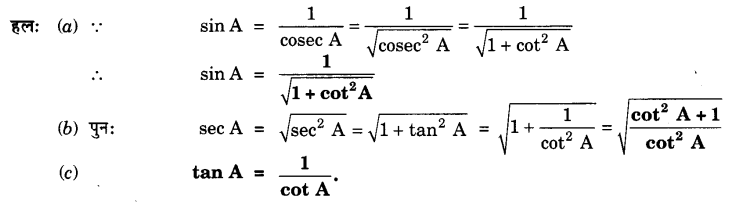
प्र० 1. त्रिकोणमितीय अनुपातों sin A, sec A और (UPBoardSolutions.com) tan A को cot A के पदों में व्यक्त कीजिए।
UP Board Solutions for Class 10 Maths Chapter 8 Introduction to Trigonometry page 213 1

UP Board Solutions for Class 10 Maths Chapter 8 Introduction to Trigonometry page 213 2

UP Board Solutions

UP Board Solutions for Class 10 Maths Chapter 8 Introduction to Trigonometry page 213 3
UP Board Solutions for Class 10 Maths Chapter 8 Introduction to Trigonometry page 213 3.1

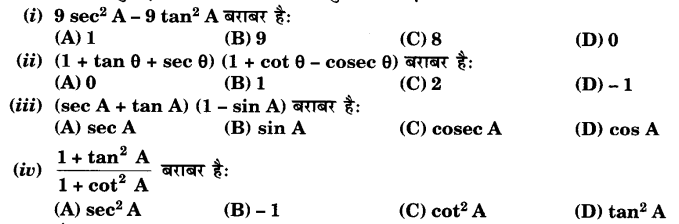
प्र० 4. सही विकल्प चुनिए और अपने विकल्प की पुष्टि (UPBoardSolutions.com) कीजिए:
UP Board Solutions for Class 10 Maths Chapter 8 Introduction to Trigonometry page 213 4
UP Board Solutions for Class 10 Maths Chapter 8 Introduction to Trigonometry page 213 4.1

UP Board Solutions
UP Board Solutions for Class 10 Maths Chapter 8 Introduction to Trigonometry page 213 4.2

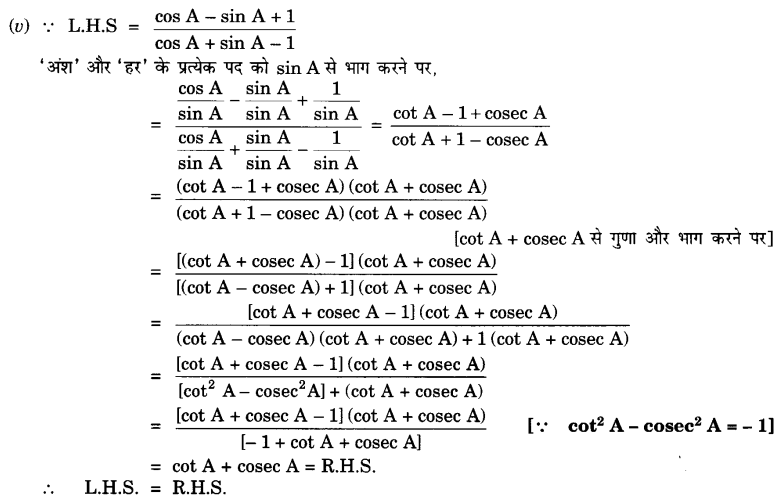
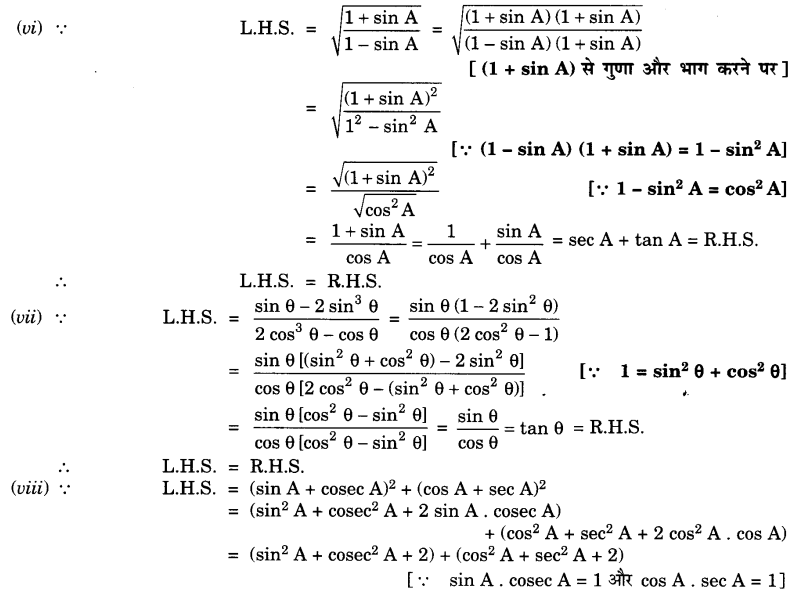
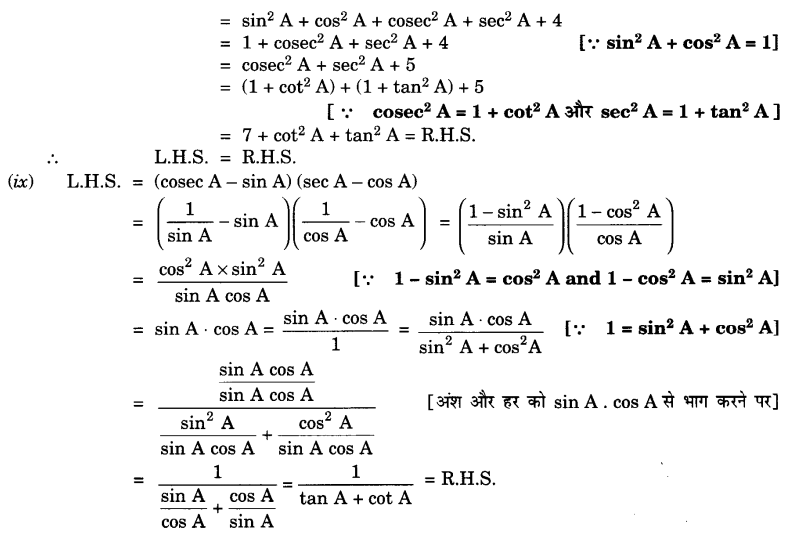
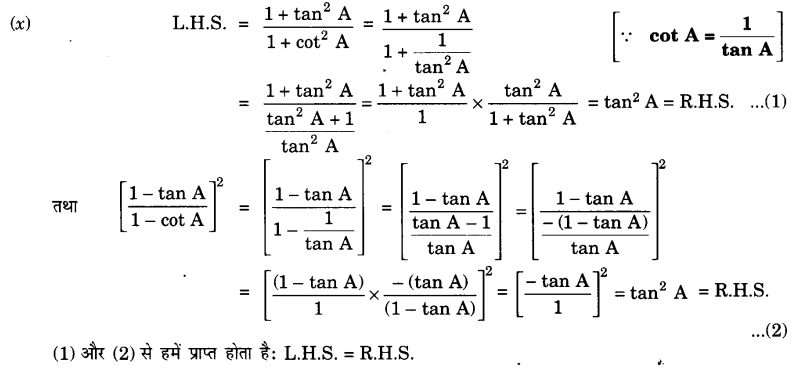
प्र० 5. निम्नलिखित सर्वसमिका सिद्ध कीजिए, जहाँ वे कोण, जिनके लिए व्यंजक परिभाषित है, न्यूनकोण है :
UP Board Solutions for Class 10 Maths Chapter 8 Introduction to Trigonometry page 213 5
UP Board Solutions for Class 10 Maths Chapter 8 Introduction to Trigonometry page 213 5.1

UP Board Solutions
UP Board Solutions for Class 10 Maths Chapter 8 Introduction to Trigonometry page 213 5.2
UP Board Solutions for Class 10 Maths Chapter 8 Introduction to Trigonometry page 213 5.3

UP Board Solutions
UP Board Solutions for Class 10 Maths Chapter 8 Introduction to Trigonometry page 213 5.4
UP Board Solutions for Class 10 Maths Chapter 8 Introduction to Trigonometry page 213 5.5

UP Board Solutions
UP Board Solutions for Class 10 Maths Chapter 8 Introduction to Trigonometry page 213 5.6
UP Board Solutions for Class 10 Maths Chapter 8 Introduction to Trigonometry page 213 5.7

Hope given UP Board Solutions for Class 10 Maths Chapter 8 are helpful to complete your homework.

If you have any doubts, please comment below. UP Board Solutions try to provide online tutoring for you.

CBSE Sample Papers for Class 10 Maths Paper 1

These Sample papers are part of CBSE Sample Papers for Class 10 Maths. Here we have given CBSE Sample Papers for Class 10 Maths Paper 1.

CBSE Sample Papers for Class 10 Maths Paper 1

Board CBSE
Class X
Subject Maths
Sample Paper Set Paper 1
Category CBSE Sample Papers

Students who are going to appear for CBSE Class 10 Examinations are advised to practice the CBSE sample papers given here which is designed as per the latest Syllabus and marking scheme as prescribed by the CBSE is given here. Paper 1 of Solved CBSE Sample Paper for Class 10 Maths is given below with free pdf download solutions.

Time allowed: 3 Hours
Maximum Marks: 80

General Instructions

  • All questions are compulsory.
  • The question paper consists of 30 questions divided into four sections A, B, C andD.
  • Section A contains 6 questions of 1 mark each. Section B contains 6 questions of 2 marks each. Section C contains 10 questions of 3 marks each. Section D contains 8 questions of 4 marks each,
  •  There is no overall choice. However, an internal choice has been provided in four questions of 3 marks each and three questions of 4 marks each. You have to attempt only one of the alternatives in all such questions.
  • Use of calculators is not permitted.

Section – A

Question 1.
Explain why 13233343563715 is a composite number?

Question 2.
Solve the following quadratic equation for x :
4x2-4a2x + (a4-b4) = 0.

Question 3.
Ifratio of corresponding sides of two similar triangles is 5 : 6, then find ratio of their areas.

Question 4.
If the sum of n terms of an A.P. is given by Sn = (3n2 + 2n), find its nth term.

Question 5.
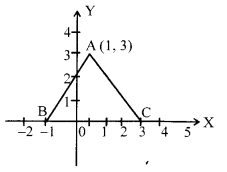
In fig., the area of triangle ABC (in sq. units) is :
CBSE Sample Papers for Class 10 Maths Paper 1 img 1

Question 6.

Show that: cosec2 θ – tan2(90° – θ) = sin2θ + sin(90° – θ)

Section – B

Question 7.
Prove that [latex]\sqrt { 5 } [/latex] is irrational.

Question 8.
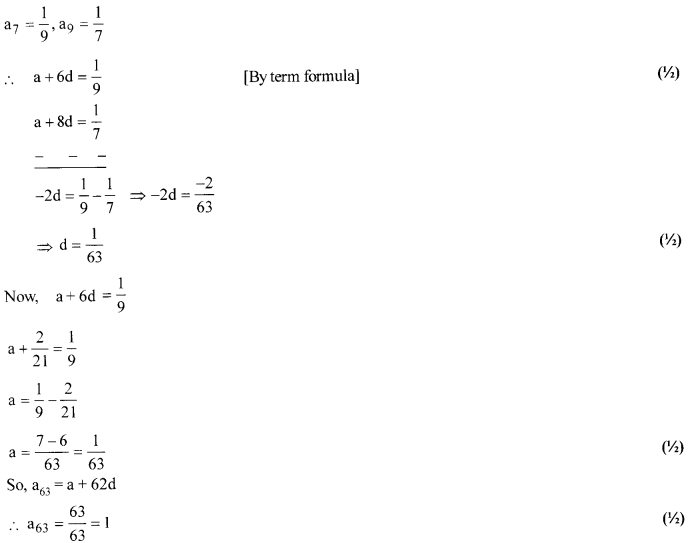
If the seventh term of an AP is [latex s=2]\frac { 1 }{ 9 } [/latex]  and its ninth term is [latex s=2]\frac { 1 }{ 7 } [/latex], find its 63rd term.

Question 9.
A card is drawn at random from a well shuffled pack of 52 playing cards. Find the probability of getting neither a red card nor a queen.

Question 10.
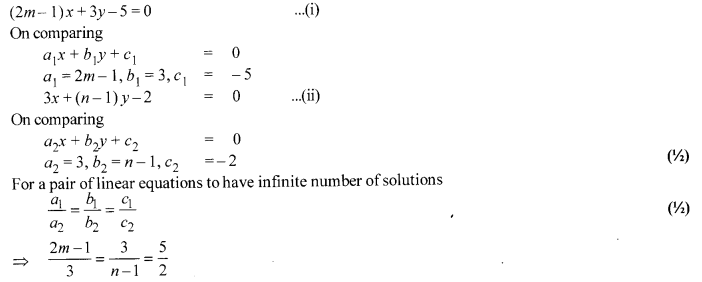
Determine the values of m and n so that the following system of linear equations have infinite number of solutions :
(2m — l)x + 3y-5=0
3x + (n – l) y-2 = 0

Question 11.
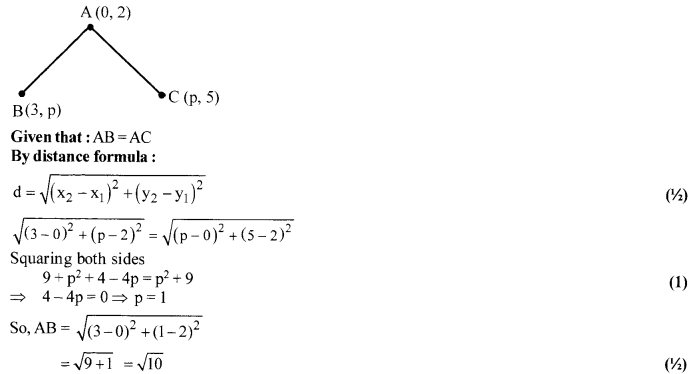
If the point A (0,2) is equidistant from the points B (3, p) and C (p, 5), find p. Also find the length of AB.

Question 12.
Two different dice are tossed together. Find the probability that the product of the two numbers on the top of the dice is 6.

Section – C

Question 13.
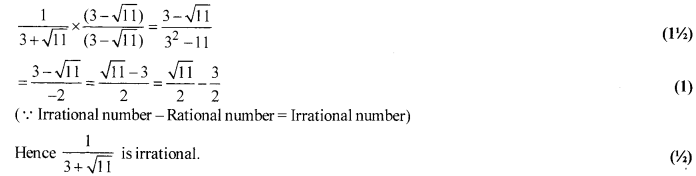
Prove that [latex s=2]\frac { 1 }{ 3+\sqrt { 11 } } [/latex] is irrational.

Question 14.
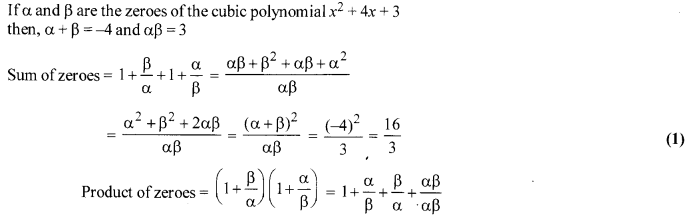
If a and P are the zeroes of the polynomial x2 + 4x + 3, find the polynomial whose zeroes are 1+ [latex s=2]\frac { \beta }{ \alpha } [/latex] and 1+ [latex s=2]\frac { \alpha }{ \beta } [/latex].

Polynomial Roots Calculator is a set of methods aimed at finding values of x for which F(x)=0 Rational Roots

Question 15.
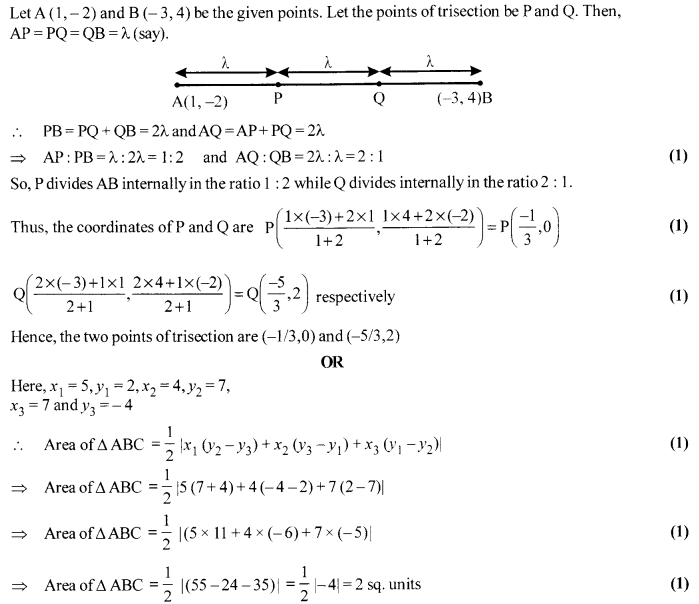
Find the coordinates of points which trisect the line segment joining (1, -2) and (- 3.4).
OR
Find the area of the triangle formed by the points A (5,2), B (4, 7) and C (7, -4).

Question 16.
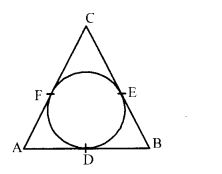
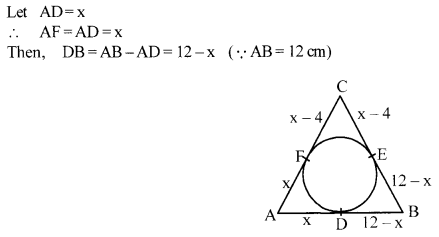
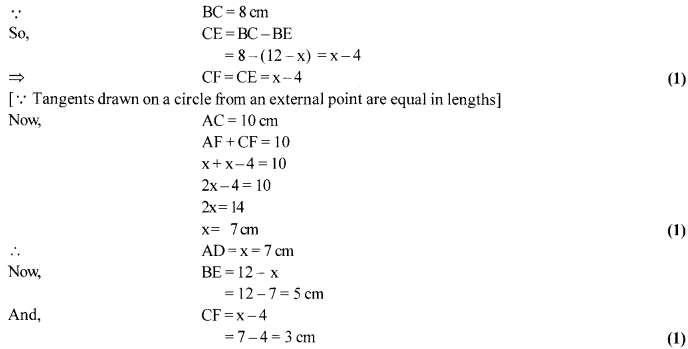
In fig., a circle inscribed in triangle ABC touches its sides AB, BC and AC at points D, E and F respectively. If AB = 12 cm, BC = 8 cm and AC = 10 cm, then find the lengths of AD, BE and CF.
CBSE Sample Papers for Class 10 Maths Paper 1 img 2

Question 17.
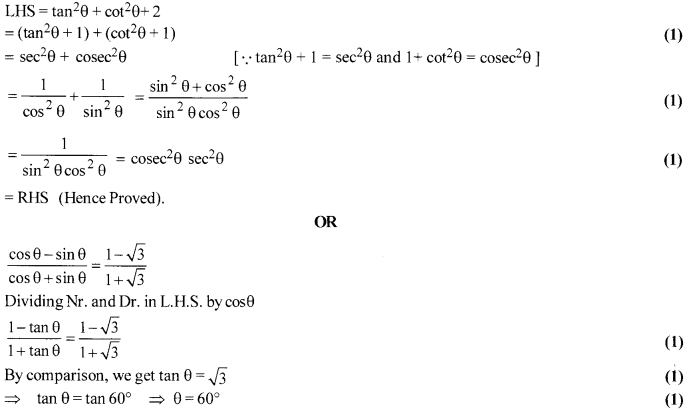
Prove that tan2 θ + cot2 θ + 2 = sec2 θ + cosec2 θ = sec2θ cosec2θ
OR
If [latex s=2]\frac { \cos { \theta } -\sin { \theta } }{ \cos { \theta } -\sin { \theta } } [/latex] = [latex s=2]\frac { 1-\sqrt { 3 } }{ 1+\sqrt { 3 } } [/latex] then find the value of 0.

Question 18.
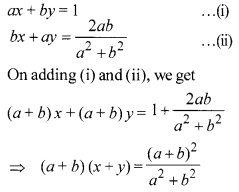
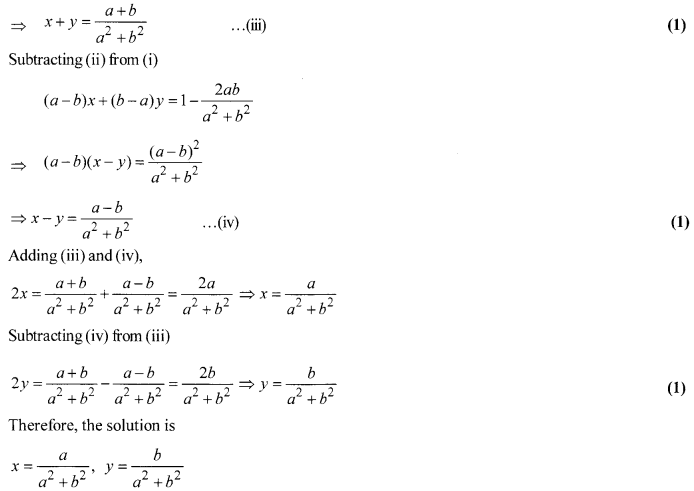
Solve the system of equations : ax + by = 1, bx + ay = [latex s=2]\frac { 2ab }{ { a }^{ 2 }+{ b }^{ 2 } } [/latex] .

Question 19.
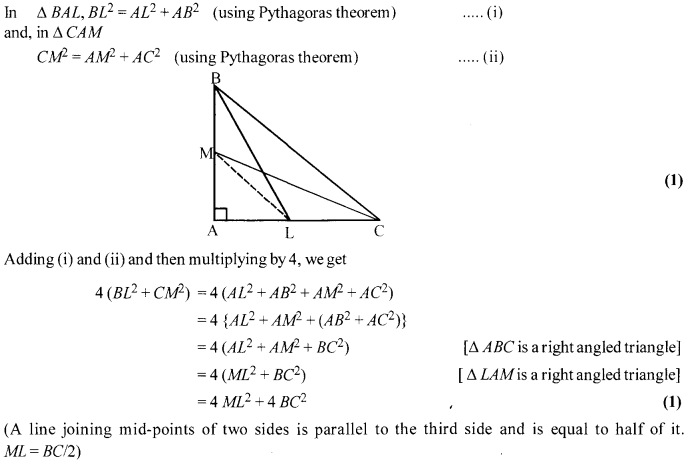
BL and CM are medians of ∆ ABC right angled at A. Prove that 4 (BL2 + CM2) = 5 BC2.
OR
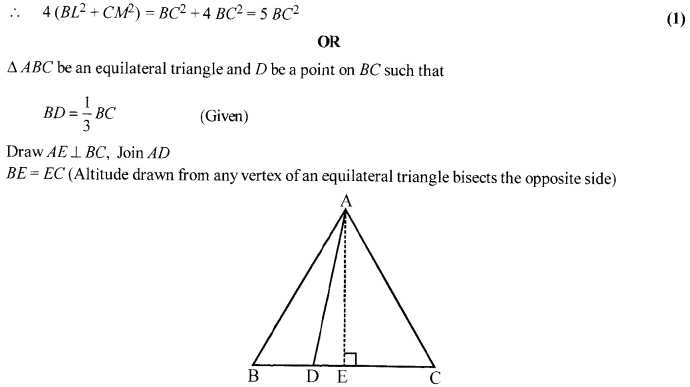
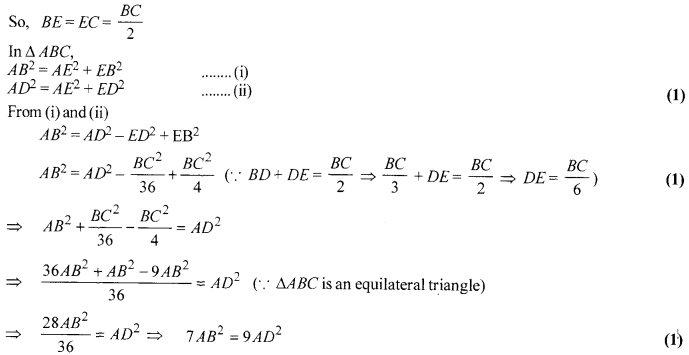
In an equilateral triangle ABC, the side BC is trisected at D. Prove that 9 AD2 = 7 AB2.

Question 20.
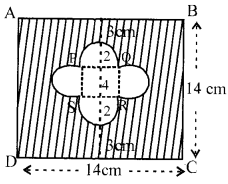
In figure find the area of the shaded region [Use u = 3.14]

Question 21.
The data regarding marks obtained by 48 students of a class in a class test is given below. Calculate the modal marks of students.
CBSE Sample Papers for Class 10 Maths Paper 1 img 3

Question 22.
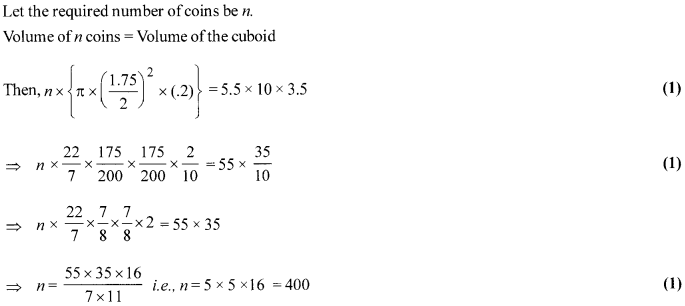
How many silver coins, 1.75 cm in diameter and of thickness 2 mm, must be melted to form a cuboid of dimensions 5.5 cm × 10 cm × 3.5 cm?
OR
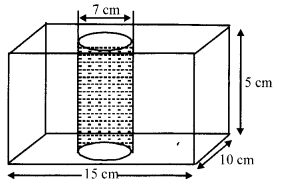
In figure, from a cuboidal solid metallic block of dimensions 15 cm × 10 cm × 5 cm, a cylindrical hole of diameter 7 cm is drilled out. Find the surface area of the remaining block. [Use π = [latex s=2]\frac { 22 }{ 7 } [/latex] ]
CBSE Sample Papers for Class 10 Maths Paper 1 img 4

Section – D

Question 23.
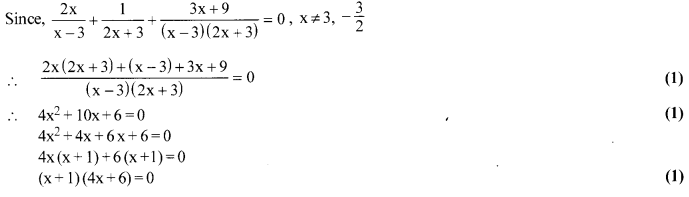
Solve for x : [latex s=2]\frac { 2x }{ x-3 } +\frac { 1 }{ 2x+3 } +\frac { 3x+9 }{ (x-3)(2x+3) } [/latex] = 0 , x ≠ 3, -[latex s=2]\frac { 3 }{ 2 } [/latex]
OR
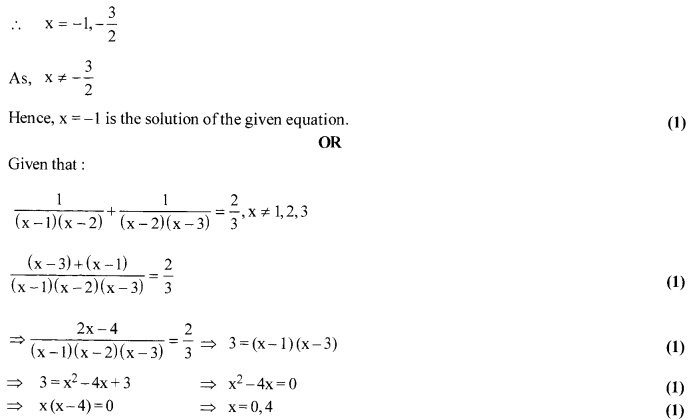
Solve for x: [latex s=2]\frac { 1 }{ (x-1)(x-2) } +\frac { 1 }{ (x-2)(x-3) } =\frac { 2 }{ 3 } [/latex] ,x≠ 1,2,3

Question 24.
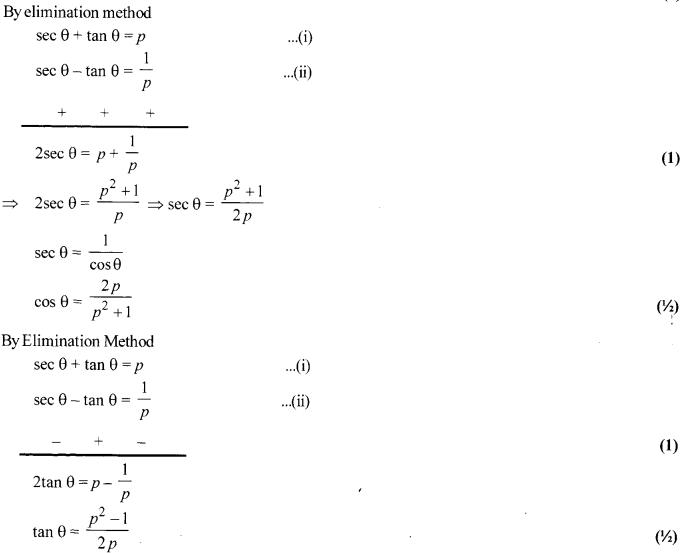
If sec θ + tan θ = p, show that sec θ – tan θ = [latex s=2]\frac { 1 }{ p } [/latex] . Hence, find the values of cos θ and sin θ.

Question 25.
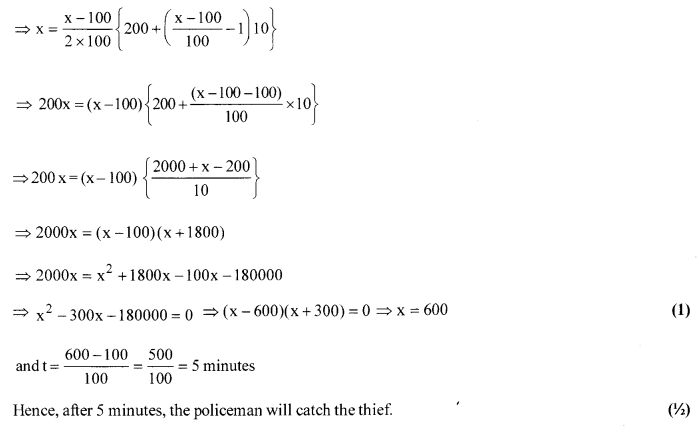
A thief runs away from a police station with a uniform speed of 100 m/minute. After one minute, a policeman runs behind the thief to catch him. He goes at a speed of 100 m/minute in first minute and increases his speed by 10 m/min in each succeeding minute. How many minutes will the policeman take to catch the thief?

Question 26.
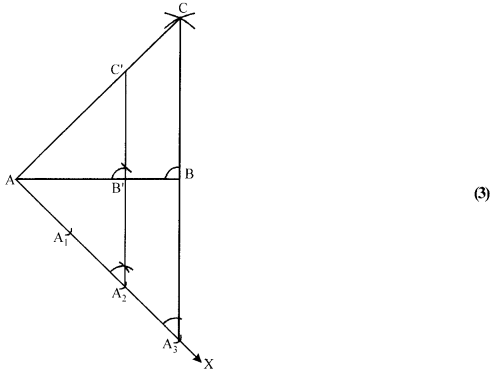
Construct a A ABC in which AB = 5 cm, BC = 6 cm and AC = 7 cm. Now, construct a triangle similar to AABC such that each of its sides is two-third of the corresponding sides of A ABC.

Question 27.
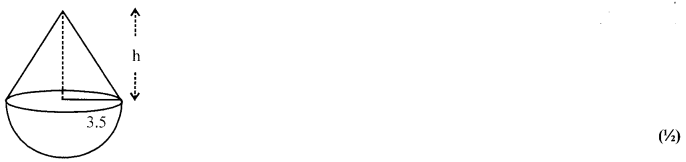
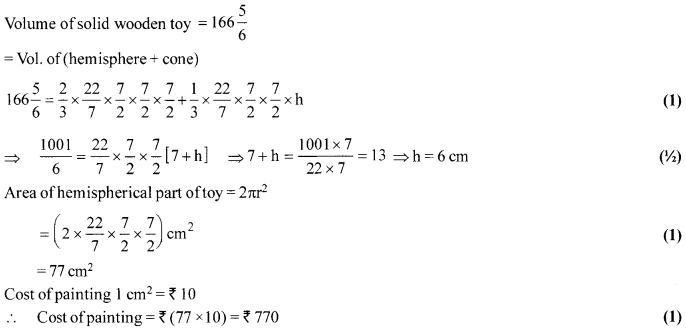
A solid wooden toy is in the form of a hemisphere surmounted by a cone of same radius. The radius of
hemisphere is 3.5 cm and the total wood used in the making of toy is [latex s=2]166\frac { 5 }{ 6 } [/latex] cm3. Find the height of the toy.
OR
Also, find the cost of painting the hemispherical part of the toy at the rate of ₹10 per cm2.[Use π = [latex s=2]\frac { 22 }{ 7 } [/latex] ]

Question 28.
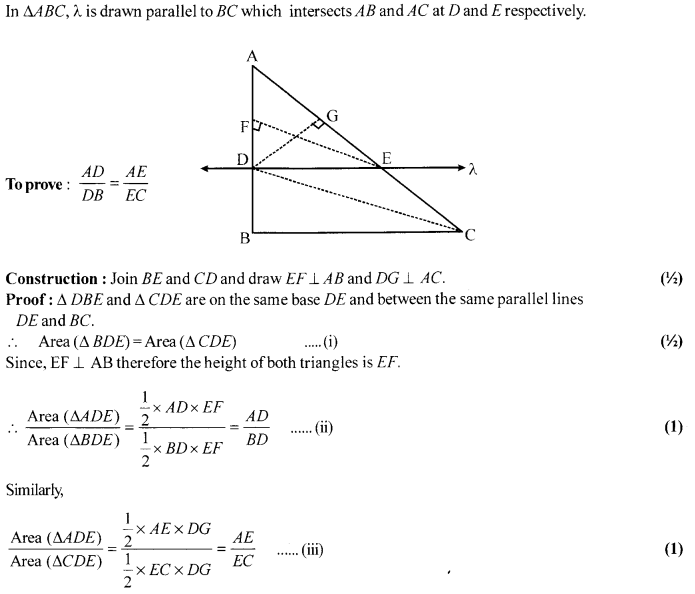
Prove that if a line is drawn parallel to one side of a triangle to intersect the other two sides in distinct points, then other two sides are divided in the same ratio.
OR
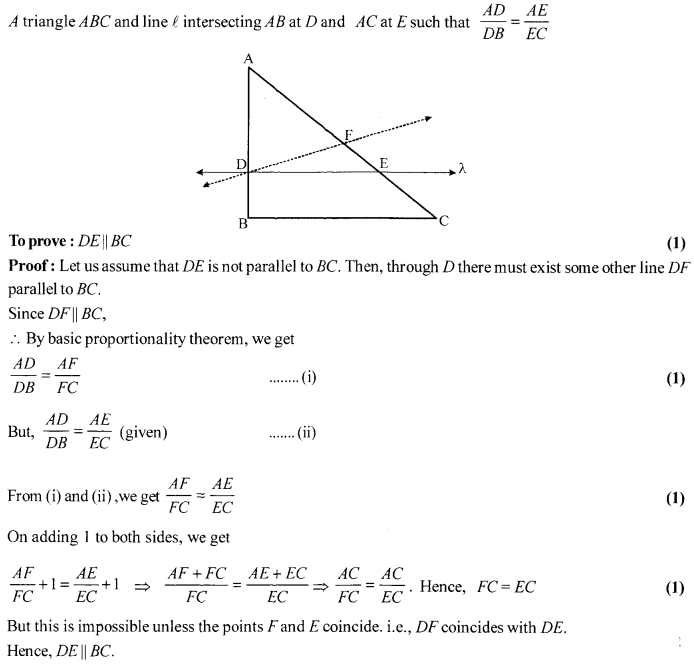
If a line divides any two sides of a triangle in the same ratio, then prove that the line is parallel to the third side.

Question 29.
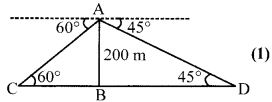
Two ships are there in the sea on either side of a light house in such a way that the ships and the light house are in the same straight line. The angles of depression of two ships as observed from the top of the light house are 60°and 45°. If the height of the light house is 200 m, find the distance between the two ships. [Use [latex s=2]\sqrt { 3 } [/latex] =1.73].
OR
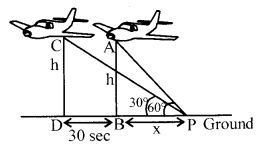
The angle of elevation of an aeroplane from a point on the ground is 60°. After a flight of 30 seconds the angle
of elevation becomes 30°. If the aeroplane is flying at a constant height of 3000 [latex s=2]\sqrt { 3 } [/latex] m, find the speed of the aeroplane.

Question 30.
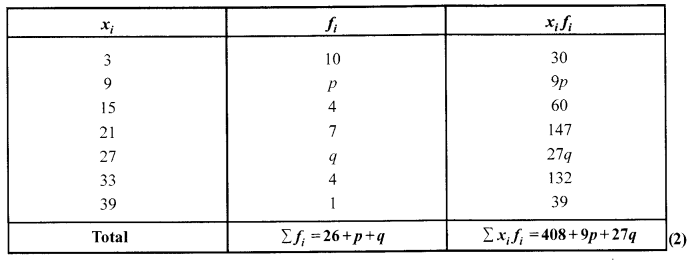
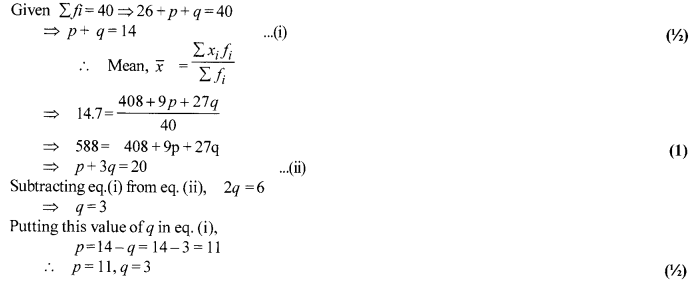
Ifthe mean of the following data is 14.7, find the value ofp and q.
CBSE Sample Papers for Class 10 Maths Paper 1 img 5

Solutions

Section – A

Solution 1.
Since the given number ends in 5. which means it is a multiple of 5. Hence it is a composite number. (1)

Solution 2.
(4x2 – 4a2 + a4) – b4 = 0 (1/2)
⇒ (2x – a2)2 – (b2)2 = 0
∴ (2x – a2 + b2) (2x – a2 – b2) = 0
(∵a2 – b2 = (a + b) (a – b))
⇒ x = [latex s=2]\frac { { a }^{ 2 }-{ b }^{ 2 } }{ 2 } [/latex] ,[latex s=2]\frac { { a }^{ 2 }+{ b }^{ 2 } }{ 2 } [/latex] (1/2)

Solution 3.
Suppose the triangles be ∆ABC and ∆DEF
[latex s=2]\frac { ar(\triangle ABC) }{ ar(\triangle DEF) } [/latex] = ([latex s=2]\frac {5 }{ 6 } [/latex])2 = [latex s=2]\frac {25 }{ 36 } [/latex] (1)
Hence, required ratio is 25 : 36

Solution 4.
It is given that Sn = 3n2 + 2n
∴Sn-1 = 3 (n-1)2 + 2(n- 1) = 3n2-4n + 1, nthterm, tn (1/2)
= (Sum ofnterms)-[Sumof(n-1)terms]
= Sn – Sn-1 = (3n2 + 2n) – (3n2 – 4n + 1) = (6n -1) (1/2)

Solution 5.
Since, the coordinates of given triangle are A(1, 3), B (-1,0) and C (4,0). So, the area of triangle ABC
= [latex s=2]\frac { 1 }{ 2 } [/latex][1(0-0)+(-1)(0-3)+(3-0)] (1/2)
= [latex s=2]\frac { 1 }{ 2 } [/latex] [3+12] = [latex s=2]\frac { 15 }{ 2 } [/latex] = 7.5.sp. unis. (1/2)

Solution 6.
LHS = cosec2θ – tan2(90° -θ)
= cosec2θ – cot2θ  (∵ cot θ = tan(90° -0))  (1/2)
= 1 = sin2θ + cos2θ
= sin2θ + sin2(90° – θ) = RHS (1/2)

Section – B

Solution 7.
Let if possible [latex ]\sqrt { 5 } [/latex] = [latex s=2]\frac { p }{ q } [/latex], where p and q are co-prime.
∴5 × q2 = p2 ….(i)
⇒ 5 divides p
⇒ p = 5 × P1; p1 is an integer. ….(ii)  (1/2)
From (i) and (ii),
5 × q2 = (5 ×p1)2 = 52 × p12
⇒ q2 = 5 × p12 ⇒ 5 divides q (1/2)
⇒ q = 5 × q1; q1 is an integer …..(iii) (1/2)
From (ii) and (iii), we find 5 a common factor of p and q. It contradicts that p and q are co-prime. Hence, [latex]\sqrt { 5 } [/latex] is an irrational number. (1/2)

Solution 8.
CBSE Sample Papers for Class 10 Maths Paper 1 img 6

Solution 9.
Total number of events = 52  (1/2)
In a pack of 52 playing cards, there are 2 red queens and 2 black queens, respectively.
Number of cards that are neither red nor queen = 52 – (26 + 2) = 24  (1/2)
Now, favourable number of events = 24
So, required probability = [latex s=2]\frac { 24 }{ 52 } [/latex] = [latex s=2]\frac { 6 }{ 13 } [/latex]  (1)

Solution 10.
CBSE Sample Papers for Class 10 Maths Paper 1 img 7
CBSE Sample Papers for Class 10 Maths Paper 1 img 8

Solution 11.
CBSE Sample Papers for Class 10 Maths Paper 1 img 9

Solution 12.
P (Product = 6) = P [(1,6), (2,3), (3,2), (6,1)] (1)
Probability = [latex s=2]\frac { 4 }{ { 6 }^{ 2 } } [/latex] = [latex s=2]\frac { 4 }{ 36 } [/latex] = [latex s=2]\frac { 1 }{ 9 } [/latex]  (1)
Hence, the probability that the product of the two numbers on the top of the dice is 6, will be [latex s=2]\frac { 1 }{ 9 } [/latex].

Section – C

Solution 13.
CBSE Sample Papers for Class 10 Maths Paper 1 img 10

Solution 14.
CBSE Sample Papers for Class 10 Maths Paper 1 img 11
CBSE Sample Papers for Class 10 Maths Paper 1 img 12

Solution 15.
CBSE Sample Papers for Class 10 Maths Paper 1 img 13

Solution 16.
CBSE Sample Papers for Class 10 Maths Paper 1 img 14
CBSE Sample Papers for Class 10 Maths Paper 1 img 15

Solution 17.
CBSE Sample Papers for Class 10 Maths Paper 1 img 16

Solution 18.
CBSE Sample Papers for Class 10 Maths Paper 1 img 17
CBSE Sample Papers for Class 10 Maths Paper 1 img 18

Solution 19.
CBSE Sample Papers for Class 10 Maths Paper 1 img 19
CBSE Sample Papers for Class 10 Maths Paper 1 img 20
CBSE Sample Papers for Class 10 Maths Paper 1 img 21

Solution 20.
CBSE Sample Papers for Class 10 Maths Paper 1 img 22
Area of sq. ABCD = (side)2= 196 cm2   (1)
Area of small sq. = (side)2 = 42=16cm2
Area of 4 semi-circles = 4 × [latex s=2]\frac { 1 }{ 2 } [/latex]πr2 = [4.[latex s=2]\frac { 1 }{ 2 } [/latex](3.14)(2)2] = 25.12 cm2
∴ Area of shaded region = (196- 16-25.12)cm2= 154.88 cm2   (1)

Solution 21.
CBSE Sample Papers for Class 10 Maths Paper 1 img 23

Solution 22.
CBSE Sample Papers for Class 10 Maths Paper 1 img 24

Section – D

Solution 23.
CBSE Sample Papers for Class 10 Maths Paper 1 img 25
CBSE Sample Papers for Class 10 Maths Paper 1 img 26

Solution 24.
CBSE Sample Papers for Class 10 Maths Paper 1 img 27
CBSE Sample Papers for Class 10 Maths Paper 1 img 28

Solution 25.
CBSE Sample Papers for Class 10 Maths Paper 1 img 29
Let the policeman catch the thief at a distance of x metres from the police station.
By the time policeman starts, the thief is at a distance of 100 m.
So, by the time thief travels x -100 more distance with a speed of 100 m/min, the policeman travels x m to catch him, increasing speed by 10 m every minute.  (1/2)
Time taken by the thief to come to the catch point from the time the policeman starts,
t = [latex s=2]\frac { x-100 }{ 100 } [/latex] ….(i)   (1)
Distance travelled by the policeman in first minute = 100 m, and in second minute = 110, in third minute = 120.
and in tth minute = 100 +(t – 1) 10
Total distance covered by the policeman in t minutes is x [latex s=2]\frac { t }{ 2 } [/latex]{200+(t-1)10} (1)
CBSE Sample Papers for Class 10 Maths Paper 1 img 30

Solution 26.
(i) Draw a line segment AB = 5 cm.
CBSE Sample Papers for Class 10 Maths Paper 1 img 31
(ii) With A as centre and radius = 7 cm, draw an arc above AB.  (1)
(iii) With B as centre and radius = 6 cm, draw another arc, intersecting the arc drawn in step (ii) at C.
(iv) Join AC and BC to obtain ∆ ABC.
(v) Below AB, draw a ray AX making a suitable acute angle with AB on opposite side ofC with respect to AB.
(vi) Draw three arcs intersecting the ray AX at A1, A2, A3 such that AA1 = A1A2 = A2A3.
(vii) Join A3B.
(viii) Draw A2B’ || A3B, meeting AB at B’.
(ix) From B’, draw B’C’ || BC, meeting AC at C’.
∆AB’C’ is the required triangle, each of the whose sides is two-third of the corresponding sides of
∆ ABC.

Solution 27.
CBSE Sample Papers for Class 10 Maths Paper 1 img 32
CBSE Sample Papers for Class 10 Maths Paper 1 img 33

Solution 28.
CBSE Sample Papers for Class 10 Maths Paper 1 img 34
CBSE Sample Papers for Class 10 Maths Paper 1 img 35
OR
CBSE Sample Papers for Class 10 Maths Paper 1 img 36

Solution 29.
Let AB is the height of light house = 200m  (1)
Two ships are at points C and D on either side of AB (light house)
In ∆ABC,
tan 60° =[latex s=2]\frac { AB }{ BC } [/latex] ⇒BC = [latex s=2]\frac { 200\sqrt { 3 } }{ 3 } \quad =\quad \frac { 200\times 1.73 }{ 3 } [/latex] = 115.33 m
CBSE Sample Papers for Class 10 Maths Paper 1 img 37
In ∆ABD,
tan 45° = [latex s=2]\frac { AB }{ BD } [/latex] ⇒BD = 200 (1)
Distance between both ships = BC +BD
= 1115.33+200 = 315.33 cm (1)
OR
CBSE Sample Papers for Class 10 Maths Paper 1 img 38
According to figure,
In ∆ABP, tan 60° =[latex s=2]\frac { AB }{ BP } [/latex] = [latex s=2]\frac { h }{ x } [/latex] = [latex s=2]\frac { 3000\sqrt { 3 } }{ x } [/latex]  (1)
⇒ h = [latex s=2]\sqrt { 3 } [/latex]x ⇒ x= 3000m ….(i)
In APDC, tan 30° = [latex s=2]\frac { h }{ x+BD } [/latex] (1)
x + BD= h[latex s=2]\sqrt { 3 } [/latex] ….(ii)
From (i) and (ii)
x + BD=3x ⇒ BD = 2x
⇒ BD = 2(3000)
⇒ BD= 6000m  (1)
Speed of aeroplane = [latex]\frac { BD }{ 30Sec } [/latex] = [latex]\frac { 6000 }{ 30 } [/latex] = 200 m/cm  (1)

Solution 30.
CBSE Sample Papers for Class 10 Maths Paper 1 img 39
CBSE Sample Papers for Class 10 Maths Paper 1 img 40

We hope the CBSE Sample Papers for Class 10 Maths paper 1 help you. If you have any query regarding CBSE Sample Papers for Class 10 Maths paper 1, drop a comment below and we will get back to you at the earliest.

UP Board Solutions for Class 10 Commerce Chapter 2 Final Accounts with Simple Adjustments

UP Board Solutions for Class 10 Commerce Chapter 2 Final Accounts with Simple Adjustments

Final Accounts with Simple Adjustments Objective Type Questions (1 Mark)

Question 1.
Outstanding wages is shown in: (UP 2014)
(a) Debit side of trading account
(b) Debit side of P & L Account
(c) Liability side of Balance Sheet
(d) Asset side of Balance Sheet.
Answer:
(a) Debit side of trading account

Question 2.
Income earned but not received is termed as:
(a) Accrued Income
(b) Income Received in Advance
(c) Either (a) or (b)
(d) None of these.
Answer:
(a) Accrued Income

Question 3.
The Depreciation figure provided under Trial Balance shall find place under ………..
(a) Balance Sheet
(b) Trading Account
(c) Profit and Loss Account
(d) None of these
Answer:
(c) Profit and Loss Account

UP Board Solutions

4. The amount of closing stock given under Trial Balance shall find place in ………
(a) Trading Account
(b) Profit and Loss Account
(c) Balance Sheet
(d) None of these.
Answer:
(c) Balance Sheet

Question 5.
……….. is a income which has been received but has not been earned.
(a) Depreciation
(b) Unearned Income
(c) Accrued Income
(d) Interest.
(b) Unearned Income

Final Accounts with Simple Adjustments Definite Answer Type Questions (1 Mark)

Question 1.
What term is used for the wear and tear caused to the fixed assets due to their continuous use?
Answer:
Depreciation.

Question 2.
What term is used for the amount drawn from the business by proprietor for personal use?
Answer:
Drawings.

UP Board Solutions

Question 3.
What term is used for the goods which remain unsold at the end of the Financial Year?
Answer:
Closing Stock.

Final Accounts with Simple Adjustments Very Short Answer Type Questions (2 Marks)

Question 1.
What kind of items are treated as Adjustments?
Answer:
All such transactions which are related (UPBoardSolutions.com) to the period of final accounts but are not in Trial Balance as they are unrecorded in the books of accounts and the transactions which are recorded but are not concerned with the period of final accounts but one included in Trial Balance are treated as adjustments.

Question 2.
What is meant by Adjustments? (UP 2017)
Answer:
Adjustments imply to adjust or present the figures drawn from ledger by following accounting principles and postulates, in such manner that when they included in final accounts it would reveal the true and fair view of a business.

Question 3.
What is meant by the term ‘Provision’?
Answer:
The term ‘provision’ means an amount retained in order to provide domination in the value of and, or to provide for any known liability whose amount cannot be ascertained correctly.

UP Board Solutions

Question 4.
Write two items which are written in the credit side of profit and loss account? (UP 2015, 18)
Answer:
There are two items which are written in the credit side of profit and loss account:

  • Receipt on Intrest
  • Receipt on Rent.

Final Accounts with Simple Adjustments Short Answer Type Questions (4 Marks)

Question 1.
Give the importance of adjustment entries while preparing the Final Accounts.
Answer:
The adjustments are important in view of the fact that in order (UPBoardSolutions.com) to arrive at an accurate figure of the actual net profit earned or net loss sustained during any particular Financial Year, it is necessary to see that only items at expenses or gains relating to the particular financial year are brought into the profit and loss account.

Question 2.
Distinguish between accrued and unearned incomes?
Answer:
Difference between Accrued and Unearned Income:

Accrued Income Unearned Income
1. The income which is earned by the businessman before the date of preparation of Final Account but not received is called Accrued Income. 1. The income which is not earned by the businessman before the date of preparation of Final Accounts but is received before such date is called unearned income.
2. This income is shown at the credit side of profit and loss account by adding it to the concerned head of income. 2. This income is also shown at the credit side of profit and loss account but by deducting it from the concerned head of income.
3. This income is shown on the Assets side of the Balance Sheet. 3. This income is shown on the Liabilities side of the Balance Sheet.

UP Board Solutions

Question 3.
Distinguish between outstanding expenses and prepaired expenses.
Answer:
Difference Between Outstanding Expenses and Prepaired Expenses:

Outstanding Expenses Prepaired Expenses
1. These are those expenses for which services had been received but not paid till the last accounting period or preparation of final accounts. 1. These are those expenses for which services had not been received but are paid well in advance.
2. These expenses are shown at the debit of Trading or Profit and Loss Account by Adding them to the concerned expense. 2. These expenses are shown at the credit of trading or profit and loss account by deducting them from the concerned expense.
3. Outstanding expenses are shown at the liabilities side of the Balance Sheet. 3. Prepaid expenses are shown at the Assets side of the Balance Sheet.
4. Outstanding Expenses are concerned with the current financial year i.e., for which final accounts are prepared. 4. Prepaid expenses are concerned with the next Financial years i.e., the year following the year for which final accounts are prepared.

Final Accounts with Simple Adjustments Long Answer Type Questions (8 Marks)

Question 1.
What do you understand by Adjustment? Explain the kinds of general adjustments. (UP 2002, 13)
Or
What do you understand by Adjustments? Write about any six kinds of it. Give its Journal Entry also. (UP 2012)
Or
From the following adjustment show any five of them in Profit and Loss A/c and the Balance Sheet after recording their journal entries:
(i) Prepaid Insurance
(ii) Unearned Income
(iii) Interest on Drawings
(iv) Bad Debts
(v) Depreciation
(vi) Outstanding Salaries
(vii) Interest on Capital
(viii) Provision for Discount on Debtors. (UP 2002)
Or
Discuss ten types of adjustment entries to he made while preparing Final Account. Give its journal entries also. (UP 2004)
Or
What is meant by Adjustment entries? Make adjustment journal entries of the following:
(i) Depreciation on Machinery
(ii) Outstanding Expenses
(iii) Prepaid Expenses
(iv) Accrued Income
(v) Reserve for Doubtful Debts
(vi) Unearned income
(vii) Closing stock. (UP 2005, 10)
Or
What are the types of adjustment entries? Journalise the following adjustment with imaginary amount:
(i) Reserve for discount on creditors
(ii) Interest on drawings. (UP 2005)
Or
Write about any four adjustments carried in the final account. Pass Journal Entries for them also. (UP 2014)
Answer:
Meaning of Adjustments: At the end of the financial period every trader prepares the final accounts in which all the expenses and incomes related to the current trading period are included. But it generally happens that certain expenses relating to a trading period do not appear in the books of that financial period. On the other hand, it also happens that expenses (UPBoardSolutions.com) under certain heads, such as Insurance, Telephone Subscription etc. are paid for a year well in advance. It is necessary to scrutinize carefully all items of expenditure to ascertain that all expenses paid or unpaid but relating to the period of trading are brought into books of accounts.

UP Board Solutions

If any item of expenditure is paid for in advance, the same must be properly apportioned between the period, that has already expired and the period that is yet to expire so that proper adjustments may be made in this respect. All items of gains will also have to be similarly scrutinized to see all gains relating to the period whether received or accrued are brought into account.

Thus, all such transactions which are related to the period of final accounts but are not in Trial Balance as they are unrecorded in the books of accounts and the transactions which are recorded but are not concerned with the period of final accounts but are included in Trial Balance are treated as adjustments.

Meaning of Entries for Adjustments: The entries which are made for the adjustments are called entries for adjustments.
Preparing of Amended Trial Balance: When entries for adjustments are made, it, makes a change in the accounts already opened and some new accounts are also opened which diminishes the purpose served by already prepared Trial Balance. The old Trial Balance does not serve its purpose. Thus an Amended Trial Balance is prepared in which entries for adjustments are also taken into account. On the basis of Amended Trial Balance, the final accounts Eire prepared.

Important Adjustments: The adjustments are important in view of the fact that in order to arrive at Em accurate figure of the actual net profit earned or net loss sustained during any particular financial year, it is necessary to see that (UPBoardSolutions.com) only items of expenses or gains relating to the particular financial year are brought into the Profit and Loss Account. The following are the main adjustments usually made in the books of account:

  • Closing Stock.
  • Outstanding Expenses.
  • Prepaid Expenses.
  • Accrued Incomes.
  • Unearned Incomes.
  • Depreciation.
  • Appreciation.
  • Interest on Capital.
  • Interest on Drawings
  • Bad Debts.
  • Reserve for Bad and Doubtful Debts
  • Reserve for a discount on Debtors
  • Reserve for a discount on Creditors.

UP Board Solutions

Closing Stock: The goods which remain unsold at the end of a financial year are termed as Closing Stock. The unsold stock of goods should never be valued at selling price if that price exceeds cost price. If the market price is less than cost price, then the stock is valued at the market price. When the market price is less than cost price then a loss has evidently been incurred, since the goods can only be sold at loss. It should be remembered that closing stock should be valued at market price or cost price whichever is less. The figure of closing stock is shown on the credit side of the Trading Account in order to ascertain the Gross Profit. The amount of closing stock is also shown on the Assets side of the Balance Sheet.

Outstanding Expenses: The prevalent practice in modern business is that rent, salaries, wages, interest, etc. of each month are paid in the subsequent months. Suppose, the trading period of a business ends on 31st March, it would follow that the office rent, staff salaries, wages, interest, etc. for the month of March, not having been paid in that month, will not appear in the (UPBoardSolutions.com) books for the period ended on 31st March, and yet, as expenses under these heads have been incurred and as they belong to the current financial year ending on 31st March, it is necessary that they should be charged to Trading or Profit and Loss Account of the particular financial year.

Such an adjustment is made by means of a journal entry debiting the various nominal accounts concerned with the amounts due and crediting an account called ‘Outstanding Expenses’. The Outstanding Expenses will appear as a liability in the liability side of the Balance Sheet. In the next trading period when these expenses are paid off, then Outstanding Expenses Account is debited and cash account is credited.

Prepaid Expenses: Where the expenses have been paid in advance, the nominal account concerned should be adjusted, so that the proportionate amount applicable to the period of trading only may be charged off to the Trading or Profit and Loss Account as expenses for the particular year and the amount paid in advance is shown in the Balance Sheet as Em asset under the heading ‘Prepaid Expenses’.
Example: Insurance premium, Telephone subscription, Advance rent, Advance expenses, etc.

The journal entry passed for adjusting the amount is Prepaid expenses should be debited and the nominal account concerned must be credited. The prepaid expenses account is an asset as it represents a pre-payment in respect of which some benefit is yet to be received.

Accrued Income: Income which has been earned but not received is termed as ‘Accrued Income’. If any item of income such as Rent receivable, Interest on Securities, Interest on Loan, Commission, Discount etc. is earned and belongs to the financial period but not received then it is necessary that all such incomes relating to that financial period should be shown in the accounts.

The necessary adjustment for the purpose of bringing such accrued incomes into account should, therefore, be made by means of a journal entry debiting accrued, income account and crediting the source of income. The debit to accrued income account will appear as an asset in the Balance Sheet.

Unearned Income: Unearned Income is an income which has been received it has not been earned. Suppose, if, in any financial year, businessman receives some money and in respect of which full services have not been rendered by him. The amount for which service has not been provided is to be treated as a liability. A journal entry is passed for the amount received in respect of which the service still remains to be rendered. The nominal account concerned is debited and an account styled as Unearned (UPBoardSolutions.com) Income is credited. This credit balance on the latter account is shown as a liability in the Balance Sheet. At the commencement of the coming financial year, the above entry would be reversed.

Depreciation: The term Depreciation means a permanent decline in value of the asset due to wear and tear or from any other cause. All assets have either a definite or an estimated period of utility to the business in which they are employed and as the years pass by, their measure of usefulness diminishes or declines with the result that they have to be discarded when they become useless. The loss sustained by way of depreciation should be charged to the Profit and Loss Account each year otherwise final accounts will fail to show the true facts of the business.

UP Board Solutions

The depreciation arising from the use of the assets should be charged in the period to which it relates, irrespective of whether a profit or loss has been made. The journal entry for writing off depreciation on any asset is to debit Depreciation account and credit the respective Asset account. The effect of such an entity would be that it will reduce the book value of the asset and the loss is charged to the Profit and Loss Account.

Appreciation: When a country faces problems such as drought, plague or war then the Government of the country circulates extra currency to overcome the prevailing problems. The purchasing power of money is reduced by the extra circulation of money and prices of various commodities and assets begin to rise. Appreciation in value of assets is again for the business and is shown on the credit side of the Profit and Loss Account and the assets are shown by the appreciated value in the Balance Sheet.

Interest on Capital: A businessman expects his business to yield a much better return on the capital employed than it would have earned if the same amount was invested in other securities. This is because of the extra risk and efforts involved in carrying out the business. In order to find out, whether the business has really yielded any profit in excess of the current rate of interest, he charges that interest to Profit and Loss Account and credit the same to his Capital Account. The interest on capital paid is loss or can be said an expense for the business and a gain to the owner himself.

If any such interest is to be adjusted at the end of the financial year, journal entry has to be passed debiting interest account and crediting the Capital Account of the owner with the amount of interest to be paid.

Interest on Drawings: A businessman often draws some money out of his business to meet out his personal expenses. Such withdrawals reduce his capital balance in the business. In some cases, such drawings are debited to (UPBoardSolutions.com) a separate account called ‘Drawings Account’ and this account is then closed by transfer to the capital account at the end of each financial year.
Interest on drawings are calculated from the date of withdrawal till the end of the financial period, and amount thus ascertained is debited to the Capital Account and credited to the Interest Account. The owner is thus charged with interest on the sum withdrawn for meeting out his personal expenses.

Bad Debts: In modern business, most of the transactions are done on a credit basis. Whether it is a small businessman or a big business house all have a major percentage of credit transactions in the business.

It’s a common feature in the business that some of the debtors fail to pay their debts in full. The debts which are irrecoverable from the debtors are called ‘Bad Debts’. Tfie journal entry to write off Bad Debts would be to debit Bad Debts Account and credit the Personal Account of the customer who has failed to pay. The debit balance of Bad Debts Account represents a loss and is transferred to the Profit and Loss Account.

If the amount of Bad Debts appears in Adjustment Entries then Profit and Loss Account is debited with the amount and the same is deducted from the Debtors in the Balance Sheet.

Reserve for Bad and Doubtful Debts: After writing off all known Bad Debts, the businessman tries to find out the list of those customers from whom payment may be doubtful. Such debts are called Doubtful Debts, and in order to arrive at an accurate figure of the net profit made in any particular financial year, it is necessary to provide for Doubtful Debts. This is done by estimating the further less likely to be sustained on the recovery of Book Debts and a journal entry is passed, debiting the Profit and Loss Account and crediting Reserve for Bad and Doubtful Debts Account.

UP Board Solutions

The credit balance of Reserve for Bad and Doubtful Debts Account is shown in the Balance Sheet as a deduction from the net amount of Sundry Debtors i.e., the amount arrived after deducting the amount of bad debts from debtors so that the net estimated realisable amount from Sundry Debtors may be shown in outer column of the Balance Sheet.

If the amount of Bad Debts equals the amount of reserve made in that period, then correct profit or loss is ascertained. If there is any balance left in Reserve for Bad and Doubtful Debts Account then the same is shown as a profit on the credit side of the Profit and Loss Account. In the next financial year, the balance of the reserve is known as Old Reserve. If Bad Debts and Old Reserve for Bad and Doubtful Debts are given in the Trial Balance and if some reserve is to be made on Debtors for the present financial year, then the number of Bad Debts and the amount of New Reserve will be added. The amount of Old Reserve for Bad and Doubtful Debts will be deducted from the above amount arrived and the balance will be shown on the debit side of the Profit and Loss Account.

When the balance of Old Reserve for Bad and Doubtful Debts is more than the total of Bad Debts and Reserve for Bad and Doubtful debts then old balance is shown on the credit side of the Profit and Loss Account (UPBoardSolutions.com) and Bad Debts plus new Reserve are shown on the debit side of the Profit and Loss Account. The amount of New Reserve is deducted from the debtors in the Balance Sheet.

Reserve for a discount on Debtors: In modern times as most of the business transactions are done on a credit basis, the trader gives some incentive in the form of discount to his customers for early realisation of payments. The loss arising due to discount to be allowed will be estimated and brought into accounts. This will help in showing the exact realisable amount from customers in the Balance Sheet.

At the end of each financial year, therefore, it becomes necessary to estimate this loss of discount that will have to be allowed to the customers, and make a provision in this respect. The provision is made by way of a certain percentage being calculated on Sundry Debtors at the close of the financial year and by debiting the Discount Account and crediting the Reserve for Discount Account. The credit balance of Reserve for Discount Account is shown by deducting the same from the number of Sundry Debtors in the Balance Sheet.

If both Reserve for Bad and Doubtful Debts and Reserve for Discount are to be made, then first Reserve for Bad and Doubtful Debts is made and after deducting the same from the amount of the Sundry Debtors, the Reserve for Discount is made on the balance amount of the Sundry Debtors remaining after deduction of the Reserve for Bad and Doubtful Debts. Both the reserves Eire shown on the debit side of the Profit and Loss Account and are deducted from the Sundry Debtors in the Balance Sheet. Discount cannot be given to those customers from whom payment is doubtful.

Question 2.
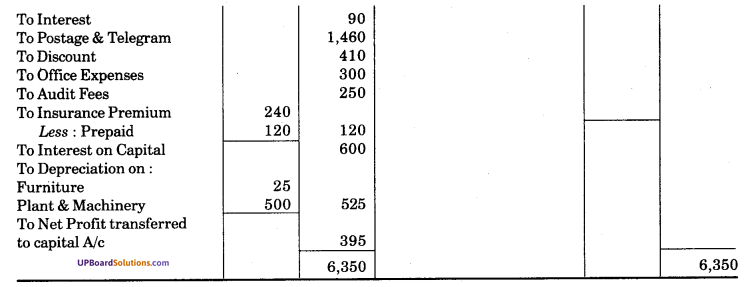
From the following trial balance extracted from the books of Sonal International Ltd., prepare Trading & Profit and Loss account for the year ended on 30th June 2011 and a Balance Sheet as on that date:
UP Board Solutions for Class 10 Commerce Chapter 2 Final Accounts with Simple Adjustments
Adjustments:
(i) The closing stock was valued at Rs. 8,000.
(ii) Outstanding expenses; Salaries Rs. 500; Taxes Rs. 200.
(iii) The insurance premium is paid for the year 2011.
(iv) Provide interest on capital at 5% and on drawings Rs. 40.
(v) Depreciate furniture at 5% and Plant & Machinery by 10%.
Solution:
UP Board Solutions for Class 10 Commerce Chapter 2 Final Accounts with Simple Adjustments

UP Board Solutions
UP Board Solutions for Class 10 Commerce Chapter 2 Final Accounts with Simple Adjustments

Question 3.
List the items to be shown at the debit and credit side of the trading account.
Answer:
Items which are shown at the Debit side of Trading Account:

  1. Opening Stock: This is the closing stock of the previous year.
  2. Purchases: This is the total of cash and credit purchases made during the year.
  3. Purchases Return: The goods which are returned back from purchased (UPBoardSolutions.com) goods are called purchase return. This amount is deducted from the number of purchases.
  4. Direct Expenses: These are the expenses which are essential for undertaking the work of production or for the procurement of goods such as octroi, freight, cartage, wages, power, collect.

Items which are shown at the Credit side of Trading Account:

  1. Sales: This is the total of cash and credit sales made during the year.
  2. Sales Return: The goods which are returned by the customers due to some reasons are known as sales return. The value of these goods is deducted from the number of sales.
  3. Closing Stock: The goods which remain unsold at the end of the financial year is called closing stock. This stock of goods is valued at cost price or market price whichever is less.

UP Board Solutions

Question 4.
Give journal entries for the following adjustments and show them in the balance sheet as on that date: (UP 2016)
(a) Outstanding salaries Rs. 300 and Rent Rs. 200.
(b) The cost of the building is Rs. 1,00,000. Plant and Machinery are Rs. 80,000 (UPBoardSolutions.com) and furniture are Rs. 2,000. Provide depreciation at the rate of 5%.
Solution:
UP Board Solutions for Class 10 Commerce Chapter 2 Final Accounts with Simple Adjustments

Question 5.
From the following Trial Balance prepared from the books of M/s Sunil Brothers for the year ending 31st December, 2011:
UP Board Solutions for Class 10 Commerce Chapter 2 Final Accounts with Simple Adjustments
Prepare Trading and Profit and Loss Account for the year ending 31st December 2011 and the Balance Sheet as on that date with the following adjustments:
(i) Closing Stock was worth ₹ 4,000.
(ii) Charge 5% depreciation on Buildings.
(iii) Make provision for reserve for bad and doubtful debts @ 5% on Sundry Debtors.
(iv) Prepaid insurance premium ₹ 50.
(v) Unpaid expenses: Salary ₹ 100 and Wages ₹ 140.
Solution:
UP Board Solutions for Class 10 Commerce Chapter 2 Final Accounts with Simple Adjustments

Question 6.
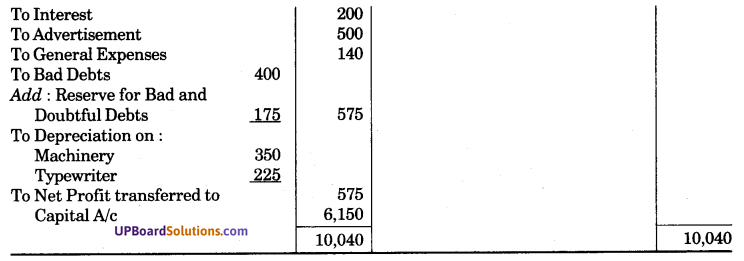
From the following Trial Balance, prepare Trading Account, Profit and Loss Account for the year ending 31st December, 2011 and the Balance Sheet on that date:
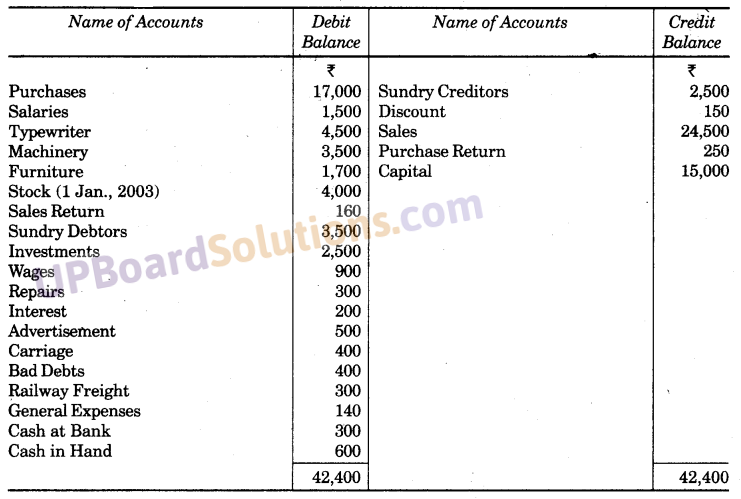
UP Board Solutions for Class 10 Commerce Chapter 2 Final Accounts with Simple Adjustments

UP Board Solutions
Adjustments:
(i) Depreciate machinery by 10% and typewriter by 5%.
(ii) Make a reserve @ 5% on sundry debtors for bad and doubtful debts.
(iii) Outstanding expenses—salaries ₹ 100 and wages ₹ 100.
(iv) Value of closing stock as on 31st December 2011 was ₹ 8,000.
Solution:
UP Board Solutions for Class 10 Commerce Chapter 2 Final Accounts with Simple Adjustments

Question 7.
What is the method of accounting for the following adjustment:
(a) Outstanding expenses
(b) Prepaid expenses,
(c) Depreciation
(d) Closing stock
(e) Bad debts.
Answer:
UP Board Solutions for Class 10 Commerce Chapter 2 Final Accounts with Simple Adjustments

Question 8.
(a) Rs. 3,000 is to be received as rent. Received Rs. 50 in advance. Give journal entry and show it in the balance sheet.
(b) Give journal entry to show its effect in the balance sheet for the following: Capital is Rs. 50,000, Rs. 5,000 are withdrawn by the proprietor for personal purposes. Interest at the rate of 6% is to be charged.
Answer:
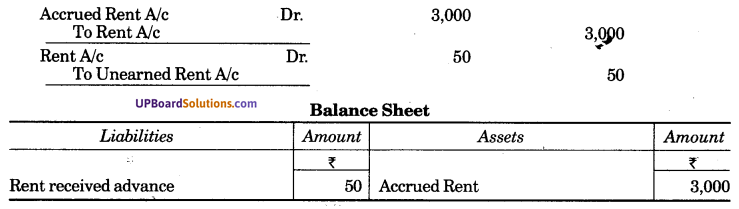
UP Board Solutions for Class 10 Commerce Chapter 2 Final Accounts with Simple Adjustments

UP Board Solutions

Question 9.
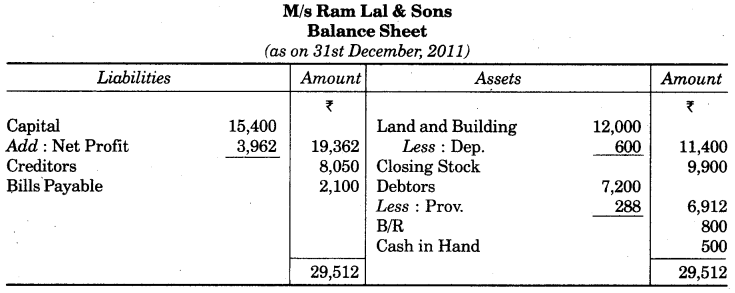
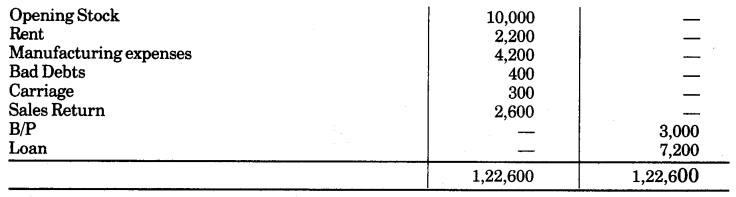
Prepare Trading and Profit and Loss Account and Balance Sheet of M/s Ram Lai and Sons on 31st December 2011 from the following Trial Balance:
UP Board Solutions for Class 10 Commerce Chapter 2 Final Accounts with Simple Adjustments
Adjust the following items:
(a) Closing Stock Rs. 9,900.
(b) Depreciate Land and Building @ 5%.
(c) Make a Provision for Bad and Doubtful Debts on Debtors @ 4%.
Solution:
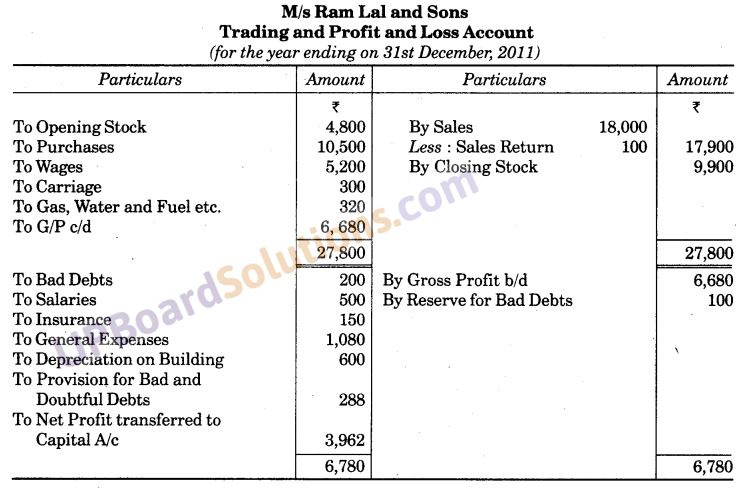
UP Board Solutions for Class 10 Commerce Chapter 2 Final Accounts with Simple Adjustments
UP Board Solutions for Class 10 Commerce Chapter 2 Final Accounts with Simple Adjustments 1

Question 10.
Pass adjustment entries for the following:
(i) Closing stock Rs. 5,000
(ii) Provision for bad debts @ 5% on Debtors of Rs. 50,000.
(iii) Provision for discount on debtors @ 2% on above (ii).
(iv) Provision for discount on creditors @ 2[latex]\frac { 1 }{ 2 }[/latex] on Rs. 40,000.
(v) Depreciation machinery worth Rs. 20,000 @ 10%.
Solution:
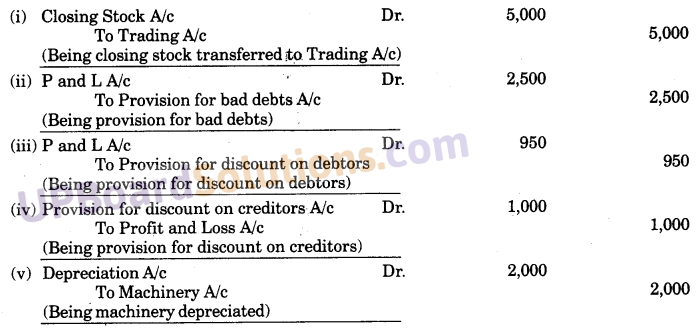
UP Board Solutions for Class 10 Commerce Chapter 2 Final Accounts with Simple Adjustments

Question 11.
Explain any five items to be included in Trading A/c.
Answer:

  1. Opening Stock: This is the value of stock in hand on the first date of the accounting period. This item is shown in the debit side of the Trading Account. This is same as the closing stock of the last accounting period.
  2. Wages: Wages paid to the labourer directly involved in production work is shown in the debit side of the balance sheet.
  3. Freight Inward: Freight and cartage paid on carrying the raw material and consumables to the factory site are shown under such head in the debit side of Trading Account.
  4. Octroi: Octroi is a local tax to be paid to the local government. This is imposed on produced goods or carrying raw material. This item is debited in Trading Account.
  5. Salary of Factory Manager: If any production manager is appointed in the factory, his salary will also be shown in Trading Account.

UP Board Solutions

Question 12.
From the following Trial Balance, prepare Trading Account and Profit and Loss Account for the year ending on 31st March, 2014 and Balance Sheet as on that date: (UP 2018)
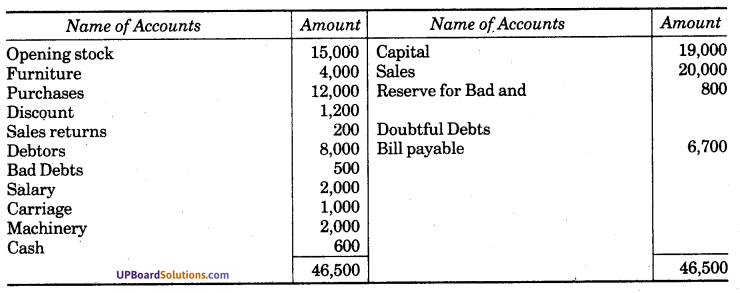
UP Board Solutions for Class 10 Commerce Chapter 2 Final Accounts with Simple Adjustments
Adjustments:
(i) Closing stock Rs. 1,500
(ii) Depreciate machinery @ 5% p.a.
(iii) Make provision for bad and doubtful debts on debtors @ 5%.
(iv) Make reserve for discount on debtors @ 2%.
(v) Outstanding salary is Rs. 200.
Solution:
UP Board Solutions for Class 10 Commerce Chapter 2 Final Accounts with Simple Adjustments

Question 13.
Prepare Trading Account, Profit and Loss Account for the year ending on 31st December, 2007 and Balance Sheet as on that date of M/s Raman and Brothers from the following Trial Balance:
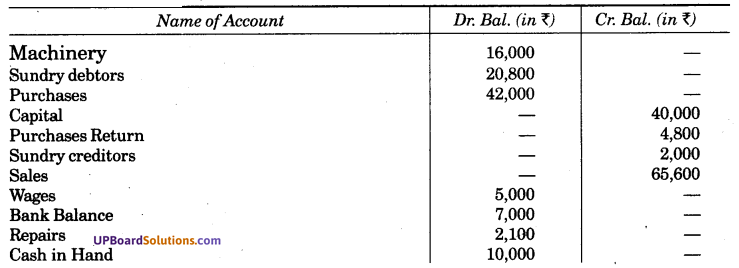
UP Board Solutions for Class 10 Commerce Chapter 2 Final Accounts with Simple Adjustments
UP Board Solutions for Class 10 Commerce Chapter 2 Final Accounts with Simple Adjustments 2
Value of closing stock on 31st Dec. 2007 was Rs. 12,000. Rs. 1,000 is to be provided as depreciation on machinery. Interest on capital is to be provided at 5%. Rs. 100 is to be paid for the repair. (UP 2008)
Solution:
UP Board Solutions for Class 10 Commerce Chapter 2 Final Accounts with Simple Adjustments

Question 14.
From the following Trial Balance of M/s Mani Ram Dhani Ram Kolkata, prepare Trading Account. Profit and Loss Account for the year ending on 31st December 2008 and its Balance Sheet as on that date:
UP Board Solutions for Class 10 Commerce Chapter 2 Final Accounts with Simple Adjustments
Adjustments:
(i) Closing Stock (31.12.2008): Rs. 19,900.
(ii) Depreciation on Furniture @ 10%: on Motor car @ 20% and on Building @ 10%.
(iii) Reserve for Bad Debts on debtors @ 5%. (UP 2009)
Solution:
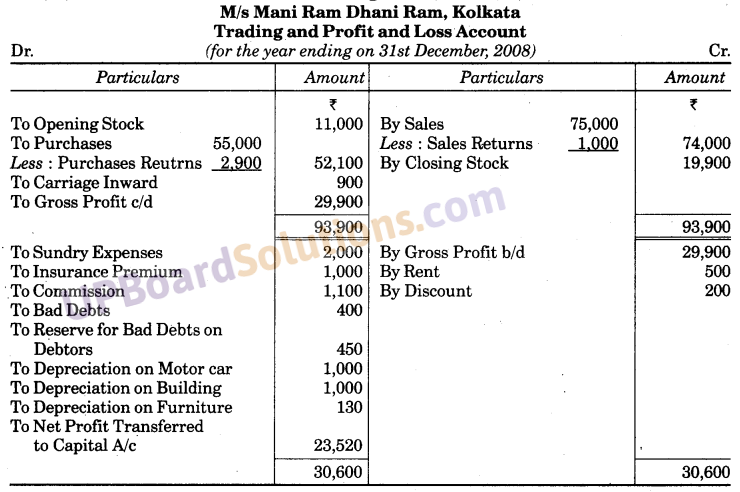
UP Board Solutions for Class 10 Commerce Chapter 2 Final Accounts with Simple Adjustments
UP Board Solutions for Class 10 Commerce Chapter 2 Final Accounts with Simple Adjustments 3

UP Board Solutions

Question 15.
Pass Journal entries in proper form for the following adjustments:
(i) Outstanding salaries of the employees are Rs. 6,000.
(ii) Prepaid Insurance premium is Rs. 1,500.
(iii) Interest accrued @ 6% on Capital Rs. 1,00,000.
(iv) Depreciation accrued @ 10% on Building Rs. 1,50,000.
(v) Commission accrued is Rs. 400. (UP 2009)
Solution:
UP Board Solutions for Class 10 Commerce Chapter 2 Final Accounts with Simple Adjustments

Question 16.
From the following information, prepare Balance Sheet of M/s Krishna B alar am, Ballia as on 31st December, 2008:
Cash in hand Rs. 11,400; Cash at BankRs. 15,300; Debtors Rs. 50,000; Creditors Rs. 20,000; Bills Receivable Rs. 15,000; Bills Payable Rs. 11,000; Capital Rs. 1,75,000; Machinery Rs. 50,000; Building Rs. 2,75,000; Closing Stock Rs. 30,000; Furniture Rs. 25,000; General Reserve Rs. 20,000 and Net Profit Rs. 2,25,200.
Other Information:
Net profit was calculated after taking into consideration the following adjustments:
(i) Interest on Capital @ 6% per annum.
(ii) Depreciation on Machinery and Furniture @ 10% per annual.
(iii) Reserve for Bad and Doubtful Debts on Debtors @ 5%. (UP 2009)
Solution:
UP Board Solutions for Class 10 Commerce Chapter 2 Final Accounts with Simple Adjustments 4

UP Board Solutions

Question 17.
From the following Trial Balance of M/s Ghasiram Patiram, prepare Trading Account and Profit and Loss Account for the year ended 31st December 2009 and Balance Sheet as on that date:
UP Board Solutions for Class 10 Commerce Chapter 2 Final Accounts with Simple Adjustments
On 31st December, cost of stock was Rs. 30,000. Charge depreciation on machinery @ 10%. Make reserve for Bad and Doubtful Debts @ 5% on debtors and charge interest on capital @ 6%. Salaries of Rs. 1,000 are prepaid.
Or
From the following information, prepare profit and loss account pff M/s Aajani & Brothers for the year ended 31st December, 2009: Debtors Rs. 50,000; Received Discount Rs. 750; Repair Rs. 200; Reserve for Doubtful (UPBoardSolutions.com) Debts Rs. 1,025; Machinery Rs. 20,000; Cash Rs. 5,000; Deposit in Bank Rs. 1,000; Advertisement Expenses Rs. 10,000; Gross Profit Rs. 59,000; Creditors Rs. 35,000; Capital Rs. 40,000; Drawing Rs. 9,000; Insurance Premium Annually Rs. 2,000.
Adjustments:
(i) Bad Debts on Debtors Rs. 1,000; Reserve for Bad Debts @ 5%;
(ii) Interest on Capital and Drawing @ 6%;
(iii) Written off 1/5 of Advertisement;
(iv) Insurance Premium is prepaid for 3 months. (UP 2010)
Solution:
UP Board Solutions for Class 10 Commerce Chapter 2 Final Accounts with Simple Adjustments

UP Board Solutions
UP Board Solutions for Class 10 Commerce Chapter 2 Final Accounts with Simple Adjustments

Question 18.
From the following Trial Balance of M/s Dhani Ram Nirdhan Ram, prepare Trading Account and Profit and Loss Account for the year ending on 31st December 2010 and its Balance Sheet as on that date:
UP Board Solutions for Class 10 Commerce Chapter 2 Final Accounts with Simple Adjustments
Adjustments:
(i) Closing stock: Rs. 46,000.
(ii) Outstanding wages: Rs. 1,600.
(iii) Prepaid insurance: Rs. 600
(iv) Depreciation on building @ 12%. (UP 2011)
Solution:
UP Board Solutions for Class 10 Commerce Chapter 2 Final Accounts with Simple Adjustments
UP Board Solutions for Class 10 Commerce Chapter 2 Final Accounts with Simple Adjustments 5
UP Board Solutions for Class 10 Commerce Chapter 2 Final Accounts with Simple Adjustments 6

UP Board Solutions for Class 10 Commerce

UP Board Solutions for Class 10 Hindi रस

UP Board Solutions for Class 10 Hindi रस

These Solutions are part of UP Board Solutions for Class 10 Hindi. Here we have given UP Board Solutions for Class 10 Hindi रस.

रस

परिभाषा-‘रस’ का अर्थ है–‘आनन्द’ अर्थात् काव्य से जिस आनन्द की अनुभूति होती है, वही ‘रस’ है। इस प्रकार किसी काव्य को पढ़ने, सुनने अथवा अभिनय को देखने पर पाठक, श्रोता या दर्शक को जो आनन्द प्राप्त होता है, उसे ‘रस’ कहते हैं। रस को ‘काव्य की आत्मा’ भी कहा जाता है।

रस के स्वरूप और उसके व्यक्त होने की प्रक्रिया का वर्णन करते हुए भरतमुनि ने अपने नाट्यशास्त्र में लिखा है-‘विभावानुभावव्यभिचारिसंयोगाद्रसनिष्पत्तिः’ अर्थात् विभाव, अनुभाव और व्यभिचारी भाव के संयोग से रस की निष्पत्ति होती (UPBoardSolutions.com) है। इस सूत्र में स्थायी भाव का स्पष्ट उल्लेख नहीं है; अत: इस सूत्र का पूरा अर्थ होगा कि स्थायी भाव ही विभाव, संचारी भाव और अनुभाव के संयोग से रस-रूप में परिणत हो जाते हैं।
अंग या अवयव-रस के चार अंग होते हैं, जिनके सहयोग से ही रस की अनुभूति होती है। ये चारों अंग या अवयव निम्नलिखित हैं–

  1. स्थायी भाव,
  2. विभाव,
  3. अनुभाव तथा
  4. संचारी भाव। स्थायी भाव

UP Board Solutions

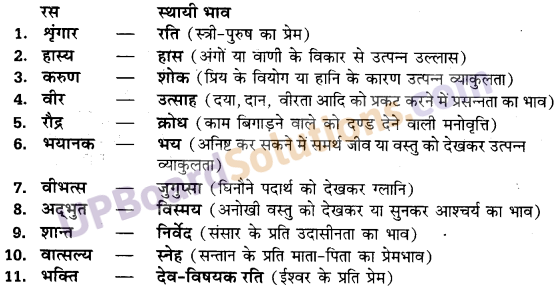
जो भाव मानव के हृदय में हर समय सुप्त अवस्था में विद्यमान रहते हैं और अनुकूल अवसर पाते ही जाग्रत या उद्दीप्त हो जाते हैं, उन्हें स्थायी भाव कहते हैं। प्राचीन आचार्यों ने नौ रसों के नौ स्थायी भाव माने हैं, किन्तु बाद में आचार्यों ने इनमें दो रस और जोड़ दिये। इस प्रकार रसों की कुल संख्या ग्यारह हो गयी। रस और उनके स्थायी भाव निम्नलिखित हैं-

UP Board Solutions for Class 10 Hindi रस img-1

विभाव

जिन कारणों से मन में स्थित सुप्त स्थायी भाव जाग्रत या उद्दीप्त होते हैं, उन्हें विभाव कहते हैं। विभाव के दो भेद होते हैं|

(1) आलम्बन-विभाव-जिस वस्तु या व्यक्ति के कारण किसी व्यक्ति में कोई स्थायी भाव जाग्रत हो जाये तो वह वस्तु या व्यक्ति उस भाव का आलम्बन-विभाव कहलाएगा; जैसे-जंगल से गुजरते समय अचानक शेर के दिखाई देने से भय नामक स्थायी भाव जागने पर ‘शेर आलम्बन-विभाव होगा।
आलम्बन-विभाव के भी दो भेद होते हैं—आश्रय और विषय। जिस व्यक्ति के मन में स्थायी भाव उत्पन्न होते हैं उसे आश्रय तथा जिस व्यक्ति या वस्तु के कारण आश्रय के चित्त में स्थायी भाव उत्पन्न होते हैं, उसे विषय कहते हैं। इस उदाहरण में व्यक्ति को ‘आश्रय’ तथा शेर को ‘विषय’ कहेंगे।

(2) उद्दीपन-विभाव-जो कारण स्थायी भावों को उत्तेजित या उद्दीप्त करते हैं, (UPBoardSolutions.com) वे उद्दीपन- विभाव कहलाते हैं; जैसे—शेर की दहाड़। यह स्थायी भाव ‘भय’ को उद्दीप्त करता है।

UP Board Solutions

अनुभाव

मन में आने वाले स्थायी भाव के कारण मनुष्य में कुछ शारीरिक चेष्टाएँ उत्पन्न होती हैं, वे अनुभाव कहलाती हैं; जैसे–शेर को देखकर भाग खड़ा होना या बचाव के लिए जोर-जोर से चिल्लाना। इस प्रकार उसकी बाह्य चेष्टाओं से दूसरों पर भी यह प्रकट हो जाता है कि उसके मन में अमुक भाव जाग्रत हो गया है।

अनुभाव मुख्यत: चार प्रकार के होते हैं—

  1. कायिक,
  2. मानसिक,
  3. आहार्य तथा
  4. सात्त्विक

(1) कायिक अनुभाव–आश्रय द्वारा इच्छापूर्वक की जाने वाली आंगिक चेष्टाओं को कायिक, (शरीर से सम्बद्ध) अनुभाव कहते हैं; जैसे—भागना, कूदना, हाथ से संकेत करना आदि।

(2) मानसिक अनुभाव-हृदय की भावना के अनुकूल मन में हर्ष-विषाद आदि भावों के उत्पन्न होने से जो भाव प्रदर्शित किये जाते हैं, वे मानसिक अनुभाव कहलाते हैं।

(3) आहार्य अनुभाव-मन के भावों के अनुसार अलग-अलग प्रकार की कृत्रिम वेश-रचना करने को आहार्य अनुभाव कहते हैं।

(4) सात्त्विक अनुभाव-जिन शारीरिक विकारों पर आश्रय का कोई वश नहीं होता, अपितु वे स्थायी भाव के उद्दीप्त होने पर स्वत: ही उत्पन्न हो जाते हैं, वे सात्त्विक अनुभाव कहलाते हैं। ये आठ प्रकार के होते हैं—

  1. स्तम्भ (शरीर के अंगों का जड़ हो जाना),
  2. स्वेद (पसीने-पसीने हो जाना),
  3. रोमांच (रोंगटे खड़े हो जाना),
  4. स्वर-भंग (आवाज न निकलना),
  5. कम्प (काँपना),
  6. विवर्णता (चेहरे का रंग उड़ जाना),
  7. अश्रु (आँसू),
  8. प्रलय (सुध-बुध खो बैठना)।

UP Board Solutions

संचारी भाव

आश्रय के मन में उठने वाले अस्थिर मनोविकारों को संचारी भाव कहते हैं। ये मनोविकार पानी के बुलबुलों की भाँति बनते-मिटते रहते हैं। संचारी भाव को व्यभिचारी भाव के नाम से भी पुकारते हैं। ये स्थायी भावों को अधिक पुष्ट करने में सहायक का कार्य करते हैं। (UPBoardSolutions.com) ये अपना कार्य करके तुरन्त स्थायी भावों में ही विलीन हो जाते हैं। प्रमुख संचारी भावों की संख्या तैंतीस मानी गयी है, जो इस प्रकार हैं-

  1. निर्वेद,
  2. आवेग,
  3. दैन्य,
  4. श्रम,
  5. मद,
  6. जड़ता,
  7. उग्रता,
  8. मोह,
  9. विबोध,
  10. स्वप्न,
  11. अपस्मार,
  12. गर्व,
  13. मरण,
  14. आलस्य,
  15. अमर्ष,
  16. निद्रा,
  17. अवहित्था,
  18. उत्सुकता,
  19. उन्माद,
  20. शंका,
  21. स्मृति,
  22. मति,
  23. व्याधि,
  24.  सन्त्रास,
  25. लज्जा,
  26. हर्ष,
  27. असूया,
  28. विषाद,
  29. धृति,
  30. चपलता,
  31. ग्लानि,
  32. चिन्ता और
  33. वितर्क।

UP Board Solutions

[विशेष—कक्षा 10 के पाठ्यक्रम में केवल हास्य और करुण रस ही निर्धारित हैं, किन्तु अध्ययन में परिपक्वता की दृष्टि से श्रृंगार और वीर रस को भी संक्षेप में यहाँ दिया जा रहा है; क्योंकि पद्यांशों का । काव्य-सौन्दर्य लिखने के लिए इनका ज्ञान भी आवश्यक है।]

(1) श्रृंगार रस

परिभाषा–स्त्री-पुरुष के पारस्परिक प्रेम (मिलन या विरह) के वर्णन से हृदय में उत्पन्न होने वाले आनन्द को श्रृंगार रस कहते हैं। यह रसराज कहलाता है। इसका स्थायी भाव ‘रति’ है।

भेद-श्रृंगार रस के दो भेद होते हैं–

  1. संयोग श्रृंगार तथा
  2. वियोग (विप्रलम्भ) श्रृंगार।

(1) संयोग श्रृंगार-जब नायक-नायिका के विविध प्रेमपूर्ण कार्यों, मिलन, वार्तालाप, स्पर्श आदि का वर्णन होता है, तब संयोग श्रृंगार होता है; उदाहरण-

बतरस लालच लाल की, मुरली धरी लुकाय।
सौंह करै भौंहनि हँसै, दैन कहै नटि जाय।

स्पष्टीकरण-

(1) स्थायी भाव–रति।
(2) विभाव—

  • आलम्बन-कृष्ण। आश्रय-राधा।
  • उद्दीपन-बतरस लालच।

(3) अनुभाव-बाँसुरी छिपाना, भौंहों से हँसना, मना करना।
(4) संचारी भाव-हर्ष, उत्सुकता, चपलता आदि।

(2) वियोग (विप्रलम्भ) श्रृंगार—प्रबल प्रेम होते हुए भी जहाँ नायक-नायिका के वियोग का । वर्णन हो, वहाँ वियोग श्रृंगार होता है; उदाहरण-

ऊधौ मन न भये दस बीस ।
एक हुतौ सो गयौ स्याम सँग, को अवराधै ईस ॥
इंद्री सिथिल भई केसव बिनु, ज्यौं देही बिनु सीस।
आसा लागिरहति तन स्वासा, जीवहिं कोटि बरीस ॥
तुम तौ सखा स्यामसुन्दर के, सकल जोग के ईस ।
सूर हमारें नंदनंदन बिनु, और नहीं जगदीस ॥

स्पष्टीकरण–

(1) स्थायी भाव–रति।
(2) विभाव—

  • आलम्बन–कृष्ण। आश्रय-गोपियाँ।
  • द्दीपन—उद्धव का योग सन्देश।

(3) अनुभाव-विषाद।।
(4) संचारी भाव-दैन्य, जड़ता, स्मृति आदि।

UP Board Solutions

(2) हास्य रस [2009, 10, 11, 12, 13, 14, 15, 16, 17, 18]

परिभाषा-किसी व्यक्ति के विकृत रूप, आकार, वेशभूषा आदि को देखकर (UPBoardSolutions.com) हृदय में जो विनोद का भाव उत्पन्न होता है, वही ‘हास’ कहलाता है। यही ‘हास’ नामक स्थायी भाव विभाव, अनुभाव तथा संचारी भाव से पुष्ट होकर हास्य रस कहलाता है; उदाहरण-

बिन्ध्य के बासी उदासी तपोब्रतधारी महा बिनु नारि दुखारे।
गौतम तीय तरी तुलसी, सो कथा सुनि भै मुनिबूंद सुखारे ॥
छैहैं सिला सब चन्द्रमुखी, परसे पद-मंजुल-कंज तिहारे।
कीन्हीं भली रघुनायक जू करुना करि कानन को पगु धारे॥ [2009]

स्पष्टीकरण–

  1.  स्थायी भाव-हास (हँसी)।
  2. विभाव—
    • आलम्बन–विन्ध्य के वासी तपस्वी। आश्रय-पाठक।
    • उद्दीपन-अहिल्या की कथा सुनना, राम के आगमन पर प्रसन्न होना, स्तुति करना।।
  3. अनुभाव-हँसना।।
  4. संचारी भाव–स्मृति, चपलता, उत्सुकता आदि।
    अन्य उदाहरण—

    • पूछति ग्रामवधू सिय सों, ‘कहौ साँवरे से, सखि रावरे क़ो हैं ?
    • आगे चना गुरुमात दए ते, लए तुम चाबि हमें नहिं दीने ।
      स्याम कह्यो मुसकाय सुदामा सौं, चोरी की बान में हौ जू प्रवीने ।।
      पोटरी कॉख में चॉपि रहे तुम, खोलत नाहिं सुधारस भीने ।
      पाछिली बानि अजौ ने तजौ तुम, तैसेई भाभी के तन्दुल कीन्हे ।।

(3) करुण रस [2009, 10, 11, 12, 13, 14, 15, 16, 17, 18]

परिभाषा–प्रिय वस्तु तथा व्यक्ति के नाश या अनिष्ट से हृदय में उत्पन्न क्षोभ से ‘शोक’ उत्पन्न होता है। यही शोक नामक स्थायी भाव जब विभाव, अनुभाव तथा संचारी भाव से पुष्ट हो जाता है तब ‘करुण रस’ दशा को प्राप्त होता है; उदाहरण-श्रवणकुमार की मृत्यु पर उसकी माता की यह दशा करुण रस की निष्पत्ति कराती है–

मणि खोये भुजंग-सी जननी,
फन-सा पटक रही थी शीश,
अन्धी आज बनाकर मुझको,
किया न्याय तुमने जगदीश ?

UP Board Solutions

स्पष्टीकरण–

  1. स्थायी भाव—शोक।
  2. विभाव—
    • आलम्बन-श्रवण। आश्रय–पाठक।
    • उद्दीपन-दशरथ की उपस्थिति।
  3. अनुभाव-सिर पटकना, प्रलाप करना आदि।
  4. संचारी भाव-स्मृति, विषाद आदि।

अन्य उदाहरण

(1) अभी तो मुकुट बँधा था माथ, हुए कल ही हल्दी के हाथ ।
खुले भी न थे लाज के बोल, खिले भी चुम्बन शून्य कपोल ।।
हाय रुक गया यहीं संसार, बना सिन्दूर अनल अंगारे ।
वातहत लतिका यह सुकुमार, पड़ी है। छिन्नाधार ।।

(2) सोक बिकल सब रोवहिं रानी। रूप सीले बल तेज बखानी ।।
करहिं बिलाप अनेक प्रकारा। परहिं भूमि तल बारहिं बारा ।। [2017]

(4) वीर रस

परिभाषा-शत्रु के उत्कर्ष को मिटाने, दोनों की दुर्दशा देख उनका उद्धार करने, (UPBoardSolutions.com) धर्म का उद्धार करने आदि में जो उत्साह कर्मक्षेत्र में प्रवृत्त करता है, वह वीर रस कहलाता है। वीर रस का स्थायी भाव ‘उत्साह’ है; उदाहरण-

मैं सत्य कहता हूँ सखे, सुकुमार मत जानो मुझे।
यमराज से भी युद्ध में प्रस्तुत सदा मानो मुझे ॥
है और की तो बात ही क्या, गर्व मैं करता नहीं।
मामा तथा निज तात से भी, समर में डरता नहीं ॥

स्पष्टीकरण-

  1. स्थायी भाव–उत्साह।
  2. विभाव-
    • आलम्बन-कौरव। आश्रय-अभिमन्यु।
    • उद्दीपन-चक्रव्यूह की रचना।
  3. अनुभाव-अभिमन्यु की उक्ति।
  4.  संचारी भाव-गर्व, हर्ष, उत्सुकता आदि।

UP Board Solutions

अभ्यास

प्रश्न 1
निम्नलिखित में कौन-सा रस है ? उसका स्थायी भाव एवं परिभाषा लिखिए
(1) बिपति बँटावन बंधु बाहु बिनु करौं भरोसो काको ?
(2) नाना वाहन नाना वेषा। बिहसे सिव समाज निज देखा ।।
कोउ मुखहीन बिपुल मुख काहू। बिनु पद–कर कोऊ बहु-बाहू ।।
(3) जो भूरि भाग्य भरी विदित थी निरुपमेय सुहासिनी ।
हे हृदयवल्लभ! हूँ वही अब मैं महा हतभागिनी ।।
जो साथिनी होकर तुम्हारी थी अतीव सनाथिनी ।।
है अब उसी मुझ-सी जगत में और कौन अनाथिनी ।।
(4) जथा पंख बिनु खग अति दीना। मनि बिनु फन करिबर कर हीना ।।
अस मम जिवन बन्धु बिन तोही। जौ जड़ दैव जियावइ मोही ।। [2010, 11]
(5) सीस पर गंगा हँसै, भुजनि भुजंगा हँसै ।
हास ही को दंगा भयो नंगा के विवाह में ।। [2010, 12, 14]
(6) हँसि हँसि भाजै देखि दूलह दिगम्बर को,
पाहुनी जे आवें हिमाचल के उछाह में। [2011, 12, 13, 15]
(7) हे जीवितेश ! उठो, उठो यह नींद कैसी घोर है।
है क्या तुम्हारे योग्य, यह तो भूमि सेज कठोर है।।
(8) हरि जननी मैं बालक तेरा। काहे न अवगुण बकसहु मेरा ।।
सुत अपराध करै दिन केते। जननी कैचित रहै न तेते ।।
कर गहि केस करे जो घाता। तऊ न हेत उतारै माता ।।
कहैं कबीर एक बुधि बिचारी। बालक दुःखी-दुःखी महतारी ।।
(9) जेहि दिसि बैठे नारद फूली। सो दिसि तेहिं न बिलोकी भूली ।।
पुनि पुनि मुनि उकसहिं अकुलानी। देखि दसा हर गन मुसुकाहीं ।। [2014]
(10) ब्रज के बिरही लोग दुखारे।
बिनु गोपाल ठगे से ठाढ़े, अति दुर्बल तन कारे ।।
नंद जसोदा मारग जोवति, निस दिन साँझ सकारे ।
चहुँ दिसि कान्ह कान्ह कहि टेरते, अँसुवन बहत पनारे ।।
(11) ऊधौ मोहिं ब्रज बिसरत नाहीं ।।
वृंदावन गोकुल वन उपवन सघन कुंज की छाहीं ।।
(12) चहुँ दिसि कान्ह कान्हें कहि टेरत, अँसुवने बहत पनारे ।। [2013]
(13) तात तात हा तात पुकारी। परे भूमितल व्याकुल भारी ।।
चलत न देखन पायउँ तोही। तात न रामहिं सौंपेउ मोही ।। [2009, 10]
(14) हा! वृद्धा के अतुल धन, हा! मृदुता के सहारे ।
ही ! प्राणों के परमप्रिय, हा! एक मेरे दुलारे ।
(15) गोपी ग्वाल गाइ गो सुत सब, अति ही दीन विचारे ।
सूरदास प्रभु बिनु यौं देखियत, चंद बिना ज्यौं तारे ।।

UP Board Solutions
(16) प्रिय पति वह मेरा प्राण प्यारा कहाँ है ।
दु:ख जलनिधि डूबी का सहारा कहाँ है ।।
लख मुख जिसका आज लौं जी सकी हूँ, |
वह हृदय हमारा नैन- तारा कहाँ है ।। [2011]
(17) करि विलाप सब रोवहिं रानी। महा बिपति किमि जाय बखानी ।।
सुन विलाप दुखहूँ दुख लागा। धीरजहूँ कर धीरज भागा ।।
(18) कौरवों का श्राद्ध करने के लिए।
या कि रोने को चिता के सामने।
शेष अब है रह गया कोई नहीं,
एक वृद्धा एक अन्धे के सिवा।। [2010, 12, 14]
(19) पति सिर देखत मन्दोदरी। मुरुछित बिकले धरनि खसि परी।।
जुबति बूंद रोवत उठि धाई। तेहि उठाइ रावन पहिं आई ।। [2012]
(20) राम-राम कहि राम (UPBoardSolutions.com) कहि, राम-राम कहि राम ।
तन परिहरि रघुपति विरहं, राउ गयउ सुरधाम् ।। [2012]
(21) मम अनुज पड़ा है, चेतनाहीन होके,
तरल हृदय वाली जानकी भी नहीं है ।
अब बहु दु:ख से अल्प बोला न जाता,
क्षण भर रह जाता है न उद्विग्नता से ।। [2013]
(22) बिलपहिं बिकलदास अरु दासी। घर घर रुदन करहिं पुरवासी ।
अँथयउ आजु भानुकुल भानू। धरम अवधि गुन रूप निधानू ।। [2018]
उत्तर
(1) रस — करुण, स्थायी भाव – शोक।
(2) रस — हास्य, स्थायी भाव – शोक।
(3) रस — करुण, स्थायी भाव – शोक।
(4) रस — करुण, स्थायी भाव – शोक।
(5) रस — करुण, स्थायी भाव – शोक।
(6) रस — हास्य, स्थायी भाव – हास।
(7) रस – करुण, स्थायी भाव – शोक।
(8) रस — करुण, स्थायी भाव – शोक।
(9) रस — हास्य, स्थायी भावे – हास।
(10) रस — करुण, स्थायी भाव – शोक।
(11) रस — करुण, स्थायी भाव – शोक!
(12) रस — करुण, स्थायी भाव – शोक।
(13) रस — करुण, स्थायी भाव – शोक।
(14) रस — करुण, स्थायी भाव – शोक।
(15) रस — करुण, स्थायी भाव – शोक।
(16) रस — करुण, स्थायी भाव – शोक।
(17) रस — करुण, स्थायी भाव – शोक।
(18) रस — करुण, स्थायी भाव – शोक।
(19) रस — करुण, स्थायी भाव – शोक।
(20) रस — करुण, स्थायी भाव – शोक।
(21) रस — करुण, स्थायी भाव – शोक।
(22) रस — करुण, स्थायी भाव – शोक।

UP Board Solutions

[ संकेत-परिभाषा के लिए सम्बन्धित रस की सामग्री का अध्ययन करें।]

प्रश्न 2
करुण रस का स्थायी भाव बताते हुए एक उदाहरण दीजिए। [2011]
या
करुण रस की परिभाषा लिखिए और उसका एक उदाहरण दीजिए। [2011, 12, 13, 14, 15, 16, 17]
या
करुण रस की परिभाषा सोदाहरण लिखिए।
उत्तर
[संकेत-करुण रस के अन्तर्गत दिये गये विवरण को पढ़िए।]

प्रश्न 3
हास्य रस की परिभाषा लिखिए और उसका स्थायी भाव भी बताइए। [2011]
या
हास्य रस की परिभाषा उदाहरण सहित  लिखिए। [2009, 11, 12, 13, 14, 15, 16, 17]
या
हास्य रस का लक्षण और उदाहरण दीजिए।
या
हास्य रस का स्थायी भाव लिखिए तथा एक उदाहरण बताइट। [2009, 11]
उत्तर
[ संकेत-हास्य रस के अन्तर्गत दिये गये विवरण को पढ़िए।]

UP Board Solutions

प्रश्न 4
निम्नांकित पद्यांश में वर्णित रस का उल्लेख करते हुए उसका स्थायी भाव बताइए-
मेरी भव बाधा हरौ, राधा नागरि सोय।
जा तन की झाँईं परै, स्याम हरित दुति होय ॥
उत्तर
प्रस्तुत दोहे के एक से अधिक अर्थ हैं। एक अर्थ के आधार पर इसे भक्ति रस का दोहा माना जाता है तथा दूसरे अर्थ के आधार पर श्रृंगार रस का। भक्ति रस का स्थायी भाव है—देव विषयक रति तथा शृंगार रस का स्थायी (UPBoardSolutions.com) भाव है-रति।
[ संकेत–उपर्युक्त दोनों ही रस पाठ्यक्रम में निर्धारित नहीं हैं।]

प्रश्न 5
‘भक्ति रस’ और ‘वात्सल्य रस’ में क्या अन्तर है ? कोई एक उदाहरण लिखिए।
या
वात्सल्य रस की उदाहरण सहित परिभाषा लिखिए।
उत्तर
देवताविषयक रति अर्थात् भगवान् के प्रति अनन्य प्रेम ही विभाव, अनुभाव और संचारी भावों से पुष्ट होकर भक्ति रस में परिणत हो जाता है;
उदाहरण-

पुलक गात हिय सिय रघुबीरू। जीह नामु जप लोचन नीरू॥ पुत्र, बालक, शिष्य, अनुज आदि के प्रति रति को भाव स्नेह कहलाता है। इसका वत्सल नामक स्थायी भाव; विभाव, अनुभाव और संचारी भावों से पुष्ट होकर वात्सल्य रस में परिणत हो जाता है; उदाहरण-

जसोदा हरि पालने झुलावै ।
हलराउँ, दुलरावें, मल्हावै, जोइ-सोइ कछु गावें ॥

[संकेत-उपर्युक्त दोनों ही रस पाठ्यक्रम में निर्धारित नहीं हैं।]

UP Board Solutions

प्रश्न 6
सिसु सब राम प्रेम बस जाने। प्रीति समेत निकेत बखाने ।।
निज-निज रुचि सब लेहिं बुलाई। सहित सनेह जायँ दोउ भाई ।।
उपर्युक्त चौपाई में निहित रस तथा उसका स्थायी भाव लिखिए।
उत्तर
प्रश्न में दी गई चौपाई में श्रृंगार रस है, जिसका स्थायी भाव ‘रति’ है।

[संकेत-यह रस पाठ्यक्रम में निर्धारित नहीं है।

We hope the UP Board Solutions for Class 10 Hindi रस help you. If you have any query regarding UP Board Solutions for Class 10 Hindi रस, drop a comment below and we will get back to you at the earliest.


UP Board Solutions for Class 10 Hindi Chapter 6 अजन्ता (गद्य खंड)

UP Board Solutions for Class 10 Hindi Chapter 6 अजन्ता (गद्य खंड)

These Solutions are part of UP Board Solutions for Class 10 Hindi. Here we have given UP Board Solutions for Class 10 Hindi Chapter 6 अजन्ता (गद्य खंड).

जीवन-परिचय एवं कृतियाँ

प्रश्न 1.
भगवतशरण उपाध्याय के जीवन-परिचय एवं साहित्यिक योगदान पर प्रकाश डालिए। [2009, 10]
या
भगवतशरण उपाध्याय का जीवन-परिचय दीजिए एवं उनकी एक रचना का नामोल्लेख कीजिए। [2011, 12, 13, 14, 15, 16, 17, 18]
उत्तर
संस्कृत-साहित्य तथा पुरातत्त्व के समर्थ अध्येता एवं हिन्दी-साहित्य के प्रसिद्ध उन्नायक भगवतशरण उपाध्याय अपने मौलिक और स्वतन्त्र विचारों के लिए प्रसिद्ध हैं। ये प्राचीन भारतीय इतिहास एवं संस्कृति के प्रमुख अध्येता और व्याख्याकार होते हुए भी रूढ़िवादिता एवं परम्परावादिता से ऊपर रहे हैं। |

जीवन-परिचय-भगवतशरण उपाध्याय का जन्म सन् 1910 ई० में बलिया (उत्तर प्रदेश) जिले के ‘उजियारपुर’ नामक ग्राम में हुआ था। इनकी प्रारम्भिक शिक्षा अपने ग्राम में हुई। उच्च शिक्षा-प्राप्ति के लिए ये बनारस आये और काशी हिन्दू विश्वविद्यालय से प्राचीन इतिहास में एम० ए० की परीक्षा उत्तीर्ण की। ये संस्कृत-साहित्य और पुरातत्त्व के अध्येता तथा हिन्दी-साहित्य के उन्नायक रहे हैं। ये प्रयाग एवं लखनऊ संग्रहालयों (UPBoardSolutions.com) के पुरातत्त्व विभाग के अध्यक्ष भी रहे हैं। इन्होंने पिलानी स्थित बिड़ला महाविद्यालय में प्राध्यापक के पद पर भी कार्य किया। तत्पश्चात् विक्रम विश्वविद्यालय, उज्जैन में प्राचीन इतिहास विभाग के प्रोफेसर एवं अध्यक्ष पद पर कार्य करके अवकाश ग्रहण किया और देहरादून में स्थायी रूप से निवास करते हुए साहित्य-सेवा में जुट गये। अगस्त, सन् 1982 ई० में इसे मनीषी साहित्यकार ने इस असारे संसार से विदा ले ली।

रचनाएँ–उपाध्याय जी ने हिन्दी में तो विपुल साहित्य की रचना की ही है, किन्तु अंग्रेजी में भी इनकी कुछ एक प्रसिद्ध रचनाएँ हैं। इनकी उल्लेखनीय रचनाएँ निम्नलिखित हैं

  1. पुरातत्त्व-‘मन्दिर और भवन’, ‘भारतीय मूर्तिकला की कहानी’, ‘भारतीय चित्रकला की कहानी’, ‘कालिदास का भारत’। इन पुस्तकों में प्राचीन भारतीय संस्कृति, साहित्य और कला का सूक्ष्म वर्णन हुआ है।। |
  2. इतिहास–‘खून के छींटे’, ‘इतिहास साक्षी है’, ‘इतिहास के पन्नों पर’, ‘प्राचीन भारत का इतिहास’, ‘साम्राज्यों के उत्थान-पतन’ आदि। इन पुस्तकों में प्राचीन इतिहास को साहित्यिक सरसता के साथ प्रस्तुत किया गया है।
  3. आलोचना-‘विश्व साहित्य की रूपरेखा’, ‘साहित्य और कला’, ‘कालिदास’ आदि। इन ग्रन्थों में साहित्य के विविध पक्षों पर प्रकाश डाला गया है। |
  4. यात्रा-वृत्तान्त-‘कलकत्ता से पीकिंग’, ‘सागर की लहरों पर’, ‘मैंने देखा लाल चीन’ आदि। इनमें इनकी विदेश-यात्राओं का सजीव विवरण है।
  5. संस्मरण और रेखाचित्र--‘मैंने देखा’, ‘इँठा आम’। इनमें स्मृति के साथ-साथ संवेदना के रंगों से भरे सजीव शब्द-चित्र उभारे गये हैं।
  6. अंग्रेजी ग्रन्थ-‘इण्डिया इन कालिदास’, ‘वीमेन इन ऋग्वेद’ तथा ‘एंशियेण्ट इण्डिया’।

UP Board Solutions

साहित्य में स्थान-उपाध्याय जी पुरातत्त्व और संस्कृति के महान् विद्वान् हैं। उन्होंने अपने गम्भीर और सूक्ष्म अध्ययन को अपनी रचनाओं में साकार रूप प्रदान किया है। वे हिन्दी के पुरातत्त्वविद्, भारतीय

संस्कृति के अध्येता, रेखाचित्रकार और महान् शैलीकार थे। विदेशों में दिये गये उनके व्याख्यान हिन्दी साहित्य की अमूल्य धरोहर हैं। इन्होंने सौ से भी अधिक पुस्तकें लिखकर हिन्दी-साहित्य में अपना उल्लेखनीय स्थान बनाया है।

गद्यांशों पर आधारित प्रश्न

प्रश्न-पत्र में केवल 3 प्रश्न (अ, ब, स) ही पूछे जाएँगे। अतिरिक्त प्रश्न अभ्यास एवं परीक्षोपयोगी दृष्टि से महत्त्वपूर्ण होने के कारण दिए गये हैं।
प्रश्न 1.
जिन्दगी को मौत के पंजों से मुक्त कर उसे अमर बनाने के लिए आदमी ने पहाड़ काटा है। किस तरह इंसान की खूबियों की कहानी सदियों बाद आने वाली पीढ़ियों तक पहुँचायी जाए, इसके लिए आदमी ने कितने ही उपाय सोचे और किये।  उसने चट्टानों पर अपने संदेश खोदे, ताड़ों-से ऊँचे धातुओं-से चिकने पत्थर के खम्भे खड़े किये, ताँबे और पीतल के पत्तरों पर अक्षरों के मोती बिखेरे और उसके जीवन-मरण की कहानी सदियों के उतार पर सरकती चली आयी, चली आ रही है, जो आज हमारी अमानत-विरासत बन गयी है। [2011]
(अ) प्रस्तुत गद्यांश के पाठ और लेखक का नाम लिखिए।
(ब) रेखांकित अंशों की व्याख्या कीजिए।
(स)

  1. प्रस्तुत गद्यांश में लेखक क्या कहना चाहता है ?
  2. व्यक्ति ने आगामी पीढ़ी तक अपनी  बातों को पहुँचाने के लिए क्या-क्या किया है ?
  3. आगामी पीढ़ी तक पहुँचायी गयी बातें आज हमारे लिए क्या स्थान रखती हैं ?
  4. लेखक की दृष्टि में अजन्ता की गुफाओं के निर्माण का क्या उद्देश्य रहा है ?

[ सरकती = फिसलती। अमानत = सुरक्षित रखने के लिए दी गयी वस्तु, धरोहर। विरासत = पूर्वजों से। प्राप्त सम्पत्ति या गुण, उत्तराधिकार।]

UP Board Solutions
उत्तर
(अ) प्रस्तुत गद्यावतरण हमारी पाठ्य-पुस्तक ‘हिन्दी’ के ‘गद्य-खण्ड’ में संकलित तथा भारतीय पुरातत्त्व के महान् विद्वान् श्री भगवतशरण उपाध्याय द्वारा लिखित ‘अजन्ता’ शीर्षक निबन्ध से उद्धृत है। अथवा निम्नवत् लिखेंपाठ का नाम-अजन्ता। लेखक का नाम—भगवतशरण उपाध्याय।।
[विशेष—इस पाठ के शेष सभी गद्यांशों के प्रश्न ‘अ’ (UPBoardSolutions.com) के लिए यही उत्तर इसी रूप में लिखा जाएगा।]

(ब) प्रथम रेखांकित अंश की व्याख्यो-मनुष्य का जीवन क्षणभंगुर है। मृत्यु सबको निगल जाती है। मृत्यु से छुटकारा पाने का एक ही उपाय है, वह है कृति (रचना)। मनुष्य को कुछ ऐसी रचना कर देनी चाहिए, जो अनन्तकाल तक स्थायी रहे। जब तक वह रचना विद्यमान रहेगी, उसके रचयिता का नाम जीवित रहेगा। लोग उसे भी याद करेंगे। किसी व्यक्ति विशेष को अगली पीढ़ियाँ जानें और सैकड़ों-हजारों वर्षों के बाद आने वाली पीढ़ियाँ भी अपने महान् पूर्वजों की विशेषताओं और इतिहास से परिचित हों, इसके लिए मनुष्य ने अनेक उपाय सोचे और उन उपायों को कार्यरूप में परिणत भी किया।

द्वितीय रेखांकित अंश की व्याख्या–लेखक का कहना है कि अपनी बातों को अग्रिम पीढ़ी तक पहुँचाने के उद्देश्य से मनुष्य ने पत्थर की विशाल चट्टानों पर सन्देश खुदवाये जिससे आने वाली सन्तति उन्हें पढ़े और जाने। कभी मनुष्य ने ताड़ के वृक्षों के समान ऊँचे चिकने पत्थरों से स्तम्भ बनवाये तथा ताँबे और पीतल के पत्रों पर सुन्दर मोती जैसे अक्षरों में लेख लिखवाये जो आगे आने वाली पीढ़ियों को उनके पूर्वजों की कहानी सुनाएँ। इसी प्रकार मानव-जाति का इतिहास एक पीढ़ी से दूसरी पीढ़ी तक चला आ रहा है। ये पहाड़ों की गुफाएँ, चट्टान, स्तम्भ तथा लेख आज हमारे समाज की धरोहर हैं। ये हमारे पूर्वजों की परम्परा से चली आती हुई हमारी सम्पत्ति हैं। हम इन पर गर्व करते हैं।
(स)

  1. प्रस्तुत गद्यांश में लेखक कहना चाहता है कि अमरत्व प्राप्त करने के लिए व्यक्ति को कला का सहारा लेना चाहिए।
  2. अपनी बातों को आगामी पीढ़ी तक पहुँचाने के लिए व्यक्ति ने पत्थर की चट्टानों पर सन्देश खुदवाये, ऊँचे-चिकने पत्थरों के खम्भे बनवाये, ताँबे-पीतल के पत्रों पर लेख लिखवाये तथा पर्वतों पर गुफा-मन्दिर बनवाये।
  3. आगामी पीढ़ी तक विभिन्न माध्यमों से पहुँचायी गयी बातें आज हमारे लिए धरोहर को स्थान रखती हैं, जो पूर्वजों की परम्परा से आयी हमारी सम्पत्ति हैं।
  4. लेखक की दृष्टि में अजन्ता की गुफाओं के निर्माण का (UPBoardSolutions.com) उद्देश्य यह है कि सैकड़ों-हजारों वर्षों के बाद आने वाली पीढ़ियाँ भी अपने पूर्वजों की विशेषताओं और अपने देश के इतिहास से परिचित हो सकें।

प्रश्न 2.
जैसे संगसाजों ने उन गुफाओं पर रौनक बरसायी है, चितेरे जैसे रंग और रेखा में दर्द और दया की कहानी लिखते गये हैं, कलावन्त छेनी से मूरतें उभारते-कोरते गये हैं, वैसे ही अजन्ता पर कुदरत का नूर बरस पड़ा है, प्रकृति भी वहाँ थिरक उठी है। बम्बई के सूबे में बम्बई और हैदराबाद के बीच, विन्ध्याचल के पूरब-पश्चिम दौड़ती पर्वतमालाओं से निचौंधे पहाड़ों का एक सिलसिला उत्तर से दक्खिन चला गया है, जिसे सह्याद्रि कहते हैं। (2015)
(अ) प्रस्तुत गद्यांश के पाठ और लेखक का नाम लिखिए।
(ब) रेखांकित अंश की व्याख्या कीजिए।
(स)

  1. प्रस्तुत गद्यांश में लेखक ने किस स्थान का और कैसा चित्रण किया है ?
  2. अजन्ता के गुफा मन्दिर किस पहाड़ की श्रृंखला को सनाथ करते हैं ?
  3. सह्याद्रि की भौगोलिक स्थिति को स्पष्ट कीजिए।

UP Board Solutions

[ संगसाज = शिल्पी, पत्थरों पर चित्र कुरेदने वाले। रौनक = सुन्दरता। कलावन्त = कलाकार। कुदरत = प्रकृति। नूर = आभा, चमक। निचौंधे = नीचे का। गुहा = गुफा।]
उत्तर
(ब) रेखांकित अंश की व्याख्या-अजन्ता की गुफाओं को देखकर ऐसा लगता है कि पत्थरों को काटकर मूर्ति बनाने वाले कलाकारों ने इन गुफाओं में चारों ओर सौन्दर्य की वर्षा कर दी है। चित्रकारों ने रंगों और रेखाओं के माध्यम से पीड़ा और (UPBoardSolutions.com) करुणा की भावनाओं को व्यक्त करने वाले सजीव चित्र अंकित कर दिये हैं। शिल्पकारों ने अपनी छेनी की चोटों से पत्थरों को काटकर और उभारकर सजीव मूर्तियाँ बना दी हैं। अजन्ता की गुफाओं में प्रकृति ने भी विशेष सौन्दर्य बरसाया है। ऐसा लगता है कि प्रकृति भी उस कलात्मक सौन्दर्य को देखकर आनन्द से नृत्य करने लगी है।
(स)

  1. प्रस्तुत गद्यांश में लेखक ने अजन्ता की गुफाओं के चारों ओर की प्राकृतिक वैभव की छटा, गुफाओं के पत्थरों पर भावपूर्ण चित्र एवं जीवन्त मूर्तियों का बड़ा सजीव, हृदयग्राही और आलंकारिक चित्रण किया है।
  2. अजन्ता के गुफा मन्दिर; जो देशी-विदेशी पर्यटकों के आकर्षण का केन्द्र हैं; सह्याद्रि की पर्वतश्रृंखला को सनाथ करते हैं।
  3. बम्बई प्रदेश (स्वतन्त्रता पूर्व बम्बई एक प्रदेश था, अब महाराष्ट्र प्रदेश में मुम्बई नाम का एक महानगर) में बम्बई और हैदराबाद के मध्य में विन्ध्याचल की पूर्व-पश्चिम की ओर जाती हुई पर्वतश्रेणियों के नीचे से पर्वतों की एक श्रृंखला उत्तर से दक्षिण की ओर चली गयी है। इस पर्वत-श्रृंखला का नाम सह्याद्रि’ है। इसी पर्वत-श्रृंखला को लेखक ने पहाड़ी जंजीर कहा है। इसी पर अजन्ता के गुफा-मन्दिर स्थित हैं।

UP Board Solutions

प्रश्न 3.
अजन्ता गाँव से थोड़ी दूर पर पहाड़ों के पैरों में साँप-सी लोटती बाधुर नदी कमान-सी मुड़ गयी है। वहीं पर्वत का सिलसिला एकाएक अर्द्धचन्द्राकार हो गया है, कोई दो-सौ पचास फुट ऊँचा हरे वनों के बीच मंच पर मंच की तरह उठते पहाड़ों का यह सिलसिला हमारे पुरखों को भा गया और उन्होंने उसे खोदकर भवनों-महलों से भर दिया। सोचिए, जरा ठोस पहाड़ की चट्टानी छाती और कमजोर इंसान का उन्होंने मेल जो किया, तो पर्वत का हिया दरकता चला गया और वहाँ एक-से-एक बरामदे, हॉल और मन्दिर बनते चले गये।
(अ) प्रस्तुत गद्यांश के पाठ और लेखक का नाम लिखिए।
(ब) रेखांकित अंश की व्याख्या कीजिए।
(स)

  1. प्रस्तुत गद्यांश में लेखक क्या कहना चाहता है ?
  2. अजन्ता की भौगोलिक स्थिति का वर्णन अपने शब्दों में कीजिए।

[ अर्द्धचन्द्राकार = आधे चन्द्रमा के आकार का। पुरखे = पूर्वज। भा गया = अच्छा लगा।]
उत्तर
(ब) रेखांकित अंश की व्याख्या-लेखक श्री भगवतशरण उपाध्याय जी का कहना है कि दो-सौ पचास फुट ऊँचे पर्वतों की अर्द्धचन्द्राकार पंक्ति हमारे पूर्वजों को बहुत अच्छी लगी और उन्होंने वहाँ पर्वतों को काट-छाँटकर भवन और महल बना दिये। (UPBoardSolutions.com) विचार करके देखिए कि दुर्बल मनुष्य और कठोर चट्टानों का जो मेल हुआ उससे पर्वतों का हृदय कटता चला गया और वहाँ एक-से-एक सुन्दर बरामदे, हॉल और मन्दिरों का निर्माण होता चला गया। मनुष्य के दुर्बल हाथों ने पर्वतों की कठोर चट्टानों को काटकर सुन्दर भवन, उनके विभिन्न भाग और मन्दिरों का निर्माण कर डाला।
(स)

  1. प्रस्तुत गद्यांश में लेखक ने यह स्पष्ट किया है कि लगन और परिश्रम से मनुष्य कठिन से कठिन कार्य भी कर सकता है। ।
  2. अजन्ता गाँव से कुछ ही दूरी पर बाधुर नदी पर्वत की तलहटी में साँप की भाँति लोटती हुई धनुष के आकार में मुड़ गयी है। इसी स्थान पर पर्वत भी आधे चन्द्रमा के आकार के हो गये हैं। हरे-भरे वनों के बीच में ऐसा लगता है कि जैसे पर्वतों ने मंच के ऊपर मंच का निर्माण कर दिया हो।

UP Board Solutions

प्रश्न 4.
पहले पहाड़ काटकर उसे खोखला कर दिया गया, फिर उसमें सुन्दर भवन बना लिए गए, जहाँ खंभों पर उमादी मूरतें विहँस उठीं। भीतर की समूची दीवारें और छतें रगड़कर चिकनी कर ली गयीं और तब उनकी जमीन पर चित्रों की एक दुनिया ही बसा दी गयी। पहले पलस्तर लगाकर आचार्यों ने उन पर लहराती रेखाओं में चित्रों की काया सिरज दी, फिर उनके चेले कलावन्तों ने उनमें रंग भरकर प्राण फेंक दिए। फिर तो दीवारें उमग उठीं, पहाड़ पुलकित हो उठे। [2014]
(अ) प्रस्तुत गद्यांश का सन्दर्भ (पाठ और लेखक का नाम) लिखिए।
(ब) रेखांकित अंशों की व्याख्या कीजिए।
(स) पहाड़ों को किस प्रकार जीवन्त बनाया गया?
[ मूरतें = मूर्तियाँ। विहँस = मुसकराना, खिलना। सिरजना = बनाना। कलावन्तों = कलाकारों। प्राण फेंक देना = जीवन्त बना देना।]
उत्तर
(ब) प्रथम रेखांकित अंश की व्याख्या-प्रस्तुत गद्यांश में लेखक कहते हैं कि सर्वप्रथम गुफाओं के अन्दर की दीवारों और छतों को रगड़-रगड़कर अत्यधिक चिकना बना लिया गया। तत्पश्चात् उस चिकनी पृष्ठभूमि पर चित्रकारों के द्वारा अनेकानेक चित्र (UPBoardSolutions.com) बना दिये गये, जिनको देखकर ऐसा लगता है। कि चित्रों की एक नयी दुनिया ही निर्मित कर दी गयी हो।।
द्वितीय रेखांकित अंश की व्याख्या–प्रस्तुत गद्यांश में लेखक का कहना है कि गुफा की भीतरी दीवारों पर चित्रकारों के द्वारा विभिन्न चित्रों को बाहरी रेखाओं के द्वारा प्रदर्शित किया गया और उसके बाद उनके शिष्यों ने उन चित्रों को रँगकर ऐसा बना दिया कि वे सजीव लगने लगे।

(स) पहाड़ों को काटकर भवन का रूप दिया गया। दीवारों, छतों और खम्भों को चिकना कर उन पर सजीव चित्र निर्मित किये गये। चित्रों में रंग भी भरा गया। इस प्रकार पहाड़ों को जीवन्त बना दिया गया।

UP Board Solutions

प्रश्न 5.
कितना जीवन बरस पड़ा है इन दीवारों पर; जैसे फसाने अजायब का भण्डार खुल पड़ा हो। कहानी से कहानी टकराती चली गयी है। बन्दरों की कहानी, हाथियों की कहानी, हिरनों की कहानी, क्रूरता और भय की, दया और त्याग की। जहाँ बेरहमी है, वहीं दया का भी समुद्र उमड़ पड़ा है। जहाँ पाप है, वहीं क्षमा की सोता फूट पड़ा है। राजा और कैंगले, विलासी और भिक्षु, नर और नारी, मनुष्य और पशु सभी कलाकारों के हाथों सिरजते चले गये हैं। हैवान की हैवानी को इंसान की इंसानियत से कैसे जीता जा सकता है, कोई अजन्ता में जाकर देखे। बुद्ध का जीवन हजार धाराओं में होकर बहता है। जन्म से लेकर निर्वाण तक उनके जीवन की प्रधान घटनाएँ कुछ ऐसे लिख दी गयी हैं कि आँखें अटक जाती हैं, हटने का नाम नहीं लेतीं। [2009, 12, 14, 17]
(अ) प्रस्तुत गद्यांश के पाठ और लेखक का नाम लिखिए।
(ब) रेखांकित अंशों की व्याख्या कीजिए।
(स)

  1. अजन्ता की दीवारों पर किनकी कहानियाँ चित्रित हैं ?
  2. अजन्ता की गुफाओं में किस महापुरुष के जीवन को विस्तार से चित्रित किया गया है?
  3. अजन्ता की गुफाओं में किन-किन विरोधी भावों और व्यक्तियों का चित्रण है ? या दीवारों पर बने चित्र किन-किन से सम्बन्धित हैं ?
  4. कलाकारों के हाथों क्या सिरजते चले गये हैं?

[ फसाने = कहानियाँ। बेरहमी = निर्दयता। सिरजना = बनाना। हैवान = क्रूर। हैवानी = क्रूरता। इंसान = मनुष्य। इंसानियत = मानवता।]

UP Board Solutions
उत्तर
(ब) प्रथम रेखांकित अंश की व्याख्या–प्रस्तुत गद्यांश में लेखक कहते हैं कि अजन्ता की गुफाओं की दीवारों पर बने चित्र इतने सुन्दर हैं कि उन्हें देखकर लगता है कि इन दीवारों पर मानो जीवन स्वयं ही उतर आया है। अजन्ता के इन भित्ति-चित्रों में आश्चर्यजनक कथा-कहानियाँ एक-दूसरे से जुड़ती हुई चली गयी हैं। इन्हें देखकर ऐसा लगता है कि आश्चर्यजनक कथाओं का एक विशाल भण्डार ही यहाँ स्थित है। बन्दरों, हाथियों और (UPBoardSolutions.com) हिरणों की चित्र-कथाओं द्वारा क्रूरता, भय, दया और त्याग की भावनाओं का यहाँ सजीव चित्रण हुआ है। किसी चित्र में क्रूरता है तो किसी में असीम दया की कहानी चित्रित है। कहीं पाप का दृश्य अंकित है तो कहीं क्षमा का भी दृश्य है।

द्वितीय रेखांकित अंश की व्याख्या-श्री भगवतशरण उपाध्याय जी का कहना है कि अजन्ता की गुफाओं में राजा हो या दरिद्र, विलासी हो या भिखारी, पुरुष हो या स्त्री, मनुष्य हो या पशु कलाकारों ने इन सभी के चित्रों में रंग-रेखाओं के द्वारा जीवन भर दिया है और यह भाव व्यक्त किया है कि ‘असाधु साधुना जयेत्’ अर्थात् दुष्ट को सज्जनता से जीतना चाहिए, क्योंकि मानवता के सामने हैवानियत नतमस्तक हो जाती है। अजन्ता की गुफाओं में बने ऐसे चित्रों को देखकर कोई भी व्यक्ति सत्प्रेरणा ग्रहण कर सकता है।
(स)

  1. अजन्ता की दीवारों पर बन्दरों की, हाथियों की, हिरनों की, क्रूरता और भय की, दया और त्याग की कहानियाँ चित्रित हैं। ।
  2. अजन्ता की गुफाओं में भगवान् बुद्ध के सम्पूर्ण जीवन की; जन्म से लेकर निर्वाण तक; सभी प्रधान घटनाओं को इतनी खूबसूरती से चित्रित किया गया है कि उन चित्रों पर से आँखें हटती ही नहीं।
  3. अजन्ता की गुफा में बेरहमी और दया, पाप और क्षमा आदि विरोधी भावों का तथा राजा और रंक, विलासी और भिक्षु, नर और नारी, मनुष्य और पशु आदि विरोधी व्यक्तियों का चित्रण है।
  4. कलाकारों के हाथों राजा और रंक, विलासी और भिक्षु, नर (UPBoardSolutions.com) और नारी, मनुष्य और पशु आदि विरोधी व्यक्तियों के चित्र सिरजते (बनते) चले गये हैं।

UP Board Solutions

प्रश्न 6.
यह हाथ में कमल लिये बुद्ध खड़े हैं, जैसे छवि छलकी पड़ती है, उभरे नयनों की जोत पसरती जा रही है। और यह यशोधरा है, वैसे ही कमल-नाल धारण किये त्रिभंग में खड़ी। और यह दृश्य है। महाभिनिष्क्रमण का-यशोधरा और राहुल निद्रा में खोये, गौतम दृढ़ निश्चय पर धड़कते हिया को सँभालते। और यह नन्द है, अपनी पत्नी सुन्दरी का भेजा, द्वार पर आए बिना भिक्षा के लौटे भाई बुद्ध को जो लौटाने आया था और जिसे भिक्षु बन जाना पड़ा था। बार-बार वह भागने को होता है, बार-बार पकड़कर संघ में लौटा लिया जाता है। उधर वह यशोधरा है बालक राहुल के साथ। [2013]
(अ) प्रस्तुत गद्यांश के पाठ और लेखक का नाम लिखिए।
(ब) रेखांकित अंशों की व्याख्या कीजिए।
(स)

  1. प्रस्तुत गद्यांश में क्या वर्णित किया गया है ? या प्रस्तुत गद्यांश में कहाँ के दृश्यों का चित्रण किया गया है ?
  2. “महाभिनिष्क्रमण’ क्या है ? इसके दृश्य का विस्तृत वर्णन कीजिए।

(जोत = प्रकाश। त्रिभंग = शरीर को तीन जगह से टेढ़ा करके खड़ा होना। दृढ़ निश्चय = पक्का इरादा।]
उत्तर
(ब) प्रथम रेखांकित अंश की व्याख्या–प्रस्तुत गद्यांश में लेखक भगवान् बुद्ध के घर त्यागते समय के अजन्ता के चित्रों का वर्णन करते हुए कहते हैं कि एक तरफ हाथ में कमल पकड़े हुए भगवान् बुद्ध खड़े हैं जिनका सौन्दर्य सर्वत्र छलककर बिखरता प्रतीत हो रहा है और उनकी आँखों का प्रकाश सर्वत्र फैल रहा है। उनकी पत्नी यशोधरा भी, वैसा ही कमल का फूल, कमल-नाल पकड़कर त्रिभंगी (तीन स्थान से बल पड़ी हुई) मुद्रा (UPBoardSolutions.com) में खड़ी हुई चित्रित की गयी हैं। यह चित्र बड़ा ही जीवन्त लग रहा

द्वितीय रेखांकित अंश की व्याख्या–प्रस्तुत गद्यांश में लेखक भगवान् बुद्ध के गृह-त्याग के पश्चात् भिक्षा माँगने के एक चित्र का वर्णन करते हुए कहते हैं कि एक चित्र में गौतम बुद्ध के साथ उनका भाई नन्द है, जो अपनी पत्नी सुन्दरी के द्वारा भेजा गया है गौतम बुद्ध को वापस लौटा लाने के लिए। सुन्दरी ने भिक्षा माँगने आए गौतम बुद्ध को बिना भिक्षा दिये द्वार से ही वापस कर दिया था। लेकिन नन्द बुद्ध को वापसे तो नहीं लौटा पाता वरन् उनके उपदेशों से प्रभावित होकर स्वयं भिक्षु बन जाता है।
(स)

  1. प्रस्तुत गद्यांश में अजन्ता की गुफाओं में चित्रित भगवान् बुद्ध के महाभिनिष्क्रमण (गृह-त्याग) के दृश्य का चित्र-रूप में अत्यधिक भावात्मक और विस्तृत वर्णन किया गया है।
  2. संसार से वैराग्य होने पर शान्ति की खोज जैसे महान् उद्देश्य के लिए गौतम बुद्ध द्वारा अपनी पत्नी, पुत्र, परिवार और राजप्रासाद को त्यागकर निष्क्रमण कर जाने की क्रिया ‘महाभिनिष्क्रमण’ कहलायी। इस चित्र में गौतम बुद्ध की पत्नी यशोधरा और पुत्र राहुल को निद्रामग्न और गौतम बुद्ध को अपने धड़कते हृदय को सँभालते हुए गृह-त्याग की दृढ़ निश्चयी मुद्रा में चित्रित किया गया है। .

UP Board Solutions

प्रश्न 7.
और उधर वह बन्दरों का चित्र है, कितना सजीव-कितना गतिमान्। उधर सरोवर में जल-विहार करता वह गजराज कमलदण्ड तोड़-तोड़कर हथिनियों को दे रहा है। वहाँ महलों में प्यालों के दौर चल रहे हैं, उधर वह रानी अपनी जीवन-यात्रा समाप्त कर रही है, उसका दम टूटा जा रहा है। खाने-खिलाने, बसने-बसाने, नाचने-गाने, कहने-सुनने, वन-नगर, ऊँच-नीच, धनी-गरीब के जितने नज़ारे हो सकते हैं, सब आदमी अजन्ता की गुफाओं की इन दीवारों पर देख सकता है। [2012]
(अ) उपर्युक्त गद्यांश का सन्दर्भ लिखिए।
(ब) रेखांकित अंश की व्याख्या कीजिए।
(स) आदमी अजन्ता की गुफाओं की दीवारों पर क्या देख सकता हैं ?
[ सरोवर = तालाब। गजराज = हाथियों का राजा।]
उत्तर
(ब) रेखांकित अंश की व्याख्या–प्रस्तुत गद्यांश में लेखक अजन्ता की गुफाओं में चित्रित चित्रों का वर्णन करते हुए लिख रहे हैं कि गुफा में एक ओर सरोवर में जल-क्रीड़ा करते हुए गजराज और हथिनियों को चित्रित किया है, जिसमें वह सरोवर में उगे हुए कमल-नाल को तोड़कर साथ में क्रीड़ा करने वाली हथिनियों को दे रहा है तो दूसरे चित्र में महलों में मनाये जाने वाले किसी उत्सव का चित्रण है। इस चित्र में लोगों को मद्यपान (UPBoardSolutions.com) करते हुए दिखाया गया है। जहाँ एक ओर महल में कुछ लोग जश्न मना रहे हैं तो दूसरी ओर एक रानी को प्राण-त्याग करते हुए दर्शाया गया है। यह चित्र इतना सजीव है कि ऐसा प्रतीत होता है कि उसकी जीवन-लीला अब समाप्त होने ही वाली है। ऐसे सजीव दृश्य अजन्ता की गुफा की दीवारों पर ही देखे जा सकते हैं, अन्यत्र कहीं नहीं।

(स) व्यक्ति अजन्ता की गुफा की दीवारों पर खाने-खिलाने, बसने-बसाने, नाचने-गाने, कहने-सुनने, वन-नगर, ऊँच-नीच, अमीर-गरीब से सम्बन्धित जितने भी सम्भव दृश्य हो सकते हैं, उन सभी को देख सकता है।

UP Board Solutions

प्रश्न 8.
इन पिछले जन्मों में बुद्ध ने गज, कपि, मृग आदि के रूप में विविध योनियों में जन्म लिया था और संसार के कल्याण के लिए दया और त्याग का आदर्श स्थापित करते वे बलिदान हो गये थे। उन स्थितियों में किस प्रकार पशुओं तक ने मानवोचित व्यवहार किया था, किस प्रकार औचित्य का पालन किया था, यह सब उन चित्रों में असाधारण खूबी से दर्शाया गया है और उन्हीं को दर्शाते समय चितेरों ने अपनी । जानकारी की गाँठ खोल दी है। [2013]
(अ) उपर्युक्त गद्यांश का सन्दर्भ लिखिए। (ब) रेखांकित अंश की व्याख्या कीजिए।
(स) अपनी जानकारी की गाँठ खोलने का क्या आशय है ?
[कपि = बन्दर। औचित्य = उचित होने का भाव। चितेरों = चित्रकारों। गाँठ खोलना = बात प्रकट करना।]
उत्तर
(ब) रेखांकित अंश की व्याख्या–प्रस्तुत गद्यांश में लेखक ने अजन्ता की गुफाओं में चित्रित चित्रों का वर्णन किया है। बुद्ध के अनेक योनियों में जन्म लेने की कथा ‘जातक’ नामक ग्रन्थ में वर्णित है। वे लिखते हैं कि जब बुद्ध का जन्म विविध जानवरों की योनियों में हुआ था, उस समय विद्यमान अन्य जानवरों ने भी ऐसा व्यवहार किया था, जो कि मनुष्यों के लिए उचित हो। उन सभी ने किस प्रकार औचित्य अथवा उपयुक्तता का निर्वाह किया था यह सब कुछ अजन्ता के चित्रों में अत्यधिक खूबी के साथ चित्रित किया गया है। आशय यह है कि बुद्ध के पूर्वजन्मों के समस्त विवरणों का विशेष चित्रांकन किया गया है।

(स) अपनी जानकारी की गाँठ खोलने का आशय यह है कि अपने ज्ञान को विस्तार से प्रकट कर देना।।

UP Board Solutions

प्रश्न 9.
अजन्ता संसार की चित्रकलाओं में अपना अद्वितीय स्थान रखता है। इतने प्राचीन काल के इतने सजीव, इतने गतिमान, इतने बहुसंख्यक कथा-प्राण चित्र कहीं नहीं बने। अजन्ता के चित्रों ने देश-विदेश सर्वत्र की चित्रकला को प्रभावित किया। उसका प्रभाव पूर्व के देशों की कला पर तो पड़ा हीं, मध्य-पश्चिमी एशिया भी उसके कल्याणकर प्रभाव से वंचित न रह सका। [2014]
(अ) प्रस्तुत गद्यांश के पाठ और लेखक का नाम लिखिए।
(ब) रेखांकित अंशों की व्याख्या कीजिए।
(स) अजन्ती की कला का प्रभाव किन-किन देशों पर पड़ा ? या अजन्ता की चित्रकला का बाहर के देशों पर क्या प्रभाव पड़ा?
उत्तर
(ब) प्रथम रेखांकित अंश की व्याख्या-लेखक का कथन है कि अजन्ता की चित्रकला अद्भुत और बेजोड़ है। संसार में उसका उपमान नहीं है। निस्सन्देह, विश्व में चित्रकला का यह सर्वोत्कृष्ट नमूना है। दुनिया में कोई दूसरा ऐसा स्थान नहीं, जहाँ (UPBoardSolutions.com) इतने प्राचीन और इतने सजीव चित्र पाये जाते हों। ऐसी कोई चित्रशाला नहीं, जहाँ ऐसे गतिशील तथा इतनी बड़ी संख्या में चित्र मिलते हों, जिनमें कथाओं को चित्रित कर दिया गया हो। ऐसे स्थान समस्त संसार में दुर्लभ हैं। इसीलिए देश और विदेश की चित्रकलाओं पर अजन्ता की चित्रकला का विशेष प्रभाव पड़ा है।

द्वितीय रेखांकित अंश की व्याख्या–प्रस्तुत गद्यांश में लेखक का कहना है कि अजन्ता की चित्रकला का विशेष प्रभाव अपने देश पर ही नहीं विदेश की चित्रकलाओं पर भी पड़ा है। चीन, जापान, इण्डोनेशिया आदि पूर्व के देशों में इसके जैसे प्रयोग स्पष्ट रूप से देखने को मिलते हैं। साथ ही ईरान, मिस्र आदि मध्य-पश्चिमी एशिया के देशों की चित्रकला भी इसके प्रभाव से अपने को मुक्त नहीं कर सकी है।

UP Board Solutions

(स) अजन्ता की कला का प्रभाव चीन, जापान, इण्डोनेशिया आदि पूर्व के देशों के साथ-साथ ईरान, मिस्र आदि मध्य-पश्चिमी एशिया के देशों की चित्रकला पर भी पर्याप्त रूप से पड़ा।

व्याकरण एवं रचना-बोध

प्रश्न 1
निम्नलिखित शब्दों से उपसर्ग पृथक् कीजिए-
सन्देश, अभिराम, सनाथ, विहँस, बेरहमी, अद्वितीय।।
उत्तर
UP Board Solutions for Class 10 Hindi Chapter 6 अजन्ता (गद्य खंड) img-1

UP Board Solutions

प्रश्न 2
निम्नलिखित उपसर्गों के योग से तीन-तीन शब्दों की रचना कीजिए-
अति, उप, सु, वि, परि, अ।
उत्तर
UP Board Solutions for Class 10 Hindi Chapter 6 अजन्ता (गद्य खंड) img-2

UP Board Solutions
प्रश्न 3
प्रत्ययरहित और प्रत्ययसहित शब्द-युग्म यहाँ दिये जा रहे हैं। इनका स्वरचित वाक्यों में इस प्रकार प्रयोग कीजिए कि इनके अर्थ का अन्तर स्पष्ट हो जाए।
कला-कलावन्त, हैवान-हैवानी, इंसान-इंसानियत, सुरक्षा-सुरक्षित, कल्याण-कल्याणकर।
उत्तर
कला-कलावन्त–कला की उपासना को कलावन्त अपना धर्म मानते हैं।
हैवान-हैवानी-हैवान की हैवानी के सम्मुख सभी विवश हो जाते हैं।
इंसान-इंसानियत-इंसान को कभी भी इंसानियत नहीं छोड़नी चाहिए।
सुरक्षा-सुरक्षित–कड़ी सुरक्षा-व्यवस्था के बावजूद (UPBoardSolutions.com) मन्त्री जी, सुरक्षित नहीं रह सके।
कल्याण-कल्याणकर-केवल कल्याणकर योजनाएँ बनाकर ही समाज का कल्याण नहीं हो सकता।

We hope the UP Board Solutions for Class 10 Hindi Chapter 6 अजन्ता (गद्य खंड) help you. If you have any query regarding UP Board Solutions for Class 10 Hindi Chapter 6 अजन्ता (गद्य खंड), drop a comment below and we will get back to you at the earliest.