UP Board Solutions for Class 10 Commerce Chapter 8 Time and Labour Saving Appliances in Business Office

UP Board Solutions for Class 10 Commerce Chapter 8 Time and Labour Saving Appliances in Business Office

Time and Labour Saving Appliances in Business Office Objective Type Questions (1 Mark)

Question 1.
Which machines are used for addition, subtraction, multiplication and division?
(a) Typing
(b) Punching
(c) Fax
(d) Calculating
Answer:
(d) Calculating

Question 2.
Which machines provide a printed record of the items added?
(a) Fax
(b) Adding
(c) Punching
(d) Typing
Answer:
(b) Adding

UP Board Solutions

Question 3.
………… machine prints addresses on envelops, wrappers, news- paper etc.
(a) Fax
(b) Adding
(c) Calculating
(d) Addressing
Answer:
(d) Addressing

Question 4.
………. developed punched card system.
(a) Dr. Harman Hallerith and Mr. James Pones
(b) Dr. Robert Desouza and Mr. James Pones
(c) Dr. Harman Hollerith and Dr. Robert Desouza
(d) Mr. S. G. William and Mr. James Pones
Answer:
(a) Dr. Harman Hallerith and Mr. James Pones

Question 5.
A computer has ………… component units are section.
(a) 6
(b) 5
(c) 4
(d) 3
Answer:
(b) 5

UP Board Solutions

Time and Labour Saving Appliances in Business Office Definite Answer Type Questions (1 Mark)

Question 1.
Write the name of machines which make many copies of certain letters or other documents?
Answer:
Duplicating Machines or (UPBoardSolutions.com) Duplicators.

Question 2.
What kind of machine is used to affix stamps on outward letters and envelops?
Answer:
Franking Machine.

Question 3.
Name of the machine which can be sent letter, table, chart, graph etc. in printed form is a place to another in no time.
Answer:
Fax Machine.

Question 4.
What kind of machine is very useful in these undertakings or departments which have a very large client etc.
Answer:
Addressing and mailing machines.

Question 5.
Name of the machine which records the time of arrival and departure of an employee.
Answer:
Time Records.

UP Board Solutions

Question 6.
What for time Recording Machine is used in an office? (UP 2013)
Answer:
Time Recording machines record the time of (UPBoardSolutions.com) arrival and departure of an employee.

Question 7.
What for photostat machine is used in an office? (UP 2012)
Answer:
Offices may require a number of copies of certain letters or other documents. By Photo state machine obtaining a number of copies of the master impression.

Time and Labour Saving Appliances in Business Office Very Short Answer Type Questions (2 Marks)

Question 1.
What are the various kinds of Typewriters available in the market?
Answer:
Various types of typewriters are available in the market. Standard typewriter, Portable Typewriter, Noiseless and Electronic Typewriter are main.

Question 2.
Name the component units of a computer.
Answer:
A computer has five component units or sections:

  • Input Unit
  • Memory or Storage Unit
  • Arithmetic Unit
  • Control Unit
  • Output Unit.

UP Board Solutions

Question 3.
What are the two main types of “adding machines”?
Answer:
Adding machines can be of two main types:

  • Listing Machine
  • Non-listing Machine.

Question 4.
What is the use of calculating machine?
Answer:
Calculating machine is used for addition, (UPBoardSolutions.com) subtraction, multiplication and division.

Question 5.
Write the name of anyone time and labour saving machine. (UP 2015, 18)
Answer:
Typewriter.

Time and Labour Saving Appliances in Business Office Short Answer Type Questions (4 Marks)

Question 1.
Write a short note on “Book-keeping Machine”.
Answer:
The most important and perhaps the most advanced mechanical device used in big business offices is the book-keeping machine. It can post ledgers, make statements, prepare payroll and add and subtract. The sheets are inserted in the machine and amount keys are pressed. The whole thing is printed and balances are automatically extracted. Such machines are largely used in big business houses of America and England, and no are most helpful for insurance and banking companies. The important makers of this machine are the Burroughs, the Remington and the Elliot Fisher.

UP Board Solutions

Question 2.
How does the “Stencil Duplicator” operate.
Answer:
A stencil is a special kind of coated tissue paper on which matter can be written with a special kind of nib called ‘Stylers’ or on a ‘typewriter’ by remaining the ribbon. The stencil gets punched by pressure from (UPBoardSolutions.com) stylers on typewriter key. The cut stencil is then put on the machines. The stencil is then put on the machines. The stencil gets ink through the cuts on it and imprints the matter on the duplicating paper placed therein. The duplicating machine called ‘Mimeograph’ can be hand-operated or electrically operated.

Question 3.
Explain in brief any four main appliances used in an office.
Answer:

  1. Adding Machines: These machines are quite widely used in offices because addition is the most common operation performed by the office clerks.
  2. Calculating Machine: These machines are used for addition, subtraction, multiplication and division calculating machines contribute greatly to business efficiency by eliminating chances of errors and by relieving the office clerks of routine and tiring mental work.
  3. Time Recorders: Time recorders are the machines which record the time of arrival and departure of an employee.
  4. Duplicating machines or Duplicators: Offices may require a number of copies of certain letters or other documents. Duplicating is a process of obtaining a number of copies of the master impression.

Question 4.
State any four main uses of a computer. (UP 2019)
Answer:

  1. The Businessmen are using computer to the internet with their customers anywhere in the world.
  2. An organisation can use computers for marketing their products.
  3. People can manage the office work at home through computer.
  4. Computer can also be used in the education field.

UP Board Solutions

Time and Labour Saving Appliances in Business Office Long Answer Type Question (8 Marks)

Question 1.
Describe four labour and time-saving device in business offices. (UP 2015, 17)
Answer:
The following are the main time and labour saving appliances:
(a) Typewriter: This is the most common medical and for writing. It infused not only for need and clean writing but also for the fact that a number of copies can be made with the use of carbon or stencil. Typewriters are available (UPBoardSolutions.com) in different sizes and have different technological sophistication. Various types of typewriters are available. Standard typewriter, portable typewriter, Noiseless and Electronic Typewriter are main.

(b) Book-keeping Machine: The most important and perhaps the most advanced mechanical service used in big business offices in the book-keeping machine. It can fast ledgers, make statements, prepare payrolls and add and subtract. The stutes are inverted in the machine and amount keys are pressed. The whole thing is printed and balances are automatically extracted. Such machines are largely used in big business houses of America and England and are most helpful for insurance and banking companies. The important makers of this machine are the Burnougts, the Remington and the Elliot-Fister.

(c) Time Recorder: Time recorders are the machines which record the time of arrival and departure of an employee. The Cled fill Book Time Recorder in a good mape. Time recording machines are mostly used in big factories where thousands of workers on duties and the task of recording the time of their arrival and departure accordingly is not ordinarily possible.

These machines are like a big clock. Each worker is given a card bearing a number. As soon as he comes to the factory, he has to insert the card into the machine and a slight pressure prints the time of his arrival. The same thing has to be done at the time of departure. An official goes through these cards and can easily detect those who can take or go early. It is of great help in ensuring punctuality on the part of the workers.

UP Board Solutions

(d) Funded Card System: Funded card system is a system of accounting in which the accounting data contained in primary discounts in transcribed into a number of holes in a card known or punched card. In other words, (UPBoardSolutions.com) the sake which was recorded in the ledger and other books in words and figures may be recorded in code by making holes on the cards. Or Harman Hollerith and Mrs James Pones were the first to develop this method for processing census data.
UP Board Solutions for Class 10 Commerce

UP Board Solutions for Class 10 Commerce Chapter 19 Law of Diminishing Marginal Utility

UP Board Solutions for Class 10 Commerce Chapter 19 Law of Diminishing Marginal Utility

Law of Diminishing Marginal Utility Objective Type Questions (1 Mark)

Question 1.
The law of diminishing marginal utility regulates our daily:
(a) Income
(b) Production
(c) Expenditure
(d) Saving
Answer:
(c) Expenditure

UP Board Solutions

Question 2.
When the total utility is maximum marginal utility is:
(a) Zero
(b) Less than one
(c) More than one
(d) None of these
Answer:
(a) Zero

Question 3.
The more we have of a thing, the ………… we want to have of it.
(a) Less
(b) More
(c) Either (a) or (b)
(d) None of these
Answer:
(a) Less

Question 4.
The law of diminishing marginal utility ………. in the case of rare collections.
(a) Apply
(b) Does not apply
(c) either (a) or (b)
(d) None of these
Answer:
(b) Does not apply

UP Board Solutions

Question 5.
If the period of consumptions is not the ……….. law of diminishing marginal utility does not operate.
(a) Stop
(b) Never end
(c) Continuous
(d) None of these
Answer:
(c) Continuous

Law of Diminishing Marginal Utility Definite Answer Type Questions (1 Mark)

Question 1.
What are human wants?
Answer:
Unlimited.

Question 2.
Write the direction of Marginal Utility Curve.
Answer:
The curve slopes downwards (UPBoardSolutions.com) to the right.

UP Board Solutions

Law of Diminishing Marginal Utility Very Short Answer Type Questions (2 Marks)

Question 1.
State any two assumptions of law of diminishing marginal utility.
Answer:
Two assumptions of law of diminishing marginal utility are as follows:
(a) Change in other person’s stock: The law of diminishing marginal utility does not hold if there occurs a change in other people’s stock. According to the law, marginal utility diminishes when there is an increase in our (UPBoardSolutions.com) stock. But it is pointed out that in some cases the utility changes not because of a change in our stock, but because of a change iri other people’s stock.

(b) Suitable Time: In order to make the law applicable, the commodity should be consumed within a certain time otherwise, the law will not operate.

Question 2.
Write a brief note on the importance of the law of diminishing marginal utility.
Answer:
The importance of the law can be explained as under:
(a) Indicates relation between the standard of living and efficiency: (UPBoardSolutions.com) The law of diminishing marginal utility helps us to understand the reason for a fall in the efficiency owing to a rise in the standard of living of the people.

(b) Theory of Taxation and Public Expenditure: Prof. Marshall utilised the law of diminishing marginal utility to build up his theory of taxation and public expenditure.

UP Board Solutions

(c) Importance in the Field of Exchange: The law of diminishing marginal utility has its own importance in the field of exchange also. When the supply of any commodity increases its marginal utility decreases and the prices also come down. The commodities which are supplied largely have no value-in-exchange. Thus, the law has considerable importance in the field of exchange.

(d) Basis of Consumer’s Surplus: The utility derived by a consumer from each (UPBoardSolutions.com) successive unit of a commodity goes on diminishing, though the price of the article remains unchanged. He stops his purchase and that point where the utility derived equals utility lost. Thus, the law of diminishing margined utility is the basis of the concept of consumer’s surplus.

UP Board Solutions for Class 10 Commerce

UP Board Solutions for Class 10 Commerce Chapter 18 Utility, Marginal Utility, Total Utility

UP Board Solutions for Class 10 Commerce Chapter 18 Utility, Marginal Utility, Total Utility

Utility, Marginal Utility, Total Utility Objective Type Questions (1 Mark)

Question 1.
Marginal Utility may be:
(a) Positive
(b) Negative
(c) Zero
(d) All of these
Answer:
(d) All of these

Question 2.
When the consumption of marginal unit gives neither satisfaction nor dissatisfaction, the marginal utility is:
(a) Positive
(b) Negative
(c) Zero
(d) All of these
Answer:
(c) Zero

Question 3.
Marginal utility ………….. with successive units of consumption.
(a) Increases
(b) Decreases
(c) Either (a) or (b)
(d) None of these
Answer:
(b) Decreases

UP Board Solutions

Question 4.
Marginal utility is the ………… associated with the consumption of successive units.
(a) Sum of Marginal Utility
(b) Sumof Total Utility
(c) Neither (a) or (b)
(d) None of these
Answer:
(a) Sum of Marginal Utility

Question 5.
When marginal utility diministes with successive units of consumption, the total utility at first increases at a ………. rate.
(a) Increasing
(b) Diminishing
(c) Decreasing
(d) None of these
Answer:
(b) Diminishing

Utility, Marginal Utility, Total Utility Definite Answer Type Questions (1 Mark)

Question 1.
Who says that “the additional benefit which a person derives from a given increase of his stock of a thing diminishes with every increase in the stock that he already has.”
Answer:
Prof. Marshall.

UP Board Solutions

Question 2.
What marginal is said when the consumption of the last unit gives some satisfaction?
Answer:
Positive.

Utility, Marginal Utility, Total Utility Very Short Answer Type Questions (2 Marks)

Question 1.
Define Utility.
Answer:
In common language, the word ‘utility’ means usefulness but in economics, it is used for the propriety in a commodity to satisfy human wants. According to Baugh, “Utility is (UPBoardSolutions.com) the capacity to satisfy human wants.”

Question 2.
Write two characteristics of utility.
Answer:
The characteristics of the utility are as follows:

  • Utility is created by Wants: Utility in any commodity is created by an effective desire to possess it. If a thing is not wanted, it has no utility.
  • Utility is an abstract quality: Utility is (UPBoardSolutions.com) a commodity can only be experienced. It is a psychological characteristic. It cannot be seen or touched physically.

Question 3.
What are the two kinds of utility? (UP 2016)
Answer:
Utility is of two kinds:

  • Marginal Utility
  • Total Utility.

UP Board Solutions

Utility, Marginal Utility, Total Utility Short Answer Type Questions (4 Marks)

Question 1.
What is the total utility?
Answer:
Total Utility: The total utility from the consumption of an article is the sum of utilities of all units consumed at a particular time to satisfy a particular want. Prof. A. L. Meyers defines it as, “the sum of (UPBoardSolutions.com) the marginal utility associated with the consumption of the successive units.” Prof. Marshall says that “the total utility or the total pleasure or another benefit it yields him increases but does not increase at the same route as his stock increases.”

Question 2.
How marginal utility and total utility-related?
Answer:
The relation between the total utility and marginal utility is deep. The total utility increases so long as the marginal utility is positive. The total utility is maximum when the marginal utility is zero. After this point, the total (UPBoardSolutions.com) utility begins to decrease and marginal utility is negative.

Question 3.
Distinguish between marginal utility and total utility. (UP 2019)
Answer:

Total Utility Marginal Utility
1. Meaning Total utility means total benefits obtained by a person from the consumption of goods and services. Marginal utility means the amount of utility a person gains from the consumption of each successive unit of a commodity.
2. Result Suffers from diminishing returns. Declines for each additional unit consumed.

Utility, Marginal Utility, Total Utility Long Answer Type Questions (8 Marks)

Question 1.
What do you mean by the total utility and marginal utility? Explain with the help of example and diagram. (UP 2008, 09)
Or
What do you understand by the term Total Utility and Marginal Utility? What are the kinds of Marginal Utility?
Answer:
Total Utility: Total Utility is the sum of the utility derived from the (UPBoardSolutions.com) consumption of all the units of a commodity at the disposal of the consumer at a particular time.

UP Board Solutions

Marginal Utility: Marginal utility is the utility of the last unit of the commodity that is consumed at any particular time. In order to satisfy our wants, we have to consume a number of units of a commodity. For instance, a person consumes 2 bananas yielding 6 and 4 units of utility at a time, the marginal utility is the utility of second banana which is equal to 4. Now, further suppose that he takes one more banana yielding him utility, say 2 units, then in such a case third banana is the marginal unit and its marginal utility will be equal to 2.

The marginal utility may be of three kinds i.e., (i) positive, (ii) negative, and (iii) zero.

  • Marginal utility is positive when the consumption of the last unit gives some satisfaction.
  • Marginal utility is negative when the consumption of marginal unit gives some dissatisfaction or does not yield any utility.
  • Marginal utility is zero when consumption neither provides (UPBoardSolutions.com) satisfaction nor causes any dissatisfaction.

Relationship between marginal and total utility

Units of Chapatis consumed in succession Marginal Utility Remarks Units of Total Utility
1 40 Positive Marginal Utility 40
2 30 70
3 20 90
4 10
5 0 Zero Marginal Utility 100
6 -10 Negative Marginal Utility 100
7 -20 70

Marginal utility of a commodity to a person is based on two things. These two things are as follows :

  • Consumption should be regular and unbroken.
  • The utility in question should be the utility of the final unit (or marginal unit) consumed.

For example, if an individual takes only 3 units of chapatis and his hunger is satisfied then the marginal unit is the third one and the marginal utility is the utility derived from its consumption, i.e., 20 units as shown in the table.

UP Board Solutions

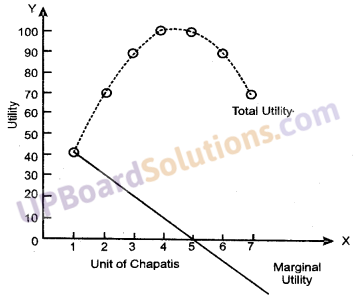
The relation between the total utility and marginal utility is deep. The total utility increases so long as the marginal utility is positive. The total utility is maximum when the marginal utility is zero. After this point, the (UPBoardSolutions.com) total utility begins to decrease and marginal utility is negative. This relationship between total and marginal utility is well explained through the following figure:
It can be exhibited with the help of the diagram given in figure.
UP Board Solutions for Class 10 Commerce Chapter 18 Utility, Marginal Utility, Total Utility

Question 2.
List the importance of Law of Diminishing Marginal Utility. (UP 2009)
Answer:
The law of diminishing marginal utility is considered as one of the basic laws of Economics.
The importance of the law can be explained as under:
1. Basis of the Law of Demand: The law of diminishing marginal utility provides the function for various laws of consumption. The law of demand which is a very important law of consumption is based on the law of diminishing marginal utility.

2. Basis of Equi-marginal Utility: The law of equity-marginal utility or the law of substitution is derived from the law of diminishing marginal utility. A consumer does not spend his total income on the purchase of one (UPBoardSolutions.com) commodity alone, instead, he spends it on different commodities in such a manner as to ensure that the marginal utility obtained from every commodity purchased is in the same relationship to price.

UP Board Solutions

3. Basis of Consumer’s Surplus: The utility derived by a consumer from each successive unit of a commodity goes on diminishing, though the price of the article remains unchanged. He stops his purchase at that point where the utility derived equals utility lost. Thus, the law of diminishing marginal utility is the basis of the concept of consumer’s surplus.

4. Indicates Relation between Standard of Living and Efficiency: The law of diminishing marginal utility helps us to understand the reason for a fall in the efficiency owing to a rise in the standard of living of the people.

5. Importance in the Field of Production: The law of substitution is based on the law of diminishing marginal utility. Accordingly, the factors of production can be substituted. The process of substitution is influenced by the prevailing prices of the factor of production. The dearer factors will be substituted by cheaper factors. The law of diminishing marginal utility will prove helpful to understand the law of substitution.

6. Theory of Taxation and Public Expenditure: Prof. Marshall utilized the law of diminishing marginal utility to build up his theory of taxation and public expenditure.

7. Public Finance: Modern governments follow the system of taxation so as to transfer the purchasing power from the richer sections of the society to the poorer section. This will help to achieve greater economic equity among the various sections of the society. Taxation and public expenditure is undertaken by the government are based on the law of diminishing marginal utility.

8. Importance in the Field of Exchange: When the supply of any commodity (UPBoardSolutions.com) increases, its marginal utility decreases and the prices also come down. The commodities which are supplied largely have no value-in-exchange. Thus, the law has considerable importance in the field of exchange.

UP Board Solutions

Question 3.
What are the assumptions of Law of Diminishing Marginal Utility? (UP 2009)
Answer:
The law of diminishing marginal utility is based on certain assumptions and any change in the assumptions would obstruct the operation of the Law. ‘Other things remaining the same’ signifies certain assumptions and conditions without which the law cannot operate. The law of diminishing marginal utility is based on the following important conditions or assumptions:

1. The Units of the Commodity must be Homogeneous: The first condition to be satisfied for the operation of the law is that units of the commodity must be similar in quality and quantity. Suppose, you give two oranges to (UPBoardSolutions.com) a hungry man to appease his hunger. The first orange which you gave him is a slightly damaged one while the second orange is a better one. Naturally, when the first orange was not tasty, he will derive more satisfaction from the second orange.

UP Board Solutions

Suppose, you give a third orange also, that would be the best of the three oranges; he may even derive more utility from its consumption than the other two oranges. If the units of the commodity are not similar in quality, the law of diminishing marginal utility will not operate. Similarly, the quantity of each unit must remain the same. If the first orange is very small in size while the second orange is double the size of the first orange, the law of diminishing marginal utility does not operate. Thus, if the units of the commodity are not alike in quality and size, the law may not operate.

2. The Process of Consumption should be Continuous: The second condition is that the period of consumption should be continuous and there should not arise any time-gap between consumption of the two units of the commodity. For example, (UPBoardSolutions.com) a person eats one chapati at 8 O’clock in the morning, the second chapati at 9 O’clock in the morning and the third chapati at 10 a.m. The law of diminishing marginal utility does not apply here because the period over which consumption is spread is not continuous and sufficient time interval given will obstruct the operation of the law. If the second chapati is taken immediately after the first chapati, the utility of the later will diminish.

3. The Price of the Commodity and its Substitutes should Remain the Same:
The price of the commodity should remain unchanged during the process of consumption. For instance, if the price of an article has reduced considerably consumers may want it with increased intensity and the desire to get more and more of that article will increase its utility. Therefore, the law of diminishing marginal utility will not operate as far as the commodity in question becomes cheap and one wants it with increased intensity.

The price of the substitutes should also remain the same for the operation of the law. If the cost of an article comes down, the demand for it will increase and it is natural to increase its utility also. If the price of the substitute of an article goes up, people start consuming the article in question and the utility of the article goes up, comparatively to that of the substitute. Thus, the (UPBoardSolutions.com) unchangeableness of the price of the article in question and the substitute thereof is very important for the operation of the law of diminishing marginal utility.

4. Taste, Habit, Fashion and Income of the Consumer should remain Unchanged: The law of diminishing marginal utility operates only if the taste, habit and income of the consumer do not change, in those cases where the period of consumption is long. For example, the particular design of a shirt which is not in fashion may yield only less utility to a person, but if the same shirt comes in fashion, its utility is liable to increase.

UP Board Solutions

5. Mental Approach: The mental outlook of the consumer should remain the same. Normally, a person who eats 5 chapatis should feel satisfied, and if he is forced to eat more, he will yield zero utility and later on negative utility. Suppose, he takes some intoxicants after eating 5 chapatis, he craves for more chapatis and subsequently its utility will increase rather than diminishing. Under such a situation the law does not work.

Question 4.
Explain the Law of Diminishing Marginal Utility in detail. (UP 2008)
Or
Explain the Law of Diminishing Marginal Utility with the help of a diagram. (UP 2011, 13)
Answer:
Law of Diminishing Marginal Utility: Law of Diminishing Marginal Utility states that as a person purchases more and more units of a commodity, its marginal utility diminishes. The more we have of a commodity, the less urgently we want its subsequent units and the utility of its succeeding units goes on diminishing. According to Prof. Marshall, “The additional benefit which a person derives from a given increase of the stock of a thing diminishes with every increase in the stock, which he already has.” This concept can be cleared from the following example:

A person who is hungry starts eating bread to satisfy his hunger. Suppose that he consumes 5 pieces of bread. The utility of the first bread will be great. The utility of second bread will not give him the same amount of utility as the first bread has already satisfied a part of his hunger. The second bread yields less satisfaction in comparison to the first bread. The third bread (UPBoardSolutions.com) will yield even less utility than the second bread. The satisfaction of the fourth bread will be less than that of the third and of the fifth will be less than that of the fourth. This way, the utility of each bread will go on diminishing with every successive bread. Ultimately he would reach a stage where his hunger is fully satisfied and the utility of next bread would come down to zero. If he is forced to take more, he will derive ‘negative utility’ or ‘disutility’.

UP Board Solutions

This example makes it clear that as a person gets more and more units of a commodity, the marginal utility derived from the successive units diminishes.

Tabular Representation: The following table illustrates the Law of Diminishing Marginal Utility as applied to the consumption of slices of bread:

Units
(Slices of bread)
Marginal Utility
(Units of satisfaction)
Total Utility
1 25 25
2 23 48
3 19 67
4 15 82
5 10 92
6 0 92
7 -12 80
8 -20 60

Marginal utility of bread till the 5th unit is positive if the consumer proceeds further to consume the 6th unit, marginal unit drops down to zero. After the zero points, utility becomes negative i.e., the 7th and 8th units give negative utility.
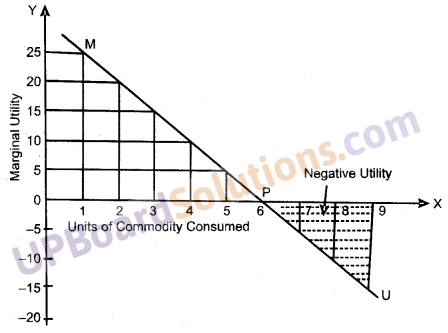
Diagrammatic Representation: The Law of Diminishing Marginal Utility can (UPBoardSolutions.com) be represented diagrammatically. The above illustration can be better understood with the help of the following diagram:

UP Board Solutions
UP Board Solutions for Class 10 Commerce Chapter 18 Utility, Marginal Utility, Total Utility
Along the OX-axis units of the commodity is represented and along the OY-axis marginal utility is measured. ‘MU’ is the marginal utility curve. This curve slopes downwards to the right because with every additional increase in the quantity of the commodity consumed, there is a decline in the marginal utility. At the 6th unit, the marginal utility drops down to zero. ‘P’ is (UPBoardSolutions.com) the point of satiety, and then it becomes negative. The dotted area below the OX-axis represents negative utility.

UP Board Solutions for Class 10 Commerce

UP Board Solutions for Class 10 Commerce Chapter 17 Indigenous Bankers

UP Board Solutions for Class 10 Commerce Chapter 17 Indigenous Bankers

Indigenous Bankers Objective Type Questions (1 Mark)

Question 1.
The indigenous bankers are more financially:
(a) Week
(b) Sound
(c) Strong
(d) None of these
Answer:
(b) Sound

Question 2.
Sahukars and Mahajans do not accept deposits from:
(a) People
(b) Bank
(c) Government
(d) None of these
Answer:
(a) People

UP Board Solutions

Question 3.
Indigenous bankers play a vital role in the ………….
(a) Agriculture
(b) Industry
(c) Urban areas
(d) Private Sector
Answer:
(a) Agriculture

Question 4.
The indigenous banker’s charge: (UP 2016)
(a) Lower rate of interest
(b) A reasonable rate of interest
(c) Higher rate of interest
(d) None of these
Answer:
(c) Higher rate of interest

Question 5.
The indigenous bankers are the oldest institution providing:
(a) Insurance Facilities
(b) Loans Facilities
(c) Locker’s Facilities
(d) Banking Facilities
Answer:
(d) Banking Facilities

UP Board Solutions

Indigenous Bankers Definite Answer Type Questions (1 Mark)

Question 1.
What is called indigenous hankers in Chennai (Madras)?
Answer:
Chetti.

Question 2.
Which bank does not accept small deposits?
Answer:
Modern Banks.

Question 3.
Which committee defines an indigenous banker or banks as an individual or private firm receiving deposits and dealing in hundis of lending money.
Answer:
The Indian Central Banking (UPBoardSolutions.com) Enquiry Committee.

UP Board Solutions

Indigenous Bankers Very Short Answer Type Questions (2 Marks)

Question 1.
Who is called a money-lender?
Answer:
Money-lender is also called Sahukars or Mahajans. Sahukars or Mahajans only provide loans to the borrowers. They do not accept any deposits from the people. These people utilise their own capital in granting loans (UPBoardSolutions.com) to people. Generally, Sahukars and Mahajans do other business along with this money lending business.

Question 2.
What is the meaning of indigenous bankers?
Answer:
Indigenous bankers are persons or institutions which provides the loan, discount hundis and accept deposits from the people. Their area of function is mostly in towns or big villages. The indigenous bankers also provide functional assistance to Sahukars and Mahajans.

Question 3.
Give any main functions of indigenous bankers.
Answer:

  1. The modern banks have not been able to extend their network in rural areas and the financial requirements of that area are met by indigenous bankers.
  2. Indigenous bankers issue and discount hundis. They also give (UPBoardSolutions.com) a loan on the basis of hundis.

UP Board Solutions

Question 4.
Write any four demerits of indigenous bankers. (UP 2019)
Answer:

  1. A high rate of interest
  2. Inadequacy of funds
  3. Fraudulent Practice
  4. Not efficient.

Indigenous Bankers Short Answer Type Questions (4 Marks)

Question 1.
Why indigenous bankers are important in India?
Answer:
The modern banks have their network mostly in the cities and the desired development of these banks in the rural areas has not been fulfilled. India, being a country of villages, its major population lives in villages. (UPBoardSolutions.com) The main business of villagers is agriculture. The financial needs of the agriculturists are met by the indigenous bankers and moneylenders because we do not have modern banks in. every village. It is estimated that 90% of the agricultural needs are met by indigenous bankers.

The Indian farmer, being poor, needs money after very short intervals. Sometimes they need money for seeds and fertilisers to pay revenue (Lagan) and also for their personal needs etc. Only indigenous bankers can give a loan at short intervals and without much paperwork. When the farmers sell their crops their financial position is good but after sometimes they have to depend on moneylenders or indigenous bankers for their financial needs. Thus, we can say that indigenous bankers play a vital role in the agriculture of (UPBoardSolutions.com) our country.

UP Board Solutions

Question 2.
Distinguish between indigenous bankers and money-lenders.
Answer:
Difference between indigenous bankers and money-lenders.

Indigenous Bankers Money-lenders
1. They do accept deposits from the people. 1. They do not accept deposits from the people.
2. They do business from the deposits accepted. 2. They do their business with their own capital.
3. They discount hundis. 3. They do not discount hundis.
4. The banking business is their primary business. 4. The banking business is not their primary business. They do this business along with other business.
5. The rate of interest charged by them is comparatively lower than money-lenders. 5. The rate of interest charged by them is higher than indigenous bankers.
6. They give huge loans only on security. 6. They give huge loans even without any security.
7. They generally give loan for agriculture, business and for small industries. 7. They generally give loan for personal needs and rarely give loans for production needs.

Question 3.
Distinguish between indigenous banks and commercial banks.
Answer:
Difference between indigenous banks and commercial banks.

Indigenous Banks Commercial Banks
1. The deposits with these bankers are very nominal. They generally do business with their own capital. 1. Major portion of their capital is formed by means of deposits. The success of these banks depends upon their deposits.
2. They do not provide the facility to withdraw money by cheque. 2. They provide the facility for making payment by cheque.
3. They do some other business along with banking business. 3. They only perform banking business.
4. They even give a loan without any security. 4. These banks do not give loan without proper security.
5. The rate of interest charged by them is high and keeps on changing. 5. The rate of interest is fixed and is comparatively lower than indigenous bankers.

UP Board Solutions

Indigenous Bankers Long Answer Type Questions (4 Marks)

Question 1.
Discuss the functions of indigenous bankers and also discuss its demerits. (UP 2013)
Or
Who are indigenous bankers? Briefly describe the demerits of indigenous bankers in India. (UP 2011)
Or
What are indigenous bankers? Mention its two defects. (UP 2012)
Answer:
Functions of Indigenous Bankers: Following are the main functions of indigenous bankers:

  1. Lending of Money: Lending of money is the foremost function of indigenous bankers. Money is lent without any security other than that of borrower’s own reliability. But in certain cases, security accepted by them is in the form of land, crops or ornaments.
  2. Acceptance of Deposits: Indigenous bankers accept both types of (UPBoardSolutions.com) deposits-short-term and long-term deposits, which are repayable either on-demand or after some fixed period.
  3. Dealing in Hundis: Indigenous bankers issue hundis to the traders and others for accommodation and remittance purpose. The function of discounting Hundis is also performed by them.
  4. Other Functions: Some of the other functions performed by Indigenous bankers are as follows:
    • They also perform the function of sending money from one place to another.
    • They also assist in the trade of import and export.
    • They also perform the trade of grains, gold, silver, clothes etc. They also invest money in speculation.

Demerits of Indigenous Bankers: Main drawbacks of these bankers are as below:

UP Board Solutions

  1. The rate of interest charged by indigenous bankers is very high. Because of charging of high rate of interest, the poor farmers are always exploited and their financial position does not improve.
  2. Indigenous bankers accept only nominal deposits from the public. For the purpose of granting the loan, they utilise their own capital. This policy of indigenous bankers retards the saving habit of those living in that area.
  3. In certain cases, it has come to light that the indigenous bankers indulge in fraudulent practices. They take the thumb impression of the uneducated farmers on a plain paper and then fill in more amount than actually given to them.
  4. No banking principles are followed by them, nor any book of account is maintained.
  5. There may be the cases that the farmers are unable to repay the loan and the interest (UPBoardSolutions.com) of indigenous bankers. In such a case, the bankers purchase the crops of the farmers at a very nominal rate.
  6. Indigenous bankers also satisfy the personal monetary needs of the villagers which develop the habit of extravagance and uneconomical expenditure.
  7. There is no control exercised by Reserve Bank of India upon indigenous bankers which develops inefficient management.

Question 2.
State the drawbacks of Indigenous Bankers.
Answer:
Drawbacks of Indigenous Bankers: The following are drawbacks of indigenous bankers.
1. High Rate of Interest: The indigenous bankers charge a higher rate of interest. Thus, the poor farmers are exploited by them.

2. Inadequacy of Funds: The indigenous bankers accept only nominal deposits from the public. They utilize only their own capital for providing loans. Thus, the people of that area do not develop the habit of saving. The demand of the farmer is more and the capital available with the indigenous bankers is less, which leads to high rate interest. Another problem is that the needs of all the farmers are not fulfilled.

3. Fraudulent Practice: indigenous bankers adopt fraudulent practices. They take the thumb impression of the uneducated farmers on a plain paper and then they fill more amount in it than actually given to them.

4. Lack of Sound Banking Principles: They do not adopt banking (UPBoardSolutions.com) principles and their books of accounts are not proper.

5. Nominal Payment for Crop: If the farmer is unable to repay the loan and the interest of indigenous bankers, then bankers purchase the crops of the farmers at a very nominal rate and sometimes they also take the land of the farmers at a very cheap rate.

UP Board Solutions

6. Advances for Consumption Needs: The indigenous bankers also give loan for personal needs which develop the habit of extravagance and uneconomical expenditures made by people. As the loan is easily available, the villagers spend a lot on marriages and other social customs etc.

7. No Control of Reserve Bank of India: The Reserve Bank of India has (UPBoardSolutions.com) no control over indigenous bankers because there is no such law by which Reserve Bank of India can exercise its control over them.

8. Legal Proceedings Against Farmers: When the loan is not repaid by the farmers, the indigenous bankers take legal action against them. The borrower has to spend a lot of money to defend himself against legal proceedings.

UP Board Solutions for Class 10 Commerce

Balaji Class 10 Maths Solutions Chapter 13 Surface Area and Volumes Ex 13.3

Balaji Class 10 Maths Solutions Chapter 13 Surface Area and Volumes Ex 13.3 पृष्ठीय क्षेत्रफल और आयतन

प्रश्न 1.
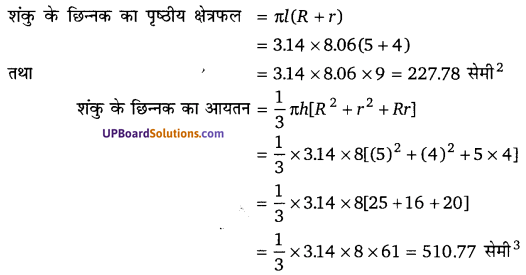
एक घर्षण वलय जो एक शंकु के छिन्नक के आकार का है, और इसके सिरों के व्यास क्रमशः 8 सेमी और 10 सेमी हैं तथा इसकी ऊँचाई 8 सेमी है। इसके पृष्ठीय क्षेत्रफल एवं आयतन ज्ञात कीजिए।
हलः
शंकु के छिन्नक के सिरों के व्यास (UPBoardSolutions.com) क्रमशः 8 सेमी और 10 सेमी
∴ R = [latex]\frac{10}{2}[/latex] = 5 सेमी, r = [latex]\frac{8}{2}[/latex] = 4 सेमी, ऊँचाई h = 8 सेमी
Balaji Class 10 Maths Solutions Chapter 13 Surface Area and Volumes Ex 13.3 2
Balaji Class 10 Maths Solutions Chapter 13 Surface Area and Volumes Ex 13.3 1
अतः छिन्नक का पृष्ठीय क्षेत्रफल = 227.78 सेमी2 तथा आयतन = 510.77 सेमी3

UP Board Solutions

प्रश्न 2.
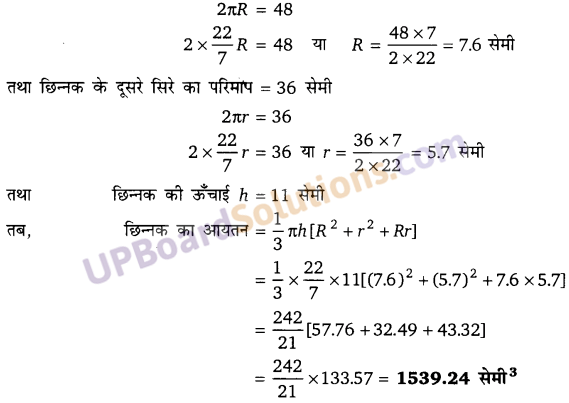
एक छिन्नक के सिरों के परिमाप 48 सेमी तथा 36 सेमी हैं। यदि इसकी ऊँचाई 11 सेमी है तो इसका आयतन ज्ञात कीजिए।
हलः
माना, छिन्नक के सिरों की त्रिज्यायें क्रमश: R सेमी और r सेमी है।
प्रश्नानुसार, छिन्नक के सिरे का परिमाप = 48 सेमी
Balaji Class 10 Maths Solutions Chapter 13 Surface Area and Volumes Ex 13.3 3

UP Board Solutions

प्रश्न 3.
6 सेमी ऊँचे एक छिन्नक के दोनों वृत्ताकार सिरों की त्रिज्याऐं क्रमश: 14 व 6 सेमी हैं। इसका वक्र पृष्ठीय क्षेत्रफल तथा कुल सम्पूर्ण पृष्ठीय क्षेत्रफल ज्ञात कीजिए।
हलः
छिन्नक के वृत्ताकार सिरों की त्रिज्यायें R = 14 सेमी, r = 6 सेमी
और छिन्नक की ऊँचाई h (UPBoardSolutions.com) = 6 सेमी
Balaji Class 10 Maths Solutions Chapter 13 Surface Area and Volumes Ex 13.3 4
अत: वक्र पृष्ठीय क्षेत्रफल = 628.57 सेमी2 तथा सम्पूर्ण पृष्ठीय क्षेत्रफल = 1357.71 सेमी2

UP Board Solutions

प्रश्न 4.
एक ठोस शंकु के छिन्नक के सिरों की त्रिज्याऐं क्रमशः 33 सेमी और 27 सेमी हैं। इसकी तिरछी ऊँचाई 10 सेमी है। इसका सम्पूर्ण पृष्ठीय क्षेत्रफल ज्ञात कीजिए।
हल:
R = 33 सेमी, r = 27 सेमी, l = 10 सेमी
छिन्नक का सम्पूर्ण पृष्ठीय क्षेत्रफल = I[R2 + r2 + l(R + r)]
= [latex]\frac{22}{7}[/latex][(33)2 + (27)2 + 10(33 + 27)]
= [latex]\frac{22}{7}[/latex] [1089 + 729 + 10 × 60]
= [latex]\frac{22}{7}[/latex] ×[1089 + 729 + 600]
= [latex]\frac{22}{7}[/latex] × 2418 = 7599.42 सेमी2

प्रश्न 5.
एक बाल्टी एक धातु के चादर की बनी है। इसका आकार शंक के छिन्नक के रूप का है, इसकी गहराई 24 सेमी है और इसके ऊपरी सिरे का व्यास तथा पेंदी का व्यास क्रमशः 30 सेमी तथा 10 सेमी हैं। तो उस दूध का मूल्य ज्ञात कीजिए जो इस बाल्टी को पूरा-पूरा भर सकता है। यदि दूध ₹ 20 प्रति लीटर की दर से मिलता हो और साथ ही धातु की चादरें जो बाल्टी बनाने में प्रयुक्त की गयी है, की कीमत ज्ञात कीजिए यदि चादरें ₹ 10 प्रति 100 वर्ग सेमी की दर से खरीदी गयी है।
हलः
बाल्टी के ऊपरी सिरे तथा पेंदी का (UPBoardSolutions.com) व्यास क्रमश: 30 सेमी तथा 10 सेमी
∴ R = [latex]\frac{30}{2}[/latex] = 15 सेमी, r = [latex]\frac{10}{2}[/latex] = 5 सेमी, गहराई h = 24 सेमी
Balaji Class 10 Maths Solutions Chapter 13 Surface Area and Volumes Ex 13.3 5

अतः दूध का मूल्य = ₹ 163.42 तथा चादर का मूल्य = ₹ 171.28

UP Board Solutions

प्रश्न 6.
दूध का एक बर्तन जिसकी ऊँचाई 18 सेमी है, छिन्नक के आकार का है। इसके ऊपरी तथा निचले सिरों की त्रिज्याऐं क्रमशः 8 व 32 सेमी हैं। इसको ₹ 20 प्रति लीटर की दर से भरने में कुल कितने दूध की आवश्यकता है?
हल:
R = 32 सेमी, r = 8 सेमी तथा ऊँचाई h = 18 सेमी (UPBoardSolutions.com)
छिन्नक के आकार के बर्तन का आयतन = [latex]\frac{1}{3}[/latex]πh[R2 + r2 + R.r]
= [latex]\frac{1}{3}[/latex] × [latex]\frac{22}{7}[/latex] × 18[(32)2 + (8)2 + 32 × 8]
= [latex]\frac{132}{7}[/latex][1024 + 64 + 256] = [latex]\frac{132}{7}[/latex] × 1344 = 25344 सेमी3
∵ 1 लीटर = 1000 घन सेमी
∴ [latex]\frac{25344}{1000}[/latex] = 25.34 लीटर
∵ 1 लीटर दूध का मूल्य = 120
∴ 25.34 लीटर दूध का मूल्य = 20 × 25.34 = ₹506.80
अतः दूध की आवश्यकता = 25:34 लीटर तथा दूध का मूल्य = ₹ 506.88

Balaji Publications Mathematics Class 10 Solutions