UP Board Solutions for Class 10 Commerce Chapter 14 Commercial Banks

UP Board Solutions for Class 10 Commerce Chapter 14 Commercial Banks

Commercial Banks Objective Type Questions (1 Mark)

Question 1.
The Head Office of Bank of Baroda is in:
(a) Madras
(b) Kanpur
(c) Mumbai
(d) Delhi
Answer:
(c) Mumbai

Question 2.
Canara Bank was established in the year:
(a) 1906
(b) 1910
(c) 1918
(d) 1924
Answer:
(a) 1906

UP Board Solutions

Question 3.
On 15th April 1980 Government of India nationalised banks. (UP 2016)
(a) 4
(b) 6
(c) 8
(d) 10
Answer:
(b) 6

Question 4.
The bank compares the signature of the customer on the withdrawal form with that in the ……….
(a) Pass Book
(b) Cash Book
(c) Bank Autograph Book
(d) None of these
Answer:
(c) Bank Autograph Book

Question 5.
If the customers want to withdraw the fixed deposit money before …….. days, no interest will be given.
(a) 40
(b) 42
(c) 44
(d) 46
Answer:
(d) 46

UP Board Solutions

Commercial Banks Definite Answer Type Questions (1 Mark)

Question 1.
When fourteen Commercial Banks of India were nationalised?
Answer:
19th July 1969.

Question 2.
On 15th April 1980 how many banks were nationalised?
Answer:
Six.

Question 3.
For which class of people Current Account is beneficial?
Answer:
Businessmen.

Question 4.
In India how many banks were nationalised in the beginning?
Answer:
14.

UP Board Solutions

Commercial Banks Very Short Answer Type Questions (2 Marks)

Question 1.
What is a Commercial Bank?
Answer:
In India, the term ‘Commercial Banks’ refers to these banks which have been established under the provisions of Indian Companies Act, 1913. Sometimes, these banks are referred to as (UPBoardSolutions.com) Joint Stock Banks. Commercial Banks as the banks which finance the trade and industry of the country by arranging short term credit facilities.

Question 2.
What is a Pay-in-slip book?
Answer:
Pay-in-slip books used for depositing cash and cheques in the bank. The book consists of 10, 20 or 30 slips. The slip has two parts-original and counterfoil. The details of cash or cheque are entered in the slip as well as in the counterfoil and are sent to the bank. The clerk concerned checks the details and accepts the cash or cheque. Then he stamps the counterfoil and puts his signature on it. The original part of pay in slip remains with the bank. Generally, different pay in slips is used for depositing cheques and cash. They are different in colour.

Question 3.
What is a cheque book?
Answer:
Cheque Book: Bank provides a Cheque Book to every holder of Current Account. The number of forms in a cheque book varies from 10 to 100. The cheque book has two parts— counterfoil, which remains with the account holder and forms, which are issued for payments or for withdrawing money from the bank. All the details are filled in the form is given for withdrawing (UPBoardSolutions.com) or in settlement of some dues. Cheque book is an important document and it should be kept properly. In case it is lost, the bank should be intimated immediately.

UP Board Solutions

Question 4.
What is a passbook?
Answer:
Pass Book: Pass Book is a copy of the account maintained by the bank in its books. All the transactions whether debit or credit are likewise written in it. Generally, the passbook should be sent every month to the bank for completion of entries. If there is any mistake in the passbook, it should be immediately rectified.

Commercial Banks Short Answer Type Questions (4 Marks)

Question 1.
Write a short note on the Fixed Deposit Account.
Answer:
The term fixed deposit means deposits repayable after the expiry of a certain period which ordinarily varies from one year to five years. The rate of interest is higher in a fixed deposit account in comparison to other deposits, the rate of interest also depends upon the period of fixed deposits. The longer the period during which the money is to remain with the (UPBoardSolutions.com) banker, the higher is the rate of interest. The bankers occasionally allow their customers to withdraw their fixed deposits before their due dates but in such cases, the customers have to forego their accrued interest.

The fixed deposit account is generally opened by those persons who do not have any other source of profitable investment. The persons who have excess money and which is not required by them in the near future open this type of account. The depositor can also borrow money against the security of fixed deposit.

UP Board Solutions

Question 2.
What is Cash Credit?
Answer:
Cash credit is an arrangement by which a banker allows his customer to borrow money up to a certain limit against either a bond of credit by one or more sureties or certain other security. The bank does not give the entire loan at one particular time. What the bank does is that it opens the account in the name of the debtor and allows him to withdraw the money from time to time (UPBoardSolutions.com) up to a certain limit determined by the value of the stocks kept in the debtor’s godown.

The godown remains in the possession of the bank. The debtor continues to withdraw small sums of money according to his requirements, but he cannot exceed the credit limit allowed to him. The bank, however, charges interest only on the amount withdrawn from the account. This type of loan is very popular with the Indian Businessmen.

Question 3.
Write in short about the savings bank account.
Answer:
Saving Bank Account is meant for the middle class and low-class income group persons. The motive of this account is to establish the habit of savings amongst these people. The bank also provides a cheque facility to the Savings Bank Account holder, but there should always be a minimum balance of Rs. 300 in the account.

UP Board Solutions

In this account, the depositor can withdraw and deposit money once in a day. Thus, it is suited to those who want to deposit their small savings in a bank, which they need to withdraw only casually, and not every now and then. The interest allowed on Saving Bank Deposit is lower than given of Fixed Deposit but higher than that given on Current Account. It is calculated on the lowest balance kept during the month.

Question 4.
What do you understand by home saving safe account?
Answer:
Home Safe Deposit Account is a very good means of encouraging thrift among persons having small income or among children. A person wishing to open an account has to give an application to the bank. After completion of all the formalities, the bank supplies a safe to the depositor, which he keeps with himself and in which he drops his small savings from time to time.

Periodically the safe is taken to the bank where it is opened and the proceeds (UPBoardSolutions.com) are credited to the account of the depositor. Such accounts carry only a very small rate of interest. The bank also provides withdrawal facility on this account but only after a certain amount has been deposited in the account.

Commercial Banks Long Answer Type Questions (8 Marks)

Question 1.
What do you mean by Commercial Bank? Discuss the services being rendered by Commercial Banks to its customers nowadays.
Or
Briefly describe the functions of Commercial Banks. (UP 2011, 12)
Or
Describe the functions of commercial banks. (UP 2019)
Answer:
In simple words, Commercial Banks are those which finance the trade and industry of the country by arranging short-term credit facilities.
According to the Indian Companies Act, 1913, “Commercial Banks are Joint Stock Banks which provide short-term loans for trade and industry of the country.” The main object of these banks is to provide credit to the internal trade (UPBoardSolutions.com) of the country, for which they accept deposits from the public. Commercial Banks do not provide fixed or long-term capital for trade or industries.

The functions of Commercial Banks are the following:
1. Acceptance of Deposits: The bank accepts the following types of deposits from the public:

Fixed Deposit Account: The term fixed deposit means deposits repayable after the expiry of a certain period which ordinarily varies from one year to five years. The rate of interest is higher in the fixed deposit account in comparison to other deposits. Money can also be borrowed against the security of fixed deposit.

UP Board Solutions

Current Account: This account is generally opened by businessmen. Under this account, the customer can deposit or withdraw money as and when he likes. No Interest is allowed by first-class banks on such accounts.

Saving Bank Account: Such account is meant for the middle class and low-class income group persons. The main objective of such account is to develop the habit of savings. When these small savings are pooled, it forms a large capital which can be used for the economic growth of the country.

Home Safe Deposit Account: Such account is a very good means of encouraging thrift among persons having small income or among children. These accounts carry only a very small rate of interest.

Recurring Deposit Account: Any person can open this account in his personal name or joint names and in case of minor under the guardianship of someone. The term of account depends upon the wish of the account (UPBoardSolutions.com) holder, which varies from 1 year to 7 years. The amount to be deposited every month in the account should be Rs. 10 or in multiples thereof but to a maximum limit of Rs. 500 per month.

2. Lending of money: Lending of money in the form of loans and advances is another important function of the banks. The various types of loans and advances are as follows:

  • Ordinary loans
  • Overdraft
  • Cash Credits
  • Acceptance of bills
  • Discounting of bills
  • Loans at call and short notice.

UP Board Solutions

The advances made by Indian banks are against the following securities:

  • Personal credit
  • Against valuable marketable securities
  • Against precious documents.

3. Agency Functions: The various agency functions rendered by the bank are as follows:

  • Collection of payments of cheques, bills of exchange, hundis etc.
  • Payment of insurance premium, income tax, hundis, bills of exchange etc.
  • Collecting dividends, interests etc. of the customers.
  • Sale and purchase of shares and (UPBoardSolutions.com) securities for its customers.
  • Transfer of funds from place to place.
  • The bank acts as the Trustee and Executor.

4. Other Functions. Other functions performed by the bank are as follows:

  • Safe custody of valuable goods such as gold and silver ornaments, important papers, shares and debentures.
  • Issuing of traveller’s cheques.
  • Giving information about its customers.
  • Collection of statistics.
  • The bank also provides short-term loans to the farmers. The amount given is meant for purchasing of fertilisers, pesticides, electricity expenses etc.
  • Transfer of funds from place to place.
  • The bank acts as the Trustee and Executor.

5. Other Functions. Other functions performed by the bank are as follows:

  • Safe custody of valuable goods such as gold and silver ornaments, important papers, shares and debentures.
  • Issuing of travellers’ cheques.
  • Giving information about its customers.
  • Collection of statistics.
  • The bank also provides short-term loans to the farmers. The amount given is meant for purchasing of fertilisers, pesticides, electricity expenses etc.

UP Board Solutions

Question 2.
Write the advantages of Bank Nationalization. (UP 2008, 11)
Answer:
Advantages of Bank Nationalization: The advantages of Bank Nationalization are as follows:
1. The utilisation of Bank Credit in National Interest: If the banks are allowed to be operated by private individuals, then the bank credit shall not be used in the interests of the nation. On the contrary, the bank credit will be utilised in the interests of those individuals who control the banks.

2. Business Fluctuations can be Checked: As is well known, a capitalist economy is all the time afflicted by business fluctuations. The slump and the boom follow each other at regular intervals. These fluctuations (UPBoardSolutions.com) cause untold harm to the economy of the country. The government can keep effective control, only if the banks are fully nationalised.

3. Inter-bank Competition can be Ended: There is at present going on wasteful competition among Indian banks which benefit no one. If all the banks are nationalised, this wasteful competition will automatically come to an end.

4. The utilisation of Bank Profits in National Interest: If the banks operate under private management, the profits will surely be utilised in the interests of those individuals who manage and control the banks. If, on the contrary, the banks are nationalised, their profits will be utilised in the national interest.

5. Development of Specialised Banks: There is at present acute shortage of agricultural, industrial and Indian foreign exchange banks in the country. If the entire banking industry is nationalised, the government will surely take steps to develop specialised banking institutions in the. country.

6. Improvement in Efficiency: The government banks in view of their vast resources are able to attract competent, trained and experienced staff more effectively than the private banks. Consequently, the level of operational efficiency is bound to be higher in government banks in comparison to private banks.

7. Balanced Growth of Banks: At present, the private banks operate only in those areas where they get good business, hence, generally all the banks are in towns and big cities. With the nationalisation of banks, the government will open the branches in those areas which do not have banking facilities. In this way, by nationalising the banks, they would have balanced growth.

8. Curb on Corruptions: Many businessmen violate the foreign exchange rules with the consent of the banks. They increase the value of the export invoice and decrease the value of the import invoice. Many (UPBoardSolutions.com) banks give loan to their directors on the nominal rate of interest. Sometimes these banks provide indirect benefits to their directors, such as—foreign tours on bank expenses, free accommodation etc. All these malpractices can be abolished by nationalising the banks.

UP Board Solutions

9. Abolition of Foreign Banks: The foreign banks held a dominant position in the Indian banking system. They almost controlled the foreign exchange business of the country as well as they competed with the Indian banks. These foreign banks used our capital for the welfare of their country and not for ours. They also remitted a large portion of their profits to their respective countries. All these problems could be solved by the nationalisation of banks.

10. Economic Growth of the Country: By nationalising the banks, the full banking structure will function for the benefit of the country. The same has been proved by the State Bank and Reserve Bank. They functioned in the national interest after they were nationalised. Both the banks provided credit facilities in rural areas, and now, the deposits received by the nationalised banks are being used (UPBoardSolutions.com) for the economic growth of the country.

Question 3.
Point out the differences between the Central Bank and Commercial Bank. (UP 2009)
Answer:
Difference between Central Bank and Commercial Bank

UP Board Solutions

Central Bank Commercial Banks
1. This is Banker’s Bank, thus controls all the banking functions of the country. 1. Commercial Bank is a part of the banking function and is controlled by Central Bank.
2. Its motive is not to earn profit but to provide banking facilities. 2. Its motive is to earn profits.
3. It works as Government’s Banker, so the government provides many special facilities to the bank.lt has the monopoly of Note Issue. 3. They work as the bankers (UPBoardSolutions.com) of the general public and the Government does not provide any special facilities to them.
4. It grants loans to other banks of the country if they are in need of it. 4. They do not have the power of issuing the notes.
5. It manages the government’s reserve and provides security. 5. They get a loan from Central Bank when they are in need of it. They do not have any relation with government reserves.

UP Board Solutions for Class 10 Commerce

UP Board Solutions for Class 10 Commerce Chapter 13 State Bank of India

UP Board Solutions for Class 10 Commerce Chapter 13 State Bank of India

State Bank of India Objective Type Questions (1 Mark)

Question 1.
The head office of State Bank of India is in:
(a) Calcutta
(b) Delhi
(c) Mumbai
(d) Agra
Answer:
(c) Mumbai

Question 2.
Prior to the State Bank of India coming into being it was known as:
(a) Central Bank of India
(b) State Bank of India
(c) Reserve Bank of India
(d) Imperial Bank of India
Answer:
(d) Imperial Bank of India

Question 3.
State Bank of India came into existence on:
(a) 1st July 1955
(b) 1st April 1955
(c) 1st June 1955
(d) 1st Sept 1955
Answer:
(b) 1st April 1955

UP Board Solutions

Question 4.
State Bank can grant loans to industries against their assets for a period of…….. years.
(a) 7
(b) 8
(c) 9
(d) 10
Answer:
(a) 7

Question 5.
There are ………….. Regional Offices of State Bank of India:
(a) 10
(b) 11
(c) 12
(d) 13
Answer:
(c) 12

UP Board Solutions

State Bank of India Definite Answer Type Questions (1 Mark)

Question 1.
What was the name of State Bank of India before the nationalisation?
Answer:
Imperial Bank.

Question 2.
In which year the State Bank of India was established?
Answer:
1st July 1955.

State Bank of India Very Short Answer Type Questions (2 Marks)

Question 1.
Give two functions of State Bank of India.
Answer:
Functions of State Bank of India are as follows:

  • It collects money from the public (UPBoardSolutions.com) on behalf of the Government and also makes payments in accordance with its instructions.
  • The Bank also manages the public debt of the Central and the State Governments.

UP Board Solutions

Question 2.
Give two prohibited functions of State Bank of India.
Answer:
Prohibited Functions of State Bank of India:

  • The State Bank of India cannot re-discount those bills which do not carry at least two signatures of reputable persons.
  • The State Bank of India can neither discount (UPBoardSolutions.com) bills nor extend credit to individuals or firms above the sanctioned limit.

State Bank of India Short Answer Type Questions (4 Marks)

Question 1.
Give the main achievement of State Bank of India.
Answer:
Achievement of State Bank of India are as follows:

  • The major credit for the development of banking facilities in the country during the past few years belongs to the State Bank of India.
  • The capital and other reserves of the State Bank of India was more than 1000 crores in the year 1990-91.
  • The State Bank of India group has rendered a valuable service by opening most of its branches in rural areas of the country. More than 75% of branches are in rural areas and small towns.
  • The number of villages adopted by the bank stood at 56,405 with a quantum of credit to the tune of Rs. 905 crores covering 23.6 lacs farmers in 1984.
  • The State Bank of India opened agricultural development branches with adequate technical expertise to help the farmers for agricultural development. The number of such branches stood at 432 (UPBoardSolutions.com) by the end of 1984 with outstanding advances amounting to Rs. 641 crores covering 16.8 lacs farmers.
  • By the end of 1984, the bank’s advances to landless labourers, tenant farmers and sharecroppers accounted for 38% of the bank’s direct agricultural advance.
  • The bank had advanced a sum of Rs. 1,737 crores to 4.7 lacs small scale industrial establishments up to Dec. 31, 1984.

UP Board Solutions

Question 2.
What are the functions of the State Bank of India as a Commercial Bank?
Answer:
The functions of the State Bank of India as a Commercial Bank are as follows:

  • The advancing and lending of money and opening of Cash Credit Account.
  • Providing credit facilities for trade, industries and commerce of the country.
  • Promotion of savings in rural areas.
  • Providing facilities to Rural Credit Commission, co-operative selling and for godowns.
  • The receiving of deposits and keeping cash account.
  • The buying and selling of gold.
  • The receiving of all kinds of bonds, scripts, title deeds or valuables for safe custody.
  • The drawing, accepting, discounting, buying, (UPBoardSolutions.com) selling of bills of exchange and other negotiable securities.

State Bank of India Long Answer Type Questions (8 Marks)

Question 1.
Discuss the objectives and achievements of the State Bank of India. (UP 2008, 09, 13, 15)
Or
Describe the objectives of the establishment and functions of the State Bank of India. (UP 2011)
Answer:
Objectives of State Bank of India. The State Bank of India was started with the following objectives:

  1. To establish a strong banking network, so as to serve the people of the country more efficiently.
  2. To provide adequate banking facilities to rural people, because there were negligible banking facilities in villages.
  3. To provide more and convenient credit facilities for the agricultural sector.
  4. To provide financial assistance to small scale sector for their development, so that the overall economy of the country also improves.
  5. To encourage and mobilize small savings and to develop a habit of thrift among villagers and people of small and low-income group.
  6. To provide financial assistance to warehousing schemes for more storage facilities for agricultural products.
  7. To give necessary financial assistance to the weaker sections of the (UPBoardSolutions.com) society, so that they become self-supporting and contribute to the economic prosperity of the country.
  8. To help in the transfer of funds from one place to another as per the requirements of different agencies.
  9. To assist the Reserve Bank of India in implementing the monetary and credit policies in the country.

UP Board Solutions

Achievements of State Bank of India: Following are the achievements of State Bank of India:

  1. The major credit for the development of banking facilities in the country during the past few years belongs to the State Bank of India. In 1993, the total.number of branches of the State Bank of India was 8,738 and that of subsidiary banks 4,317. The total number of branches of the State Bank of India group was thus 13055 in 1993.
  2. The capital and other reserves of the State Bank of India was more than 1000 crores in the year 1990-91.
  3. The State Bank of India group has rendered a valuable service by opening most of its branches in rural areas of the country. More than 75% of branches are in rural areas and small towns.
  4. The number of villages adopted by the bank stood at 56,405 with a quantum of credit to the tune of Rs. 905 crores covering 23.6 lacs farmers in 1984.
  5. The State Bank of India opened agricultural development branches with adequate technical expertise to help the farmers for agricultural development. The number of such branches stood at 432 by the end of 1984 with outstanding advances amounting to Rs. 641 crores covering 16.8 lacs farmers.
  6. By the end of 1984, the bank’s advances to landless labourers, tenant farmers, and sharecroppers accounted for 38% of the bank’s direct agricultural advance.
  7. The bank had advanced a sum of Rs. 1,737 crores to 4.7 lacs (UPBoardSolutions.com) small scale industrial establishments up to Dec. 31, 1984.
  8. The State Bank has also extended credit to the weaker sections of the community like tribals, Harijans, persons who are socially handicapped, and disabled, orphans, slum dwellers etc. By the end of 1984, the bank had assisted 3.1 lakh persons under various innovative banking schemes and the total outstanding stood at Rs. 33 crores.

From the above discussion, it is clear that the establishment of the State Bank of India was an important event in the history of Indian banking. State Bank of India has helped in overcoming the problem of rural credit to a certain extent. With over 13,000 branches, it is evident that the State Bank of India has become a powerful organisation in the Indian banking system besides having offices even in other countries like America and Germany.

The State Bank of India has helped a lot in the prosperity of our rural areas by providing facilities for agriculturist, weaker sections of the society and cottage and small scale industries, etc. By opening its branches in rural areas it has developed the habit of saving among the residents of rural areas. Another important function of the State Bank of India is its functioning as an agent of the State Bank of India. In fact, it is very difficult for the Reserve Bank of India to open its branches in each and every place and so where there are no branches of Reserve Bank of India, the State Bank of India performs its functions. An eminent scholar has rightly remarked, “If the Reserve Bank of India is the garden of our banking system, the State Bank of India is its Gardner.”

UP Board Solutions

Question 2.
Describe the functions of State Bank of India. (UP 2009, 17)
Answer:
State Bank, being a commercial bank, performs all the functions of a commercial bank. In those areas where Reserve Bank does not have its own branches, State Bank acts as the agent of Reserve Bank. In this manner, State Bank, besides functioning as a commercial bank, also performs certain central banking functions, which are as below:

  1. It collects money from the public on behalf of the Government and also makes payments in accordance with its instructions.
  2. The bank also manages public debts of the Central and (UPBoardSolutions.com) the State Governments.
  3. It receives deposits from the Commercial Banks and also gives loans to them on demand.
  4. The State Bank of India re-discounts the bills of the Commercial Banks.
  5. It also acts as the Clearing House.

UP Board Solutions

The State Bank of India performs all the functions of a Commercial Bank. Besides these functions, the State Bank of India also provides facilities for improving rural credit. The functions of State Bank of India are:

  1. The advancing and lending of money and opening of Cash Credit Account.
  2. Providing credit facilities for trade, industries and commerce of the country.
  3. Promotion of savings in rural areas.
  4. Providing facilities of Rural Credit Commission, co-operative selling and for godowns.
  5. The receiving of deposits and keeping cash account.
  6. The buying and selling of gold.
  7. The receiving of all kinds of bonds, scripts, title deeds and valuables for safe custody.
  8. The drawings, accepting, discounting, buying, selling of Bills of Exchange and other negotiable securities.
  9. The drawing of Bills of Exchange and granting of letters of credit payable out of India.
  10. The borrowing of money for the purpose of the business (UPBoardSolutions.com) of the State Bank of India and the giving of securities for money so borrowed.
  11. Acting as an agent of any Co-operative Bank which is registered under the law in force.
  12. The underwriting of the issue of any stocks, shares, debentures or other securities in which State Bank of India is authorised to invest its funds.
  13. The buying of Bills of Exchange payable out of India, not exceeding 15 months in case of bills relating to the financing of seasonal agricultural operations and 6 months in any other case.

UP Board Solutions for Class 10 Commerce

UP Board Solutions for Class 10 Commerce Chapter 12 Central Bank: Reserve Bank of India

UP Board Solutions for Class 10 Commerce Chapter 12 Central Bank: Reserve Bank of India

Central Bank: Reserve Bank of India Objective Type Questions (1 Mark)

Question 1.
Reserve Bank of India is the:
(a) Commercial Bank of India
(b) Foreign Exchange Bank of India
(c) Central Bank of India
(d) Rural Bank of Indian
Answer:
(c) Central Bank of India

Question 2.
The main object of the Reserve Bank of India is to stabilise:
(a) Exchange Rates and Internal Prices
(b) Issuing Notes
(c) Credit Control
(d) None of these
Answer:
(a) Exchange Rates and Internal Prices

UP Board Solutions

Question 3.
The Reserve Bank Act was passed in:
(a) 1929
(b) 1930
(c) 1931
(d)1932
Answer:
(a) 1929

Question 4.
NACSF set-up in
(a) 1950
(b) 1952
(c) 1954
(d) 1956
Answer:
(d) 1956

Question 5.
Reserve Bank started functioning from …….
(a) 1st April 1932
(b) 1st April 1935
(c) 1st January 1932
(d) 1st January 1935
Answer:
(b) 1st April 1935

Central Bank: Reserve Bank of India Definite Answer Type Questions (1 Mark)

Question 1.
Name the factors in which economic development of the country depends.
Answer:
Effective control of money and credit.

Question 2.
Write the name of the banker of the banks. (UP 2013)
Answer:
Reserve Bank (UPBoardSolutions.com) of India.

UP Board Solutions

Question 3.
In which year Reserve Bank of India started issuing notes with a monopoly?
Answer:
1st April 1935.

Question 4.
In which year Reserve Bank of India was nationalised? (UP 2015)
Answer:
1948.

Question 5.
Write the name of representative bank of Reserve Bank of India. (UP 2015)
Answer:
State Bank of India.

UP Board Solutions

Central Bank: Reserve Bank of India Very Short Answer Type Questions (2 Marks)

Question 1.
Point out two main functions of the Reserve Bank of India. (UP 2019)
Answer:

  • Issue of notes
  • Sale and purchase of foreign exchange.

Question 2.
What is a Scheduled Bank?
Answer:
A Scheduled Bank is one which satisfies the following conditions:

  • Its paid-up capital and reserve should not be less than Rs. 5 lacs.
  • Its policy should not be (UPBoardSolutions.com) contrary to the interest of the depositors.

Question 3.
Give two characteristics of Reserve Bank of India.
Answer:
The main characteristics of Central Bank are as follows:

  • They are not primarily profit-seeking enterprise.
  • They are subject to close control and participation by the national government.

UP Board Solutions

Question 4.
What is Non-Scheduled Bank?
Answer:
The non-scheduled banks are those banks which are not included in the second schedule of Reserve Bank of India Act. These banks are generally small local banks whose paid-up capital and reserves (UPBoardSolutions.com) are less than Rs. 5 lacs. These banks have to keep a certain percentage of their deposits with the Reserve Bank of India in the form of cash reserve. The Reserve Bank of India provides all the facilities to these banks also, which it provides to Scheduled Banks.

Question 5.
Give two main central banking functions of Reserve Bank of India.
Answer:
Two main central banking functions of the Reserve Bank of India are as follows:

  • Issue of Notes.
  • Sale and Purchase of Foreign Exchange.

UP Board Solutions

Central Bank: Reserve Bank of India Short Answer Type Questions (4 Marks)

Question 1.
Distinguish between Central Bank and Commercial Banks.
Answer:
Difference between Central Bank and Commercial Banks.

Central Bank Commercial Banks
1. This is Banker’s Bank. This controls all the banking functions of the country. 1. Commercial Bank is a part of the banking function and is controlled by Central Bank.
2. Its motive is not to earn profit but to provide banking facilities. 2. Its motive is to earn profits.
3. Its works as Government’s banker, so the government provides many special facilities to the bank. 3. They work as the bankers of the general public and the Government does not provide any special facilities to them.
4. It has the monopoly of Note-Issue. 4. They do not have the power of issuing the notes.
5. It grants loans to other banks of the country if they are in need of it. 5. They get loan from Central Bank when they are in need of it.
6. It manages the government’s reserve and provides security. 6. They do not have any relation with government reserves.

Question 2.
Give four prohibited functions of Reserve Bank of India.
Answer:
Prohibited functions of Reserve Bank of India are as follows:

  1. The Reserve Bank of India can neither buy its own shares nor can it buy shares of other banks or commercial firms.
  2. The Reserve Bank of India cannot buy immoral (UPBoardSolutions.com) prosperity, barring its own premises, nor can it grant loans against the securities of any such immovable property.
  3. The Reserve Bank of India cannot grant a loan to any party without proper security.
  4. The Reserve Bank of India cannot give interest to its depositors on their deposits.

UP Board Solutions

Central Bank: Reserve Bank of India Long Answer Type Questions (8 Marks)

Question 1.
What do you understand by the Central Bank? Discuss the main functions of the Reserve Bank of India. (UP 2009, 13)
Or
Describe the functions of Reserve Bank of India as a Central Bank of India. (UP 2011, 18)
Or
Write two main functions of the Reserve Bank of India. (UP 2012, 14)
Answer:
Central Bank: The Central Bank is an institution which is charged with the responsibility of managing the expansion and contraction of the volume of money in the interest of general public welfare. This is the apex bank in the banking system of any country normally assigned with the responsibility of issuing notes and also with the supervision of the banking system.
Functions of the Reserve Bank of India: In India, the Central Bank, the Reserve Bank of India performs the following functions:

  • Central Banking Functions,
  • General Banking Functions.

Central Banking Functions: The following are some of the central banking functions of Reserve Bank of India:

1. Issue of Notes: The Reserve Bank of India has been given the monopoly of the issue of banknotes from 1st April 1935. The bank has the power to issue notes of Rs. 2, Rs. 5, Rs. 10, Rs. 20, Rs. 50, Rs. 100, Rs. 500 and Rs. 1,000. Notes of Re. 1 are issued by the Government of India. The Re. 1 notes are issued as a subsidiary to Re. 1 coins.

2. Banker’s Bank: Reserve Bank is called banker’s bank because it provides services and facilities to other banks in a similar manner as a commercial bank provides services and facilities to the general public. The banks which are affiliated to the Reserve Bank may get a loan from it at the time of need. It re- discounts their bills and provides help at the time of need.

3. Government’s Banker: The Reserve Bank also acts as a banker to the central and State Governments by keeping their money. It also carries out their exchange remittance and other banking operations, besides managing public debt. The bank also transfers the reserve from one place to another, makes payments according to the instructions provided by (UPBoardSolutions.com) the Government and accepts deposits on their behalf. The bank also engages itself in floating loan treasury bills on behalf of the Central and State Governments.

UP Board Solutions

4. Sale and Purchase of Foreign Exchange: Sale and purchase of foreign exchange is very important function of the Reserve Bank whereby it assists in the smooth flow of foreign trade.

5. Credit Control: Monetary system of the country is stabilised through credit control which is very essential for the prosperity of the trade and industry of the country. The Reserve Bank expands and contracts credit according to the need of the country.

6. Clearing House Facility: The Reserve Bank acts as Clearing House for commercial banks. Transactions of member banks are settled through this facility of the clearinghouse. All the banks maintain their accounts with the Reserve Bank. These banks do not pay off their liabilities in cash. All the claims and counterclaims are settled with the minimum use of cash. The representatives of various banks meet each other every day at Clearing House and exchange their credit documents to settle their accounts.

General Banking Functions: The Reserve Bank of India, in addition to its Central Banking functions, also performs following general banking functions:

  1. The Reserve Bank of India accepts deposits from the Government of India and the State Governments but it pays no interest on such deposits.
  2. The Reserve Bank of India re-discounts the commercial bills and promissory notes tendered by the Scheduled Banks.
  3. The bank gives loans to its member banks for a maximum period of 90 days.
  4. The Reserve Bank of India can borrow from any Scheduled Bank or Foreign Bank for a period not exceeding 30 days.
  5. The Reserve Bank of India can buy and sell securities of Central and State Governments.
  6. The Reserve Bank of India can keep in custody gold, silver, diamonds and other securities etc. for safety purposes.
  7. The bank can open its account with Central Bank of other (UPBoardSolutions.com) countries or with International Bank.
  8. The Reserve Bank of India arranges for Industrial Finance.
  9. The Reserve Bank of India controls credit in the country.
  10. The Reserve Bank of India can borrow from the Central Government or State Governments for a period not exceeding 90 days.

Question 2.
Give the main characteristics of Reserve Bank of India. (UP 2009)
Answer:
Characteristics of Reserve Bank of India: Reserve Bank of India has the following two characteristics:
1. Non-Profit Seeking Enterprise: The motive of Central Bank is not to earn profit as in the case of other Commercial Banks and business organizations. The Central Bank has to work for the benefit of the country whether it gains or loss. When the government is not the owner of Central Bank, then the dividend which is to be paid to shareholders is fixed by law so that the bank does not indulge in any activity which is unhealthy for the country for earning more profits.

2. Control and Participation of the Government: The main object of the government is to make the life of its citizens happy. The economic development of a country depends upon the principles of the government. For (UPBoardSolutions.com) every scheme of welfare and development, proper economic management is required. For achieving the desired results of these objects there has to be cooperation and coordination between the government and the Central Bank.

UP Board Solutions

Another important object of Central Bank is to control the monetary and credit system of the country. Now almost all the countries have nationalised Central Banks because it is possible that proper co-ordination and co-operation between the government and Central Bank may lack if a Central Bank is an independent organisation.

Question 3.
How the Reserve Bank of India was originated? Explain.
Answer:
Origin of Reserve Bank of India: In the year 1921, Imperial Bank of India was established by the Government. Main functions of Imperial Bank involved banker to the government and the banker’s bank, besides functioning as a commercial bank. Still, there was a general feeling that it lacked in certain respects because of which it could not be called as Central Bank in the proper way.

Certain drawbacks of Imperial Bank were as follows:

  1. Monetary system prevailing in the country lacked elasticity as the power of issuing notes was not conferred on the Imperial Bank. The power of issuing the notes was the sole prerogative of the Government of India.
  2. Though the Bank functioned as banker’s bank and the banker to the (UPBoardSolutions.com) Government, it also functioned as commercial bank used to compete with other commercial banks.
  3. Imperial Bank did not exercise any control over money and credit as all the banks used to keep their own reserves.
  4. No power was vested in the Imperial Bank to make arrangement for finances for foreign trade.

UP Board Solutions

No commendable success could be achieved by the Imperial Bank in its functioning as Central Bank of the country. In the year 1925, Hilton Young Commission was asked by the Government of India to express its views on the subject. The Commission opined in favour of the establishment of a new Central Bank for the country. Without exercising any function in the nature of a commercial bank.

Pursuant to this, the government of India introduced a bill, but it could not be passed on account of differences amongst the Members of Legislature. In the year 1929, again a plea was raised by the Central Banking Enquiry (UPBoardSolutions.com) Committee, supporting the establishment of Reserve Bank. Finally, the Reserve Bank of India Act, 1934 was passed, empowering the functioning of Reserve Bank from 1st of April, 1935.

UP Board Solutions for Class 10 Commerce

UP Board Solutions for Class 10 Commerce Chapter 3 Bank Reconciliation Statement

UP Board Solutions for Class 10 Commerce Chapter 3 Bank Reconciliation Statement

Bank Reconciliation Statement Objective Type Questions (1 Mark)

Question 1.
When the balance as per cash book is the starting point, direct deposits by customers are:
(a) Added
(b) Subtracted
(c) Not required to be adjusted
(d) None of these
Answer:
(a) Added

Question 2.
A Bank Reconciliation Statement is prepared with the help of:
(a) Bank Statement and Bank Column of the Cash Book
(b) Bank statement and Cash Column of the Cash Book
(c) Bank column of the Cash Book and Cash Column of the Cash Book
(d) None of the above.
Answer:
(a) Bank Statement and Bank Column of the Cash Book

UP Board Solutions

Question 3.
A debit balance in the depositer’s cash book will be shown as:
(a) A debit balance in the Bank Statement
(b) A credit balance in the Bank Statement
(c) An overdrawn balance in the Bank Statement
(d) None of above
Answer:
(b) A credit balance in the Bank Statement

Question 4.
A Bank Reconciliation statement is a ………….
(a) Part of Cash Book
(b) Part of Bank Account
(c) Part of Financial Statement
(d) None of these
Answer:
(b) Part of Bank Account

Question 5.
Bank ………… make payment on behalf of customers. (UP 2012, 17)
(a) can
(b) cannot
(c) not known
(d) all of these are incorrect
Answer:
(a) can

Question 6.
Bank reconciliation statement is prepared by: (UP 2015)
(a) Trader
(b) Bank
(c) Debtor
(d) Creditor.
Answer:
(a) Trader

UP Board Solutions

Bank Reconciliation Statement Definite Answer Type Questions (1 Mark)

Question 1.
Write the name of the statement prepared for reconciling the balances of cash book and passbook? (UP 2014)
Answer:
Bank Reconciliation Statement.

Question 2.
Who is prepared a Bank Reconciliation statement?
Answer:
Trader or the Bank Account Holder.

Question 3.
Write the name of the book in which entry made by the bank.
Answer:
Pass Book.

Question 4.
Which type of transactions are entered into cash book?
Answer:
Cash transactions are entered (UPBoardSolutions.com) into cash-book.

UP Board Solutions

Bank Reconciliation Statement Very Short Answer Type Questions (2 Marks)

Question 1.
What do you mean by Bank Reconciliation statement?
Answer:
The statement which is prepared to find out the reasons for differences in the balances of Cash Book and that of the Pass Book is known as Bank Reconciliation Statement.

Question 2.
What are the two methods of preparing the Bank Reconciliation Statement?
Answer:
There are following two methods of reconciling the bank balances:

  1. Bank Reconciliation Statement without preparation of Adjusted Cash Book.
  2. Bank Reconciliation Statement After the (UPBoardSolutions.com) preparation of the Adjusted Cash Book.

UP Board Solutions

Question 3.
Write two importances of Bank Reconciliation Statement.
Answer:

  1. The reconciliation will bring out any errors that may have been committed either in the cash book or in the Pass Book.
  2. It helps in finding out the actual position of the bank balance.

Bank Reconciliation Statement Short Answer Type Questions (4 Marks)

Question 1.
Prepare a Bank Reconciliation Statement from the following particulars as on 31st March 2014: (UP 2015)
(i) Debit Balance as per Cash Book – Rs. 8,000
(ii) Cheques issued but not presented for payment – Rs. 1,880
(iii) Cheques deposited into the bank for collection but not yet collected by the bank – Rs. 2,000
(iv) Interest allowed by the bank – Rs. 80
(v) An insurance premium paid by the bank but no information is given to the customer – Rs. 800
(vi) Bank charges – Rs. 50
Solution:
UP Board Solutions for Class 10 Commerce Chapter 3 Bank Reconciliation Statement

UP Board Solutions

Question 2.
Prepare a Bank Reconciliation Statement as on 31st December 2012 of Shyam Nandan, Kanpur from the following particular:
(i) Debit balance as per Cash Book on 31st December 2012 was Rs. 5,000.
(ii) A cheque of Rs. 1,000 was sent for collection but was not collected by the bank.
(iii) A cheque of Rs. 500 was issued but it was not presented for payment.
(iv) Rs. 125 credited in the Pass Book for interest was not entered into Cash Book.
(v) Rs. 500 of Insurance Premium was directly paid by the bank. (UP 2016)
Solution:
UP Board Solutions for Class 10 Commerce Chapter 3 Bank Reconciliation Statement

Question 3.
Explain any two reasons for the differences in the balances of the two books.
Answer:
Following two reasons for the differences in the balance as shown by the cash book and pass book are:
(i) Cheques issued but not presented for payment: As (UPBoardSolutions.com) soon as any person is issued a cheque by the customer of the bank it is recorded on the credit side in the bank column of the cash book. The same cheque is presented by the person after a duration of time. Thus, if in between this duration the balances are reconcilled there will be differences in the two balances.

(ii) Cheques deposited but not collected or credited by the Bank: As soon as the cheques are deposited in the bank, the customer debits the bank column of the cash book. This will lead to an increase in the balance in the Cash Book. The book will not increase the balance unless the amount is really received. The process of the collection takes some time and is during this duration the balances are compared there will be a difference in the two because of these cheques.

UP Board Solutions

Bank Reconciliation Statement Long Answer Type Questions (8 Marks)

Question 1.
What is the Bank Reconciliation Statement? Explain its utility and describe the method of preparing it. (UP 2002, 09, 16)
Or
When and why is the Bank Reconciliation Statement prepared? Prepare a Bank Reconciliation Statement with the imaginary figures. (UP 2006)
Or
Why, when and by whom is Bank Reconciliation Statement prepared? Give a proforma of Bank Reconciliation Statement. (UP 2019)
Or
What do you mean by the Bank Reconciliation Statement? Why is it necessary to prepare this statement by the businessmen? (UP 2007, 10)
Or
What are the main objectives of preparing a Bank Reconciliation Statement? (UP 2008)
Or
What is the Bank Reconciliation Statement? Why is it prepared? What are various reasons for differences in the balances of Cash Book and Pass Book at any particular date? Describe. (UP 2011, 18)
Answer:
Bank Reconciliation Statement: Bank balance as shown by the cash book must tally with the balance shown by the passbook. It is quite often seen that the balances as revealed by the cash book and the passbook do not tally. These differences may arise due to numerous reasons. In order to tally the balances of bank column of cash book and the passbook, a statement is prepared (UPBoardSolutions.com) which is known as the ‘Bank Reconciliation Statement’. Thus, Bank Reconciliation Statement may be defined as “The statement which is prepared to find out the reasons of differences in the balances of Cash Book and that of the Pass Book is known as Bank Reconciliation Statement”.

UP Board Solutions

Importance of Bank Reconciliation Statement: The various reasons for the preparation of Bank Reconciliation statement are as follows:
1. Cheques Issued but not Presented for Payment: As soon as any person is issued a cheque by the customer of the bank it is recorded on the credit side in the bank column of the cash book. The same cheque is presented by the person after a duration of time. Thus, if in between this duration the balances are reconciled there will be a difference in the two balances.

2. Cheques Deposited but not Collected or Credited by the Bank: As soon as the cheques are deposited in the bank, the customer debits the bank column of the cash book. This will lead to an increase in the balance in the cash book. The bank will not increase the balance unless the amount is really received. The process of collection of cheques takes some time. If during this duration the balances are compared there will be a difference in the two because of these cheques.

3. Bank Charges: The bank provides many services to its customers. It provides services like collection of dividends, collection of interest, etc. The bank charges some extra amount for these services. Thus bank balance is (UPBoardSolutions.com) reduced as this is debited from the customers account without giving an intimation. This reduces the bank balance and no entry is made in the cash book.

4. Direct Deposits by Customers: There may be some customers who may deposit the money directly into the bank. Thus, the bank balance is increased while the balance in the cash book is not adjusted, accordingly this causing a difference in the balance.

5. A collection made by the Bank on Behalf of Customer: The bank may collect dividend on shares, on government securities etc. on behalf of the customer. The bank credits the amount to the passbook. This increases its balance. While the balance of the cash book is undercast. Thus, the two balances will differ from each other.

6. Dishonour of Bill Discounted with the Bank: The customer gets the bill discounted from the bank before the due date but if on the due date it was dishonoured the bank will debit the amount and the passbook balance will be reduced whereas the cash book will remain unchanged. This will also lead to the difference in the balances.

UP Board Solutions

7. Interest Charged and Allowed by the Bank: When there is overdraft, the bank may charge interest on overdraft. The bank, will record it on the debit side of the passbook. There will be no entry in the cash book to this effect unless some information is received by the bank, thus leading to a difference in the balances. The bank allows some interest on the amount deposited by the customer on a specific date but the customer is informed at a later date. The customer will not pass any entry to this effect in the bank column of the cash book. Hence, there will be a difference between the two balances.

The procedure of Preparing a Bank Reconciliation Statement: In order to prepare a Bank Reconciliation Statement, the following steps should be undertaken:
1. Selection of date: Select the date on which the reconciliation statement is to be prepared. It is advisable for the students that the last date of the month should be taken into consideration so that balances as revealed by the Cash Book and the Pass Book may be easily taken out.

2. Scrutinising of entries: The entries on the debit and the credit sides in the Bank column of the Cash Book are checked with the respective credit and debit sides in the statement relating to the period in question.

3. Grouping of items: The items which are left unticked should be grouped according (UPBoardSolutions.com) to their respective headings.

4. Placing of items: The remaining unticked items should be grouped under two main headings ‘Add’ and ‘Less’.
This grouping of items is of course based on a decision whether the student wants to start the reconciliation statement with the Cash Book Balance or the Pass Book Balance.

5. Copying of Statement: The Bank Reconciliation Statement should be copied into the Cash Book at the end of the month or it should be kept safely in a separate record.

UP Board Solutions

Rules to be followed for Bank Reconciliation Statement: If the balance of Cash Book is given in the question and the Pass Book balance is to be scrutinised then the following items will be added:

  • Cheques issued but not presented in the bank for payment till the end of the month.
  • Amounts credited by the bank without giving intimation to the customer by the end of the month.

The following items will be subtracted from the given balance:

  • Amounts debited by the bank in the account of the customer without giving any information to him by the end of the month.
  • Amounts of credit which have been anticipated to be credited but no credit was provided by the bank till the end of the month.

If overdraft (balance) is given then ( – ) sign will be asserted before balancing figures and calculation will be done accordingly. If the balance of Pass Book is given in the problem and balance of Cash Book is asked, then
Add:

  • Amounts debited by the bank in the account of the customer without intimating the customer till the end of the month.
  • Amounts of credit which were expected to be credited but no credit could be given.

Less:

  • Cheques issued but not presented in the bank for payment till the end of the period in question.
  • Amounts credited by the bank without giving intimation to the customer (UPBoardSolutions.com) till the end of the month.

UP Board Solutions

Specimen of Bank Reconciliation Statement
UP Board Solutions for Class 10 Commerce Chapter 3 Bank Reconciliation Statement

Question 2.
What are the reasons for differences in the balance as per Cash Book and as per Bank Pass Book? (UP 2002)
Or
What is a Bank Reconciliation Statement? Discuss the reason liable for the difference between the balance of Cash Book and Bank Pass Book? (UP 2003, 13)
Or
What is the Bank Reconciliation Statement? What are the reasons for the difference in the balance of Bank Column of Cash Book and the balance of Pass Book? Give eight reasons for the difference in their balance. (UP 2004)
Or
What is the importance of Bank Reconciliation Statement? Explain the causes of differences in the Cash Book and Pass Book Balance. (UP 2005, 10)
Or
What do you understand by the Bank Reconciliation Statement? What are the reasons for the difference in balance between Cash Book and Pass Book? What are the objectives of preparing Bank Reconciliation Statement? (UP 2005)
Answer:
Meaning and Importance of Bank Reconciliation Statement:
Bank Reconciliation Statement: Bank balance as shown by the cash book must tally with the balance shown by the passbook. It is quite often seen that the balances as revealed by the cash book and the passbook do not tally. These differences may arise due to numerous reasons. In order to tally the balances of bank column of cash book and the passbook, a statement is prepared which (UPBoardSolutions.com) is known as the ‘Bank Reconciliation Statement’. Thus, Bank Reconciliation Statement may be defined as “The statement which is prepared to find out the reasons of differences in the balances of Cash Book and that of the Pass Book is known as Bank Reconciliation Statement”.

UP Board Solutions

Importance of Bank Reconciliation Statement: The various reasons for the preparation of Bank Reconciliation statement are as follows:
1. Cheques Issued but not Presented for Payment: As soon as any person is issued a cheque by the customer of the bank it is recorded on the credit side in the bank column of the cash book. The same cheque is presented by the person after a duration of time. Thus, if in between this duration the balances are reconciled there will be a difference in the two balances.

2. Cheques Deposited but not Collected or Credited by the Bank: As soon as the cheques are deposited in the bank, the customer debits the bank column of the cash book. This will lead to an increase in the balance in the cash book. The bank will not increase the balance unless the amount is really received. The process of collection of cheques takes some time. If during this duration the balances are compared there will be a difference in the two because of these cheques.

3. Bank Charges: The bank provides many services to its customers. It provides services like collection of dividends, collection of interest, etc. The bank charges some extra amount for these services. Thus bank balance is reduced as this is debited from the customers account without giving any intimation. This reduces the bank balance and no entry is made in the cash book.

4. Direct Deposits by Customers: There may be some customers who may deposit the money directly into the bank. Thus, the bank balance is increased while the balance in the cash book is not adjusted, accordingly this causing a difference in the balance.

5. A collection made by the Bank on Behalf of Customer: The bank may collect dividend on shares, on government securities etc. on behalf of the customer. The bank credits the amount to the passbook. This increases its balance. (UPBoardSolutions.com) While the balance of the cash book is undercast. Thus, the two balances will differ from each other.

UP Board Solutions

6. Dishonour of Bill Discounted with the Bank: The customer gets the bill discounted from the bank before the due date but if on the due date it was dishonoured the bank will debit the amount and the passbook balance will be reduced whereas the cash book will remain unchanged. This will also lead to the difference in the balances.

7. Interest Charged and Allowed by the Bank: When there is overdraft, the bank may charge interest on overdraft. The bank, will record it on the debit side of the passbook. There will be no entry in the cash book to this effect unless some information is received by the bank, thus leading to a difference in the balances. The bank allows some interest on the amount deposited by the customer on a specific date but the customer is informed at a later date. The customer will not pass any entry to this effect in the bank column of the cash book. Hence, there will be a difference between the two balances.

Reasons Liable for the Difference between the balance of Cash Book and Bank Pass Book. The reasons liable for the difference may be summarised as below:
1. Cheques Issued but not Presented for Payment: As soon as any person is issued a cheque by the customer of the bank, it is recorded on the credit side in the bank column of the cash book. The same cheque is presented by the person after a duration of time. Thus, if in between this duration the balances are reconciled, there will be differences in the two balances.

2. Cheques Deposited but not Collected or Credited by the Bank: As soon as the cheques are deposited in the bank, the customer debits the bank column of the cash book. This will lead to an increase in the balance in the cash book. The bank will not increase the balance unless the amount is really received. The process of collection of cheques takes some time and if during this duration the balances are compared, there will be differences in the two because of these cheques.

3. Bank Charges: The bank provides many services like collection of dividends, collection of interest, etc. The bank charges some extra amount for these services. Thus, the bank balance is reduced as this is debited from the customer’s account without giving any intimation. This reduces the bank balance and no entry is made in the cash book.

UP Board Solutions

4. Direct Deposits by Customers: There may be some customers who may deposit the money directly into the bank. Thus, the bank balance is increased while the balance in the cash book is not adjusted accordingly, causing (UPBoardSolutions.com) a difference in the balances.

5. Collection by the Bank on behalf of Customer: The bank may collect dividend on shares, on government securities etc. on behalf of the customer. The bank credits the amount to the passbook, and this increases its balance. While the balance of the cash book is undercast. Thus, the two balances will differ from each other.

6. Dishonour of Bill Discounted with the Bank: The customer gets bill discounted from the bank before the due date but if on the due date it was dishonoured the bank will debit the amount and the passbook balance will be reduced whereas the cash book will remain unchanged. This will also lead to the difference in the balances.

7. Interest Charged and Allowed by the Bank: When there is overdraft, the bank may charge interest on overdraft. The bank will record it on the debit side of the passbook. There will be no entry in the cash book to this effect unless some information is received by the customer leading to a difference in the balances. Similarly, the bank allows some interest on the amount deposited by the customer on a specific date but the customer is informed at a later date. The customer will not pass any entry to this effect in the bank column of the cash book. Hence, there will be a difference between the two balances.

Question 3.
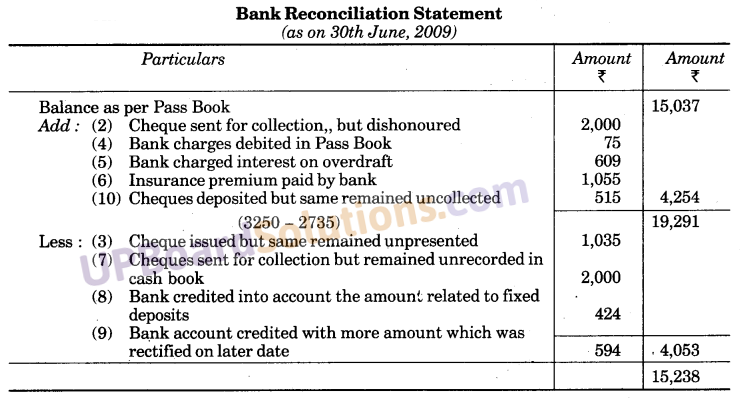
Prepare Bank Reconciliation Statement on 30th June 2011 as per the following information:

  1. The credit balance of pass-book on 30th June 2011 was Rs. 15,037.
  2. A cheque of Rs. 2,000 was sent for collection which was dishonoured.
  3. Cheques of Rs. 5,350 were issued for payment, but cheques worth Rs. 1,035 were presented for payment on 5th July 2011.
  4. Bank charges of Rs. 75 were debited in pass-book.
  5. Bank charged Rs. 609 as interest on overdraft.
  6. Bank paid Rs. 1,055 towards insurance as per standing instructions but Was not entered in the cash book.
  7. A cheque of Rs. 2,000 was sent for collection but was not entered in cash book by mistake.
  8. The bank credited Rs. 424 in the account related to fixed deposits (UPBoardSolutions.com) as per standing instructions.
  9. The bank credited Rs. 993 instead of Rs. 399 in the trader’s account by mistake which was rectified on 17th July 2011.
  10. Cheques of Rs. 3,250 were deposited for collection, but bank collected Rs. 2,735 only.

UP Board Solutions

Solution.
UP Board Solutions for Class 10 Commerce Chapter 3 Bank Reconciliation Statement

Question 4.
Prepare a Bank Reconciliation Statement from the following particulars:

  1. On 31st December 2011, there was an overdraft balance of Rs. 13,880 as per Pass Book.
  2. Bank charged interest of Rs. 240 on overdraft for 6 months on 31st December 2011. This was not recorded in the Cash Book.
  3. Bank expenses of Rs. 60 are not recorded in the Cash Book.
  4. A cheque amounting to Rs. 2,300 was issued but not (UPBoardSolutions.com) presented for payment.
  5. Rs. 4,340 cheque was sent to the bank but was not collected and deposited.
  6. A bill of Rs. 1,000 which was discounted with Bank in November 2011 was dishonoured on 31st December 2011.

UP Board Solutions

Solution:
Bank Reconciliation Statement on 31st December, 2011
UP Board Solutions for Class 10 Commerce Chapter 3 Bank Reconciliation Statement

Question 5.
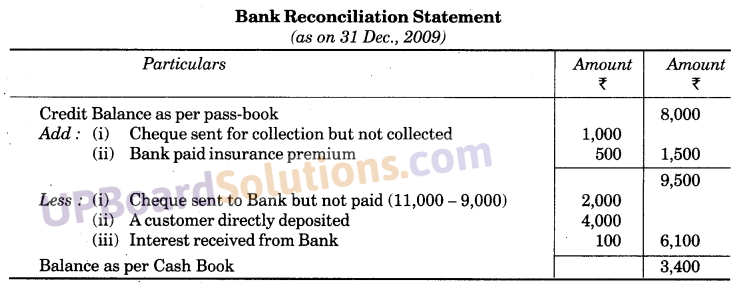
From the following particulars, prepare Bank Reconciliation Statement as on 31st December 2009:
On 31st December 2009, the passbook of Gaurav Khemka shows the credit balance Rs. 8,000. On comparing a cash book with a passbook, the following differences are found:
(i) Cheques sent to the bank for collection but not yet collected Rs. 1,000.
(ii) Cheques of Rs. 11,000 issued but out of them only cheques of Rs. 9,000 were presented for payment
(iii) Direct deposited by the customer in his bank account Rs. 4,000.
(iv) An insurance premium paid by bank Rs. 500.
(v) Rs. 100 has been credited by the bank. (UP 2010)
Solution:
UP Board Solutions for Class 10 Commerce Chapter 3 Bank Reconciliation Statement

Question 6.
From the following particulars prepare a Bank Reconciliation Statement as on 31st March 2007. The credit balance as per bank Pass Book on this date was Rs. 20,500:
(i) Out of total cheques of Rs. 2,000 issued during the month, cheques of Rs. 500 were presented for payment in May 2007, while a cheque of Rs. 100 was lost in transit.
(ii) In accordance with standing instruction of account holder, Bank paid LIC premium of Rs. 600 for which no entry was made in the Cash Book.
(iii) A customer directly deposited Rs. 2,000 in the bank for which no entry was recorded in Cash Book.
(iv) Bank charges of Rs. 50 debited into Pass Book were not recorded in Cash Book. (UP 2008)
Solution:
UP Board Solutions for Class 10 Commerce Chapter 3 Bank Reconciliation Statement

UP Board Solutions

Question 7.
Prepare a Bank Reconciliation Statement as on 31st December 2008 on the basis of the following information:
(i) Bank Account balance as per Cash Book was Rs. 18,000 on 31st December 2008.
(ii) The cheque for Rs. 2,500 was sent to the bank for collection but was not collected.
(iii) Cheques for Rs. 4,000 and 3,000 were issued to creditors but the only cheque for Rs. 4,000 was presented for payment.
(iv) Following transactions were entered into Pass Book but Cash Book was left unrecorded:
(a) Bank Charges Rs. 50.
(b) Rs. 200 were paid for Insurance premium.
(c) Rs. 5,000 were deposited in the Bank Account directly by a customer. (UP 2009)
Solution:
UP Board Solutions for Class 10 Commerce Chapter 3 Bank Reconciliation Statement

Question 8.
From the following information, prepare a Bank Reconciliation Statement as on 31st December 2010:
(i) Balance as per Cash Book Rs. 8,000.
(ii) Cheques of Rs. 11,000 sent to the bank for the collection were not collected.
(iii) Cheques of Rs. 12,000 were issued but only cheques of Rs. 10,000 were presented for payment.
(iv) Rs. 4,000 was directly deposited into a bank by a customer.
(v) Rs. 500 was credited by the bank for interest.
(vi) Insurance premium was paid by the bank Rs. 1,500. (UP 2011)
Solution:
UP Board Solutions for Class 10 Commerce Chapter 3 Bank Reconciliation Statement

UP Board Solutions for Class 10 Commerce

UP Board Solutions for Class 10 Commerce Chapter 11 Bank: Origin, Meaning, Functions and Importance

UP Board Solutions for Class 10 Commerce Chapter 11 Bank: Origin, Meaning, Functions and Importance

Bank: Origin, Meaning, Functions and Importance Objective Type Questions (1 Mark)

Question 1.
The name of the account where the money is repayable after a fixed duration is:
(a) Fixed Deposit Account
(b) Recurring Deposit Account
(c) Saving Account
(d) Current Account
Answer:
(a) Fixed Deposit Account

Question 2.
The scheme of the recurring deposit account was started in the year:
(a) 1960
(b) 1962
(c) 1964
(d) 1966
Answer:
(c) 1964

Question 3.
Sale and purchase of foreign currency is done by:
(a) Reserve Bank of India
(b) State’ Bank of India
(c) Punjab National Bank
(d) Foreign Exchange Bank
Answer:
(d) Foreign Exchange Bank

UP Board Solutions

Question 4.
In ……….. account, the customer may withdraw money as and when he likes.
(a) Saving Account
(b) Current Account
(c) Fixed Deposit Account
(d) Recurring Deposit Account
Answer:
(b) Current Account

Question 5.
The word ‘Bank’ has been derived from the Italian word ………
(a) Bango
(b) bingo
(c) Banking
(d) Bingo
Answer:
(a) Bango

Bank: Origin, Meaning, Functions and Importance Definite Answer Type Questions (1 Mark)

Question 1.
Who is played a very important part in the economic development of all the nations of the world?
Answer:
Banking.

Question 2.
Write the name of the bankers of the banks. (UP 2013)
Answer:
Reserve Bank of India.

UP Board Solutions

Question 3.
In which year Reserve Bank of India was set up?
Answer:
1964.

Question 4.
Name the bank which has made an important contribution in the field of giving loans for industrial finance in India.
Answer:
Commercial Bank.

Question 5.
Write the name of Present Central Finance Minister of India.
Answer:
Shree Arun Jethali.

Bank: Origin, Meaning, Functions and Importance Very Short Answer Type Questions (2 Marks)

Question 1.
Give two agency functions of a bank.
Answer:
Two agency function of a bank is as follows:

  • Collecting Customer’s Fund: The (UPBoardSolutions.com) bank collects the funds of its customers from other banks and credits them to their accounts.
  • Payment of Premium: The bank pays to the insurance companies on behalf of its customers. It may also pay certain bills of the customers as per their activities.

UP Board Solutions

Question 2.
What is an exchange bank?
Answer:
Exchange banks also function as a commercial bank but the only difference is that their main function is the sale and purchase of foreign currencies. In international trade, the main problem is of payment, and without foreign exchange, the business is not possible. Then the exchange bank comes to the rescue of the exporter and the bank purchases the bills from the exporter and makes (UPBoardSolutions.com) the payment by discounting the bills.

Question 3.
What are the main functions of a bank?
Answer:
Main functions of a bank are as follows:
1. Acceptance of Deposit: Acceptance of deposits is a very important function of a modern bank. The bank collects the surplus balance of the individuals and of the firms by giving facilities for opening different deposit accounts. Bank gives some interest on the deposits.

2. Advancing of Loans: The deposits received by the banks are not allowed to lie idle in the cash box of the bank. After keeping certain cash reserves, the balance is given by the bank to the needy borrowers in the form of loans and advances.

3. Discounting of bills: This is another type of lending which (UPBoardSolutions.com) is very popular with modern banks. If the holder of an exchange bill needs money immediately, he can get it discounted by the bank. After deducting its commission, the bank pays the present price of the bill to the holder.

UP Board Solutions

Bank: Origin, Meaning, Functions and Importance Long Answer Type Questions (8 Marks)

Question 1.
How is credit created by a Bank? (UP 2008, 18)
Answer:
Creation of Credit by Bank. Grating of loans and advances is important to function of the bank. But the process by which the banks grant loans and advances has special significance for the modern economy. Money is said to be created when the banks, through their lending activities, make a net addition to the total supply of money in the economy.

The customers deposit their savings (cash or cheques) in their accounts in the bank. These deposits convert currency money into deposit money. The deposit money provides funds, out of which the bank makes loans and advances to its customers. The bank knows by experience that all these primary deposits are not going to be withdrawn by the depositors at any one particular (UPBoardSolutions.com) time. So the bank, after keeping a small percentage of these deposits in cash, uses the balance for making loans and advances to the customers. The primary deposit which is kept in cash by the bank is known as Cash Reserve.

After keeping a small percentage of deposits as Cash Reserve, the balance percentage of deposits are given as loans and advances to the persons in need. When the borrower is granted loan by the bank, the loan money is not paid to the borrower in cash but is credited to his deposit account. The borrower, however, can withdraw the entire loan money either at once or in small instalments according to his requirements. Thus, the formation of credit takes place. We can explain it with an example.
Example: Let us suppose that the minimum Cash Reserve observed by the bank is 10% and a person deposits Rs. 2,000 in the bank.

As the minimum Cash Reserve is 10%, the bank will keep Rs. 200 (10% of Rs. 2,000 as the Cash Reserve and the balance Rs. 1800 (2000 <$E-> 200) will be given by the bank as loan or advance. As already pointed out, the bank does not pay the loan amount in cash but the loan money is credited to borrower’s deposit account. Now the bank will keep 10% as Cash Reserve of the loan amount which will amount to Rs. 180 (i.e., 10% of Rs. 1,800) and the balance of Rs. 1620 (i.e., 1800 < $E- > 180) can be given by the bank as loan or advance. Again the bank will keep 10% Cash Reserve amounting to Rs. 162 (i.e., 10% of Rs. 1620) and the balance of Rs. 1458 (i.e., 1620 <$E- > 162) can (UPBoardSolutions.com) be given as loan or advance. In this way, the process of multiple credit creation will continue.

UP Board Solutions

In the above example, the minimum Cash Reserve Rate is 10%. The initial deposit of Rs. 2,000 will result in creating derivative deposits of Rs. 1800. Thus, there is a ten times increase in derivative deposits on the basis of the original excess reserve of Rs. 1800. The bank has a limited amount but by creating credit, it increased the amount to a large extent. Banks are helpful in fulfilling the needs of the country by creating credit which increases the economical and industrial development of the country.

Thus, we can say that banks do not create credit by only accepting deposits but also create credit by giving loans and advance, a loan is not given in cash but is deposited in the account of the borrower. So we can say that loans create deposits and deposits create loans.

Question 2.
How a saving account is opened with a bank? Write its advantages.
Answer:
Saving Bank Account is meant for the middle class and low-class income group persons for developing the habit of saving among them.
A person wishing to open a Saving Bank Account has to fill in the form and make a declaration therein that he has read the rules of Saving Bank Account. He has also to give specimen signature. Then the amount is deposited in the account by the account-holder and the same is entered in the passbook which is handed over to the depositor. If the account-holder has opted for cheque facility then a cheque book is also issued to the account-holder.

Advantages of Opening Saving Account: Following are the advantages of this account:

  1. Encourage Savings: This account helps the people to develop the habit of saving money.
  2. Feeling of Economy: When a person feels the importance of saving, he tries his best for the proper and necessary utilization of money. This avoids extravagance.
  3. Profitable to Low Income Group: People belonging to (UPBoardSolutions.com) low-income group finds this account much profitable.
  4. Facility to Minors: They can also open an account and deposit their savings in it.
  5. Earning of Interest: The person depositing his savings get interested in his deposits.

UP Board Solutions

Question 3.
How many types of account can be open in a bank? (UP 2008)
Answer:
The following types of accounts can be opened in a bank:
1. Fixed Deposit Account: The term fixed deposit means deposits repayable after the expiry of a certain period which ordinarily varies from one year to five years. The rate of interest is higher in a fixed deposit account in comparison to other deposits. Money can also be borrowed against the security of fixed deposit.

2. Current Account: This account is generally opened by businessmen. Under this account, the customer can deposit or withdraw money as and when he likes. No Interest is allowed by first-class banks on such accounts.

3. Savings Bank Account: Such account is meant for the middle class and low-class income group persons. The main objective of such account is to develop the habit of savings. When these small savings are pooled, it forms a large capital which can be used for the economic growth of the country.

4. Home Safe Deposit Account: Such account is a very good means of encouraging thrift among persons having small income or among children. These accounts carry only a very small rate of interest.

5. Recurring Deposit Account: Any person can open this account in his personal name or joint names and in case of minor under the guardianship of someone. The term of account depends upon the wish of an account (UPBoardSolutions.com) holder, which varies from 1 year to 7 years. The amount to be deposited every month in the account should be Rs. 10 or in multiples thereof but to the maximum limit of Rs. 500 per month.

UP Board Solutions

Question 4.
List the precautions adopted or information gathered by the bank before opening an account.
Answer:
The bank must be very careful and gather certain information before opening an account. These precautions could be of following nature:
1. Minor: A person after attaining the age of 18 years becomes major. Prior to this age, he is minor. As per the law, a minor cannot enter into any contract. For the contracts entered into by the minor, no legal liability can be cast upon him. There is nothing wrong in dealing with a minor but if a bank provides overdraft facility to a minor, it cannot take any legal action to recover in the name of the minor, but the account should be operated by the guardian.

2. Mad Person: No contract can be entered into with a person who is not of sound mind. Hence, no account should be opened of the person who is of unsound mind, but if the account has already been opened, the bank should stop the payments of the cheques issued by him and suspend all the transactions in relation to his account.

3. Married Lady: A lady who is married, is free to open the account but the bank should be very judicious in providing loans to her because her husband cannot be made responsible for the loans taken by her. The bank should advance any loan but only by taking some guarantee or if the lady has some assets in her name.

4. Agent: The account can also be opened in the name of an agent. (UPBoardSolutions.com) Before opening the account, the bank should verify the rights of the agents.

5. Partnership Firm: Banks, before opening the account of a partnership firm should collect some information, such as partnership deed, soap registration or sale tax registration, nature of the business, names and addresses of the partners and signatures of the partners having right to operate the account.

6. Joint Stock Companies: The bank should obtain the following information before opening the account of joint-stock companies:

  • The right of directors, managers and officers of the company as mentioned in articles of association and memorandum of association.
  • The copy of the resolution under which the company has appointed them as their bankers.
  • Certificate of commencement of business should also be inspected by the bank.

UP Board Solutions

7. Trust: In case the account to be opened is that of the trust, the bank should study the trust because it contains the rights of the trustees. Generally, the deed mentions the rights regarding operation of the account, limit, of loan etc.

8. Joint Account: While opening a joint account, the banker must obtain (UPBoardSolutions.com) definite instructions as to how the account is to be operated. Whether all of them shall operate the account or delegate the authority to one should also be cleared.

UP Board Solutions for Class 10 Commerce