UP Board Solutions for Class 6 Maths Chapter 10 लघुत्तम समापवर्त्य एवं महत्तम समापवर्तक

UP Board Solutions for Class 6 Maths Chapter 10 लघुत्तम समापवर्त्य एवं महत्तम समापवर्तक

These Solutions are part of UP Board Solutions for Class 6 Maths. Here we have given UP Board Solutions for Class 6 Maths Chapter 10 लघुत्तम समापवर्त्य एवं महत्तम समापवर्तक.

अभ्यास 10(a)

प्रश्न 1.
स्तम्भ 1 की संख्याओं का स्तम्भ 2 के अपवर्तकों से मिलान कीजिए (मिलान करके)-
UP Board Solutions for Class 6 Maths Chapter 10 लघुत्तम समापवर्त्य एवं महत्तम समापवर्तक 1

प्रश्न 2.
निम्नांकित संख्याओं के प्रथम पाँच गुणज लिखिए (लिखकर)-
(क) 3 के प्रथम पाँच गुणज = 3, 6, 9, 12, 15
(ख) 4 के प्रथम पाँच गुणज = 4, 8, 12, 16, 20
(ग) 5 के प्रथम पाँच गुणज = 5, 10, 15, 20, 25
(घ) 9 के प्रथम पाँच गुणज = 9, 18, 27, 36, 45

UP Board Solutions

प्रश्न 3.
स्तम्भ 1 की संख्याओं का स्तम्भ 2 के साथ मिलान कीजिए (मिलान करके)-
UP Board Solutions for Class 6 Maths Chapter 10 लघुत्तम समापवर्त्य एवं महत्तम समापवर्तक 2

प्रश्न 4.
7 के सभी अपवर्त्य ज्ञात कीजिए जो 100 से कम हो।
उत्तर-
7 के अपवर्त्य – 7, 14, 21, 28, 35, 42, 49, 56, 63, 70, 77, 84, 91, 98

प्रश्न 5.
496 के सभी अपवर्तकों को लिखिए और दिखाइए की यह एक सम्पूर्ण संख्या है।
उत्तर-
496 के अपवर्तक – 1, 2, 4, 8, 16, 31, 62, 124, 248, 496
सभी गणुनखण्डों का योग = 1 + 2 + 4 + 8 + 16 + 31 + 62 + 124 + 248 + 496 = 992 (496 x 2) अर्थात् 496 का दो गुना है
अतः 496 एक सम्पूर्ण संख्या है।

UP Board Solutions

प्रश्न 6.
रिक्त स्थानों की पूर्ति कीजिए।

  1. प्रत्येक संख्या स्वयं की अपवर्तक होती है।
  2. प्रत्येक संख्या का पूर्ण विभाजक उसका अपवर्तक होता है।
  3. किसी संख्या का प्रत्येक अपवर्तक उस संख्या से छोटा या उसके बराबर होता है।
  4. प्रत्येक संख्या अपने अपवर्तक का एक अपवर्त्य होती है।
  5. 78 के अपवर्तक हैं 1, 2, 3, 6, 13, 26, 39, 78.

अभ्यास 10(b)

प्रश्न 1.
9 के अभाज्य गुणनखण्ड बताइए।
उत्तर-
3 x 3

प्रश्न 2.
यदि किसी संख्या के अभाज्य गुणनखण्ड 2, 2 और 3 हैं, तो संख्या बताइए।
उत्तर-
12

प्रश्न 3.
एक संख्या के गुणनखण्ड 8 और 3 हैं। उसके अभाज्य गुणनखण्ड बताइए।
उत्तर-
2 x 2 x 2 x 3

UP Board Solutions

The prime factors of 144 are the prime numbers which divide 144 exactly, without remainder as defined by the Euclidean division.

प्रश्न 4.
यहाँ 60 के लिए दो भिन्न-भिन्न गुणनखण्ड वृक्ष दिए गए हैं। इनमें अज्ञात संख्याओं को अपनी अभ्यास पुस्तिका पर लिखिए।
हल:
UP Board Solutions for Class 6 Maths Chapter 10 लघुत्तम समापवर्त्य एवं महत्तम समापवर्तक 3

प्रश्न 5.
चार अंकों की सबसे बड़ी संख्या लिखिए और उसे अभाज्य गुणनखण्ड के रूप में व्यक्त कीजिए।
हल:
चार अंकों की सबसे बड़ी संख्या = 9999 का अभाज्य गुणनखण्ड = 3 x 3 x 11 x 101

प्रश्न 6.
पाँच अंकों की सबसे छोटी संख्या लिखिए और उसे अभाज्य गुणनखण्ड के रूप में व्यक्त कीजिए।
हल:
पाँच अंकों की सबसे छोटी संख्या = 10000
1000 का अभाज्य गुणनखण्ड = 2 x 2 x 2 x 2 x 5 x 5 x 5 x 5

प्रश्न 7.
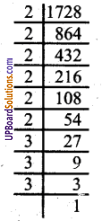
1728 के अभाज्य गुणनखण्ड भाग-विधि द्वारा ज्ञात कीजिए।
हल:
UP Board Solutions for Class 6 Maths Chapter 10 लघुत्तम समापवर्त्य एवं महत्तम समापवर्तक 4
1728 के अभाज्य गुणनखण्ड = 2 x 2 x 2 x 2 x 2 x 2 x 3 x 3 x 3

प्रश्न 8.
निम्नांकित संख्याओं के अभाज्य गुणनखण्ड ज्ञात कीजिए- 112, 120, 135, 140, 150, 1228
UP Board Solutions for Class 6 Maths Chapter 10 लघुत्तम समापवर्त्य एवं महत्तम समापवर्तक 5
UP Board Solutions for Class 6 Maths Chapter 10 लघुत्तम समापवर्त्य एवं महत्तम समापवर्तक 6

प्रश्न 9.
80 और 90 के बीच की अभाज्य संख्या है-
उत्तर-
83 और 89

UP Board Solutions

प्रश्न 10.
रिक्त स्थानों की पूर्ति कीजिए-
(i) वे संख्याएँ जिनके दो या दो अधिक अपवर्तक होते हैं भाज्य संख्याएँ कहलाती हैं।
(ii) वे संख्याएँ जिनके अपवर्तक 1 और स्वयं वह संख्या होती है, अभाज्य संख्याएँ कहलाती है।
(iii) एक न तो भाज्य और न ही अभाज्य है।
(iv) एक संख्या के अपवर्त्य 7, 14, 21, 28, हैं। वह संख्या 7 है।

अभ्यास 10(c)

प्रश्न 1.
अभाज्य गुणनखण्डन द्वारा निम्नांकित संख्याओं के म०स० ज्ञात कीजिए।
(i) 144, 198
हल :
144 = 2 x 2 x 2 x 2 x 3 x 3
198 = 2 x 3 x 3 x 11
म०स० = 2 x 3 x 3 = 18

(ii) 225, 450
हल:
225 = 5 x 5 x 3 x 3
450 = 5 x 5 x 2 x 3 x 3
म०स० = 5 x 5 x 3 x 3 = 225

(iii) 13, 39, 273
हल:
13 = 1 x 13
39 = 13 x 3
273 = 13 x 3 x 7
म०स० = 13

UP Board Solutions

(iv) 120, 144, 204
हल:
120 = 2 x 2 x 2 x 3 x 5
144 = 2 x 2 x 2 x 2 x 3 x 3
204 = 2 x 2 x 3 x 17
म०स० = 2 x 2 x 3 = 12

(v) 101, 909, 1111
हल:
101 = 1 x 101
909 = 3 x 3 x 101
1111 = 1 x 11 x 101
म०स० = 101

(vi) 625, 3125, 15625
हल:
625 = 5 x 5 x 5 x 5
3125 = 5 x 5 x 5 x 5 x 5
15625 = 5 x 5 x 5 x 5 x 5 x 5
म०स० = 5 x 5 x 5 x 5 = 625

प्रश्न 2.
भाग-विधि द्वारा निम्नांकित संख्याओं को म० ज्ञात कीजिए-
UP Board Solutions for Class 6 Maths Chapter 10 लघुत्तम समापवर्त्य एवं महत्तम समापवर्तक 7
UP Board Solutions for Class 6 Maths Chapter 10 लघुत्तम समापवर्त्य एवं महत्तम समापवर्तक 8

UP Board Solutions

प्रश्न 3.
वह बड़ी से बड़ी संख्या बताइए जिससे 125 और 94 को भाग देने पर प्रत्येक दशा में 1 शेष रहे।
हल:
125 – 1 = 124 तथा 94 – 1 = 93
UP Board Solutions for Class 6 Maths Chapter 10 लघुत्तम समापवर्त्य एवं महत्तम समापवर्तक 9
अतः अभीष्ट संख्या = 31

प्रश्न 4.
वह बड़ी से बड़ी संख्या बताइए जिससे 49, 59 और 109 को भाग देने पर क्रमशः 1,3 और 5 शेष रहे।
हल:
49 – 1 = 48, 59 – 3 = 56 तथा 109 – 5 = 104
UP Board Solutions for Class 6 Maths Chapter 10 लघुत्तम समापवर्त्य एवं महत्तम समापवर्तक 10
म०स० = 2 x 2 x 2 = 8
अतः अभीष्ट संख्या = 8

प्रश्न 5.
निम्नांकित भिन्नों को अंश एवं हर में उनके म०स० से भाग देते हुए सरलतम रूप में बदलिए-
UP Board Solutions for Class 6 Maths Chapter 10 लघुत्तम समापवर्त्य एवं महत्तम समापवर्तक 11
UP Board Solutions for Class 6 Maths Chapter 10 लघुत्तम समापवर्त्य एवं महत्तम समापवर्तक 12

अभ्यास 10(d)

प्रश्न 1.
प्रश्नवाचक चिह्न में उचित संख्या भरिए (भरकर)-
UP Board Solutions for Class 6 Maths Chapter 10 लघुत्तम समापवर्त्य एवं महत्तम समापवर्तक 13
उत्तर-
42

UP Board Solutions

प्रश्न 2.
निम्नांकित संख्या-युग्मों के ऐसे समापवर्त्य ज्ञात कीजिए जिनका मान 80 से कम हो।
(क) 9 और 15
हल:
9 = 9, 18, 27, 36, 45, 54, 63, 72
15 = 15, 30, 45, 60, 75
अतः 9 और 15 का समापवर्त्य जो 80 से कम हो = 45

(ख) 6 और 10
हल:
6 = 6, 12, 18, 24, 30, 36, 42, 48, 54, 60, 66, 72, 78
10 = 10, 20, 30, 40, 50, 60, 70
अतः 6 और 10 का समापवर्त्य जो 80 से कम हो = 30, 60

(ग) 8 और 9
हल:
8 = 8, 16, 24, 32, 40, 48, 56, 64, 72
9 = 9, 18, 27, 36, 45, 54, 63, 72
अतः 8 और 9 का समापवर्त्य जो 80 से कम हो = 72

(घ) 7 और 11
हल:
7 = 7, 14, 21, 28, 35, 42, 49, 56, 63, 70, 77
11 = 11, 22, 33, 44, 55, 66, 77
अंतः 7 और 11 का समापवर्त्य जो 80 से कम हो = 77

प्रश्न 3.
60 तक की उन संख्याओं को ज्ञात कीजिए जो 4 और 6 दोनों से पूर्णतः विभाज्य हैं।
हल:
4 = 4, 8, 12, 16, 20, 24, 28, 32, 36, 40, 44, 48, 52, 56, 60
6 = 6, 12, 18, 24, 30, 36, 42, 48, 54, 60
अतः 60 तक की संख्याएँ 12, 24, 36, 48, 60 है जो 4 तथा 6 दोनों से पूर्णतया विभाज्य हैं।

UP Board Solutions

प्रश्न 4.
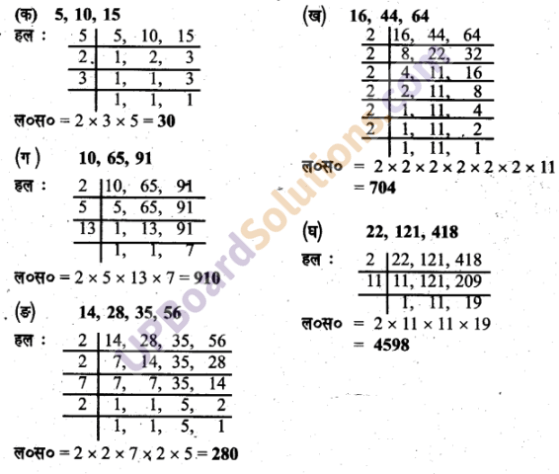
निम्नांकित संख्याओं का ल०स० ज्ञात कीजिए-
UP Board Solutions for Class 6 Maths Chapter 10 लघुत्तम समापवर्त्य एवं महत्तम समापवर्तक 14

प्रश्न 5.
वह छोटी से छोटी संख्या बताइए जो 20, 25 और 40 से पूर्णतः विभाज्य हो।
हल:
UP Board Solutions for Class 6 Maths Chapter 10 लघुत्तम समापवर्त्य एवं महत्तम समापवर्तक 15
ल०स० = 2 x 2 x 5 x 5 x 2 = 200

प्रश्न 6.
वह छोटी से छोटी संख्या बताइए जिसमें यदि 3 जोड़ दें तो योगफल 36, 45 और 50 से अलगअलग पूरा-पूरा विभाजित हो जाए।
हल:
अभीष्ट संख्या तीनों संख्याओं के ल०स० में से 3 घटाने पर प्राप्त होगी।
UP Board Solutions for Class 6 Maths Chapter 10 लघुत्तम समापवर्त्य एवं महत्तम समापवर्तक 16
ल०स० = 2 x 2 x 5 x3 x 3 x 5 = 900
अतः अभीष्ट संख्या = 900 – 3 = 897

प्रश्न 7.
वह छोटी से छोटी संख्या बताइए जिसमें 75, 80 और 135 से भाग देने पर प्रत्येक दशा में 3 शेष बचे।
हल:
अभीष्ट संख्या दी हुई संख्याओं के ल०स० में 3 जोड़ने पर प्राप्त होगी।
UP Board Solutions for Class 6 Maths Chapter 10 लघुत्तम समापवर्त्य एवं महत्तम समापवर्तक 17
ल०स० = 5 x 3 x 5 x 16 x 9 = 10800
अतः अभीष्ट संख्या = 10800 + 3 = 10803

UP Board Solutions

प्रश्न 8.
वह छोटी से छोटी संख्या बताइए जिसमें 7 घटाने पर शेष बची संख्या 20, 28, 35 और 105 से पूर्णतः विभक्त हो।
हल:
अभीष्ट संख्या दी हुई संख्याओं के ले०स० में 7 जोड़ने पर प्राप्त होगी।
UP Board Solutions for Class 6 Maths Chapter 10 लघुत्तम समापवर्त्य एवं महत्तम समापवर्तक 18
ल०स० = 2 x 5 x 7 x 2 x 3 = 420
अतः अभीष्ट संख्या = 420 + 7 = 427

प्रश्न 9.
वह छोटी से छोटी संख्या ज्ञात कीजिए जिसे 35, 45 तथा 55 से भाग देने पर क्रमशः 17, 27 तथा 37 शेष बचें।
हल:
भाजकों में से शेष घटाने पर, 35 – 17 = 18, 45 – 27 = 18, 55 – 37 = 18,
अभीष्ट संख्या दी हुई संख्याओं के ल०स० में 18 घटाने पर प्राप्त होगी।
UP Board Solutions for Class 6 Maths Chapter 10 लघुत्तम समापवर्त्य एवं महत्तम समापवर्तक 19
ल०स० = 5 x 7 x 9 x 11 = 3465
अतः अभीष्ट संख्या = 3465 – 18 = 3447

अभ्यास 10(e)

प्रश्न 1.
रिक्त भाग में उचित विकल्प भरिए (भरकर)-
UP Board Solutions for Class 6 Maths Chapter 10 लघुत्तम समापवर्त्य एवं महत्तम समापवर्तक 20
उत्तर-
6

प्रश्न 2.
निम्नांकित प्रत्येक संख्या-युग्म के लिए दिखाइए कि ल०स० तथा म०स० का गुणनफल संख्याओं के गुणनफल के बराबर होता है-
UP Board Solutions for Class 6 Maths Chapter 10 लघुत्तम समापवर्त्य एवं महत्तम समापवर्तक 21
UP Board Solutions for Class 6 Maths Chapter 10 लघुत्तम समापवर्त्य एवं महत्तम समापवर्तक 22

प्रश्न 3.
दो संख्याओं का म०स० 16 तथा उनका गुणनफल 6400 है, उनका ल०स० ज्ञात कीजिए।
हल:
ल०स० x म०स० = दोनों संख्याओं का गुणनफल
ल०स० x 16 = 6400
ल०स० = 400

UP Board Solutions

प्रश्न 4.
क्या दो संख्याओं का म०स० 14 तथा उनका ल०स०204 हो सकता है? उत्तर की पुष्टि में कारण दीजिए।
हल :
204 (ल०स०), 14 (म०स०) से पूर्णतया विभाज्य नहीं है।
अतः दो संख्याओं का म०स० 14 तथा उनका ल०स० 204 नहीं हो सकता।

प्रश्न 5.
2211 तथा 5025 का म०स० भाग-विधि से ज्ञात करके इसके आधार पर इन संख्याओं का ल०स० ज्ञात कीजिए।
UP Board Solutions for Class 6 Maths Chapter 10 लघुत्तम समापवर्त्य एवं महत्तम समापवर्तक 23

प्रश्न 6.
95, 285 और 399 के लघुतम समापवर्त्य में इनका महत्तम समापवर्तक कितनी बार सम्मिलित है?
UP Board Solutions for Class 6 Maths Chapter 10 लघुत्तम समापवर्त्य एवं महत्तम समापवर्तक 24

प्रश्न 7.
17 वह बड़ी से बड़ी संख्या है जो संख्याओं 102 तथा 187 को पूर्णतः विभाजित करती है। इसके आधार पर वह छोटी से छोटी संख्या ज्ञात कीजिए जिसको ये संख्याएँ पूरा-पूरा विभाजित करती हैं।
UP Board Solutions for Class 6 Maths Chapter 10 लघुत्तम समापवर्त्य एवं महत्तम समापवर्तक 25

अभ्यास 10(f)

प्रश्न 1.
रिक्त भाग में नीचे दिए गए विकल्पों में से सही विकल्प चुनकर भरिए (भरकर)-
UP Board Solutions for Class 6 Maths Chapter 10 लघुत्तम समापवर्त्य एवं महत्तम समापवर्तक 26

प्रश्न 2.
एक प्राथमिक विद्यालय की कक्षा-1 में 120 और कक्षा-2 में 90 छात्र हैं। इन्हें बड़ी से बड़ी समान छात्र-संख्या में बाँटने पर प्रत्येक समूह में छात्रों की संख्या कितनी होगी?
हल:
प्रत्येक समूह में विद्यार्थियों की संख्या 90 व 120 के म०स० के बराबर होगी।
UP Board Solutions for Class 6 Maths Chapter 10 लघुत्तम समापवर्त्य एवं महत्तम समापवर्तक 27
अतः प्रत्येक समूह में विद्यार्थियों की अभीष्ट संख्या = 30

प्रश्न 3.
कापियों की वह छोटी से छोटी संख्या ज्ञात कीजिए जो 3,6, 12 व 15 के बंडलों में अलग-अलग किन्तु बराबर-बराबर बाँटी जा सकें।
हल:
कापियों की वह संख्या 3, 6, 12 व 15 का ल०स० होगी।
UP Board Solutions for Class 6 Maths Chapter 10 लघुत्तम समापवर्त्य एवं महत्तम समापवर्तक 28
ल०स० = 3 x 2 x 2 x 5 = 60
अतः कापियों की छोटी से छोटी अभीष्ट संख्या = 60

प्रश्न 4.
55 मीटर लम्बे और 22 मीटर चौड़े एक मैदान में वर्गाकार दरियाँ बिछानी हैं। एक ही नाप की कम से कम बिछाई जाने वाली दरियों की संख्या ज्ञात कीजिए।
हल:
एक ही नाप की वर्गाकार दरियों की कम से कम संख्या के लिए दरियों का बड़े से बड़े आकार को होना आवश्यक है। मैदान की लम्बाई 55 मीटर व चौड़ाई 22 मीटर का म०स० लेने पर,
UP Board Solutions for Class 6 Maths Chapter 10 लघुत्तम समापवर्त्य एवं महत्तम समापवर्तक 29
म०स० = 11
अतः वर्गाकार दरी की भूजा = 11 मीटर
वर्गाकार दरी का क्षेत्रफल = 11 x 11 = 121 वर्ग मीटर
मैदान का क्षेत्रफल = लम्बाई x चौड़ाई = 55 x 22 = 1210 वर्ग मीटर
अतः वर्गाकार दरियों की कम से कम संख्या = 10

UP Board Solutions

प्रश्न 5.
तीन ग्रह किसी तारे के चारों ओर क्रमशः 200, 250 और 300 दिनों में एक चक्कर लगाते हैं। यदि वे किसी दिन तारे के एक ही ओर एक सीध में हों तो कितने दिनों में पुनः वे उसी स्थिति में आ जायेंगे।
हल:
अभीष्ट दिनों की संख्या 200, 250 और 300 के ल०स० के बराबर होगी।
UP Board Solutions for Class 6 Maths Chapter 10 लघुत्तम समापवर्त्य एवं महत्तम समापवर्तक 30
ल०स० = 2 x 2 x 5 x 5 x 2 x 5 x 3 = 3000 दिन
अतः 3000 दिन बाद तीनों ग्रह उसी स्थिति में आ जाएँगे।

प्रश्न 6.
कपड़े के तीन थानों में क्रमशः 125 मी 220 मी और 275 मी कपड़ा है। बड़ी से बड़ी नाप का फीता बताइए जो तीनों थानों के कपड़ों को पूरा-पूरा नाप सके।
नोट – तीनों थानों का कपड़ा पूरा-पूरा नापने के लिए फीते की लम्बाई 125 मी, 220 मी और 275 मी के म०स० के बराबर होगी।
हल:
UP Board Solutions for Class 6 Maths Chapter 10 लघुत्तम समापवर्त्य एवं महत्तम समापवर्तक 31
UP Board Solutions for Class 6 Maths Chapter 10 लघुत्तम समापवर्त्य एवं महत्तम समापवर्तक 32
अतः अभीष्ट बड़ी से बड़ी नाप के फीते की लम्बाई = 5 मी

प्रश्न 7.
छः घंटियाँ एक साथ बजनी आरम्भ हुईं। यदि वे क्रमशः 2, 4, 6, 8, 10 और 12 सेकंड के अन्तराल से बजती हों तो 30 मिनट में वे कितनी बार इकट्ठी बजेंगी?
हल :
एक साथ पुनः साथ बजने की गणना 2, 4, 6, 8, 10 और 12 के ल०स० के बराबर होगी।
UP Board Solutions for Class 6 Maths Chapter 10 लघुत्तम समापवर्त्य एवं महत्तम समापवर्तक 33
ल०स० = 2 x 2 x 2 x 3 x 5 = 120 सेकंड = 2 मिनट
30 मिनट में बजने की संख्या = 15 बार

प्रश्न 8.
एक टोकरी के आमों को एक बालिका 4, 6 और 9 की ढेरियों में सजाती है। प्रत्येक बार 1 आम टोकरी में शेष बच जाता है। बताइए कि टोकरी में कम से कम कितने आम हैं?
हल:
प्रश्नानुसार, टोकरी में आमों की संख्या 4, 6 और 9 के ल०स० से 1 अधिक है।
UP Board Solutions for Class 6 Maths Chapter 10 लघुत्तम समापवर्त्य एवं महत्तम समापवर्तक 34
ल०स० = 2 x 2 x 3 x 3 = 36
अतः टोकरी में आमों की संख्या = 36 + 1 = 37

प्रश्न 9.
चार पहियों की परिधियाँ क्रमशः 50 सेमी, 60 सेमी, 90 सेमी और 100 सेमी लम्बी है। कम से कम कितनी दूरी चलने में चारों पहिए साथ-साथ पूरे-पूरे चक्कर लगाएँगे।
हल:
अभीष्ट दूरी 50, 60, 90 और 100 का ल०स० होगी।
UP Board Solutions for Class 6 Maths Chapter 10 लघुत्तम समापवर्त्य एवं महत्तम समापवर्तक 35
ल०स० = 2 x 2 x 3 x 5 x 5 x 3 = 900 सेमी = 9 मी
अतः 9 मीटर दूरी चलने में चारों पहिए साथ-साथ पूरे चक्कर लगाएँगे।

UP Board Solutions

प्रश्न 10.
एक व्यापारी हर चौथे दिन कानपुर जाता है जबकि दूसरा व्यापारी हर दसवें दिन। वे दोनों यदि 3 जनवरी को कानपुर एक साथ गए हों तो अगली तियि बताइए जब वे पुनः एक साथ कानपुर जाएँगे।
हल:
4 दिन और 10 दिन के ल०स० के बराबर समय के पश्चात् दोनों व्यापारी पुनः एक-साथ कानपुर जाएँगे।
UP Board Solutions for Class 6 Maths Chapter 10 लघुत्तम समापवर्त्य एवं महत्तम समापवर्तक 36
ल०स० = 2 x 2 x 5= 20 दिन
अतः 3 जनवरी को जाने के 20 दिन बाद वे पुनः साथ गए होंगे = 3 + 20 = 23 जनवरी

दक्षता अभ्यास-10

प्रश्न 1.
निम्नलिखित में सत्य/असत्य कथन अपनी अभ्यास पुस्तिका में लिखिए (सत्य – असत्य लिखकर)-

  1. दो संख्याओं का गुणनफले उनके ल०स० और म० स० के गुणनफल से छोटा होता है। (असत्य)
  2. यदि कोई संख्या किन्हीं दो संख्याओं से अलग-अलग पूर्णतः विभाज्य हो तो वह उनके गुणनफल से भी सदैव पूर्णतः विभाज्य होगी। (असत्य)
  3. एक भाज्य तथा दूसरी अभाज्य संख्याएँ आपस में सह-अभाज्य हो सकती हैं। (सत्य)
  4. अभाज्य संख्याएँ सह-अभाज्य भी होती हैं। (सत्य)
  5. किसी संख्या का इकाई का अंक विषम हो तो वह 2 से विभाज्य होती है। (असत्य)
  6. 724 में 4 का पूरा-पूरा भाग जाता है। (सत्य)
  7. एक संख्या 12 से विभाज्य है तो वह 3 से भी विभाज्य होगी। (सत्य)
  8. दी गई संख्याओं का ल०स० उनमें से सबसे बड़ी संख्या से छोटा नहीं हो सकता। (सत्य)
  9. किन्हीं संख्याओं का ल०स० उनके म०स० का अपवर्त्य नहीं होता है। (असत्य)
  10. सह-अभाज्य संख्याओं का म०स०1 होता है। (सत्य)

प्रश्न 2.
निम्नांकित के प्रथम पाँच अपवर्त्य लिखिए –
(i) 13
(ii) 23
(iii) 26
(iv) 40
हल:
(i) 13 = 13, 26, 39, 52, 65
(ii) 23 = 23, 46, 69, 92, 115
(ii) 26 = 26, 52, 78, 104, 130
(iv) 40 = 40, 80, 120, 160, 200

प्रश्न 3.
निम्नांकित में से 15 किसका अपवर्तक है-
(i) 3125
(i) 122940
(ii) 151290
हल:
(i) [latex]\frac { 3125 }{ 15 }[/latex] = [latex]\frac { 625 }{ 3 }[/latex] = 208[latex]\frac { 1 }{ 3 }[/latex]
(i) [latex]\frac { 122940 }{ 15 }[/latex] = 8196,
(ii) [latex]\frac { 151290 }{ 15 }[/latex] = 10086
चूँकि संख्या 15, संख्याओं 122940 और 151290 को पूर्णतया विभाजित करती है।
अतः 15, 122940 व 151290 का गुणनखण्ड है।

UP Board Solutions

प्रश्न 4.
5904 और 4048 को म०स० मत कीजिए।
UP Board Solutions for Class 6 Maths Chapter 10 लघुत्तम समापवर्त्य एवं महत्तम समापवर्तक 37

प्रश्न 5.
चार छ एक मैदान के चारों ओर दौड़ लगाते हैं। वे क्रमशः 30 सेकंह, 40 सेकंड, 50 सेकंड और 60 सेकेंड में मैदान का पूरा चक्कर लगाते हैं। यदि वे मैदान के किसी बिन्दु से एक साथ दौड़ना प्रारम्भ करें तो बताइए किं कम से कम कितने समय पश्चात् वे उसी बिन्दु पर पुनः मिलेंगे।
हल:
पुनः मिलने का समय 30, 40, 50 और 60 के ल०स० के बराबर होगी।
UP Board Solutions for Class 6 Maths Chapter 10 लघुत्तम समापवर्त्य एवं महत्तम समापवर्तक 38
ल०स० = 2 x 2 x 2 x 3 x 5 x 5 = 600 सेकंड = 10 मिनेट

प्रश्न 6.
दो संख्याओं का मैस० 35 और उनका ल०स० 525 है। उनमें एक संख्या 175 है तो दूसरी संख्या निम्नांकित में से कौन-सी होंगी?
(i) 25.
(ii) 49
(i) 63
(iv) 105
हल:
प्रथम संख्या x दूसरी संख्या = म०स० x ल०स०.
175 x दूसरी संख्या = 35 x 525
दूसरी संख्या = [latex]\frac { 35 x 525 }{ 175 }[/latex] = 105
अतः दूसरी संख्या (iv) 105 सही है।

UP Board Solutions

प्रश्न 7.
दो टंकियों में क्रमशः 72 ली तथा 116 ली दूध भरा है। बड़ी से बड़ी धारिता का बरतन बताइए जिससे दोनों टंकियों के दूध को पूरा-पूरा नापा जा सके।
हल:
बरतन की धारिता 72 तथा 116 के म०स० के बराबर होगी।
UP Board Solutions for Class 6 Maths Chapter 10 लघुत्तम समापवर्त्य एवं महत्तम समापवर्तक 39
अतः 4 ली धारिता वाले बरतन की आवश्यकता होगी।

प्रश्न 8.
एक कमरे का फर्श 300 सेमी x 425 सेमी नाप का है। उसमें बड़ी से बड़ी किस नाप की वर्गाकार यत लगाई जा सकती हैं ताकि टाइखों की संख्या कम से कम रहे?
हल:
वर्गाकार टाइलों की बड़ी से बड़ी नाप ज्ञात करने के लिए 300 व 425 का मस० निकालना होमा।
UP Board Solutions for Class 6 Maths Chapter 10 लघुत्तम समापवर्त्य एवं महत्तम समापवर्तक 40
वर्गाकार यइल की भुजा = 25 सेमी
वर्गाकार टाइल की नाप = भुजा x भुजा = 25 सेमी x 25 सेमी

प्रश्न 9.
तीन हौजों में क्रमशः:330, 375 और 450 लीटर पानी भरा है। बड़े से बड़े पीपे की थाखिला बताइए जिससे लैजों के पास से पूरी-पूरी जुर में निकाला जा के।
हृल:
पीपे की धारिता 330, 375 और 450 के म०स० के बराबर होगी।
UP Board Solutions for Class 6 Maths Chapter 10 लघुत्तम समापवर्त्य एवं महत्तम समापवर्तक 41
UP Board Solutions for Class 6 Maths Chapter 10 लघुत्तम समापवर्त्य एवं महत्तम समापवर्तक 42
अतः 15 ली धारिता वाले पीपे की।

प्रश्न 10.
वह बड़ी से बड़ी संख्या ज्ञात कीजिए जिससे 804 तथा 1745 को भाग देने पर क्रमशः 5 तवा 6 शेष बचे।
हल:
अभीष्ट संख्या 804 – 5 = 799 तथा 1745 – 6 = 1739 का म०स० होगी।
UP Board Solutions for Class 6 Maths Chapter 10 लघुत्तम समापवर्त्य एवं महत्तम समापवर्तक 43
अतः अभीष्ट बड़ी से बड़ी संख्या = 47

UP Board Solutions

प्रश्न 11.
वह बड़ी से बड़ी संख्या ज्ञात कीजिए जिससे 590, 908 और 1014 को भाग देने पर प्रत्येक दशा में समान शेष बचे।
हुल:
UP Board Solutions for Class 6 Maths Chapter 10 लघुत्तम समापवर्त्य एवं महत्तम समापवर्तक 44
अभीष्ट संख्या 908 – 590 = 318 और 1014 – 908 = 106 का म०स० होगी।
अतः अभीष्ट संख्या = 106

प्रश्न 12.
उत्तर का सही विकल्प छौंटिए
(क) तीन संख्याएँ 1 : 2 : 3 के अनुपात में हैं। यदि उनका म०स० 12 है तो ये संख्याएँ हैं-
(i) 12, 24, 36
(ii) 10, 20, 30
(iii) 5, 10, 15
(vi) 4, 8, 12
उत्तर-
(i) 12, 24, 36

(ख) तीन लकड़ी के लट्ठे क्रमशः 36 मी, 45 मी तथा 63 मी लम्बे हैं। इनमें से कोई बराबर लम्बाई के छोटे-छोटे गुटकों में बाँटना है। प्रत्येक गुटके की अधिकतम लम्बाई है-
(i) 9 मी
(ii) 18 मी
(iii) 51 मी
(vi) 4.5 मी
उत्तर-
(i) 9 मी

(ग) नापने की तीन छड़े क्रमशः 64 सेमी, 80 सेमी तथा 96 सेमी लम्बी हैं। इनमें से कोई भी छड़ प्रयोग करके कम से कम किस लम्बाई का कपड़ा पूर्ण रूप से नापा जा सकता है-
(i) 0.96 मी
(ii) 19.20 मी
(iii) 9.60 मी
(iv) 96 मी।
उत्तर-
(iii) 9.60 मी

UP Board Solutions

प्रश्न 13.
तीन विभिन्न चौराहों पर यातायात की बत्तियाँ क्रमशः 48 सेकंड, 72 सेकंड और 108 सेकंड के बाद बदलती हैं। यदि वे 8 बजकर 20 मिनट पर एक साथ बदलें तो पुनः एक साथ कब बदलेंगी।
हल:
पुनः बत्तियाँ बदलने का समय 48, 72 और 108 का ल०स० होगा।
UP Board Solutions for Class 6 Maths Chapter 10 लघुत्तम समापवर्त्य एवं महत्तम समापवर्तक 45

ल०स० = 2 x 2 x 2 x 3 x 3 x 2 x 3 = 432 सेकंड = 7 मिनट 12 सेकंड
अतः समय 8 बजकर 27 मिनट 12 सेकंड होगा।

प्रश्न 14.
एक आयत का क्षेत्रफल 56 वर्ग सेमी है। पूर्णाकों में उसकी लम्बाई और चौड़ाई क्या-क्या हो सकती है?
उत्तर-
आयत का क्षेत्रफल = 56 वर्ग सेमी = लम्बाई x चौड़ाई
56 = 1 x 56, 56 = 2 x 28, 56 = 4 x 14, 56 = 7 x 8
अतः आयत की लम्बाई और चौड़ाई = 1 सेमी x 56 सेमी, 2 सेमी x 28 सेमी, 4 सेमी x 14 सेमी, 7 सेमी x 8 सेमी.

We hope the UP Board Solutions for Class 6 Maths Chapter 10 लघुत्तम समापवर्त्य एवं महत्तम समापवर्तक help you. If you have any query regarding UP Board Solutions for Class 6 Maths Chapter 10 लघुत्तम समापवर्त्य एवं महत्तम समापवर्तक, drop a comment below and we will get back to you at the earliest.

UP Board Solutions for Class 12 Computer Chapter 17 डाटाबेस कन्सेप्ट

UP Board Solutions for Class 12 Computer Chapter 17 डाटाबेस कन्सेप्ट are part of UP Board Solutions for Class 12 Computer. Here we have given UP Board Solutions for Class 12 Computer Chapter 17 डाटाबेस कन्सेप्ट.

Board UP Board
Textbook NCERT
Class Class 12
Subject Computer
Chapter Chapter 17
Chapter Name डाटाबेस कन्सेप्ट
Number of Questions 26
Category UP Board Solutions

UP Board Solutions for Class 12 Computer Chapter 17 डाटाबेस कन्सेप्ट

बहुविकल्पीय प्रश्न

प्रश्न 1.
DBMS का सम्बन्ध निम्नलिखित में से किससे है? (2012)
(a) डाटा के भण्डारण से
(b) डाटाबेस से डाटा प्राप्त करने से
(c) डाटाबेस की सुरक्षा से
(d) उपरोक्त सभी
उत्तर
(d) उपरोक्त सभी

प्रश्न 2.
DBMS का पूर्ण रूप क्या है?
(a) डाटाबेस मैनेज सिस्टम
(b) डिस्ट्रीब्यूटिड मैनेजमेण्ट सिस्टम
(c) डाटाबेस मैनेजमेण्ट सिस्टम
(d) उपरोक्त में से कोई नहीं
उत्तर
(c) डाटाबेस मैनेजमेण्ट सिस्टम

प्रश्न 3.
निम्नलिखित में से कौन-सा डाटाबेस मैनेजमेण्ट सिस्टम का उदाहरण नहीं है?
(a) MS-Word
(b) Oracle
(c) Sybase
(d) MS-Access
उत्तर
(a) MS-Word

प्रश्न 4.
एक टेबल में कितनी प्राइमरी की हो सकती हैं?
(a) दो
(b) तीन
(c) एक
(d) चार
उत्तर
(c) एक

प्रश्न 5.
रिलेशनल डाटाबेस में डाटा किस फॉर्म में स्टोर रहता है?
(a) नम्बर
(b) डिग्री
(C) टेबल
(d) टपल
उत्तर
(d) रिलेशनल डाटाबेस में प्रत्येक रिकॉर्ड को टपल के रूप में स्टोर किया जाता है।

अतिलघु उत्तरीय प्रश्न

प्रश्न 1.
डाटाबेस शब्द का अर्थ समझाइए। (2008)
अथवा
DBMS का पूर्ण रूप लिखिए।
उत्तर
किसी कार्य विशेष से सम्बन्धित सूचनाओं तथा डाटा का व्यवस्थित रूप से एकत्रीकरण ही डाटाबेस कहलाता है। DBMS को पूर्ण रूप डाटाबेस मैनेजमेण्ट सिस्टम है।

प्रश्न 2.
DBMS की व्याख्या संक्षेप में कीजिए। (2015, 13)
उत्तर
डाटाबेस मैनेजमेण्ट सिस्टम प्रोग्राम का एक ऐसा समूह है, जो डाटाबेस को परिभाषित करने, क्रिएट करने व व्यवस्थित करने के लिए प्रयोग किया जाता है।

प्रश्न 3.
RDBMS की एक वाक्य में व्याख्या कीजिए। (2016)
उत्तर
रिलेशनल डाटाबेस के रख-रखाव के तरीके को रिलेशनल डाटाबेस मैनेजमेण्ट सिस्टम (RDBMS) कहा जाता है।

प्रश्न 4.
रिलेशनल डाटाबेस तन्त्र के गुणों को समझाइए। (2012)
उत्तर
रिलेशनल डाटाबेस तत्र में निम्न गुण पाए जाते हैं।

  1. प्रत्येक टेबल के सभी रिकॉर्ड्स के फिल्ड संख्या एक समान होना चाहिए।
  2. प्रत्येक फाइल में एक ही प्रकार के रिकॉर्ड होते हैं।

प्रश्न 5.
नॉर्मलाइजेशन शब्द को समझाइए। (2012)
उत्तर
रिलेशनल मॉडल के अन्तर्गत नॉर्मलाइजेशन का अर्थ है-डाटाबेस में होने वाली पुनरावृत्ति को कम करना।

प्रश्न 6.
SQL का विकास समय बताइए। (2015)
उत्तर
SQL का विकास 1970 के दशक में डॉ. ई.एफ. कोड ने किया था।

प्रश्न 7.
फाइल में लिखने के लिए SQL के किन्हीं दो स्टेटमेण्ट को समझाइट। (2012)
उत्तर

  1. DELETE इस कमाण्ड का प्रयोग किसी टेबल से अवांछित रॉज अथवा रिकॉर्ड्स को डिलीट करने के लिए किया जाता है।
  2. INSERT किसी टेबल को क्रिएट करने के पश्चात् उस टेबल में डाटा-रिकॉड्र्स को एण्टर करने के लिए INSERT कमाण्ड का प्रयोग होता है।

लघु उत्तरीय प्रश्न ।

प्रश्न 1.
डाटाबेस मैनेजमेण्ट सिस्टम क्या है? इनके मुख्य उद्देश्यों का वर्णन कीजिए। (2009)
उत्तर
डाटाबेस मैनेजमेण्ट सिस्टम प्रोग्राम का एक ऐसा समूह है, जो डाटाबेस परिभाषित करने, क्रिएट करने तथा मेण्टेन करने के लिए यूजर को योग्य बनाता है। यह उपयोगकर्ता को एक ऐसा वातावरण प्रदान करती है, जिसके माध्यम से डाटा को संग्रहीत करना तथा पुन: प्राप्त करना बहुत ही सुविधाजनक हो जाता है।
डाटाबेस मैनेजमेण्ट सिस्टम के मुख्य उद्देश्य निम्नलिखित हैं

  1. इसका मूल उद्देश्य प्रयोगकर्ता और डाटाबेस के मध्य एक ऐसा दक्ष और सुविधाजनक वातावरण बनाना है, जिसमें डाटाबेस और प्रयोगकर्ता के मध्य डाटा का आदान-प्रदान सरलता से हो सके।
  2. इसका दूसरा उद्देश्य डाटाबेस के प्रयोगकर्ताओं की जानकारियों का तथा उनके द्वारा की जाने वाली डाटाबेस क्रियाओं का प्रबन्धन करना है।

प्रश्न 2,
रिलेशनल डाटाबेस सिस्टम का वर्णन कीजिए। (2013, 09)
उत्तर
रिलेशनल डाटाबेस में डाटा को द्वि-आयामी सारणियों (Two-dimensional tables) के रूप में संग्रहीत किया जाता है। इन सारणियों को रिलेशन भी कहा जाता है। रिलेशन डाटाबेस के रख रखाव के लिए रिलेशनल डाटाबेस मैनेजमेण्ट सिस्टम (RDBMS) की आवश्यकता होती है। RDBMS, DBMS का ही एक प्रकार हैं। रिलेशनल डाटाबेस की मुख्य विशेषता यह है कि एकल डाटाबेस में एक-से-अधिक सारणियों को संग्रहीत किया जा सकता है और ये सारणियाँ आपस में सम्बन्धित होती हैं।

प्रश्न 3.
फंक्शनल डिपेण्डेन्सी पर संक्षिप्त वर्णन कीजिए। (2010)
उत्तर
किसी टेबल का फील्ड A, फील्ड B पर तब फंक्शनली डिपेण्डेण्ट होता है, जब फील्ड A के समस्त मान फील्ड B में उपस्थित हो। इसे हम → (ऐरो सिम्बल) से प्रदर्शित करते हैं।
जैसे B ← A

प्रश्न 4.
निम्नलिखित SQL क्वेरी के उदाहरण दीजिए।
(i) Create
(ii) Select
(iii) Delete
(iv) Update
Student यहाँ टेबल का नाम है।
उत्तर
(i) CREATE TABLE Student (Roll_NO int (5),
(ii) SELECT * FROM Student;
उपरोक्त क्वेरी से Student टेबल का सारा डाटा रिट्रीव किया जाता है।
SELECT Name FROM Student;
उपरोक्त क्वेरी से किसी एक विशेष प्रकार का डाटा रिट्रीव किया जाता है।
(iii) DELETE Student;
(iv) UPDATE Student SET Name =”Shikha” WHERE Roll_No = 1;

प्रश्न 5.
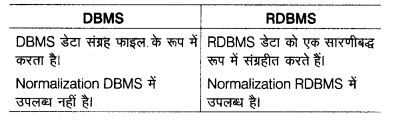
DBMS व RDBMS में बीच कोई दो अन्तर बताइए। (2017)
उत्तर
DBMS व RDBMS के बीच अन्तर निम्न प्रकार है
UP Board Solutions for Class 12 Computer Chapter 17 डाटाबेस कन्सेप्ट img-1

लघु उत्तरीय प्रश्न ।।

प्रश्न 1.
डाटाबेस से आप क्या समझते हैं? (2010)
अथवा
डाटाबेस की अवधारणा तथा सिद्धान्तों का वर्णन कीजिए !(2008)
अथवा
डाटाबेस क्या है? उनके गुणों व अवगुणों का वर्णन कीजिए| (2012)
अथवा
DBMS की प्रमुख विशेषताओं का वर्णन कीजिए। (2014)
उत्तर
किसी कार्य विशेष से सम्बन्धित सूचनाओं/डाटा का व्यवस्थित रूप से एकत्रीकरण ही डाटाबेस कहलाता है। डाटाबेस डाटा फाइल्स का एक ऐसा समूह है, जो एकीकृत फाइल सिस्टम (Integrated file system) की भाँति होता है तथा डाटा के डुप्लीकेशन (Duplication) को कम करता है, साथ ही कोई भी वांछित सूचना सरलता से एक्सेस करता है।
इस एकीकृत फाइल सिस्टम में अनेक फाइल्स एक दूसरे से सम्बद्ध होते हुए भी पूर्णता का आभास प्रदान करती हैं। टेलीफोन डायरेक्ट्री, इसका एक अच्छा उदाहरण हैं।
उदाहरण यदि आपने किसी इण्डेक्स्ड एड्रेस बुक (Indexed address book) में अपने जानने वाले व्यक्तियों के नाम, टेलीफोन नम्बर एवं एड्रेस को लिख रखा है, तो इसे एक डाटाबेस कहा जा सकता हैं।

DBMS की मुख्य विशेषताएँ निम्नलिखित हैं

  1. डाटाबेस का निर्माण करना।
  2. नए डाटा को सम्मिलित करना या जोड़ना।
  3. वर्तमान डाटा को सम्पादित करना।
  4. डाटा को अस्थायी एवं स्थायी रूप से डिलीट करना।

प्रश्न 2.
नॉर्मलाइजेशन से आप क्या समझते हैं? 2NF क्या है और उसके लाभ व हानियाँ क्या है? (2010, 08)
अथवा
विभिन्न प्रकार के नॉर्मलाइजेशन के लाभ क्या है? (2012)
अथवा
नॉर्मलाइजेशन क्या है? इससे प्राप्त लाभ को लिखें।
अथवा
नॉर्मलाइजेशन का वर्णन कीजिए। द्वितीय नॉर्मल फॉर्म को समझाइट। (2015, 10)
उत्तर
रिलेशनल मॉडल के अन्तर्गत नॉर्मलाइजेशन का मुख्य कार्य डाटाबेस में होने वाली पुनरावृत्ति (Redundancy) को कम करना है। दूसरे शब्दों में, हम कह सकते हैं कि डाटा को केवल एक ही बार संग्रहीत करना चाहिए, क्योंकि डाटा को अनेक बार तथा अनेक जगह पर संग्रहीत करने में समय व स्टोरेज दोनों का ही व्यय होता है। डाटा को नॉर्मलाइज करने के लिए टेबल को अन्य टेबल में विभक्त किया जाता है।

(ii) द्वितीय नॉर्मल फॉर्म कोई भी सारणी द्वितीय नॉर्मल फॉर्म (2NF) में तब कहलाई जाती है, जब वह सारणी प्रथम नॉर्मल फॉर्म में हो तथा प्रत्येक एट्रिब्यूट जोकि Non-key है, प्राइमरी की पर फंक्शनली डिपेण्डेण्ट हो।
Table : Employee

Emp_No Name Designation
25 Rakesh Computer Operator
26 Manish Manager
27 Rakesh Computer Program

इस टेबल में प्राइमरी की Emp_No है, यहाँ पर एट्रिब्यूट प्राइमरी की पर फंक्शनली डिपेण्डेण्ट नहीं है, इसलिए इसे निम्न प्रकार से विभक्त करेंगे

Emp_No Name
25 Rakesh
26 Manish
27 Rakesh
Emp_No Designation
25 Computer Operator
26 Manager
27 Computer Program

अब इस प्रकार से बनी टेबल में कोई Designation हटाया जाता है, तो डाटा नष्ट नहीं होगा।
नॉर्मलाइजेशन से निम्न प्रकार के लाभ होते हैं।

  1. यह डाटा की होने वाली पुनरावृत्ति को कम करता है तथा यह आकार में छोटा होता है, इसलिए इसे स्टोर करने के लिए कम मैमोरी की आवश्यकता होती है।
  2. डाटा की पुनरावृत्ति नहीं होती, डाटा की एक से अधिक विभिन्न प्रतियों को स्टोर करने की सम्भावना कम होती है।

नॉर्मलाइजेशन के प्रयोग से निम्न हानियाँ हैं

  1. डाटा को नॉर्मलाइज्ड करने के लिए अधिक मैमोरी की आवश्यकता होती है।
  2. डाटाबेस में अधिक टेबल होती है, जिन्हें जोड़ना कठिन होता है।

प्रश्न 3.
नॉर्मलाइजेशन के विभिन्न प्रकारों का उदाहरण सहित वर्णन कीजिए। (2010)
उत्तर
यहाँ अनेक प्रकार के नॉर्मल फॉर्म परिभाषित हैं।
(i) प्रथम नॉर्मल फॉर्म डाटा को नॉर्मलाइज करने की प्रक्रिया 1NF से ही आरम्भ होती है। कोई भी टेबल प्रथम नॉर्मल फॉर्म में होती है, यदि कोई भी दो रॉ (Row) एक समान नहीं हो तथा प्रत्येक कोष्ठक में केवल एक ही मान रखा हो।
Table : Course

Course_id Course_Name College
101 BCA Deewan
102 BBA GBIT
103 MCA IIMT

उपरोक्त सारणी में प्रस्तुत टेबल 1NF में है, जहाँ प्रत्येक कोष्ठक में एक मान है।

(ii) द्वितीय नॉर्मल फॉर्म इसके लिए लघु उत्तरीय प्रश्न II का प्रश्न 2 देखें।
(iii) तृतीय नॉर्मल फॉर्म कोई भी टेबल तृतीय नॉर्मल फॉर्म (3NF) में तब माना जाता है, जब वह द्वितीय नॉर्मल फॉर्म (2NF) में हो तथा प्रत्येक एट्रिब्यूट Non-key हो, जो केवल प्राइमरी की पर फंक्शनली डिपेण्डेन्ट
हो और किसी पर नहीं। उपरोक्त टेबल Designate को निम्न प्रकार से विभक्त करेंगे।

Desig_No Designation
1 Computer Operator
2 Manager
3 Computer program
Desig_No Emp_No
1 25
2 26
3 27

Normality formula is defined as the number of grams that is equal to the solute mixed in per liter of the solution.

प्रश्न 4.
बॉयस-कोड नॉर्मल फॉर्म (BCNF Boyce-Codd Normal Form) से आपका क्या तात्पर्य है? उदाहरण सहित वर्णन करें। (2008)
उत्तर
BCNF, 3NF का एडवान्स वर्ज़न है। एक टेबल BCNF’ में तब मानी जाती है जब वह 3NF में हो तथा प्रत्येक फंक्शनल डिपेण्डेन्सी में प्रथम टेबल की सुपर की हो।
सारणी को BCNF में होने के लिए निम्न आवश्यकताएँ हैं।
(i) दी गई सारणी में अनेक कैण्डिडेट की हो।
(ii) जहाँ अनेक कैण्डिडेट की कम्पोजिट की (Key) की तरह कार्य करती है।
(iii) जहाँ कैण्डिडेट की एक-दूसरे को ओवरलैप (Overlap) करती है।
(iv) जहाँ एक एट्रिब्यूट समान होता है।
(v) रिलेशन तब BCNF में कहलाया जाता है, जब प्रत्येक डिटरमिनेण्ट एक कैण्डिडेट हो।

सारणी को BCNF में बदलने के लिए
Table : Project

E_Code Proj_Code Dept Depthead Hours
E101 P27 System E901 90
E305 P27 Finance E909 10
E508 P51 Admin E908 NULL
E101 P51 System E901 101
E101 P20 System E901 60
E508 P27 Admin E908 72

सारणी से Overlapping एट्रिब्यूट को ढूंढिए और Remove कीजिए और कैण्डिडेट की के part को तथा एट्रिब्यूट को जिस पर फंक्शनली डिपेण्डेण्ट हो, दूसरी सारणी में रख दीजिए और बचे हुए एट्रिब्यूट को ग्रुप कर दीजिए। यहाँ पर Dept, E_Code पर डिपेण्डेण्ट है, इसलिए इसे एक सारणी में रखिए।

E_code Dept
E101 System
E305 Finance
E508 Admin
E101 System
E101 System
E508 Admin

Depthead भी E_Code तथा Dept पर डिपेण्डेण्ट है, लेकिन E_Code कॉमन एट्रिब्यूट है, इसलिए इसे हटा दीजिए।

Depthead Dept
E901 System
E909 Finance
E908 Admin
E901 System
E901 System
E908 Admin

प्रश्न 5.
SQL पर संक्षिप्त टिप्पणी लिखो। (2016, 14, 10, 07, 06)
अथवा
SQL क्या है? इस पर की जाने वाली डाटा सम्बन्धित मुख्य क्रियाओं को समझाइए।
अथवा
SQL क्या है? किसी उच्चस्तरीय भाषा से यह कैसे भिन्न है? (2008)
अथवा
विस्तार में sQL की व्याख्या करें। (2018)
उत्तर
एस-क्यू-एल (SQL) का पूरा नाम स्ट्रक्चर्ड क्वेरी लैंग्वेज (Structured Query Language) है। यह एक हाई लेवल लैंग्वेज है, जिसका प्रयोग डाटाबेस एवं इससे सम्बन्धित ऑब्जेक्टस; जैसे-टेबल्स (Tables), क्वेरीज (Queries), व्यूज (Views) इत्यादि को क्रिएट (Create) करने, टेबल के स्ट्रक्चर (Structure) को परिवर्तित करने, टेबल में डाटा को इन्सर्ट (Insert), अपडेट (Update) एवं डिलीट (Delete) करने में किया जाता है।
डाटाबेस पर की जाने वाली डाटा सम्बन्धी मुख्य क्रियाएँ निम्न प्रकार हैं।

  1. इन्सर्ट इसका अर्थ होता है-किसी टेबल में डाटा को जोड़ना।
  2. डिलीट इसका अर्थ होता है-किसी टेबल से अवांछित रॉज अथवा रिकॉर्ड्स को मिटाना।
  3. अपडेट इसका अर्थ है-किसी टेबल या व्यू में स्टोर डाटा को अपडेट अर्थात् मॉडिफाइ करना।

SQL एक उच्चस्तरीय भाषा ही है, लेकिन इसमें कुछ अन्तर भी है; जैसे –

  1. इसमें डाटा की पुनरावृत्ति को कम किया जाता है।
  2. इसमें विभिन्न प्रकार की कमाण्ड प्रयोग की जाती है; जैसे- डिलीट, इन्सर्ट, अपडेट आदि।
  3. प्रयोगकर्ता की आवश्यकतानुसार पहले से उपलब्ध डाटाबेस में से डाटा को रिट्रीव (Retrieve) कर सकते हैं।

दीर्घ उत्तरीय प्रश्न

प्रश्न 1.
डाटा क्या है? डाटाबेस क्या है? हमें डाटाबेस की आवश्यकता क्यों होती है? रिलेशनल डाटाबेस की विशेषताएँ समझाइए। (2006)
उत्तर
किसी वस्तु, व्यक्ति या समूह के बारे में किसी तथ्य अथवा जानकारी को डाटा कहा जाता है। किसी व्यक्ति का नाम, किसी वस्तु का वजन तथा मूल्य, किसी कक्षा के विद्यार्थियों की उम्र आदि ये सभी डाटा के उदाहरण हैं। डाटाबेस, सूचनाओं (या डाटा) का एक ऐसा व्यवस्थित संग्रह (Organised collection) होता है, जिससे हम किसी भी सूचना को सरलता से प्राप्त कर सकते हैं। डाटाबेस व्यवस्थित इसलिए होता है, क्योंकि इसमें किसी भी डाटा या सूचना को एक निश्चित स्थान पर पहले से तय किए हुए रूप में रखा जाता है, ताकि कभी भी आवश्यकता पड़ने पर उसे आसानी से ढूँढ़कर देखा जा सके।

डाटाबेस की आवश्यकता
हाथ से बनाए गए डाटाबेस (हस्तचालित डाटाबेस) में बहुत-सी समस्याएँ होती है; जैसे –

  1. नया डाटा जोड़ने की समस्या
  2. डाटा को बदलने की समस्या
  3. डाटा को अपनी शर्तों के अनुसार प्राप्त करने की समस्या आदि।

इन सभी समस्याओं को दूर करने के लिए कम्प्यूटरीकृत डाटाबेस का निर्माण किया गया। इसमें सभी सूचनाएँ कम्प्यूटर पर रखी जाती हैं और कम्प्यूटर की सहायता से ही उनका रख-रखाव तथा प्रोसेसिंग की जाती है।
कम्प्यूटर पर डाटाबेस बनाने के कई कारण हैं, जो निम्नलिखित हैं

  1. कम्प्यूटर पर बड़े आकार का डाटाबेस सरलता से बनाया जा सकता है, क्योंकि उसमें डाटा को संग्रहीत करने की क्षमता अधिक होती है।
  2. कम्प्यूटर की कार्य करने की गति तेज होने के कारण कितने भी बड़े डाटाबेस में से कोई भी इच्छित सूचना निकालना और डाटाबेस पर विभिन्न क्रियाएँ करना आदि कार्य बहुत कम समय में ही सम्पन्न हो । जाते हैं। इतना ही नहीं, तेज गति के कारण उस पर कोई लम्बी-चौड़ी रिपोर्ट निकालना और छापना मिनटों का कार्य होता है।
  3. इसमें हस्तचालित डाटाबेस की तुलना में बहुत कम खर्च आता है।
    रिलेशनल डाटाबेस की विशेषताएँ निम्नलिखित हैं।

रिलेशनल डाटाबेस की विशेषताएँ
रिलेशनल डाटाबेस को विशेषताएँ निम्न हैं

  1. डाटाबेस की प्रत्येक फाइल में एक ही तरह के रिकॉर्ड होते हैं।
  2. डाटाबेस की फाइल में प्रत्येक रिकॉर्ड के फील्डों की संख्या समान होती है।
  3. टेबल के प्रत्येक रिकॉर्ड का एक विशेष आइडेण्टीफायर होता है।

प्रश्न 2.
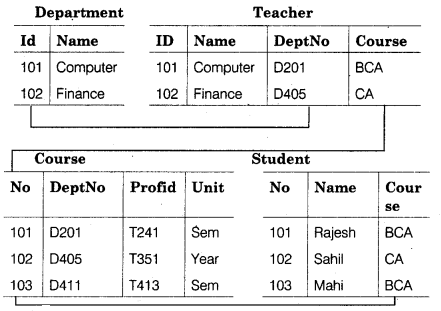
रिलेशनल डाटाबेस मॉडल को विस्तार से समझाएँ। (2018)
उत्तर
रिलेशनल डाटा मॉडल में, डाटा सारणियों के रूप में संग्रहीत किया जाता है। इन डाटा सारणियों में स्तम्भ, सारणी में स्टोर होने वाले डेटा के प्रकार को तथा पंक्तियाँ डेटा को दर्शाती हैं। यह मॉडल डाटाबेस संरचना को सरल बना देता है। इसमें सारणियों (Tables) का उपयोग किया जाता है अर्थात् डाटा को द्विविमीय टेबल्स के रूप में स्टोर किया जाता है। टेबल्स को एक-दूसरे से सम्बद्ध किया जाता है। इसमें पॉइण्टर नहीं होता। टेबल्स में कोई भौतिक सम्बन्ध भी नहीं होता।
UP Board Solutions for Class 12 Computer Chapter 17 डाटाबेस कन्सेप्ट img-2
रिलेशनल डाटा मॉडल के लाभ निम्न हैं

  1. टेबल के रूप में संरचना साधारण होती है, जिसे समझना आसान है।
  2. टेबल्स में डाटा पर सभी प्रकार की क्रियाएँ करना सरल है।
  3. टेबल्स में गणितीय क्रियाएँ करना भी सम्भव होता है।
  4. रिलेशनल डेटाबेस मैनेजमेण्ट सिस्टम में एक क्वेरी लैंग्वेज उपलब्ध होती है।
  5. यह डाटा संगठन बहुत फ्लेक्सिबल है।

प्रश्न 3.
रिलेशनल डाटाबेस मैनेजमेण्ट सिस्टम क्या है? इसके क्या लाभ हैं? समझाइए (2007)
अथवा
RDBMS पर निबन्ध लिखिए। (2014, 13)
उत्तर
रिलेशनल डाटाबेस में, डाटा को द्वि-आयामी सारणियों के रूप में संग्रहीत किया जाता है। इन सारणियों को रिलेशन (Relation) भी कहा जाता है। रिलेशन डाटाबेस के रख-रखाव के लिए रिलेशनल डाटाबेस मैनेजमेण्ट सिस्टम (Relational Database Management System-RDBMS) की आवश्यकता होती हैं।

RDBMS, DBMS का ही एक प्रकार है। रिलेशनल डाटाबेस की मुख्य विशेषता यह है कि एकल डाटाबेस में एक से अधिक सारणियों को संग्रहीत किया जा सकता है और ये सारणियाँ आपस में सम्बन्धित होती है। रिलेशनल डाटाबेस एक ऐसा डाटाबेस है, जोकि रिलेशनल मॉडल पर आधारित है। इस मॉडल के अनुसार, डाटा को विभिन्न टेबल्स में संग्रहीत किया जा सकता हैं।
इस प्रकार के मॉडल के मुख्य गुण निम्नलिखित हैं।
(i) प्रत्येक टेबल के सभी रिकॉर्ड्स का स्ट्रक्चर एक जैसा ही होगा।
(ii) प्रत्येक टेबल के सभी रिकॉर्ड्स के एट्रिब्यूट की संख्या एक जैसी ही होगी।
(iii) टेबल के प्रत्येक रिकॉर्ड का कोई-न-कोई आइडेण्टीफायर होता है। यदि Students का डाटा संग्रहीत करना हो

Roll_No Name Address
1 Rajesh Delhi
2 Ravi Mumbai
3 Manish Kolkata
4 Sagar Meerut
5 Nitin Modipuram

रिलेशनल डाटाबेस की कुछ सम्बन्धित पदावली निम्नलिखित हैं।

  1. रिलेशन (Relation) इसके अन्तर्गत एक टेबल (Table) तैयार की जाती है, जो एक सिक्वेन्शियल फाइल को निरूपित करती है, जिसमें टेबल की पंक्तियाँ (Rows) फाइल के रिकॉर्ड को इण्डीकेट करती हैं, एवं स्तम्भ (Column) रिकॉर्ड के फील्ड को दर्शाता है। ये टेबल्स रिलेशन ही होते हैं। रिलेशन को उच्चस्तरीय फाइल्स के रूप में समझा जाता हैं।
    • प्रत्येक रिलेशन में एक ही तरह के रिकॉर्ड होते हैं।
    • किसी दिए गए रिलेशन में प्रत्येक रिकॉर्ड के फील्डों की संख्या समान होती है।
    • प्रत्येक रिकॉर्ड का एक अलग पहचानने वाला आइडेण्टीफायर (Identifier) होता है।
    • रिलेशन के अन्दर रिकॉर्ड किसी विशेष क्रम में व्यवस्थित होते हैं।
  2. टपल (Tuplo) रिलेशन में प्रत्येक रिकॉर्ड को टपल कहा जाता है।
  3. एट्रिब्यूट (Attribute) रिलेशन के सन्दर्भ में प्रत्येक कॉलम् (फील्ड) को एट्रिब्यूट कहते हैं।
  4. डोमेन (Domain) रिलेशन के सन्दर्भ में डोमेन मानों का एक समूह होता है, जिससे किसी कॉलम में दिए गए वास्तविक मानों को व्युत्पन्न किया जा सकता है।

प्रश्न 4.
नॉर्मलाइजेशन का मुख्य कार्य क्या है? प्रथम तथा द्वितीय नॉर्मल फॉर्म को उदाहरण सहित समझाइए। (2006)
उत्तर
यहाँ अनेक प्रकार के नॉर्मल फॉर्म परिभाषित हैं।
(i) प्रथम नॉर्मल फॉर्म डाटा को नॉर्मलाइज करने की प्रक्रिया 1NF से ही आरम्भ होती है। कोई भी टेबल प्रथम नॉर्मल फॉर्म में होती है, यदि कोई भी दो रॉ (Row) एक समान नहीं हो तथा प्रत्येक कोष्ठक में केवल एक ही मान रखा हो।
Table : Course

Course_id Course_Name College
101 BCA Deewan
102 BBA GBIT
103 MCA IIMT

उपरोक्त सारणी में प्रस्तुत टेबल 1NF में है, जहाँ प्रत्येक कोष्ठक में एक मान है।

(ii) द्वितीय नॉर्मल फॉर्म इसके लिए लघु उत्तरीय प्रश्न II का प्रश्न 2 देखें।
(iii) तृतीय नॉर्मल फॉर्म कोई भी टेबल तृतीय नॉर्मल फॉर्म (3NF) में तब माना जाता है, जब वह द्वितीय नॉर्मल फॉर्म (2NF) में हो तथा प्रत्येक एट्रिब्यूट Non-key हो, जो केवल प्राइमरी की पर फंक्शनली डिपेण्डेन्ट
हो और किसी पर नहीं। उपरोक्त टेबल Designate को निम्न प्रकार से विभक्त करेंगे।

Desig_No Designation
1 Computer Operator
2 Manager
3 Computer program
Desig_No Emp_No
1 25
2 26
3 27

We hope the UP Board Solutions for Class 12 Computer Chapter 17 डाटाबेस कन्सेप्ट will help you. If you have any query regarding UP Board Solutions for Class 12 Computer Chapter 17 डाटाबेस कन्सेप्ट, drop a comment below and we will get back to you at the earliest.

UP Board Solutions for Class 9 Science Chapter 1 Matter in Our Surroundings

UP Board Solutions for Class 9 Science Chapter 1 Matter in Our Surroundings (हमारे आस-पास के पदार्थ)

पाठ्य-पुस्तक के प्रश्नोत्तर

पाठगत प्रश्न (पृष्ठ संख्या-4)

प्रश्न 1.
निम्न में से पदार्थ छाँटो-कुर्सी, वायु, स्नेह, गन्ध, घृणा, बादाम, विचार, शीत, शीतल पेय, इत्र की सुगन्ध।
उत्तर-
पदार्थ निम्न हैं-कुर्सी, वायु, बादाम तथा शीतल पेय पदार्थ, यह सभी स्थान घेरते हैं तथा इन सभी का द्रव्यमान होता है।

UP Board Solutions

प्रश्न 2.
निम्नलिखित प्रेक्षण के कारण बताइए : गरमा-गरम खाने की गंध कई मीटर दूर से ही आपके पास पहुँच जाती है, लेकिन ठंडे खाने की महक लेने के लिए आपको उसके पास जाना पड़ता है।
उत्तर-
किसी पदार्थ की गंध या महक हमें तब अनुभव होती है जब गंध के कण वायु में मिश्रित होकर हमारी नाक तक पहुँचते हैं। यह भी जानते हैं कि कणों का विसरण किसी माध्यम में (UPBoardSolutions.com) उच्च ताप पर अधिक तथा निम्न ताप पर कम होता है। इसलिए गरमा-गरम खाने की गंध तेजी के साथ कई मीटर दूर तक पहुँच जाती है। लेकिन ठंडे खाने की गंध लेने के लिए हमें उसके पास जाना पड़ता है।

प्रश्न 3.
स्वीमिंग पूल में गोताखोर पानी काट पाता है। इससे पदार्थ का कौन-सा गुण प्रेक्षण होता है?
उत्तर-
स्वीमिंग पूल में गोताखोर पानी काट पाता है। क्योंकि जल के कणों के मध्य आकर्षण बल होता है जो कणों को साथ-साथ रखता है।

प्रश्न 4.
पदार्थ के कणों की क्या विशेषताएँ होती हैं?
उत्तर-
पदार्थ के कणों की विशेषताएँ

  1. पदार्थ के कणों के मध्य एक आकर्षण बल उपस्थित होता है।
  2. पदार्थ के कणों के मध्य (UPBoardSolutions.com) पर्याप्त रिक्त स्थान होता है।
  3. पदार्थ के कण निरन्तर गतिशील होते रहते हैं।
  4. पदार्थ के तीन रूप ठोस, द्रव और गैस हैं। पदार्थ की ये अवस्थाएँ उसके कणों की विभिन्न विशेषताओं के कारण होती हैं।

पाठगत प्रश्न (पृष्ठ संख्या – 6)

प्रश्न 1.
किसी तत्त्व के द्रव्यमान प्रति इकाई आयतन को घनत्व कहते हैं। (घनत्व = द्रव्यमान/ आयतन) घनत्व बढ़ने के साथ निम्नलिखित को आरोही क्रम में लिखो -वायु, चिमनी का , शहद, पानी, चॉक, रूई और लोहा।
उत्तर-
घनत्व के बढ़ते क्रम में पदार्थ :
वायु < चिमनी का धुआँ < रुई < पानी < शहद < चॉक < लोहा।

UP Board Solutions

प्रश्न 2.
(a) पदार्थ की विभिन्न अवस्थाओं के गुणों में होने वाले अंतर को तालिकाबद्ध कीजिये।
उत्तर-
(a) पदार्थ की विभिन्न अवस्थाओं में निम्नलिखित अन्तर पाये जाते हैं-
UP Board Solutions for Class 9 Science Chapter 1 Matter in Our Surroundings image - 1
(b) निम्नलिखित पर टिप्पणी कीजिए-दृढ़ता, संपीड्यता, तरलता, बर्तन में गैस का भरना, आकार, गतिज ऊर्जा एवं घनत्व।
उत्तर-
(i) दृढ़ता : दृढ़ता पदार्थों का वह गुण है। जिसके कारण बाह्य बल लगाने पर भी पदार्थ अपना आकार नहीं बदलते परन्तु बल लगाने पर वे टूट जाते हैं, जैसे ठोस पदार्थ दृढ़ होते हैं।

(ii) संपीड्यता : संपीड्यता का अर्थ है कि पदार्थ पर बल लगाने पर उसके कण एक-दूसरे के समीप आ जाएँ जिससे उसका आयतन कम हो जाये। ठोस पदार्थों को तथा द्रवों का संपीडन नहीं किया जा सकता। गैसों को आसानी से संपीडित किया जा सकता है।

(iii) तरलता : तरलता का अर्थ है बहाव। ऐसे पदार्थ जो बह सकते हैं तरल या द्रव पदार्थ कहलाते हैं। कुछ पदार्थ आसानी से बहते हैं जैसे जल, दूध आदि परन्तु कुछ पदार्थ धीरे बहते हैं जैसे शहद, ग्लिसरीन।।

(iv) बर्तन में गैस का भरना : गैसों को आसानी से संपीडित किया जा सकता है इसलिए गैसों के अत्यधिक आयतन को एक कम आयतन वाले सिलेण्डर में संपीडित करके (UPBoardSolutions.com) भरा जा सकता है जैसे द्रवित पैट्रोलियम गैस (L.P.G.), अस्पतालों में दिये जाने वाले ऑक्सीजन सिलेण्डरों में भी सपीडित करके गैस को भरा जाता है। इसी प्रकार संपीडित प्राकृतिक गैस (C.N.G.) को भी अधिक ताप पर गैस सिलेण्डरों में भरा जाता है।

(v) आकार : यदि पदार्थ के कणों के बीच आकर्षण बल बहुत अधिक हो तो उनका आकार निश्चित होता है, जैसे ठोस पदार्थों का आकार निश्चित होता है। परन्तु तरल पदार्थ के कणों के मध्य आकर्षण बल कम होने के कारण आकार निश्चित नहीं होता। वे उसी बर्तन का आकार ग्रहण कर लेते हैं जिसमें उन्हें रखा जाता है। इसी प्रकार गैसीय पदार्थों का आकार भी निश्चित नहीं होता है।

(vi) गतिज ऊर्जा एवं घनत्व : पदार्थ के कण सदैव गतिशील रहते हैं जिनके कारण उनमें गतिज ऊर्जा होती है। ठोस पदार्थों के कणों की गतिज ऊर्जा बहुत कम होती है तरल पदार्थों में ठोस पदार्थों से अधिक तथा गैसीय पदार्थ की गतिज ऊर्जा सबसे अधिक होती है।
घनत्व किसी पदार्थ के एक इकाई आयतन का द्रव्यमान होता है। सामान्यतः येस पदार्थों का घनत्व अधिक होता है। गैसीय पदार्थों के कणों के मध्य खाली स्थान बहुत अधिक होता (UPBoardSolutions.com) है इनकी गतिज ऊर्जा भी बहुत अधिक होती है परन्तु इनका घनत्व ठोस तथा द्रवों की अपेक्षा बहुत कम होता है।

UP Board Solutions

प्रश्न 3.
कारण बताएँ
(a) गैस पूरी तरह उस बर्तन को भर देती है, जिसमें इसे रखते हैं।
(b) गैस बर्तन की दीवारों पर दबाव डालती है।
(c) लकड़ी की मेज ठोस कहलाती है।
(d) हवा में हमें आसानी से अपना हाथ चला सकते हैं, लेकिन एक ठोस लकड़ी के टुकड़े में हाथ चलाने के लिए हमें कराटे में दक्ष होना पड़ेगा।
उत्तर-
(a) गैस पूरी तरह उस बर्तन को भर देती है। जिसमें उसे हम रखते हैं क्योंकि उच्च गतिज ऊर्जा तथा नगण्य आकर्षण बलों के कारण, गैस के अणु उच्च वेग से सभी दिशाओं में गतिशील होते रहते हैं।
(b) तेजी से गति करते हुए, जब गैस के अणु बर्तन की दीवारों से टकराते हैं, वे दाब डालते रहते हैं। गैस द्वारा डाला गया दाब तेजी से गति करने वाले गैस-अणुओं की बर्तन की दीवारों से टक्करों के कारण होता है।
(c) लकड़ी की मेज ठोस कहलाती है, क्योंकि इसका (UPBoardSolutions.com) आकार तथा आयतन निश्चित होता है।
(d) हवा में हाथ आसानी से चला सकते हैं क्योंकि हवा के अणु आसानी से काटे जा सकते हैं। ऐसा इसलिए होता है क्योंकि कणों के बीच बहुत कम बल लगी होता है। जबकि लकड़ी के कणों के बीच बहुत कम स्थान होता है,
अत: उनके बीच अत्यधिक बल लगा होता है। उसमें हाथ चलाने के लिए हमें कराटे में दक्ष होना पड़ेगा।

प्रश्न 4.
सामान्यतया ठोस पदार्थों की अपेक्षा द्रवों का घनत्व कम होता है। लेकिन आपने बर्फ के टुकड़े को पानी पर तैरते देखा होगा। पता लगाइए ऐसा क्यों होता है?
उत्तर-
बर्फ का टुकड़ा पानी पर तैरता है क्योंकि यह अपने अधिक आयतन के कारण अपने द्रव्यमान से अधिक पानी हटा सकता है। इसीलिए बर्फ का टुकड़ा तैरता रहता है। बर्फ का आयतन अपने उस जल से जिससे वह बना होता है अधिक होता है।

पाठगत प्रश्न (पृष्ठ संख्या 9)

प्रश्न 1.
निम्नलिखित तापमान को सेल्सियस में बदलें-
(a) 300 K
(b) 573 K
उत्तर-
(a) K = °C + 273
°C = K – 273 = 300 – 273 = 27°C
(b) K = °C + 273
°C = K – 273 = 573 – 273 = 200°C

प्रश्न 2.
निम्नलिखित ताप पर जल की भौतिक अवस्था क्या होगी ?
(a) 250°C
(b) 100°C
उत्तर-
(a) 250°C ताप पर जल गैसीय अवस्था में बदल जायेगा।
(b) 100°C ताप पर जल द्रव तथा गैसीय अवस्था में बदल जायेगा।

प्रश्न 3.
किसी भी पदार्थ की अवस्था परिवर्तन के दौरान तापमान स्थिर क्यों रहता है?
उत्तर-
किसी पदार्थ का ताप बढ़ाने पर वह एक निश्चित ताप पर अवस्था में परिवर्तन करके दूसरी भौतिक अवस्था प्राप्त कर लेता है। अब इसका ताप स्थिर रहता है क्योंकि अब समस्त (UPBoardSolutions.com) ऊष्मा अवस्था परिवर्तन में काम आती है तथा यह तब तक रहता है जब तक पदार्थ एक अवस्था से दूसरी अवस्था में पूर्ण रूप से न बदल जाए, ऐसी ऊष्मा को पदार्थ की गुप्त ऊष्मा कहते हैं।

UP Board Solutions

प्रश्न 4.
वायुमंडलीय गैसों को द्रव में परिवर्तन करने के लिए कोई विधि सुझाइए।
उत्तर-
हम जानते हैं कि पदार्थ की अवस्थाएँ दाब व तापमान के द्वारा तय होती हैं। ताप कम करके व दाब बढ़ाकर पदार्थ की अवस्था परिवर्तन किया जा सकता है। वायुमण्डलीय गैस की ऊपर ऊँचाई पर ताप कम होने के कारण गैस संघनित होकर बादलों में बदल जाती है जो द्रव की छोटी-छोटी बूंदों से मिलकर बना होता है।

पाठगत प्रश्न (पृष्ठ संख्या 11)

प्रश्न 1.
गर्म, शुष्क दिन में कूलर अधिक ठंडा क्यों करता है ?
उत्तर-
कूलर के आधार में एक पानी भरने का बर्तन होता है। घनाकार बर्तन के एक फलक पर पंखा लगाया जाता है व अन्य तीन फलकों पर घास की चटाई। उन पर एक युक्ति का प्रयोग कर पानी गिराया जाता है, पंखा बाहरी हवा को अंदर खींचता है और पानी का वाष्पन होता है जिसके लिए वह (UPBoardSolutions.com) ऊष्मा अन्दर आने वाली हवा से ग्रहण करता है और हवा ठंडी हो जाती है।

प्रश्न 2.
गर्मियों में घड़े का जल ठंडा क्यों होता है?
उत्तर-
मिट्टी से बने घड़े में छोटे-छोटे छिद्र होते हैं। जिनसे घड़े में भरा पानी रिसकर बाहर आ जाता है तथा वायुमंडल की गर्म वायु के संपर्क में आकर वाष्पीकृत हो जाता है। जल के वाष्प में परिवर्तित होने के लिए आवश्यक ऊष्मीय ऊर्जा घड़े के भीतर वाले जल से प्राप्त होती है। इससे घड़े के भीतर उपस्थित जल ठंडा हो जाता है।

प्रश्न 3.
ऐसीटोन/पेट्रोल या इत्र डालने पर हमारी हथेली ठंडी क्यों हो जाती है ?
उत्तर-
ऐसीटोन/पेट्रोल या इत्र शीघ्रता से वाष्पीकृत हो जाते हैं। जब इन पदार्थों को हथेली पर डाला जाता है | तो यह हथेली से ऊर्जा प्राप्त कर लेते हैं तथा वाष्पीकृत
हो जाते हैं। ऊर्जा (ताप) के रूस से हमारी हथेली ठंडी | हो जाती है।

प्रश्न 4.
कप की अपेक्षा प्लेट से हम गर्म दूध या चाय जल्दी क्यों पी लेते हैं ?
उत्तर-
वाष्पीकरण या वाष्पन एक सतही प्रक्रिया है। प्लेट की खुली सतह का क्षेत्रफल कप के क्षेत्रफल से | अधिक होता है, अतः प्लेट में दूध या चाय का वाष्पीकरण कप की अपेक्षा तेजी से होता है, व वे जल्दी ठंडे हो जाते हैं।

UP Board Solutions

प्रश्न 5.
गर्मियों में हमें किस प्रकार के कपड़े पहनने चाहिए ?
उत्तर-
गर्मियों में हमें सूती कपड़े पहनने चाहिए। पसीने के वाष्पीकरण के दौरान पसीना हमारे शरीर या आसपास से ऊर्जा प्राप्त करके वाष्प में बदल जाता है। वाष्पीकरण की (UPBoardSolutions.com) गुप्त ऊष्मा के बराबर ऊष्मीय ऊर्जा हमारे शरीर से अवशोषित हो जाती है जिससे शरीर ठंडा हो जाता है। चूंकि सूती कपड़ों में पसीने का अवशोषण अधिक होता है, इसलिए हमारा पसीना इसमें अवशोषित होकर वायुमंडल में आसानी से वाष्पीकृत हो जाता है।

अभ्यास प्रश्न (पृष्ठ संख्या-13-14)

प्रश्न 1.
निम्नलिखित तापमानों को सेल्सियस इकाई में परिवर्तित करें :
(a) 293 K
(b) 470 K
उत्तर-
(a) °C = K – 273 = 293 – 273 = 20°C
(b) °C = K – 273 = 470 – 273 = 197°C

प्रश्न 2.
निम्नलिखित तापमानों को केल्विन इकाई में परिवर्तित करें :
(a) 25°C
(b) 373°C
उत्तर-
(a) K = °C + 273 = 25 + 273 = 298 K
(b) K= °C + 273 = 373 + 273 = 646 K

प्रश्न 3.
निम्नलिखित अवलोकनों हेतु कारण लिखें-
(a) नैफ्थलीन को रखा रहने देने पर यह समय के साथ कुछ भी ठोस पदार्थ छोड़े बिना अदृश्य हो जाती है।
उत्तर-
नैफ्थलीन एक ऊर्ध्वपातन पदार्थ है और वह ठोस अवस्था से सीधे गैस में (बिना द्रव बने) परिवर्तित हो जाता है।
अतः कोई अवशेष नहीं बचता।

(b) हमें इत्र की गन्ध बहुत दूर बैठे हुए भी पहुँच जाती है।
उत्तर-
इत्र के कण वायु के कणों के साथ शीघ्रता से विसरित होकर वायुमण्डल में फैल जाते हैं। इसी प्रकार चारों ओर फैलने के कारण हमें कई मीटर दूर बैठे भी गन्ध पहुँच जाती है।

प्रश्न 4.
निम्नलिखित पदार्थों को उनके कणों के बीच बढ़ते हुए आकर्षण के अनुसार व्यवस्थित करें –
(a) जल
(b) चीनी
(c) ऑक्सीजन
उत्तर-
ऑक्सीजन < जल < चीनी।

UP Board Solutions

प्रश्न 5.
निम्नलिखित तापमानों पर जल की भौतिक अवस्थाएँ क्या हैं ?
(a) 25°C
(b) 0°C
(c) 100°C
उत्तर-
(a) 25°C पर पानी द्रव अवस्था में होगा।
(b) 0°C पर पानी ठोस अवस्था में होगा क्योंकि पानी 0°C पर जम जाता है।
(c) 100°C पर पानी गैसीय अवस्था में होगा क्योंकि 100°C पर पानी वाष्प अवस्था में बदल जाता है।

प्रश्न 6.
पुष्टि हेतु कारण दें
(a) जल कमरे के ताप पर द्रव है
(b) लोहे की अलमारी कमरे के ताप पर ठोस होती है।
उत्तर-
(a) पानी कक्ष-ताप पर द्रव होता है क्योंकि इसका कोई निश्चित आकार नहीं होता, इसे जिस बर्तन में डाला जाता है उसी की आकृति जैसा बन जाता है। इसका निश्चित आयतन होता है, इसे फर्श पर डालने से ढलान की ओर रहता है|
अतः हम कह सकते हैं कि कक्ष -ताप (UPBoardSolutions.com) पर पानी द्रव है।
(b) लोहे की अलमारी कठोर व असंपीड्य है, इसका आकार निश्चित है इसीलिए यह ठोस है।

प्रश्न 7.
273 K पर बर्फ को ठंडा करने पर तथा जल को इसी तापमान पर ठंडा करने पर शीतलता का प्रभाव अधिक क्यों होता है ?
उत्तर-
273 K पर पानी के कणों की अपेक्षा बर्फ के कणों की ऊर्जा कम होती है। फलतः, बर्फ वातावरण से अधिक ऊष्मा अवशोषित कर सकता है। यही कारण है कि समान ताप पर होते हुए भी बर्फ पानी की अपेक्षा अधिक ठंडक पहुँचाता है।

प्रश्न 8.
उबलते हुए जल अथवा भाप में से जलने की तीव्रता किसमें अधिक महसूस होती है ?
उत्तर-
373 K पर वाष्प के कणों की ऊर्जा समान ताप पर पानी के कणों की ऊर्जा से अधिक होती है। ऐसा वाष्प के कणों द्वारा वाष्पन की गुप्त ऊष्मा के रूप में अतिरिक्त ऊर्जा अवशोषित किए जाने के कारण होता है। अतः जब वाष्प त्वचा के संपर्क में आता है तो समान ताप पर उबलते पानी की अपेक्षा अधिक ऊर्जा मुक्त करता है। फलतः 373 K पर वाष्प द्वारा समान ताप पर उबलते पानी की अपेक्षा अधिक जलन पैदा होती है।

UP Board Solutions

प्रश्न 9.
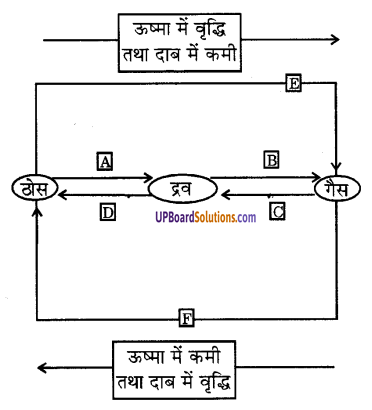
निम्नलिखित चित्र के लिए A, B, C, D, E तथा F की अवस्था परिवर्तन को नामांकित करें-
उत्तर-
UP Board Solutions for Class 9 Science Chapter 1 Matter in Our Surroundings image - 2

अति महत्वपूर्ण प्रश्नोत्तर

अतिलघु उत्तरीय प्रश्न

प्रश्न 1.
पदार्थ के कणों के आकार के विषय में आप क्या जानते हैं ?
उत्तर-
पदार्थ के कणों के आकार अत्यन्त सूक्ष्म हैं।

प्रश्न 2.
दो पदार्थों के नाम लिखिए जो ऊर्ध्वपातन करते हैं।
उत्तर-
अमोनियम क्लोराइड, कपुर।

प्रश्न 3.
दो गैसों के नाम बताइए जिन्हें घरों तथा अस्पतालों में संपीडित रूप में आपूर्ति की जाती है।
उत्तर-
LPG तथा ऑक्सीजन।

प्रश्न 4.
केल्विन पैमाने पर जल का क्वथनांक तथा हिमांक लिखिए।
उत्तर-
क्वथनांक = 373K, हिमांक = 273K

प्रश्न 5.
निम्न में से कौन-से पदार्थों का निश्चित आयतन है लेकिन निश्चित आकार नहीं ?
ऑक्सीजन, शर्करा, क्रिस्टल, लकड़ी, जल, वायु।
उत्तर-
जल

UP Board Solutions

प्रश्न 6.
निम्न में से कौन-से पदार्थों को आकार व आयतन निश्चित नहीं है ?
ऑक्सीजन, शर्करा क्रिस्टल, लकड़ी, जल, वायु
उत्तर-
ऑक्सीजन तथा वायु।

प्रश्न 7.
प्राचीन भारतीय दार्शनिकों के अनुसार ‘पंचतत्त्व’ कौन-से हैं ?
उत्तर-
प्राचीन भारतीय दार्शनिकों के अनुसार ‘पंचतत्त्व’ हैं, पृथ्वी, वायु, अग्नि, जल और आकाश।

प्रश्न 8.
तरल क्या है? दो उदाहरण दीजिए।
उत्तर-
कोई भी पदार्थ जो बह सकता है और अपना आकार बदल सकता है, तरल कहलाता है, जैसे-द्रव तथा गैस।

प्रश्न 9.
जल में घुली ऑक्सीजन का एक उपयोग लिखिए।
उत्तर-
जलीय जीव जल में घुली ऑक्सीजन का उपयोग श्वसन के लिए करते हैं।

प्रश्न 10.
ठोस, द्रव एवं गैसों में किसकी संपीड्यता सबसे अधिक और किसकी सबसे कम है?
उत्तर-
गैसों की संपीड्यता सबसे अधिक और ठोसों की सबसे कम है।

प्रश्न 11.
ठोस, द्रव और गैस की दृढ़ता के घटते क्रम में व्यवस्थित कीजिए।
उत्तर-
ठोस > द्रव > गैस

प्रश्न 12.
ठोस, द्रव व गैस में से किसको खुरची | जा सकता है ?
उत्तर-
ठोस को खुरचा जा सकता है।

UP Board Solutions

प्रश्न 13.
पदार्थ के कणों में गतिज ऊर्जा क्यों होती | है ?
उत्तर-
पदार्थ के कण निरन्तर गतिशील होते हैं. इसीलिए उनमें गतिज ऊर्जा उत्पन्न होती रहती है।

प्रश्न 14.
आप जल की धार को क्यों नहीं काट | पाते?
उत्तर-
जल के कणों के मध्य एक बल कार्य करता है जो उन्हें एक साथ बाँधे रखता है।

प्रश्न 15.
दो गैसों के उदाहरण लिखिए।
उत्तर-
ऑक्सीजन एवं हाइड्रोजन

लघु उत्तरीय प्रश्न

प्रश्न 1.
पसीना आने पर हमें पंखे के पास बैठने पर ठंडक क्यों अनुभव होती है ?
उत्तर-
पसीने के वाष्पन के लिए ऊष्मा शरीर से ली जाती है। पंखे में बैठने से वाष्पन की दर बढ़ जाती है और हमें ठंडक अनुभव होती है।

प्रश्न 2.
आर्द्रता से आप क्या समझते हैं ?
उत्तर-
वायु के प्रति घन मीटर में उपस्थित जलवाष्प की मात्रा आर्द्रता कहलाती है।

प्रश्न 3.
ऊर्ध्वपातन की परिभाषा दीजिए।
उत्तर-
किसी पदार्थ का ठोस अवस्था से सीधा गैसीय अवस्था में बदलना ऊर्ध्वपातन कहलाता है।

UP Board Solutions

प्रश्न 4.
किन्हीं दो ऊर्ध्वपातन पदार्थों के नाम लिखिए।
उत्तर-
कपूर, अमोनियम क्लोराइड, नैफ्थलीन एवं शुष्क बर्फ।

प्रश्न 5.
उन कारकों को लिखिएँ जो किसी गैस को द्रवित करने में सहायक हैं।
उत्तर-
उच्च दाब व निम्न ताप दो ऐसे कारक हैं। जो किसी गैस को द्रवित करने में सहायक हैं।

प्रश्न 6.
फैला देने पर गीले कपड़े क्यों जल्दी सूखते हैं ?
उत्तर-
फैला देने पर गीले कपड़े जल्दी सूखते हैं। क्योंकि फैलाने से उनकी सतह का क्षेत्रफल बढ़ जाता है। और जल के वाष्पन की दर बढ़ जाती है।

प्रश्न 7.
गलन की गुप्त ऊष्मा क्या है ?
उत्तर-
किसी पदार्थ के 1 किग्रा को उसके गलनांक पर ठोस अवस्था से द्रव अवस्था में बदलने के लिए आवश्यक ऊष्मा, गलन की गुप्त ऊष्मा कहलाती है।

प्रश्न 8.
वाष्पन की गुप्त ऊष्मा क्या है ?
उत्तर-
किसी पदार्थ के 1 किग्रा को उसके क्वथनांक पर द्रव अवस्था से गैसीय अवस्था में बदलने के लिए आवश्यक ऊष्मा, वाष्पन की गुप्त ऊष्मा कहलाती है।

प्रश्न 9.
गुप्त ऊष्मा का मात्रक क्या है ?
उत्तर-
गुप्त ऊष्मा का मात्रक है कैलोरी प्रति ग्राम या जूल प्रति किग्रा।

प्रश्न 10.
बर्फ के गलन की गुप्त ऊष्मा क्या है?
उत्तर-
बर्फ के गलन की गुप्त ऊष्मा 80 कैलोरी/ग्राम या 335 जूल/ग्राम या 335 x 103 जूल/किग्रा है।

प्रश्न 11.
जल के वाष्पन की गुप्त ऊष्मी क्या है?
उत्तर-
जल के वाष्पन की गुप्त ऊष्मा 2260 जूल/ग्राम या 2260 x 103 जूल/किग्रा है।

UP Board Solutions

प्रश्न 12.
अन्तराणुक बलों के आधार पर ठोस, दुव तथा गैसों का वर्णन कीजिए।
उत्तर-
ठोसों में अन्तराणुक बल अत्यधिक प्रबल होते हैं ताकि इसे बनाने वाले अवयव कण इस प्रकार व्यवस्थित होते हैं कि उनके मध्य स्थान नगण्य होता है। इसी कारण ठोसों को संपीडित नहीं किया जा सकता तथा इनका घनत्व अधिक होता है।
द्रवों में अन्तराणुक बल इतने प्रबल होते हैं कि वे (UPBoardSolutions.com) अवयव कणों को एक साथ बाँधे रख सकें, लेकिन उतने प्रबल नहीं होते कि अवयव कणों की स्थिति निश्चित रख सकें। इसी कारण द्रवों का आकार निश्चित नहीं होता तथा द्रव बहते हैं। गैसों में अन्तराणुक बल नगण्य (अत्यधिक निर्बल) होते हैं। इसलिए गैसों के अवयव कण स्वतंत्र रूप से गतिशील होते हैं तथा उपलब्ध स्थान को घेर लेते हैं।

प्रश्न 13.
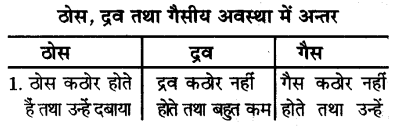
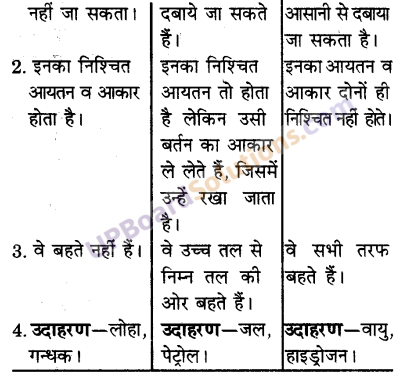
भौतिक अवस्था के आधार पर पदार्थ की विभिन्न अवस्थाएँ क्या हैं ? उनमें अन्तर कीजिए।
उत्तर-
भौतिक अवस्था के आधार पर पदार्थ की निम्नलिखित तीन अवस्थाएँ हैं-
(i) ठोस अवस्था
(ii) द्रव अवस्था
(iii) गैसीय अवस्था।
UP Board Solutions for Class 9 Science Chapter 1 Matter in Our Surroundings image - 3
UP Board Solutions for Class 9 Science Chapter 1 Matter in Our Surroundings image - 4

प्रश्न 14.
वायुमण्डलीय गैसों का विसरण जलीय जीवों के लिए किस प्रकार उपयोगी है?
उत्तर-
वायुमण्डलीय गैसें, विशेषकर, ऑक्सीजन एवं कार्बन डाइऑक्साइड, विसरण द्वारा जल में घुल जाती हैं। घुलीं हुई ऑक्सीजन का उपयोग जलीय जन्तु श्वसन के लिए करते हैं। जलीय पादप जल में घुली हुई कार्बन डाइऑक्साइड का उपयोग प्रकाश संश्लेषण द्वारा खाद्य निर्माण में करते हैं।

दीर्घ उत्तरीय प्रश्न

प्रश्न 1.
क्या होता है जब एक ठोस पदार्थ को गर्म किया जाता है ?
उत्तर-
जब एक ठोस पदार्थ को गर्म किया जाता है, तब उसका तापमान बढ़ता जाता है या उसके कणों की गतिज ऊर्जा बढ़ती जाती है जिसके कारण पदार्थ के कण अधिक तेजी से कम्पन करने लगते हैं और कणों के मध्य की दूरी बढ़ती जाती है और एक स्थिति ऐसी आती है जब ऊष्मा (UPBoardSolutions.com) द्वारा प्रदत्त ऊर्जा कणों के आकर्षण बल के बराबर हो जाती है और ठोस पिघलकर द्रव में परिवर्तित हो जाता है। यह तापमान पदार्थ का गलनांक कहलाता है।
अतः ‘‘किसी पदार्थ का गलनांक वह तापमान है। जिस पर कोई पदार्थ पिघलकर सामान्य वायुमंडलीय दाब पर द्रव में परिवर्तित हो जाता है।”
उदाहरण के लिए, बर्फ का गलनांक 273.16 K है। (सुविधा के लिए इसे हम 273 K लेते हैं।) K को ‘केल्विन’ कहते हैं।

UP Board Solutions

प्रश्न 2.
वाष्पीकरण या वाष्पन क्या है ? उन कारकों का उल्लेख कीजिए जिन पर वाष्पीकरण की दर निर्भर करती है।
उत्तर-
वाष्पीकरण या वाष्पन वह प्रक्रिया है जिसके द्वारा कोई द्रव अपने क्वथनांक से भी कम ताप पर वाष्प में परिवर्तित हो जाता है।
वायुमण्डल से ऊष्मा लेकर द्रव की खुली सतह के कण वाष्प में बदल जाते हैं। वाष्पीकरण की दर निम्न कारकों पर निर्भर करती है :
(i) द्रव की खुली सतह : द्रव को छोटे या कम खुली सतह वाले बर्तन में रखने पर वाष्पन की दर कम और चौड़े या अधिक खुली सतह वाले बर्तन में अधिक होती है।
(ii) वायु का ताप : वायुमण्डल का ताप अधिक होने पर वाष्पीकरण की दर अधिक होती है।
(iii) वायुमण्डल में उपस्थित आर्द्रता : वायुमण्डल में उपस्थित आर्द्रता या नमी कम होने पर वाष्पीकरण की दर अधिक और अधिक होने पर कम होती है।
(iv) वायु की गति में वृद्धि : जब वायु की गति बढ़ जाती है तो जलवाष्प तेजी से दूर ले जायी जाती है जिससे आस-पास के स्थान में जलवाष्प की मात्रा कम हो जाती है और वाष्पन की दर बढ़ जाती है। यह सामान्य अनुभव की बात है कि तेज वायु में कपड़े जल्दी सूखते हैं।

प्रश्न 3.
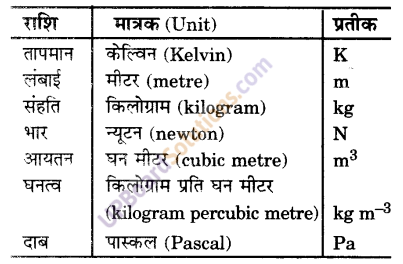
कुछ मापने योग्य राशियों के S.I. मात्रक व प्रतीक लिखिए।
उत्तर-
कुछ मापने योग्य राशियाँ, उनके S.I. मात्रक एवं प्रतीक-
UP Board Solutions for Class 9 Science Chapter 1 Matter in Our Surroundings image - 5

प्रश्न 4.
गैसें बर्तन की दीवारों पर दाब क्यों डालती हैं ? संपीडित गैसों के सामान्य उदाहरण दीजिए व उनके उपयोग लिखिए।
उत्तर-
गैसीय अवस्था में, कण सभी दिशाओं में गतिशील रहते हैं और बर्तन की दीवारों से टकराते रहते हैं। और बर्तन की दीवारों पर दाब आरोपित करते हैं। सिलिंडर में गैस उच्च दाब (Pressure) पर भरी जाती है और वह अत्यधिक संपीडित होती है। वह गैस संपीडित गैस (Compressed gas) कहलाती है। अत्यन्त उच्च दाब पर संपीडित गैस द्रवित हो जाती है, इसे द्रवीकृत गैस (Liquefied gas) (UPBoardSolutions.com) कहते हैं। उदाहरणार्थ,
(i) घरों में खाना बनाने के लिए उपयोग किये जाने वाले सिलिंडर में उच्च दाब पर पेट्रोलियम गैस भरी जाती है जिसे द्रवीकृत पेट्रोलियम गैस (Liquefied Petroleum Gas : LPG) कहते हैं।
(ii) संपीडित ऑक्सीजन (Compressed oxygen) अस्पतालों में प्रयोग की जाती है और मरीजों को दी जाती है जो सामान्य रूप से श्वसन नहीं कर पाते हैं।
(iii) संपीडित प्राकृतिक गैस (Compressed Natural Gas : CNG) का उपयोग आजकल एक स्वच्छ ईंधन (Clean fuel) के रूप में वाहन चलाने में किया जाता है।

प्रश्न 5.
विसरण क्या है ? जल में मिलाने पर किसका विसरण तेजी से होगा ठोस का या द्रव का ?
उत्तर-
विसरण : जब एक क्रिस्टल या द्रव की बूंद को जल में मिलाया जाता है, तो उसके कण धीरे-धीरे , समान रूप में जल में फैल जाते हैं। इस प्रकार हम कह सकते हैं कि जब दो अलग प्रकार के कणों वाले पदार्थ : सम्पर्क में होते हैं, तो उन पदार्थों के कणों का स्वत: मिश्रित । (intermixing) होना विसरण कहलाता है।
अतः ‘‘सम्पर्क में होने पर दो या अधिक प्रकार के कणों का स्वतः मिश्रित होना, विसरण कहलाता है।”
एक ठोस का दूसरे ठोस में विसरण संभव नहीं है या अत्यन्त कम है। एक ठोस का या एक द्रव का किसी द्रव में विसरण सामान्य प्रक्रिया है और किसी द्रव का अन्य द्रव में विसरण की दर ठोस की अपेक्षा अधिक होती है। ताप के साथ भी विसरण की दर बढ़ जाती है।

UP Board Solutions

प्रश्न 6.
बताइये क्यों गरमा-गरम खाने की गंध कई मीटर दूर से ही आपके पास पहुँच जाती है लेकिन ठंडे खाने की महक लेने के लिए आपको उसके पास जाना पड़ता है?
उत्तर-
किसी पदार्थ की गंध या महक हमें तभी अनुभव होती है जब महक के कण वायु में मिश्रित होकर हमारी नाक तक पहुँचते हैं। हम यह भी जानते हैं कि कणों को विसरण किसी माध्यम में उच्च ताप पर अधिक व निम्न ताप पर कम होता है। इसीलिए गरमा-गरम (उच्च ताप वाले) खाने की गंध तेजी के साथ कई मीटर दूर तक पहुँच जाती है लेकिन ठंडे (कम ताप वाले) खाने की गंध लेने के लिए हमें उसके पास जाना पड़ता है।

With the help of our online specific heat calculator you will be able to calculate the specific heat capacity instantly.

प्रश्न 7.
निम्न की परिभाषा दीजिए :
गुप्त ऊष्मा (Latent Heat), गलन की गुप्त ऊष्मा, वाष्पन की गुप्त ऊष्मा।
उत्तर-
गुप्त-ऊष्मा : किसी निश्चित ताप पर दी गयी ऊष्मा की वह मात्रा जो पदार्थ की भौतिक अवस्था में परिवर्तन करने के लिए दी जाती है, गुप्त ऊष्मा कहलाती है।

गलन की गुप्त ऊष्मा (Latent Heat of Fusion or Melting) : ऊष्मा की वह मात्रा जो किसी पदार्थ के 1 किग्रा को उसके गलनांक पर ठोस अवस्था से द्रव अवस्था में बदलने के लिए दी जाती है, गलन की गुप्त ऊष्मा कहलाती है। बर्फ के गलन की गुप्त ऊष्मा 80 कैलोरी/ग्राम या 335 जूल/ग्राम है।

वाष्पन की गुप्त ऊष्मा (Latent Heat of Vaporisation) : ऊष्मा की वह मात्रा जो किसी पदार्थ के 1 किग्रा को उसके क्वथनांक पर द्रव अवस्था से गैसीय| अवस्था में बदलने के लिये दी जाती है, वाष्पन की गुप्त ऊष्मा कहलाती है। भाप या वाष्पन की गुप्त ऊष्मा 540 कैलोरी/ग्राम या 2260 जूल/ग्राम है।

प्रश्न 8.
पदार्थ की अवस्था पर ताप और दाब का क्या प्रभाव पड़ता है? स्पष्ट कीजिए।
उत्तर-
ताप और दाब का पदार्थ की अवस्था पर प्रभाव पड़ता है। जब किसी ठोस को गर्म किया जाता है तो उसके कगों की गतिज ऊर्जा बढ़ जाती है। वे तेजी से कंपन करते हैं और अधिक स्थान ग्रहण करते हैं और वे फैलने लगते हैं। एक निश्चित तापमान पर वे आकर्षण के बंधन से मुक्त हो स्वतंत्रतापूर्वक घूमने लगते हैं। तब उसके अणुओं की गति नहीं बढ़ती और उनकी व्यवस्था और क्रम में परिवर्तन होने लगता है तब वे तरल अवस्था में बदल जाते हैं। तरल को गर्म करने से अणुओं का वेग बढ़ जाता है। उनकी गतिज ऊर्जा बढ़ (UPBoardSolutions.com) जाती है। तेज गति वाले अणुओं का संवेग जब उन पर भीतर की तरफ लग रहे बल से अधिक बढ़ जाता है तो वे वाष्प अवस्था में बदल जाते हैं और तरल की सतह से बाहर निकल आते हैं।

अभ्यास प्रश्न

बहुविकल्पीय प्रश्न

1. कणों के बीच सबसे कम आकर्षण बल है
(a) ठोसों में
(b) द्रवों में
(c) गैसों में
(d) इनमें से कोई नहीं

2. किसी ठोस का सीधे ही गैसीय अवस्था में बदलना कहलाता है
(a) वाष्पन।
(b) ऊर्ध्वपातन
(c) संघनन
(d) संगलन।

UP Board Solutions

3. ऊर्ध्वपातन पदार्थ हैं
(a) अमोनियम क्लोराइड
(b) नैफ्थेलीन
(c) (a) एवं (b) दोनों
(d) इनमें से कोई नहीं

4. किसी गैस को दृवित करने के लिए चाहिए
(a) उच्च ताप व दाब
(b) निम्न ताप व उच्च दाब
(c) निम्न ताप व दाब
(d) उच्च ताप व निम्न दाब

5. वाष्पीकरण वह प्रक्रम है जिसमें जल वाष्प में बदलता है
(a) 100°C पर
(b) अपने क्वथनांक पर
(c) अपने क्वथनांक से कम ताप पर
(d) कमरे के ताप परे

6. शुष्क बर्फ है
(a) बिना पानी वाली बर्फ
(b) ठोस कार्बन डाइऑक्साइड
(c) ठोस कार्बन मोनोक्साइड
(d) इनमें से कोई नहीं

7. कणों के मध्य सबसे कम स्थान होता है
(a) गैसों में
(b) द्रवों में
(c) ठोसों में ।
(d) इनमें से कोई भी नहीं

8. पदार्थ के कणों।
(a) के मध्य स्थान होता है।
(b) के मध्य आकर्षण बल होता हैं।
(c) में गतिज ऊर्जा होती है।
(d) उपर्युक्त सभी

UP Board Solutions

9. निम्न में पदार्थ नहीं है
(a) हवा
(b) गंध
(c) सर्दी
(d) शीतल पेय।

10. …….. तरल कहलाते हैं।
(a) स व द्रव
(b) द्रव व गैस
(c) ठोस व गैस
(d) ठोस, द्रव व गैस।

11. हम खुरच सकते हैं
(a) ठोस को
(b) द्रव को
(c) गैस को
(d) इनमें से कोई नहीं।

12. हम बहुत अधिक संपीडित कर सकते हैं
(a) ठोस को
(b) द्रव को
(c) गैस को
(d) इनमें से कोई नहीं।

13. ……. का आयतन निश्चित होता है, आकार नहीं।
(a) ठोस
(b) द्रव
(c) गैस
(d) इनमें से कोई नहीं।

14. बर्फ का गलनांक 0° लिया गया है
(a) फारेनहाइट पैमाने में
(b) केल्विन पैमाने में
(c) सेल्सियस पैमाने में
(d) गैलीलियो पैमाने में।

UP Board Solutions

15. आकार व आयतन निश्चित नहीं होता
(a) ठोसों में।
(b) द्रव में
(c) गैसों में
(d) इन सभी में

16. रसोईघर में प्रयोग करते हैं
(a) LPG
(b) MIC
(c) CNG
(d) ये सभी।

17. वाहनों में प्रयोग की जाती है
(a) LPG
(b) MIC
(c) CNG
(d) ये सभी।

18. बर्फ का गलनांक है
(a) 100°C
(b) 273 K
(c) 273°C
(d) 373 K

19. जल का क्वथनांक है
(a) 0°C
(b) 273 K
(c) 273°C
(d) 373 K

UP Board Solutions

20. गर्मियों में घड़े का जल निम्नलिखित प्रक्रमों में से किसके कारण ठंडा हो सकता है
(a) परासरण
(b) विसरण
(c) वाष्पोत्सर्जन
(d) वाष्पन ।

उत्तरमाला

  1. (c)
  2. (b)
  3. (c)
  4. (b)
  5. (c)
  6. (b)
  7. (c)
  8. (d)
  9. (c)
  10. (b)
  11. (a)
  12. (c)
  13. (b)
  14. (c)
  15. (c)
  16. (a)
  17. (c)
  18. (b)
  19. (d)
  20. (d)

We hope the UP Board Solutions for Class 9 Science Chapter 1 Matter in Our Surroundings (हमारे आस-पास के पदार्थ) help you. If you have any query regarding UP Board Solutions for Class 9 Science Chapter 1 Matter in Our Surroundings (हमारे आस-पास के पदार्थ), drop a comment below and we will get back to you at the earliest.

UP Board Solutions for Class 9 Social Science Economics Chapter 4 भारत में खाद्य सुरक्षा

UP Board Solutions for Class 9 Social Science Economics Chapter 4 भारत में खाद्य सुरक्षा

These Solutions are part of UP Board Solutions for Class 9 Social Science. Here we have given UP Board Solutions for Class 9 Social Science Economics Chapter 4 भारत में खाद्य सुरक्षा

पाठ्य-पुस्तक के प्रश्नोत्तर

प्रश्न 1
भारत में खाद्य सुरक्षा कैसे सुनिश्चित की जाती है?
उत्तर:
(क) प्रत्येक व्यक्ति के लिए खाद्य उपलब्ध रहे।
(ख) लोगों के पास अपनी भोजन आवश्यकताओं को पूरा करने के लिए पर्याप्त और पौष्टिक भोजन खरीदने के लिए धन उपलब्ध हो।
(ग) प्रत्येक व्यक्ति की पहुँच में खाद्य रहे।

UP Board Solutions

प्रश्न 2.
कौन लोग खाद्य असुरक्षा से अधिक ग्रस्त हो सकते हैं?
उत्तर:
अनुसूचित जाति, अनुसूचित जनजाति एवं अन्य पिछड़ा वर्ग के अन्य क्षेत्र जो या तो भूमि के आधार पर गरीब हैं या जिनके पास बहुत कम भूमि है, क्रमशः खाद्य असुरक्षा के शिकार हैं। प्राकृतिक प्रकोपों से प्रभावित लोग जो शहरों में पलायन करते हैं, वह भी खाद्य असुरक्षा के शिकार होते हैं। गर्भवती महिलाएँ एवं नर्सिंग माँ भी कुपोषण एवं खाद्य असुरक्षा स्तर का शिकार (UPBoardSolutions.com) होती है। उक्त के अलावा भूमिहीन अर्थात् थोड़ी या नाम मात्र की भूमि पर निर्भर लोगों को खाद्य असुरक्षा से ग्रस्त लोगों की श्रेणी में हम शामिल कर सकते हैं जिनका विवरण इस प्रकार हैं

  1.  शहरी कामकाजी मजदूर ।
  2. अनुसूचित जाति, अनुसूचित जनजाति और अन्य पिछड़ी जातियों के कुछ वर्गों के लोग
  3.  प्राकृतिक आपदाओं से प्रभावित लोग
  4.  गर्भवती तथा दूध पिला रही महिलाएँ तथा पाँच वर्ष से कम उम्र के बच्चे
  5.  पारम्परिक दस्तकार
  6. पारम्परिक सेवाएँ प्रदान करने वाले लोग
  7.  अपना छोटा-मोटा काम करने वाले कामगार
  8.  भिखारी

प्रश्न 3.
भारत में कौन-से राज्य खाद्य असुरक्षा से अधिक ग्रस्त हैं?
उत्तर:
भारत में ओडिशा, बिहार, झारखण्ड, पश्चिम बंगाल, उत्तर प्रदेश, छत्तीसगढ़ एवं महाराष्ट्र आदि राज्य खाद्य असुरक्षा से ग्रस्त हैं।

प्रश्न 4.
क्या आप मानते हैं कि हरित क्रान्ति ने भारत को खाद्यान्न में आत्मनिर्भर बना दिया है? कैसे?
उत्तर:
भारत में सरकार ने स्वतन्त्रता के पश्चात् खाद्यान्नों में आत्मनिर्भर बनने का यथासम्भव प्रयास किया है। भारत में कृषि क्षेत्र में एक नयी रणनीति अपनायी गयी, जैसे-हरित क्रान्ति के कारण गेहूँ उत्पादन में वृद्धि हुई। गेहूँ की सफलता के बाद चावल के क्षेत्र में इस सफलता की (UPBoardSolutions.com) पुनरावृत्ति हुई। पंजाब और हरियाणा में सर्वाधिक वृद्धि दर दर्ज की गयी, जहाँ अनाजों का उत्पादन 1964-65 के 72.3 लाख टन की तुलना में बढ़कर 1995-96 में 3.03 करोड़ टन पर पहुँच गया, जो अब तक का सर्वाधिक ऊँचा रिकार्ड था। दूसरी तरफ, तमिलनाडु और आन्ध्र प्रदेश में चावल के उत्पादन में उल्लेखनीय वृद्धि हुई। अतः हरित क्रान्ति ने भारत को काफी हद तक खाद्यान्न में आत्मनिर्भर बना दिया है।

प्रश्न 5.
भारत में लोगों का एक वर्ग अब भी खाद्य से वंचित है? व्याख्या कीजिए।
उत्तर:
यह सत्य है कि भारत में लोगों का एक वर्ग अब भी खाद्य से वंचित है। आज भारत खाद्यान्न उत्पादन में आत्मनिर्भर देश बन चुका है। ऐसे में देश का कोई नागरिक खाद्य से वंचित नहीं होना चाहिए। वास्तविक अभ्यास एवं वास्तविक जीवन में ऐसा नहीं है। लोगों को एक वर्ग अब भी खाद्य से वंचित है। ऐसा इसलिए है, क्योंकि उनके पास खाद्य खरीदने के लिए आवश्यक राशि नहीं है। यह लोग दीर्घकालिक गरीब हैं जो कोई क्रय शक्ति नहीं रखते। इस वर्ग में भूमिहीन एवं बेरोज़गार लोग शामिल हैं।
खाद्य से वंचित सर्वाधिक प्रभावित वर्गों में है-ग्रामीण क्षेत्रों में भूमिहीन परिवार जो थोड़ी बहुत अथवा नगण्य भूमि पर निर्भर हैं, कम वेतन पाने वाले लोग, शहरों में मौसमी रोजगार पाने वाले लोग। अनुसूचित जाति, अनुसूचित जनजाति और अन्य पिछड़ी जातियों के कुछ वर्गों (इनमें से निचली जातियाँ) को या तो भूमि का आधार कमजोर होता है। वे लोग भी खाद्य की दृष्टि से सर्वाधिक असुरक्षित होते हैं, जो प्राकृतिक आपदाओं से प्रभावित हैं और जिन्हें काम की तलाश में दूसरी जगह जाना पड़ता है। खाद्य असुरक्षा से ग्रस्त आबादी का बड़ा भाग गर्भवती तथा दूध पिला रही महिलाओं तथा पाँच वर्ष से कम उम्र के बच्चों का है।

प्रश्न 6.
जब कोई आपदा आती है तो खाद्य पूर्ति पर क्या प्रभाव होता है?
उत्तर:
किसी प्राकृतिक आपदा जैसे—सूखा, बाढ़ आदि के कारण खाद्यान्न की कुल उपज में गिरावट दर्ज की जाती है जिससे क्षेत्र विशेष में खाद्यान्न की कमी हो जाती है जिसकी वजह से खाद्यान्नों की कीमतें बढ़ जाती हैं। समाज के निर्धन वर्ग के लोग ऊँची कीमतों पर खाद्यान्न नहीं खरीद पाते हैं। (UPBoardSolutions.com) यदि यह आपदा अधिक लंबे समय तक बनी रहती है तो भुखमरी की स्थिति उत्पन्न हो सकती है। जो अकाल की स्थिति बन सकती है।

UP Board Solutions

प्रश्न 7.
मौसमी भुखमरी और दीर्घकालिक भुखमरी में भेद कीजिए।
उत्तर:
दीर्घकालिक भुखमरी यह मात्रा एवं/या गुणवत्ता के आधार पर अपर्याप्त आहार ग्रहण करने के कारण होती है। गरीब लोग अपनी अत्यन्त निम्न आय और जीवित रहने के लिए खाद्य पदार्थ खरीदने में अक्षमता के कारण दीर्घकालिक भुखमरी से ग्रस्त होते (UPBoardSolutions.com) हैं। मौसमी भुखमरी-यह फसल उपजाने और काटने के चक्र से सम्बन्धित हैं। यह ग्रामीण क्षेत्रों की कृषि क्रियाओं की मौसमी प्रकृति के कारण तथा नगरीय क्षेत्रों में अनियमित श्रम के कारण होती है। जैसे—बरसात के मौसम में अनियमित निर्माण के कारण श्रमिक को कम काम रहता है।

प्रश्न 8.
गरीबों को खाद्य सुरक्षा देने के लिए सरकार ने क्या किया? सरकार की ओर से शुरू की गई किन्हीं दो योजनाओं की चर्चा कीजिए।
उत्तर:
भारत सरकार ने लोगों की मूलभूत आवश्यकताओं को ध्यान में रखकर खाद्य सुरक्षा प्रणाली अपनायी है। इसे सार्वजनिक वितरण प्रणाली और अन्त्योदय अन्न योजना के आधार पर स्पष्ट किया जा सकता है।

(क) सार्वजनिक वितरण प्रणाली–केन्द्र सरकार, भारतीय खाद्य निगम के द्वारा किसानों से अधिप्राप्त अनाज को विनियमित कर राशन की दुकानों के माध्यम से समाज के गरीब वर्गों में वितरित करती है। इसे सार्वजनिक वितरण प्रणाली कहते हैं। वर्तमान में देश के ज्यादातर क्षेत्रों, गाँवों, कस्बों और शहरों में राशन की दुकानें हैं। सार्वजनिक वितरण प्रणाली खाद्य सुरक्षा के लिए भारत सरकार द्वारा उठाया गया महत्त्वपूर्ण कदम है। राशन की दुकानों को उचित मूल्य की दुकानें कहते हैं। यहाँ चीनी, खाद्यान्न और खाना पकाने के (UPBoardSolutions.com) लिए मिट्टी के तेल का भण्डारण और वितरण किया जाता है।

संशोधित सार्वजनिक वितरण प्रणाली (आर.पी.डी.एस.) को 1992 में देश के 1700 ब्लॉकों में संशोधित सार्वजनिक वितरण प्रणाली शुरू की गई। इसका लक्ष्य दूर-दराज और पिछड़े क्षेत्रों में सार्वजनिक वितरण प्रणाली से लाभ पहुँचाना था। लक्षित सार्वजनिक वितरण प्रणाली (टी.पी.डी.एस.) को जून 1997 से सभी क्षेत्रों में गरीबों को लक्षित करने के सिद्धान्त को अपनाने के लिए प्रारम्भ की गई। यह पहला मौका था जब निर्धनों और गैर-निर्धनों के लिए विभेदक कीमत नीति अपनाई गई।

(ख) अन्त्योदय अन्न योजना (ए.ए.वाई.) और अन्नपूर्णा योजना (ए.ए.एस.)-ये योजनाएँ क्रमशः ‘गरीबों में भी सर्वाधिक गरीब’ और ‘दीन वरिष्ठ नागरिक समूहों पर लक्षित हैं। इस योजना का क्रियान्वयन पी.डी.एस. के पहले से ही मौजूद नेटवर्क के साथ जोड़ा गया।

प्रश्न 9.
सरकार बफर स्टॉक क्यों बनाती है?
उत्तर:
सरकार बफर स्टॉक को कुछ निश्चित कृषि फसलों जैसे–गेहूँ, गन्ना आदि के लिए नियमित करता है। बफर स्टॉक भारतीय खाद्य निगम (एफ.सी.आई.) के माध्यम से सरकार द्वारा अधिप्राप्त अनाज, गेहूँ और चावल को भण्डार है। भारतीय खाद्य निगम अधिशेष उत्पादन वाले राज्यों में किसानों (UPBoardSolutions.com) से गेहूँ और चावल खरीदता है। किसानों को उनकी फसल के लिए पहले से घोषित कीमतें दी जाती हैं। इस मूल्य को न्यूनतम समर्थित मूल्य कहा जाता है। इन फसलों के उत्पादन को प्रोत्साहन देने के उद्देश्य से बुआई के मौसम से पहले सरकार न्यूनतम समर्थित मूल्य की घोषणा करती है। खरीदे हुए अनाज खाद्य भंडारों में रखे जाते हैं। ऐसा कमी वाले क्षेत्रों में और समाज के गरीब वर्गों में बाजार कीमत से कम कीमत पर अनाज के वितरण के लिए किया जाता है। इस कीमत को निर्गम कीमत भी कहते हैं।

प्रश्न 10.
टिप्पणी लिखें
(क) न्यूनतम समर्थित कीमत
(ख) बफर स्टॉक
(ग) निर्गम कीमत
(घ) उचित दर की दुकान
उत्तर:
(क) न्यूनतम समर्थित कीमत-भारतीय खाद्य निगम अधिशेष उत्पादन वाले राज्यों में किसानों से गेहूँ और चावल खरीदता है। किसानों को उनकी फसल के लिए पहले से घोषित कीमतें दी जाती हैं। इस मूल्य को न्यूनतम समर्थित मूल्य कहा जाता है। सरकार फसलों के उत्पादन को प्रोत्साहन देने के उद्देश्य से बुआई के मौसम से पहले न्यूनतम समर्थित मूल्य की घोषणा करती है। खरीदे हुए अनाज खाद्य भंडारों में रखे जाते हैं।

(ख) बफर स्टॉक-अतिरिक्त भंडार गेहूँ एवं चावल जैसे अनाजों का स्टॉक है जो सरकार द्वारा भारतीय खाद्य निगम से प्राप्त किया जाता है। इसका वितरण घाटे के क्षेत्रों एवं आवश्यक लोगों को किया जाता है।

(ग) निर्गमित कीमत-निर्गमित मूल्य पर सरकार द्वारा घाटे के क्षेत्रों में अनाज का वितरण किया जाता है, निर्गमित मूल्य कहलाती है। यह कीमत बाजार मूल्य की तुलना में कम होती है।

(घ) उचित दर वाली दुकानें भारतीय खाद्य निगम द्वारा अधिप्राप्त अनाज को सरकार विनियमित राशन दुकानों के माध्यम से समाज के गरीब वर्गों में वितरित करती हैं।
राशन कि दुकानों में, जिन्हें उचित दर वाली दुकानें कहा जाता है, पर चीनी, खाद्यान्न और खाना पकाने के लिए मिट्टी के तेल का भंडार होता है। ये लोगों को सामान बाजार कीमत से कम कीमत पर देती है। अब अधिकांश क्षेत्रों, गाँवों, कस्बों और शहरों में राशन की दुकानें हैं।

UP Board Solutions

प्रश्न 11.
राशन की दुकानों के संचालन में क्या समस्याएँ हैं?
उत्तर:
राशन की दुकानों के संचालन में आने वाली प्रमुख समस्यायें इस प्रकार हैं

  1. राशन की दुकान खोलने के लिए पर्याप्त मात्रा में उच्च कोटि की सीमित वस्तुओं का सरकार द्वारा उपलब्ध न किया जाना।
  2.  सभी सदस्यों का राशन न लेना।।
  3. घटिया वस्तुओं का न खरीदा जाना।
  4.  कुछ दुकानदारों द्वारा छल-कपट, धोखा-धड़ी, चोर बाजारी और काला बाजारी करना।
  5.  पर्याप्त मात्रा में राशन की दुकान का उपलब्ध न होना।
  6.  राशन की दुकानों का देहातों में दूर स्थित होना।

प्रश्न 12.
खाद्य और सम्बन्धित वस्तुओं को उपलब्ध कराने में समितियों की भूमिका पर एक टिप्पणी लिखें।
उत्तर:
देश के दक्षिणी और पश्चिमी भागों में सहकारी समितियाँ भी खाद्य सुरक्षा में एक महत्त्वपूर्ण भूमिका निभा रही है। सहकारी समितियाँ निर्धन लोगों को खाद्यान्न की बिक्री के लिए कम कीमत वाली दुकानें खोलती हैं। उदाहरणार्थ, तमिलनाडु में जितनी राशन की दुकानें हैं, उनमें से करीब 94 प्रतिशत सहकारी समितियों के माध्यम से चलाई जा रही हैं। दिल्ली में मदर डेयरी उपभोक्ताओं को दिल्ली सरकार द्वारा निर्धारित नियंत्रित दरों पर अन्य वस्तुएँ जैसे-दूध और सब्जियाँ उपलब्ध कराने में तेजी से (UPBoardSolutions.com) प्रगति कर रही है। गुजरात में दूध तथा दुग्ध उत्पादों में अमूल एक और सफल सरकारी समिति का उदाहरण है। देश के विभिन्न भागों में कार्यरत सरकारी समितियों के और अनेक उदाहरण हैं, जिन्होंने समाज के विभिन्न वर्गों के लिए खाद्य और सम्बन्धित वस्तुएँ उपलब्ध कराई हैं।

अतिलघु उत्तरीय प्रश्न

प्रश्न 1.
महाराष्ट्र के ‘एकेडमी ऑफ डेवलपमेंट साइंस’ की खाद्य सुरक्षा में भूमिका का वर्णन कीजिए।
उत्तर:
इस संस्था ने महाराष्ट्र के विभिन्न भागों में अनाज बैंकों की स्थापना के लिए गैर-सरकारी संगठनों के नेटवर्क की सहायता की। यह संस्था गैर-सरकारी संगठनों के लिए खाद्य सुरक्षा के विषय में प्रशिक्षण और क्षमता निर्माण कार्यक्रम का संचालन करती है।

प्रश्न 2.
सार्वजनिक वितरण प्रणाली की विफलता के मुख्य कारण बताइए।
उत्तर:
सार्वजनिक वितरण प्रणाली की विफलता का मुख्य कारण अखिल भारतीय स्तर पर सार्वजनिक वितरण प्रणाली की खाद्यान्नों की औसत उपभोग मात्रा 1 किलोग्राम प्रति व्यक्ति प्रतिमाह है। बिहार, ओडिशा और उत्तर प्रदेश में प्रति व्यक्ति उपभोग को आँकड़ा 300 ग्राम प्रति व्यक्ति प्रतिमाह से भी कम हैं।

प्रश्न 3.
सार्वजनिक वितरण प्रणाली को किन आधारों पर कड़ी आलोचना का सामना करना पड़ा है?
उत्तर:
सार्वजनिक वितरण प्रणाली को अनेक आधारों पर कड़ी आलोचना का सामना करना पड़ा है। अनाजों से साढ़स भरे अन्न भंडारों के बावजूद भुखमरी की घटनाएँ हो रही है। भारतीय खाद्य निगम के भंडार अनाज से भी हैं। कहीं अनाज सड़ रहा है तो कुछ स्थानों पर चूहे अनाज खा रहे हैं।

प्रश्न 4.
सहायिकी (सब्सिडी) क्या है?
उत्तर:
सहायिकी (सब्सिडी) वह भुगतान है जो सरकार द्वारा किसी उत्पादक को बाजार कीमत की अनुपूर्ति के लिए किया जाता है। सहायिकी से घरेलू उत्पादकों के लिए ऊँची आय कायम रखते हुए, उपभोक्ता कीमतों को कम किया जा सकता है।

UP Board Solutions

प्रश्न 5.
न्यूनतम समर्थित कीमत में वृद्धि से किसानों तथा फसलों पर क्या प्रभाव पड़ता है?
उत्तर:
न्यूनतम समर्थित कीमत में वृद्धि से विशेषतया खाद्यान्नों के अधिशेष वाले राज्यों के किसानों को अपनी भूमि पर मोटे अनाजों की खेती समाप्त कर धान और गेहूं उपजाने के लिए प्रेरित किया जाता है जबकि मोटे अनाज गरीबों का प्रमुख भोजन है। धान की खेती के लिए सघन सिंचाई से पर्यावरण और जल स्तर में गिरावट आई है।

प्रश्न 6.
भारत में राशन व्यवस्था की शुरुआत कब हुई?
उत्तर:
भारत में राशन व्यवस्था की शुरुआत बंगाल के अकाल की पृष्ठभूमि में 1940 ई. के दशक में हुई। इस अकाल में 30 लाख से अधिक लोग मारे गए थे। हरित क्रान्ति से पहले खाद्य संकट से उबरने के लिए 1960 ई. के दशक के दौरान राशन प्रणाली पुनः जीवित की गयी।

प्रश्न 7.
अकाल से आप क्या समझते है?
उत्तर:
अकाल फसलों के उत्पादन कम होने से लोगों में भुखमरी उत्पन्न हो जाती है जिससे बड़े पैमाने पर मौतें होती हैं। जो लोग भुखमरी तथा विवश होकर होकर दूषित जल या सड़े भोजन के प्रयोग से फैलने वाली महामारियों तथा भुखमरी से उत्पन्न कमजोरी से रोगी के प्रति शरीर की प्रतिरोधी क्षमता में कमी उत्पन्न होती है।

प्रश्न 8.
उचित दर वाली दुकानों से क्या तात्पर्य है?
उत्तर:
राशन की दुकानों में जिन्हें उचित दर वाली दुकानें कहा जाता है, जहाँ चीनी, खाद्यान्न और खाना पकाने के लिए मिट्टी के तेल का भंडार होता है, ये सामान लोगों को बाजार कीमत से कम कीमत पर वितरण किया जाता है।

प्रश्न 9.
राशन कार्ड रखने वाले परिवार को लगभग कितना सामान प्रतिमाह मिलता है?
उत्तर:
राशन कार्ड रखने वाले कोई भी परिवार प्रतिमाह इनकी एक अनुबंधित मात्रा (जैसे 35 किलोग्राम अनाज, 5 लीटर मिट्टी का तेल, 5 किलोग्राम चीनी आदि) निकटवर्ती राशन की दुकान से खरीद सकता है।

प्रश्न 10.
सोमालिया में अकाल का क्या कारण है?
उत्तर:
सोमालिया (अफ्रीकी देश) में अकाल-नागरिक अशान्ति का परिणाम है। देश में खाद्य वितरण प्रणाली पूरी तरह टूट गयी है।

प्रश्न 11.
राशन कार्ड के प्रकार बताइए।
उत्तर:
राशन कार्ड के निम्नलिखित तीन प्रकार होते हैं

  1.  गरीबों में सबसे गरीब के लिए (अंत्योदय) कार्ड।
  2.  गरीबी रेखा से नीचे बी. पी. एल. कार्ड उनके लिए हैं जो गरीबी रेखा से नीचे हैं।
  3. गरीबी रेखा से ऊपर ए. पी. एल. कार्ड सभी अन्य लोगों के लिए।

प्रश्न 12.
अकाल के विपक्ष में तीन आधुनिक हथियारों को बताइए।
उत्तर:
अकाल के विरुद्ध आधुनिक हथियार

  • नाइट्रोजन उर्वरकों का उपयोग
  •  रेगिस्तानी कृषि
  • आधुनिक कृषि तकनीक का उपयोग।

प्रश्न 13.
अकाल को परिभाषित कीजिए।
उत्तर:
अकाल उस परिस्थिति को कहते हैं जिसमें किसी क्षेत्र या देश की जनसंख्या का बड़ा भाग अल्प भोजन और कुपोषण से ग्रस्त होता है, जिसके कारण भुखमरी, जीवन का साधारण अंग बन जाती है।

UP Board Solutions

प्रश्न 14.
स्वतन्त्रता से पूर्व अकाल के पड़ने के कोई दो कारण बताइए।
उत्तर:
अकाल के लिए उत्तरदायी कारण निम्नलिखित हैं

  1.  खाद्य की अधिक कमी,
  2. विनाश, चाहे प्राकृतिक हो या मानव निर्मित,
  3. ब्रिटिश सरकार की दमन नीतियाँ।

प्रश्न 15.
राशनिंग क्या है? इसका उपयोग क्यों किया जाता है?
उत्तर:
राशनिंग उस मात्रा पर प्रतिबंध को दर्शाती है जो उपभोक्ताओं द्वारा क्रय एवं उपभोग की जा सकती है। राशनिंग उन गरीब उपभोक्ताओं के लिए वस्तुओं की उपलब्धि को सुनिश्चित करती है जो कि स्वतन्त्र बाजार में वस्तुएँ प्राप्त नहीं कर पाते। सीमित वस्तुएँ जैसे—मिट्टी का तेल, सीमेंट, वनस्पति घी आदि वस्तुएँ भी राशन कार्ड द्वारा बेची जाती हैं।

लघु उत्तरीय प्रश्न

प्रश्न 1.
खाद्य सुरक्षा में किसे शामिल किया जा सकता है?
उत्तर:
खाद्य सुरक्षा में निम्नलिखित शामिल हैं

  1.  खाद्य की उपलब्धता यहाँ पर सभी के लिए भोजन उपलब्ध होना चाहिए।
  2. खाद्य की अधिकता-सभी व्यक्तियों के पास खाद्य (भोजन) होना चाहिए। यह सभी तक पहुँचना चाहिए।
  3.  खाद्य की प्राप्ति-सभी व्यक्तियों के पास पर्याप्त, सुरक्षित एवं पोषण खाद्य खरीदने के लिए पर्याप्त क्रय शक्ति होनी चाहिए।

A buffer Capacity system is a solution that resists a change in pH when acids or bases are added.

प्रश्न 2.
खाद्यान्न के गोदामों में आवश्यकता से अधिक अनाज का होना फिर भी लोगों के पास खाने के लिए भोजन नहीं है। इस विडम्बना से आप क्या समझते हैं?
उत्तर:
अतिरिक्त भंडार (Buffer Stock) की पर्याप्तता के बावजूद हमारे देश की 26% जनसंख्या गरीबी रेखा से नीचे रह रही है। इसका अर्थ यह हुआ कि प्रतिदिन उनके पास भोजन खरीदने के साधन भी नहीं हैं। हालांकि यह प्रतिशत 19992000 में कम हुआ जो 1993-94 में 36% था; इन गरीबों (UPBoardSolutions.com) की सम्पूर्ण संख्या 26 करोड़ है। यह प्रदर्शित करता है कि यहाँ पर कुछ लोगों के पास खाने के लिए पर्याप्त भोजन नहीं है, जबकि सरकार के गोदामों में खाद्यान्न रखने की जगह नहीं है। उपरोक्त परिस्थितियों में हमारे कृषि वैज्ञानिकों को उत्पादन में वृद्धि के लिए कई अन्य उपाय खोजने पड़ेंगे जिससे हमारी जनसंख्या के कई लाख लोगों को भोजन प्रदान किया जा सके।

प्रश्न 3.
सार्वजनिक वितरण प्रणाली को स्पष्ट कीजिए।
उत्तर:
सरकार द्वारा विनियमित बिन्दु पर आवश्यक वस्तुओं के वितरण को सार्वजनिक वितरण प्रणाली कहते हैं। हमारे देश में लगभग 4,60,000 राशन एवं उचित कीमत की दुकानें हैं जो सम्पूर्ण देश में फैली हुई हैं। मिट्टी का तेल, गन्ना, कोयला आदि भी सरकारी उचित कीमत की दुकानों के द्वारा बेची जाती है। उपभोक्ता सहकारी समितियाँ (co-operatives) भी सार्वजनिक वितरण प्रणाली के ऐजेंट के रूप में एक महत्त्वपूर्ण भूमिका निभाती हैं। इन सहकारी समितियों द्वारा विनियमित कपड़े एवं अन्य वस्तुएँ बेची जाती हैं।

कभी-कभी व्यापारिक एजेंसी द्वारा राशन कार्ड के आधार पर वनस्पति तेल भी बेचा जाता है।
सुपर बाज़ार ने सार्वजनिक वितरण प्रणाली की एजेंसी के रूप में एक महत्त्वपूर्ण भूमिका निभाई है। दिल्ली में विभिन्न गतिशील मोटर वाहन (vans) को भी दिल्ली प्रशासन एवं सुपर बाजार द्वारा प्रारम्भ किया गया है। जिससे शहर के प्रत्येक हिस्से में आवश्यक वस्तुओं का प्रवाह किया जा सके। (UPBoardSolutions.com) दिल्ली दृध योजना एवं मदर डेयरी भी दूध की आपूर्ति उचित दर (fair price) पर करती है। जनजातियों के क्षेत्रों (tribal areas) में भी विशेष सहायता योजना (special subsidied scheme) के अन्तर्गत अनाज को रियायती दरों पर उपलब्ध कराया जाता है।

प्रश्न 4.
सहकारी समितियाँ किस प्रकार खाद्य सुरक्षा में सहायक होती हैं?
उत्तर:
सहकारी समितियाँ भारत में खाद्य सुरक्षा में महत्त्वपूर्ण भूमिका निभाती हैं। सहकारी समितियों ने गरीब लोगों को कम मूल्य पर वस्तुएँ बेचने के लिए दुकानों का निर्माण किया है। उदाहरण के लिए तमिलनाडु में चलाई जाने वाली सभी उचित कीमत की दुकानों में से 94 प्रतिशत दुकानें सहायक समितियों द्वारा चलाई जाती हैं। दिल्ली में, मदर डेयरी ने दिल्ली सरकार द्वारा निश्चित नियंत्रित कीमत पर उपभोक्ताओं के लिए दूध एवं सब्जियों के संचय का प्रयास किया है। अमूल भी सहकारी समितियों की सफलता की एक कहानी है। यह देश में श्वेत क्रान्ति लाया था। यहाँ सहकारी समितियों के कई और अन्य उदाहरण है जो खाद्य सुरक्षा को भारत के (UPBoardSolutions.com) विभिन्न भागों के विभिन्न वर्गों में सुनिश्चित करता है। इसी प्रकार महाराष्ट्र में Academy of Development Science ने गैर-सरकारी संगठनों द्वारा अनाज बैंक बनाने की सुविधा उपलब्ध की। ADS प्रशिक्षण की व्यवस्था करता है। यह भोजन सुरक्षा के उद्देश्य से संगठित गैर-सरकारी संगठनों के लिये भवन की व्यवस्था करता है। महराष्ट्र के विभिन्न भागों में अनाज बैंकों का धीरे-धीरे विकास हो रहा है।

UP Board Solutions

प्रश्न 5.
अन्त्योदय अन्न योजना एवं अन्नपूर्णा योजना को स्पष्ट कीजिए।
उत्तर:
अन्त्योदय अन्न योजना (AAY) दिसम्बर 2000 ई. में प्रारम्भ हुई। इस योजना के अन्तर्गत गरीबी रेखा से नीचे पाए जाने वाले परिवारों की पहचान की गयी। गरीब परिवारों की प्रदेश सरकार के ग्रामीण विकास विभाग ने गरीबी रेखा के आधार पर पता लगाया। प्रत्येक पहचान किए गए परिवार को 25 किलोग्राम (UPBoardSolutions.com) अनाज अत्यधिक रियायती मूल्य पर प्रदान किया गया। गेहूं का मूल्य 2 रुपये प्रति किलो और चावल 3 रुपये प्रति किलो दर पर प्रदान किए गए। अप्रैल 2002 ई. से खाद्यान्न की मात्रा 25 किलो से बढ़ाकर 35 किलो कर दी गई।

इसके पश्चात् इस योजना का प्रसार गरीबी रेखा के नीचे दिए जाने वाले 50 लाख अन्य परिवारों में किया गया! यह वृद्धि जून 2003 ई. एवं अप्रैल 2004 ई. में की गई। इस वृद्धि से दो करोड़ परिवारों की सहायता प्रदान की जाती है।
अन्नपूर्णा योजना (APS)–यह वर्ष 2000 में सीनियर नागरिकों को 10 किलोग्राम मुफ्त अनाज प्रदान करने के लिए सार्वजनिक वितरण प्रणाली के रूप में आरम्भ की गई।

प्रश्न 6.
राष्ट्रीय काम के बदले अनाज कार्यक्रम को लागू करने के उद्देश्य बताइए।
उत्तर:
14 नवम्बर, 2004 ई. को यह कार्यक्रम पूरक श्रम रोजगार के सृजन को तीव्र करने के उद्देश्य से देश के 150 पिछड़े जिलों में शुरू किया गया। यह कार्यक्रम उन समस्त ग्रामीण गरीबों के लिए है, जिन्हें वेतन रोजगार की आवश्यकता है।
और जो अकुशल शारीरिक श्रम करने के इच्छुक हैं। इसे शत-प्रतिशत केन्द्र द्वारा प्रायोजित कार्यक्रम के रूप में लागू किया गया और राज्यों को निःशुल्क अनाज मुहैया कराया जाता रहा है। जिला स्तर पर कलेक्टर शीर्ष अधिकारी है और उन पर इस कार्यक्रम की योजना बनाने, कार्यान्वयन, समन्वयन और पर्यवेक्षण की जिम्मेदारी है। वर्ष 2004-05 में इस कार्यक्रम के लिए 20 लाख टन अनाज के अतिरिक्त 2,020 करोड़ रुपये नियत किए गए हैं।

प्रश्न 7
अन्त्योदय अन्न योजना से आप क्या समझते हैं? टिप्पणी करें।
उत्तर:
अन्त्योदय अन्न योजना दिसम्बर, 2000 में शुरू की गई थी। इस योजना के अन्तर्गत लक्षित सार्वजनिक वितरण प्रणाली में आने वाले निर्धनता रेखा से नीचे के परिवारों में से एक करोड़ लोगों की पहचान की गई। सम्बन्धित राज्य के ग्रामीण विकास विभागों ने गरीबी रेखा से नीचे के गरीब परिवारों को सर्वेक्षण के द्वारा चुना। 2 रुपये प्रति किलोग्राम गेहूँ और 3 रुपये प्रति किलोग्राम की अत्यधिक आर्थिक सहायता (UPBoardSolutions.com) प्राप्त दर पर प्रत्येक परिवार को 25 किलोग्राम अनाज उपलब्ध कराया गया। अनाज की यह मात्रा अप्रैल 2002 में 25 किलोग्राम से बढ़ा कर 35 किलोग्राम कर दी गई। जून 2003 और अगस्त 2004 में इसमें 50-50 लाख अतिरिक्त बी.पी.एल. परिवार दो बार जोड़े गए। इससे इस योजना में आने वाले परिवारों की संख्या 2 करोड़ हो गई।

प्रश्न 8.
भुखमरी से आप क्या समझते हैं? भारत में भुखमरी के कितने प्रकार हैं?
उत्तर:
भुखमरी खाद्य की दृष्टि से असुरक्षा को इंगित करने वाला एक दूसरा पहलू है। भुखमरी गरीबी की एक अभिव्यक्ति मात्र नहीं है, यह गरीबी लाती है। इस तरह खाद्य की दृष्टि से सुरक्षित होने से वर्तमान में भुखमरी समाप्त हो जाती है और भविष्य में भुखमरी का खतरा कम हो जाता है।
भुखमरी के प्रकार

(क) दीर्घकालिक भुखमरी–यह मात्रा या गुणवत्ता के आधार पर अपर्याप्त आहार ग्रहण करने के कारण होती है। गरीब लोग अपनी अत्यन्त निम्न आय और जीवित रहने के लिए खाद्य पदार्थ खरीदने में अक्षमता के कारण दीर्घकालिक भुखमरी से ग्रस्त होते हैं।
(ख) मौसमी भुखमरी-यह फसल उपजाने और काटने के चक्र से सम्बन्धित हैं। यह ग्रामीण क्षेत्रों की कृषि क्रियाओं की मौसमी प्रकृति के कारण ना नारी क्षेत्रों में अनियमित श्रम के कारण होती है। जैसे-बरसात के मौसम में अनियत निर्माण श्रमिक को कम काम रहता है।

दीर्घ उत्तरीय प्रश्न

प्रश्न 1.
खाद्य और खाद्य से सम्बन्धित वस्तुओं को उपलब्ध कराने में सहकारी समितियों और गैर सरकारी संगठनों की भूमिका को स्पष्ट कीजिए।
उत्तर:

  1.  गुजरात में दूध तथा दुग्ध उत्पादों में अमूल एक और सफल सहकारी समिति का उदाहरण है। इसने देश में श्वेत क्रान्ति ला दी है।
  2. भारत में सहकारी समितियों के कई उदाहरण हैं जो समाज के विभिन्न वर्गों की खाद्य सुरक्षा के लिए अच्छा काम कर रहे हैं।
  3.  भारत में गैर-सरकारी संगठन की खाद्य सुरक्षा के लिए अच्छा काम कर रहे हैं।
  4. इसी तरह, महाराष्ट्र में एकेडमी ऑफ डेवलपमेंट साइंस (ए.डी.एस.) ने विभिन्न क्षेत्रों में अनाज बैंकों की स्थापना के लिए गैर-सरकारी संगठनों के नेटवर्क में सहायता की है।
  5. ए.डी.एस. गैर-सरकारी संगठनों के लिए खाद्य सुरक्षा के विषय में प्रशिक्षण और क्षमता निर्माण कार्यक्रम संचालित करती है।
  6. अनाज बैंक अब धीरे-धीरे महाराष्ट्र के विभिन्न भागों में खुलते जा रहे हैं।
  7. अनाज बैंकों की स्थापना, गैर-सरकारी संगठनों के माध्यम से उन्हें फैलाने और खाद्य सुरक्षा पर सरकार की नीति को प्रभावित करने में ए.डी.एस. की कोशिश रंग ला रही है।
  8.  ए.डी.एस. अनाज बैंक कार्यक्रम को एक सफल और नए प्रकार के खाद्य सुरक्षा कार्यक्रम के रूप में स्वीकृति मिली। हैं।
  9. भारत में विशेषकर देश के दक्षिणी और पश्चिमी भागों में सहकारी समितियाँ भी खाद्य सुरक्षा में एक महत्त्वपूर्ण भूमिका निभा रही हैं।
  10.  सहकारी समितियाँ निर्धन लोगों को खाद्यान्न की बिक्री के लिए कम कीमत वाली दुकानें खोलती हैं।
  11. दिल्ली में मदर डेयरी उपभोक्ताओं को दिल्ली सरकार द्वारा निर्धारित नियंत्रित दरों पर दूध और सब्जियाँ उपलब्ध कराने में तेजी से प्रगति कर रही है।

UP Board Solutions

प्रश्न 2.
कुछ पोषक भोजन कार्यक्रमों को संक्षेप में प्रस्तुत कीजिए।
उत्तर:

  1. दोपहर के भोजन की योजना-यह वर्ष 1962-63 में शुरू किया गया था। इसका लक्ष्य 6 से 11 वर्ष की आयु के बच्चों को प्रोटीन युक्त पौष्टिक भोजन प्रदान करना है। वर्ष 1983 तक इसने 18 लाख बच्चों को इस कार्यक्रम में शामिल किया।
  2.  विशेष पोषण योजना-यह वर्ष 1970-71 में प्रारम्भ किया गया। इसका लक्ष्य 0-6 वर्ष की आयु के बच्चों को प्रोटीन युक्त 300 कैलोरी प्रदान करना है और गर्भवती को वर्ष में 300 दिन 500 कैलोरी प्रोटीन के साथ प्रदान करना है। वर्ष 1983 तक इस कार्यक्रम में 9 लाख लोग शामिल थे। इस कार्यक्रम में पौष्टिक एवं शक्तिवर्धक खाद्य का उत्पादन भी शामिल है।
  3. विशेष पौष्टिक भोजन कार्यक्रम-वर्ष 1960 में विशेष पौष्टिकता की कमी को दूर करने के लिए निम्न विशेष पौष्टिक भोजन कार्यक्रम जारी किए गए।
  4. व्यवहारिक संतुलित पौष्टिक आहार योजना-यह वर्ष 1960 में दो राज्यों में प्रारम्भ हुआ। वर्ष 1973 तक यह सभी राज्यों में फैल गया। इस कार्यक्रम का मुख्य उद्देश्य संतुलित आहार, सुरक्षित खाद्य का उपभोग एवं पकाने की उचित तकनीकी के विचार को फैलाना था।

प्रश्न 3.
अनाज प्रबन्ध का वर्णन कीजिए।
उत्तर:
द्वितीय (II) विश्व युद्ध के दौरान अनाज की कमी को पूरा करने के लिए इसे प्रारम्भ किया गया था। द्वितीय विश्व युद्ध से अनाज प्रबंध निरंतर उसी एवं अन्य रूप में चल रहा है। अनाज प्रबंध के आवश्यक तत्त्व निम्नलिखित हैं-

(क) सार्वजनिक वितरण प्रणाली का रख-रखाव।
(ख) अनाज के अतिरिक्त भंडार का रख-रखाव।
(ग) सरकारी एजेंसी द्वारा बाजार में उपलब्ध अतिरिक्त खाद्यान्नों की सार्वजनिक वितरण के रूप में प्राप्ति करना एवं उसका भंडार बनाना।
(घ) अनाज के प्रबंध में आवश्यक एवं न्यायोचित प्रतिबन्ध लगाना।
(ङ) निजी व्यापार का नियमन जिससे खाद्यान्नों की जमाखोरी एवं उनमें सट्टेबाज़ी रोकी जा सकें।
(च) जब कभी आवश्यक हो, तो घरेलू उत्पादन की सहायता के लिए विदेशों से खाद्यान्न का आयात करना।

प्रश्न 4.
अकाल के लिए उत्तरदायी कारणों को संक्षेप में प्रस्तुत कीजिए।
उत्तर:
अकाल के लिए निम्नलिखित कारण उत्तरदायी हैं-

  1. युद्ध एवं जान बूझकर राजनीतिक हस्तक्षेप भी अकाल को कारण हो सकता है-इन दिनों क्षेत्रों में विनाशकारी युद्ध एवं कुछ राजनैतिक मतभेद अकाल की स्थिति पैदा करते हैं।
  2. नागरिक उथल-पुथल (अशान्ति) और भोजन वितरण प्रणाली की दुर्व्यवस्था-समूहों के मध्य टकराव एवं मुठभेड़ कभी-कभी खाद्य वितरण प्रणाली को तोड़ देते हैं और अकाल को बढ़ावा देते हैं।
  3. अधिक खाद्य कमी-अकाल की प्रधान विशेषता खाद्य की अधिक कमी होना है। खाद्य (भोजन) अनुपलब्ध है। चाहे यह उपलब्ध हो लेकिन इसके मूल्य के अधिक होने के कारण यह सामान्य लोगों की पहुँच तक नहीं होता।
  4.  फसल की असफलता या स्थिति में परिवर्तन जैसे सूखा-हार्वेस्ट के बाढ़, सूखा एवं प्राकृतिक आपदाओं के कारण निरन्तर असफल होने के परिणामस्वरूप खाद्य स्तर में कमी होती है और यह आकाल की स्थिति लाता है।
  5.  विनाश चाहे प्राकृतिक या मानव निर्मित किसी भी प्रकार का विनाश चाहे प्राकृतिक हो या मानव द्वारा निर्मित आर्थिक स्थिति को नुकसान पहुंचाता है और अकाल को पैदा करता है।

Hope given UP Board Solutions for Class 9 Social Science Economics Chapter 4 are helpful to complete your homework.

If you have any doubts, please comment below. UP Board Solutions try to provide online tutoring for you.

UP Board Solutions for Class 10 Computer Science Chapter 1 Computer and Communication

UP Board Solutions for Class 10 Computer Science Chapter 1 Computer and Communication

Computer and Communication Long Answer Type Questions (8 Marks)

Question 1.
Write in brief about the evolution of computer. (U. P. 2010, 17)
Answer:
A computer is a high-speed electronic device that accepts data and instructions from the user, then processes the data accordingly to produce information as output. It is capable of performing arithmetic and logical operations on data. It also stores and executes set of instructions. Data is entered in the computer through some input devices like keyboard, mouse, etc. It is then processed by C.P.U. and the result is displayed through an output device like a monitor.

The invention of the computer has affected many areas of our life. In its early time, it was a very costly and rare machine, limited to scientific laboratories and research centres. It was difficult to work on (UPBoardSolutions.com) and they were very bulky. Slowly, the technology improved and the size of the computer reduced as well as its working became easy.

Computers have completely altered the structure of a business, a large volume of accounting and record-keeping, data can be manipulated, organized, stored, retrieved and used for scientific purposes.

Nowadays, a computer is used in homes, offices, shops and almost every-where. It is used to do simple as well as the most difficult calculations. Every business, no matter big or small, is based on computers. Similarly, an organization without computer is hard to find. Computer has changed the world.

UP Board Solutions
UP Board Solutions for Class 10 Computer Science Chapter 1 Computer and Communication 1
Evolution of Computer: The first mechanical calculator developed by Blaise Pascal acted as a model for modem computers. Since then many machines have been developed which have to lead the way to modem microcomputers. A series of a scientific breakthrough by many scientists have contributed to produce this electronic machine called the computer.
1. Abacus: Movable beads on a wooden frame constituted the first (UPBoardSolutions.com) known calculating device. The abacus was used by the ancient Greeks and Romans.

2. Pascaline: The gear-driven machine capable of addition, subtraction and multiplication, considered as a first mechanical calculator, was invented by French mathematician Blaise Pascal in the year 1642.

3. Jacquard’s Loom: In 1801, a Frenchman named Joseph Jacquard perfected a loom that was controlled by the holes in cardboard punched cards. This machine gave an idea about storage.

4. Difference Engine: In 1822, Charles Babbage invented his first machine (Difference Engine). He designed it to calculate logarithm tables. A series of levers were used to enter the data and a device similar to the typewriter was used to print the output.

5. Analytical Engine: In 1833, it was developed by Charles Babbage to perform addition, subtraction, multiplication and division through the use of the stored program. First programmer lady Ada Augusta Byron Lovelace helped him in its developing.

6. Atanasoff-Berry Computer: This electronic machine was developed by Dr John Atanasoff in 1939 for certain mathematical equations. It was called Atanasoff-Berry Computer or ABC, after its inventor’s name and his assistant Clifford Berry. It used 45 vacuum tubes for internal logic and capacitors for storage.

7. Mark 1: In 1944, Dr. Howard Aiken developed a machine called an (UPBoardSolutions.com) Automatic Sequence Controlled Calculator which was later named as Mark-I. It was the first electromechanical computer.

Age Difference Calculator helps to determine the age gap between two persons easily.

UP Board Solutions

8. ENIAC: First fully electronic computer named ENIAC (Electronic Numerical Integrator and Calculator) was developed by Prosper Eckert and J.W. Mauchly in 1945. It used high-speed vacuum tube switching devices.

9. EDVAC: In 1946, Dr John Von Neumann used the principle of storing in 0 and 1 (Binary Digits) in place of earlier technologies and developed EDVAC with the new concept of ‘stored program’. ED VAC (Electronic Discrete Variable Automatic Computer).

10. UNIVAC: Universal Automatic Computer was developed by Eckert and Mauchly in the year 1951. It was the first commercial computer used by Electronic Corporation. Its memory was MDL (Mercury Delay Line).

11. PDP Series: The computer of this series was developed by DEC (Digital Equipment Corporation).

  • PDP-1 → 1961 → 8 bit → 4 KB
  • PDP-8 → 1965 → 16 bit → 16 KB
  • PDP-11 → 1970 → 16 bit → 32 KB

12. Micro Computers: Intel is the No. 1 company in the microprocessor. The microprocessors developed by this company were the best for microcomputers, few of them are as follows:

  • 8080 → 1974 → 8 bits
  • 8085 → 1978 → 8 bits
  • 8086 → 1980 → 16 bits
  • 80286 → 1982 → 32 bits
  • 80386 → 1985 → 32 bits
  • 80486 → 1986 → 32 bits

UP Board Solutions

13. Pentium Series: After 80486, Intel developed Pentium processors which are used almost in every computer nowadays.

  • Pentium → 1993
  • Pentium I → 1995
  • Pentium II → 1997
  • Pentium Mobile → 1998
  • Pentium III → 1999
  • Pentium IV → 2000
  • Pentium Centrino → 2004

Question 2.
What are the different components of the Computer?
Answer:
The main components of the computer system are as follows:

  • Computer Hardware.
  • Computer Software.
  • Computer User.

Hardware:
Computers are made up of many electronic and electro-mechanical devices. The devices together are referred to as computer hardware.
Hardware is the physical components of the computer which (UPBoardSolutions.com) are tangible and visible to the user. Hardware is mainly categorised into two parts:

  1. C.P.U. (Central Processing Unit),
  2. Peripherals.

UP Board Solutions

Input/Output System:
The computer will be of no use if it is not communicating with the external world. For a computer, it is must to have a system to receive information from the outside world and must be able to communicate results to the external world. Thus, a computer consists of an Input/Output (I/O) System.

Input Unit: Input unit is a link between user and computer. It takes the input from the user and converts it into a form understandable by the computer. It consists of input devices attached to the computer which feeds the data and instructions into the computer. Examples of Input Devices :

  1. Keyboard
  2. Mouse
  3. Scanner
  4. Light Pen
  5. Optical Character Reader (OCR)
  6. Magnetic Ink Character Reader (MICR), etc.

1. Keyboard: The Keyboard is one of the most common input devices for the computer. The layout of the keyboard is like that of the traditional QWERTY type-writer.
UP Board Solutions for Class 10 Computer Science Chapter 1 Computer and Communication 2
Different type of keys of a keyboard are as follows:

  • Alphabetical keys (A to Z, a to z)
  • Numeric keys (0 to 9)
  • Function keys (FI to FI2)
  • Special keys (@, !, +, -, <, =, etc.)
  • Cursor control keys (space bar, →,  ↓, ↑, etc.)

2. Mouse: A mouse is a pointing device used while display based package. It is a push-button control device that eliminates the need to type computer commands. Instructions are given by the user to the computer by (UPBoardSolutions.com) pointing an arrow on the screen to a picture or word and then pushing the button on the mouse. The user moves the arrow on the screen by sliding the mouse across the desktop. It is used for selection, dragging, drawing, playing games, etc.
UP Board Solutions for Class 10 Computer Science Chapter 1 Computer and Communication 3

UP Board Solutions

3. MICR: Today banks are issuing special types of cheques. These cheques have the cheque number printed by special magnetic ink. The cheque clearance is done using computers. There is a special device called a MICR. It directly reads the cheque number, bank code, branch code etc. and converts it in machine-readable form.

4. OCR: Optical Character Reader is an information processing device that converts typed or handwritten data in a form that the computer understands. Its speed ranges from 50 to 3000 characters per second.

5. Scanner: Scanner is used to convert photographs and other images from documents and drawing into electronic form. The scanner is used to scan the images and store them on the disk, as a file.
UP Board Solutions for Class 10 Computer Science Chapter 1 Computer and Communication 4

UP Board Solutions

6. Light Pen: A light pen is an electronic device in the form of a photodiode, that allows the operator to identify a particular point or character displayed on the screen, and can be used alone or in conjunction with (UPBoardSolutions.com) a keyboard to add, rearrange or delete information, modify images displayed on the screen.
UP Board Solutions for Class 10 Computer Science Chapter 1 Computer and Communication 5

Output Unit:
It is a communication link between the computer and the user. The output unit consists of the output devices attached to the computer. The output devices help in the communication of data and information from machine to man.
The output devices help the computer to communicate with the user by converting the electric signals to human understandable signals. Examples of output devices:

  • VDU (Visual Display Unit)
  • Printer
  • Plotter.

UP Board Solutions for Class 10 Computer Science Chapter 1 Computer and Communication 6
The output on the VDU is called soft copy output whereas the output on paper, which is produced on printers and plotters is referred to as hard copy output.

UP Board Solutions

1. Monitor/VDU: Monitor is a device to interact with the computer. The messages from the computer are displayed on the screen of the monitor. It is the most common output device using a Cathode Ray Tube (CRT) to produce images. Images are formed by a collection of spots, each known as a pixel.
Classification of Monitors: Monitors can be classified based on:
(A) Resolution: The number of pixels that make up the screen
The examples are CGA (Colour Graphic Adapter), EGA (Enhanced (UPBoardSolutions.com) Graphic Adapter), VGA (Video Graphic Array Adapter), SVGA (Super Video Graphic Array Adapter), CGA having the least resolution and SVGA the highest resolution.

(B) Colour Facilities:
Monochrome. Single colour display on a black background.
Colour monitors. Which can display multicolour outputs by combining red, green and blue in varying intensities?

2. Printer: A printer is a device that can record information permanently on paper in the form of printed copies.
Printers are mainly divided into two parts:
(i) Impact,
(ii) Non-Impact

(i) Impact Printer: These printers print characters by striking the character against the inked ribbon, which leaves an impression on the paper. Impact printers are noisy and can be used to create carbon copies.

UP Board Solutions

(a) Dot-Matrix Printer: This is one of the most popular printers used for personal computing systems. These printers are cheaper as compared to other technologies. Dot Matrix Printer uses impact technology and a print head containing banks of wires moving at high speeds against inked ribbon and paper. These printers form characters by building them up by dots. The character matrix (array of wires) are of 7’5, 7’7, 9’7, 9’9.
The speeds range from 40 cps (characters per seconds) to about 1000 cps.
UP Board Solutions for Class 10 Computer Science Chapter 1 Computer and Communication 7
(b) Line Printer: The line printer prints one line at a time. The speed of line printers is measured in lines per minute. The printing speed of these printers varies from 300-3000 lines per minute. The width of the line is 15 (UPBoardSolutions.com) inches and the line has 96 to 160 characters. Different types of line printers are Drum printers, Chain printers and Band printers.

(c) Daisy Wheel: Daisy wheel printer contains a disk of metal or plastic and it has 96 characters on its petals. This disk is capable of rotating. A hammer hits the petal to print the character. Speed of the Daisy wheel printer is 20-100 characters per second. These printers cannot be used for longer duration and also these are very slow in functioning. The main feature of the Daisy wheel printer is that its printing is of superior quality.

(ii) Non-Impact Printer: Non-impact printers print characters without directly striking on the paper. Non-impact printers cannot create carbon copies. They are, however, very quiet.

(a) Laser Printer: This is a high quality, high speed, high volume technology which works in non-impact fashion on plain paper or pre-printed forms.
Printing is achieved by deflecting laser beam on to the photosensitive surface of a drum. The latent image attracts the toner (A special kind to ink) to the image areas. The toner is then electrostatically transferred to the paper and fixed into the permanent image. The speed of printing can range from 10 pages per minute to about 200 pages per minute. This technology is relatively expensive but is becoming very popular because of the quality, speed and noiseless operations.

UP Board Solutions
UP Board Solutions for Class 10 Computer Science Chapter 1 Computer and Communication 8

(b) Ink-Jet Printer: Ink-Jet printers print by spraying a cont-rolled stream of tiny ink droplets (from a fine nozzle) accurately on the paper forming either dot matrix or solid characters. These are non-impact printers.
The typical speed ranges from 50 cps to above 300 cps. This technology has (UPBoardSolutions.com) been used well for the production of colour printing and elaborate graphics.
UP Board Solutions for Class 10 Computer Science Chapter 1 Computer and Communication 9
3. Plotter: Plotter is an output device that is used to produce graphical outputs on the paper. It uses pens, either of a single colour or multi-colour to draw pictures. Engineering designs can be printed with good precision by making use of plotters.
There are two types of plotters:

UP Board Solutions

  • Drum Plotter,
  • Flatbed Plotter.

Applications of Plotters:

  • Computer-Aided Design (CAD).
  • Map Drawing.
  • Architectural Drafting.
  • General Business Applications.

System Unit:
The system unit is a box-like case that houses the electronic components of the computer that are used to process data. The system unit is made of metal or plastic and is designed to protect the electronic components from damage. (UPBoardSolutions.com) The electronic components and most storage devices reside inside the system unit and the other devices such as a keyboard, mouse, monitor are located outside the system unit.
UP Board Solutions for Class 10 Computer Science Chapter 1 Computer and Communication 10
MotherBoard:
It is the main printed circuit board in an electronic device, which contains sockets that accept additional boards. In a personal computer, the motherboard contains the bus, CPU, memory sockets, keyboard controller and supporting chips.
UP Board Solutions
UP Board Solutions for Class 10 Computer Science Chapter 1 Computer and Communication 11
Chips that control the video display, serial and parallel ports, mouse and disk drives may or may not be present on the motherboard. If not, they are independent controllers that are plugged into an expansion slot on the motherboard.
Central Processing Unit (CPU)
CPU is the brain of a computer system. It consists of:

  • Control Unit (CU),
  • Arithmetic Logical Unit (ALU),
  • Memory Unit (MU).

The parts of a CPU are connected by an electronic component referred to as a bus, which acts as an electronic highway between them. In order to temporarily store data and instructions, the CPU has special-purpose storage devices (UPBoardSolutions.com) called as registers. The CPU of a modem computer is fully electronic. It is made up of millions of electronic components etched on to a number of silicon chips. These chips are all assembled on a printed circuit board called the Mother Board.

UP Board Solutions
Functions of CPU: The main functions of the CPU are the following:

  • To store data and instructions.
  • To control the sequence of operations.
  • To carry out the processing.

The CPU of a personal computer is mainly recognized by the microprocessor chip that it uses.
Microprocessor Chips: A microprocessor is assembled from thousands of tiny transistors, resistors and other electronic components. A typical microprocessor is fabricated on a single tiny chip of silicon and is combined with other elements. These other elements provide input and output connections, storage and control to form a complete microprocessor onboard.

In the 70’s, Intel engineers built the first microprocessor chip for a Japanese manufacturer of desk calculators. Subsequently, 8-bit data processing capabilities were developed in chips. In 1974, a personal-sized system was developed and called ‘ALTAIR 8800′ which used the Intel 8-bit microprocessor.

In the 80’s, the personal computer systems started being based on a 16-bit microprocessor. The most popular amongst these is IBM PC.

All 16-bit personal computers are also built around a few popular microprocessors. The Intel 8088 is found in IBM PC. Another popular microprocessor used in systems such as Apple, Cromemco and many other vendors (UPBoardSolutions.com) is the Motorola’s 68000.
Intel 80286, 80386 and 80486 are 32-bit microprocessor chips.
Intel’s Pentium series is the latest 32-bit and 64-bit microprocessor chips.
The microprocessor is the brain of a computer system. It is the place where actual processing is done. It consists of :

UP Board Solutions

  1. Control Unit
  2. ALU or Arithmetic Logic Unit
  3. Registers.

1. C.U. (Control Unit): It controls the movement of data and program instructions into, and out of the C.P.U. and to control the operations of A.L.U., C.U., fetches the instructions from the main memory into registers, decodes it and sends control signals to other components of the computer so that the appropriate actions are carried out. This is known as fetch executes cycle.

2. ALU (Arithmetic Logic Unit): The ALU performs all the arithmetic and logical functions, that is, it adds, subtracts, multiplies, divides and does comparisons. It also performs logical operations (AND, OR and NOT). These operations provide the facility of decision making through the computer. The result of a logical operation is either TRUE or FALSE.
A.L.U. only operates on data that is in the internal C.P.U. memory, also known as registers. C.P.U. memory, also known as registers. Registers are very fast, temporary storage whose functions are to receive and hold data. They are not accessible to the programmers.

3. Registers: A register is a special temporary location within the CPU. Registers very quickly accept, store and transfer data and instructions that are being used immediately. To execute an instruction, the control unit of the CPU retrieves it from main memory and places it into a register.

The number and types of registers in a CPU vary according to the CPU design. Their size (capacity) and number can affect the processing power of a computer system. In general, the “larger” is the register (the more bits it (UPBoardSolutions.com) can carry at once), the greater is the processing power.

BUS: The term ‘bus’ refers to an electrical pathway through which bits are transmitted between the various computer components. Depending on the design of a system, several types of buses may be present.
The control bus is the pathway for all timing and controlling functions sent by the control unit to the other units of the system.
The address bus is the pathway used to locate the storage position in memory where the next instruction is to be executed or the next piece of data will be found.
Data bus is the pathway where the actual data transfer takes place.

UP Board Solutions

Question 3.
What do you mean by memory? Explain in brief.
Answer:
Memory: A computer system has storage areas, referred to as memory. The memory can receive, hold and deliver data when instructed to do so. Data that are being processed are held in Primary Memory, which is capable of sending and receiving the data at very high speeds. Secondary memory stores data not currently being used and operates more slowly, but it is capable of storing large volumes of data.

Primary Memory: Primary Memory consists of semi-conductor memory chips and is used to store data and programs currently in use. Each storage element of memory is directly (randomly) accessible and can be examined and modified without affecting other cells. Main memory can be volatile or non-volatile. Primary memory is classified into two groups:
(A) RAM (Random Access Memory),
(B) ROM (Read Only Memory).
UP Board Solutions for Class 10 Computer Science Chapter 1 Computer and Communication 12
RAM is read/write memory. It is a volatile memory. It stores the information as long as power is switched on and the information is lost when the power supply is switched off. RAM is of two types:

  • DRAM: It needs constant refreshing in order for the stored data to be maintained.
  • SRAM: It does not need refreshing. It is faster and expensive than DRAM.

Features of RAM: The main features of RAM are as follows:

  • Data that needs to be processed and the instructions which are used for processing are held in the RAM.
  • Each element of RAM is a memory location in which data can be stored. Each location has a unique address. Using this address, data can be directly retrieved or stored.
  • Since RAM must hold the data to be processed and the instructions for (UPBoardSolutions.com) processing, its size or capacity is one of the measures of the power of the computer.

Functions of RAM: The principal function of the main memory is to act as a buffer between the CPU and the rest of the computer system components.
Main memory is used for the following purposes:

  • Storage of a copy of the main software program that controls the general operation of the computer. This copy is loaded into main memory when the computer is turned on. and it stays there as long as the computer is on.
  • The temporary storage of a copy of application programs and instructions to be retrieved by the CPU for interpretation and executed.
  • The temporary storage of data that has been input from the keyboard or another input device until instructions call for the data to be transferred into the CPU for processing.

Read-Only Memory (ROM): ROMs are the memories on which it is not possible to write the data when they are on-line to the computer. They can only be read. The ROMs can be used in storing programs provided by the manufacturer of computer for basic operations. ROMs are non-volatile in nature and need not be loaded in a secondary storage device.

UP Board Solutions

All the different pair combinations from the factors of 70 above are the Factor Pairs of 70.

ROMs can be written only at the time of manufacture. It is necessary, and also convenient, to have instructions stored in ROM. For example, if you are using a microcomputer with floppy disk drives, the more instructions in ROM. the fever diskettes you may have to handle.
UP Board Solutions for Class 10 Computer Science Chapter 1 Computer and Communication 13
The process of manufacturing ROM chips and recording data on them was more expensive than the process of producing RAM chips. As a result, manufacturers tended to record in ROM only those instructions that were crucial to the operation of the computer.

PROM, EPROM, EEPROM: In addition to ROM, three additional categories of non-volatile memory are used in some computer systems namely PROM, EPROM and EEPROM.

PROM: Programmable Read-Only Memory is a non-volatile memory which allows the user to program the chip with a PROM writer. The chip can be programmed once, thereafter it cannot be altered. Therefore, PROMs are (UPBoardSolutions.com) more flexible than ROMs.
EPROM stands for Erasable Programmable Read-Only Memory. EPROM chips were developed as an improvement over PROM chips.

The EPROMs can be written electrically. It requires the erasure of whole storage cells by exposing the chip to ultraviolet light, thus brings them to the same initial state. This erasure is a time-consuming process. Once all the cells have been brought to the same initial state, then the EROM can be written electrically.

EEPROM stands for Electrically Erasable Programmable Read-Only Memory. EEPROMs are becoming increasingly popular as they do not require prior erasure of previous contents. It avoids the inconvenience of having to take chips out of the computer to change data and instructions. Instead, changes can be made electrically under software control. These chips are being used in point-of-sale terminals to record price-related data for products. The only disadvantage of EEPROM chips is that they cost more than regular ROM chips.

Secondary Memory: Secondary memory is also known as permanent memory as we can store data on it for future use. It is both read/write memory and consists of different storage devices known as secondary storage devices as follows:

(A) Magnetic tape: Magnetic tape allows large amount of data to be stored economically passes the devices write head, data is recorded by magnetising the iron oxide in different directions. While reading the iron oxide causes a current in the read head.

UP Board Solutions

(B) Floppy disk: It is a plastic film coated with iron oxide metal and protected by a plastic jacket as cover that has an opening which allows the read/write head to retrieve or store data. The most common floppy disk now in use is the 3.5″ disk also known as micro floppy. Earlier floppies were of 5.25″ and 8″.

(C) Hard disk: It comprises at least one rigid disk protected by a strong and airtight casing. It contains disks, read/write head, access arms, servomotor and the electronic circuit board to control the disk (UPBoardSolutions.com) operations. This is the most common secondary storage device having the highest storage capacity (2GB, 4GB, 10GB, 40GB….). It is fast and speeds of less than 10 microseconds are achievable.

(D) Optical disk: These are plastic disks handles more data in comparison to floppy disks. In Optical disk a light source is used to catch data patterns on the disks. Normally two laser lights are used; a weak to read data and stronger to write by burning the surface of the disk. Different types of optical disks are CD-R, CD-R/W, DVD.

Free and easy to use online median calculator. ➤ Calculates the median value of a set of numbers

Question 4.
Describe Software in brief.
Answer:
Software: Software is one of the primary elements of a computer system. It is a set of computer programs, procedures and associated documentation related to the effective operation of a computer system.
The software’s are classified into the following categories:

  1. System Software,
  2. Utility Software,
  3. Application Software.

1. System Software: System software is programs that directly interact with the hardware. For example, when a file is to be saved on a disk, the system software sends the required instructions to perform this task. It provides the environment to write application programs.
The system software is written by computer professionals called System Programmers.

UP Board Solutions
The system software is of two types:

  • Translators
  • Operating System.

Translators: Instructions given to a computer in any language, have to be translated into machine code for the computer systems to execute the instructions. This work of translation is done by a Translator.
Translators can be classified as:

  • Interpreters,
  • Compilers,
  • Assemblers.

(a) Interpreters: Interpreters are the translators which are used to convert programming language into machine language for the purpose of execution line by line. It translates one statement at a time and executes it.

(b) Compilers: The compiler translates the whole program code (known as source code) and prints a list of errors which have to be corrected as a whole. Once the program is error-free, the executable code is generated.

(c) Assemblers: This software translates a program written in assembly language to machine code.

(ii) Operating System: An Operating System is a set of routine programs that are used to manage the operations of the computer.
The Operating System isolates the hardware from the user. The user (UPBoardSolutions.com) communicates with the Operating System, supplies application programs and the data that are in a language and format acceptable to the Operating System and receives output.

UP Board Solutions
Some of the popular operating systems are:
DOS, WINDOWS 95, WINDOWS 98, WINDOWS NT, WINDOWS Millennium, XP, OS/2, LINUX, UNIX.

2. Utility Software: A utility program is a type of system software that performs a specific task, usually related to managing a computer, its devices or its programs. Most operating systems include several utility programs.
Some of the utilities are described below:

(i) File Compression Utility: A file compression utility reduces or compresses the size of a file. A compressed file takes up less storage space on a hard disk or floppy disk, which frees up room on the disk and improves system performance.
When a compressed file is received, it must be uncompressed or unzipped to restore it to its original form. Two popular stand-alone file compression utilities are PKZIP and WinZip.

Disk Scanner: A Disk Scanner is a utility that detects and corrects both physical and logical problems on a hard disk or floppy disk. It also searches and removes unwanted files.
Windows 98/XP includes two disk scanner utilities:

  • Scan Disk which detects and corrects problems.
  • Disk Cleanup searches for and removes unnecessary files such as temporary files.

(ii) Disk Defragmenter: A disk defragmenter is a utility that reorganizes the files and unused space on a computer’s hard disk so that data can be accessed more quickly and programs can run faster.
When a computer stores data on a disk, it places the data in the first (UPBoardSolutions.com) available sector on the disk. Disk defragmenter reorganises the file and unused space. Windows includes a disk defragmenter called Disk Defragmenter.

(iii) Uninstaller: An uninstaller is a utility that removes an application, as well as any associated entries in the system files. When you install an application, the operating system records the information that it uses to run the software in the system files.
If you attempt to remove the application from your computer by deleting the files and folders associated with that program without running the uninstaller, the system file entries remain.

(iv) Anti-virus: An anti-virus program is a utility that prevents v detects and removes viruses from a computer’s memory or storage devices. A virus is a program that copies itself into other programs and spreads through multiple computers. Viruses are designed to damage a computer intentionally by destroying or corrupting their data.

(v) Back-Up: This is used to back-up files on your hard disk. Files can be back-up to a floppy disk, a tape drive or another computer on the network. If the original files are damaged or lost, it can be restored from the backup.

(vi) Search Engine: It is used to search files or data from the disk quickly. It works randomly to give search results to the user as quickly as possible.

UP Board Solutions

3. Application Software: Application software consists of programs designed to perform specific tasks for users.
Application software also called a software application, can be used for the following purposes:

  • As a productivity/business tool.
  • To assist with graphics and multimedia projects.
  • To support household activities, for personal business, or for education.
  • To facilitate communications.

Word Processor: Word Processor transforms a screen into ‘sheets of paper’ to be written on, and provides quick and accurate ways to create and revise business documents.
These packages allow:
Text to be written in document form.
Edit any part of a document.
Adjust the format of a document, such as margins, spacing, page numbers.
Save the entire document on a disk and retrieve it later.
Example:
Wordstar, MS-Word, Word Perfect, Page Maker.

Spreadsheets: A spreadsheet is a table consisting of rows and columns, and provides business professionals with a quick and accurate means of performing mathematical calculations involved in answering a question.
It performs various mathematical functions as well as logical and conditional operations in a quick and accurate manner.
Examples: Lotus 1-2-3, Quattro Pro, Excel, Multiplan.

Database Management System: Database Management System (UPBoardSolutions.com) (DBMS) is a set of programs that manipulates a database by appending, deleting and modifying records. It is used to generate the queries, forms, reports etc. on the basis of some condition by using different records stored in it.
The two basic types of data management software are

  • File management systems, for example, Dbase, Foxbase, FoxPro etc.
  • Relational Database Management System, for example, Ingress, Oracle, Unify etc.

UP Board Solutions

Graphics/Presentation Packages: This software is used to create slide transition, animation, etc. by using its advanced features. Most of the graphics or presentations are being prepared using this software.
PowerPoint, Corel Draw, Macromedia, Director.

Desk Top Publishing (DTP) Software: It is a software system that is used to produce attractive page layouts complete with pictures and text printed in a variety of styles, which is ideal for use in newspaper and magazine publishing companies.
Examples: Page Maker, Word, Corel Draw.

Question 5.
What are the different means of communication available in the modern age? Give their comparison also. (U. P. 2006, 12, 15, 19)
Answer:
Communication Media: The medium (or media) is the matter or substance that carries the voice or data transmission. It can be copper (wire or coaxial cable), glass (fibre optical cable), or wave (microwave). A circuit (channel or line) is nothing more than the path over which data moves.
Communication media is of two types:
(A) Guided / Wired Media: In this type of media, wires are used.
It is further classified into three categories:
(1) Twisted Pair Cable:
UP Board Solutions for Class 10 Computer Science Chapter 1 Computer and Communication 14
Made of copper, coated with insulating material and continuously twisted throughout its entire length.
Twisted cable helps minimize the effects of noise or electromagnetic interference.
Relatively inexpensive and easy to install.
Low immunity of noise, narrow bandwidth.
Data rates up to 20 Mbps in LAN; 19.2 Kbps for long-distance (UPBoardSolutions.com) communications over the telephone network.
Readily available in existing buildings.
Usage: Voice communication, Data communication e.g., telephone.

UP Board Solutions

2. Coaxial Cable:
Consists of wire surrounded by the insulating layer, shielding layer and an outer jacket.
UP Board Solutions for Class 10 Computer Science Chapter 1 Computer and Communication 15
Quarter-inch or more in diameter, therefore, less flexible than twisted pair.
Less susceptible to noise but more expensive than twisted pair.
Wider bandwidth, more difficult to install/tap, more costly than twisted pair.
Data rate up to 150 Mbps.
Usage:
Data Communication Video Transmission Voice Communication
Used extensively in LAN and relatively short distance (10 miles). For longer distance, repeaters may be necessary.

3. Fibre Optic Cable:
UP Board Solutions for Class 10 Computer Science Chapter 1 Computer and Communication 16

  • One or more glass or plastic fibres are woven together to form the core of the cable. This core is surrounded by a glass or plastic layer called the cladding, which in turn is covered with plastic or other material for protection.
  • The light source used is either LASER or light-emitting diodes (LED) whereas the detector is a photodiode.
  • Low error rate, very high noise immunity, immunity to electrical and magnetic noise.
  • Reduced size and weight (than copper or coaxial).
  • The high cost of installation with special equipment.
  • Very expensive, but maybe economical for high-volume application.
  • Broad bandwidth.
  • High data rate-over 2 Gbps possible.

Usage:

  • Voice Communication
  • Video Communication
  • Data Communication
  • Networks using fibre-optic are called “Fibre Distributed Data Interface” (FDDI) often ring-based.

UP Board Solutions

(B) Unguided/Wireless Media: In this type of media, wires are not used, means no physical connection.

Question 6.
Why are computer and communication used together? What are its advantages? Give their application. (U. P. 2004, 16, 17)
Answer:
Communication: Communication is a process in which data is (UPBoardSolutions.com) transferred from one place to another. The three components of communication are:

  • Sender: where the information is sent.
  • Receiver: to whom the information is sent.
  • Medium: through which the information is sent.

A computer is an electronic machine which can perform a variety of tasks like:

  • Text formatting
  • Producing sound
  • Creating graphics
  • Show clippings, etc.

All the above tasks are needed in the process of communication and that is why a computer is one of the most popular devices used for communication. In computer, communication information is sent electronically.

Advantages of Computer Communication: There are the following advantages of computer communication:

  • A user-friendly environment.
  • Information can be sent in multiple ways.
  • Information can be transferred in pictures, sound, text, etc. from the same place.
  • Secured means of communication.
  • It saves time as well as money.

Application of Computer Communication: There are the following applications of computer communication:

  • E-mail: Electronic mail is one of the most popular applications of communication.
  • Video-conferencing: People from far off places can organize meetings very easily.
  • Chatting: Different persons from different places can exchange their thoughts at the same time.
  • Information Distributor: Information available on different computers can be used.

UP Board Solutions

Question 7.
Draw the basic model for primary communication. Explain the functions of each block. (U. P. 2007, 10)
or
What is a basic model of communication? Explain its various parts. (U. P. 2008)
or
Give a simple block-view of a primary communication system. Explain the working of each block in detail. (U. P. 2011)
Answer:
Communication: Transferring the data from one place to another is known as “communication.” For this, computers are playing a very important role in today’s life. We can connect one computer to others in any (UPBoardSolutions.com) part of the world very easily and computers are used to do fast and accurate communication.

Every communication system has the following important components:

1. Sender: It is an electronic device which is responsible for sending information e.g., Telephone, Computer, Mobile, etc.

2. Data Communication Device: It is a device which accepts the data from source sending device and converts it into such a form (analogue signal) that can be transmitted over communication channels e.g., computers with the modem.

3. Communication Medium: In order to transfer the information from one place to another “carriers are needed”, and in a computer network these carriers are generally of two types:

Guided Communication Medium: In this type of medium, wires are used to transfer the data and it is also known as wired media. It consists of:

  • Twisted Pair Cable,
  • Co-axial Cable,
  • Fibre Optics Cable.

UP Board Solutions

Unguided Communication Medium: This is wireless medium, hence, no wires are used. It is categorised into:

  • Radio Waves,
  • Microwave Waves,
  • Satellite Communication.

UP Board Solutions for Class 10 Computer Science Chapter 1 Computer and Communication 17
4. Receiver: It is used to accept signals of the communication system and convert them in an understandable form. Generally, the receiver is a computer with a modem.
Examples:

  • TCP/IP (Transmission Control Protocol/Internet Protocol): TCP breaks up the data to be sent into packets. It guarantees that any data sent to the destination computer reaches it. IP is a set of conventions used to send packets from one host to another. It is responsible for routing the packets to a desired destination IP address.
  • X.12: This protocol is used to establish the connection between companies to exchange important papers.
  • X. 25: This protocol establishes the interface for common (UPBoardSolutions.com) data network.
  • HTTP: HyperText Transfer Protocol works on the internet to send and receive files from different locations.

UP Board Solutions

Computer and Communication Short Answer Type Questions (4 Marks)

Question 1.
Define TCP/IP.
Answer:
The Internet is a packet-switching network, data is transmitted by converting it into packets. This work is done by the set of rules or standard designs to enable a computer to connect to one another and to exchange information known as PROTOCOL.

  • TCP/IP is the only protocol used to send data all around the Internet.
  • TCP/IP is made up of two components—TCP and IP.

TCP (Transmission Control Protocol): TCP breaks up the data to be sent into packets. It guarantees that any data sent to the destination computer reaches it.

IP (Internet Protocol): IP is a set of conventions used for routing packets from one host to another. It is responsible for routing the packets to a desired destination IP address.

Question 2.
Define different types of Verbal Communication. (U. P. 2008)
Answer:
Verbal Communication. When any data or information is transferred verbally from one place to another, it is known as verbal communication, such as the communication between two persons on the telephone.
Different types of Verbal Communications are:

  • Telephone: With the help of telephone, we can converse with others from a distance. The communication is verbal in this case and the medium is wire.
  • Intercom: It is just like telephone technology, but it is limited to a building or campus for the purpose of conversation between the two.
  • Mobile: It is the modem technology of the telephone system. In this, we can also converse with each other, but the medium in this is magnetic wave through the air.
  • Chatting through Computer: In this technology, we can exchange our views and thoughts verbally by using a microphone. The medium in this technology is the telephone.

UP Board Solutions

Question 3.
Explain the ISO reference model. (U. P. 2016, 19)
Answer:
An interconnected protocol for the computer to computer communication as recommended by the International Standards Organisation (ISO) is gaining wide acceptance. It is an approach based on defining a (UPBoardSolutions.com) number of distinct layers each addressing itself to one aspect of linking. This is known as the ISO model for Open System Interconnection. It is a seven-layer architecture and defines a separate set of protocols for each layer.

Question 4.
Define satellite Communication.
Answer:

  1. Line of sight required between satellite and earth stations.
  2. 12 to 24 transponders per satellite. These transponders receive, amplify, change frequency and transmit.
  3. Geosynchronous orbit (22,300 miles).
  4. Low security—anyone with satellite dish and right frequency can tune in.
  5. Ease of adding stations.
  6. Data rates of up to 50 Mbps.
  7. Microwave signal at 6 GHz is beamed to it from a transmitter on the earth.

It is amplified and retransmitted to the earth at 4 GHz by a system called a transponder mounted on the satellite to avoid interference.

Question 5.
Explain Data Communication. (U. P. 2017)
Answer:
Communication refers to the electronic transmission of any type of electronic information encompasses telephone communication, the transmission of television signals, data communication of all forms, electronic mail, facsimile transmission, and so on.

Data communication is the movement of encoded information from one point to another by means of an electrical or optical transmission system, such systems often are called data communication networks.

UP Board Solutions

Computer and Communication Very Short Answer Type Questions (2 Marks)

Question 1.
Give names of various type of communication media. (U. P. 2014)
Answer:
Communication media are of two types:

  1. Guided or Wired media:
    • Twisted pair cable
    • Coaxial cable
    • Optical Fibre Cable.
  2. Unguided or Wireless media:
    • Microwave
    • Satellite.

Question 2.
How many layers are there in the ISO model? (U. P. 2016)
Answer:
There are seven layers in the ISO model.

Question 3.
Which layer is responsible for file transfer?
Answer:
The application layer is responsible for file transfer.

Question 4.
Which communication is used to link metropolitan cities?
Answer:
Microwave communication is used to link metropolitan cities.

UP Board Solutions

Question 5.
Discuss Wireless Communication Media. (U. P. 2014)
Answer:
In this type of media, wires are not used, means not physical connection.

Question 6.
At how much distance are the repeaters used in microwave transmission?
Answer:
Repeaters are used at a distance of 30-35 km (UPBoardSolutions.com) in microwave transmission.

Question 7.
What is RS-232-C?
Answer:
RS-232-C is a kind of protocol which is used to link a digital device to the modem.

Question 8.
Explain the full form of E-mail.
Answer:
The full form of E-mail is Electronic Mail.

UP Board Solutions

Computer and Communication Objective Type Questions (1 Mark)

There are four alternative answers for each part of the questions. Select the correct one and write in your answer book:

Question 1.
Which communication media has a data rate of up to 20 Mbps?
(a) Coaxial cable
(b) Twisted cable
(c) Fibre optic
(d) Microwave.
Answer:
(b) Twisted cable

Question 2.
Which is not a protocol? (U. P. 2014)
(a) TCP/IP
(b) HTTP
(c) X-25
(d) ISP.
Answer:
(d) ISP

Question 3.
Which is not a physical communication channel?
(a) Twisted pair
(b) Coaxial pair
(c) Fibre optic
(d) Microwave
Answer:
(d) Microwave

UP Board Solutions

Question 4.
In which media, transponders are used? (U. P. 2012, 14)
(a) Satellite
(b) Microwave
(c) Fibre optic
(d) Twisted cable.
Answer:
(a) Satellite

Question 5.
Transponders are used in which communication media? (U. P. 2014)
(a) Fibre optic
(b) Microwave
(c) Satellite
(d) Co-axial cable.
Answer:
(d) Co-axial cable

Question 6.
Which of the following is not Hardware? (U. P. 2015)
(a) CPU
(b) RAM
(c) Windows
(d) MODEM.
Answer:
(c) Windows

Question 7.
In which transmission medium the data transmits in the form of light waves? (U. P. 2017)
(a) Copper wire
(b) Coaxial Cables
(c) Telephone lines
(d) Optical Fibre Cable.
Answer:
(b) Coaxial Cables

UP Board Solutions

Question 8.
Which of the following is not an input device? (U. P. 2018)
(a) Key-board
(b) Printer
(c) Mouse
(d) Joy-stick
Answer:
(b) Printer

Question 9.
Which one of the following is an O.S.? (U. P. 2018, 19)
(a) MODEM
(b) Ink-jet
(c) Pen drive
(d) DOS.
Answer:
(d) DOS.

Question 10.
Which of the following is not a hardware device? (U. P. 2018)
(a) Memory
(b) Cache
(c) Excel
(d) Processor.
Answer:
(c) Excel

UP Board Solutions

Question 11.
What type of communication happens in Computer Communication? (U. P. 2019)
(a) Simplex
(b) Full duplex
(c) Half-duplex
(d) Quarter.
Answer:
(a) Simplex

Question 12.
Whose Communication range is high among the following? (U. P. 2019)
(a) Cable Communication
(b) Microwave Communication
(c) Satellite Communication
(d) Radio Communication.
Answer:
(c) Satellite Communication

UP Board Solutions for Class 10 Computer Science