Balaji Class 10 Maths Solutions Chapter 13 Surface Area and Volumes Ex 13.3

Balaji Class 10 Maths Solutions Chapter 13 Surface Area and Volumes Ex 13.3 पृष्ठीय क्षेत्रफल और आयतन

प्रश्न 1.
एक घर्षण वलय जो एक शंकु के छिन्नक के आकार का है, और इसके सिरों के व्यास क्रमशः 8 सेमी और 10 सेमी हैं तथा इसकी ऊँचाई 8 सेमी है। इसके पृष्ठीय क्षेत्रफल एवं आयतन ज्ञात कीजिए।
हलः
शंकु के छिन्नक के सिरों के व्यास (UPBoardSolutions.com) क्रमशः 8 सेमी और 10 सेमी
∴ R = [latex]\frac{10}{2}[/latex] = 5 सेमी, r = [latex]\frac{8}{2}[/latex] = 4 सेमी, ऊँचाई h = 8 सेमी
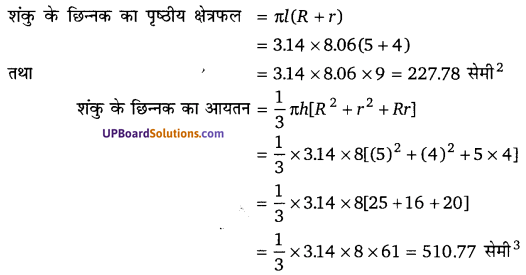
Balaji Class 10 Maths Solutions Chapter 13 Surface Area and Volumes Ex 13.3 2
Balaji Class 10 Maths Solutions Chapter 13 Surface Area and Volumes Ex 13.3 1
अतः छिन्नक का पृष्ठीय क्षेत्रफल = 227.78 सेमी2 तथा आयतन = 510.77 सेमी3

UP Board Solutions

प्रश्न 2.
एक छिन्नक के सिरों के परिमाप 48 सेमी तथा 36 सेमी हैं। यदि इसकी ऊँचाई 11 सेमी है तो इसका आयतन ज्ञात कीजिए।
हलः
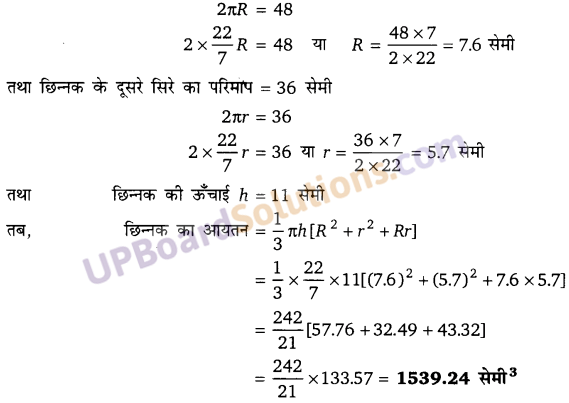
माना, छिन्नक के सिरों की त्रिज्यायें क्रमश: R सेमी और r सेमी है।
प्रश्नानुसार, छिन्नक के सिरे का परिमाप = 48 सेमी
Balaji Class 10 Maths Solutions Chapter 13 Surface Area and Volumes Ex 13.3 3

UP Board Solutions

प्रश्न 3.
6 सेमी ऊँचे एक छिन्नक के दोनों वृत्ताकार सिरों की त्रिज्याऐं क्रमश: 14 व 6 सेमी हैं। इसका वक्र पृष्ठीय क्षेत्रफल तथा कुल सम्पूर्ण पृष्ठीय क्षेत्रफल ज्ञात कीजिए।
हलः
छिन्नक के वृत्ताकार सिरों की त्रिज्यायें R = 14 सेमी, r = 6 सेमी
और छिन्नक की ऊँचाई h (UPBoardSolutions.com) = 6 सेमी
Balaji Class 10 Maths Solutions Chapter 13 Surface Area and Volumes Ex 13.3 4
अत: वक्र पृष्ठीय क्षेत्रफल = 628.57 सेमी2 तथा सम्पूर्ण पृष्ठीय क्षेत्रफल = 1357.71 सेमी2

UP Board Solutions

प्रश्न 4.
एक ठोस शंकु के छिन्नक के सिरों की त्रिज्याऐं क्रमशः 33 सेमी और 27 सेमी हैं। इसकी तिरछी ऊँचाई 10 सेमी है। इसका सम्पूर्ण पृष्ठीय क्षेत्रफल ज्ञात कीजिए।
हल:
R = 33 सेमी, r = 27 सेमी, l = 10 सेमी
छिन्नक का सम्पूर्ण पृष्ठीय क्षेत्रफल = I[R2 + r2 + l(R + r)]
= [latex]\frac{22}{7}[/latex][(33)2 + (27)2 + 10(33 + 27)]
= [latex]\frac{22}{7}[/latex] [1089 + 729 + 10 × 60]
= [latex]\frac{22}{7}[/latex] ×[1089 + 729 + 600]
= [latex]\frac{22}{7}[/latex] × 2418 = 7599.42 सेमी2

प्रश्न 5.
एक बाल्टी एक धातु के चादर की बनी है। इसका आकार शंक के छिन्नक के रूप का है, इसकी गहराई 24 सेमी है और इसके ऊपरी सिरे का व्यास तथा पेंदी का व्यास क्रमशः 30 सेमी तथा 10 सेमी हैं। तो उस दूध का मूल्य ज्ञात कीजिए जो इस बाल्टी को पूरा-पूरा भर सकता है। यदि दूध ₹ 20 प्रति लीटर की दर से मिलता हो और साथ ही धातु की चादरें जो बाल्टी बनाने में प्रयुक्त की गयी है, की कीमत ज्ञात कीजिए यदि चादरें ₹ 10 प्रति 100 वर्ग सेमी की दर से खरीदी गयी है।
हलः
बाल्टी के ऊपरी सिरे तथा पेंदी का (UPBoardSolutions.com) व्यास क्रमश: 30 सेमी तथा 10 सेमी
∴ R = [latex]\frac{30}{2}[/latex] = 15 सेमी, r = [latex]\frac{10}{2}[/latex] = 5 सेमी, गहराई h = 24 सेमी
Balaji Class 10 Maths Solutions Chapter 13 Surface Area and Volumes Ex 13.3 5

अतः दूध का मूल्य = ₹ 163.42 तथा चादर का मूल्य = ₹ 171.28

UP Board Solutions

प्रश्न 6.
दूध का एक बर्तन जिसकी ऊँचाई 18 सेमी है, छिन्नक के आकार का है। इसके ऊपरी तथा निचले सिरों की त्रिज्याऐं क्रमशः 8 व 32 सेमी हैं। इसको ₹ 20 प्रति लीटर की दर से भरने में कुल कितने दूध की आवश्यकता है?
हल:
R = 32 सेमी, r = 8 सेमी तथा ऊँचाई h = 18 सेमी (UPBoardSolutions.com)
छिन्नक के आकार के बर्तन का आयतन = [latex]\frac{1}{3}[/latex]πh[R2 + r2 + R.r]
= [latex]\frac{1}{3}[/latex] × [latex]\frac{22}{7}[/latex] × 18[(32)2 + (8)2 + 32 × 8]
= [latex]\frac{132}{7}[/latex][1024 + 64 + 256] = [latex]\frac{132}{7}[/latex] × 1344 = 25344 सेमी3
∵ 1 लीटर = 1000 घन सेमी
∴ [latex]\frac{25344}{1000}[/latex] = 25.34 लीटर
∵ 1 लीटर दूध का मूल्य = 120
∴ 25.34 लीटर दूध का मूल्य = 20 × 25.34 = ₹506.80
अतः दूध की आवश्यकता = 25:34 लीटर तथा दूध का मूल्य = ₹ 506.88

Balaji Publications Mathematics Class 10 Solutions

UP Board Solutions for Class 10 Commerce Chapter 16 Nationalisation of Banks in India

UP Board Solutions for Class 10 Commerce Chapter 16 Nationalisation of Banks in India

Nationalisation of Banks in India Objective Type Questions (1 Mark)

Question 1.
The first bill favouring nationalisation of hank was presented on:
(a) 23rd August 1953
(b) 23rd August 1963
(c) 23rd August 1973
(d) 23rd August 1983
Answer:
(b) 23rd August 1963

Question 2.
The name of the lady who presented the first bill in favour of nationalisation was:
(a) Mrs Subhandra Joshi
(b) Mrs Jyoti Rani
(c) Mrs Soniya Gandhi
(d) None of these
Answer:
(a) Mrs Subhandra Joshi

UP Board Solutions

Question 3.
The ordinance nationalising the bank was issued on ………
(a) 19th July 1996
(b) 19th July 1989
(c) 19th July 1969
(d) 19th July 1998
Answer:
(c) 19th July 1969

Question 4.
In the first instance ………. major banks were nationalised.
(a) 14
(b) 16
(c) 18
(d) 20
Answer:
(a) 14

UP Board Solutions

Question 5.
The government nationalised 6 more banks through an ordinance dated ………..
(a) 18th April 1970
(b) 19th April 1980
(c) 19th April 1970
(d) 18th April 1980
Answer:
(c) 19th April 1970

Question 6.
Which of the following banks is a nationalised bank in India? (UP 2019)
(a) Yes Bank
(b) Dena Bank
(c) Axis Bank
(d) None of these.
Answer:
(b) Dena Bank

Nationalisation of Banks in India Definite Answer Type Questions (1 Mark)

UP Board Solutions

Question 1.
When were 14 Banks nationalised in India? (UP 2016, 17)
Answer:
19th July 1969.

Question 2.
What is the number of nationalised banks in India?
Answer:
14.

Question 3.
Which is the number of banks which ordinance issued by the President of India on 16th April 1980?
Answer:
6.

Nationalisation of Banks in India Very Short Answer Type Questions (2 Marks)

Question 1.
Write names of those banks which were nationalised in April 1980.
Answer:

  1. Oriental Bank of Commerce
  2. Vijaya Bank
  3. Punjab and Sindh Bank
  4. Corporation Bank
  5. New Bank of India
  6. Andhra Bank.

UP Board Solutions

Question 2.
Write names of those banks which were nationalised in 1969.
Answer:

  1. Central Bank of India
  2. Bank of India
  3. Punjab National Bank
  4. Bank of Baroda
  5. United Commerical Bank
  6. Canara Bank
  7. United Bank of India
  8. Dena Bank,
  9. Union Bank (UPBoardSolutions.com) of India
  10. Allahabad Bank
  11. Syndicate Bank
  12. Indian Bank
  13. Indian Overseas Bank
  14. Bank of Maharashtra.

Question 3.
Give any two advantages of Nationalised Banks. (UP 2015)
Answer:
Two advantages of nationalized banks are as follows:
(i) Inter-Bank competition can be ended: There is unnecessary competition among Indian Banks which benefits no one. If all the banks are nationalised, this necessary competition will automatically (UPBoardSolutions.com) come to an end.

UP Board Solutions

(ii) Development of Specialised Banks: There is at present acute shortage of agricultural, industrial and Indian Foreign Exchange banks in the country. If the entire banking industry is nationalised, the government will surely take steps to a developed specialised banking institution in the country.

Question 4.
Give any two disadvantages of nationalised banks. (UP 2015, 18)
Answer:
Two disadvantages of nationalised banks are as follows:
(i) Violation of Financial Secrecy: The third argument against bank nationalisation is that it will violate the financial secrecy of individual depositors and of institutions.

(ii) Payment of Compensation: The Government will need (UPBoardSolutions.com) substantial funds to compensate the shareholders of private banks if it decides to nationalise them. The amount needed by the Government is estimated to be around Rs. 100 crores.

UP Board Solutions

Question 5.
Mention two main objectives of nationalisation of banks in India. (UP 2019)
Answer:

  1. To eliminate the concentration of economic power in few hands.
  2. To extend banking facilities to unbanked rural Areas.

Nationalisation of Banks in India Short Answer Type Questions (4 Marks)

Question 1.
What do you understand by the nationalisation of banks?
Answer:
After independence, the people started thinking on the lines of nationalisation, for overcoming the problems and defects of the trade and industries. The banking institutions were one of them, which despite social control could not satisfy the needs of the people. The development of banks was very erratic and the Indian money market was not organised.

The Indian commercial banks did not open their branches in rural areas of provided loans only to big industrialist and businessmen. The really needy persons such as farmers, cottage and small industries, artisans (UPBoardSolutions.com) etc. were deprived of this facility. Because of all these problems, the demand for nationalisation of banks became greater. The demand for nationalisation the banks was intensified, with the nationalisation of Imperial Bank.

UP Board Solutions

Question 2.
Give some arguments in favour of nationalisation of hanks.
Answer:
The following arguments were advanced in favour on nationalisation:
(a) Balanced Growth of Banks: At present, the private banks operate only in those areas where they get good business, hence, generally all the banks are in towns and big cities. With the nationalisation of banks, the (UPBoardSolutions.com) government will open the branches in those areas which do not have banking facilities. In this way, by nationalising the banks they would have balanced growth.

(b) Improvement of Efficiency: The Government banks in view of their vast resources are able to attract competent, trained and experienced staff more effectively than the private banks. Consequently, the level of operational efficiency is bound to be higher in Government banks in comparison to private banks.

(c) Utilisation of Bank Credit in National Interest: If the banks are allowed to be operated by private individuals, then the bank’s credit shall not be used in the interests of the nation. On the contrary, the bank’s credit will be utilised in the interests of these individuals who control the banks.

(d) Business Fluctuations can be checked: As is well known, a capitalist economy is all the time affected by business fluctuations. The slump and the boom follow each other at regular intervals. These fluctuations cause untold harm to the economy of the country. The government can keep effective control only if the banks are fully nationalised.

UP Board Solutions

Question 3.
Give some arguments against nationalisation of banks.
Answer:
The following arguments were advanced against the nationalisation of banks:
(a) Fall in the efficiency of services: At present, the banks provide efficient services on a lower rate to customers due to the competition among the banks. After nationalization the banks would not be able to provide (UPBoardSolutions.com) these kinds of facilities.

(b) Violation of Financial Secrecy: The third argument against bank nationalisation is that it will violate the financial secrecy of individual depositors and of institutions.

(c) Payment of compensation: The Government will need substantial funds to compensate the shareholders of private banks if it decides to nationalise them. The amount needed by the Government is estimated to be around (UPBoardSolutions.com) Rs. 100 crores.

UP Board Solutions

(d) Lack of Elasticity: The quality of elasticity is one of the important aspects of the banking system. With the nationalisation of banks, they will lose the quality of elasticity because they will have to take prior permission from his high officers before taking any decision.

UP Board Solutions for Class 10 Commerce

UP Board Solutions for Class 10 Commerce Chapter 7 Communication System

UP Board Solutions for Class 10 Commerce Chapter 7 Communication System

Communication System Objective Type Questions (1 Mark)

Question 1.
S. T. D. stands for:
(a) Subscribers Trunk Dialing
(b) Subscribers Telephone Dialing
(c) Subscribers Trunk Dialer
(d) None of these
Answer:
(a) Subscribers Trunk Dialing

Question 2.
A mobile telephone system was inaugurated in the year:
(a) 1987
(b) 1985
(c) 1989
(d) 1991
Answer:
(b) 1985

UP Board Solutions

Question 3.
The popular code available in the market are :
(a) X. Y. Z. Code
(b) A. B. C. Code
(c) Bentley Code
(d) A. B. C Code and Bentley Code
Answer:
(d) A. B. C Code and Bentley Code

Question 4.
When the telegraphic message is sent through the telephone, this method of sending a message is called:
(a) Hologram
(b) Phonogram
(c) Telegram
(d) None of these
Answer:
(b) Phonogram

Question 5.
A key word is used to send telegrams.
(a) Cypher
(b) Code
(c) Travellers
(d) None of these
Answer:
(a) Cypher

UP Board Solutions

Communication System Definite Answer Type Questions (1 Mark)

Question 1.
Name of telegram which are sent by one person to another within the limits of the country.
Answer:
Inland Telegram.

Question 2.
State the full form of I. S. D.
Answer:
International Subscriber Dialing.

Question 3.
What kind of telegram is sent only by government offices and only for official work.
Answer:
State Telegram.

Question 4.
Which letters are sent by sea route?
Answer:
Foreign Letters.

Question 5.
When was speed post service started in India? (UP 2019)
Answer:
1986.

UP Board Solutions

Question 6.
Name the most commonly used accounting software in India. (UP 2019)
Answer:
Tally.

Communication System Very Short Answer Type Questions (2 Marks)

Question 1.
What do you understand by travellers telegram?
Answer:
Telegram can also be delivered to a person travelling (UPBoardSolutions.com) by train. The sender has to write the name of the person, name of the train and number of the bogie and the name of the station at which the train will halt. When the train reaches that station the message is delivered to that person.

Question 2.
Name the various kinds of telegrams.
Answer:

  1. Inland Telegram
  2. Foreign Telegram.

Question 3.
What do you mean by phonogram? (UP 2015)
Answer:
There is a facility provided by the post and telegraph department to send the messages through telephone. This method of sending a message is called ‘Phonogram’. This arrangement of the phonogram is made in the town having telephone. The telephone subscriber can convey the message of telegram to the telegraph office. The department sends the message to the addressee by (UPBoardSolutions.com) telegram and the charge is added to the telephone bill of the subscriber.

UP Board Solutions

Question 4.
Give two differences between code and cypher telegram.
Answer:
Difference between code and cypher telegram.

Code Telegram Cypher Telegram
1. Will the help of code (book) any person can find out the message. Thus the message does not remain secret. 1. Only the persons who know the keyword can find out the message. Thus the message remains secret.
2. The message cannot be communicated without the help of code. 2. Cypher telegrams are sent with the help of code as well as a keyword.

Question 5.
What are the two main advantages of the telegram?
Answer:
Advantages of telegrams are as follows:

  1. If the message is long, then telephone charges would be much more than expenses incurred on telegram.
  2. Telegram is also sent when the message is important and prompt action is required.

Question 6.
Write the names of any two means of quick communication.
Answer:

  1. Telephone
  2. Internet.

Communication System Short Answer Type Questions (4 Marks)

Question 1.
What do you understand by cypher telegram? What are its advantages? (UP 2016)
Answer:
Cypher Telegrams: When the sender wants to keep the message completely secret then cypher telegrams are sent. Such telegrams can be written in digits or letters but usually cypher telegrams are written digits.
Advantages of cypher telegram are as follows:
Only the persons who know the key word can find out the message. (UPBoardSolutions.com) Thus the message remains secret.

UP Board Solutions

Question 2.
Write a note on the utility of telephone.
Answer:
The telephone is the most important means of quick communication. It is also popular because the caller and the receiver both are direct contacts directly with the different parts of the world. Its use is increasing day by day and for this reason, it has become indispensable for a businessman these days. In present times, every business house, industry, insurance companies etc. must essentially have a telephone. The professionals like doctor, lawyer, chartered accountant etc. cannot function properly without a telephone (UPBoardSolutions.com) connection. Without a telephone connection, the working of the business organisations and people in profession will be affected adversely. From the point of view of communication, the telephone has an important place and having a telephone also an indication of reputation and status in society.

Communication System Long Answer Type Questions (8 Marks)

Question 1.
Write notes on S.T.D. and I.S.D. (UP 2008, 10)
Answer:
Subscribers Trunk Dialling (S.T.D.): Under this facility, the person can make trunk calls without the help of a telephone exchange. Now most of the towns have this facility. Suppose a person intends to talk to his friend in Lucknow then he will have to dial the code of the town first and then the number. Each town has a separate code which has STD facility. It is of great importance for the business community as they can make calls at their convenience. In trunk calls the charges are for a minimum period of 3 minutes whereas in STD you have to pay only for the duration of the call which can be less or more than 3 minutes.

International Subscribers Dialling (I.S.D.): These days the telephone service is so advanced that a person can talk to a person sitting in some other country by telephone without the help of the operator. This facility of direct dialling is known as International Subscribers Dialling. Different codes are allotted to every country which are connected by this facility. The subscriber has to dial the international code first i.e., 00 then the country code followed by the area code and at last the overseas telephone number. It is quicker because you have not to book the call and wait till it is matured. There is no limit for duration of the call. A person can talk as long as he wishes and is charged for only the time he talked. It is easier in the sense that the subscriber can call at his convenience whether it is day or night and there is no language problem either.

UP Board Solutions

Question 2.
Write short notes on: (UP 2015)

  1. Teleprinter
  2. FAX System
  3. Internal Telephone Exchange
  4. Radio Paging.

Answer:
1. Teleprinter: Teleprinter is used by major newspapers for collecting news relating to other countries as well as news relating to the native country. A printer is attached to this machine which prints the news on the paper as they are communicated to the office.

2. FAX System: FAX service provides automatic communication through printed words between subscribers in cities and towns provided with Electronic Telephone Exchanges. FAX .subscribers establish their own connections.

3. Internal Telephone Exchange: In big business organizations and offices there are many departments like purchases, sales, accounts, administration etc. Every department has its own officer and each officer has a different (UPBoardSolutions.com) telephone connection so that they can talk to each other on telephone which saves the time of going and coming from one department to another. Under this system, an Internal Telephone Exchange is established within the premises. An operator is appointed who helps in connecting the calls.

4. Radio Paging: This is a one-way communication system. Messages are transmitted to subscribers by means of aerial signals in the form of tone or vibrations through pocket-size receiver called pager. It was introduced in Delhi in 1985. It is now available in all over the country.

UP Board Solutions

Question 3.
Describe the uses of computers in a business office. (UP 2011)
Answer:
Computer is the most important part in a business office.
Following are uses of computers in a business office:

  1. Help in planning: By the help of computer we can collect data which is very helpful in planning.
  2. Help in Finance: Most companies world wide are rapidly switching to a computerised accounting system. Long time consuming calculations and other mathematics-intensive problems can now be solved at the press of a button.
  3. Help in Management: The personal computer has revolutionised manage- ment functions. Computer reduces paper-work, speeds up communication and improves the quality of work.
  4. Help in Accounting: Accounting work in a business office becomes (UPBoardSolutions.com) early with the help of a computer. A computer has made accounting easier with the help of many softwares.
  5. Others:
    • It saves time and money.
    • It seams to have become the backbone of all activities.
    • The computer helps to prepare different reports.
    • It helps to take decisions earlier.

UP Board Solutions for Class 10 Commerce

UP Board Solutions for Class 10 Commerce Chapter 6 Indexing

UP Board Solutions for Class 10 Commerce Chapter 6 Indexing

Indexing Objective Type Questions (1 Mark)

Question 1.
Card indexing was previously used only in:
(a) Libraries
(b) Hostel
(c) Canteen
(d) None of these
Answer:
(a) Libraries

Question 2.
In simple indexing, a special type of book is used bearing letters on the ……….. hand side.
(a) Left
(b) Right
(c) Either (a) or (b)
(d) None of these
Answer:
(b) Right

UP Board Solutions

Question 3.
In vowel inducing each letter is sub-divided in ……….. sub-divisions.
(a) 8
(b) 4
(c) 5
(d) 10
Answer:
(c) 5

Question 4.
When for any reference name card is taken out ………… card in kept in its place.
(a) Index
(b) Absent
(c) Guide
(d) None of these
Answer:
(b) Absent

Question 5.
In the case of card indexing similar names can be clearly distinguished by using cards of …………. colours.
(a) Mix
(b) Different
(c) Black
(d) White
Answer:
(b) Different

UP Board Solutions

Indexing Definite Answer Type Questions (1 Mark)

Question 1.
Write the name of the latest system of indexing?
Answer:
Card index.

Question 2.
What kind of indexing many cards can be seen of a time?
Answer:
Visible Index.

Question 3.
Write the name of the register in which details of outgoing letters arc written. (UP 2014)
Answer:
Despatch Register.

Indexing Very Short Answer Type Questions (2 Marks)

Question 1.
Give any two objects of indexing.
Answer:
Objects of indexing are as follows:

  1. The operation of filing will become (UPBoardSolutions.com) so complicated that it could be happened only by that person who has done filing.
  2. In the absence of indexing, the filing system will become unscientific and incomplete, because it would be a tedious job to find out any document for reference.

UP Board Solutions

Question 2.
What do you mean by Absent cards?
Answer:
When for any reference, name card is taken out, an absent card is kept in its place. It contains all the information regarding the name card as to why is it taken out, who has taken it out and when is it taken out?

Question 3.
What is visible indexing?
Answer:
In visible indexing, cards are arranged in such a manner (UPBoardSolutions.com) that at a time many cards can be seen visible indexing occupies very little space. It can be fitted on the corner of a desk or on a wall.

Question 4.
Name various methods of indexing.
Answer:
Following methods of indexing are adopted by different business houses:

  1. Letter Book or Simple Index
  2. Vowel Index
  3. Card Index
  4. Visible Index.

Question 5.
Give any two advantages of card indexing.
Answer:
Advantages of card indexing are as follows:

1. Cleanliness: In card indexing, the index remains very clean because in this system there is no need to cut the names of those customers with whom the concern has stopped dealing. In this situation, in card indexing, the new card is kept at the appropriate place and the old card is taken out.

2. Time-Saving: This system saves a lot of time. The necessary card is taken immediately with the help of guide cards.

UP Board Solutions

Question 6.
Point out four advantages of card indexing. (UP 2019)
Answer:

  1. Cleanliness
  2. Time-saving
  3. Easy in operation
  4. Elasticity.

Indexing Short Answer Type Questions (4 Marks)

Question 1.
What is Index? Describe its two importances. (UP 2012)
Answer:
Index: The object of filing is to preserve letters and documents in such a manner that they can be found out quickly, whenever they are required for future references. This object of filing can only be made possible (UPBoardSolutions.com) if letters are filed serially according to some particular method. Therefore, a technique is required which can indicate the exact location of a particular letter which is required for the reference and filed in a file. This particular technique is called index.

Importance of Index:

  1. In the absence of an index, it would not be possible to find out the name of the customers who have not placed any order since long.
  2. The employees cannot be held responsible for any delay and inefficiency. It will take a lot of time in finding out the references which will result in delays.

UP Board Solutions

Question 2.
What is a simple indexing? What are the points to be kept in mind in simple indexing?
Answer:
Simple Indexing: For simple indexing, a special type of book which contains thick letters in it is used. In this book, each sheet bears a letter of the alphabet on the right-hand side. Edges of the sheet are cut so that all the letters of the alphabet are seen together. In this, generally, the last page is allotted X, Y and Z, because the names beginning with these letters are generally very small in number.

Following points to be kept in mind in simple indexing:

  1. While writing the names in the book only first name should be considered. The words showing respect should be avoided. For example, name of ‘Thakur Pratap Singh’ should be written in ‘P’, not in T.
  2. Some business houses adopt the technique of writing names on the basis of surnames. They do not write the full name of the customers, but instead of that, they use initials. For example, the name of Shri S. K. Bhatia is written on the page bearing ‘B’.

Indexing Long Answer Type Questions (8 Marks)

Question 1.
What is Card Indexing? Describe its merits and demerits. (UP 2009, 13, 14)
Or
What is the index? What are the advantages of indexing? Describe briefly. (UP 2011)
Or
What is the index? Describe its two importances. (UP 2012)
Answer:
Card Indexing. Card indexing is the latest system in the field of maintaining the index. The system is given the name of “card indexing” for the fact that in it index is made on the card. Card indexing is mainly used in (UPBoardSolutions.com) connection with vertical filing.
The name card which is used in this indexing is made of thick paper which bears the name and address of the correspondent. These name cards are kept in an almirah having many drawers.

This system of card indexing also uses guide cards or index cards which are made of thick paper. These cards are used for the purpose of dividing the drawer into several compartments according to the vowel.
Merits of Card Indexing. Card indexing has several advantages of great value which increase its importance in a business house which are as follows :

1. Cleanliness: In card indexing, the index remains very clean because, in this system, there is no need to cut the names of those customers with whom the concern has stopped dealing. In this situation, in card indexing, the new card is kept at the appropriate place and the old card is taken out.

2. Easy in Operation: In this system, new cards are kept easily without disturbing the others. Whenever a new correspondent appears, his card can easily be inserted in the drawer without disturbing the present order.

3. Time-Saving: This system saves a lot of time. The necessary card is taken out immediately with the help of guide cards.

4. Easy in Finding Cards: The cards can be found out easily and quickly with the use of index or guide cards.

5. Only Current Cards Remain: If the correspondence with any customer is stopped, his card can easily be removed. Thus, only current cards are allowed to remain.

6. Economical and Cheap: This system is quite economical. In a big business house, this indexing is cheaper than ordinary indexing, since the expenses of having a bound book and its occasional renewal with additions to existing correspondents are saved or avoided.

UP Board Solutions

Demerits of Card Indexing: The card indexing also suffers from certain disadvantages. These are as follows:

1. Occupies More Space: This system can be used by big business houses only because it requires more space than simple indexing.

2. Only One Card can be Seen at a Time: In this system, only one card can be seen at a time because each card is in front of another card. Several cards are to be handled for finding out a particular card. For this reason, (UPBoardSolutions.com) this method is known as ‘blind method’.

3. Difficulty in Finding Out Misplaced Cards: If any card is misplaced, it becomes difficult to locate it under this system.

4. Useful for Big Organization Only: The equipment of card indexing are costly, hence, it can only be used by big organizations.

5. Fear of being Lost or Altered: In this system, there is always a fear of the cards being lost or altered.

Question 2.
Describe Card Indexing and explain its utility. (UP 2009)
Answer:
Card Indexing: Card indexing is the latest system in the field of maintaining the index. The system is given the name of “card indexing” for the fact that in it index is made on the card.
This system of card indexing also uses guide cards or index cards which are made of thick paper. These cards are used for the purpose of dividing the drawer into several compartments according to the vowel.

The utility of Card Indexing. The utility of card indexing is as follows:

1. Keeping Files Vertically: Card indexing is particularly used for keeping the files vertically.

2. Address of the Customer: The address of the customer can be written along with the name on the card. This saves the cost of keeping an address book separately.

3. Page Number of the Customer’s Accounts: Sometimes reference of the ledger folio is mentioned in the card. If this is done, there remains no need for providing an index in the account books.

4. Customer’s Economic Condition: All the necessary information regarding the customer’s economic condition can also be written on the card.

5. Name of Customer’s Bank: Name of Customer’s bank can also be written on a card.

6. Pieces of information Regarding Instalments: Nowadays, generally costly goods are sold on instalments. In such cases, the details of the instalments can be written on name cards.

UP Board Solutions

7. Helpful in Follow up System: Sometimes customers maintain silence after making enquiries of the goods and do not place orders. In this case, several letters are sent in order to secure orders. This is called a (UPBoardSolutions.com) Follow-up System of Correspondence. If this system is adopted, the card indexing is of great help. On receiving an enquiry from the customer, its reference may be written on his name card. The reference of the letters sent in reply can also be given on his name card.

8. Customer’s Business: On the name cards, nature of the business of the respective customers may be written, This helps in sending and securing goods from the customers. The important terms and conditions of business can also be written on name cards.

9. Preservation of Price-List etc: Price-lists and other information received from the customers can also be preserved on the name cards.

10. Informations Regarding Credit: When goods are sold on credit then it is convenient to maintain the reference regarding the period and maximum amount of credit allowed to the customers on the name card.

UP Board Solutions for Class 10 Commerce

Balaji Class 9 Maths Solutions Chapter 13 Quadrilateral Ex 13.3

Balaji Class 9 Maths Solutions Chapter 13 Quadrilateral Ex 13.3 चतुर्भज

प्रश्न 1.
सिद्ध कीजिए कि किसी त्रिभुज में उसके शीर्ष से आधार पर डाली गयी माध्यिका उसकी अन्य दो भुजाओं के मध्य बिन्दुओं को मिलाने वाला रेखाखण्ड समद्विभाजित करता है।
हलः
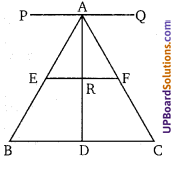
ज्ञात है: एक ∆ABC जिसमें E तथा F, AB तथा AC के मध्य बिन्दु हैं। शीर्ष A से BC पर एक रेखाखण्ड AD खींचा जो EF को R पर काटता है।
सिद्ध करना है: AR = RD
रचना: PAQ,BC के समान्तर रेखा खींची।
उपपत्तिः E तथा F, AB तथा AC के मध्य बिन्दु हैं। (दिया है)
∴ EF || BC
PAQ||BC
∴ PAQ|| EF || BC
Balaji Class 9 Maths Solutions Chapter 13 Quadrilateral Ex 13.3
∴ PAQ, EF तथा BC तीन समान्तर रेखायें हैं जो तिर्यक रेखा AB के बीच बराबर अन्त:खण्ड काटती हैं। अतः इन्हीं समान्तर रेखाओं के बीच तिर्यक रेखा AD के बीच बने अन्तः खण्ड भी बराबर होंगे।
∴ AR = RD

Balaji Class 9 Maths Solutions Chapter 13 Quadrilateral Ex 13.3

प्रश्न 2.
सिद्ध कीजिए कि समलम्ब चतुर्भुज की असमान्तर भुजाओं के मध्य बिन्दुओं को मिलाने वाला रेखाखण्ड समान्तर भुजाओं के योग का आधा होता है।
हलः
Balaji Class 9 Maths Solutions Chapter 13 Quadrilateral Ex 13.3
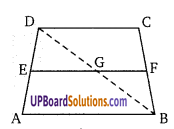
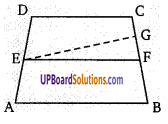
ज्ञात है: ABCD एक समलम्ब है जिसकी भुजाएँ AB व DC एक दूसरे के समान्तर है।
E तथा F क्रमशः AD तथा BC के मध्य बिन्दु हैं। EF को मिलाया।
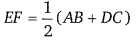
सिद्ध करना है:
Balaji Class 9 Maths Solutions Chapter 13 Quadrilateral Ex 13.3 Q3
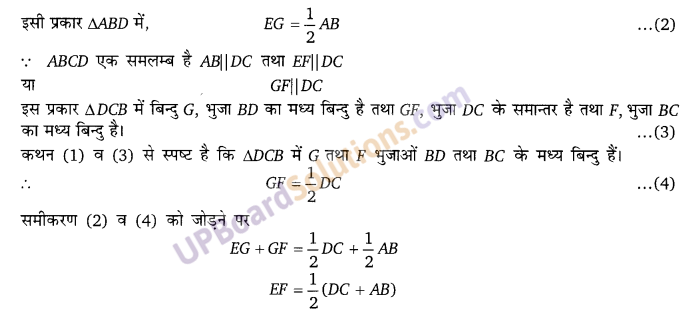
उपपत्तिः ∆ABD में, बिन्दु E, भुजा AD का मध्य बिन्दु है तथा EG, भुजा AB के समान्तर है।
∴ बिन्दु G, BD का मध्य बिन्दु है …(1)
Balaji Class 9 Maths Solutions Chapter 13 Quadrilateral Ex 13.3

प्रश्न 3.
सिद्ध कीजिए कि समलम्ब चतुर्भुज की असमान्तर भुजाओं के मध्य-बिन्दुओं को मिलाने वाला रेखाखण्ड समान्तर भुजाओं के समान्तर होता हैं।
हलः
Balaji Class 9 Maths Solutions Chapter 13 Quadrilateral Ex 13.3
ज्ञात है: E तथा F, AD तथा BC के मध्य बिन्दु हैं।
सिद्ध करना है: EF||AB तथा EF||DC
रचनाः माना EF, AB के समान्तर नहीं है। इसलिए EG एक रेखा ऐसी खींची जिससे EG|| AB तथा EG||EG|| AB परन्तु EG तथा EF एक प्रतिच्छेद बिन्दु E पर काटती हैं।
परन्तु दो प्रतिच्छेदी रेखा एक रेखा के समान्तर नहीं हो सकती।
∴ EG तथा EF एक ही रेखा होगी।
∴ AB|| EF|| DC

Balaji Class 9 Maths Solutions Chapter 13 Quadrilateral Ex 13.3

प्रश्न 4.
ABCD एक समान्तर चतुर्भुज है। जिसमें E व F क्रमशः AB व CD के मध्य बिन्दु हैं। सिद्ध कीजिए कि-
(i) AF||EC
(ii) CE व AF विकर्ण BD को समत्रिभाजित करते हैं। [NCERT]
हलः
Balaji Class 9 Maths Solutions Chapter 13 Quadrilateral Ex 13.3
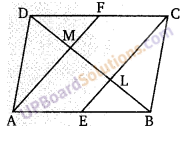
ज्ञात है: ABCD एक समान्तर चतुर्भुज में E तथा F क्रमश: AB तथा CD के मध्य बिन्दु हैं।
(i) सिद्ध करना हैः AF|| EC
उपपत्तिः (i) ∆ADF तथा ∆BCE में,
AD = BC (समान्तर चतुर्भुज की भुजाएँ)
DF = EB (समान्तर चतुर्भुज की भुजाएँ)
∠ADC = ∠ABC (समान्तर चतुर्भुज के सम्मुख कोण)
अतः ∆ADF ≅ ∆BCE
∴ AF = EC
∴ AFCE एक समान्तर चतुर्भुज होगा। (∴ AE||FC तथा AE = FC)
अतः समान्तर चतुर्भुज में AF||EC
(ii) ∵ समान्तर चतुर्भुज AECF में तिर्यक रेखा BD है। समान्तर चतुर्भुज ABCD में तिर्यक रेखा DB द्वारा काटे गये अन्त:खण्ड बराबर होंगे
∴ DM = ML = LB
अत: CE व AF विकर्ण BD को समत्रिभाजित करते हैं।

प्रश्न 5.
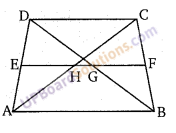
एक समलम्ब चतुर्भुज में उसके आधार के समान्तर एक रेखा उसकी असमान्तर भुजाओं में से एक को समद्विभाजित करती है। सिद्ध कीजिए कि यह इसके किसी विकर्ण को भी समद्विभाजित करेगी।
हलः
Balaji Class 9 Maths Solutions Chapter 13 Quadrilateral Ex 13.3
E, AD का मध्य बिन्दु है।
∴ DE = EA
AB||DC|| EF
तिर्यक रेखा DA पर बने अन्त:खण्ड DE = EA (जो दिया है)
∴ तिर्यक रेखा DB पर बने अन्त:खण्ड DG = GB होंगे।
AB के समान्तर रेखा E से होते हुए H,G पर प्रतिच्छेद करते हुए F तक खींची गयी है।
∴ बिन्दु F, CB का मध्य बिन्दु होगा।
DC|| AB
∴ तिर्यक रेखा CB पर बने अन्त:खण्ड CF = FB तथा तिर्यक रेखा CA पर बने अन्त:खण्ड CH = HA

Balaji Class 9 Maths Solutions Chapter 13 Quadrilateral Ex 13.3

प्रश्न 6.
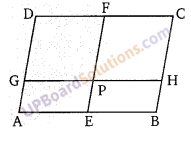
ABCD एक समान्तर चतुर्भुज है तथा E व F क्रमश: AB व CD के मध्य D, बिन्दु हैं। एक अन्य रेखा GH, AD,EF व BC को क्रमशः G,P व H बिन्दुओं पर प्रतिच्छेद करती है। सिद्ध कीजिए कि GP = PH
हलः
Balaji Class 9 Maths Solutions Chapter 13 Quadrilateral Ex 13.3
ABCD एक समान्तर चतुर्भुज है। E तथा F, AB तथा CD के मध्य बिन्दु हैं।
∴ AD||BC, AB तिर्यक रेखा काटती है।
∴ अन्त:खण्ड AE = EB
∴ DC तिर्यक रेखा काटती है।
∴ अन्त:खण्ड DF = FC
बिन्दु E को F से मिलाने पर वह बिन्दु P से होकर जाती है।
∴ तिर्यक रेखा GH के अन्त:खण्ड GP = PH होंगे।

Balaji Publications Mathematics Class 9 Solutions