CBSE Sample Papers for Class 10 Maths Paper 4

These Sample papers are part of CBSE Sample Papers for Class 10 Maths. Here we have given CBSE Sample Papers for Class 10 Maths Paper 4.

CBSE Sample Papers for Class 10 Maths Paper 4

Board CBSE
Class X
Subject Maths
Sample Paper Set Paper 4
Category CBSE Sample Papers

Students who are going to appear for CBSE Class 10 Examinations are advised to practice the CBSE sample papers given here which is designed as per the latest Syllabus and marking scheme as prescribed by the CBSE is given here. Paper 4 of Solved CBSE Sample Paper for Class 10 Maths is given below with free pdf download solutions.

Time allowed: 3 Hours
Maximum Marks: 80

General Instructions


  • All questions are compulsory.
  •  The question paper consists of 30 questions divided into four sections A, B, C andD.
  • Section A contains 6 questions of 1 mark each. Section B contains 6 questions of 2 marks each. Section C contains 10 questions of 3 marks each. Section D contains 8 questions of 4 marks each,
  • There is no overall choice. However, an internal choice has been provided in four questions of 3 marks each and three questions of 4 marks each. You have to attempt only one of the alternatives in all such questions.
  • Use of calculators is not permitted.

Section-A

This Calculator computes the Degree and Leading Coefficient Calculator term of a given Polynomial.

Question 1.
The values of the remainder r, when a positive integer a is divided by 3 are 0 and 1 only. Justify your answer.

Question 2.
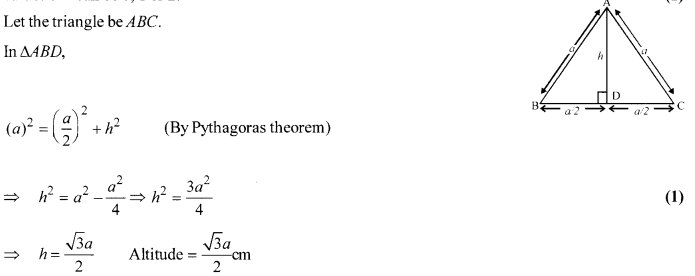
Find the altitude of an equilateral triangle when each of its side is ‘a’ cm.

Question 3.
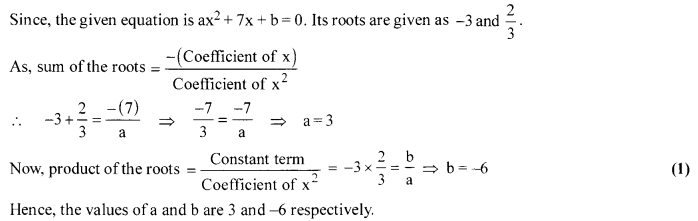
If x =[latex s=2]\frac { 2 }{ 3 } [/latex] and x = – 3 are roots of the quadratic equation ax2 + 7x + b = 0, find the values of a and b.

Question 4.
If A + B = 90° and sec A =[latex s=2]\frac { 5 }{ 3 } [/latex] , then find the value of cosec B.

Question 5.
The first three terms of an AP respectively are 3y – 1, 3y + 5 and 5y + 1. Then find y.

Find the Value of x is used to consider unknown value.

Question 6.
Find the value of x such that PQ = QR where co-ordinates of P, Q, R are (6, -1), (1, 3), and (x, 8) respectively.

Section-B

Question 7.
Find the LCM of 66 & 486 by the Prime factorisation method. Hence find their HCF.

Question 8.
The sum of the 5th and the 9th terms of an AP is 30. If its 25th term is three times its 8th term, find the AP.

Question 9.
A bag contains 5 red balls and some blue balls. If the probability of drawing a blue ball is double that of a red ball, then find the number of blue balls in the bag.

Question 10.
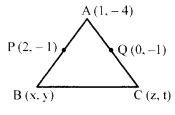
Find the area of the triangle ABC with A (1, – 4) and mid-points of sides through A being (2, -1) and (0,-1).

Question 11.
Find the value of a so that the point (3, a) lies on the line represented by 2x – 3y = 5.

Question 12.
Two dice are thrown simultaneously. What is the probability that the sum of the numbers appearing on the dice is a prime number?

Section-C

Question 13.
Find the HCF of 81 and 237 and express it as a linear combination of 81 and 237.

Question 14.
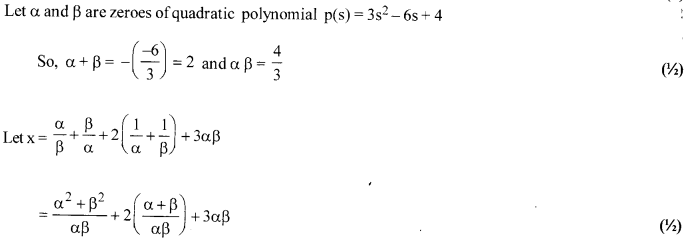
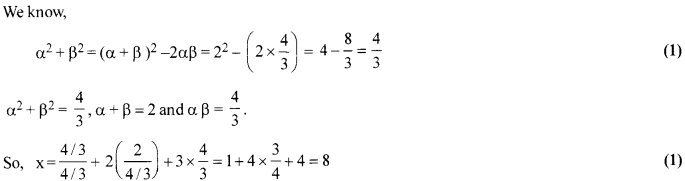
If a and (1 are the zeroes of the quadratic polynomial p(s) = 3 s2 – 6s + 4, find the value of
[latex s=2]\frac { \alpha }{ \beta } +\frac { \beta }{ \alpha } +2\left( \frac { 1 }{ \alpha } +\frac { 1 }{ \beta } \right) +3\alpha \beta [/latex].

Question 15.
In fig., PSR, RTQ and PAQ are three semicircles of diameters 10 cm, 3 cm and 7 cm respectively. Find the perimeter ofthe shaded region.
[Use π = 3.14]
CBSE Sample Papers for Class 10 Maths Paper 4 img 1

Question 16.
150 spherical marbles, each of diameter 1.4 cm, are dropped in a cylindrical vessel of diameter 7 cm containing some water, which are completely immersed in water. Find the rise in the level of water in the vessel.
OR
Volume and surface area of a solid hemisphere are numerically equal. What is the diameter ofhemisphere?

Question 17.
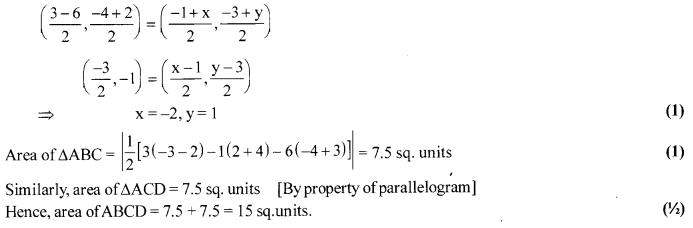
The three vertices ofaparallelogram ABCD are A(3,^l), B(-l,-3)andC(-6,2). Find the coordinates of vertex D and find the area of ABCD.

Question 18.
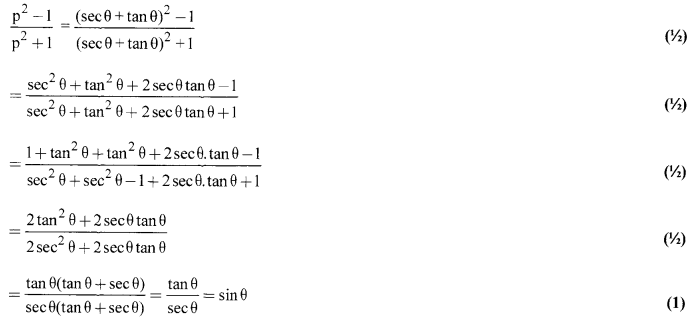
If sec θ + tan θ = p, then prove that [latex s=2]\frac { { p }^{ 2 }-1 }{ { p }^{ 2 }+1 } [/latex] = sin θ
OR
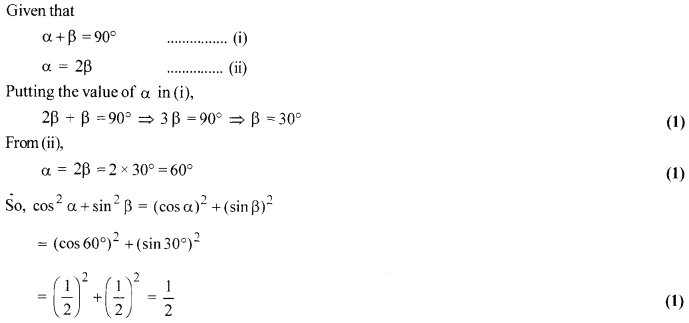
If α + β = 90° and α = 2β , then find the value of cos2 α + sin2 β

Question 19.
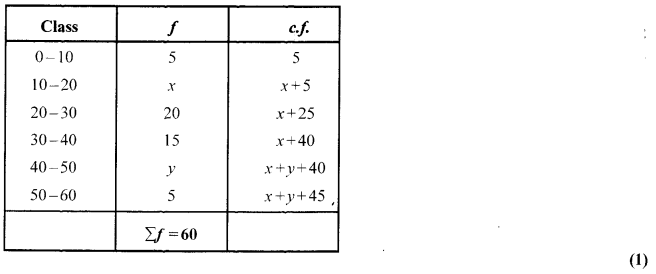
If the median for the following frequency distribution is 28.5, find the values ofx and y:
CBSE Sample Papers for Class 10 Maths Paper 4 img 2
OR
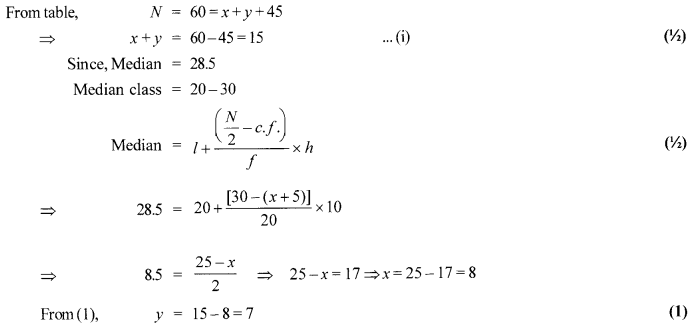
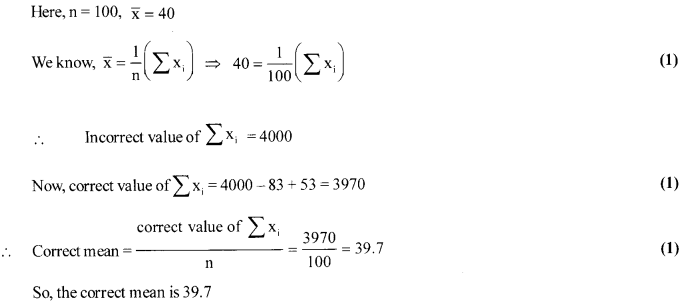
The mean of marks scored by 100 students was found to be 40. Later on it was discovered that a score of 53 was misread as 83. Find the correct mean.

Question 20.
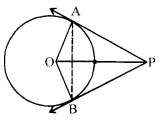
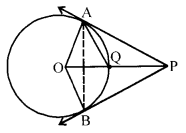
In the adjoining figure, PA and PB are tangents to a circle with centre O. If OP is equal to the diameter of the circle, prove that ∆ABP is an equilateral triangle.
CBSE Sample Papers for Class 10 Maths Paper 4 img 3

Question 21.
Solve: 2x2 +3y2 = 35; [latex s=2]\frac { { x }^{ 2 } }{ 2 } +\frac { { y }^{ 2 } }{ 3 } [/latex] = 5

Question 22.
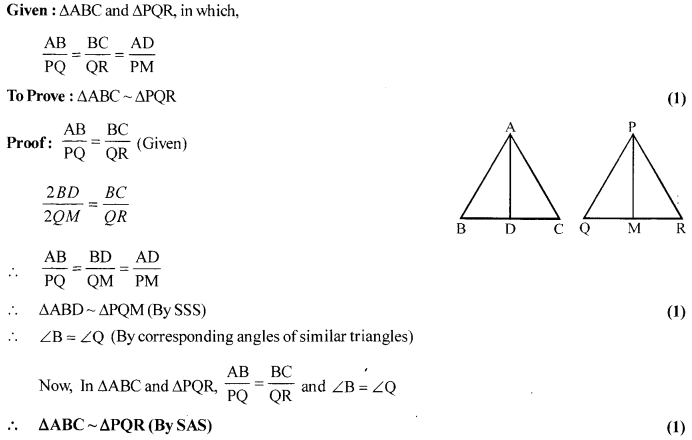
Sides AB and BC and median AD of a triangle ABC are respectively proportional to sides PQ and QR and median PM of triangle PQR. Prove that ∆ABC ~ ∆PQR
OR
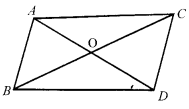
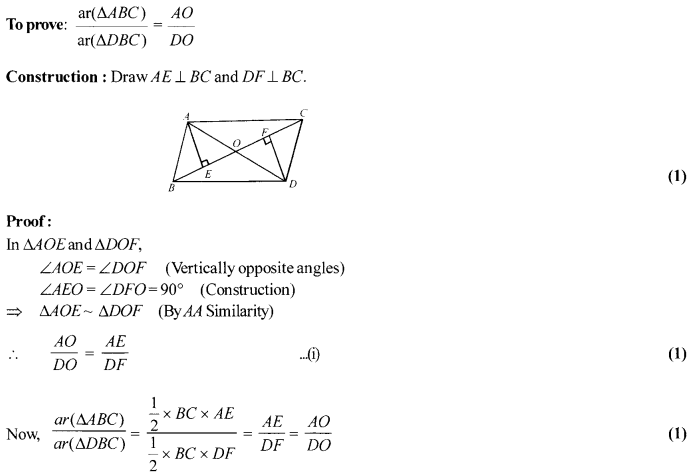
In the given figure, ∆ABC and ∆DBC are on the same base BC. AD and BC intersect at O. Prove that
[latex]\frac { ar(\triangle ABC) }{ ar(\triangle DBC) } =\frac { AO }{ DO } [/latex].
CBSE Sample Papers for Class 10 Maths Paper 4 img 4

Section-D

Question 23.
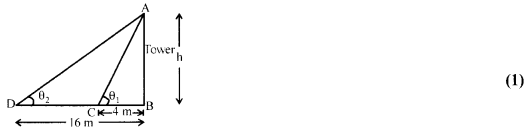
On a straight line passing through the foot of a tower, two points C and D are at distances of 4 m and 16m from the foot respectively. If the angles of elevation from C and D of the top of the tower are complementary, then find the height of the tower.
OR
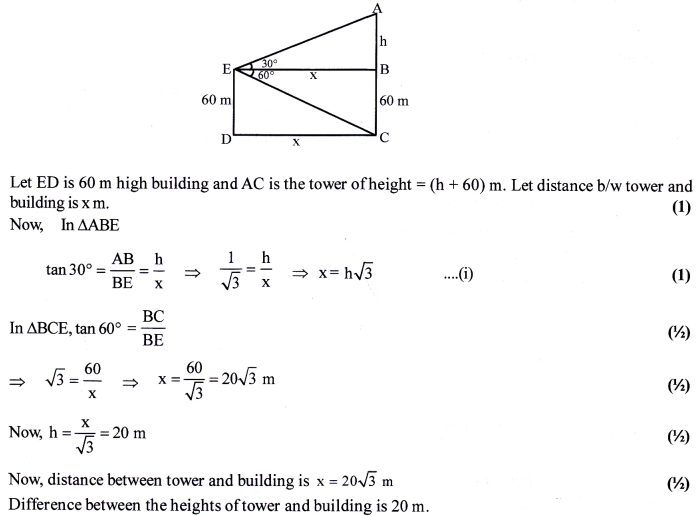
The angles of elevation and depression of the top and the bottom of a tower from the top of a building, 60 m high, are 30° and 60° respectively. Find the difference between the heights of the building and the tower and the distance between them.

Question 24.
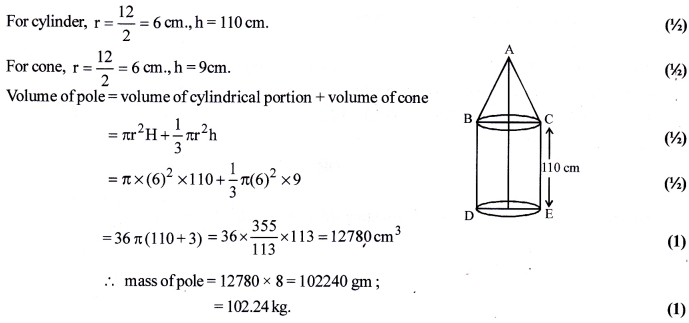
An iron pole consisting of a cylindrical portion 110 cm. high and of base diameter 12cm. is surmounted by a cone 9 cm. high. Find the mass of the pole, given that 1 cm3 of iron has 8 gram mass (approx.).
[use 71 = 355/113].

Question 25.
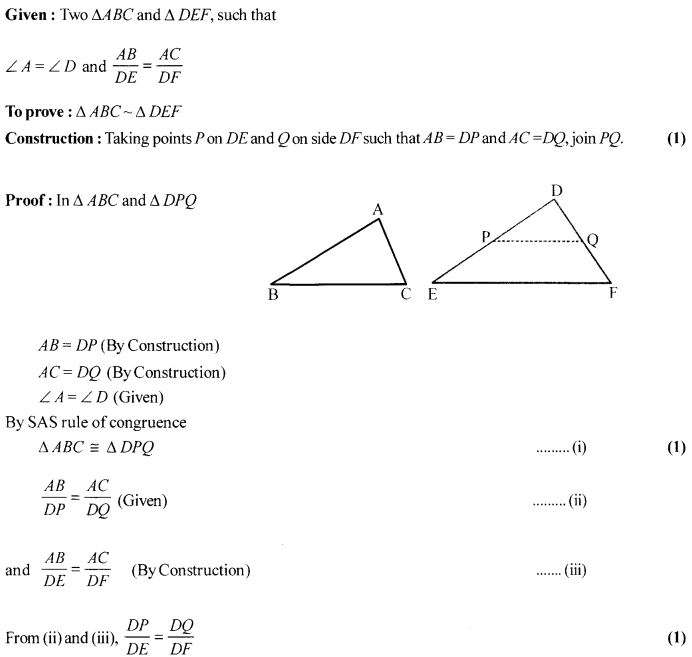
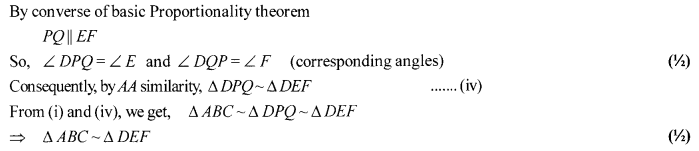
If one angle of a triangle is equal to one angle of the other triangle and the sides including these angles are proportional, then prove that the two triangles are similar.
OR
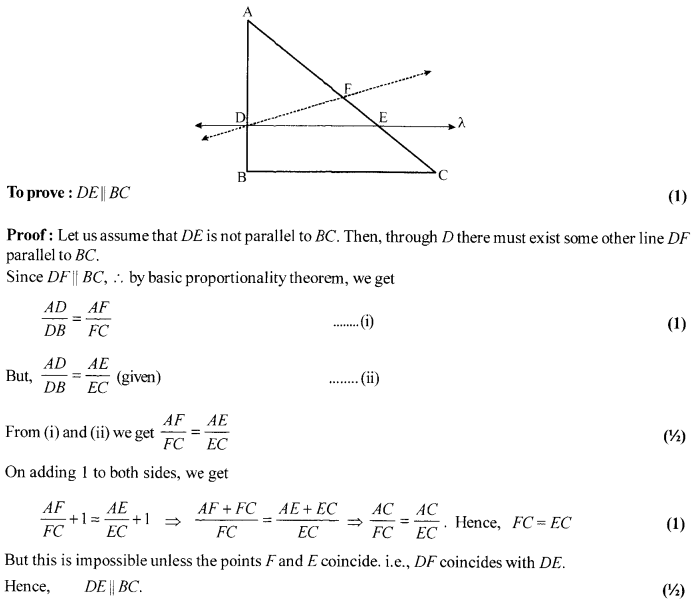
If a line divides any two sides of a triangle in the same ratio, then prove that the line is parallel to the third side.

Question 26.
CBSE Sample Papers for Class 10 Maths Paper 4 img 5

Question 27.
Draw a circle of radius 4 cm. Take a point P outside the circle. Without using the centre of the circle, draw two tangents to the circle from point P.

Question 28.
The frequency distribution of scores obtained by 230 candidates in a medical entrance test is as follows:
CBSE Sample Papers for Class 10 Maths Paper 4 img 6
Draw cumulative frequency curve or ogive by more than method.

Question 29.
If the equation (1 + m2) x2 + 2mcx + c2 – a2 = 0 has coincident roots show that c2 = a2 (1 + m2)
or c = ±a[latex]\sqrt { 1+{ m }^{ 2 } } [/latex] .
OR
If x = 4 and x = -5 are roots of3x2-2mx + 2n = 0, find the values of ‘m’ and ‘n’.

Question 30.
If four numbers in A.P. are such that their sum is 50 and the greatest number is 4 times the least, then find the numbers.

Solutions
Section-A

Solution 1.
No. According to Euclid’s division lemma, a=3q + r, where 0 ≤ r < 3 and r is an integer. Therefore, the values of r can be 0, 1 or 2. (1)

Solution 2.
CBSE Sample Papers for Class 10 Maths Paper 4 img 7

Solution 3.
CBSE Sample Papers for Class 10 Maths Paper 4 img 8

Solution 4.
Given, A + B = 90° and sec A = [latex s=2]\frac { 5 }{ 3} [/latex]
⇒ sec(90°-B) =[latex s=2]\frac { 5 }{ 3} [/latex] (∵ A + B = 90°)
∴ cosec B = [latex s=2]\frac { 5 }{ 3} [/latex] (1)

Solution 5.
a1 = 3y- 1, a2 = 3y+ 5, a3 = 5y+ 1
∴ a2 – a1 = 3 – a1
⇒(3y + 5) – (3y- 1) = (5y + 1) – (3y +5) ⇒6 = 2y-4 (1)
⇒ 2y=10 ⇒ y=5

Solution 6.
Since, PQ = QR ⇒ Q is mid-point of PR.
∴ Using mid-point formula,
1 = [latex s=2]\frac { 6+x }{ 2} [/latex] ⇒ 6 + x = 2 ⇒x = -4. (1)

Section-B

Solution 7.
The Prime factorisation of 66 & 486 gives
66 = 2 × 3 × 11
486 = 2 × 3 ×3 ×3 × 3 × 3= 2 × 35 (1/2)
∴The LCM of these two integer is
2 × 35 × 11 = 5346 (1/2)
HCF (66,486) = [latex]\frac { 66\times 486 }{ LCM(66,486) } =\frac { 66\times 486 }{ 5346 } [/latex] = 6 (1)

Solution 8.
Given : a5 + a9 = 30
a25 = 3a8
Now, a + 4d + a+8d = 30
⇒ 2a+ 12d = 30
⇒ a + 6d = 15 …(i) (1/2)
and, a + 24d=3a + 21d ⇒2a-3d = 0 …(ii) (1/2)
From eqs. (i) and (ii)
CBSE Sample Papers for Class 10 Maths Paper 4 img 9

Now, put d = 2 in eq. (i)
a+ 12=15 ⇒ a = 3
Required A.P. = 3,5,7,………….. (1/2)

Solution 9.
Let the number of blue balls = x
∴ Total number ofballs = 5 + x
P (blue ball) = [latex s=2]\frac { x }{ 5+x } [/latex] (1/2)
P (red ball) = [latex s=2]\frac { 5 }{ 5+x } [/latex] (1/2)
Given that P (blue) = 2 × p (red)
[latex s=2]\frac { x }{ 5+x } [/latex] = 2 × [latex s=2]\frac { 5 }{ 5+x } [/latex]
⇒ [latex s=2]\frac { x }{ 5+x } [/latex] = [latex s=2]\frac { 10 }{ 5+x } [/latex]
On solving we get x = 10 (1)

Solution 10.
CBSE Sample Papers for Class 10 Maths Paper 4 img 10
P is the mid-point ofAB
∴ x+1=4⇒x = 3 [By Mid-Point formula]
y-4 = -2 ⇒ y = 2
⇒ B(3,2) (1/2)
Similarly,
z + 1 = 0 ⇒z = -1
and t – 4 = -2 ⇒t = 2
⇒ C(—1,2)
∴ Area ∆ABC (1/2)
= [latex s=2]\frac { 1 }{ 2 } [/latex][1(2 – 2)+3(2+4)-1(-4-2)] ⇒[latex s=2]\frac { 1 }{ 2 } [/latex] ×24 = 12 sq units (1)

Solution 11.
Since, (3, a) lies on the line 2x – 3y = 5
So, 2 × 3 – 3a = 5 (1)
⇒ 6 —3a = 5 ⇒ a= [latex s=2]\frac { 1 }{ 3 } [/latex] (1)

Solution 12.
Total number of possible outcomes when two dice are thrown simultaneously =36 (1/2)
Sum of the numbers appearing on the dice
is a prime number i.e., 2,3,5,7 and 11
So, the possible outcomes are (1,1), (1,2), (2, 1), (1,4), (2,3), (3,2), (4,1), (1,6), (2,5),
(3,4), (4,3), (5,2), (6,1), (5,6) and (6,5).
Number of possible outcomes = 15 (1)
∴ Required probability = [latex s=2]\frac { 15 }{ 36 } [/latex] = [latex s=2]\frac { 5 }{ 12 } [/latex] (1/2)

Section-C

Solution 13.
Given integers are 81 and 237 such that 81 < 237.
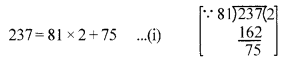
Applying Euclid’s division lemma to 81 and 237, we get
CBSE Sample Papers for Class 10 Maths Paper 4 img 11
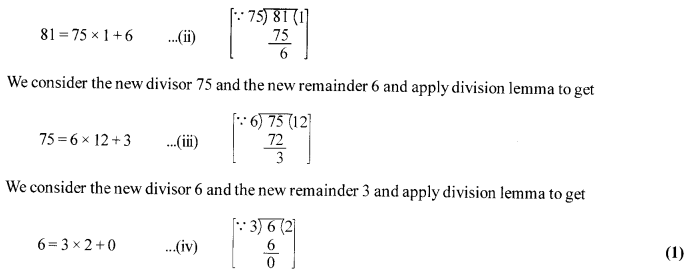
Since the remainder 75 ≠ 0. So, consider the divisor 81 and the remainder 75 and apply division lemma to get
CBSE Sample Papers for Class 10 Maths Paper 4 img 12
The remainder at this stage is zero. So, the last divisor i.e. 3 is the HCF of 81 and 237.
To represent the HCF as a linear combination of the given two numbers, we start from the last but one step and successively eliminate the previous remainders as follows :
From (iii), we have
3 = 75 – 6 × 12
⇒3 = 75-(81 – 75 × 1) ×12
[Substituting 6 = 81 -75 × 1 obtained from (ii)]
⇒ 3 = 75 – 12 × 81 + 12 × 75
⇒ 3 = 13 × 75 – 12 × 81
⇒ 3 = 13 × (237-81 × 2)-12 × 81 [Substituting 75 = 237 – 81 × 2 obtained from (i)] (1)
⇒ 3 = 13 × 237 – 26 × 81 – 12 × 81
⇒ 3 = 13 × 237 – 26 × 81 – 12 × 81
⇒ 3 = 13 × 237-38 × 81
⇒ 3 = 237 × + 81 y, where x = 13 and
y = -38 ….v (1)

Solution 14.
CBSE Sample Papers for Class 10 Maths Paper 4 img 13
CBSE Sample Papers for Class 10 Maths Paper 4 img 14

Solution 15.
Perimeter of shaded region
= Perimeter (QTR+ QAP + PSR) (1)
= π[latex]\left[ 5+\frac { 3 }{ 2 } \frac { 7 }{ 2 } \right] =\pi \left[ \frac { 20 }{ 2 } \right] [/latex] =10π = 31.4cm (2)

Solution 16.
Let the radius of spherical marble = 0.7 cm (1/2)
Volumeofl marble =[latex s=2]\frac { 4 }{ 3 } [/latex]πr3 = [latex s=2]\frac { 4 }{ 3 } [/latex]π(0.7)3 cm3 (1/2)
Volume of 150 marble = 200π(0.7)3 cm3 (1/2)
Let h be the rise in the height of water
∴ Volume of water raised = Volume of 150 marbles (1/2)
So, π × 72 × h = 200π(0.7)3 ⇒ h = [latex]\frac { 200\times 7\times 7\times 7 }{ 7\times 7\times 10\times 10\times 10 } [/latex]
⇒ h = 1.4 cm (1)
OR
Let the radius ofhemisphere = r
Now, volume ofhemisphere = [latex s=2]\frac { 2 }{ 3 } [/latex] πr3 (1/2)
Surface area ofhemisphere = 3πr2 (1/2)
A.T.Q, volume ofhemisphere = surface area ofhemisphere (1/2)
⇒ [latex s=2]\frac { 2 }{ 3 } [/latex] πr3 = 3πr2 ⇒r= [latex s=2]\frac { 9 }{ 2 } [/latex]units (1)

Solution 17.
Suppose the co-ordinates of vertex D are (x, y), then
Mid-point of AC = Mid-point of BD (For parallelogram ABCD) (1/2)
CBSE Sample Papers for Class 10 Maths Paper 4 img 15

Solution 18.
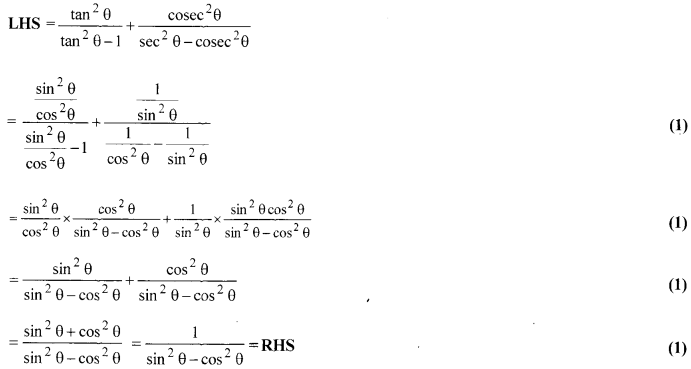
CBSE Sample Papers for Class 10 Maths Paper 4 img 16
OR
CBSE Sample Papers for Class 10 Maths Paper 4 img 17

Solution 19.
CBSE Sample Papers for Class 10 Maths Paper 4 img 18
CBSE Sample Papers for Class 10 Maths Paper 4 img 19
OR
CBSE Sample Papers for Class 10 Maths Paper 4 img 20

Solution 20.
Let OP meet the circle at Q. Join AQ. As OP is equal to the diameter of the circle and OQ is radius, so OQ = QP i.e. Q is mid-point of OP. Since PA is tangent to the circle at A and OA is its radius, OA ⊥L AP i.e. ∠OAP = 90°.
In right triangle OAP, Q is mid-point of hypotenuse,
CBSE Sample Papers for Class 10 Maths Paper 4 img 21
∴AQ = OQ = QP
Also OA = OQ (radii of same circle)
⇒ OA=OQ = AQ ⇒ ∆OAQ is equilateral
⇒ ∠AOQ = 60° ⇒ ∠AOP = 60°. (1)
In ∆OAP, ∠OPA + ∠AOP + ∠OAP =180°
⇒ ∠OPA+60°+ 90° = 180°
⇒ ∠OPA= 30°
⇒ ∠APB = 60° (∴OP is bisector of ZAPB) (1)
Also PA = PB ⇒ ∠PAB = ∠PBA.
In ∆PAB, ∠PAB + ∠PBA+ ∠APB = 180°
⇒ 2 ∠PAB+ 60° =180°
⇒ ∠PAB=60°
⇒ Triangle ABP is equilateral. (1)

Solution 21.
∴Letx2 = u, y2 = v
⇒ 2u + 3v=35 and [latex]\frac { u }{ 2 } +\frac { v }{ 3 } [/latex] = 5 (1/2)
⇒ 2u + 3v = 35 …(i)
⇒ 3u + 2v = 30 …(ii) (1/2)
Multiply (i) by 3 and (ii) by 2 and subtracting (ii) from (i), we have
⇒ 6u – 6u + 9v – 4v= 105 – 60
⇒ 5v = 45 ⇒v = 9
Substituting v = 9 in (1), we get 2u + 2 7 = 3 5
2u = 8 => u = 4 ⇒x2 = 4, y2 = 9
∴ x = ± 2,y = ± 3 is the required solution. (1)

Solution 22.
CBSE Sample Papers for Class 10 Maths Paper 4 img 22
OR
CBSE Sample Papers for Class 10 Maths Paper 4 img 23

Section-D

Solution 23.
Suppose AB be a tower and there are two points C and D at the distances of 4 m and 16 m from the foot of the tower respectively
CBSE Sample Papers for Class 10 Maths Paper 4 img 24
Since, the angles of elevation from C and D of the top of the tower are complementary.
So,e,+e2 = 90° …(i) (1/2)
Let the height of the tower be h.
Then, from equation (i), tan (θ1 + θ2) = tan 90° (1/2)
⇒ [latex]\frac { \tan { { \theta }_{ 1 } } +\tan { { \theta }_{ 2 } } }{ 1-\tan { { \theta }_{ 1 } } \tan { { \theta }_{ 2 } } } =\frac { 1 }{ 0 } [/latex]
⇒ 1- tan θ1 tan θ2 =0 ⇒ tan θ1 tan θ2 = 1 (1)
⇒ [latex]\frac { h }{ 4 } \times \frac { h }{ 16 } [/latex] = 1 ⇒ h<2 = 64 ⇒ h = 8 m (∵Height cannot be negative) (1)
Hence, the height of the tower is 8 m.
OR
CBSE Sample Papers for Class 10 Maths Paper 4 img 25

Solution 24.
CBSE Sample Papers for Class 10 Maths Paper 4 img 26

Solution 25.
CBSE Sample Papers for Class 10 Maths Paper 4 img 27
CBSE Sample Papers for Class 10 Maths Paper 4 img 28
OR
CBSE Sample Papers for Class 10 Maths Paper 4 img 29
CBSE Sample Papers for Class 10 Maths Paper 4 img 30

Solution 26.
CBSE Sample Papers for Class 10 Maths Paper 4 img 31

Solution 27.
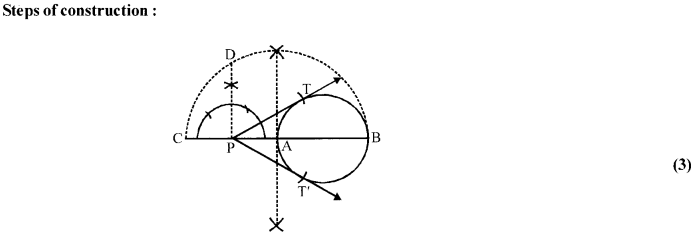
CBSE Sample Papers for Class 10 Maths Paper 4 img 32
(i) Draw a line segment 4 cm.
(ii) Take a point P outside the circle and draw a secant PAB, intersecting the circle at A and B.
(iii) Produce AP to C such that AP = CP.
(iv) Draw a semi-circle with CB as diameter.
(v) Draw PD⊥L CB, intersecting the semi-circle at D.
(vi) With P as centre and PD as radius draw arcs to intersect the given circle at T and T’.
(vii) Join PTand PT’. Then, PTand PT’ are the required tangents.

Solution 28.
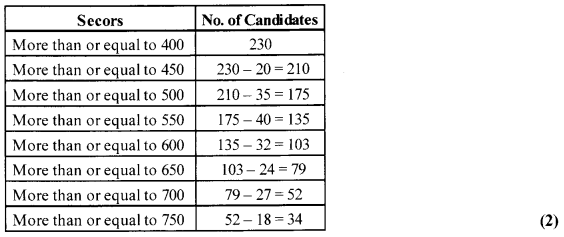
First convert the given frequency distribution table to More Than Type frequency distribution table.
CBSE Sample Papers for Class 10 Maths Paper 4 img 33
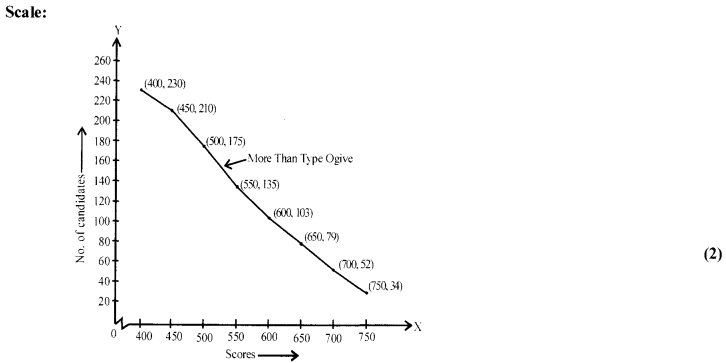
Now mark the lower limits along X-axis and cumulative frequencies along F-axis, and plot the points (400,230), (450,210), (500,175), (550,135), (600,103), (650,79), (700,52), (750,34). Join the points listed above by smooth free hand curve to obtain the more than type ogive.
CBSE Sample Papers for Class 10 Maths Paper 4 img 34

Solution 29.
The equation (1 + m2) x2 + 2mcx + c2 – a2 = 0
For coincident (Repeated roots) D = 0 (1/2)
⇒ (2mc)2 -4(1+ m2) (c2 – a2) = 0 (1/2)
⇒ 4m2c2 – 4(c2 – a2 + m2c2 – m2a2) = 0 (1/2)
⇒ m2c2 – c2 + a2 – m2c2 + m2a2 = 0 (1/2)
⇒ m2a2 – c2 + a2 = 0 (1/2)
⇒ m2a2 + a2 = c2 ⇒ a2 (1 +m2) = c2 (1)
⇒ c = ±a[latex]\sqrt { 1+{ m }^{ 2 } } [/latex] Hence proved. (1/2)
OR
Put x = 4, we get 3(4)2 – 2m (4) + 2n = 0 (1/2)
⇒ 48-8m + 2n = 0 =>2n-8m = -48 ⇒ n-4m = -24 ….(i) (1)
Put x = -5, we get 3 (-5)2 – 2m (-5) + 2n = 0 (1/2)
⇒ 75 + 10m + 2n = 0 ⇒2n + 10m=-75 ….(ii) (1)
Solving (i) and (ii) we get, m = – [latex s=2]\frac { 3 }{ 2 } [/latex]and n = -30 (1)

Solution 30.
Let (a-3d),(a-d),(a + d),(a + 3d) are the four numbers
∴ Sum = 50
⇒ (a-3d) + (a-d) + (a + d) + (a-3d) = 50
⇒ a= [latex s=2]\frac { 25 }{ 2 } [/latex] (1)
also, (a + 3d) = 4(a-3d) (1)
⇒ 5 d=a
⇒ d = [latex s=2]\frac {5 }{ 2 } [/latex] (1/2)
5,10, 15 and 20 are the required numbers ofA.P. (1)

We hope the CBSE Sample Papers for Class 10 Maths paper 4 help you. If you have any query regarding CBSE Sample Papers for Class 10 Maths paper 4, drop a comment below and we will get back to you at the earliest.

UP Board Solutions for Class 10 Computer Science Chapter 4 Discrete Mathematics

UP Board Solutions for Class 10 Computer Science Chapter 4 Discrete Mathematics

Discrete Mathematics Long Answer Type Questions (8 Marks)

Question 1.
How are characters created by Binary Numbers? What are its different codes? Explain with examples. (UP 2011)
Answer:
Computer Code: Computer codes are used to convert data into binary form to make the computer understand it. Apart from this, they are responsible for error-free signal flow in the computer. Three popular computer codes are:
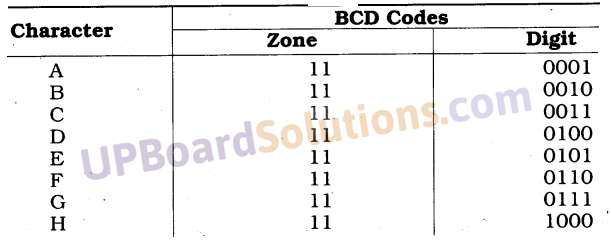
BCD (Binary Coded Decimal): It is one of the earliest developed (UPBoardSolutions.com) memory codes. In this, every digit is converted into binary form separately:
e.g.,
UP Board Solutions for Class 10 Computer Science Chapter 4 Discrete Mathematics 1
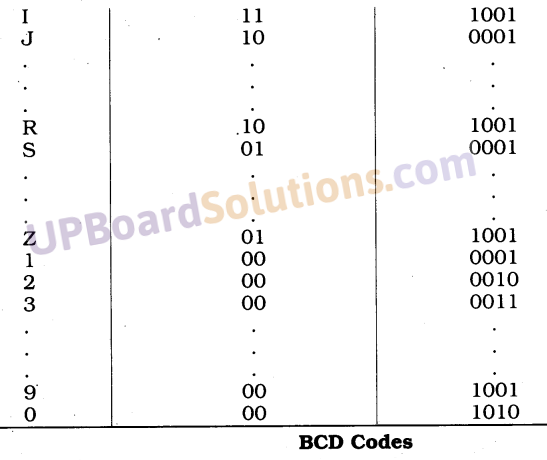
But four-bit code can handle only 24 = 16 dIfferent characters that are why it is extended to 6-bit code and It can handle 26 = 64 different characters. It is 6-bit code and divided into two parts i.e., zone bit and character code.
Zone bit consists of Z bits and character zone consists of 4 bits.
To understand more look at the table given below:

UP Board Solutions
UP Board Solutions for Class 10 Computer Science Chapter 4 Discrete Mathematics 2
UP Board Solutions for Class 10 Computer Science Chapter 4 Discrete Mathematics 3
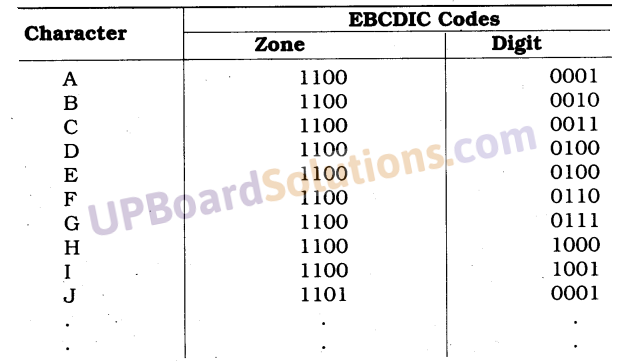
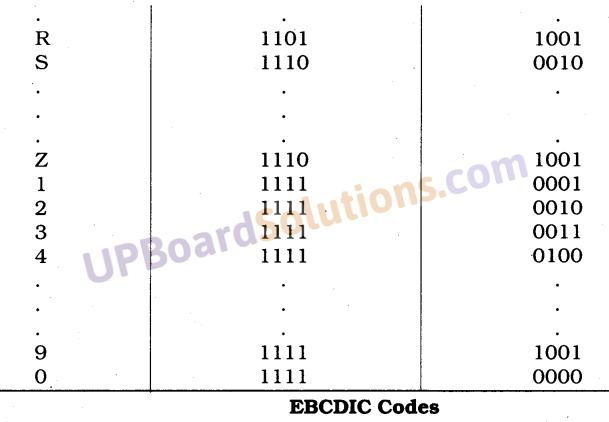
EBCDIC (Extended Binary Coded Decimal Interchange Code): BCD can convert only 64 characters but we use more than 64 characters in computer to represent data. To overcome this problem, 2 more bits have been added to the zone bit to develop new 8-bit code and, that is why it is known as extended binary coded decimal interchange code. EBCDIC is 8- bit code which can encode 28 = 256 different characters. It is similar to BCD in working but it has 4 bits in bit zone. To understand more table is given below:

UP Board Solutions
UP Board Solutions for Class 10 Computer Science Chapter 4 Discrete Mathematics 4
UP Board Solutions for Class 10 Computer Science Chapter 4 Discrete Mathematics 5
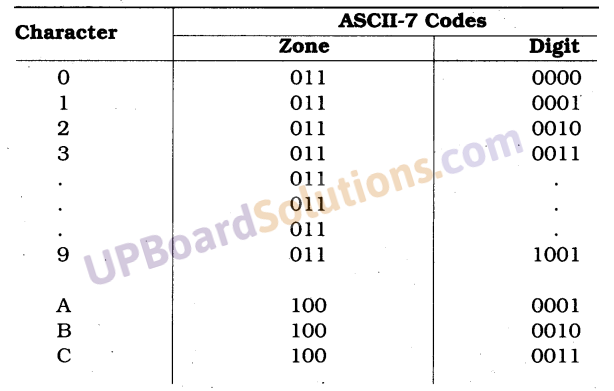
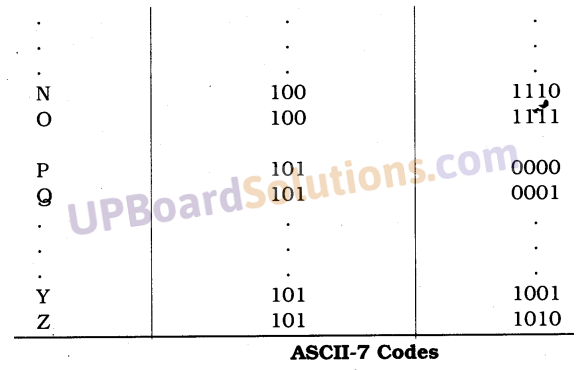
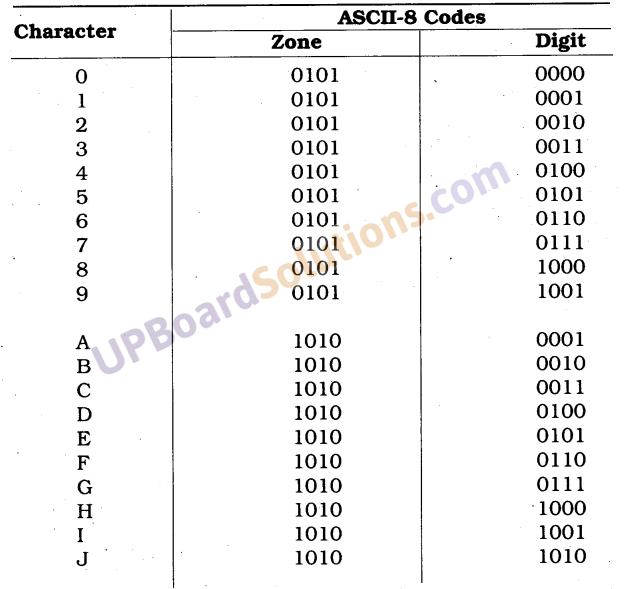
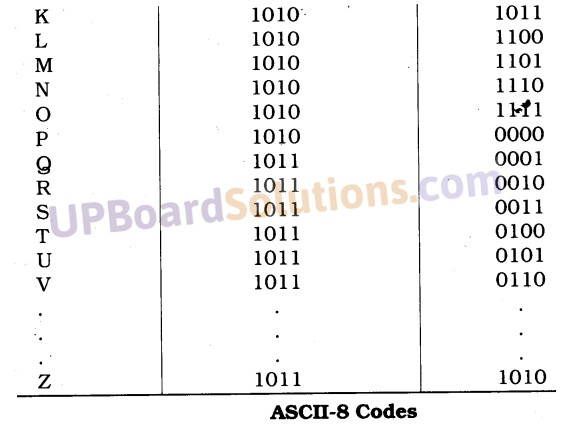
ASCII (American Standard Code for Information Interchange): This code is the most popular and widely accepted computer code. It is the standard code for computers, developed by the American National Standards Institute in the year 1963 for (UPBoardSolutions.com) encoding different characters in the computer. It is used by almost every manufacturing company. ASCII codes are of two types:
(a) 7-bit Code: To encode 27 = 128 characters with 3 bits in zone bit and four in character zone.
UP Board Solutions for Class 10 Computer Science Chapter 4 Discrete Mathematics 6
UP Board Solutions for Class 10 Computer Science Chapter 4 Discrete Mathematics 7
(b) 8-bit code: To encode 28 = 256 characters with 4 bits in bit zone and 4 bits in character zone.
UP Board Solutions for Class 10 Computer Science Chapter 4 Discrete Mathematics 8
UP Board Solutions for Class 10 Computer Science Chapter 4 Discrete Mathematics 9

UP Board Solutions

What is 5/8 as a decimal you ask? Converting the fraction 5/8 into a decimal is very easy.

Question 2.
Define character representation in computers. (UP 2008)
Or
What is meant by “character representation”? Explain one such code in detail. (UP 2009)
Or
What is meant by character coding? Explain one coding methods in detail. (UP 2016)
Or
What is Character Representation? (UP 2018)
Answer:
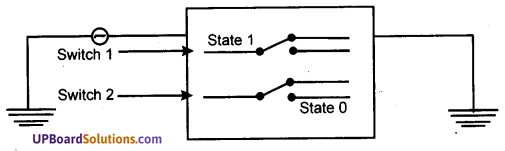
Character Representation: Physical devices used to store and process data in computers are two-state devices. A switch, for example, is a two-state device. It can be either ON or OFF. Electronic devices such as transistors used in computers must function reliably when operated as switches. Thus, all data to be stored and processed in computers are transformed or coded as strings of two symbols, one symbol to represent each state.
UP Board Solutions for Class 10 Computer Science Chapter 4 Discrete Mathematics 10
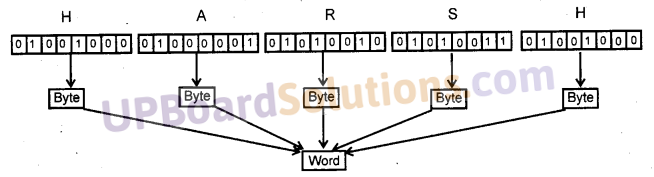
Coding of characters has been standardized to facilitate the exchange of recorded data between computers. The most popular standard is known as ASCII. Each letter is a unique combination of Binary Digits (BITS). That is, each letter (UPBoardSolutions.com) is a group of charged and uncharged transistors and it is grouped in such a way that a particular combination represents a specific character. A group of 8 BITS which is used to represent a character is called a byte. The length of 1 word is called word length which ranges from 1 byte to 64 bytes.
The internal code representation of string HARSH is:
UP Board Solutions for Class 10 Computer Science Chapter 4 Discrete Mathematics 11

UP Board Solutions

Question 3.
Explain the Number System.
Answer:
Number System: Number systems are very important to understand because the design and organization of a computer system depend on it.
Number systems are basically of two types:
1. Non-positional Number System: In this number system, each symbol represents the same value regardless of its position in the number and the symbols are simply added to find out the value of a particular number. Since it is very difficult to perform arithmetical operations with such a number system, positional number systems have been developed.

2. Positional Number System: In a positional number system, there are only a few symbols (UPBoardSolutions.com) called digits, and these symbols represent different values depending on the position they occupy in the number.

The value of each digit in such a number is determined by three considerations :

  1. The digit itself
    Face Value: The face value of a digit always remains the same regardless of its position in the number, e.g., the face value of 4 in 554, 40567 etc. is 4.
  2. The position of the digit in the number.
    Place Value: Place value of a digit changes due to change in its position, e.g., place value of 2 in 4210 is 2 hundred, in 32,450 it is 2 thousand, etc.
  3. The base of the number system (where the base is defined as the total number of digits available in the number system), e.g., Decimal number system has base 10 since it includes only 10 digits 0, 1, 2, ….., 9, to represent any number.

UP Board Solutions

The various positional systems in use are:

  1. Binary number system
  2. Octal number system
  3. Decimal number system
  4. Hexadecimal number system.

Convert fraction 6 and 1/2 to decimal. What is 6 1/2 as a decimal? Answer: 6.5.

Question 4.
What are the logical operators? What are their different types? Explain operators making their Truth Table. (UP 2007, 08, 10)
Answer:
Logical Operators: AND, OR, and NOT are logical operators. Since these operators are operated on logical values 0 and 1, that is why these operators are called logical operators.

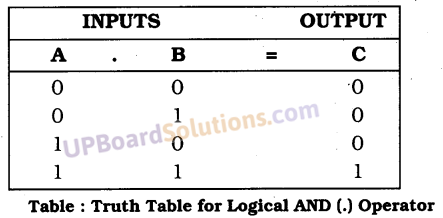
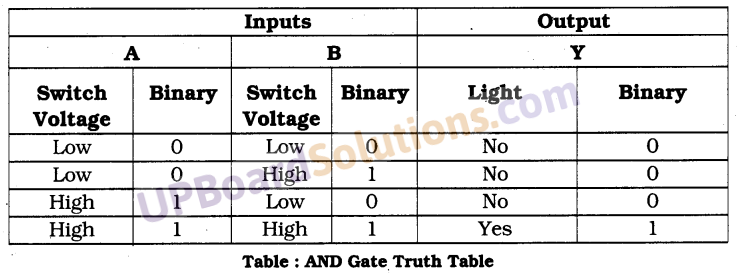
AND Operator: An AND operator is represented by the symbol ‘.’. Basically AND operator is used to performing logical multiplication. A, B, and C are three logical variables, where A, B, are input variables and C is the output variable. We can define the AND operator by listing all possible combinations of A and B and the resulting value of C in the operation A.B = C.

It may be noted that since the variables A and B can have only two possible values (0 or 1) so only four (22) combinations of inputs are possible as shown in the following table. The resulting output values for each of the four input combinations (UPBoardSolutions.com) are given in the table. Such a table is known as the truth table. Thus, the table is the truth table for the logical AND operator.

UP Board Solutions
UP Board Solutions for Class 10 Computer Science Chapter 4 Discrete Mathematics 12
As we can observe from the truth table that in AND operation, the output will be 1 when all inputs are 1 else output will be 0.
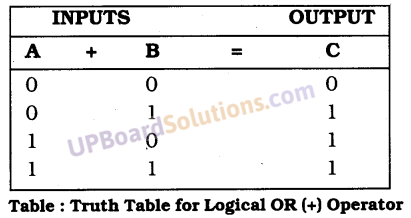
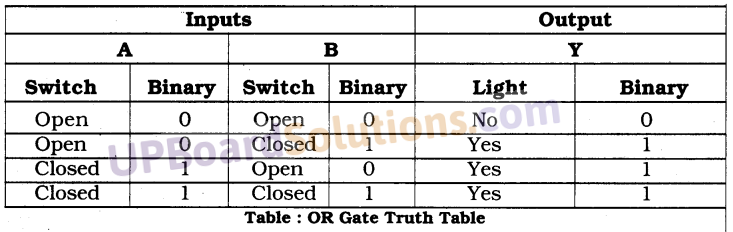
OR Operator: An OR operator is represented by the symbol V. Basically an OR operator is used to perform logical addition. As in the previous example, A and B are input variables and C its output variable. We can define the OR operator by listing all possible combinations of A and B and the resulting value of C in the equation A + B = C. The truth table for Logical OR operator is shown in the following Table:
UP Board Solutions for Class 10 Computer Science Chapter 4 Discrete Mathematics 13
As we can observe from the truth table that in logical addition, the output will be 1 when any one input is 1. It means if all inputs are 0 then the output will be 0.

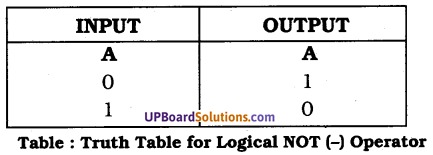
NOT Operator: The two operators (AND and OR) are binary operators because they operate on two variables. NOT operator denoted by is a Unary operator because it operates on a single variable. NOT operator is also known as complementation operator or inverse operator.
Thus, complement of A is [latex]\bar { A } [/latex]. Complement of (A + B) is [latex]\bar { (A+B } )[/latex]. If value
of [latex]\bar { A } [/latex] is 0 then value of A is 1 and if value of A is 1 then value of [latex]\bar { A } [/latex] is 0. (UPBoardSolutions.com) The truth table for logical NOT operator is shown in table.
UP Board Solutions for Class 10 Computer Science Chapter 4 Discrete Mathematics 14

Question 5.
Write about the postulates of Boolean Algebra.
Answer:
Postulates of Boolean Algebra: Boolean Algebra is an algebraic structure defined on a set of elements B together with two binary operators + and . provided the following postulates are satisfied:
(1) (a) Closure with respect to the operator +
(b) Closure with respect to the operator.

UP Board Solutions

(2) (a) An identity element with respect to +, designated by
0 : X + 0 = 0 + X = X.
(b) An identify element with respect to designated by
1 : X . 1 = 1 . X = X.

(3) (a) Commutative with respect to + : X + Y = Y + X
(b) Commutative with respect to . : X . Y = Y . X

(4) (a) . is distributive over : : X . (Y + Z) = (X . Y) + (X . Z)
(b) + is distributive over . : X + (Y . Z) = (X + Y) . (X + Z)

(5) For every element X ∈ B, there exists an element [latex]\bar { X } [/latex] ∈ B such that:
(a) X × [latex]\bar { X } [/latex] = 1
(b) X . [latex]\bar { X } [/latex] = 0
The postulates listed above are called Huntington (1904) Postulates and need (UPBoardSolutions.com) no proof. They are used to prove the theorems of Boolean Algebra.

Question 6.
What are the different Gates in Boolean Algebra? (UP 2004, 05, 07)
Or
What is ‘Truth Table’? How is it helpful in understanding GATES? (UP 2006)
Or
Explain the working of a NAND Gate. Give its two application. (UP 2009, 10)
Or
How can you show that NAND is a Universal Gate? Explain with diagrams and truth tables. (UP 2011, 19)
Answer:
Truth Table: A table that shows all the input-output possibilities of a logic circuit is called a truth table.
There are several types of the truth table. AND, OR, NOT, NAND, NOR, XOR, XNOR Gates are described below:
(a) AND Gate: In English language, Input A is ANDed with Input B to get output Y.

UP Board Solutions
UP Board Solutions for Class 10 Computer Science Chapter 4 Discrete Mathematics 15
UP Board Solutions for Class 10 Computer Science Chapter 4 Discrete Mathematics 16
The truth table illustrates four ways to express the logical ANDing of A and B.
The AND Gate works on the principle that output will be high when all the inputs (UPBoardSolutions.com) are high otherwise output will be low.

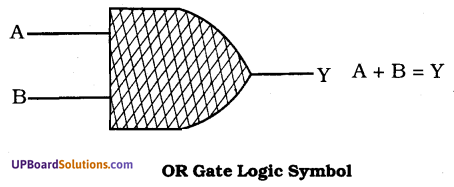
(b) OR Gate: In OR Gate, input A is ORed with input B to get output Y.
UP Board Solutions for Class 10 Computer Science Chapter 4 Discrete Mathematics 17
UP Board Solutions for Class 10 Computer Science Chapter 4 Discrete Mathematics 18
The OR Gate works on the principle that, if anyone input is high, the output will be high. Thus, the only case when output will be low is when all inputs are low i.e., 0.

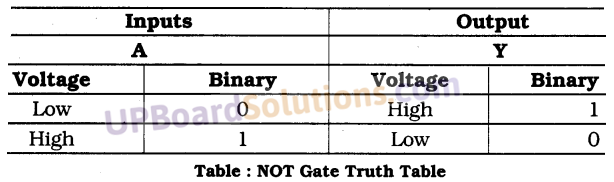
(c) NOT Gate: The NOT Gate is an electronic circuit that generates an output signal which is the reverse of the input signal. A NOT gate is also known as an inverter because it inverts the input.

UP Board Solutions
UP Board Solutions for Class 10 Computer Science Chapter 4 Discrete Mathematics 19
UP Board Solutions for Class 10 Computer Science Chapter 4 Discrete Mathematics 20

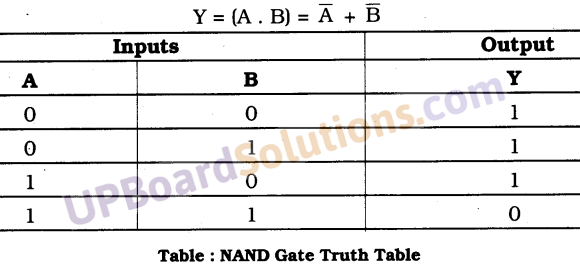
(d) NAND Gate: A NAND Gate is a complemented AND gate. That is, the output of NAND Gate will be 1 if anyone of the inputs is 0 and will be 0 when all the inputs are 1.
UP Board Solutions for Class 10 Computer Science Chapter 4 Discrete Mathematics 21
UP Board Solutions for Class 10 Computer Science Chapter 4 Discrete Mathematics 22

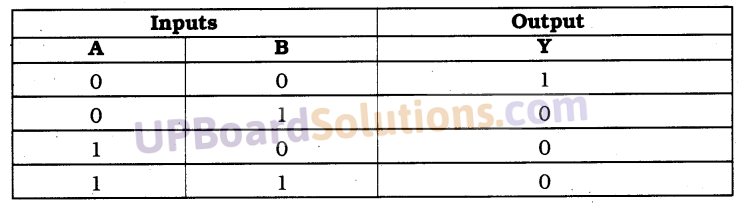
(e) NOR Gate: A NOR Gate is a complemented OR Gate. That is, the output of a NOR Gate will be 1 only when all inputs are 0 and will be 0 if any input represents a 1.
UP Board Solutions for Class 10 Computer Science Chapter 4 Discrete Mathematics 23
UP Board Solutions for Class 10 Computer Science Chapter 4 Discrete Mathematics 24

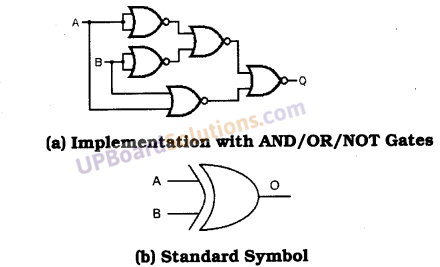
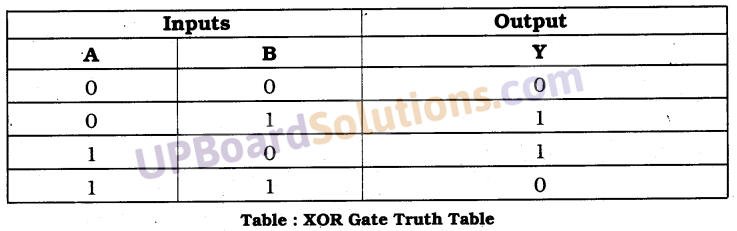
(f) XOR Gate (Exclusive-OR Gate): XOR Gate is a combination of AND, OR, and NOT (UPBoardSolutions.com) Gates. symbol denotes XOR operation. This Gate works on the principle that if an odd number of inputs are 1, the output will be 1 otherwise output will be 0.

UP Board Solutions
UP Board Solutions for Class 10 Computer Science Chapter 4 Discrete Mathematics 25
UP Board Solutions for Class 10 Computer Science Chapter 4 Discrete Mathematics 26
As observed from the truth table, the output is 1 when odd numbers of inputs are 1.

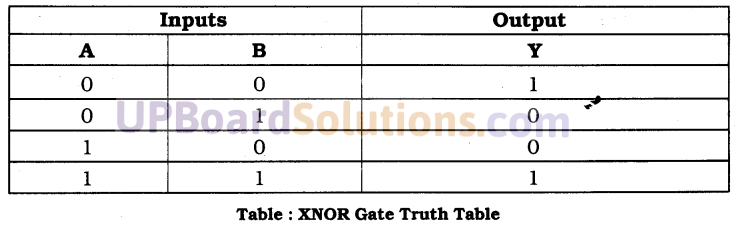
(g) XNOR Gate (Exclusive-NOR Gate): Similarly, XNOR gate is also formed with a combination of AND, OR, and NOT gates. symbol denotes XNOR operation. Since this gate is the inverse of XOR gate, the output will be 0 when odd numbers of inputs are 1 otherwise output will be 1.
UP Board Solutions for Class 10 Computer Science Chapter 4 Discrete Mathematics 27
UP Board Solutions for Class 10 Computer Science Chapter 4 Discrete Mathematics 28

UP Board Solutions

Question 7.
Explain the basic features of ASCII Code. (UP 2005, 08, 09, 10)
Or
Explain in detail the features of the ASCII character code. (UP 2007)
Answer:
ASCII: Binary numbers are coded to represent characters in the computer memory. Several codes are used for this purpose. One most commonly used code is the American Standard Code for Information Interchange (ASCII). ASCII has been adopted by several American computer manufacturers as their computer’s internal code. This code is popular in data communications, is used (UPBoardSolutions.com) almost exclusively to represent data internally in microcomputers, and is frequently found in the larger computers produced by some vendors.

ASCII is of two types: ASCII-7 and ASCII-8. ASCII-7 is a 7-bit code that represents 128 (27) different characters.
ASCII-8 is an extended version of ASCII-7. It is an 8-bit code that represents 256 (28) different characters rather than 128.
e.g. (i) A is given ASCII code 65.

Now if we convert 65 into Binary form we get 01000001 → 1 byte
In the same way, every character has its own ASCII value after converting into binary code stored on the computer.

Question 8.
Describe various Binary Arithmetic Operations. (UP 2008, 09, 11)
Or
What is binary arithmetic? Explain with suitable example. (UP 2017)
Answer:
Four basic arithmetic operations are performed inside a computer using binary numbers. These are addition, subtraction, multiplication, and division. Since binary numbers are made up of 0’s and 1’s, results of arithmetic operations are also in 0’s and 1’s only.

Binary Addition: Binary addition is performed in the same manner as decimal addition. However the binary system has only two digits, the addition table for binary arithmetic is very simple, consisting of only four entries. The complete table for binary addition is as follows:
0 + 0 = 0
0 + 1 = 1
1 + 0 = 1
1 + 1 = 0

UP Board Solutions

Plus a carry of 1 to next higher column. Carryovers are performed in the same manner as in decimal arithmetic. Since 1 is the largest digit in the binary system, any sum greater than 1 requires that a digit be carried over.
Example:
UP Board Solutions for Class 10 Computer Science Chapter 4 Discrete Mathematics 29
UP Board Solutions for Class 10 Computer Science Chapter 4 Discrete Mathematics 30
Binary Subtraction: From the following table, it is clear that the lower digit is subtracted (UPBoardSolutions.com) from the upper digit. If the lower digit is larger than the upper digit, it is necessary to borrow from the column to the left which equals to 2 (10).
0 – 0 = 0
1 – 0 = 1
1 – 1 = 0
0 – 1 = 1
with borrow from the next column. Thus, the only case in which it is necessary to borrow is when 1 is subtracted from 0.
Example
UP Board Solutions for Class 10 Computer Science Chapter 4 Discrete Mathematics 31
Binary Multiplication: Multiplication in the binary system also follows the same general rules as decimal multiplication. The table for binary multiplication is as follows:
0 × 0 = 0
0 × 1 = 0
1 × 0 = 0
1 × 1 = 1
Example:
UP Board Solutions for Class 10 Computer Science Chapter 4 Discrete Mathematics 32

UP Board Solutions
Binary Division: Binary division is, again, very simple. As in the decimal system (or in any other system), division by zero is meaningless, here too. Hence, the complete table for the binary division is as follows:
0/1 = 0
1/1 = 1
The division process is performed in a manner similar to the decimal division.
Example:
UP Board Solutions for Class 10 Computer Science Chapter 4 Discrete Mathematics 33

Discrete Mathematics Short Answer Type Questions (4 Marks)

Question 1.
What is the order of precedence in Boolean Algebra? (UP 2007, 09, 19)
Answer:
In a Boolean expression, many operators are used. The order in which they are operated is known as precedence. The precedence of Boolean operators is as follows:

  1. The expression is scanned from left to right.
  2. Expressions enclosed within parentheses are evaluated first.
  3. All complement (NOT) operations are performed next.
  4. All ‘.’ (AND) operations are performed after that.
  5. Finally, all ‘+’ (OR) operations are performed in the end.

UP Board Solutions

Question 2.
Define the Principal of Quality. (UP 2016)
Answer:
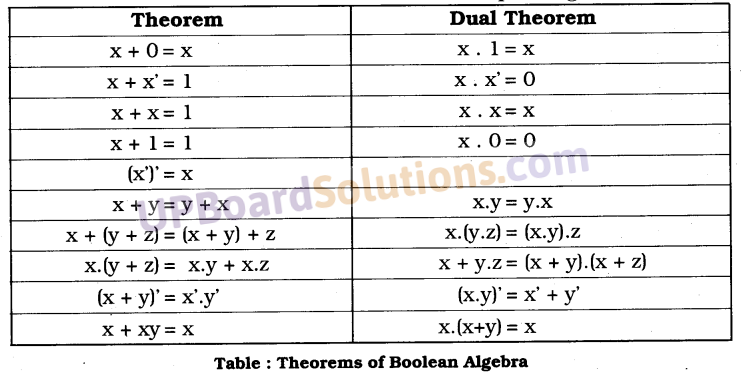
The Huntington Postulates have been listed in two parts: (a) and (b). One part may be obtained from the other if ‘+’ is interchanged ‘+’ with ‘.’ and ‘0’ in interchanged with ‘1’ and vice-versa. This important property of Boolean Algebra (UPBoardSolutions.com) is called Principle of Quality. This principle ensures that, if a theorem is proved using the postulates, then a dual theorem obtained interchanging ‘+’ with ‘.’ and ‘0’ with ‘1’ automatically holds and need not be proved separately.
The table below lists theorems and their corresponding dual theorems.
UP Board Solutions for Class 10 Computer Science Chapter 4 Discrete Mathematics 34

Question 3.
Write a note on De Morgan’s Theorems to prove it.
Answer:
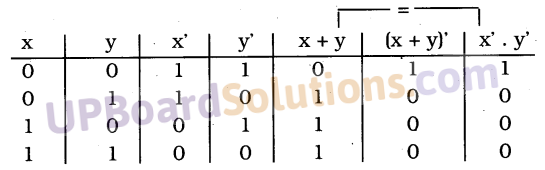
Theorem (a): De Morgan’s Theorems: (x + y)’ = x’. y’
Proof: The truth table for proving this theorem is given below:
UP Board Solutions for Class 10 Computer Science Chapter 4 Discrete Mathematics 35
From the truth table, it is clear that both sides of the theorem are equal. Hence, the theorem is proved.
Theorem (b): (x + y)’ = x’ + y’
Proof: The truth table for proving this theorem is given below:
UP Board Solutions for Class 10 Computer Science Chapter 4 Discrete Mathematics 36

UP Board Solutions
From the truth table, It is clear that both sides of the theorem are equal. Hence, the theorem is proved.
Theorems 6(a) and 6(b) are very important and useful. They are known as De Morgan’s theorems. They can be extended to n variables as given below:
(X1 + X2 + X3 + ………. + Xn)’ = X1‘ . X2‘ . X3‘ …….. Xn‘
(X1 . X2 . X3. …… Xn)’ = X1‘ + X’2 + X3‘ + ……….. + Xn‘

Question 4.
Write AND and OR LAWS of Discrete mathematics.
Answer:
AND LAWS: AND LAWS are the laws which work on logical multiplication. They are:
1. x . 1 = x
2. x . x’ = 0
3. x . x = x
4. x . 0 = 0
“The tabular representations of truth values of a compound statement based on the truth values of the prime connective ness of statements is called TRUTH TABLE.”
Truth table consists of horizontal lines (rows) and vertical lines (columns). If a compound statement consists of N statements, the number of rows will be 2^N. The number of columns in a truth table depends upon the number of relationships between these statements.

Discrete Mathematics Very Short Answer Type Questions (2 Marks)

Question 1.
Discuss De-Morgan’s Theorem. (UP 2014)
Answer:
First Theorem: This theorem states that the complement of a sum of the binary variable is equal to the product of the complement of the binary variables.
Second Theorem: The theorem states that the complement of a product of binary (UPBoardSolutions.com) variable is equal to the sum of the complement of the binary variable

Question 2.
What is the full form of ASCII? (UP 2014)
Answer:
The full form of ASGII is American Standard Code for Information Interchange.

Question 3.
If A = 0 and B = 1, then find the value of y from the following expression:
Y = (A . B)
Answer:
Y = [latex]\bar { (0.1 } )[/latex] = [latex]\bar { (0 } )[/latex] = 1

UP Board Solutions

Question 4.
Give the name of the Boolean operators. (UP 2014)
Answer:
AND Operator, Or operator and NOT operator.

Question 5.
Write a full form of EBCDIC. (UP 2017)
Answer:
Extended Binay Coded Decimal Interchange Code.

Discrete Mathematics Objective Type Questions (1 Marks)

There are four alternative answers for each part of the questions. Select the (UPBoardSolutions.com) correct one and write in your answer book:

Question 1.
Each letter is a unique combination of:
(a) Bits
(b) Bytes
(c) Word length
(d) Binary.
Answer:
(a) Bits

Question 2.
A group of 8 bits which is used to represent a character is called :
(a) Bits
(b) Bytes
(c) Integer
(d) None of these.
Answer:
(b) Bytes

UP Board Solutions

Question 3.
The most popular standard is known as:
(a) BCD
(b) ABC
(c) ASC
(d) ASCII
Answer:
(d) ASCII

Question 4.
In the hexadecimal number system, the base :
(a) 8
(b) 10
(c) 16
(d) None of these.
Answer:
(c) 16

Question 5.
The binay equivalent of the number (15)10. (UP 2014)
(a) (1101)
(b) (1110)2
(c) (1111)2
(d) (1000)2.
Answer:
(a) (1101)

UP Board Solutions

Question 6.
Which logic gate has only one input and one output? (UP 2015)
(a) NOT
(b) NOR
(c) OR
(d) AND.
Answer:
(a) NOT

Question 7.
The value of the binary number (1010)2 would be?
(a) (14)10
(b) (12)10
(c) (10)10
(d) (11)10
Answer:
(c) (10)10

Question 8.
What is binary equivalent of [31]10. (UP 2017)
(a) 10000
(b) 11111
(c) 100000
(d) 11110.
Answer:
(b) 11111

UP Board Solutions

Question 9.
Which of the following is a single input logic gate? (UP 2018)
(a) NAND
(b) AND
(c) NOT
(d) NOR.
Answer:
(c) NOT

UP Board Solutions for Class 10 Computer Science

UP Board Solutions for Class 10 Hindi Chapter 7 रामनरेश त्रिपाठी (काव्य-खण्ड)

UP Board Solutions for Class 10 Hindi Chapter 7 रामनरेश त्रिपाठी (काव्य-खण्ड)

These Solutions are part of UP Board Solutions for Class 10 Hindi. Here we have given UP Board Solutions for Class 10 Hindi Chapter 7 रामनरेश त्रिपाठी (काव्य-खण्ड).

कवि-परिचय

प्रश्न 1.
श्री रामनरेश त्रिपाठी का जीवन-परिचय देते हुए उनकी काव्य-कृतियों (रचनाओं) का उल्लेख कीजिए। [2009, 10, 16]
या
रामनरेश त्रिपाठी का जीवन-परिचय देते हुए उनकी किसी एक रचना का नामोल्लेख कीजिए। [2012, 13, 14]
उत्तर
पं० रामनरेश त्रिपाठी स्वदेश-प्रेम, मानव-सेवा और पवित्र प्रेम के गायक कवि हैं। इनकी रचनाओं में छायावाद का सूक्ष्म सौन्दर्य एवं आदर्शवाद का मानवीय दृष्टिकोण एक साथ घुल-मिल गये हैं। आप बहुमुखी प्रतिभा से सम्पन्न साहित्यकार (UPBoardSolutions.com) हैं। राष्ट्रीय भावनाओं पर आधारित इनके काव्य अत्यन्त हृदयस्पर्शी हैं।

UP Board Solutions

जीवन-परिचय-हिन्दी-साहित्य के विख्यात कवि रामनरेश त्रिपाठी का जन्म सन् 1889 ई० में उत्तर प्रदेश के जौनपुर जिले के कोइरीपुर ग्राम के एक साधारण कृषक परिवार में हुआ था। इनके पिता पं० रामदत्त त्रिपाठी एक आस्तिक ब्राह्मण थे। इन्होंने नवीं कक्षा तक स्कूल में पढ़ाई की तथा बाद में स्वतन्त्र अध्ययन और देशाटन से असाधारण ज्ञान प्राप्त किया और साहित्य-साधना को ही अपने जीवन का लक्ष्य बनाया। इन्हें केवल हिन्दी ही नहीं वरन् अंग्रेजी, संस्कृत, बंगला और गुजराती भाषाओं को भी अच्छा ज्ञान था। इन्होंने दक्षिण भारत में हिन्दी भाषा के प्रचार और प्रसार का सराहनीय कार्य कर हिन्दी की अपूर्व सेवा की। ये हिन्दी-साहित्य-सम्मेलन की इतिहास परिषद् के सभापति होने के साथ-साथ स्वतन्त्रतासेनानी एवं देश-सेवी भी थे। साहित्य की सेवा करते-करते सरस्वती का यह वरद पुत्र सन् 1962 ई० में स्वर्गवासी हो गया। |

रचनाएँ–त्रिपाठी जी श्रेष्ठ कवि होने के साथ-साथ बाल-साहित्य और संस्मरण साहित्य के लेखक भी थे। नाटक, निबन्ध, कहानी, काव्य, आलोचना और लोक-साहित्य पर इनका पूर्ण अधिकार था। इनकी प्रमुख काव्य-रचनाएँ निम्नलिखित हैं|

(1) खण्डकाव्य-पथिक’, ‘मिलन’ और ‘स्वप्न’। ये तीन प्रबन्धात्मक खण्डकाव्य हैं। इनकी विषयवस्तु ऐतिहासिक और पौराणिक है, जो देशप्रेम और राष्ट्रीयता की भावना से ओत-प्रोत है।
(2) मुक्तक काव्य-मानसी’ फुटकर काव्य-रचना है। इस काव्य में त्याग, देश-प्रेम, मानव-सेवा और उत्सर्ग का सन्देश देने वाली प्रेरणाप्रद कविताएँ संगृहीत हैं।
(3) लोकगीत-‘ग्राम्य गीत’ लोकगीतों का संग्रह है। इसमें (UPBoardSolutions.com) ग्राम्य-जीवन के सज़ीव और प्रभावपूर्ण गीत हैं। इनके अतिरिक्त त्रिपाठी जी द्वारा रचित प्रमुख कृतियाँ हैं|

वीरांगना’ और ‘लक्ष्मी’ (उपन्यास), ‘सुभद्रा’, ‘जयन्त’ और ‘प्रेमलोक’ (नाटक), ‘स्वप्नों के चित्र (कहानी-संग्रह), ‘तुलसीदास और उनकी कविता’ (आलोचना), ‘कविता कौमुदी’ और ‘शिवा बावनी (सम्पादित), ‘तीस दिन मालवीय जी के साथ’ (संस्मरण), ‘श्रीरामचरितमानस की टीका (टीका), ‘आकोश की बातें’; ‘बालकथा कहानी’; ‘गुपचुप कहानी’; ‘फूलरानी’ और ‘बुद्धि विनोद’ (बाल-साहित्य), ‘महात्मा बुद्ध’ तथा ‘अशोक’ (जीवन-चरित) आदि।

साहित्य में स्थान–खड़ी बोली के कवियों में आपका प्रमुख स्थान है। अपनी सेवाओं द्वारा हिन्दी साहित्य के सच्चे सेवक के रूप में त्रिपाठी जी प्रशंसा के पात्र हैं। राष्ट्रीय भावों के उन्नायक के रूप में आप हिन्दी-साहित्य में अपना विशेष स्थान रखते हैं।

UP Board Solutions

पद्यांशों की ससन्दर्भ व्याख्या

स्वदेश-प्रेम

प्रश्न 1.
अतुलनीय जिसके प्रताप का
साक्षी है प्रत्यक्ष दिवाकर ।
घूम-घूम-कर देख चुका है,
जिनकी निर्मल कीर्ति निशाकर।
देख चुके हैं जिनका वैभव,
ये नभ के अनन्त तारागण।
अगणित बार सुन चुका है नभ,
जिनका विजय-घोष रण-गर्जन ।। [2015]
उत्तर
[ अतुलनीय = जिसकी तुलना न की जा सके। साक्षी = प्रत्यक्ष द्रष्टा। दिवाकर = सूर्य। निशाकर = चन्द्रमा। रण-गर्जन = युद्ध की गर्जना। ]

सन्दर्भ-प्रस्तुत पद्यांश हमारी पाठ्य-पुस्तक ‘हिन्दी’ के ‘काव्य-खण्ड में संकलित श्री रामनरेश त्रिपाठी द्वारा रचित ‘स्वदेश-प्रेम’ शीर्षक कविता से अवतरित है। यह कविता त्रिपाठी जी के काव्य-संग्रह ‘स्वप्न’ से ली गयी है।

[ विशेष—इस शीर्षक के अन्तर्गत आने वाले समस्त पद्यांशों के लिए यही सन्दर्भ प्रयुक्त होगा।]

प्रसंग-कवि ने इन पंक्तियों में भारत के गौरवपूर्ण (UPBoardSolutions.com) अतीत की झाँकी प्रस्तुत की है।

व्याख्या–त्रिपाठी जी कहते हैं कि तुम अपने उन पूर्वजों का स्मरण करो, जिनके अतुलनीय प्रताप की साक्षी सूर्य आज भी दे रहा है। ये ही तो हमारे पूर्वपुरुष थे, जिनकी धवल और स्वच्छ कीर्ति को चन्द्रमा भी यत्र-तत्र-सर्वत्र धूम-घूमकर देख चुका है। वे हमारे पूर्वज ऐसे थे, जिनके ऐश्वर्य को तारों का अनन्त समूह बहुत पहले देख चुका था। हमारे पूर्वजों की विजय-घोषों और युद्ध-गर्जनाओं को भी आकाश अनगिनत बार सुन चुका है। तात्पर्य यह है कि हमारे पूर्वजों के पवित्र चरित्र, प्रताप, यश, वैभव, युद्ध-कौशल आदि सभी कुछ अद्भुत और अभूतपूर्व था।

काव्यगत सौन्दर्य-

  1. कवि ने अपने पूर्वजों के गुणों का गरिमामय गान किया है।
  2. भाषासंस्कृत शब्दों से युक्त साहित्यिक खड़ी बोली
  3. शैली-भावात्मक।
  4. रस-वीर।
  5. गुण-ओज।
  6. छन्द-प्रत्येक चरण में 16-16 मात्राओं वाला मात्रिक छन्दः
  7. अलंकार-अनुप्रास, रूपक और पुनरुक्तिप्रकाश।

UP Board Solutions

प्रश्न 2.
शोभित है सर्वोच्च मुकुट से,
जिनके दिव्य देश का मस्तक।
पूँज रही हैं सकल दिशाएँ।
जिनके जय-गीतों से अब तक ॥
जिनकी महिमा का है अविरल,
साक्षी सत्य-रूप हिम-गिरिवर।
उतरा करते थे विमान-दल
जिसके विस्तृत वक्षस्थल पर ।।[2014]
उत्तर
[ दिव्य = अलौकिक। सकल = सम्पूर्ण अविरल = लगातार, निरन्तर। साक्षी = गवाह। सत्य-रूप हिम-गिरिवर = सत्य स्वरूप वाला श्रेष्ठ हिमालय। वक्षस्थल = सीना।]

प्रसंग-प्रस्तुत पंक्तियों में भारत के गौरवपूर्ण अतीत की झाँकी प्रस्तुत की गयी है।

व्याख्या—कवि त्रिपाठी जी आगे कहते हैं कि यह ‘भारत’ (UPBoardSolutions.com) हमारे चिरस्मरणीय पूर्वजों का देश है। इसका मस्तक हिमालयरूपी सर्वोच्च मुकुट से सुशोभित हो रहा है। हमारे पूर्वजों के विजय-गीतों से आज . तक भी सम्पूर्ण दिशाएँ पूँज रही हैं। ये ही तो वे पूर्वज थे, जिनकी महिमा की गवाही आज भी सत्य स्वरूप वाला श्रेष्ठ हिमालय दे रहा है अथवा जिनकी महिमा की गवाही आज भी हिमालय के रूप में प्रत्यक्ष है। इस भारत-भूमि के अति विस्तृत अथवा विशाल वक्षस्थल पर विभिन्न देशों के विमान समूह बना-बनाकर उतरा करते थे।

काव्यगत विशेषताएँ–

  1. हिमालय के महत्त्व और सौन्दर्य की झाँकी प्रस्तुत की गयी है।
  2. भाषा-साहित्यिक और बोधगम्य खड़ीबोली।
  3. शैली-भावात्मक और वर्णनात्मक।
  4. रसवीर।
  5. गुण-ओज।
  6. छन्द-प्रत्येक चरण में 16-16 मात्राओं वाला मात्रिक छन्द।
  7. अलंकार , अनुप्रास और रूपक।

UP Board Solutions

प्रश्न 3.
सागर निज छाती पर जिनके,
अगणित अर्णव-पोत उठाकरे ।
पहुँचाया करता था प्रमुदित,
भूमंडल के सकल तटों पर ।
नदियाँ जिसकी यश-धारा-सी ।
बहती हैं अब भी निशि-वासर।
हूँढो, उनके चरण-चिह्न भी पाओगे तुम इनके तट पर । [2017]
उत्तर
[ अगणित = अनगिनत। अर्णव-पोत = समुद्री जहाज। प्रमुदित = प्रसन्नचित्त। भूमंडल = पृथ्वीमण्डल। निशि-वासर = रात-दिन।]

प्रसंग-प्रस्तुत पंक्तियों में भारत के अतीत की गरिमापूर्ण झाँकी प्रस्तुत की गयी है।

व्याख्या-हमारे पूर्वज ऐसे थे कि स्वयं समुद्र भी उनकी सेवा में तत्पर रहता था। वह अपनी छाती पर उनके असंख्य जहाजों को उठाकर प्रसन्नता के साथ पृथ्वी के एक कोने से दूसरे कोने पर स्थित समस्त बन्दरगाहों पर पहुँचाया करता था। (UPBoardSolutions.com) इस देश में रात-दिन बहती हुई नदियों की धारा मानो हमारे उन पूर्वजों का यशोगान गाती जाती है। धन्य थे वे हमारे ऐसे पूर्वज! जिनका समर्पण, उत्साह और शौर्य अद्भुत था। कवि को विश्वास है कि उनके चंरण-चिह्न आज भी हमारी नदियों और समुद्रों के तटों पर मिल जाएँगे। तात्पर्य यह है कि यदि आप अपने पूर्वजों का अनुसरण करेंगे तो आपको उनका मार्गदर्शन अवश्य मिलता रहेगा।

काव्यगत सौन्दर्य-

  1. पूर्वजों की गौरव-गाथा का सजीव और आलंकारिक वर्णन किया गया है।
  2. भाषा-सरल, सुबोध तथा साहित्यिक खड़ीबोली।
  3. शैली-भावात्मक।
  4. रस-वीर।
  5. छन्द-प्रत्येक चरण में 16-16 मात्राओं वाला मात्रिक छन्द।
  6. गुण–ओज।
  7. अलंकार— अनुप्रास, ‘नदियाँ जिसकी यश-धारा-सी’ में उपमा तथा रूपक हैं।

UP Board Solutions

प्रश्न 4.
विषुवत्-रेखा का वासी जो,
जीता है नित हाँफ-हाँफ कर।
रखता है अनुराग अलौकिक,
वह भी अपनी मातृ-भूमि पर ॥
धुववासी, जो हिम में, तम में,
जी लेता है काँप-काँप कर। वह भी अपनी मातृ-भूमि पर, |
कर देता है प्राण निछावर ॥ [2011]
उत्तर
[ विषुवत्-रेखा = भूमध्य रेखा, वह कल्पित रेखा जो पृथ्वी तल के मानचित्र पर ठीक बीचो-बीच (गणना के लिए) पूर्व-पश्चिम है। वासी = निवासी, रहनेवाला। अनुराग = प्रेम। अलौकिक = दिव्य, लोक से परे। धुववासी = ध्रुव प्रदेश का रहने वाला। तम = अन्धकार।]

प्रसंग-कवि ने इन पंक्तियों में बताया है कि प्रत्येक मनुष्य को अपनी (UPBoardSolutions.com) मातृभूमि से प्रेम होता है। वह उसे छोड़कर कहीं जाना पसन्द नहीं करता। |

व्याख्या-जो मनुष्य भूमध्य-रेखा का निवासी है, जहाँ असहनीय गर्मी पड़ती है, वहाँ वह गर्मी के कारण हाँफ-हॉफकर अपना जीवन व्यतीत करता है, फिर भी उस स्थान से लगाव के कारण वहाँ की भीषण गर्मी को छोड़कर वह शीतल प्रदेश में नहीं जाता। वह कष्ट उठाता हुआ भी अपनी मातृभूमि पर असाधारण प्रेम और अपार श्रद्धा रखता है। जो मनुष्य ध्रुव प्रदेश का रहने वाला है, जहाँ सदा बर्फ जमी रहने के कारण भयंकर सर्दी पड़ती है, वहाँ वह भयंकर ठण्ड से काँप-कॉपकर अपना जीवन-निर्वाह कर लेता है, किन्तु ठण्ड से घबराकर गर्म प्रदेशों में जाकर जीवन नहीं बिताता। उसे भी अपनी मातृभूमि से बहुत प्रेम होता है और उसकी रक्षा के लिए वह भी अपने प्राण निछावर कर देता है।

काव्यगत सौन्दर्य-

  1. कवि ने स्पष्ट किया है कि मानव-मात्र को मातृभूमि से स्वाभाविक प्रेम होता है।
  2. इन पंक्तियों में स्वदेश-प्रेम की प्रेरणा दी गयी है।
  3. भाषा-सरल खड़ी बोली।
  4. रस–वीर।
  5. शैली-भावात्मक।
  6. छन्द-प्रत्येक चरण में 16-16 मात्राओं वाला मात्रिक छन्द।
  7. गुण-ओज।
  8. शब्दशक्ति–व्यंजना।
  9. अलंकार-‘अनुराग अलौकिक’ तथा ‘हिम में, तम में में अनुप्रास, ‘हाँफ-हाँफ’ तथा ‘काँप-काँप’ में पुनरुक्तिप्रकाश।
  10. भावसाम्य-महर्षि वाल्मीकि ने जन्मभूमि को स्वर्ग से (UPBoardSolutions.com) भी बढ़कर माना है-‘जननी जन्मभूमिश्च, स्वर्गादपि गरीयसी।’

UP Board Solutions

प्रश्न 5.
तुम तो, हे प्रिय बंधु, स्वर्ग-सी,
सुखद्, सकल विभवों की आकर।
धरा-शिरोमणि मातृ-भूमि में,
धन्य हुए हो जीवन पाकर॥
तुम जिसका जल अन्न ग्रहण कर,
बड़े हुए लेकर जिसकी रज।
तन रहते कैसे तज दोगे,
उसको, हे वीरों के वंशज ॥
उत्तर
[ आकर = खान, खजाना। धरा-शिरोमणि = पृथ्वी पर सबसे अच्छी व सर्वश्रेष्ठ।]

प्रसंग-इन पंक्तियों में कवि ने मातृभूमि को स्वर्ग से भी बढ़कर बताते हुए देशप्रेम की प्रेरणा प्रदान । की है।

व्याख्या–देशप्रेम की प्रेरणा देते हुए कवि भारतवासियों से कहता है कि विषुवत् और ध्रुव-प्रदेशों के निवासी भी अपने देश से प्रेम रखते हैं तो आपको अपनी भारत-भूमि से तो निश्चय ही अधिक प्रेम होना चाहिए; क्योंकि यहाँ की धरती सुख-समृद्धि से युक्त, समस्त वैभवों से परिपूर्ण तथा स्वर्ग से भी बढ़कर है। सभी देशों की धरती की अपेक्षा इस धरती पर जन्म पाना बड़े पुण्यों का फल होता है। तुम धन्य हो कि जो तुमने यहाँ (UPBoardSolutions.com) जन्म पाया है और यहाँ का अन्न खाकर, पानी पीकर और इसी की धूल-मिट्टी में खेलकर बड़े हुए हो; तब शरीर के रहते हुए हे वीरों के वंशज! तुम इसको कैसे त्याग दोगे ? अर्थात् इसकी रक्षा करना तुम्हारा पहला कर्तव्य है।

काव्यगत सौन्दर्य-

  1. मातृभूमि की रक्षा करना प्रत्येक देशवासी का पहला कर्त्तव्य है।
  2. भाषा-प्रवाहमयी खड़ी बोली
  3. शैली-भावात्मक।
  4. रस-वीर।
  5. गुण-ओज।
  6. शब्द-शक्ति–व्यंजना।
  7. छन्द-प्रत्येक चरण में 16-16 मात्राओं वाला मात्रिक छन्द।
  8. अलंकार-‘स्वर्ग-सी सुखद’ में उपमा तथा अनुप्रास।
  9. भावसाम्य-राष्ट्रकवि मैथिलीशरण गुप्त तो स्वदेश-प्रेम की भावना से रहित हृदय को (UPBoardSolutions.com) हृदय न मानकर पत्थर मानते हैं

जो भरा नहीं है भावों से, बहती जिसमें रसधार नहीं।
वह हृदय नहीं है,पत्थर है, जिसमें स्वदेश का प्यार नहीं ॥

UP Board Solutions

प्रश्न 6.
जब तक साथ एक भी दम हो,
हो अवशिष्ट एक भी धड़कन।
रखो आत्म-गौरव से ऊँची
पलकें, ऊँचा सिर, ऊँचा मन ॥
एक बूंद भी रक्त शेष हो,
जब तक मन में हे शत्रुजय !
दीन वचन मुख से न उचारो, मानो नहीं मृत्यु का भी भय ॥ [2017]
उत्तर
[दम = साँस। अवशिष्ट = बाकी, बची हुई। शत्रुजय = शत्रु को जीतने वाले। उचारो = बोलो।]

प्रसंग-प्रस्तुत पंक्तियों में त्रिपाठी जी स्वाभिमान की भावना बनाये रखने पर बल दे रहे हैं।

व्याख्या-कविवर त्रिपाठी जी का कथन है कि जब तक तुम्हारी साँसें चल रही हैं और तुम्हारा हृदय धड़क रहा है, तब तक तुम्हें अपना और अपने देश का गौरव ऊँचा रखना है। अपनी पलकें, अपना सिर तथा अपना मनोबल ऊँचा रखना है; अर्थात् तुम्हें कोई ऐसा कार्य नहीं करना है, जिससे तुम्हें किसी के सामने सिर झुकाना पड़े, आँखें नीची करनी पड़े और दीन-हीन बनना पड़े। जब तक तुम्हारे शरीर में एक बूंद भी रक्त शेष रहे, तब तक (UPBoardSolutions.com) हे शत्रु को जीतने वाले भारतीयो! तुम दीन वचन नहीं बोलो और देश की रक्षा करते हुए यदि तुम्हारी मृत्यु भी हो जाए तो तुम्हें उसका भी डर नहीं होना चाहिए।

काव्यगत सौन्दर्य-

  1. स्वाभिमान की रक्षा पर बल दिया गया है।
  2. भाषा-सहज और सरल खड़ी बोली।
  3. शैली-भावात्मक।
  4. रस-वीर।
  5. छन्द–प्रत्येक चरण में 16-16 मात्राओं वाला मात्रिक छन्दः
  6. गुण-ओज।
  7. शब्दशक्ति-व्यंजना।
  8. अलंकार-अनुप्रास।
  9. भावसाम्य-अन्यत्र भी कहा गया है

जिसको न निज गौरव तथा निज देश का अभिमान है।
वह नर नहीं पशु है निरा और मृतक समान है॥

UP Board Solutions

प्रश्न 7.
निर्भय स्वागत करो मृत्यु का,
मृत्यु एक है विश्राम-स्थल।
जीव जहाँ से फिर चलता है,
धारण कर नव जीवन-संबल ॥
मृत्यु एक सरिता है, जिसमें,
श्रम से कातर जीव नहाकर ।।
फिर नूतन धारण करता है, |
काया-रूपी वस्त्र बहाकर ॥ [2011, 13, 18]
उत्तर
[ निर्भय = भयरहित होकर। विश्राम-स्थल = विश्राम करने का स्थान। संबल = सहारा। सरिता = नदी। कातर = दु:खी। नूतन = नये। काया = शरीर।]

प्रसंग-कवि ने प्रस्तुत पंक्तियों में मृत्यु से भयभीत न होने की प्रेरणा दी है।

व्याख्या–हे भारत के वीरो! तुम निर्भय होकर मृत्यु का स्वागत करो और मृत्यु से कभी मत डरो; क्योंकि मृत्यु वह स्थान है, जहाँ मनुष्य अपने जीवनभर की थकावट को दूर कर विश्राम प्राप्त करता है; अतः मानव को उससे भयभीत नहीं होना चाहिए। मृत्यु वह स्थान है, जहाँ मनुष्य पुराने शरीर को त्यागकर नया शरीर धारण करता है और पुन: नवीन जीवन की यात्रा पर अग्रसर होता है। कवि कहता है कि मृत्यु एक नदी है, जिसमें नहाकर (UPBoardSolutions.com) मनुष्य जीवनभर की थकान को दूर करता है। वह उस मृत्युरूपी नदी में अपने शरीररूपी
पुराने वस्त्र को बहा देता है और पुन: दूसरे नये जीवनरूपी वस्त्र को धारण करता है। कवि का तात्पर्य यह है कि हमें निर्भीकता और उल्लास के साथ मृत्यु का स्वागत करना चाहिए।

काव्यगत सौन्दर्य-

  1. जीवनरूपी मार्ग के मध्य में पड़ने वाले विश्राम-गृह के रूप में मृत्यु की कल्पना, कवि की नितान्त मौलिक कल्पना है। यह त्रिपाठी जी की प्रगल्भ चिन्तनशक्ति की परिचायक है।
  2. कवि ने स्वदेश पर मर-मिटने की प्रेरणा दी है।
  3. भाषा-सरल खड़ी बोली।
  4. शैली–उद्बोधन।
  5. रस-वीर।
  6. छन्द-प्रत्येक चरण में 16-16 मात्राओं वाला मात्रिक छन्द।
  7. गुण–प्रसाद।
  8. शब्दशक्ति–व्यंजना।
  9. अलंकार-‘मृत्यु एक है विश्राम-स्थल’ तथा ‘मृत्यु एक सरिता है’ में रूपक तथा अनुप्रास।
  10. भावसाम्य–
    1. अंग्रेजी के कवि मिल्टन ने मृत्यु का मूल्यांकन करते हुए कहा है कि ‘मृत्यु सोने की वह चाबी है, जो अमरता के महल को खोल देती है।
    2.  कवि के विचारों पर भारतीय दर्शन का, विशेषकर गीता (UPBoardSolutions.com) का, प्रत्यक्ष प्रभाव परिलक्षित होता है–

वासांसि जीर्णानि यथा विहाय, नवानि गृह्णाति नरोऽपराणि।।
तथा शरीराणि विहाय जीर्णान्यन्यानि संयाति नवानि देही ।

UP Board Solutions

प्रश्न 8.
सच्चा प्रेम वही है जिसकी ।
तृप्ति आत्म-बलि पर हो निर्भर ।
त्याग बिना निष्प्राण प्रेम है,
करो प्रेम पर प्राण निछावर ॥
देश-प्रेम वह पुण्य-क्षेत्र है,
अमल असीम, त्याग से विलसित ।
आत्मा के विकास से जिसमें,
मनुष्यता होती है विकसित ॥ [2009, 12, 14, 16]
उत्तर
[तृप्ति = सन्तुष्टि। आत्म-बलि = अपने प्राण न्योछावर कर देना। निष्प्राण = प्राणरहित, मृत। पुण्य-क्षेत्र = पवित्र स्थान। अमल = स्वच्छ। विलसित = सुशोभित। ]

प्रसंग–कवि ने त्याग और बलिदान को ही सच्चे देश-प्रेम के लिए आवश्यक माना है।

व्याख्या-कवि कहता है कि सच्चा प्रेम वही है, जिसमें आत्म-त्याग की भावना होती है; अर्थात् आत्म-त्याग पर ही सच्चा प्रेम निर्भर होता है। सच्चे प्रेम के लिए यदि हमें अपने प्राणों को भी न्योछावर करना पड़े तो पीछे नहीं हटना चाहिए। बिना त्याग के प्रेम (UPBoardSolutions.com) प्राणहीन या मृत है। त्याग से ही प्रेम में प्राणों का संचार होता है; अत: सच्चे प्रेम के लिए प्राणों का बलिदान करने को भी सदैव प्रस्तुत रहना चाहिए। देशप्रेम वह पवित्र भावना है, जो निर्मल और सीमारहित त्याग से सुशोभित होती है। देशप्रेम की भावना से ही मनुष्य की आत्मा विकसित होती है। आत्मा के विकास से मनुष्य का विकास होता है; अत: देशप्रेम से आत्मा का विकास और आत्मा के विकास से मनुष्यता का विकास करना चाहिए।

काव्यगत सौन्दर्य-

  1. प्रस्तुत पद में देशप्रेम की उत्पत्ति के मूल भावों पर प्रकाश डाला गया है।
  2. भाषा-सरल खड़ी बोली।
  3. शैली-उद्बोधन।
  4. रस–वीर।
  5. छन्द–प्रत्येक चरण में 16-16 मात्राओं वाला मात्रिक छन्द।
  6. गुण-ओज।
  7. अलंकार-“करो प्रेम पर प्राण निछावर’ में अनुप्रास तथा रूपका
  8. भावसाम्य-रामधारी सिंह ‘दिनकर’ जी ने भी कहा है

स्वातन्त्र्य गर्व उनका जो नर फाकों में प्राण गॅवाते हैं ।
पर नहीं बेचमन का प्रकाशरोटी का मोल चुकाते हैं।

UP Board Solutions

काव्य-सौन्दर्य एवं व्याकरण-बोध

प्रश्न 1.
निम्नलिखित पंक्तियों में प्रयुक्त रस का नाम सलक्षण बताइए-
विषुवत्-रेखा का वासी जो,
जीता है नित हाँफ-हाँफ कर।
रखता है अनुराग अलौकिक,
वह भी अपनी मातृभूमि पर ॥
धुववासी जो हिम में तम में,
जी लेता है। काँप-काँप कर।
वह भी अपनी मातृ-भूमि पर,
कर देता है। प्राण निछावर ॥
उत्तर
वीर रस है। इसका लक्षण ‘काव्य-सौन्दर्य (UPBoardSolutions.com) के तत्त्व’ के अन्तर्गत देखें।

प्रश्न 2.
निम्नलिखित पंक्तियों में कौन-सा अलंकार है ? परिभाषा सहित लिखिए-
(क) निर्भय स्वागत करो मृत्यु का ,
मृत्यु एक है विश्राम-स्थल ।
जीव जहाँ से फिर चलता है ,
धारण कर नव जीवन-संबल ॥
मृत्यु एक सरिता है, जिसमें ,
श्रम से कातर जीव नहाकर ।
फिर नूतन : धारण करता है,
काया-रूपी वस्त्र बहाकर ॥

UP Board Solutions

(ख) तुम तो, हे प्रिय बन्धु, स्वर्ग-सी, सुखद, सकल विभवों की आकर।
धरा-शिरोमणि मातृभूमि में, धन्य हुए हो जीवन पाकर ॥
उत्तर
(क) मृत्यु एक है विश्राम-स्थल तथा ‘मृत्यु एक सरिता है’ में रूपक अलंकार है। रूपक अलंकार में उपमेय में उपमान का निषेधरहित आरोप होता है।

(ख) ‘स्वर्ग-सी सुखद’ में उपमा अलंकार है। उपमा (UPBoardSolutions.com) अलंकार में उपमेय और उपमान में स्पष्ट और सुन्दर समानता दिखाई जाती है।

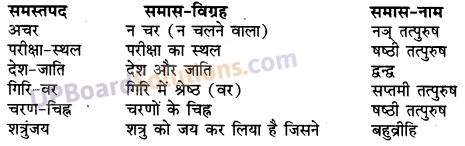
प्रश्न 3.
निम्नलिखित पदों में सनाम समास-विग्रह कीजिए-
अचर, परीक्षा-स्थल, देश-जाति, गिरि-वर, चरण-चिह्न, शत्रुजय |
उत्तर
UP Board Solutions for Class 10 Hindi Chapter 7 रामनरेश त्रिपाठी (काव्य-खण्ड) img-1

We hope the UP Board Solutions for Class 10 Hindi Chapter 7 रामनरेश त्रिपाठी (काव्य-खण्ड) help you. If you have any query regarding UP Board Solutions for Class 10 Hindi Chapter 7 रामनरेश त्रिपाठी (काव्य-खण्ड), drop a comment below and we will get back to you at the earliest.


UP Board Solutions for Class 10 Commerce Chapter 5 Filing

Practice free Class 7 Science MCQ Question of Heat with Answers are available here .

Download MCQ Questions for Class 11 Hindi with Answers through quick links available.

UP Board Solutions for Class 10 Commerce Chapter 5 Filing

Filing Objective Type Questions (1 Mark)

Question 1.
In folder filing system, folder file is made of:
(a) Hard Cardboard Sheet
(b) Soft Cardboard Sheet
(c) Thick Cardboard Sheet
(d) None of these
Answer:
(c) Thick Cardboard Sheet

Question 2.
Index cards or guide cards are made of
(a) Cardboard Papers
(b) Hardboard Papers
(c) Colour Papers
(d) Black and White Papers
Answer:
(a) Cardboard Papers

UP Board Solutions

Question 3.
If the Pigeon-hole system is adopted according to English alphabets these are ……… compartments.
(a) 12
(b) 24
(c) 36
(d) 48
Answer:
(b) 24

Question 4.
Most modem way of filing under Horizontal filing system is …………. system.
(a) Pigeon-hole Filing System
(b) Vertical or upright Filing System
(c) Shanon Filing System
(d) None of these
Answer:
(c) Shanon Filing System

UP Board Solutions

Question 5.
………. is an improved form of a folder filing system.
(a) Clip filing
(b) Shanon Filing System
(c) Pigeon-hole Filing System
(d) None of these
Answer:
(a) Clip filing

Filing Definite Answer Type Questions (1 Mark)

Question 1.
Which is the most modern way of filing under the horizontal filing system?
Answer:
Shanon Filing System.

Question 2.
In which filing system a hard and thick steel wire is used?
Answer:
Wire filing or Spindle (UPBoardSolutions.com) Filling System.

Question 3.
Which cards are made of cardboard paper?
Answer:
Index cards or guide cards.

Question 4.
What kind of filing system mostly used in Government offices?
Answer:
Cardboard Filing System.

UP Board Solutions

Question 5.
What kind of file is made of thick cardboard sheet?
Answer:
Folder file.

Filing Very Short Answer Type Questions (2 Marks)

Question 1.
What is filing?
Answer:
In common language ‘Filing’ means keeping papers in its container i.e., file. The systematic preservation of letters for future reference is known as filing and it is an art of great value to (UPBoardSolutions.com) modern business.

Question 2.
What is vertical filing?
Answer:
Still, further advancement in the art of filing is the vertical or upright filing system. Under this system, the files or folders containing letters are kept in the vertical position. The letters under this system remain unfastened as against the flat filing system where they are carefully fastened.

UP Board Solutions

Question 3.
Explain Shanon Filing.
Answer:
This is the most modern way of filing under the horizontal filing system. It contains all the merits of a good filing system. For this system, a cabinet is required which contains 4 to 64 compartments or (UPBoardSolutions.com) drawers. The number of compartments varies according to the need. This type of cabinet can be purchased from the market.

Question 4.
What is wire filing?
Answer:
Wire filing is the oldest and simplest system of filing. In this system, a hard and thick steel wire is used. One end of the wire remains attached to a wooden piece and the other end remains painted and bent letters, vouchers, post-cards etc. are threaded on its hooked piece of wire as they are received.

Filing Short Answer Type Questions (4 Marks)

Question 1.
What are the advantages of vertical filing? (UP 2016)
Answer:
Advantages of vertical filing are as follows:

  1. Secrecy: This system maintains secrecy because under this if the file of a customer is taken out, other files are not founded. This maintain the secrecy.
  2. Safety: Due to locking arrangements in the drawers, letters are safe. There is no danger of misplacing of letters.
  3. Scientific: Along with the letters of the customers, (UPBoardSolutions.com) their replies are also kept inside the folders. Thus, this method is more scientific.
  4. Elasticity: This system has the merit of elasticity. The number of folders can easily be increased or decreased according to the requirement.
  5. Modern System: This is the most modern system of filing which is most commonly used nowadays.

Question 2.
Give the main objects of filing.
Answer:
Following are the main objects of filing:

  1. Preservation of letters for future reference.
  2. Filing saves important documents from destruction.
  3. If there is any dispute arising between the business house and its correspondent. It can be settled with reference to past correspondence. It can act as evidence in the court of law.
  4. Some documents are legally required to be preserved for a certain number of years.
  5. Sometimes, instead of placing a new order, customers are the supplier to repeat the order. In such a case reference to past letters becomes necessary.

UP Board Solutions

Question 3.
Give some essentials of good filing system. (UP 2015)
Answer:
Essential of good filing system are as follows:

  1. Simplicity: Filing system should be very simple so that a man of general intelligence can easily operate it. There should not be any need for training for this type of work.
  2. Safety: The main purpose of filing is to preserve the documents, so the filing system should be safe. That system which safeguards the documents from rats, insects, moisture etc.
  3. Less Space Required: nowadays business houses suffer (UPBoardSolutions.com) the accommodation problem. For this reason, filing should be of that type in which less space is required.
  4. Economical: Expenses of filing should not be a burden on business. Cost of filing should be on less as possible. Only that filing system will be popular in which lesser expenses are incurred.
  5. Easily Reachable: Files should be kept at a very convenient place where one can reach easily.

Filing Long Answer Type Questions (8 Marks)

Question 1.
What is filing? Describe vertical filing in detail. (UP 2001)
Or
Describe the vertical filing system. (UP 2001)
Or
What do you understand by filing? Describe the objectives of filing.(UP 2009, 14)
Or
Define filing. What are the advantages of filing? Describe briefly. (UP 2018)
Answer:
Meaning and Definition of Filing. In common language ‘Filing’ means keeping papers in their container i.e. file. But this definition of filing is not at all appropriate. Different authors have defined filing in different ways. Some of the important definitions are given below:

According to Thomas Evelyn, “Filing is the systematic classification of records and their safe preservation. It is the storing of letters, papers and documents so that they can be readily found when required.”
According to Stephenson, “Filing provides a mechanism whereby business record may be stored so as to be readily available when required.”

It is very necessary for the proper functioning of a business house that all inward and outward correspondence of business should be carefully preserved for future reference. For this reason, it is required that there should be a good arrangement of preserving the copies of the letter coming in and going out of the office. These letters may be required at any time in future due to one reason or another. The letters should be preserved so systematically that no time would be wasted in finding them out.

UP Board Solutions

The systematic preservation of letters for future reference is known as filing and ‘ it is an art of great value to modern business. If the filing system is inefficient then it creates a lot of trouble for the business house. So, the (UPBoardSolutions.com) primary object of filing is the preservation of letters for future reference in a systematic manner.

Vertical Filing System: Under vertical or upright filing system, files or folders containing letters are kept in a vertical position. This system requires an almirah or cabinet containing drawers or compartments. Under this system, files are kept vertically and for that reason, drawers are made quite deep. The cabinet can also be locked, if needed, for the purpose of safety and secrecy.

Essential Requirements of Vertical Filing System: Following are the requirements of vertical filing system:

1. Cabinet: Under a vertical filing system, an almirah containing drawers or compartment is of prime requirement. A minimum number of drawers is two but the maximum number of drawers depends upon the requirements of the business house. Drawers are quite deep because the files are kept vertically.

2. Folder: In every business house some customer is regular and some irregular. Those customers who are regularly having regular correspondence are allotted a separate folder. This folder is made of strong cardboard which is folded from the middle so that the letters can be easily arranged in it. The back portion of the cardboard is slightly longer than the front side. The portion so extended contains an address or symbol of the customer. These folders are kept in the drawers either numerically, alphabetically or geographically depending upon the circumstances of the business house.

3. Index Cards or Guide Cards: These index cards or guide cards are also made of cardboard paper. The cards are kept in such a manner that they are slightly higher than the folder so that on the higher portion, full detail of the folder is written in short. For example, the folders are kept in alphabetical order and on guide card alphabet ‘S’ is written. It means that the folder contains all the correspondence of those customers whose names start from letter ‘S’.

4. Absent Cards: The colours of absent card is different than the colour of the folder and guide card. When the folder is taken out, this absent card is kept in the drawer in place of a folder. Absent card contains the details like folder number, the date when the folder was taken out, and the name of the person who took out the folder.

5. Transfer Cases: After some time with the regular incoming of letters and other documents, the file becomes full of them and there is no more space left in the file. At this point, all the old letters are removed and kept in a box made (UPBoardSolutions.com) of tin or wood known as transfer cases.

6. Sorting Tubs: All the letters which are to be filed are kept in a tub, popularly known as sorting tub. This sorting tub contains guide cards so that the letters are sorted out in a systematic manner.

7. Distribution shelves: When all the letters are sorted out, the letters which are to be put in a particular drawer, are put in the distribution shelf which is attached with the handle of the drawer.

UP Board Solutions

8. Collection Trays: In big organizations, there are two trays placed upon every table; one is meant for keeping incoming letters and the other is meant for letters which are to be despatched. These collection trays may either be made of wood or of wire.

Question 2.
What are the essentials of an ideal filing system?
Answer:
Characteristics of Essentials of Good Filing System: Each and every filing system confers some merits and demerits too, but for being an ideal filing system it must have the following essentials incorporated in it:

1. Simplicity: Filing system should be so simple as requiring’no special training to handle. Where the filing system is technical and very much complicated, it is bound to create a lot of problems of inefficiency in work.

2. Safety: The main purpose of filing is to preserve the documents so that they may be used for future reference. That sort of filing must be adopted as is helpful in the preservation of documents from rats, insects, moisture etc.

3. Less Time Consuming: In business dealing, a lot of papers are taken (UPBoardSolutions.com) out and replaced every day. All the letters and documents should be so field and in such a manner that no time is wasted in locating any letter.

4. Less Space Requiring: Already the business houses suffer accommodation problem. Only that filing system is successful which requires as little space as that is possible.

5. Economical: All the business houses cannot afford the filing system which is expensive. A good filing system should be of the kind which requires as little money as possible in its maintenance.

6. Easily Approachable: Files should be kept at such a place and in such a manner that anyone, authorised and willing to extract any document can reach the place conveniently.

UP Board Solutions

7. Secrecy: The filing system should not be such as falling within the reach of anyone, though undesirable. If that is so, it would become very difficult to maintain secrecy. Where secrecy is disclosed, that may prove dangerous for any business house.

8. Elasticity: With the passage of time, the volume of business may grow. (UPBoardSolutions.com) When the business is advanced, a number of letters and documents which are incoming and outgoing also increases. Hence, the filing system which is adopted should be capable of being varied or extended in future.

UP Board Solutions for Class 10 Commerce

UP Board Solutions for Class 10 Computer Science Chapter 1 Computer and Communication

UP Board Solutions for Class 10 Computer Science Chapter 1 Computer and Communication

Computer and Communication Long Answer Type Questions (8 Marks)

Question 1.
Write in brief about the evolution of computer. (U. P. 2010, 17)
Answer:
A computer is a high-speed electronic device that accepts data and instructions from the user, then processes the data accordingly to produce information as output. It is capable of performing arithmetic and logical operations on data. It also stores and executes set of instructions. Data is entered in the computer through some input devices like keyboard, mouse, etc. It is then processed by C.P.U. and the result is displayed through an output device like a monitor.

The invention of the computer has affected many areas of our life. In its early time, it was a very costly and rare machine, limited to scientific laboratories and research centres. It was difficult to work on (UPBoardSolutions.com) and they were very bulky. Slowly, the technology improved and the size of the computer reduced as well as its working became easy.

Computers have completely altered the structure of a business, a large volume of accounting and record-keeping, data can be manipulated, organized, stored, retrieved and used for scientific purposes.

Nowadays, a computer is used in homes, offices, shops and almost every-where. It is used to do simple as well as the most difficult calculations. Every business, no matter big or small, is based on computers. Similarly, an organization without computer is hard to find. Computer has changed the world.

UP Board Solutions
UP Board Solutions for Class 10 Computer Science Chapter 1 Computer and Communication 1
Evolution of Computer: The first mechanical calculator developed by Blaise Pascal acted as a model for modem computers. Since then many machines have been developed which have to lead the way to modem microcomputers. A series of a scientific breakthrough by many scientists have contributed to produce this electronic machine called the computer.
1. Abacus: Movable beads on a wooden frame constituted the first (UPBoardSolutions.com) known calculating device. The abacus was used by the ancient Greeks and Romans.

2. Pascaline: The gear-driven machine capable of addition, subtraction and multiplication, considered as a first mechanical calculator, was invented by French mathematician Blaise Pascal in the year 1642.

3. Jacquard’s Loom: In 1801, a Frenchman named Joseph Jacquard perfected a loom that was controlled by the holes in cardboard punched cards. This machine gave an idea about storage.

4. Difference Engine: In 1822, Charles Babbage invented his first machine (Difference Engine). He designed it to calculate logarithm tables. A series of levers were used to enter the data and a device similar to the typewriter was used to print the output.

5. Analytical Engine: In 1833, it was developed by Charles Babbage to perform addition, subtraction, multiplication and division through the use of the stored program. First programmer lady Ada Augusta Byron Lovelace helped him in its developing.

6. Atanasoff-Berry Computer: This electronic machine was developed by Dr John Atanasoff in 1939 for certain mathematical equations. It was called Atanasoff-Berry Computer or ABC, after its inventor’s name and his assistant Clifford Berry. It used 45 vacuum tubes for internal logic and capacitors for storage.

7. Mark 1: In 1944, Dr. Howard Aiken developed a machine called an (UPBoardSolutions.com) Automatic Sequence Controlled Calculator which was later named as Mark-I. It was the first electromechanical computer.

Age Difference Calculator helps to determine the age gap between two persons easily.

UP Board Solutions

8. ENIAC: First fully electronic computer named ENIAC (Electronic Numerical Integrator and Calculator) was developed by Prosper Eckert and J.W. Mauchly in 1945. It used high-speed vacuum tube switching devices.

9. EDVAC: In 1946, Dr John Von Neumann used the principle of storing in 0 and 1 (Binary Digits) in place of earlier technologies and developed EDVAC with the new concept of ‘stored program’. ED VAC (Electronic Discrete Variable Automatic Computer).

10. UNIVAC: Universal Automatic Computer was developed by Eckert and Mauchly in the year 1951. It was the first commercial computer used by Electronic Corporation. Its memory was MDL (Mercury Delay Line).

11. PDP Series: The computer of this series was developed by DEC (Digital Equipment Corporation).

  • PDP-1 → 1961 → 8 bit → 4 KB
  • PDP-8 → 1965 → 16 bit → 16 KB
  • PDP-11 → 1970 → 16 bit → 32 KB

12. Micro Computers: Intel is the No. 1 company in the microprocessor. The microprocessors developed by this company were the best for microcomputers, few of them are as follows:

  • 8080 → 1974 → 8 bits
  • 8085 → 1978 → 8 bits
  • 8086 → 1980 → 16 bits
  • 80286 → 1982 → 32 bits
  • 80386 → 1985 → 32 bits
  • 80486 → 1986 → 32 bits

UP Board Solutions

13. Pentium Series: After 80486, Intel developed Pentium processors which are used almost in every computer nowadays.

  • Pentium → 1993
  • Pentium I → 1995
  • Pentium II → 1997
  • Pentium Mobile → 1998
  • Pentium III → 1999
  • Pentium IV → 2000
  • Pentium Centrino → 2004

Question 2.
What are the different components of the Computer?
Answer:
The main components of the computer system are as follows:

  • Computer Hardware.
  • Computer Software.
  • Computer User.

Hardware:
Computers are made up of many electronic and electro-mechanical devices. The devices together are referred to as computer hardware.
Hardware is the physical components of the computer which (UPBoardSolutions.com) are tangible and visible to the user. Hardware is mainly categorised into two parts:

  1. C.P.U. (Central Processing Unit),
  2. Peripherals.

UP Board Solutions

Input/Output System:
The computer will be of no use if it is not communicating with the external world. For a computer, it is must to have a system to receive information from the outside world and must be able to communicate results to the external world. Thus, a computer consists of an Input/Output (I/O) System.

Input Unit: Input unit is a link between user and computer. It takes the input from the user and converts it into a form understandable by the computer. It consists of input devices attached to the computer which feeds the data and instructions into the computer. Examples of Input Devices :

  1. Keyboard
  2. Mouse
  3. Scanner
  4. Light Pen
  5. Optical Character Reader (OCR)
  6. Magnetic Ink Character Reader (MICR), etc.

1. Keyboard: The Keyboard is one of the most common input devices for the computer. The layout of the keyboard is like that of the traditional QWERTY type-writer.
UP Board Solutions for Class 10 Computer Science Chapter 1 Computer and Communication 2
Different type of keys of a keyboard are as follows:

  • Alphabetical keys (A to Z, a to z)
  • Numeric keys (0 to 9)
  • Function keys (FI to FI2)
  • Special keys (@, !, +, -, <, =, etc.)
  • Cursor control keys (space bar, →,  ↓, ↑, etc.)

2. Mouse: A mouse is a pointing device used while display based package. It is a push-button control device that eliminates the need to type computer commands. Instructions are given by the user to the computer by (UPBoardSolutions.com) pointing an arrow on the screen to a picture or word and then pushing the button on the mouse. The user moves the arrow on the screen by sliding the mouse across the desktop. It is used for selection, dragging, drawing, playing games, etc.
UP Board Solutions for Class 10 Computer Science Chapter 1 Computer and Communication 3

UP Board Solutions

3. MICR: Today banks are issuing special types of cheques. These cheques have the cheque number printed by special magnetic ink. The cheque clearance is done using computers. There is a special device called a MICR. It directly reads the cheque number, bank code, branch code etc. and converts it in machine-readable form.

4. OCR: Optical Character Reader is an information processing device that converts typed or handwritten data in a form that the computer understands. Its speed ranges from 50 to 3000 characters per second.

5. Scanner: Scanner is used to convert photographs and other images from documents and drawing into electronic form. The scanner is used to scan the images and store them on the disk, as a file.
UP Board Solutions for Class 10 Computer Science Chapter 1 Computer and Communication 4

UP Board Solutions

6. Light Pen: A light pen is an electronic device in the form of a photodiode, that allows the operator to identify a particular point or character displayed on the screen, and can be used alone or in conjunction with (UPBoardSolutions.com) a keyboard to add, rearrange or delete information, modify images displayed on the screen.
UP Board Solutions for Class 10 Computer Science Chapter 1 Computer and Communication 5

Output Unit:
It is a communication link between the computer and the user. The output unit consists of the output devices attached to the computer. The output devices help in the communication of data and information from machine to man.
The output devices help the computer to communicate with the user by converting the electric signals to human understandable signals. Examples of output devices:

  • VDU (Visual Display Unit)
  • Printer
  • Plotter.

UP Board Solutions for Class 10 Computer Science Chapter 1 Computer and Communication 6
The output on the VDU is called soft copy output whereas the output on paper, which is produced on printers and plotters is referred to as hard copy output.

UP Board Solutions

1. Monitor/VDU: Monitor is a device to interact with the computer. The messages from the computer are displayed on the screen of the monitor. It is the most common output device using a Cathode Ray Tube (CRT) to produce images. Images are formed by a collection of spots, each known as a pixel.
Classification of Monitors: Monitors can be classified based on:
(A) Resolution: The number of pixels that make up the screen
The examples are CGA (Colour Graphic Adapter), EGA (Enhanced (UPBoardSolutions.com) Graphic Adapter), VGA (Video Graphic Array Adapter), SVGA (Super Video Graphic Array Adapter), CGA having the least resolution and SVGA the highest resolution.

(B) Colour Facilities:
Monochrome. Single colour display on a black background.
Colour monitors. Which can display multicolour outputs by combining red, green and blue in varying intensities?

2. Printer: A printer is a device that can record information permanently on paper in the form of printed copies.
Printers are mainly divided into two parts:
(i) Impact,
(ii) Non-Impact

(i) Impact Printer: These printers print characters by striking the character against the inked ribbon, which leaves an impression on the paper. Impact printers are noisy and can be used to create carbon copies.

UP Board Solutions

(a) Dot-Matrix Printer: This is one of the most popular printers used for personal computing systems. These printers are cheaper as compared to other technologies. Dot Matrix Printer uses impact technology and a print head containing banks of wires moving at high speeds against inked ribbon and paper. These printers form characters by building them up by dots. The character matrix (array of wires) are of 7’5, 7’7, 9’7, 9’9.
The speeds range from 40 cps (characters per seconds) to about 1000 cps.
UP Board Solutions for Class 10 Computer Science Chapter 1 Computer and Communication 7
(b) Line Printer: The line printer prints one line at a time. The speed of line printers is measured in lines per minute. The printing speed of these printers varies from 300-3000 lines per minute. The width of the line is 15 (UPBoardSolutions.com) inches and the line has 96 to 160 characters. Different types of line printers are Drum printers, Chain printers and Band printers.

(c) Daisy Wheel: Daisy wheel printer contains a disk of metal or plastic and it has 96 characters on its petals. This disk is capable of rotating. A hammer hits the petal to print the character. Speed of the Daisy wheel printer is 20-100 characters per second. These printers cannot be used for longer duration and also these are very slow in functioning. The main feature of the Daisy wheel printer is that its printing is of superior quality.

(ii) Non-Impact Printer: Non-impact printers print characters without directly striking on the paper. Non-impact printers cannot create carbon copies. They are, however, very quiet.

(a) Laser Printer: This is a high quality, high speed, high volume technology which works in non-impact fashion on plain paper or pre-printed forms.
Printing is achieved by deflecting laser beam on to the photosensitive surface of a drum. The latent image attracts the toner (A special kind to ink) to the image areas. The toner is then electrostatically transferred to the paper and fixed into the permanent image. The speed of printing can range from 10 pages per minute to about 200 pages per minute. This technology is relatively expensive but is becoming very popular because of the quality, speed and noiseless operations.

UP Board Solutions
UP Board Solutions for Class 10 Computer Science Chapter 1 Computer and Communication 8

(b) Ink-Jet Printer: Ink-Jet printers print by spraying a cont-rolled stream of tiny ink droplets (from a fine nozzle) accurately on the paper forming either dot matrix or solid characters. These are non-impact printers.
The typical speed ranges from 50 cps to above 300 cps. This technology has (UPBoardSolutions.com) been used well for the production of colour printing and elaborate graphics.
UP Board Solutions for Class 10 Computer Science Chapter 1 Computer and Communication 9
3. Plotter: Plotter is an output device that is used to produce graphical outputs on the paper. It uses pens, either of a single colour or multi-colour to draw pictures. Engineering designs can be printed with good precision by making use of plotters.
There are two types of plotters:

UP Board Solutions

  • Drum Plotter,
  • Flatbed Plotter.

Applications of Plotters:

  • Computer-Aided Design (CAD).
  • Map Drawing.
  • Architectural Drafting.
  • General Business Applications.

System Unit:
The system unit is a box-like case that houses the electronic components of the computer that are used to process data. The system unit is made of metal or plastic and is designed to protect the electronic components from damage. (UPBoardSolutions.com) The electronic components and most storage devices reside inside the system unit and the other devices such as a keyboard, mouse, monitor are located outside the system unit.
UP Board Solutions for Class 10 Computer Science Chapter 1 Computer and Communication 10
MotherBoard:
It is the main printed circuit board in an electronic device, which contains sockets that accept additional boards. In a personal computer, the motherboard contains the bus, CPU, memory sockets, keyboard controller and supporting chips.
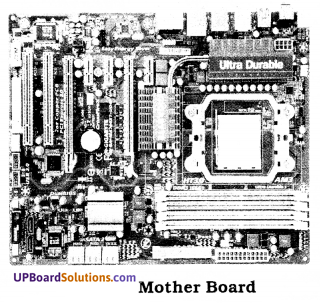
UP Board Solutions
UP Board Solutions for Class 10 Computer Science Chapter 1 Computer and Communication 11
Chips that control the video display, serial and parallel ports, mouse and disk drives may or may not be present on the motherboard. If not, they are independent controllers that are plugged into an expansion slot on the motherboard.
Central Processing Unit (CPU)
CPU is the brain of a computer system. It consists of:

  • Control Unit (CU),
  • Arithmetic Logical Unit (ALU),
  • Memory Unit (MU).

The parts of a CPU are connected by an electronic component referred to as a bus, which acts as an electronic highway between them. In order to temporarily store data and instructions, the CPU has special-purpose storage devices (UPBoardSolutions.com) called as registers. The CPU of a modem computer is fully electronic. It is made up of millions of electronic components etched on to a number of silicon chips. These chips are all assembled on a printed circuit board called the Mother Board.

UP Board Solutions
Functions of CPU: The main functions of the CPU are the following:

  • To store data and instructions.
  • To control the sequence of operations.
  • To carry out the processing.

The CPU of a personal computer is mainly recognized by the microprocessor chip that it uses.
Microprocessor Chips: A microprocessor is assembled from thousands of tiny transistors, resistors and other electronic components. A typical microprocessor is fabricated on a single tiny chip of silicon and is combined with other elements. These other elements provide input and output connections, storage and control to form a complete microprocessor onboard.

In the 70’s, Intel engineers built the first microprocessor chip for a Japanese manufacturer of desk calculators. Subsequently, 8-bit data processing capabilities were developed in chips. In 1974, a personal-sized system was developed and called ‘ALTAIR 8800′ which used the Intel 8-bit microprocessor.

In the 80’s, the personal computer systems started being based on a 16-bit microprocessor. The most popular amongst these is IBM PC.

All 16-bit personal computers are also built around a few popular microprocessors. The Intel 8088 is found in IBM PC. Another popular microprocessor used in systems such as Apple, Cromemco and many other vendors (UPBoardSolutions.com) is the Motorola’s 68000.
Intel 80286, 80386 and 80486 are 32-bit microprocessor chips.
Intel’s Pentium series is the latest 32-bit and 64-bit microprocessor chips.
The microprocessor is the brain of a computer system. It is the place where actual processing is done. It consists of :

UP Board Solutions

  1. Control Unit
  2. ALU or Arithmetic Logic Unit
  3. Registers.

1. C.U. (Control Unit): It controls the movement of data and program instructions into, and out of the C.P.U. and to control the operations of A.L.U., C.U., fetches the instructions from the main memory into registers, decodes it and sends control signals to other components of the computer so that the appropriate actions are carried out. This is known as fetch executes cycle.

2. ALU (Arithmetic Logic Unit): The ALU performs all the arithmetic and logical functions, that is, it adds, subtracts, multiplies, divides and does comparisons. It also performs logical operations (AND, OR and NOT). These operations provide the facility of decision making through the computer. The result of a logical operation is either TRUE or FALSE.
A.L.U. only operates on data that is in the internal C.P.U. memory, also known as registers. C.P.U. memory, also known as registers. Registers are very fast, temporary storage whose functions are to receive and hold data. They are not accessible to the programmers.

3. Registers: A register is a special temporary location within the CPU. Registers very quickly accept, store and transfer data and instructions that are being used immediately. To execute an instruction, the control unit of the CPU retrieves it from main memory and places it into a register.

The number and types of registers in a CPU vary according to the CPU design. Their size (capacity) and number can affect the processing power of a computer system. In general, the “larger” is the register (the more bits it (UPBoardSolutions.com) can carry at once), the greater is the processing power.

BUS: The term ‘bus’ refers to an electrical pathway through which bits are transmitted between the various computer components. Depending on the design of a system, several types of buses may be present.
The control bus is the pathway for all timing and controlling functions sent by the control unit to the other units of the system.
The address bus is the pathway used to locate the storage position in memory where the next instruction is to be executed or the next piece of data will be found.
Data bus is the pathway where the actual data transfer takes place.

UP Board Solutions

Question 3.
What do you mean by memory? Explain in brief.
Answer:
Memory: A computer system has storage areas, referred to as memory. The memory can receive, hold and deliver data when instructed to do so. Data that are being processed are held in Primary Memory, which is capable of sending and receiving the data at very high speeds. Secondary memory stores data not currently being used and operates more slowly, but it is capable of storing large volumes of data.

Primary Memory: Primary Memory consists of semi-conductor memory chips and is used to store data and programs currently in use. Each storage element of memory is directly (randomly) accessible and can be examined and modified without affecting other cells. Main memory can be volatile or non-volatile. Primary memory is classified into two groups:
(A) RAM (Random Access Memory),
(B) ROM (Read Only Memory).
UP Board Solutions for Class 10 Computer Science Chapter 1 Computer and Communication 12
RAM is read/write memory. It is a volatile memory. It stores the information as long as power is switched on and the information is lost when the power supply is switched off. RAM is of two types:

  • DRAM: It needs constant refreshing in order for the stored data to be maintained.
  • SRAM: It does not need refreshing. It is faster and expensive than DRAM.

Features of RAM: The main features of RAM are as follows:

  • Data that needs to be processed and the instructions which are used for processing are held in the RAM.
  • Each element of RAM is a memory location in which data can be stored. Each location has a unique address. Using this address, data can be directly retrieved or stored.
  • Since RAM must hold the data to be processed and the instructions for (UPBoardSolutions.com) processing, its size or capacity is one of the measures of the power of the computer.

Functions of RAM: The principal function of the main memory is to act as a buffer between the CPU and the rest of the computer system components.
Main memory is used for the following purposes:

  • Storage of a copy of the main software program that controls the general operation of the computer. This copy is loaded into main memory when the computer is turned on. and it stays there as long as the computer is on.
  • The temporary storage of a copy of application programs and instructions to be retrieved by the CPU for interpretation and executed.
  • The temporary storage of data that has been input from the keyboard or another input device until instructions call for the data to be transferred into the CPU for processing.

Read-Only Memory (ROM): ROMs are the memories on which it is not possible to write the data when they are on-line to the computer. They can only be read. The ROMs can be used in storing programs provided by the manufacturer of computer for basic operations. ROMs are non-volatile in nature and need not be loaded in a secondary storage device.

UP Board Solutions

All the different pair combinations from the factors of 70 above are the Factor Pairs of 70.

ROMs can be written only at the time of manufacture. It is necessary, and also convenient, to have instructions stored in ROM. For example, if you are using a microcomputer with floppy disk drives, the more instructions in ROM. the fever diskettes you may have to handle.
UP Board Solutions for Class 10 Computer Science Chapter 1 Computer and Communication 13
The process of manufacturing ROM chips and recording data on them was more expensive than the process of producing RAM chips. As a result, manufacturers tended to record in ROM only those instructions that were crucial to the operation of the computer.

PROM, EPROM, EEPROM: In addition to ROM, three additional categories of non-volatile memory are used in some computer systems namely PROM, EPROM and EEPROM.

PROM: Programmable Read-Only Memory is a non-volatile memory which allows the user to program the chip with a PROM writer. The chip can be programmed once, thereafter it cannot be altered. Therefore, PROMs are (UPBoardSolutions.com) more flexible than ROMs.
EPROM stands for Erasable Programmable Read-Only Memory. EPROM chips were developed as an improvement over PROM chips.

The EPROMs can be written electrically. It requires the erasure of whole storage cells by exposing the chip to ultraviolet light, thus brings them to the same initial state. This erasure is a time-consuming process. Once all the cells have been brought to the same initial state, then the EROM can be written electrically.

EEPROM stands for Electrically Erasable Programmable Read-Only Memory. EEPROMs are becoming increasingly popular as they do not require prior erasure of previous contents. It avoids the inconvenience of having to take chips out of the computer to change data and instructions. Instead, changes can be made electrically under software control. These chips are being used in point-of-sale terminals to record price-related data for products. The only disadvantage of EEPROM chips is that they cost more than regular ROM chips.

Secondary Memory: Secondary memory is also known as permanent memory as we can store data on it for future use. It is both read/write memory and consists of different storage devices known as secondary storage devices as follows:

(A) Magnetic tape: Magnetic tape allows large amount of data to be stored economically passes the devices write head, data is recorded by magnetising the iron oxide in different directions. While reading the iron oxide causes a current in the read head.

UP Board Solutions

(B) Floppy disk: It is a plastic film coated with iron oxide metal and protected by a plastic jacket as cover that has an opening which allows the read/write head to retrieve or store data. The most common floppy disk now in use is the 3.5″ disk also known as micro floppy. Earlier floppies were of 5.25″ and 8″.

(C) Hard disk: It comprises at least one rigid disk protected by a strong and airtight casing. It contains disks, read/write head, access arms, servomotor and the electronic circuit board to control the disk (UPBoardSolutions.com) operations. This is the most common secondary storage device having the highest storage capacity (2GB, 4GB, 10GB, 40GB….). It is fast and speeds of less than 10 microseconds are achievable.

(D) Optical disk: These are plastic disks handles more data in comparison to floppy disks. In Optical disk a light source is used to catch data patterns on the disks. Normally two laser lights are used; a weak to read data and stronger to write by burning the surface of the disk. Different types of optical disks are CD-R, CD-R/W, DVD.

Free and easy to use online median calculator. ➤ Calculates the median value of a set of numbers

Question 4.
Describe Software in brief.
Answer:
Software: Software is one of the primary elements of a computer system. It is a set of computer programs, procedures and associated documentation related to the effective operation of a computer system.
The software’s are classified into the following categories:

  1. System Software,
  2. Utility Software,
  3. Application Software.

1. System Software: System software is programs that directly interact with the hardware. For example, when a file is to be saved on a disk, the system software sends the required instructions to perform this task. It provides the environment to write application programs.
The system software is written by computer professionals called System Programmers.

UP Board Solutions
The system software is of two types:

  • Translators
  • Operating System.

Translators: Instructions given to a computer in any language, have to be translated into machine code for the computer systems to execute the instructions. This work of translation is done by a Translator.
Translators can be classified as:

  • Interpreters,
  • Compilers,
  • Assemblers.

(a) Interpreters: Interpreters are the translators which are used to convert programming language into machine language for the purpose of execution line by line. It translates one statement at a time and executes it.

(b) Compilers: The compiler translates the whole program code (known as source code) and prints a list of errors which have to be corrected as a whole. Once the program is error-free, the executable code is generated.

(c) Assemblers: This software translates a program written in assembly language to machine code.

(ii) Operating System: An Operating System is a set of routine programs that are used to manage the operations of the computer.
The Operating System isolates the hardware from the user. The user (UPBoardSolutions.com) communicates with the Operating System, supplies application programs and the data that are in a language and format acceptable to the Operating System and receives output.

UP Board Solutions
Some of the popular operating systems are:
DOS, WINDOWS 95, WINDOWS 98, WINDOWS NT, WINDOWS Millennium, XP, OS/2, LINUX, UNIX.

2. Utility Software: A utility program is a type of system software that performs a specific task, usually related to managing a computer, its devices or its programs. Most operating systems include several utility programs.
Some of the utilities are described below:

(i) File Compression Utility: A file compression utility reduces or compresses the size of a file. A compressed file takes up less storage space on a hard disk or floppy disk, which frees up room on the disk and improves system performance.
When a compressed file is received, it must be uncompressed or unzipped to restore it to its original form. Two popular stand-alone file compression utilities are PKZIP and WinZip.

Disk Scanner: A Disk Scanner is a utility that detects and corrects both physical and logical problems on a hard disk or floppy disk. It also searches and removes unwanted files.
Windows 98/XP includes two disk scanner utilities:

  • Scan Disk which detects and corrects problems.
  • Disk Cleanup searches for and removes unnecessary files such as temporary files.

(ii) Disk Defragmenter: A disk defragmenter is a utility that reorganizes the files and unused space on a computer’s hard disk so that data can be accessed more quickly and programs can run faster.
When a computer stores data on a disk, it places the data in the first (UPBoardSolutions.com) available sector on the disk. Disk defragmenter reorganises the file and unused space. Windows includes a disk defragmenter called Disk Defragmenter.

(iii) Uninstaller: An uninstaller is a utility that removes an application, as well as any associated entries in the system files. When you install an application, the operating system records the information that it uses to run the software in the system files.
If you attempt to remove the application from your computer by deleting the files and folders associated with that program without running the uninstaller, the system file entries remain.

(iv) Anti-virus: An anti-virus program is a utility that prevents v detects and removes viruses from a computer’s memory or storage devices. A virus is a program that copies itself into other programs and spreads through multiple computers. Viruses are designed to damage a computer intentionally by destroying or corrupting their data.

(v) Back-Up: This is used to back-up files on your hard disk. Files can be back-up to a floppy disk, a tape drive or another computer on the network. If the original files are damaged or lost, it can be restored from the backup.

(vi) Search Engine: It is used to search files or data from the disk quickly. It works randomly to give search results to the user as quickly as possible.

UP Board Solutions

3. Application Software: Application software consists of programs designed to perform specific tasks for users.
Application software also called a software application, can be used for the following purposes:

  • As a productivity/business tool.
  • To assist with graphics and multimedia projects.
  • To support household activities, for personal business, or for education.
  • To facilitate communications.

Word Processor: Word Processor transforms a screen into ‘sheets of paper’ to be written on, and provides quick and accurate ways to create and revise business documents.
These packages allow:
Text to be written in document form.
Edit any part of a document.
Adjust the format of a document, such as margins, spacing, page numbers.
Save the entire document on a disk and retrieve it later.
Example:
Wordstar, MS-Word, Word Perfect, Page Maker.

Spreadsheets: A spreadsheet is a table consisting of rows and columns, and provides business professionals with a quick and accurate means of performing mathematical calculations involved in answering a question.
It performs various mathematical functions as well as logical and conditional operations in a quick and accurate manner.
Examples: Lotus 1-2-3, Quattro Pro, Excel, Multiplan.

Database Management System: Database Management System (UPBoardSolutions.com) (DBMS) is a set of programs that manipulates a database by appending, deleting and modifying records. It is used to generate the queries, forms, reports etc. on the basis of some condition by using different records stored in it.
The two basic types of data management software are

  • File management systems, for example, Dbase, Foxbase, FoxPro etc.
  • Relational Database Management System, for example, Ingress, Oracle, Unify etc.

UP Board Solutions

Graphics/Presentation Packages: This software is used to create slide transition, animation, etc. by using its advanced features. Most of the graphics or presentations are being prepared using this software.
PowerPoint, Corel Draw, Macromedia, Director.

Desk Top Publishing (DTP) Software: It is a software system that is used to produce attractive page layouts complete with pictures and text printed in a variety of styles, which is ideal for use in newspaper and magazine publishing companies.
Examples: Page Maker, Word, Corel Draw.

Question 5.
What are the different means of communication available in the modern age? Give their comparison also. (U. P. 2006, 12, 15, 19)
Answer:
Communication Media: The medium (or media) is the matter or substance that carries the voice or data transmission. It can be copper (wire or coaxial cable), glass (fibre optical cable), or wave (microwave). A circuit (channel or line) is nothing more than the path over which data moves.
Communication media is of two types:
(A) Guided / Wired Media: In this type of media, wires are used.
It is further classified into three categories:
(1) Twisted Pair Cable:
UP Board Solutions for Class 10 Computer Science Chapter 1 Computer and Communication 14
Made of copper, coated with insulating material and continuously twisted throughout its entire length.
Twisted cable helps minimize the effects of noise or electromagnetic interference.
Relatively inexpensive and easy to install.
Low immunity of noise, narrow bandwidth.
Data rates up to 20 Mbps in LAN; 19.2 Kbps for long-distance (UPBoardSolutions.com) communications over the telephone network.
Readily available in existing buildings.
Usage: Voice communication, Data communication e.g., telephone.

UP Board Solutions

2. Coaxial Cable:
Consists of wire surrounded by the insulating layer, shielding layer and an outer jacket.
UP Board Solutions for Class 10 Computer Science Chapter 1 Computer and Communication 15
Quarter-inch or more in diameter, therefore, less flexible than twisted pair.
Less susceptible to noise but more expensive than twisted pair.
Wider bandwidth, more difficult to install/tap, more costly than twisted pair.
Data rate up to 150 Mbps.
Usage:
Data Communication Video Transmission Voice Communication
Used extensively in LAN and relatively short distance (10 miles). For longer distance, repeaters may be necessary.

3. Fibre Optic Cable:
UP Board Solutions for Class 10 Computer Science Chapter 1 Computer and Communication 16

  • One or more glass or plastic fibres are woven together to form the core of the cable. This core is surrounded by a glass or plastic layer called the cladding, which in turn is covered with plastic or other material for protection.
  • The light source used is either LASER or light-emitting diodes (LED) whereas the detector is a photodiode.
  • Low error rate, very high noise immunity, immunity to electrical and magnetic noise.
  • Reduced size and weight (than copper or coaxial).
  • The high cost of installation with special equipment.
  • Very expensive, but maybe economical for high-volume application.
  • Broad bandwidth.
  • High data rate-over 2 Gbps possible.

Usage:

  • Voice Communication
  • Video Communication
  • Data Communication
  • Networks using fibre-optic are called “Fibre Distributed Data Interface” (FDDI) often ring-based.

UP Board Solutions

(B) Unguided/Wireless Media: In this type of media, wires are not used, means no physical connection.

Question 6.
Why are computer and communication used together? What are its advantages? Give their application. (U. P. 2004, 16, 17)
Answer:
Communication: Communication is a process in which data is (UPBoardSolutions.com) transferred from one place to another. The three components of communication are:

  • Sender: where the information is sent.
  • Receiver: to whom the information is sent.
  • Medium: through which the information is sent.

A computer is an electronic machine which can perform a variety of tasks like:

  • Text formatting
  • Producing sound
  • Creating graphics
  • Show clippings, etc.

All the above tasks are needed in the process of communication and that is why a computer is one of the most popular devices used for communication. In computer, communication information is sent electronically.

Advantages of Computer Communication: There are the following advantages of computer communication:

  • A user-friendly environment.
  • Information can be sent in multiple ways.
  • Information can be transferred in pictures, sound, text, etc. from the same place.
  • Secured means of communication.
  • It saves time as well as money.

Application of Computer Communication: There are the following applications of computer communication:

  • E-mail: Electronic mail is one of the most popular applications of communication.
  • Video-conferencing: People from far off places can organize meetings very easily.
  • Chatting: Different persons from different places can exchange their thoughts at the same time.
  • Information Distributor: Information available on different computers can be used.

UP Board Solutions

Question 7.
Draw the basic model for primary communication. Explain the functions of each block. (U. P. 2007, 10)
or
What is a basic model of communication? Explain its various parts. (U. P. 2008)
or
Give a simple block-view of a primary communication system. Explain the working of each block in detail. (U. P. 2011)
Answer:
Communication: Transferring the data from one place to another is known as “communication.” For this, computers are playing a very important role in today’s life. We can connect one computer to others in any (UPBoardSolutions.com) part of the world very easily and computers are used to do fast and accurate communication.

Every communication system has the following important components:

1. Sender: It is an electronic device which is responsible for sending information e.g., Telephone, Computer, Mobile, etc.

2. Data Communication Device: It is a device which accepts the data from source sending device and converts it into such a form (analogue signal) that can be transmitted over communication channels e.g., computers with the modem.

3. Communication Medium: In order to transfer the information from one place to another “carriers are needed”, and in a computer network these carriers are generally of two types:

Guided Communication Medium: In this type of medium, wires are used to transfer the data and it is also known as wired media. It consists of:

  • Twisted Pair Cable,
  • Co-axial Cable,
  • Fibre Optics Cable.

UP Board Solutions

Unguided Communication Medium: This is wireless medium, hence, no wires are used. It is categorised into:

  • Radio Waves,
  • Microwave Waves,
  • Satellite Communication.

UP Board Solutions for Class 10 Computer Science Chapter 1 Computer and Communication 17
4. Receiver: It is used to accept signals of the communication system and convert them in an understandable form. Generally, the receiver is a computer with a modem.
Examples:

  • TCP/IP (Transmission Control Protocol/Internet Protocol): TCP breaks up the data to be sent into packets. It guarantees that any data sent to the destination computer reaches it. IP is a set of conventions used to send packets from one host to another. It is responsible for routing the packets to a desired destination IP address.
  • X.12: This protocol is used to establish the connection between companies to exchange important papers.
  • X. 25: This protocol establishes the interface for common (UPBoardSolutions.com) data network.
  • HTTP: HyperText Transfer Protocol works on the internet to send and receive files from different locations.

UP Board Solutions

Computer and Communication Short Answer Type Questions (4 Marks)

Question 1.
Define TCP/IP.
Answer:
The Internet is a packet-switching network, data is transmitted by converting it into packets. This work is done by the set of rules or standard designs to enable a computer to connect to one another and to exchange information known as PROTOCOL.

  • TCP/IP is the only protocol used to send data all around the Internet.
  • TCP/IP is made up of two components—TCP and IP.

TCP (Transmission Control Protocol): TCP breaks up the data to be sent into packets. It guarantees that any data sent to the destination computer reaches it.

IP (Internet Protocol): IP is a set of conventions used for routing packets from one host to another. It is responsible for routing the packets to a desired destination IP address.

Question 2.
Define different types of Verbal Communication. (U. P. 2008)
Answer:
Verbal Communication. When any data or information is transferred verbally from one place to another, it is known as verbal communication, such as the communication between two persons on the telephone.
Different types of Verbal Communications are:

  • Telephone: With the help of telephone, we can converse with others from a distance. The communication is verbal in this case and the medium is wire.
  • Intercom: It is just like telephone technology, but it is limited to a building or campus for the purpose of conversation between the two.
  • Mobile: It is the modem technology of the telephone system. In this, we can also converse with each other, but the medium in this is magnetic wave through the air.
  • Chatting through Computer: In this technology, we can exchange our views and thoughts verbally by using a microphone. The medium in this technology is the telephone.

UP Board Solutions

Question 3.
Explain the ISO reference model. (U. P. 2016, 19)
Answer:
An interconnected protocol for the computer to computer communication as recommended by the International Standards Organisation (ISO) is gaining wide acceptance. It is an approach based on defining a (UPBoardSolutions.com) number of distinct layers each addressing itself to one aspect of linking. This is known as the ISO model for Open System Interconnection. It is a seven-layer architecture and defines a separate set of protocols for each layer.

Question 4.
Define satellite Communication.
Answer:

  1. Line of sight required between satellite and earth stations.
  2. 12 to 24 transponders per satellite. These transponders receive, amplify, change frequency and transmit.
  3. Geosynchronous orbit (22,300 miles).
  4. Low security—anyone with satellite dish and right frequency can tune in.
  5. Ease of adding stations.
  6. Data rates of up to 50 Mbps.
  7. Microwave signal at 6 GHz is beamed to it from a transmitter on the earth.

It is amplified and retransmitted to the earth at 4 GHz by a system called a transponder mounted on the satellite to avoid interference.

Question 5.
Explain Data Communication. (U. P. 2017)
Answer:
Communication refers to the electronic transmission of any type of electronic information encompasses telephone communication, the transmission of television signals, data communication of all forms, electronic mail, facsimile transmission, and so on.

Data communication is the movement of encoded information from one point to another by means of an electrical or optical transmission system, such systems often are called data communication networks.

UP Board Solutions

Computer and Communication Very Short Answer Type Questions (2 Marks)

Question 1.
Give names of various type of communication media. (U. P. 2014)
Answer:
Communication media are of two types:

  1. Guided or Wired media:
    • Twisted pair cable
    • Coaxial cable
    • Optical Fibre Cable.
  2. Unguided or Wireless media:
    • Microwave
    • Satellite.

Question 2.
How many layers are there in the ISO model? (U. P. 2016)
Answer:
There are seven layers in the ISO model.

Question 3.
Which layer is responsible for file transfer?
Answer:
The application layer is responsible for file transfer.

Question 4.
Which communication is used to link metropolitan cities?
Answer:
Microwave communication is used to link metropolitan cities.

UP Board Solutions

Question 5.
Discuss Wireless Communication Media. (U. P. 2014)
Answer:
In this type of media, wires are not used, means not physical connection.

Question 6.
At how much distance are the repeaters used in microwave transmission?
Answer:
Repeaters are used at a distance of 30-35 km (UPBoardSolutions.com) in microwave transmission.

Question 7.
What is RS-232-C?
Answer:
RS-232-C is a kind of protocol which is used to link a digital device to the modem.

Question 8.
Explain the full form of E-mail.
Answer:
The full form of E-mail is Electronic Mail.

UP Board Solutions

Computer and Communication Objective Type Questions (1 Mark)

There are four alternative answers for each part of the questions. Select the correct one and write in your answer book:

Question 1.
Which communication media has a data rate of up to 20 Mbps?
(a) Coaxial cable
(b) Twisted cable
(c) Fibre optic
(d) Microwave.
Answer:
(b) Twisted cable

Question 2.
Which is not a protocol? (U. P. 2014)
(a) TCP/IP
(b) HTTP
(c) X-25
(d) ISP.
Answer:
(d) ISP

Question 3.
Which is not a physical communication channel?
(a) Twisted pair
(b) Coaxial pair
(c) Fibre optic
(d) Microwave
Answer:
(d) Microwave

UP Board Solutions

Question 4.
In which media, transponders are used? (U. P. 2012, 14)
(a) Satellite
(b) Microwave
(c) Fibre optic
(d) Twisted cable.
Answer:
(a) Satellite

Question 5.
Transponders are used in which communication media? (U. P. 2014)
(a) Fibre optic
(b) Microwave
(c) Satellite
(d) Co-axial cable.
Answer:
(d) Co-axial cable

Question 6.
Which of the following is not Hardware? (U. P. 2015)
(a) CPU
(b) RAM
(c) Windows
(d) MODEM.
Answer:
(c) Windows

Question 7.
In which transmission medium the data transmits in the form of light waves? (U. P. 2017)
(a) Copper wire
(b) Coaxial Cables
(c) Telephone lines
(d) Optical Fibre Cable.
Answer:
(b) Coaxial Cables

UP Board Solutions

Question 8.
Which of the following is not an input device? (U. P. 2018)
(a) Key-board
(b) Printer
(c) Mouse
(d) Joy-stick
Answer:
(b) Printer

Question 9.
Which one of the following is an O.S.? (U. P. 2018, 19)
(a) MODEM
(b) Ink-jet
(c) Pen drive
(d) DOS.
Answer:
(d) DOS.

Question 10.
Which of the following is not a hardware device? (U. P. 2018)
(a) Memory
(b) Cache
(c) Excel
(d) Processor.
Answer:
(c) Excel

UP Board Solutions

Question 11.
What type of communication happens in Computer Communication? (U. P. 2019)
(a) Simplex
(b) Full duplex
(c) Half-duplex
(d) Quarter.
Answer:
(a) Simplex

Question 12.
Whose Communication range is high among the following? (U. P. 2019)
(a) Cable Communication
(b) Microwave Communication
(c) Satellite Communication
(d) Radio Communication.
Answer:
(c) Satellite Communication
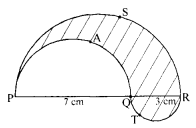
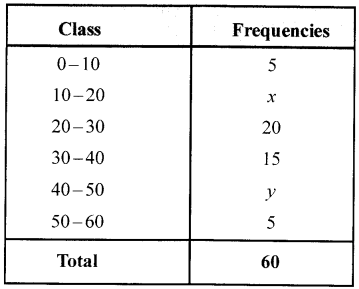
UP Board Solutions for Class 10 Computer Science