UP Board Solutions for Class 9 English Grammar Chapter 16 Controlled Composition

UP Board Solutions for Class 9 English Grammar Chapter 16 Controlled Composition

These Solutions are part of UP Board Solutions for Class 9 English. Here we have given UP Board Solutions for Class 9 English Grammar Chapter 16 Controlled Composition

Controlled Composition

Question 1.
Read the following sentences given below carefully. Then write the same things about yourself. If you haven’t learnt singing or swimming write… “I haven’t learnt singing/ swimming…….” Rohit is a boy of eleven. He comes of a rich family. People say he is smart and intelligent. It is said he started walking when he was ten months old. He started (UPBoardSolutions.com) speaking when he was one year and four months. He went to school at the age of five. There he learnt to read and write. He started playing cricket at the age of nine. Now he is a good player. His friends say that he is the best player in their group. Rohit can sing and swim. He learnt singing when he was seven. He could swim when he was nine. Begin:I am a boy of fourteen. I come of a rich family. People say…….
Answer:
I am a boy of eleven. I come of a rich family. People say I am smart and intelligent. It is said I started walking when I was ten months old. I started speaking when I was one year and four months. I went to school at the age of five. There I learnt to read and write. I started playing cricket at the age of nine. Now I am a good player. My friends say that I am the best player in our group. I can sing and swim. I learnt singing when I was seven. I could swim when I was nine.

UP Board Solutions 

Question 2.
Read the following sentences. First understand the meaning. Then rewrite the paragraph using “Ramu” for “T”. Remember there will be changes in pronounsand verbs. I am a simple man. I am living in a village with my wife. I get up early. I go to the village well to have a wash/I do not use a tooth-brush to clean my teeth. I use a twig from a neem tree instead. After my bath I have breakfast. After breakfast I go to my field. I go with (UPBoardSolutions.com) my bullocks and my wooden plough. After ploughing the field the whole day I go back home with my bullocks. I do not buy food for my family. I grow it in my field/I also grow some vegetables like potatoes, onions, carrots and radish , I do not buy clothes with money. I give some of my wheat and rice tothe shopkeeper, and he gives me cloth in exchange. The first sentence of your companion will beRamu is a simple man
Answer:
Ramu is a simple man. He is living in a village with his wife. He gets up early. He goes to thevillage well to have a wash/Hedoes
not use a tooth-brush to clean his teeth. He uses a twig from a neem tree instead. After his bath he has breakfast. After breakfast he goes to his field. He goes with his bullocks and his wooden plough. After ploughing the field the whole day he goes back home with his bullocks. He does not buy food for his family.He grows it in his field/he also grows (UPBoardSolutions.com) some vegetables like potatoes, onions, carrots and radish, he does not buy clothes with money. He gives some of his wheat and rice to the shop keeper, and shopkeeper gives him clothes in exchange.

Question 3.
This is the description of an incident in a village hospital. Imagine that this happened a few days ago. Rewrite the whole passage in the past tense. Generally the hospital is closed by nine in the evening. But it is a great comfort for Pan Singh to find Doctor Sahib in his room. The doctor listens to the story of PanSingh’s bad luck. He is a kind-hearted man. He immediately gets up, lights a lamp and looks at Pan Singh’s wound. (UPBoardSolutions.com) He feels that Pan Singh’s wound must be dressed properly. He asks the hospital peon to call the compounder. The compounder lives quite near the hospital. Meanwhile the doctor gives some medicine to Pan Singh so that he falls asleep and doesn’t feel the pain.
Answer:
Generally the hospital was closed by nine in the evening. But it was a great comfort for PanSingh to find Doctor Sahib in his room. The doctor listened to the story of Pan Singh’s bad luck. He was a kind-hearted man. He immediately got up, lights a lamp and looks at Pan Singh’s wound. He felt that Pan Singh’s wound must be dressed properly. He asked the hospital peon to call the compounder. The compounder lived quite near the hospital. Meanwhile the doctor gave some medicine to Pan Singh so that he fell asleep and did not feel the pain.

UP Board Solutions

Question 4.
Here is a description of what is happening now in Dr. Misra’s house. Read it carefully. Imagine that all this happened last week. Rewrite the Paragraph by making necessary changes. The car stops infront of Dr. Misra’s house. Vinay gets out of the car and rings the door bell. The door is opened by a maid servant. “Is Dr. Misra at home?” asks Vinay, “I must see him immediately. Tell him Dr. Murthy has sent me.” The maid servant shows him (UPBoardSolutions.com) into the sitting room and goes into the house.Dr. Misra appears soon after. Vinay gets up from his chair and say, “I am Vinay, Dr. Murthy’s son. My father is ill. He has sent me to fetch you.” Dr. Misra gets ready in no time and hurries out. Vinay opens the door of the car. Dr. Misra gets into the car. Vinay sits beside him; he is nervous. He is still. Both of them sit quiet.
Answer:
The car stopped infront of Dr. Misra’s house. Vinay got out of the car and rang the door bell. The door was opened by a maid  servant.  “Is Dr. Misra athome?” asked Vinay, “I must see him immediately. Tell him Dr. Murthy has sent me.” The maid servant showed him into the sitting room and went into thehouse. Dr. Misra appeared  soon after. Vinay got up from his chairand said, “I am Vinay, Dr. Murthy’s son. My father is ill. He has (UPBoardSolutions.com) sent me to fetch you. ” Dr. Misra got ready in no time and hurriest out. Vinay opened the door of the car. Dr. Misra got into the car. Vinay sat beside him; he was nervous. He was still. Both of them sat quiet.

Question 5.
Complete the incomplete sentences in the Paragraph below using there is, there are, is there, are there in the blanks. . . . . . . . . … any trains at the station? yes… . . . . …. three trains right now. On platforms number one… . . . . . …a passenger train. It is going to Kanpur. . . . . . . . . . . . … not many people in this train. People do not like to travel by passenger train…………a goods train on platform number five. It is quite a big train………… no passengers in this train. Almost all the wagons are locked. On platform number seven……….a mail train. It is a very fast train. It is going to Bombay……..four first-class compartments in the train………… A ladies’ compartment also? Yes……..two. Both the compartments are fully packed…………… a sleeper coach in this train? Yes, a big one……… more than seventy berths in it. I am thirsty. I want to have some tea……….any tea’ stalls on platform number seven? I am sure……..one. Let us see…………five tea stalls on this platform………..many things to eat in one of them. The others sell only tea and biscuits. Let us go to the first one, because………..many eatables in that stall.
Answer:
Are these any trains at the station? yes, there are three trains right now. On platform number one there is a passenger train. It is going to Kanpur. There are not many people in this train. People do not like to travel by passenger train there (UPBoardSolutions.com) is a goods train on platform number five. It is quite a big train there is no passengers in this train. Almost all the wagons are locked. On plaform number seven there is a mail train. It is a very fast train. It is going to Bombay there are four first-class compartments in the
train. Is there a ladies’ compartment also? Yes, there are two. Both the compartments are fully packed. Is there a sleeper coach in this train? Yes, a big one there are more than seventy berths in it.I am thirsty. I want to have some tea are there (UPBoardSolutions.com) any tea stalls on platform number seven? I am sure there is one. Let us see there are five tea stalls on this platform there are many things to eat in one of them. The others sell only tea and biscuits. Let us go to the first one, because there are many eatables in that stall.

Question 6.
Read the following sentences. Then describe a girl who is just the opposite of Rashmi. Select any name. Rashmi is a very clever girl. She is smart and active too. She takes interest in whatever she does. She likes cooking. She likes sewing, she likes reading good books. She loves her school. She does not waste her free time in school, playing or (UPBoardSolutions.com) gossiping. Even at-home she likes to stay with her mother and do things for her. She is very quick at work, and her mother always wants her help in the kitchen. She looks after her younger brother and sister. Some of the following words might help youdislike, dull, slow, inactive.
Answer:
Suman is a very foolish girl. She is lazy and inactive too. She does not take interest in whatever she does. She dislikes cooking. She dislikes sewing, she dislikes reading good books. She hates her school. She wastes her free time in school, playing or gossiping. Even at home she dislikes to stay with her mother and do things for her. She is very slow at work, and her mother never wants her help in the kitchen. She does not look after her younger brother and sister.

UP Board Solutions

Question 7.
Complete the incomplete sentences in the Paragraph by using either “much” or “many” or “a lot of” or “some” in the blanks. [Note: We usually use “a lot of” in positive sentences and “much”, “many” in negative and interrogative sentences.] How………… money has Rekha got? Ten rupees. How……….mangoes can she buy? She can buy about fourteen. But Rahul hasn’t got………money. He can’t buy……mangoes. He can buy…….bananas. Are there……..bananas in the shop? Yes, there are……….. Gopal has………money. He is rich. He will go to the big shop in the corner and buy……..things. Are there…..people in that shop? Not………., but there are…….women………..are buyingice-cream……… are buying toffees……….women are drinking coca-cola.
Answer:
How much money has Rekha got? Ten rupees. How many mangoes can she buy? She canbuy about fourteen. But Rahul hasn’t got a lot of money. He can’t buy many mangoes. He can buy some bananas. Are there many bananas in the shop? Yes, there are a lot of. Gopal has a lot of money. He is rich. He will go to the big shop in the corner and buy many things.  Are there many people  in that shop? Not many but there are some women some are buying ice-cream some are buying toffees some women are drinking coca-cola.

Question 8.
For each of the sentence in box A find matching sentences from box B, C, D and E and put them together to make a paragraph. You will get five different paragraphs by doing this for example, if you start with sentence in box A you will get (UPBoardSolutions.com) the children did not come back home till sunset . Their parents are worrying about them. The father went to look for them etc. A B C D E

( A)
1. The children did not come back home till sunset.
2. A number of people were standing by the side of the road.
3. Why didn’t Maya go to school yesterday?
4. It is raining
5. Riding on an elephant is a pleasure.

(B)
1. While she was getting ready for school she heard a knock at the door.
2. People are running because they do not want to get wet.
3. Their parents started worrying about them.
4. While the animal walks, it moves fromside to side.
5. man was lying there with blood on and around him.

(C)
1. They are running across the road without looking around.
2. What has happened? asked a policeman who came there?
3. When she opened it she saw her uncle smiling at her?
4. Usually there is a seat on its back .
5. Their father went out to look for them.

(D)
1. They are not using the zebra crossing.
2. There has been an accident on the road was the answer from the crowd.
3. Four or five people can sit on it.
4. He had just arrived from Mumbai.
5. In the mean time the children came back.

UP Board Solutions
(E)
1. She then decided not to go to school.
2. They said they had been watching a puppet show in the park.
3. This may cause accidents.
4. The mahout sits on the elephant’s neck.
5. Move away please. Let me have a look said the policeman.
Answers:
1. The children did not come back home till sunset.
Their parents started worrying  about them.
2. A number of people were standing by the side of the road. What has happened?
asked a policeman who came there.
3. Why didn’t Maya go to school yesterday? While she was getting ready for school
she heard a  knock at the door.
4. It is raining. She then decided not to go to school.
5. Riding on an elephant is a pleasure. The mahout  sits on the elephant’s neck.

We hope the UP Board Solutions for Class 9 English Grammar Chapter 16 Controlled Composition help you. If you have any query regarding UP Board Solutions for Class 9 English Grammar Chapter 16 Controlled Composition , drop a comment below and we will get back to you at the earliest.

UP Board Solutions for Class 10 Home Science Chapter 17 मानव अस्थि-संस्थान तथा सन्धियाँ

UP Board Solutions for Class 10 Home Science Chapter 17 मानव अस्थि-संस्थान तथा सन्धियाँ

These Solutions are part of UP Board Solutions for Class 10 Home Science . Here we have given UP Board Solutions for Class 10 Home Science Chapter 17 मानव अस्थि-संस्थान तथा सन्धियाँ.

विस्तृत उत्तरीय प्रश्न

प्रश्न 1:
अस्थि-संस्थान या अस्थि-तन्त्र से आप क्या समझती हैं? अस्थि-संस्थान (कंकाल) का क्या कार्य है? [2007, 09, 10, 11, 12, 13, 14, 15, 16, 17]
या
मनुष्य के शरीर में अस्थि-संस्थान (कंकाल-तन्त्र) की क्या उपयोगिता है? [2007, 09, 10, 11, 13, 14, 15, 17, 18]
या
कंकाल-तन्त्र (अस्थि-संस्थान) या अस्थि-पंजर की हमारे शरीर में क्या उपयोगिता है? मानव शरीर में कुल कितनी अस्थियाँ होती हैं? [2008, 09, 10 ]
या
यदि शरीर में हड्डियाँ न होतीं तो क्या हानि होती? [2013]
उत्तर:
अस्थि-संस्थान का अर्थ एवं कार्य

यह सत्य है कि बाहर से देखने पर शरीर की हड्डियाँ या अस्थियाँ दिखाई नहीं देतीं, परन्तु यदि शरीर की त्वचा तथा मांसपेशियाँ आदि हटा दी जाएँ, तो अन्दर केवल अस्थियों का ढाँचा मात्र रह जाएगा। इसके अतिरिक्त यदि ऊपर से ही शरीर के किसी भाग को हाथ से टटोला जाए, तो त्वचा के नीचे मांस और मांस के नीचे एक प्रकार की कठोर रचना महसूस होती है। ये कठोर रचना अस्थियाँ ही हैं। शरीर में विभिन्न अस्थियाँ आपस में व्यवस्थित रूप (UPBoardSolutions.com) से सम्बद्ध रहती हैं। शरीर की सभी अस्थियाँ परस्पर सम्बद्ध होकर ही कार्य करती हैं। शरीर में अस्थियों की इस व्यवस्था को ही अस्थि-संस्थान या कंकाल-तन्त्र (Skeletal system) कहते हैं। अस्थि-संस्थान ही शरीर को दृढ़ता, आकृति तथा गति प्रदान करता है। अस्थि-संस्थान में अनेक अस्थियाँ तथा अस्थि-सन्धियाँ पाई जाती हैं।

UP Board Solutions

कंकाल अथवा अस्थि-संस्थान की उपयोगिता

हमारे शरीर में उपस्थित लगभग 206 अस्थियाँ सम्मिलित रूप से कंकाल अथवा अस्थि-संस्थान का निर्माण करती हैं। अस्थि-संस्थान हमारे शरीर का एक निश्चित ढाँचा है, जिसकी उपयोगिता निम्नवर्णित हैं

(1) निश्चित आकार प्रदान करना:
कंकाल अथवा अस्थि-संस्थाने हमारे शरीर को एक निश्चित आकार प्रदान करता है। अस्थियों के अभाव में मानव-शरीर मांस के एक लोथड़े के समान ही होता, जो न तो सीधा खड़ा हो सकता और न ही इसका कोई स्थिर आकार ही होता। वास्तव में अस्थि-संस्थान के द्वारा ही व्यक्ति के शरीर की लम्बाई एवं चौड़ाई का निर्धारण होता है।

(2) दृढता प्रदान करना:
अस्थि-संस्थान शरीर को भली-भाँति साधे रहता है। शरीर के लगभग सभी भागों को सुदृढ़ रखने में अस्थियों का भरपूर योगदान रहता है। अस्थि-संस्थान के ही कारण हमारा शरीर बाहरी आघातों को सहन कर लेता है। अस्थि-संस्थान के माध्यम से ही हम भारी-से-भारी बोझ को भी उठा लिया करते हैं।

(3) कोमल अंगों को सुरक्षा प्रदान करना:
भिन्न-भिन्न स्थानों पर अस्थियाँ कोमल अंगों को कवच प्रदान करती हैं; जैसे–पसलियाँ फेफड़ों व (UPBoardSolutions.com) हृदय को, मेरुदण्ड सुषुम्ना नाड़ी को तथा कपाल मस्तिष्क को सुरक्षा प्रदान करता है।

(4) पेशियों को संयुक्त होने का स्थान प्रदान करना:
विभिन्न स्थानों पर पेशियाँ अस्थियों से जुड़ी रहती हैं। पेशियाँ अस्थियों को सबल एवं सचल बनाती हैं।

(5) शरीर को गतिशीलता प्रदान करना:
अस्थि-संस्थान में अनेक महत्त्वपूर्ण स्थानों पर सन्धियाँ होती हैं। अस्थियों, सन्धियों एवं पेशियों के पारस्परिक सहयोग से शरीर व इसके अन् गतिशील होते हैं।

UP Board Solutions

(6) लाल एवं श्वेत रक्त कणिकाओं का निर्माण:
प्रत्येक अस्थि के मध्य भाग में अस्थि-मज्जा होती है। अस्थि-मज्जा में रुधिर की लाल एवं श्वेत कणिकाओं का निर्माण होता है।

(7) श्वसन में सहयोग देना:
ट्रैकिया अथवा वायुनलिका के छल्ले एवं पसलियाँ फेफड़ों को फूलने के संकुचन करने में सहायता प्रदान करती हैं।

(8) श्रवण में सहयोग देना:
कान की कॉर्टिलेज अस्थियाँ श्रवण क्रिया में सहयोग प्रदान करती हैं।

(9) नेत्रों को सहयोग देना:
हमारे नेत्र कपाल में बने अस्थि गड्ढों में सुरक्षित रहते हैं। इनमें उपस्थित पेशियाँ नेत्रों की गति को नियन्त्रित करती हैं।

(10) उत्तोलक का कार्य करना:
बोझा ढोते एवं सामान उठाते समय मेरुदण्ड एक उत्तम उत्तोलक का कार्य करता है।

अस्थियों (हड्डियों) की बनावट (रचना)

अस्थियाँ मानव शरीर का सबसे कठोर भाग होती हैं। मुख्य अस्थियों से भिन्न कुछ उपास्थियाँ मुलायम भी होती हैं जिन्हें कार्टिलेज कहते हैं। अस्थियों का निर्माण जीवित कोशिकाओं से होता है। अस्थियाँ सफेद रंग की तथा छूने में कठोर होती हैं। अस्थियाँ भीतर (UPBoardSolutions.com) से खोखली होने के कारण कठोर होते हुए भी हल्की होती हैं। अस्थियों में एक नली होती है जिसके अन्दर एक गूदेदार पदार्थ भरा होता है, जिसे अस्थिमज्जा (Bone marrow) कहते हैं। जिस खोखले स्थान पर यह अस्थि-मज्जा होती है, उसे अस्थि-गुहा कहते हैं। अस्थि-मज्जा में लाल और श्वेत रक्त कण बनते हैं। नली के चारों ओर असंख्य अस्थि-कोशिकाएँ होती हैं। ये कोशिकाएँ टूटी हुई अस्थि को जोड़ने में भी सहायक होती हैं। अस्थि-नली में रक्तवाहिनी और नाड़ी सूत्र होते हैं। इसी कारण जीवित मनुष्य की अस्थि का रंग कुछ गुलाबीपन लिए होता है और मृत अवस्था में उसका रंग श्वेत हो जाता है। अस्थियां एक आवरण से ढकी रहती हैं, जिसे अस्थिच्छद कहते हैं। यह आवरण बहुत बड़ा होता है तथा मांसपेशियों से जुड़ा रहता है। अस्थियों का निर्माण विभिन्न खनिजों से होता है। इनमें मुख्य हैं-कैल्सियम फॉस्फेट, कैल्सियम कार्बोनेट तथा मैग्नीशियम फॉस्फेट। इनमें सर्वाधिक मात्रा कैल्सियम फॉस्फेट की ही होती है।

UP Board Solutions

अस्थियों का विकास जीवन के आरम्भ से ही होना शुरू हो जाता है। भ्रूणावस्था में पूरा-का-पूरा कंकाल उपास्थि का ही होता है, परन्तु जन्म के उपरान्त इसका अधिकांश भाग हड्डी में परिवर्तित हो जाता है। यह परिवर्तन उपास्थि के मैट्रिक्स (Matrix) में चूने तथा फॉस्फोरस के लवणों के जमने या निक्षेपण (Deposition) से होता है और इस क्रिया को अस्थि-भवन कहते हैं।

अस्थि-संस्थान के भाग

मानव अस्थि-संस्थान को निम्नलिखित तीन मुख्य भागों में विभक्त किया जा सकता है
(1) सिर अथवा खोपड़ी:
खोपड़ी में कपाल (जिसमें मस्तिष्क सुरक्षित रहता है) तथा आनन (चेहरा) सम्मिलित रहते हैं।

(2) धड़:
वक्ष एवं उदर धड़ के दो भाग होते हैं। वक्ष में रीढ़ की अस्थि, उरोस्थि, हॅसली की अस्थियाँ, कन्धे की अस्थियाँ, पसलियाँ तथा नितम्ब की अस्थियाँ आदि होती हैं, जबकि उदर . अस्थिविहीन होता है।

(3) शाखाएँ:
शाखाओं में दो जोड़े होते हैं-ऊर्ध्व शाखाएँ (भुजाएँ) तथा अधोशाखाएँ (डाँगें)।

प्रश्न 2:
मानव कपाल की संरचना का सचित्र एवं संक्षिप्त वर्णन कीजिए।
या
सिर की अस्थियों की बनावट और कार्य का चित्र सहित वर्णन कीजिए।
उत्तर:
सिर अथवा खोपड़ी

मानव खोपड़ी में कुल 22 अस्थियाँ होती हैं जिनमें से 14 चेहरे में तथा शेष ऊपरी भाग में स्थित होती हैं। खोपड़ी के दो प्रमुख भाग होते हैं
(1) कपाल (क्रेनियम) तथा
(2) चेहरा (फेस)

कपाल की अस्थियाँ

कपाल ब्रेन बॉक्स की तरह है। यह हमारे शरीर में सिर के ऊपरी भाग में स्थित होता है। यह अन्दर से खोखला तथा गुम्बद की तरह होता है। इसमें हमारा मस्तिष्क सुरक्षित रहता है। कपाल की रचना 8 चपटी हड्डियों के द्वारा होती है। ये हड्डियाँ आपस (UPBoardSolutions.com) में मजबूती से तथा न हिलने-डुलने वाली
सन्धियों अर्थात् अचल सन्धियों से जुड़ी होती हैं। कपाल में निम्नलिखित 8 हड्डियाँ होती हैं

(क) ललाटास्थि (Frontal Bone):
यह माथा बनाती है और सामने वाले भाग में अकेली ही स्थित होती है। इसी में हमारी आँखों के दो गड्ढे भी होते हैं।

(ख) पार्शिवकास्थि (Parietal Bones):
ये संख्या में दो तथा ललाटास्थियों के ठीक नीचे मध्य में आपस में जुड़ी हुई अस्थियाँ होती हैं और कपाल का बीच का ऊपरी भाग बनाती हैं, जोकि गुम्बद की तरह होता है। ये दोनों कानों की तरफ फैली होती हैं तथा ये बड़ी हड्डियाँ होती हैं।
UP Board Solutions for Class 10 Home Science Chapter 17 मानव अस्थि-संस्थान तथा सन्धियाँ

UP Board Solutions

(ग) पाश्चादास्थि (Occipital Bones):
यह हड्डी भी पार्शिवकास्थि से जुड़ी हुई उसके ठीक पीछे स्थित होती है और खोपड़ी का पश्च भाग बनाती है। इस हड्डी में खोपड़ी का एक बड़ा छिद्र होता है, जिसे महाछिद्र कहते हैं। रीढ़ की हड्डी के अन्दर स्थित सुषुम्ना इसी छिद्र से होकर मस्तिष्क के साथ जुड़ी (UPBoardSolutions.com) होती है। इसमें महाछिद्र के दोनों ओर इधर-उधर दो महत्त्वपूर्ण उभार होते हैं जो खोपड़ी को रीढ़ की हड्डी के साथ जोड़ने में सहायक होते हैं। वास्तव में इन्हीं उभारों पर खोपड़ी टिकी रहती है।

(घ) शंखास्थियाँ (Temporal Bones):
ये हड्डियाँ संख्या में दो होती हैं और सिर के दोनों ओर कनपटियों को बनाती हैं। कान भी इन्हीं अस्थियों पर स्थित होते हैं। प्रत्येक कान का छिद्र भी इन्हीं अस्थियों पर होता है।

(ङ) जतुकास्थि (Sphenoid Bones):
यह दोनों शंखास्थियों के बीच कपाल का निचला तल बनाती है। यह आगे की तरफ ललाट से जुड़ी होती है और पंख की तरह होती है। सम्पूर्ण रूप में इसका आकार एक तितली की तरह दिखाई पड़ता है।

(च) झरझरास्थि या बहु छिद्रिकास्थि (Ethmoid Bone):
यह संख्या में एक होती है और कपाल का निचला तल बनाती है। यह दोनों आँखों के कोटरों के बीच स्थित होती है। इस हड्डी में अनेक छोटे-छोटे छिद्र होते हैं। इन छिद्रों से होकर मस्तिष्क से निकलने वाली तन्त्रिका-तन्त्र की नाड़ियाँ, रक्त की नलिकाएँ आदि निकलती हैं। इस हड्डी से नाक के अन्दर के भीतरी भाग की संरचना भी बनती है।

UP Board Solutions

चेहरे की अस्थियाँ

मानव का चेहरा निम्नलिखित 14 हड्डियों से निर्मित होता है

(क) अधोहनु या निचले जबड़े की अस्थियाँ (Lower Jaw Bones):
यह जबड़ा चेहरे का सबसे निचला भाग हैं। यह अत्यधिक मजबूत तथा काफी बड़ी हड्डी का बना होता है। इसका आधार घोड़े की नाल की तरह होता है। इसको मेण्डिबल भी कहते हैं। ठोढ़ी भी इसी हड्डी के द्वारा बनती है। यह हड्डी निचले जबड़े को हिला-डुला सकती है; जिसके द्वारा भोजन का भक्षण, पीसना-चबाना इत्यादि कार्य होते हैं। इस हड्डी में ऊपर की ओर 16 गड्ढे होते हैं, जिनमें 16 दाँत फिट रहते हैं।।

(ख) ऊर्ध्व-हनु या ऊपरी जबड़े की अस्थियाँ (Upper Jaw Bones):
यह दो हड्डियों से मिलकर बनता है। दोनों हड्डियों में से एक दाहिनी तथा एक बाईं ओर होती है तथा नाक के ठीक नीचे मध्य में जुड़ी रहती है। इसी हड्डी के द्वारा मुँह के अन्दर तालु का अगला भाग भी बनता है। इन दोनों हड्डियों को मैक्सिलरी अस्थियाँ कहते हैं। प्रत्येक हड्डी में नीचे तथा आगे की ओर 8-8 गड्ढे होते हैं, जिनमें दाँत लगे रहते हैं।

(ग) कपालास्थि (Check Bones):
ये संख्या में दो होती हैं तथा कान से लेकर आँख के नीचे, नाक तक फैली रहती हैं (UPBoardSolutions.com) और आकार में चपटी होती हैं। ये गाल के ऊपरी भाग का आकार बनाती हैं, इसलिए इन्हें कपोलास्थियाँ कहते हैं।

(घ) तालुकास्थियाँ (Palate Bones):
इनकी संख्या भी दो होती है। ये छोटी हड्डियाँ हैं और तालु के पिछले हिस्से में लगी होती हैं व आगे की ओर मैक्सिलरी हड्डी से जुड़ी रहती हैं अर्थात् तालु का अगला भाग मैक्सिलरी हड्डी से तथा पिछला भाग तालुकास्थि से बनता है।

(ङ) नासास्थियाँ (Nasal Bones):
इनकी संख्या भी दो होती है। ये हड्डियों भी चपटी होती हैं। इनका आकार लगभग चौकोर होता है और ये नाक के ऊपरी भाग का कठोर कंकाल बनाती हैं।

(च) स्पंजी या टरबाइनल अस्थियाँ (Spongy Bones):
ये संख्या में दो होती हैं। ये हड्डियाँ विशेष सलवटदार तथा ऐठी हुई होती हैं जो नाक के भीतरी भाग में स्थित होती हैं। इसी मार्ग से होकर वायु आती-जाती है; अतः ये श्वसन मार्ग का निर्माण करती हैं। नाक के अन्दर इन्हें उँगलियों से टटोलकर देखा जा सकता है।

(छ) अश्रु अस्थियाँ (Lachrymal Bones):
इनकी संख्या भी दो होती है। ये हड्डियाँ छोटी तथा छिद्रयुक्त होती हैं। इनकी स्थिति नाक के ऊपरी भाग में नेत्र कोटरों के बीच में होती है। इन्हीं से होकर, छिद्र के द्वारा आँख से आँसू नाक के अन्दर पहुँचते हैं; इसीलिए इनको अश्रु अस्थियाँ भी कहते हैं।

UP Board Solutions

(ज) सीरिकास्थि (Vomer Bone):
यह संख्या में एक होती है तथा नाके के अन्दर का परदा बनाती है और इसको दो भागों में बाँटती है।

प्रश्न 3:
मेरुदण्ड (रीढ़ की हड्डी) की रचना और उसके कार्य का वर्णन कीजिए। यो मेरुदण्ड दण्ड की क्या उपयोगिता है? [2013, 15]
उत्तर :
मेरुदण्ड की रचना और कार्य

मेरुदण्ड (Vertebral Column) पीठ की त्वचा के ठीक नीचे मांसपेशियों से घिरा हुआ पृष्ठ-मध्य रेखा पर स्थित होता है। यह गर्दन तथा धड़ दोनों को साधने का महत्त्वपूर्ण कार्य करता है। इसे कशेरुक दण्ड भी कहते हैं। |

रचना:
मेरुदण्ड हमारी खोपड़ी के निचले भाग से लेकर शरीर के पिछले छोर तक स्थित छोटे-छोटे टुकड़ों के जुड़ने से बनी एक विशिष्ट रचना है। इन टुकड़ों या भागों को कशेरुकाएँ कहते हैं। छोटे बच्चे के मेरुदण्ड में कुल 33 कशेरुकाएँ होती हैं, युवावस्था में नीचे की नौ कशेरुकाओं में से पिछली पाँच मिलकर एक और अन्तिम चार मिलकर एक अस्थि बन जाती है। इस प्रकार कुल 26
कशेरुकाएँ रह जाती हैं। इनके मुख्य प्रकार निम्नलिखित हैं

(1) ग्रीवा कशेरुकाएँ (Cervical vertebrae):
इनकी संख्या 7 होती है और ये गर्दन के पिछले हिस्से में स्थित होती हैं। गर्दन को (UPBoardSolutions.com) घुमाने, सीधा करने, झुकाने इत्यादि में ये कशेरुकाएँ मजबूती के साथ लचीलापन पैदा करती हैं, साथ-ही-साथ सम्पूर्ण कशेरुक दण्ड में स्थित सुषुम्ना का अग्रभाग इन्हीं कशेरुकाओं के अन्दर स्थित होता है।
UP Board Solutions for Class 10 Home Science Chapter 17 मानव अस्थि-संस्थान तथा सन्धियाँ

(2) वक्षीय कशेरुकाएँ (Thoracic Vertebrae):
इनकी संख्या 12 होती है और ये वक्षीय प्रदेश में पृष्ठ भाग में ग्रीवा कशेरुकाएँ स्थित होती हैं। ये वक्षीय कंकालं का पिछला तथा मजबूत हिस्सा बनाती हैं। सामने की ओर अन्य हड्डियाँ स्थित होने के कारण वक्षीय स्थल बहुत अधिक लचीला नहीं होता है, फिर भी वक्ष कशेरुकाएँ आवश्यकतानुसार यह झुक सकता है।

UP Board Solutions

(3) कटि कशेरुकाएँ (Lumber Vertebrae):
इनकी संख्या 5 होती है। ये प्रमुखत: उदर तथा कमर के भाग में स्थित कटि कशेरुकाएँ होती हैं। इस भाग में आगे सामने की ओर कोई हड्डी न होने के कारण, उदर का यह भाग प्रमुखतः अत्यन्त लचीला होता है। कूल्हे की कशेरुकाएँ

(4) त्रिक कशेरुकाएँ (Sacral Vertebrae):
इनकी । संख्या 5 होती है। कमर के निचले भाग में ये शरीर का लगभग निचला छोर बनाती हैं। 5 कशेरुकाएँ वयस्क होने तक आपस में पूर्णतः समेकित हो जाती हैं और त्रिभुजाकार हड्डी त्रिकास्थि करती हैं। त्रिकास्थि कूल्हे की हड्डी व श्रोणि- इसकी विभिन्न कशेरुकाएँ तथा सम्पूर्ण मेखला के मध्य में स्थित होती है। इसके कारण ही कुल्हे की कशेरुक दण्ड के झुकाव हड्डी के साथ मिलकर मनुष्य सीधा खड़ा हो सकता है।

(5) अनुत्रिक कशेरुकाएँ (Coccycal Vertebrae):
इनकी संख्या 4 होती है। यद्यपि मनुष्य में पूँछ दिखायी नहीं पड़ती, किन्तु पूँछ के अवशेष के रूप में यहाँ 4 कशेरुकाएँ उपस्थित होती हैं। ऐसा समझा जाता है कि मानव का विकास किसी पूंछ वाले जन्तु से हुआ है और उसके अवशेषों के रूप में कुछ कशेरुकाएँ रह (UPBoardSolutions.com) गयी हैं। ये चार अस्थियाँ वयस्क अवस्था प्राप्त करते-करते आपस में समेकित होकर एक छोटी-सी संरचना अनुत्रिक बनाती हैं, जो श्रोणि-मेखला के मध्य से पीछे की ओर वास्तविक अन्तिम भाग बनाती है।

मेरुदण्ड के कार्य:
मेरुदण्ड मानव अस्थि-संस्थान का एक महत्त्वपूर्ण भाग है। इसके प्रमुख कार्य निम्नलिखित हैं

  1. मेरुदण्ड में फिसलने वाली सन्धि पाई जाती है, जिसके फलस्वरूप हम उठ-बैठ व चल पाते हैं।
  2. मेरुदण्ड की कशेरुकाओं के बीच में उपास्थि (Cartilage) की गद्दियाँ होती हैं, जिनके कारण कूदते समय मेरुदण्ड के टूटने का भय नहीं रहता है।
  3.  मेरुदण्ड की प्रथम कशेरुका सिर के लिए आधारशिला का कार्य करती है।
  4. मेरुदण्ड के अन्दर सुषुम्ना नाड़ी सुरक्षित रहती है।
  5. मेरुदण्ड पीठ की ओर पसलियों को जुड़ने का स्थान प्रदान करती है।
  6. मेरुदण्ड सिर से धड़ तक सारे शरीर को साधे रखती है।

UP Board Solutions

प्रश्न 4:
वक्ष-स्थल के अस्थि-संस्थान की संरचना का संक्षेप में परिचय दीजिए।
या
वक्ष तथा पसलियों का सचित्र वर्णन कीजिए।
उत्तर :
वक्षीय कटहरा

गर्दन से लेकर जाँघ तक का भाग धड़ कहलाता है। मध्यपट द्वारा इसके दो स्पष्ट भाग हो जाते हैं
(1) वक्ष (Thorax) तथा
(2) उदर (Abdomen)

वक्षीय भाग में शरीर के अति कोमल एवं महत्त्वपूर्ण अंग (फेफड़े, हृदय आदि) स्थित होते हैं। कंकाल का वक्षीय भाग, जिसे वक्षीय कटहरा कहते हैं, इन अंगों को पूर्ण रूप से सुरक्षित रखता है। इसमें मेरुदण्ड, उरोस्थि तथा पसलियाँ आदि सम्मिलित हैं। इनका (UPBoardSolutions.com) संक्षिप्त परिचय अग्रलिखित है

(1) रीढ़ की हड्डी या मेरुदण्ड (Vertebral Column):
वक्षीय कंकाल का पृष्ठ भाग अर्थात् पीठ का भाग इसी हड्डी के द्वारा बनता है। यह हड्डी, जो कई छोटी-छोटी छल्ले जैसी हड्डियों के पास-पास लगी होने से बनती है, अन्य हड्डियों को साधने, उन्हें उरोस्थिका स्थान देने आदि का कार्य करने के साथ ही अनेक पेशियों को भी स्थान देती है। यह हड्डी इस कंकाल का मजबूत पृष्ठ बनाती है। बनाती है।
UP Board Solutions for Class 10 Home Science Chapter 17 मानव अस्थि-संस्थान तथा सन्धियाँ

(2) उरोस्थि (Sternum):
यदि हम अपने वक्ष में मध्य रेखा पसलियाँ पर अपनी उँगलियों से टटोलकर देखें तो एक दबा हुआ स्थान महसूस होता है। इसके नीचे छाती की हड्डी या उरोस्थि होती है। यह हड्डी प्रमुख रूप से 3 महत्त्वपूर्ण भागों से मिलकर बनती है

(क) उग्र-उरोस्थि (Manubrium):
यह उरोस्थि का अगला, चौड़ा तथा चपटा भाग है, जिसका आधार लगभग तिकोना । चलायमान पसलियाँ तथा नीचे की ओर लगभग सँकरा होता जाता है। दोनों ओर की । त्रिविम दृश्य हँसली की हड्डी अर्थात् जत्रुकास्थि (Collar Bone) इन हड्डियों से जुड़ी होती है। पसलियों को (UPBoardSolutions.com) पहला जोड़ भी इसी भाग से जुड़ा होता है।

UP Board Solutions

(ख) मध्य-उरोस्थि (Mesosternum):
यह भाग काफी लम्बा और सँकरा होता है। यह भाग एक संयुक्त हड्डी के रूप में होता है, जिसमें भ्रूणावस्था में ही चार हड्डियों के टुकड़े पूरी तरह जुड़कर एक हो जाते हैं। पसलियों के छह जोड़े (दूसरी से सातवीं पसली तक) इसी भाग पर दोनों ओर जुड़े होते हैं।

(ग) पश्च-उरोस्थि या जिंफीस्टर्नम (Giphisternum):
यह छोटा भाग है। प्रारम्भिक अवस्था में तो बच्चों में यह उपास्थियों का बना होता है, किन्तु बाद में यह कड़ा हो जाता है। इस भाग में कोई पसली जुड़ी न होने के कारण यह भाग पसलियों से अलग रहता है।

पसलियाँ या पर्शकाएँ

इनकी कुल संख्या 12 जोड़े अर्थात् 24 होती है। ये विशेष रूप से धनुष-कमान की तरह झुककर वक्षीय कटहरा या पिंजरा बनाती हैं। सभी पसलियाँ पृष्ठ भाग में अपने क्रमांक से कशेरुकाओं से जुड़ी होती हैं। इस प्रकार प्रत्येक कशेरुका से दोनों ओर एक-एक पसली उसी क्रमांक में जुड़ी होती है। दूसरी ओर अर्थात् जन्तु के प्रतिपृष्ठ तल की ओर यह पसली उरोस्थि से जुड़ी रहती है, जिसमें से पहला जोड़ा उग्र उरोस्थि से तथा दूसरे से सातवें तक मध्य-उरोस्थि से जुड़े रहते हैं। आठवीं पसली अपनी ओर की सातवीं पसली से मध्य में जुड़ जाती है। नवीं व दसवीं पसली आपस में जुड़ी रहती हैं। इसके अतिरिक्त, ग्यारहवीं व बारहवीं पसली केवल कशेरुकाओं से जुड़ी रहती हैं, जिसके फलस्वरूप इनके दूसरे सिरे बिल्कुल स्वतन्त्र रहते हैं। इसलिए इन्हें मुक्त पर्शकाएँ या तैरती हुई पसलियाँ (Floating ribs) कहते हैं। इनमें से पहले से लेकर सातवें जोड़े तक तो सत्य पसलियाँ तथा शेष मिथ्या पसलियाँ होती हैं। पसलियाँ वक्षीय कटहरे का मुख्य भाग बनाती हैं तथा साथ ही ये कटहरे के भीतरी स्थान को घटा-बढ़ा भी सकती हैं। कटहरे के बीच की मांसपेशियाँ फैलकर पसलियों को झुकाती एवं सौंधा करती रहती हैं, जिससे कि कटहरे का भीतरी स्थान घटता-बढ़ता रहता है। इससे फेफड़ों की संकुचन व फैलने की गति में सहायता मिलती है।

UP Board Solutions

प्रश्न 5:
पैर की हड्डियों का वर्णन कीजिए। [2015]
या
पैर की अस्थियों का चित्र बनाकर नामांकित कीजिए। [2008]
उत्तर:
प्रत्येक पश्च-पाद के

  1. जाँघ,
  2. टाँग,
  3. टखना,
  4. तलवा तथा
  5. उँगलियाँ; पाँच भाग होते हैं। इनका संक्षिप्त परिचय निम्नलिखित है

(1) जाँघ की हड्डी अथवा उर्विका (Femur):
यह एक लम्बी वे अत्यधिक मजबूत हड्डी होती है। इसका सिरा गोल एवं चिकना होता है तथा श्रोणि उलूखल में फंसा रहता है, जिससे कि यह सहज ही कई दिशाओं में घूम सकती है। इसका दूसरा सिरा घुटने का जोड़ बनाता है तथा अपेक्षाकृत चौड़ा होता है।

(2) पगदड़ या टाँग:
घुटने से आगे टखने तक यह श्रेणिफलक भाग दी हड्डियों से मिलकर बना होता है। इनमें से भीतरी त्रिकास्थि हड्डी, जिसे अन्त:जंघिका (Tibia) कहते हैं, मोटी तथा आसनास्थि अधिक लम्बी होती है; जबकि बाहरी हड्डी, जिसे उर्विका बहि:जंधिका (Fibula) कहते हैं, अपेक्षाकृत छोटी (UPBoardSolutions.com) तथा सँकरी होती है। घुटने को मुख्य रूप से अन्त:जंघिका ही बनाती है। इस स्थान पर एक ओर अन्त:जंघिका तथा दूसरी ओर उर्विका के तल आपस में चिपके रहते हैं। बहि:जंघिका का इस ओर जानुका । का सिरा अन्त:जंघिका से जुड़ा होता है। घुटने पर सामने की क चपटी तिकोनी हड्डी और होती है, जिसे जानुका अन्तःजंघिको बहि:जंघिको (पटेला) कहते हैं। यह हड्डी घुटने को आगे की ओर मुड़ने से रोकती है, किन्तु पीछे की ओर मोड़ने में रुकावट नहीं डालती। गुल्फ की अस्थि

(3) टखना:
टखने में 7 हड्डियाँ होती हैं। ये कलाई की तरह स्थित होती हैं, किन्तु अपेक्षाकृत ज्यादा मजबूत और अंगुलास्थियाँ बड़ी भी होती हैं; अतः इनसे एड़ी को कुछ भाग भी बनता है। शरीर का सम्पूर्ण भार इन्हीं को सँभालना अस्थियों का आपसी सम्बन्ध तथा पड़ता है।
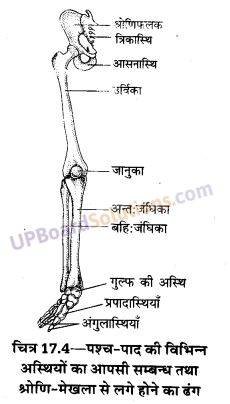
UP Board Solutions for Class 10 Home Science Chapter 17 मानव अस्थि-संस्थान तथा सन्धियाँ

(4) तलवा या प्रपाद:
इस भाग को बनाने के लिए 5 लम्बी हड्डियाँ होती हैं। ये सीधी होती हैं। तथा लगभग सम्पूर्ण तलवे को बनाती हैं। इन्हें प्रपादास्थियाँ कहते हैं। पीछे की ओर ये टखने की हड्डी से जुड़ी होती हैं, जबकि आगे की ओर इनसे उँगलियों की अस्थियाँ जुड़ती हैं।

UP Board Solutions

(5) उँगलियाँ:
प्रत्येक उँगली में 3 किन्तु अँगूठे में केवल 2 हड्डियाँ होती हैं। ये हड्डियाँ सीधी व हाथ की हड्डियों की अपेक्षा छोटी होती हैं। यहाँ अँगूठा भी उँगलियों की ही दिशा में लगा रहता है।

प्रश्न 6:
बाहु की अस्थियों का सचित्र वर्णन कीजिए।
या
बाहु की अस्थियों के नाम लिखिए। कोहनी में किस प्रकार का जोड़ पाया जाता है?
या
चित्र की सहायता से अग्रबाह की अस्थियों का वर्णन कीजिए।
या
बाह में पाई जाने वाली अस्थियों के नाम लिखिए। [2011, 13, 14, 16]
उत्तर:
बाह की अस्थियाँ

सम्पूर्ण बाहु की अस्थियों को 5 भागों में बाँट सकते हैं; जैसे-ऊपर से क्रमशः ऊपरी बाहु, अध:बाह या अग्रबाहु, कलाई, हथेली तथा उँगलियाँ। प्रत्येक भाग को बनाने के लिए एक या कुछ अस्थियाँ होती हैं; जैसे

ऊपरी बाहु की अस्थियाँ:
यह केवल एक अस्थि से बनती है जिसे प्रगण्डिकास्थि (Humerus) कहते हैं। यह एक लम्बी अस्थि होती है जो काफी मजबूत व अन्दर से खोखली होती है। लम्बाई में यह पूर्ण ऊपरी बाहु में फैली रहती है। इसकी ऊपरी सिरा गेंद की तरह गोल होता है तथा अंस-फलक के (UPBoardSolutions.com) अंसकूप में फँसा रहता है। यह अपने गोल तथा चिकनेपन के कारण कूट में आसानी से इधर-उधर या किसी भी दिशा में घूम सकता है। इसका दूसरा सिरा अग्रबाहु की अस्थि के साथ एक वि प्रकार की सन्धि बनाता है जो केवल एक ओर को खुलती या बन्द होती है। इस प्रकार की सन्धि
को कब्जा सन्धि कहते हैं। यह भाग कोहनी का जोड़ बनाता है।

अग्रबाहु की अस्थि:
अग्रबाहु या अध:बाहु में दो लम्बी मजबूत अस्थियाँ होती हैं। दोनों एक-दूसरे के पास-पास लगी रहती हैं। इन अस्थियों को बहिःप्रकोष्ठिकास्थि (Radius) तथा अन्तः प्रकोष्ठिकास्थि (UIna) कहते हैं। इनमें से रेडियस अँगूठे की ओर तथा अल्ना छोटी उँगली की ओर होती है। अल्ना अपेक्षाकृत लम्बी अस्थि है। यही अस्थि कोहनी के जत्रुकास्थि भाग में और लम्बी होकर कब्जा सन्धि बनाने में सहायक है। अंर,लङ रेडियस का ऊपरी सिरा सँकरा होता है जो प्रकोष्ठिका के साथ जुड़ा रहता है; किन्तु अगला सिरा, जो कलाई की अस्थि के पास होता है, प्रगण्डिकास्थि काफी चौड़ा होता है। इन दोनों लम्बी अस्थियों का लगाव अग्रबाहु में इस प्रकार होता है कि यदि हम हथेली को सीधा फैलाते हैं, तो ये एक-दूसरे के पास स्थित होती हैं, किन्तु हथेली को घुमाकर अन्दर अन्त:प्रकोष्ठिका की ओर ले जाएँ, तो ये एक-दूसरे के ऊपर स्थित होती हैं।
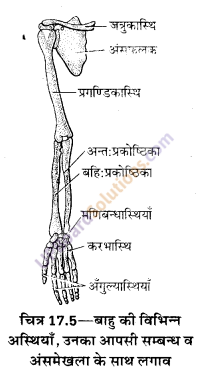
UP Board Solutions for Class 10 Home Science Chapter 17 मानव अस्थि-संस्थान तथा सन्धियाँ

कलाई की अस्थियाँ:
कलाई में 8 काफी छोटी-छोटी मणिबन्धास्थयाँ अस्थियाँ होती हैं, जिन्हें मणिबन्धिकास्थियाँ (कार्पल्स) कहते हैं। ये मणिबन्ध 4-4 की दो पंक्तियों में स्थित होकर कलाई को बाँधती हैं। इन केर भास्थि अस्थियों के छोटी-छोटी और अलग-अलग होने के कारण कलाई पूरी 18- अँगुल्यास्थियाँ तरह लचकदार होती है तथा किसी भी दिशा में आसानी से घुमाई जा जासकती है।
UP Board Solutions for Class 10 Home Science Chapter 17 मानव अस्थि-संस्थान तथा सन्धियाँ

हथेली की अस्थि:
हथेलीहथेली को 5 लम्बी और सँकरी अस्थियाँ, उनका आपसी सम्बन्ध व हड्डियाँ बनाती हैं। इन अस्थियों को करभिकाएँ या मेटा-कार्पल्स। अंसमेखला के साथ लगाव कहते हैं। कलाई की ओर ये मणिबन्ध से जुड़ी होती हैं। तथा आगे की ओर अँगुलियों की अस्थि से इनका सम्बन्ध मणिबन्धिकास्थियाँ होता है।

UP Board Solutions

अँगुलियों की अस्थि:
प्रत्येक अँगुली में 3 अस्थियाँ होती हैं। अँगूठे में केवल दो अस्थियाँ होती हैं। ये अँगुलास्थियाँ कहलाती हैं तथा छोटी होती हैं। एक-दूसरे के साथ सपाट जोड़ एक-दूसरे के ऊपर फिसलने में मदद करता है। अँगूठा अन्य अँगुलियों के पीछे हथेली के साथ। समकोण बनाता है। इसकी ऐसी स्थिति के कारण ही हम । छोटी-से-छोटी वस्तु को भी आसानी से पकड़ पाते हैं।

प्रश्न 7:
सन्धि किसे कहते हैं? सन्धि कितने प्रकार की होती हैं? उदाहरण सहित वर्णन कीजिए। [2007, 08, 10, 12, 13, 15, 17, 18]
या
मनुष्य के शरीर में कितने प्रकार की सन्धियाँ होती हैं? किसी एक प्रकार की सन्धि का चित्र बनाइए। [2009, 10, 12]
या
अस्थि सन्धि से आप क्या समझती हैं? अस्थि सन्धि के महत्त्व को स्पष्ट करते हुए उसके प्रकारों का उल्लेख कीजिए। [2007, 08, 9, 10, 16]
या
कन्दुक-खल्लिका सन्धि की रचना लिखिए व चित्र बनाइए  [ 2014, 15, 16]
या
कोहनी में किस प्रकार की सन्धि पायी जाती है? चित्र सहित वर्णन कीजिए। [2013]
या
अस्थि सन्धि से आप क्या समझती हैं? अस्थि सन्धियाँ कितने प्रकार की होती हैं? चल सन्धियों का उदाहरण सहित वर्णन कीजिए। [2008]
या
चल सन्धि क्या है ? चल सन्धि के प्रकार उदाहरण सहित लिखिए। [2009, 13]
या
सन्धियाँ कितने प्रकार की होती हैं? [2010, 13, 14, 16]
या
अस्थियों में ‘अचल सन्धि से आप क्या समझती हैं? [2018]
उत्तर:
अस्थि सन्धियाँ

शरार में दो या दो से अधिक अस्थियों के मिलने के स्थान को अस्थि-सन्धि कहते हैं। शरीर के भिन्न भिन्न अंगों की अस्थियाँ पररपा विद रहती हैं। प्रत्येक सन्धि ‘बन्धक तन्तुओं तथा ‘सौत्रिवः पनों की पट्टियों से बँधी रहती है। ये बन्धक सूत्र डोरे के समान होते हैं तथा अस्थियों को उचित स्थानों पर स्थित रखते हैं। जिन स्थानों पर दो अस्थियों की सन्धियाँ होती हैं, वहाँ पर अस्थियों में कोमल पदार्थ कार्टिलेज अधिक मात्रा में विद्यमान रहता है; अत: जोड़ पर इसके रहने से (UPBoardSolutions.com) जोड़ में सुविधा रहती है। जोड़ पर अस्थियाँ एक-दूसरे पर घूमती हैं। इससे रगड़ होना स्वाभाविक है। इस रगड़ को बचाने के लिए प्रत्येक सन्धि पर ऐसी ग्रन्थियाँ होती हैं, जिनसे एक प्रकार का चिकना द्रव पदार्थ सदैव निकलता रहता है। यह पदार्थ सन्धि को उसी प्रकार से सुरक्षित रखता है, जिस प्रकार से कोई मशीन तेल दे देने से सुरक्षित रहती है।

UP Board Solutions

क्रिया एवं महत्त्व:
सन्धियों पर ही अंगों की गति होती है। यदि हमारी बाहु की अस्थि स्केप्युता से अपने वर्तमान रूप में संयुक्त न होती तो हमारी बाँह बेकार निर्जीव अवस्था में लटकती रहती। हम उसे न तो घुमा-फिरा सकते थे और न ही ऊपर से नीचे उठा सकते थे। जब हम दौड़ते हैं, लड़ते हैं या किसी वस्तु को पकड़ते हैं, तो हमारे अंगु इन सन्धियों पर ही मुड़ते हैं। ये मुड़ने की क्रिया उत्पन्न करने वाली पेशियाँ होती हैं, जो एक सन्धि से उदय होकर दूसरी अस्थि पर एक लम्बी रस्सी के समान कण्डरा द्वारा लगती है। जब पेशी संकुचित होती है, तो जिस अस्थि पर वह लगी होती है, वह ऊपर यो सामने या पीछे की ओर उठ जाती है। इस प्रकार स्पष्ट है कि सन्धियों के द्वारा ही हमारे शरीर की विभिन्न गतियाँ सम्भव होती हैं। यदि हमारे अस्थि-संस्थान में ये समस्त सन्धियाँ न होतीं, तो हमारा शरीर किसी भी प्रकार की गति न कर पाता तथा वह पूर्ण रूप से स्थिर ही रहता।
सन्धियाँ दो प्रकार की होती हैं
(1) अचल तथा
(2) चलः

(1) अचल सन्धियाँ:
जब दो या दो से अधिक अस्थियाँ आपस में मिलकर इस प्रकार जुड़े जाएँ कि वे बिल्कुल हिल-डुल ही न सकें, तो उस सन्धि को अचल सन्धि कहते हैं। इस प्रकार की सन्धियाँ कपाल की अस्थियों में पाई जाती हैं। इस प्रकार के जोड़ के लिए अस्थियों के किनारे इस प्रकार के होने चाहिए कि वे एक-दूसरे में पूर्ण रूप से जमकर बैठ जाएँ।

UP Board Solutions

(2) चल सन्धियाँ:
दो या दो से अधिक अस्थियाँ जब एक-दूसरे के पास इस प्रकार लगी रहती हैं कि वे किसी निश्चित या कई दिशाओं में आसानी से हिल-डुल सकती हों अर्थात् गति कर सकें, तो इस प्रकार के जोड़ को चल सन्धि कहते हैं।
चल सन्धियाँ शरीर में कई प्रकार की होती हैं, जिनसे शरीर के विभिन्न अंगों को मोड़ा, घुमाया या चलाया जा सकता है। हमारे शरीर के विभिन्न अंगों को विभिन्न प्रकार के कार्य करने पड़ते हैं। ये सन्धियाँ निम्न प्रकार की होती हैं

(i) कन्दुक-खल्लिका या गेंद और प्यालेदार सन्धियाँ (Ball and Socket Joint):
यह जोड़ एक प्याले जैसे भाग में किसी दूसरी अस्थि का गोल सिरा फिट रहने से बनता है। ऐसी स्थिति में गेंद जैसा गोल सिरा प्याले जैसे गोल अस्थि में आसानी से चाहे जिधर घूम सकता है। ऐसी सन्धि को कन्दुक-खल्लिका सन्धि कहते हैं। शरीर में इस प्रकार की सन्धि कन्धे पर बाहु का जोड़ (UPBoardSolutions.com) तथा कूल्हे पर टॉग का जोड़ है।

(ii) कब्जा सन्धि (Hinge Joint):
इस प्रकार की सन्धियों में दोनों अस्थियाँ अथवा एक अस्थि एक ही दिशा में खुल या बन्द हो सकती है। इस प्रकार के जोड़ में निश्चय ही कोई एक अस्थि या उसका कोई प्रवर्ध इस प्रकार बढ़ा रहता है कि वह एक निश्चित दिशा के अलावा अन्य दिशा की गति को पूर्णत: रोकता है। इस प्रकार का जोड़ कोहनी, घुटना तथा उँगलियों में मिलता है।
UP Board Solutions for Class 10 Home Science Chapter 17 मानव अस्थि-संस्थान तथा सन्धियाँ

(iii) ख़ुटीदार सन्धि (Pivot Joint):
इसे धुराग्र सन्धि भी कहते हैं। इसमें एक अस्थि या उसके प्रवर्ध धुरे की भाँति अथवा बँटे की तरह सीधे होते हैं। इन धुरों पर दूसरी अस्थियाँ या धुरिया इस प्रकार टिकी रहती हैं कि इनको किधर भी घुमाया जा सके। इनमें केवल टिकी हुई अस्थि या अस्थियाँ ही गति करेंगी, बँटे वाली नहीं। रीढ़ की अस्थि की पहली-दूसरी कशेरुका खोपड़ी के साथ इस प्रकार का जोड़ बनाती हैं। वहीं पर इस कशेरुका का एक प्रवर्ध निकला रहता है, जिस पर खोपड़ी रखी रहती है। इस प्रकार खोपड़ी इस पर आसानी से घूमती है।

UP Board Solutions

(iv) फिसलनदार सन्धि (Sliding Joint):
इसे विसप सन्धि भी कहते हैं। ऐसी सन्धि वास्तव में कोई जोड़ नहीं बनाती है, बल्कि इनकी अस्थियाँ एक-दूसरे के ऊपर अपने चपटे तल के पास-पास लगी रहती हैं। इन दोनों की चौड़ाई में कई उपास्थियाँ होती हैं जो इन अस्थियों को गति करने के लिए फिसलने में मदद करती हैं। कलाई की अस्थि के जोड तथा कशेरुका के जोड़ों में इसी प्रकार की सन्धि होती है। यद्यपि हमारी अँगुलियों में कब्जे की तरह के पोरुए होते हैं, जबकि इन अस्थियों का आपसी जोड़ भी फिसलने वाला ही होता है।

(v) पर्याण या सैडिल सन्धि (Saddle Joint):
इस प्रकार की अस्थि सन्धि हमारे हाथ के अँगूठे की मेटाकार्पल्स तथा कार्पल्स के मध्य पाई जाती है। इस सन्धि की विशिष्ट रचना के ही कारण. हाथ को अँगूठा अन्य अँगुलियों की अपेक्षा इधर-उधर अधिक घुमाया जा सकता है। सैडिल सन्धि की रचना कन्दुक-खल्लिका से मिलती-जुलती होती हैं, परन्तु इसे सन्धि में पाए जाने वाले बॉल तथा साकेट कम विकसित होते हैं।

अस्थियों की सन्धियाँ या जोड़ सदैव ही विशेष प्रकार की डोरियों या स्नायुओं (Ligaments) से बँधे रहते हैं। इन्हीं जोड़ों पर मांसपेशियाँ लगी रहती हैं। मांसपेशियाँ गति कराने में सहायक होती हैं, जबकि ये डोरियाँ इन्हें बाँधे रखने में। इस प्रकार के जोड़ों में उपास्थियाँ भी कई बार महत्त्वपूर्ण योगदान देती हैं।

चल सन्धि की रचना

हमारे शरीर की चल-सन्धियों में इनमें कई प्रबन्ध होते हैं, ताकि अस्थियाँ आपस में रगड़ खाकर खराब न हों और वे इस प्रकार बँधी रहें कि वे अपने स्थान से हटें भी नहीं। इसके लिए श्वेत स्नायु की गोल या चौड़ी डोरियाँ होती हैं। ये इोरियाँ ही इन अस्थियों को एक-दूसरे के साथ निश्चित स्थान की ओर निश्चित दिशा में बॉधे रखती हैं। छोटी पेशियाँ इन्हें खींचकर किसी भी दिशा या गन्तव्य दिशा में हटाने की कोशिश करती हैं, किन्तु स्प्रिंग की तरह उल्टी दिशा में ये इन्हें (UPBoardSolutions.com) पूर्व-निर्धारित स्थान पर खींच लेती हैं। अस्थियों को रगड़ से बचाने का विशेष प्रबन्ध होता है। इसके लिए दोनों अस्थियों के बीच एक थैली जैसी वस्तु होती है जिसके अन्दर एक गाढ़ा स्नेहयुक्त तरल पदार्थ होता है। इस तरल पदार्थ के कारण अस्थियों के सिरे सदैव चिकने रहते हैं। चिकने तरल पदार्थ वाले इन थैलों को स्नेहको यो स्राव-सम्पुट (Synovial capsules) कहते हैं। इनके अन्दर भरे चिकने पदार्थ को स्नेहक द्रव (Synovial fluid) कहते हैं।

UP Board Solutions

लघु उत्तरीय प्रश्न

प्रश्न 1:
मानव शरीर में पाई जाने वाली अस्थियों के विभिन्न प्रकारों का उल्लेख कीजिए।
उत्तर:
यह सत्य है कि प्रायः सभी अस्थियों की आन्तरिक रचना एक समान ही होती है, परन्तु उनके बाहरी आकार में पर्याप्त भिन्नता पाई जाती है। आकार की भिन्नता के आधार पर मानव शरीर की समस्त अस्थियों को निम्नलिखित छ: प्रकारों में वर्गीकृत किया जा सकता है

  1.  चपटी अस्थियाँ:               कपाल की अस्थियाँ।
  2. लम्बी अस्थियाँ:                 बाँहों तथा टाँगों की अस्थियाँ।
  3. गोल अस्थियाँ:                  कलाई तथा टखने की अस्थियाँ।
  4. विषम अस्थियाँ:                मेरुदण्ड की अस्थियाँ।
  5. छोटी अस्थियाँ:                 अँगुलियों की अस्थियाँ।
  6. कीलाकार अस्थियाँ:         टखने की अस्थियों की दूसरी तह के भीतर की तीन अस्थियाँ।

प्रश्न 2:
सन्धि किसे कहते हैं? सन्धियों के प्रकार लिखिए। कन्धे में किस प्रकार की सन्धि पाई जाती है?
या
अस्थि सन्धियाँ किसे कहते हैं? कब्जेदार जोड़ के बारे में लिखिए। [2007, 16]
या
अस्थि-सन्धि किसे कहते हैं। सन्धियों के नाम उदाहरण सहित लिखिए। [2008]
उत्तर:
शरीर के कंकाल तन्त्र में दो या दो से अधिक अस्थियों के मिलने के स्थान को सन्धि कहते हैं। सन्धियाँ प्रमुखतः दो प्रकार की होती हैं
(1) चल सन्धि तथा
(2) अचल सन्धि।

चल सन्धियाँ पूर्ण या अपूर्ण प्रकार की हो सकती हैं। पूर्ण सन्धियाँ कई प्रकार की होती हैं; जैसे-कन्दुक-खल्लिका सन्धि, कब्जा सन्धि, धुराग्र या कीलक सन्धि, विसप सन्धि आदि। कन्धे के स्थान पर कन्दुक-खल्लिका सन्धि पाई जाती है।

UP Board Solutions

प्रश्न 3:
हमारे मेरुदण्ड में पाई जाने वाली कशेरुकाओं की संख्या एवं स्थिति का उल्लेख कीजिए।
या
मेरुदण्ड में कितनी अस्थियाँ होती हैं?
उत्तर:
एक वयस्क व्यक्ति के मेरुदण्ड में कुल 26 कशेरुकाएँ होती हैं, जिनकी स्थिति के अनुसार संख्या निम्नलिखित है
UP Board Solutions for Class 10 Home Science Chapter 17 मानव अस्थि-संस्थान तथा सन्धियाँ

अतिलघु उत्तरीय प्रश्न

प्रश्न 1:
अस्थि-संस्थान से क्या आशय है? [2003, 05]
उतर:
शरीर की समस्त अस्थियों की व्यवस्था को अस्थि-संस्थान या कंकाल-तन्त्र के नाम से जाना जाता है।

प्रश्न 2:
वयस्क मनुष्य में अस्थियों की कुल संख्या कितनी होती है?
या
शरीर में कुल कितनी अस्थियाँ होती है। [ 2011, 15]
उत्तर:
वयस्क मनुष्य के अस्थि-संस्थान में प्राय: 206 (UPBoardSolutions.com) अस्थियाँ होती हैं।

UP Board Solutions

प्रश्न 3:
मानव अस्थि-संस्थान को कितने भागों में विभक्त किया जा सकता है?
उत्तर:
मानव अस्थि-संस्थान को तीन मुख्य भागों में बाँटा जा सकता है
(1) खोपड़ी,
(2) धड़
और
(3) ऊर्ध्व तथा अधोशाखाएँ।

प्रश्न 4:
अस्थियों के विकास के लिए कौन-कौन से पोषक तत्त्व आवश्यक हैं? [2009]
उत्तर:
कैल्सियम तथा फॉस्फोरस अस्थियों के विकास के लिए आवश्यक पोषक तत्त्व हैं।

प्रश्न 5:
अस्थियों के खोखले भाग को क्या कहते हैं? उसमें क्या भरा रहता है?
उत्तर:
अस्थियों के खोखले भाग को अस्थि-गुहा कहते हैं। उसमें अस्थिमज्जा नामक गूदेदार पदार्थ भरा रहता है।

प्रश्न 6:
लाल रक्त कणिकाओं का निर्माण कहाँ होता है?
उत्तर:
लाल रक्त कणिकाएँ अस्थियों के अस्थिमज्जा भाग में बनती हैं।

प्रश्न 7:
बाल्यावस्था में मेरुदण्ड में कशेरुकाओं की संख्या बताइए।
उत्तर:
बच्चों के मेरुदण्ड में 33 कशेरुकाएँ होती हैं।

प्रश्न 8:
वयस्क व्यक्ति के मेरुदण्ड में कितनी कशेरुकाएँ पाई जाती हैं? [2009]
उत्तर:
वयस्क व्यक्ति के मेरुदण्ड में 26 कशेरुकाएँ पाई जाती हैं।

प्रश्न 9:
सिर के मुख्य भाग कौन-से हैं?
उत्तर:
सिर के दो मुख्य भाग हैं
(1) कपाल तथा
(2)  चेहरा।

प्रश्न 10:
हमारे शरीर में लम्बी अस्थियाँ कहाँ-कहाँ पाई जाती हैं?
उत्तर:
हमारे शरीर में बाँहों तथा टाँगों में लम्बी अस्थियाँ पाई जाती हैं।

UP Board Solutions

प्रश्न 11:
मानव खोपड़ी में कुल कितनी अस्थियाँ होती हैं?
उत्तर:
मानव खोपड़ी में कुल 22 अस्थियाँ होती हैं, जिनमें से 8 कपाल में तथा 14 चेहरे में स्थित होती हैं।

प्रश्न 12:
मानव खोपड़ी में प्रायः किस प्रकार की सन्धियाँ पाई जाती हैं?
उत्तर:
मानव खोपड़ी में प्राय: अचल सन्धियाँ होती हैं।

प्रश्न 13:
अस्थि सन्धि किसे कहते हैं? सन्धियों के प्रकार लिखिए। [2008, 10, 15, 16]
उत्तर:
अस्थि-संस्थान में दो अथवा दो से अधिक अस्थियों के परस्पर सम्बद्ध होने की व्यवस्था एवं स्थल को अस्थि सन्धि कहते हैं। शरीर में चल तथा अचल दो प्रकार की अस्थि सन्धियाँ पायी जाती हैं।

प्रश्न 14:
शरीर में सन्धियों से क्या लाभ हैं?
या
शरीर में कंकाल सन्धियों का क्या महत्त्व है? [2010, 12]
उत्तर:
शरीर की गतिशीलता में सन्धियों का महत्त्वपूर्ण योगदान रहता है। (UPBoardSolutions.com) इन्हीं के कारण हम अपने हाथ, पैर तथा गर्दन आदि को हिला-डुला पाते हैं। ।

प्रश्न 15:
शरीर में मूल रूप से कितने प्रकार की सन्धियाँ पाई जाती हैं? [2007, 10]
उत्तर:
हमारे शरीर में मूल रूप से दो प्रकार की सन्धि पाई जाती हैं। जिन्हें क्रमश: अचल सन्धि तथा चल सन्धि कहा जाता है।

प्रश्न 16:
अचल सन्धि का क्या अर्थ है? यह शरीर में कहाँ पायी जाती हैं?
उत्तर:
हमारे शरीर की उन अस्थि-सन्धियों को अचल सन्धि कहा जाता है, जिनमें किसी प्रकार की गति नहीं होती तथा सम्बन्धितं अस्थियाँ स्थिर होती हैं। अचल सन्धियाँ कपाल की अस्थियों में पाई : जाती हैं।

UP Board Solutions

प्रश्न 17:
पूर्ण चल सन्धियाँ कितने प्रकार की होती हैं?
उत्तर:
पूर्ण चल सन्धियाँ पाँच प्रकार की होती हैं

  1.  कब्जा सन्धि,
  2. कन्दुक-खल्लिका सन्धि,
  3.  ख़ुटीदार सन्धि,
  4. फिसलनदार या प्रसर सन्धि तथा
  5. सैडिल या पर्याण सन्धि।

प्रश्न 18:
चल तथा अचल सन्धि में क्या अन्तर है? [2007, 13]
उत्तर:
चल सन्धियों में विभिन्न प्रकार की निर्धारित गतियाँ होती हैं, जबकि अचल सन्धियों में किसी प्रकार की गति नहीं होती।

प्रश्न 19:
गेंद-गड्ढा (कन्दुक-खल्लिका) सन्धि के दो उदाहरण बताइए।
उत्तर:
गेंद-गड्ढा या कन्दुक-खल्लिका सन्धि के उदाहरण हैं-कन्धे की अस्थि सन्धि तथा कूल्हे की अस्थि सन्धि।

प्रश्न 20:
कब्जा सन्धि तथा बँटीदार सन्धि का सामान्य परिचय दीजिए।
उत्तर:
(1) कब्जा सन्धि: इस प्रकार की सन्धियों में दोनों अस्थियों अथवा एक अस्थि कब्जे की तरह एक ही दिशा में खुल या बन्द हो सकती है; जैसे–कुहनी या उँगली।
(2) ख़ुटीदार सन्धि: इसमें एक अस्थि या उसके प्रवर्ध धुरे की भाँति अथवा बँटे की तरह (UPBoardSolutions.com) सीधी होती हैं। इन पर दूसरी अस्थि को किसी भी तरफ घुमाया जा सकता है; जैसे–कशेरुका के एक प्रवर्ध पर रखी खोपड़ी। इस प्रकार खोपड़ी दाएँ या बाएँ, किधर भी घूम सकती है।

UP Board Solutions

बहुविकल्पीय प्रश्न

प्रश्न-निम्नलिखित बहुविकल्पीय प्रश्नों के सही विकल्पों का चुनाव कीजिए

1. कंकाल-तन्त्र के मुख्य कार्य हैं
(क) शरीर को आकृति एवं दृढ़ता प्रदान करना
(ख) रक्त कणों का निर्माण करना
(ग) शरीर को गति प्रदान करना
(घ) ये सभी

2. हड्डी में कड़ापन किस तत्त्व के कारण होता है? [2008, 10, 11, 12, 15, 17]
(क) लौह तत्त्व
(ख) सोडियम
(ग) मैग्नीशियम
(घ) कैल्सियम

3. हड्डियाँ किस तत्त्व से मजबूत होती हैं? [2011]
(क) प्रोटीन
(ख) सोडियम
(ग) कैल्सियम
(घ) वसा

4. खोपड़ी में अस्थियों की कुल संख्या कितनी होती है?
(क) आठ
(ख) चौदह
(ग) बाईस
(घ) चौबीस

UP Board Solutions

5. मानव कंकाल में कितनी अस्थियाँ होती हैं? [2007, 10, 13, 15, 18]
(क) 100
(ख) 206
(ग) 200
(घ) 106

6. बच्चों के मेरुदण्ड में कितनी अस्थियाँ होती हैं? [2013]
(क) 35
(ख) 33
(ग) 30
(घ) 36

7. कन्धे पर किस प्रकार की सन्धि होती है? [2014]
(क) अल्पचल सन्धि
(ख) कब्जेनुमा सन्धि
(ग) अचल सन्धि
(घ) गेंद-गड्ढा सन्धि

8. कोहनी का जोड़ कौन-सा जोड़ कहलाता है? [2015, 16, 17]
(क) धुराग्र
(ख) कब्जेदार
(ग) फिसलने वाला
(घ) ख़ुटीदार

9. चेहरे में कितनी अस्थियाँ पाई जाती हैं? [2007, 14, 17, 18]
(क) अठारह
(ख) बीस
(ग) चौदह
(घ) ये सभी

10. ऊपरी बाह की हडडी होती है
(क) लम्बी
(ख) मोटी
(ग) चपटी
(घ) कैसी भी

11. ऊपरी बाहु की अस्थि है [2018]
(क) अंसफलक
(ख) प्रगण्डिका
(ग) बहिः प्रकोण्ठिकास्थि
(घ) अन्त: प्रकोण्ठिकास्थि

UP Board Solutions

12. गर्दन के भाग में ग्रीवा कशेरुकाओं की संख्या होती है
(क) 4
(ख) 5
(ग) 6
(घ) 7

13. घुटना किस प्रकार की सन्धि का उदाहरण है?
(क) कन्दुक-खल्लिका (गेंद-गड्ढा) जोड़
(ख) कब्जेदार जोड़
(ग) कीलदार जोड़
(घ) फिसलने वाला जोड़

14. रीढ़ की हड्डी में पाया जाता है
(क) कन्दुक-खल्लिका जोड़
(ख) चूलदार जोड़
(ग) कीलदार जोड़।
(घ) फिसलने वाला (विसप) जोड़

15. मानव शरीर में कितने प्रकार के जोड़ होते हैं? [2008, 10]
(क) दो
(ख) तीन
(ग) चार
(घ) पाँच

16. मानव शरीर में कितनी जोड़ी पसलियाँ पाई जाती हैं? [2008, 11, 12, 13, 14, 15]
(क) 5 जोड़ी
(ख) 10 जोड़ी
(ग) 12 जोड़ी
(घ) 20 जोड़ी

17. खूटी (धुराग्र) सन्धि पाई जाती है [2008, 14]
(क) कन्धे में
(ख) घुटने में
(ग) खोपड़ी में
(घ) कोहनी में

18. अचल सन्धि कहाँ पाई जाती है? [2009, 10, 11]
(क) खोपड़ी में
(ख) घुटने में
(ग) कलाई में
(घ) कोहनी में

19. आठ हड्डियाँ पायी जाती हैं [2009, 10, 11]
(क) रीढ़ में
(ख) पेट में
(ग) कपाल में
(घ) हथेली में

20. रीढ़ की हड्डी में कितनी कशेरुकाएँ पायी जाती हैं? [2014, 16]
या
एक वयस्क व्यक्ति के मेरुदण्ड में कितनी कशेरुकाएँ होती हैं? [2014]
(क) 28
(ख) 24
(ग) 26
(घ) 25

UP Board Solutions

उत्तर:
1. (घ) ये सभी,
2. (घ) कैल्सियम,
3. (ग) कैल्सियम,
4. (क) आठ,
5. (ख) 206,
6. (ख) 33,
7. (घ) गेंद-गड्ढा सन्धि,
8. (ख) कब्जेदार,
9. (ग) चौदह,
10. (क) लम्बी,
11. (ख) प्रगण्डिका,
12. (घ) 7,
13. (ख) कब्जेदार जोड़,
14. (ग) कीलदार जोड़,
15. (क) दो,
16, (ग) 12 जोड़ी,
17. (ग) खोपड़ी में,
18. (क) खोपड़ी में,
19. (ग) कपाल में
20. (ग) 28

We hope the UP Board Solutions for Class 10 Home Science Chapter 17 मानव अस्थि-संस्थान तथा सन्धियाँ help you. If you have any query regarding UP Board Solutions for Class 10 Home Science Chapter 17 मानव अस्थि-संस्थान तथा सन्धियाँ, drop a comment below and we will get back to you at the earliest.


UP Board Solutions for Class 8 Hindi Chapter 1 भोजस्य राज्यप्राप्ति (अनिवार्य संस्कृत)

UP Board Solutions for Class 8 Hindi Chapter 1 भोजस्य राज्यप्राप्ति (अनिवार्य संस्कृत)

These Solutions are part of UP Board Solutions for Class 8 Hindi. Here we have given UP Board Solutions for Class 8 Hindi Chapter 1 भोजस्य राज्यप्राप्ति (अनिवार्य संस्कृत).

पुरा धाराराज्य ……………………………………………………… राज्यं कुरु।”

हिन्दी अनुवाद – प्राचीन काल में धारा राज्य में सिन्धुल नामक राजा ने प्रजा पर शासन किया। उसकी वृद्धावस्था में भोजु नामक पुत्र पैदा हुआ। जब वह पाँच वर्ष का था तब उसके पिता ने अपना बुढ़ापा जानकर छोटे भाई ‘महाबली मुञ्ज से कहा- “तुम मेरे पुत्र भोज का पालन करो। वह जब तक इस राज्य के भार को सहने में सक्षम हो, तब तक तुम ही राज्य करो।”

UP Board Solutions

विदडगत ……………………………………………………… अवाचयत्|

हिन्दी अनुवाद – राजा के मरने पर मुञ्ज की पाप-बुद्धि पैदा हुई कि यह बालक जब जवान होगा, तब मैं राजा नहीं होऊँगा। इसलिए उसने भोज को मारने का निश्चय करके अपने मित्र वत्सराज से कहा, तुम भुवनेश्वरी जंगल में रात्रि में भोज को मारकर उसका सिर मुझे दो।” वत्सराज भोज को रात में भुवनेश्वरी मन्दिर ले जाकर बोला “राजा ने आपको मारने का आदेश दिया है।” उस समय भोज ने अपने खून से वट पत्र पर एक श्लोक लिखा। उस श्लोक के द्वारा वैराग्य को प्राप्त हुए वत्सराज ने भोज (UPBoardSolutions.com) को भूमिगत तहखाने में छिपा दिया। स्वयं कृत्रिम मस्तक राजा को देकर कहा “ श्रीमान जैसा आदेश मिला, वैसा पूरा किया।” उसने भोज के उस पत्र को राजा को दे दिया। राजा ने पत्र के अक्षरों को पढ़ा

श्लोक-मान्धाता ……………………………………………………… यास्यति॥

हिन्दी अनुवाद – सतयुग के आभूषण राजा मान्धाता भी पृथ्वी से चले गए। जिन्होंने समुद्र पर सेतु का निर्माण कराया, दशानन का वध करने वाले वे राम कहाँ हैं? अर्थात् वे भी धरती पर नहीं रहे। राजन्! युधिष्ठिर आदि अन्य प्रसिद्ध राजा भी स्वर्ग सिधार गए। इस प्रकार हे मुञ्ज! किसी एक के भी साथ पृथ्वी नहीं तो क्या तुम्हारे साथ जाएगी? नहीं।

राजा ……………………………………………………… जगाम।

हिन्दी अनुवाद – राजा श्लोक के अर्थ पर विचार करके अत्यन्त लज्जित हुआ और प्रायश्चित रूप से शरीर को अग्नि में जलाने के लिए तैयार हो गया। उसी क्षण ‘भोज जीवित है’ ऐसा रहस्य वत्सराज ने खोला। (UPBoardSolutions.com) उससे अत्यन्त प्रसन्न होकर मुञ्ज भोज को राजसिंहासन पर स्थापित करके स्वयं पत्नी सहित तपोवन को गया।

UP Board Solutions

अभ्यास

प्रश्न 1.
उच्चारण करें-
नोट – विद्यार्थी स्वयं उच्चारण करें।

प्रश्न 2.
एक पद में उत्तर दें
(क) राजा सिन्धुलः कुत्र राज्यम् अकरोत्?
उत्तर :
धाराराज्ये।

(ख)
मुञ्जस्य कीदृशी बुद्धिः उत्पन्ना?
उत्तर :
पापबुद्धि

UP Board Solutions

(ग) वत्सराजः भोज कुत्र अनयत्?
उत्तर :
भुवनेश्वरी मन्दिर।

(घ)
वत्सराजः भोजं कुत्र रक्षितवान्?
उत्तर :
भूमिगृहान्तरे।

(ङ)
मुञ्जः भोजं राजसिंहासने स्थापयित्वा स्वयं पत्न्या सह कुत्र जगाम?
उत्तर :
तपोवनं।

प्रश्न 3.
किसने किससे कहा
(क) त्वं मम पुत्रं भोजं परिपालय।
उत्तर :
सिन्धुलः मुञ्जमवदत्।।

(ख)
भोज हत्वा तस्य शिरः मह्यम् देहि।
उत्तर :
मुञ्जः स्वमित्रं वत्सराजं प्राह।

(ग)
राजा भवतः वधः आदिष्टः।
उत्तर :
वत्सराजः भोज अवोचत्।

UP Board Solutions

(घ)
श्रीमता यद् आदिष्टं तत् साधितम्।
उत्तर :
वत्सराजः मुञ्ज प्राह।

प्रश्न 4.
निम्नलिखित पदों का सन्धि-विच्छेद करें
पद                             सन्धि-विच्छेद
पर्यपालयत्       =      पय + अपालयत
वृद्धावस्थायाम्  =      वृद्ध + अवस्थायाम्
नैकेनापि          =       न + एकेन + अपि

प्रश्न 5.
संस्कृत में अनुवाद करें
(क) रमेश तेरह वर्ष का है।
अनुवाद : रमेशः त्रयोदशवर्षीयः अस्ति।

(ख)
जब वह आयेगा तब पुस्तक पायेगा।
अनुवाद : यदा सः आगमिष्यति तदा पुस्तकम् लभति।

(ग)
पहले भोजपत्र पर ग्रन्थ लिखा जाता था।
अनुवाद : पुरा भोजपत्र ग्रन्थं अलिखततान्।।

(घ)
तुम भाई के साथ यहाँ आओ।
अनुवाद : त्वं भ्रातं सह अत्र आगमनं कुरु।।

UP Board Solutions

प्रश्न 6.
मजूषा से उचित पदों को चुनकर रिक्त स्थानों की पूर्ति करें (सिन्धुनामकः वटपत्रे भोजं तपोवनं)
(क) पुरा धाराराज्ये सिन्धुनामकः राजा चिरं प्रजाः पर्यपालयत्।
(ख) वत्सराजः तपोवनं भूमिगृहन्तिरे सुरक्षितवान्।
(ग) भोजः स्वरक्तेन वटपत्रे एक श्लोकम् अलिखत्।।
(घ) मुञ्जः स्वयं पत्न्या सह भोजं तपोवनं जगाम।।

We hope the UP Board Solutions for Class 8 Hindi Chapter 1 भोजस्य राज्यप्राप्ति (अनिवार्य संस्कृत) help you. If you have any query regarding UP Board Solutions for Class 8 Hindi Chapter 1 भोजस्य राज्यप्राप्ति (अनिवार्य संस्कृत), drop a comment below and we will get back to you at the earliest.

UP Board Solutions for Class 9 English Grammar Chapter 15 Long Composition

UP Board Solutions for Class 9 English Grammar Chapter 15 Long Composition

These Solutions are part of UP Board Solutions for Class 9 English. Here we have given UP Board Solutions for Class 9 English Grammar Chapter 15 Long Composition

LONG COMPOSITION
An Ideal Teacher

Hints
1. Introduction,
2. His dress and appearance,
3. His behaviour,
4. His method of teaching,
5. His qualities.

1. Introduction :

There are many teachers in my college. I respect all of them but I like Shri GP. Sharma most. He is an M.A., L.T. He teaches me Hindi. He is my also class teacher.

2. His dress and appearance:
He puts on simple clothes. In summer he puts on a dhoti and a shirt. In winter he puts on a sweater and woollen coat also. He uses a cap on his head. He is about forty years old. He is tall, healthy and well-built. He is always happy.

UP Board Solutions

3. His behaviour:
His behaviour is not harsh. He is kind towards all the students and friendly to teachers. His habits are of a sweet-tempered man. His manners are very charming.

4. His method of teaching:
His method of teaching is effective. His lessons are very interesting. Even the weakest student follows him easily. He is the master of his subject.

5. His qualities:

He has many good qualities. He is a man of good character. He is regular, punctual and hardworking. He does not waste his time in the class. He keeps his students busy all the time. He is kind-hearted. He helps poor and needy students by giving them books. He is also a good sportsman. He is a man of principle. He is an ideal teacher. So I like him most.
UP Board Solutions for Class 9 English Grammar Chapter 15 Long Composition image 1

The Cow

Hints
1. Colour and size,
2. Food,
3. Her habits,
4. Usefulness.

1. Colour and size:

Cows are of many colours. Some cows are white, some are black and some are brown. A cow is generally four feet high and six feet long. She has four legs, two ears, two horns and a long bushy tail.

2. Food:
The cow eats green grass and straw. She likes to eat oil cake also. She relishes green vegetables and fruitskins.

3. Her habits:

The cow is a gentle animal. She does not hurt anybody. Some cows are simple that children play near them. Hindus called her ‘Gau Mata’.

4. Usefulness:

The cow is very useful to us. She gives us milk. Her milk makes us healthy. It is very useful for the children. We make butter, ghee and curd from her milk. She gives us calves who pull carts and plough the fields. Her dung is used as manure (UPBoardSolutions.com) and fuel. Shoes and other leather articles are made from her skin. We make combs, buttons and many other things from her horns. In short the cow is a very useful animal. This is why the Hindus worship her.
UP Board Solutions for Class 9 English Grammar Chapter 15 Long Composition image 2

My Ideal Friend/My Best Friend

Hints
1. Introduction,
2. His dress and habits,
3. His hobbies,
4. His qualities.

1. Introduction:

“A friend in need is a friend indeed.” I have many friends but, I like Suresh the best of all. He is a friend indeed. He is an ideal student. His father is a teacher. His mother is a religious lady. He is sixteen years old.

2. His dress and habits:

He puts on simple dress. He is very simple by nature. He is very polite. He is never angry. He is always ready to help others.

UP Board Solutions

3. His hobbies:
He has many hobbies. He sings, paints and collects coins and stamps. He has collected coins and stamps.of different sizes and of many countries. He is also very fond of reading good books.

4. His qualities:
He has many good qualities. He bears a good moral character. He always helps me in need. He never tells a lie. He is regular in his morning walk. He is honest and hardworking. He respects and obeys his teachers, parents and elders. He does not waste (UPBoardSolutions.com) his time. He is neither proud nor selfish. He never makes a noise in the class. He is a good player of hockey and volleyball. His behaviour towards his elders is praiseworthy. He is a true scout. I am proud of him.
UP Board Solutions for Class 9 English Grammar Chapter 15 Long Composition image 3

An Indian Farmer

Hints
1. Introduction,
2. Home,
3. Education,
4. Daily Life,
5. Source of Enjoyment,
6. Efforts of Improvement.

1. Introduction :
India is an agriculture country. Most of its people live in villages. The main occupation of its people is farming. The Indian farmer is generally a simple man. He wears Dhoti and Kurta of Khaddar. He does not get time to be sad as he is always busy in his work.

2. Home:

He is hard-working yet he is poor. Many farmers live in huts. Some live in ordinary houses made of mud. There are thatches on them. They are very small. They are not airy. Some rich farmers have built pucca houses.

3. Education:
A farmer is often uneducated and illiterate. His knowledge is based on old ideas. He is superstitious. Now many farmers try to know new methods of farming. They know much about fertilizers and pesticides..

4. Daily Life:

A farmer generally rises early in the morning. He goes to his field with his bullocks and a plough. He starts working and works till his wife brings food for him at noon. He takes his food and then takes rest for sometime. Then he starts his work. He goes on working till evening. In the evening he returns home. Such is the life of an Indian farmer.

5. Source of Enjoyment:
At night he goes to chaupal. He enjoys songs and dramas. Sometimes he smokes hukka. He likes the stories of Alha-Udal. Sometimes he goes to fairs also.

6. Efforts of Improvement:
A farmer is the backbone of our society. The progress of our country is based on the improvement of his condition. So the government should improve his condition.
UP Board Solutions for Class 9 English Grammar Chapter 15 Long Composition image 4

The Postman

Hints
1. Introduction,
2. His work,
3. His uniform and dress,
4. His salary,
5. His condition,
6. Conclusion.

1. Introduction:
At nine O’clock the door-bell rings. We run to open the door. How happy we are when we see the postman with letters for us !

2. His work:

The postman is a very important man and is very popular with everybodyyoung and old. He brings us news from our friends and relations and sometimes money too. Sometimes he brings us bad news.

UP Board Solutions

3. His uniform and dress :
Generally the postman wears a Khaki uniform. But sometimes for a change, he wears ordinary clothes. He carries a leather bag which contains (UPBoardSolutions.com) letters, parcels, money-orders and cash. Most postmen use bicycle but there are some who prefer walking.

4. His salary:
The postman does not get a big salary but he works very hard. He performs his duty faithfully—whether it is hot summer or cold winter. He is always active.

5. His condition:
In the old days the postman was not very well educated. It was enough if he knew how to read and write English and Hindi. But today many postmen are graduates.

6. Conclusion:
When we think of the hard work that the postman does to bring us news, we admire him. He deserves all praise.
UP Board Solutions for Class 9 English Grammar Chapter 15 Long Composition image 5

My Town Or Your Town

Hints
1. Name of the town,
2. Location,
3. Around the town,
4. Its importance.

1. Name of the town:

The town I live in is famous for one reason—it has been the home of the Prime Minister of India. Pt. Jawahar Lal Nehru was brought up in Allahabad, Sri Lal Bahadur Shastri had a house at Allahabad and Smt. Indira Gandhi was born here. Anand Bhawan, donated to the nation by the Prime Minister, is now a place of historical importance.

2. Location:

Allahabad is situated near the Sangam, the place where the two rivers—the Ganga and the Yamuna, meet. Thousands of visitors and pilgrims come to Allahabad just to have a dip in the Sangam.

3. Around the Town:

It is a calm and quiet city, because there are not many industries around. Naini, a superb of Allahabad, however, is now developing fast (UPBoardSolutions.com) industrially. There is the big Agriculture Institute, the Indian Telephone Industries and the factory of Universal Tyres. A glass factory is also going to be built there shortly. Allahabad proper has the Geep lash Light Factory which makes batteries.

4. Its Importance:

There are a few spots in Allahabad which have scenic beauty. There, are the old but majestic stone buildings of the High Court and the offices of the various departments. There are other attractions for visitors too. Allahabad is famous as a seat of learning. The main office of the Board of High School and Intermediate Education is situated in Allahabad. The headquarter of the Education Department of Uttar Pradesh is located. We are proud of our town.
UP Board Solutions for Class 9 English Grammar Chapter 15 Long Composition image 6

A Festival : ‘Diwali’ Or A Festival

Hints
1. Name of the Festival,
2. The time of celebration,
3. Preparation for the festival,
4. How I celebrated,
5. Conclusion.

1. Name of the festival:

The name of the festival is Diwali. It is a famous festival of Hindus. It is celebrated throughout the country with great pomp and show. It is known as the festival of lights.

2. The time of celebration:

Diwali festival is celebrated in the month of Kartika. Generally it falls in the month of November of every year. Some people believe that Rama returned to Ayodhya after killing Ravana, the king of Lanka, on this day. So people lighted earthen lamps in (UPBoardSolutions.com) their houses to welcome Rama. Some people believe that the demon Narkasur was killed by Lord Krishna. According to Jainism Lord Mahavir got salvation on this day.

UP Board Solutions

3. Preparation for the festival:
Diwali is celebrated with great pomp and show. Houses are cleaned and white-washed. Different kinds of decorations are made before the festival. On the very day houses, shop and temples are illuminated with earthen lamp and electric bulbs.

4. How I celebrated :

This year, I enjoyed Diwali with great joy. I cleaned my house and got it white washed. All the doors and windows were painted, balloons, beautiful pictures and flowers were used to decorate the house. I enjoyed delicious feast at evening. The whole house was illuminated with earthen lamps and electric bulbs in the night. I let off fire works with my friends.

5. Conclusion:

Diwali is one of the famous festivals of India. It reminds us about Lord Rama and Lord Mahavir. But there are some social evils associated with the festival. Some people drink and gamble on the day of Diwali. It is bad custom, we should try to remove these evils.
UP Board Solutions for Class 9 English Grammar Chapter 15 Long Composition image 7

The Principal of Your College

Hints
1. Name and Qualificati on,
2. Dress,
3. Habits and Behaviour,
4. His qualities.

1. Name and Qualification:
The name of my Principal is Sri Sunder Lal Verma. He is fifty years old. He is a post-graduate. He is an M.A.L.T.

2. Dress:
His clothes are not costly. He puts on white clothes. He believes in simple living and high thinking. In winter he puts on brown suits. He uses a cap on his head.

3. Habits and Behaviour:

He is an early riser. He is regular in his work. He hates late coming. He is hard working, sincere and honest. He is always sweet tempered and sweet tongued. His behaviour is very fine. He does not abuse his servants. He does not beat his students. He is father like to them. I have never seen him angry.

4. His Qualities:
He has many good qualities. He is a man of good character. He is a hard working man. He believes in simple life. He is very regular, punctual and honest. He does not waste his time. He is kind hearted, gentle and peace loving. He (UPBoardSolutions.com) helps poor students. He is also a good sportsman. He is a man of principle. He is a good administrator too. I like him most.
UP Board Solutions for Class 9 English Grammar Chapter 15 Long Composition image 8

My Favourite Book
Or The Book You Like Most

Hints
1. Name of the book and the author,
2. Theme of the book (Description),
3. Its languages and style,
4. Reasons for liking it,
5. Conclusion.

1. Name of the book and the author:

I am fond of reading books. Reading books is my hobby. I have read so many books. The Ramcharit Manas is one of them. I like it very much. I read it again and again. Its author is Goswami Tulsidas. He was a famous poet.

2. Theme of the book (Description):

There is vivid story of Lord Ram who was the eldest son of Dashratha. Dashratha was the famous king of Ayodhya. Ram was set into forest for fourteen years. Sita who was his wife also went to the forest. His brother Laxman was with him. In the (UPBoardSolutions.com) forest Sita was carried off forcibly by Ravan; the king of Lanka. Ram killed Ravan and came back to Ayodhya after fourteen years.

3. Its languages and style:

‘The Ramcharit Manas’ is an epic. It is written in Hindi. Sanskrit is also used in it. It is in verse. Tulsidas has written so many books. All books are written in “Awadhi”, so the Ramcharit Manas is also in Awadhi.

UP Board Solutions

4. Reasons for liking it :
I like the book very much. Its language is musical and simple. It is full of wisdom. It is a store house of ideals which have worthy to be followed: Before us it presents a picture of an ideal society. It points out that the evil is punished and the good prevails in the end.

5. Conclusion:

Due to all the above qualities, the Ramcharit Manas is very popular in India. It is widely read with devotion. The Hindus worship it. It is also known as the “Ramayan’. I like it very much. I read it everyday.
UP Board Solutions for Class 9 English Grammar Chapter 15 Long Composition image 9

My Visit to A Fair

Hints
1. Introduction,
2. Scene at the ghats,
3. Description of the fair,
4. Conclusion.

1. Introduction:
The Ganga is a holy river. In the month of Kartik, Ganga fairs are held at many places. Varanasi is one of them. Once I had a chance to go to this fair with my friends.

2. Scene at the ghats:

We went to the fair by the train take. We went directly to the ghat, where our friends were waiting for us. We went to take bathe in the Ganga. There (UPBoardSolutions.com) was a very big crowd on the ghats. Police constables and volunteers were on duty. Boats were moving in the river. After bathing we came back to a hotel.

3. Description of the fair:

In the evening, we went to the fair. There were two lines of shops. They were well-decorated. We made some purchases in the market. When night befell, there was light everywhere. It looked very beautiful, we felt hungry. So we took sweets and tea. Then we went to see the circus. We came back to hotel at 12 O’clock in the night

4. Conclusion:

Fairs are very useful. There we meet many of our friends and relatives. We see many new things. We also learn some new things. We forget our sorrows. We enjoy them much.
UP Board Solutions for Class 9 English Grammar Chapter 15 Long Composition image 10

A Visit To A Zoo

Hints
1. Introduction,
2. Visit to the Zoo,
3. Scene At Zoo,
4. Conclusion.

1. Introduction:
Last Sunday, I with my friends went to visit Delhi Zoo. It is near Pragati Maidan.

2. Visit to the Zoo:
We bought tickets and went inside. It was very interesting.

3. Scene At Zoo:
We saw some animals and birds in cages. At first, we went to see the animal section. We saw many animals there such as lions, tigers, monkeys, leopard , slogs , zebras etc. We became very happy to see monkeys jumping. (UPBoardSolutions.com) We rode on elephant. Then we saw the birds section. We saw peacocks, parrots, pigeons and many other birds. They all looked very nice.

4. Conclusion:
We got much joy to see the zoo. The zoo is a very lovely place. I like it very much.
UP Board Solutions for Class 9 English Grammar Chapter 15 Long Composition image 11

A Visit To A Historical Place
Or Visit to an Important Place (2010 DG)

Hints
1. Introduction,
2. The Place of Historical Importance,
3. The Historical Background.

1. Introduction:
Yesterday, I went to Delhi from Bareilly. I wanted to see a historical place. There are many historical buildings in Delhi.

2. The Place of Historical Importance :

The Red Fort, Jama Masjid and Qutub Minar are the important historical buildings in Delhi. The Red Fort is built of red stones. It was built by Shah Jahan. The Qutub Minar is about twelve miles away from Delhi station. Its founder was Qutubuddin, (UPBoardSolutions.com) the first slave Sultan. Chandni Chowk and Connaught Place are the main markets  of  Delhi. I saw all these places besides the Parliament House Jantar Mantar and Birla Mandir.

UP Board Solutions

3. The Historical Background:
But I like the Red Fort very much. It is the monument which narrates the glory of Indian art and culture; witnessing various turns in the India’s struggle for freedom. On 15th August, 1947, the first Prime Minister of independent India, Pt. Nehru hoisted the Indian national flag of tri-colour on Red Fort. I feel very proud of it.
UP Board Solutions for Class 9 English Grammar Chapter 15 Long Composition image 12

My Mother

Hints
1. Introduction,
2. Her Nature,
3. Her Qualities,
4. Conclusion.

1. Introduction :
I am Meena. I am the daughter of Mrs. Shamo Rani. She is a post graduate retired English teacher. She loves me very much as I am her eldest daughter.

2. Her Nature:

She is fair, active and religious minded. She herself does most of the household work.  She likes cleanliness. She is daring, dashing and brave. She teaches me daily for two hours. She is always busy doing one thing or the other.

3. Her Qualities:

She hates telling lies and speaking ill of others. She is very sweet tempered. She is very honest and intelligent. She believes in simple living and high thinking. She helps the poor. She behaves well and she is never angry.

4. Conclusion:

She is a religious minded lady. She loves each and every member of the family. She is like a goddess on earth. I love my mother very much.
UP Board Solutions for Class 9 English Grammar Chapter 15 Long Composition image 13

My Father

Hints
1. Introduction,
2. His Dress and Behaviour,
3. His Qualities,
4. Daily Life,
5. Conclusion.

1. Introduction:

I am Mukesh Jain. My father is Shri S. K. Jain. He is a doctor. He has a grand personality. He is fifty yet he is smart and active.

2. His Dress and Behaviour:

He is a simple man. He is always neat and clean. He wears white shirt and white pant. His dress is always pressed and well-maintained. In winter, he wears woollen clothes. He is very kind and gentle too. Everybody likes and respects him.

3. His Qualities:

My father is a man of character. He always helps the poor and needy. He is popular among his neighbours. People respect him and come to him for advice. He is religious minded. Every day, he goes to temple and worships there for an hour. Daily (UPBoardSolutions.com) Life My father gets up early in the morning. He goes for a walk daily. He gets ready for his daily work. He leaves the house at 10 o’clock and goes to Municipal hospital. He returns from there at 4 o’clock. Then he looks after us.

4. Conclusion:

My father is a gentleman. He is a famous doctor in the district. He is always busy in doing one thing or the other. He hates telling lies and speaking ill of others. I am proud of him. I love him very much.
UP Board Solutions for Class 9 English Grammar Chapter 15 Long Composition image 14

My School Or College
Or An Ideal School

Hints
1. Name and Situation,
2. Building,
3. Library,
4. Play Ground,
5. Conclusion.

1. Name and Situation:

The name of my school is C.A.V. Inter College, Allahabad. It is situated in the heart of the city.

2. Building:

It has a very large double-storeyed building. The main building of the school consists of the three blocks. Our classes run in the main building. It has about twenty rooms with a big hall. There are four laboratories for Science and Biology. All the (UPBoardSolutions.com) rooms are airy and well-ventilated. Electric light and fans are fitted in every room. The hall of the school is very big. General meetings are held here. The Principal’s Office is in the middle of the building. There are some quarters for the peons. It has well-furnished canteen too.

UP Board Solutions

3. Library:
The main attraction of the college is its library. There are two big rooms. There is a regular issue of books. The strength of the college is about six thousand. The staff members are one hundred and fifty. All students and teachers get books issued from the library. There are two reading rooms, one for the teachers and the other for the students. Newspapers and magazines are put on the tables to read.

4. Play Ground:

We are lucky to have two play grounds. They are well-maintained. Our game superintendent is very expert. He is very careful about the play grounds. (UPBoardSolutions.com) We enjoy our games daily in the evening. Some students go to play in the vacant periods.

5. Conclusion:

Our college is a reputed college in the district. Students from rural areas also come to get their admission. We are proud of it.
UP Board Solutions for Class 9 English Grammar Chapter 15 Long Composition image 15

A Rainy Day

Hints
1. Introduction,
2. Day and Month,
3. Pleasant weather.

1. Introduction:

It rains generally in the month of July and August. Some times it rains so heavily that it becomes very difficult to come out of the houses.

2. Day and month:

It was the second week of July. On Monday the 20th, it was very hot. It was very difficult to move out. Suddenly the weather changed. A few patches of clouds were seen in the sky. Soon the cool breeze blew and it began to drizzle. After sometime, it began to rain heavily. It was the time to go to school. So I took my books and an umbrella and started for school. On the way I was completely wet. When I reached the school, I saw that some (UPBoardSolutions.com) other boys who had come were also wet. The attendance was very short. Due to thick clouds there was darkness in the class rooms. So the Principal declared it a rainy day. We were all very happy.

3. Pleasant weather:

While we were returning we saw wonderful sights. There was kneedeep water on the roads. Children were floating paper boats in the water. Some street boys were throwing mud balls at one another. There was a beautiful rainbow in the sky. The weather was very cool and pleasant. Every one was looking happy on that day. When I reached home. I changed my clothes and had a cup of tea. After this I sat in the varandah with my parents and enjoyed the rain. I enjoyed the day very much.
UP Board Solutions for Class 9 English Grammar Chapter 15 Long Composition image 16

My Idea of A Model Village
Or My Village

Hints
1. Introduction,
2. Spreading of education,
3. Arrangements of hospitals,
4. Teaching good habits.

1. Introduction :

India is a land of villages. About seventy percent people live in villages. The villagers are very poor. It is our duty to improve them.

2. Spreading of education:
The most important thing is education. Most of the villagers cannot read or write. So we should start night schools for them.

3. Arrangements of hospitals:

The villagers do not get medicines when they fall ill. So we should build hospitals for them in villages. There should be well qualified doctors in these hospitals to look after them.

4.
Teaching good habits:
The villagers have some very bad habits. They drink and smoke. They spend much money on marriages and other ceremonies. They should (UPBoardSolutions.com) be taught that all these things are bad. They should be asked to avoid them to make their lives comfortable.
UP Board Solutions for Class 9 English Grammar Chapter 15 Long Composition image 17

Prize Distribution Function
Or College Function
Or The Prize Distribution Function of Your School

Hints
1. Introduction,
2. Preparation,
3. Reception of the chief guest,
4. Cultural Programme,
5. Prize Distribution,
6. Thanks by the Principal,
7. Conclusion.

1. Introduction:
A college week was celebrated in our college this year. December 15, was the closing day when the Prize distribution function was held.

2. Preparation:

The college was decorated beautifully. A carpet was spread from the gate-up to the rostrum. All the students were in their clean uniform.

3. Reception of the chief guest :

The District Magistrate was the chief guest. He came in his car, followed by his retinue. He was received warmly by the Principal and taken to the rostrum.

4. Cultural Programme :

A very interesting but short cultural programme was displayad. The girl students presented a very good folk song and a dance. I also took part in it. I sang a filmi song.

UP Board Solutions

5. Prize Distribution:
The chief guest distributed the prizes and certificates. The winner teams of the other institutions also received prizes. The District Inspector of Schools encouraged the prize winner by shaking hands with them.

6. Thanks by the Principal:

The Principal thanked the chief guest in a very humble tonc. All appreciated it.

7. Conclusion:
In the end, sweets were distributed among the students. We enjoyed it much.
UP Board Solutions for Class 9 English Grammar Chapter 15 Long Composition image 18

A Cricket Match
Or Your Favourite Game

Hints
1. Introduction,
2. Description,
3. Conclusion.

1. Introduction:
It was the Republic Day. A cricket match was played between two collegesK.P. Inter College and C.A.V. Inter college in the evening. Both the teams came at 3 p.m. K.P. Inter College batted first.

2. Description:

Ravi, the captain of K.P. Inter College; was run out. He scored twenty runs. Vikas, the captain of C.A.V. Inter College team scored only ten runs. His show was poor. Rajesh opened magnificently. He scored eighty runs. The team of K.P. Inter College scored 210 in fifty overs. The players of C.A.V. Inter College disappointed us. Only Mohan, opened (UPBoardSolutions.com) fairly well. He scored valuable 61 runs. The fielding of K.P. Inter College was weak. But C.A.V. Inter College could not take advantage of it. The match was highly thrilling and exciting. C.A.V. Inter College needed only 25 runs in three overs and five batsmen were to come. But it could not score even 10 runs. So C.A.V. Inter College lost the match.

3. Conclusion:

The match was very interesting. It was full of ups and downs. Fortune smiled sometimes this side and sometimes that side. Some players of C.A.V. Inter College played well but they could not score well. The team of K.P. Inter College played somehow well and won the match.
UP Board Solutions for Class 9 English Grammar Chapter 15 Long Composition image 19

The Importance of Newspapers

Hints :
1. Introduction,
2. Usefulness,
3. Collection of Material,
4. Importance,
5. Conclusion.

1. Introduction :

The word ‘News’ is an amalgam of four letters ‘N’, ‘E’, ‘W’ and ‘S’, which stand for North, East, West and South respectively. Newspapers play a very important role in our lives. It is a very strong means of communication. They give news and views.

2. Usefulness:

Newspaper gives the daily news of what is happening round the world. It also gives information about the main incidents round the world. There are lots of daily newspapers such as “The Hindustan Times, The Indian Express, The Times of India, The Economic Times” etc. These newspapers give information about politics, sports, share market and prices of our daily needs etc. They increase our knowledge and wisdom. We learn much about the world’s events from newspapers. They broaden our outlook. They change our views. They guide common people of the country.

UP Board Solutions

3. Collection of Material:
The reporters of the newspapers collect the news from their own sources and from different news agencies and then publish it. The newspapers also give educational and classifieds columns. These are very educative and informative.

4. Importance:

Newspapers give every information about the incidents that take place all around the world. The paper boys called hawkers distribute the newspapers to the customer’s houses early in the morning.

5. Conclusion:

The newspapers are a very useful source of education and information.
UP Board Solutions for Class 9 English Grammar Chapter 15 Long Composition image 20

Television and Its Effects
Or Television – A Boon or A Curse
Or Television – Uses and Abuses

Hints :
1. Introduction,
2. Effect and usefulness,
3. Conclusion.

1.
Introduction:
Television is the greatest gift of science to us. It is one of the greastest inventions of science.

2.
Effect and Usefulness:
It has both good and bad effects. Its good effects are more than its bad effects. Television shows  serials on epics which help people to understand each other’s religion. It shows many quiz programmes which increase our knowledge. It shows us the latest happening in the world through news. It helps people to learn different languages. (UPBoardSolutions.com) Its bad effects arevery harmful. Over viewing of serials can effect the eyes. Extra use of television results in a wastage of time. It disturbs the mind of students in studies.

3. Conclusion:
The vulgar serials lead persons to bad habits. But if it is used properly then it is one of the greatest blessings of science.
UP Board Solutions for Class 9 English Grammar Chapter 15 Long Composition image 21

Is Science A Blessing
Or
A Curse!
Or Science Is A Good Servant But A Bad Master

Hints :
1. Introduction,
2. Important blessings of science,
3. Curses of science,
4. Misuse of science,
5. Conclusion.

1. Introduction:

It is difficult to blame science for all the ills of the world. Similarly, it is childish to lavish praises on science like a slave of all the blessings it has given us. In itself, science is only a systematized body of knowledge which man has earned with his own endeavour. It is neither good nor bad by itself. It is a gift of knowledge possessed by man. (UPBoardSolutions.com) Ultimately, it is the man, who is more important than his gift. It all depends on how he uses the gift of science, whether he uses science in the interest of human happiness and prosperity or whether he uses it to destroy humanity.

2. Important blessings of science:

So, numerous are the blessings of science that it would be difficult to enumerate them. That science has made human life comfortable and prosperous, will be readily admitted by all. Time and space have been conquered and nature has been (UPBoardSolutions.com) completely subjugated. Diseases have been controlled and the economic standard of man has been vastly increased. He has the finest means of recreation at home, while books, magazines and periodicals provide him with ample food for thought.

3.
Curses of science:
While, this is the gay side of life, its ugly side cannot be lost sight of. Science has made us grossly materialistic in our outlook. We have become selfish and greedy and are thinking in terms of our own advancement at the cost of others. Society has been divided between the ‘haves’ and ‘have-nots’ and a grim class conflict is staring us in the face. (UPBoardSolutions.com) Science has placed terrible weapons of mass destruction in the hands of man, so that, he can destroy the whole world within minutes. The world is divided into powerful military blocks, intent on large scale mass massacre of humanity and complete extinction of human civilization.

UP Board Solutions

4. Misuse of science:
While all this is true, the question is, who is really responsible for all this calamity–science or man. Really, it is the man who is to be blamed for all his misfortunes. He has been constantly misusing science for his own selfish ends. The aeroplane, for example, as the swiftest means of communication, is certainly a big blessing of science, (UPBoardSolutions.com) but man, in his madness, has been using it for dropping deadly bombs and devastating thickly populated cities. The atom bomb will destroy the world but the use of atomic energy for peaceful purposes can turn this world into heaven. So, it is not science, but its use or misuse is a significant point. Science is neither a blessing nor a curse. It is for its user—the man-to decide whether he wants to use science as a blessing or misuse it as a curse.

5.
Conclusion:
Ultimately, man is the master of science and not science, the master of man. Science is meant for man and not man for science. Science is the servant of man and man should use science wisely and discretely.
UP Board Solutions for Class 9 English Grammar Chapter 15 Long Composition image 22

We hope the UP Board Solutions for Class 9 English Grammar Chapter 15 Long Composition help you. If you have any query regarding UP Board Solutions for Class 9 English Grammar Chapter 15 Long Composition , drop a comment below and we will get back to you at the earliest.

UP Board Solutions for Class 8 Civics Chapter 2 देश की सुरक्षा एवं विदेश नीति

UP Board Solutions for Class 8 Civics Chapter 2 देश की सुरक्षा एवं विदेश नीति

These Solutions are part of UP Board Solutions for Class 8 Civics. Here we have given UP Board Solutions for Class 8 Civics Chapter 2 देश की सुरक्षा एवं विदेश नीति.

देश की सुरक्षा एवं विदेश नीति

अभ्यास

प्रश्न 1.
निम्नलिखित प्रश्नों के उत्तर दीजिए- .
(क) देश की सुरक्षा में सहायक संगठनों के बारे में लिखिए।
उत्तर
सेनाओं के तीन अंगों के अतिरिक्त कुछ अन्य संगठन हैं, जो देश की सुरक्षा के लिए कार्य करते हैं। देश की अंतरराष्ट्रीय सीमाओं पर स्थायी रूप से चौकसी का कार्य सीमा सुरक्षा बल (Border Security Force) नामक संगठन करता है। समुद्रतट की सीमाओं की सुरक्षा में तटरक्षक (Coast Guards) संगठन कार्य (UPBoardSolutions.com) करता है। इसके कार्यों में रक्षा प्रतिष्ठानों की रक्षा करना, तस्करी रोकना तथा खोज-बचाव के दलों का * गठन करना मुख्य हैं। तीसरा महत्त्वपूर्ण संगठन प्रादेशिक सेना (TerritorialArrmy) है। यह नागरिकों का एक संगठन है। इसमें देश की सुरक्षा कार्य में भाग लेने के इच्छुक नागरिक अपने खाली समय में सैन्य प्रशिक्षण ले सकते हैं। चौथा संगठन नेशनल कैडेट कोर (N.C.C) है। इसमें बालकों के साथ-साथ बालिकाओं का भी डिवीज़न है। उच्च प्राथमिक विद्यालयों में स्काउट्स एवं गाइड्स के प्रशिक्षण की व्यवस्था है।

केन्द्रीय औद्योगिक सुरक्षा बल (CISF) एक अर्द्धसैनिक बल है जिसका मुख्य कार्य सरकारी कारखानों एवं अन्य सरकारी उपक्रमों को सुरक्षा प्रदान करना है। इसके अतिरक्ति देश की आंतरिक सुरक्षा, विशिष्ट लोगों की सुरक्षा, परमाणु संस्थान, ऐतिहासिक धारोहरों आदि की भी सुरक्षा करता है। केन्द्रीय रिजर्व पुलिस बल (CRPF) भारत के केन्द्रीय सशस्त्र पुलिस बलों में सबसे बड़ा है। यह भारत सरकार के गृह मंत्रालय के तहत काम करता है। सीआरपीफ की प्राथमिक भूमिका पुलिस कारवाई में राज्य/संघ शासित प्रदेशों की सहायता, कानून व्यवस्था और आतंकवाद विरोध में निहित है। रैपिड एक्शन फोर्स (RAF) केन्द्रीय रिजर्व पुलिस (UPBoardSolutions.com) बल की एक शाखा है, जो दंगों एवं भीड़ को नियंत्रित करती है। राष्ट्रीय सुरक्षा गार्ड (NSG) गृह मंत्रालय के निरीक्षण में काम करती है और इनका मुख्य कार्य विशिष्ट व्यक्तियों की रक्षा, बंधकों का बचाव महत्त्वपूर्ण प्रतिष्ठानों को आतंकवादी खतरों से सुरक्षित करना है।

UP Board Solutions

(ख) विश्व में शांति स्थापित करने के लिए भारत ने किस नीति का समर्थन किया?
उत्तर
विश्व में शांति स्थापित करने के लिए भारत ने गुट निरपेक्षता की नीति का समर्थन किया।

(ग) पंचशीले क्या है एवं इसके सिद्धान्त कौन-कौन से हैं?
उत्तर
देश के प्रथम प्रधानमंत्री पं० जवाहर लाल नेहरू युद्ध के स्थान पर शान्ति को महत्त्व देते रहे। वह सभी राष्ट्रों की स्वतंत्रता एवम् समानता के समर्थक थे इसलिए किसी भी राष्ट्र के आंतरिक मामले में हस्तक्षेप करने के भी विरुद्ध थे। उनके इन्हीं विचारों से 1954 में पाँच सिद्धान्त बनाए गए जिन्हें पंचशील के नाम से जाना जाता है। ये हमारी विदेशनीति के आधार हैं। ये सिद्धान्त इस प्रकार हैं

  • एक दूसरे की राज्य की सीमा एवम् उनकी प्रभुसत्ता का सम्मान किया जाए।
  • एक दूसरे के भू-भाग पर आक्रमण न किया जाए।
  • एक दूसरे के आंतरिक मामले में हस्तक्षेप न किया जाए।
  • समानता और पारस्परिक लाभ को ध्यान में रखा जाए।
  • शान्तिपूर्ण सह-अस्तित्व की भावना का पालन किया जाए।

(घ) कोरिया और कांगो के संकट के समय भारत ने संयुक्त राष्ट्र संघ की क्या सहायता की?
उत्तर
भारत जब से संयुक्त राष्ट्र संघ का सदस्य बना है, वह लगातार उसे अपना सहयोग प्रदान कर रहा है। संयुक्त राष्ट्र संघ के निर्देशों के पालन में ही कोरिया के संकट के समय भारत ने एक डाक्टरी दल भेजा एवं कांगों में (UPBoardSolutions.com) संयुक्त राष्ट्र संघ के साथ अपनी सैनिक टुकड़ियाँ भेजीं।

UP Board Solutions

प्रश्न 2.
रिक्त स्थानों की पूर्ति कीजिए
उत्तर
(क) सेना में भर्ती होने के लिए पहले चयन परीक्षा होती है।
(ख) समुद्री मार्ग से तस्करी रोकने के लिए तटरक्षक संगठन कार्य करता है।
(ग) भारतीय सेनाओं का सर्वोच्च कमाण्डर राष्ट्रपति होता है।
(घ) शस्त्रों की होड़ से युद्ध की संभावनाएँ बढ़ जाती हैं।

प्रश्न 3.
निम्नलिखित कथनों में जो सही हों उनके आगे (✓) का चिह्न लगाइए|-
उत्तर
UP Board Solutions for Class 8 Civics Chapter 2 देश की सुरक्षा एवं विदेश नीति img-1

प्रश्न 4.
सोचिए और लिखिए-
उत्तर
विद्यार्थी स्वयं करें।

UP Board Solutions

प्रोजेक्ट वर्क-
विद्यार्थी स्वयं करें।

We hope the UP Board Solutions for Class 8 Civics Chapter 2 देश की सुरक्षा एवं विदेश नीति help you. If you have any query regarding UP Board Solutions for Class 8 Civics Chapter 2 देश की सुरक्षा एवं विदेश नीति, drop a comment below and we will get back to you at the earliest.



















