UP Board Class 10th English Chapter 1 Question Answer The Enchanted Pool (C. Rajagopalachari).

Class 10 English Prose Chapter 1 Questions and Answers UP Board The Enchanted Pool (C. Rajagopalachari).

कक्षा 10 अंग्रेजी पाठ 1 प्रश्न उत्तर

These Solutions are part of UP Board Solutions for Class 10 English. Here we have given UP Board Solutions for Class 10 English Prose Chapter 1 The Enchanted Pool (C. Rajagopalachari).

Comprehension Questions on Paragraphs

In the examination paper, there are asked only two questions from each paragraph. Given below are some more questions for extra practice.

Read the following passages and answer the questions put there upon:

(1) Yudhishthira waited for……………….his voice and wept. [From para 1]

Question.
1. What had the brothers of Yudhishthira gone in search of ?
(युधिष्ठिर के भाई किस वस्तु की खोज में गए थे ?)
2. What did Yudhishthira fear had happened to his brothers ?
(युधिष्ठिर को क्या भय था कि उसके भाइयों को क्या हो गया ?)
3. What did Yudhishthira do?
(युधिष्ठिर ने क्या किया ?)
4. What did Yudhishthira do when he saw his brothers lying dead ?
( युधिष्ठिर ने क्या किया जब उसने अपने भाइयों को मृत पड़े हुए देखा ?)
Answer:
1. The brothers of Yudhishthira had gone in search of water.
(युधिष्ठिर के भाई पानी की खोज में गए थे।)
2. Yudhishthira feared either they had fainted or died of thirst.
(युधिष्ठिर को भय था कि या तो (UPBoardSolutions.com) वे बेहोश हो गए यो प्यास के कारण मर गए।)
3. Yudhishthira gave up waiting and started out to look for them.
(युधिष्ठिर ने प्रतीक्षा करनी छोड़ दी और उन्हें ढूंढ़ने के लिए चल पड़े।)।
4. When Yudhishthira saw his brothers lying dead, he could not control his grief. He cried out and wept.
(जब युधिष्ठिर ने अपने भाइयों को मृत पड़े हुए पाया तब वे अपने दु:ख पर नियन्त्रण नहीं कर सके। वे चीखने लगे और रो पड़े।)

UP Board Solutions

(2) He touched the faces ……………… pool belongs to me”.[From para 2]

Question.
1. In what condition did Yudhishthira find his brothers ?
(युधिष्ठिरं ने अपने भाइयों को किस स्थिति में पाया ?)
2. what did Yudhishthira mourn ?
(युधिष्ठिर ने क्या विलाप किया ?)
3. What did Yudhishthira wonder to see the mighty limbs of his brothers ?
(अपने भाइयों की शक्तिशाली भुजाओं को देखकर युधिष्ठिर ने क्या आश्चर्य किया ?)
4. What would have happened to Yudhishthira if he had tried to drink from the pool without answering the Yaksha’s questions ?
(यदि युधिष्ठिर ने यक्ष के प्रश्नों का उत्तर दिए बिना पानी पी लिया होता तो उसके साथ क्या घटित होता ?)
5. Who did pool belong to?
(तालाब किसका था ?)
Answer:
1. Yudhishthira found his brothers lying dead.
(युधिष्ठिर ने अपने भाइयों को मृत पड़ा हुआ पाया।)
2. Yudhishthira mourned saying, “Was this to be end of all our vows? Just when
our exile is to end, you have been taken away. Even the Gods have forsaken me in my misfortune.”
(युधिष्ठिर ने यह कहते हुए विलाप किया, “क्या हमारी प्रतिज्ञाओं का यही अन्त होना था? ठीक उसी समय जब हमारे वनवास का अन्त होने वाला है तभी तुम्हें मुझसे छीन लिया गया। देवताओं ने भी मुझे
मेरी विपत्ति में छोड़ दिया।”)
3. Yudhishthira wondered to see the mighty limbs of his brothers who could have been powerful enough to kill them.
(अपने भाइयों की शक्तिशाली भुजाओं को देखकर युधिष्ठिर ने आश्चर्य किया कि इन्हें मारने वाला
इतना शक्तिशाली व्यक्ति कौन हो सकता है?)
4. If Yudhishthira has tried (UPBoardSolutions.com) to drink from the pool without answering the Yaksha’s questions, he would also have died.
(यदि युधिष्ठिर ने यक्ष के प्रश्नों का उत्तर दिए बिना तालाब का पानी पीने की चेष्टा की होती तब उसकी भी मृत्यु हो जाती।)।
5. The pool belonged to Yaksha.
(तालाब यक्ष का था।)

UP Board Solutions

(3) It did not take…………wisdom that he gets wisdom.”[From para 3]

Question.
1. What did Yudhishthira understand within a moment?
(पल भर में युधिष्ठिर ने क्या समझ लिया ?)
2. What did Yudhishthira do to bring his brothers back to life ?
(अपने भाइयों को पुनर्जीवित कराने के लिए युधिष्ठिर ने क्या किया? )
3. What does a man gain by being in the company of wise ?
|(बुद्धिमान व्यक्तियों की संगति में किसी व्यक्ति को क्या प्राप्त होता है?)
Answer:
1. Yudhishthira understood within a moment that these were the words of Yaksha.
(युधिष्ठिर एक क्षण में समझ गए कि ये शब्द यक्ष के हैं।)
2. To bring his brothers back to life Yudhishthira became ready to answer the questions of Yaksha.
(अपने भाइयों को पुनर्जीवित कराने के लिए युधिष्ठिर यक्ष के प्रश्नों का उत्तर देने को तैयार हो गए।)
3. In the company of wise a man gets wisdom. ।
(बुद्धिमान व्यक्ति की संगति में मनुष्य बुद्धिमानी प्राप्त करता है।)

(4) Your brothers died …………………….ask your questions. [From para 2 & 3 [2016]]

Question.
1. Write the name of the lesson from which the above passage has been taken. Who is the author of the lesson ?
(उपर्युक्त गद्यांश जिस पाठ से लिया गया है उसका नाम लिखिए। इस पाठ के लेखक कौन हैं?)
2. Who was the owner of the pool? Why did the four brothers of Yudhishthira die? ।
(तालाब का मालिक कौन था? युधिष्ठिर के चारों भाइयों की मृत्यु क्यों हुई?)
Answer:
1. This passage has been taken from the lesson “The Enchanted Pool. C.
Rajgopalachari is the author of this lessson.
(यह गद्यांश “The Enchanted Pool’ नामक पाठ से लिया गया है। इस पाठ के लेखक C. Rajagopalachari 1)
2. Yaksha was the owner of the pool. The four brothers of Yudhishthira died
because they did not heed the (UPBoardSolutions.com) words of Yaksha.
(तालाब का मालिक यक्ष था। युधिष्ठिर के चारों भाई इसलिए मर गए क्योंकि उन्होंने यक्ष के शब्दों पर ध्यान नहीं दिया।)

UP Board Solutions

(5) The voice put questions ……..result of good conduct.”[From para 3 & 4 [2011]]

Question.
1. what rescues man in danger ?
(खतरे में मनुष्य को कौन बचाता है ?)
2. What is swifter than the wind ?
(हवा से भी तेज कौन है ?)
3. What is more faded than a dried straw ?
(सूखी घास से भी अधिक मुरझाया हुआ कौन होता है ?)
4. Who is the friend of one who stays at home?
(उस व्यक्ति का मित्र कौन होता है जो घर पर रहता है ?)
5. What is happiness ?
(आनन्द क्या होता है ?)
Answer:
1. Courage rescues man in danger.
(साहस मनुष्य को खतरे से बचाता है।)
2 Mind is swifter than the wind.
(मस्तिष्क हवा से भी तेज है।)
3. A sorrow-stricken heart is more faded than a dried straw.
(दु:ख से संतप्त हृदय सूखी घास से भी अधिक मुरझाया हुआ होता है।)
4. Wife is the friend of one who stays at home.
(पत्नी उस व्यक्ति की मित्र होती है जो घर पर रहता है।)
5. Happiness is the result of good conduct.
(अच्छे व्यवहार का परिणाम ही आनन्द होता है।)

UP Board Solutions

Question.
1. When and where does the wife act as friend ?
(पत्नी कब और कहाँ मित्र के समान काम करती है ?)
2. What does dharma’ do to us ?
(धर्म हमारे लिए क्या करता है ?)
3. How can we be happy?
(हम प्रसन्न कैसे हो सकते हैं ?)
4. What will happen if we are proud ?
(यदि हम अभिमानी होंगे तब क्या होगा ?)
Answer:
1. The wife acts as a friend when we stay at home.
(जब हम घर पर रहते हैं तब पत्नी मित्र के समान कार्य करती है।)
2. Dharma alone (UPBoardSolutions.com) accompanies the soul in its solitary journey after death.
(धर्म ही मृत्यु के बाद आत्मा की एकाकी यात्रा में उसके साथ जाता है।)
3. If we have good conduct we can be happy.
(यदि हमारा आचरण अच्छा होगा तब हम प्रसन्न हो सकते हैं।)
                 Or
Our good conduct gives us happiness.
(हमारा अच्छा आचरण हमें आनन्द देता है।)
4. If we are proud, no body will love us.
(यदि हम अभिमानी होंगे तब कोई भी व्यक्ति हमें प्यार नहीं करेगा।)

(6) “What is that ……. is the greatest wonder.”[From para 4 & 5 [2011]]

Question.
1. What is that, by giving up which, a man becomes loved by all?
(वह कौन-सी वस्तु है जिसका त्याग करके मनुष्य सभी का प्रिय हो जाता है ?)
2. What is the loss which yields joy and not sorrow?
(वह कौन-सी हानि है जो दुःख नहीं आनन्द प्रदान करती है ?)
3. What makes one a real ‘Brahmana’ ?
(कौन-सी वस्तु किसी व्यक्ति को वास्तविक ब्राह्मण बनाती है ?)
Answer:
1. By giving up pride, a man becomes loved by all.
(अभिमान को छोड़कर मनुष्य सभी का प्रिय हो जाता है।)
2. By giving up anger, one gets joy and not sorrow.
(क्रोध को त्याग कर मनुष्य आनन्द प्राप्त करता है दुःख नहीं।)
3. Good conduct alone makes one a real Brahmana.
(अच्छा आचरण मनुष्य को वास्तविक ब्राह्मण बनाता है।)

UP Board Solutions

(7) Thus, theYaksha put …………than either of these two.”[From para 6 (2011]]

Question.
1. How many questions did Yaksha ask and how many of them did Yudhishthira answer ?
(यक्ष ने युधिष्ठिर से कितने प्रश्न पूछे और युधिष्ठिर ने उनमें से कितनों के उत्तर दिए?)
2. Did Yudhishthira  answer the questions of the Yaksha satisfactorily ?
(क्या युधिष्ठिर ने यक्ष के प्रश्नों के सन्तोषजनक उत्तर दिए ?)
3. Which brother did Yudhishthira choose to be alive ? Describe his | appearance.
(युधिष्ठिर ने कौन-से भाई को पुनर्जीवित कराने को चुना? उसका रूप-रंग बताइए।)
4. What did Yaksha ask Yudhishthira about his choice ? ।
(यक्ष ने युधिष्ठिर की पसन्द के विषय में क्या पूछा ?)
5. Who had the strength of sixteen thousand elephants ?
(सोलह हजार हाथियों की शक्ति किसमें थी ?)
Answer:
1. Yaksha asked Yudhishthira many questions and Yudhishthira answered all of them.
(यक्ष ने युधिष्ठिर से अनेक प्रश्न पूछे और युधिष्ठिर ने उन सभी का उत्तर दे दिया।)
2. Yes, Yudhishthira answered the questions of Yaksha satisfactorily.
(हाँ, युधिष्ठिर ने यक्ष के प्रश्नों का उत्तर सन्तोषजनक ढंग से दिया।)
3. Yudhishthira chose Nakula. He was cloud-complexioned, lotus-eyed,broad-chested and long-armed. (युधिष्ठिर ने नकुल को चुना। वह मेघ वर्ण का, कमल नयन वाला, चौड़े सीने वाला और बड़ी भुजाओं वाला था।)
4. Yaksha asked Yudhishthira, (UPBoardSolutions.com) “Why did you choose Nakula in preference to Bhima who has the strength of sixteen thousand elephants and he is the most dear to you.”
(यक्ष ने युधिष्ठिर से पूछा, “तुमने भीम की अपेक्षा नकुल को क्यों चुना जिसके पास सोलह हजार
हाथियों की शक्ति है और वह तुम्हें सबसे प्रिय भी है।”)
5. Bhima was Yudhishthira’s brother. He had the strength of sixteen thousand elephants.
(भीम युधिष्ठिर का भाई था। उसमें सोलह हजार हाथियों की शक्ति थी।)

(8) “OYaksha, ……. then he disappeared.[From para 7 [2011]]
                                   Or
“O Yaksha, ……………….. mayrevive.”[From pura 7 [2013, 16]] 

Question.
1.What is the shield of man ?
(मनुष्य की सुरक्षा किसमें होती है ?)
2. According to Yudhishthira when can man be ruined ?
(युधिष्ठिर के अनुसार मनुष्य का कब विनाश हो सकता है ?)
3. Why did Yudhishthira ask the Yaksha to bring Nakula back to life?
                                 Or
Why did Yudhishthira ask for Nakula’s revival ?
(युधिष्ठिर ने यक्ष से नकुल को जीवित करने के लिए क्यों कहा?)
                                 Or
How did Yudhishthira want to follow his dharma ?
(युधिष्ठिर किस प्रकार अपने धर्म का पालन करना चाहते थे ?)
4. What quality of Yudhishthira pleased the Yaksha most? How did he reward him for that ?
(युधिष्ठिर के कौन-से गुण ने यक्ष को सबसे अधिक प्रभावित किया ? उसने उसे कैसे पुरस्कृत किया ?)
5. Who had taken the form of Yaksha and why?
(यक्ष का रूप धारण किसने किया था और क्यों ?)
6. Which words in the passage have the synonyms of the following words :
(दिये गये गद्यांश में निम्नलिखित शब्दों के पर्यायवाची शब्द बताइए।)
(1) protection,
(2) destroyed.
7. What will happen if ‘Dharma’ is given up?
(यदि धर्म का त्याग कर दिया जाए तब क्या होगा?)
8. Who was Nakula?
(नकुल कौन था?)
Answer:
1. Dharma is the only shield of man.
(मनुष्य की सुरक्षा केवल धर्म में होती है।)
2. According to Yudhishthira, if dharma is given up, man will be ruined.
(युधिष्ठिर के अनुसार यदि धर्म को त्याग दिया जाए तब मनुष्य नष्ट हो जाएगा।)
3. Yudhishthira wanted to follow his dharma by reviving Nakula, the son of | Madri.
(युधिष्ठिर मादरी के पुत्र नकुल को पुनर्जीवित कराकर अपने धर्म का पालन करना चाहते थे।)
4. Yudhishthira’s impartiality pleased the Yaksha most. So Yaksha rewarded him by reviving his all dead brothers.
(युधिष्ठिर की निष्पक्षता ने यक्ष को सबसे अधिक प्रसन्न किया। अत: यक्ष ने उसके सभी मृत भाइयों को पुनर्जीवित करके पुरस्कृत किया।)
5. Yama had taken (UPBoardSolutions.com) the form of Yaksha to see and test Yudhishthira.
(युधिष्ठिर को देखने और उसकी परीक्षा लेने के लिए यम ने यक्ष का रूप धारण किया था।)
6.

  1. protection = shield,
  2. destroyed = ruined.

7. If ‘Dharma’ is given up, man will be ruined.
(यदि धर्म का त्याग कर दिया जाए तब मनुष्य का विनाश हो जाएगा।)
8. Nakula was the son of Madri.
(नकुल मादरी का पुत्र था।)

UP Board Solutions

LONG ANSWER TYPE QUESTIONS

Answer the following questions in about 60 words:
Question 1.
who was Yaksha ? What questions did he ask Yudhishthira ?
(यक्ष कौन था? उसने युधिष्ठिर से कौन-से प्रश्न पूछे?) [2011]
                         Or
Why had Yama taken the form of a Yaksha ?[2015]
(यम ने यक्ष का रूप क्यों धारण किया था ?)
Answer:
Yaksha was Yama, the God of Death. He had taken the form of Yaksha to see and test Yudhishthira. He asked Yudhishthira many questions. Some of them are given below :

  1. What rescues man in danger ?
  2. By the study of which science does man become wise?
  3. What is swifter than the wind?
  4. What is (UPBoardSolutions.com) more faded than a dried straw?
  5. What befriends a traveller?
  6. Who is the friend of one who stays at home ?
  7. Who accompanies a man in death?
  8. Which is the biggest vessel ?
  9. What is happiness?
  10. What makes one a real Brahmana ? and so on.

(यक्ष मृत्यु का देवता यम था। उसने युधिष्ठिर को देखने और उसकी परीक्षा लेने के लिए यक्ष का रूप धारण कर लिया था। उसने युधिष्ठिर से बहुत से प्रश्न पूछे। उनमें से कुछ नीचे दिए गए हैं

  1. खतरे के समय मनुष्य की रक्षा कौन करता है?
  2. कौन-से विज्ञान का अध्ययन करके मनुष्य बुद्धिमान हो जाता है?
  3. हवा से तेज चलने वाला कौन है?
  4. सूखी घास से भी अधिक मुरझाया हुआ कौन होता है?
  5. यात्री का मित्र कौन होता है?
  6. जो व्यक्ति घर पर रहता है उसका मित्र कौन होता है?
  7. मृत्यु में मनुष्य का साथ कौन देता है?
  8. सबसे बड़ा बर्तन कौन-सा है?
  9.  सुख क्या है?
  10. कौन-सी बात एक मनुष्य को सच्चा ब्राह्मण बनाती है? इसी प्रकारे अन्य और भी।)

UP Board Solutions

Question 2.
What happened to all the brothers of Yudhishthira ?
(युधिष्ठिर के सभी भाइयों को क्या हुआ ?)
Answer:
Yudhishthira was the eldest of five brothers. They all were living in exile. One day they felt overpowering thirst. So they started in search of water. They had to pass through a forest full of bear, deer and wild birds. Ultimately they reached a pool of water. They wanted to drink the water. Atonce a voice without body warned them (UPBoardSolutions.com) to answer his questions. Without answering his questions they could not drink water. But they did not pay heed to his words and wanted to drink water. So he killed them and they were lying dead near the pool.

(युधिष्ठिर पाँचों भाइयों में सबसे बड़े थे। वे सब वनवास में रह रहे थे। एक दिन उन्हें तीव्र प्यास लगी। अत; वे पानी की तलाश में निकल पड़े। उन्हें भालुओं, हिरनों तथा जंगली पक्षियों से भरे हुए जंगल में से होकर गुजरना पड़ा। आखिर में वे पानी के एक तालाब पर पहुँचे। वे पानी पीना चाहते थे। तुरन्त एक बिना शरीर की आवाज ने उन्हें चेतावनी दी कि हमारे प्रश्नों के उत्तर दो। प्रश्नों के उत्तर दिए बिना पानी नहीं पी सकते। किन्तु उन्होंने उसके शब्दों पर ध्यान नहीं दिया और पानी पीना चाहते थे। अतः उसने उन्हें मार डाला और वे तालाब के किनारे मृत पड़े हुए थे।)

Question 3.
Why did Yudhishthira want Madri’s son Nakula revived in preference | to his other brothers ?[2012]
(युधिष्ठिर अन्य भाइयों की अपेक्षा मादरी के पुत्र नकुल को क्यों पुनर्जीवित कराना चाहते थे ?)
                                                 Or
What quality of Yudhishthira pleased the Yaksha most? What did he do then?[2013, 16, 17]
(युधिष्ठिर की किस विशेषता ने यक्ष को सर्वाधिक प्रसन्न किया? फिर उसने क्या किया?)
                                                 Or
How did the Yaksha reward Yudhishthira. Give reasons for rewarding him. [2014, 15, 16, 17]
(यक्ष ने युधिष्ठिर को कैसे इनाम दिया? उन्हें इनाम देने के कारण बताइए।)
                                                 Or
Why did Yudhishthira ask for Nakula’s life? [2017]
(युधिष्ठिर ने नकुल को पुनर्जीवित करने के लिए क्यों कहा?)
Answer:
In search of his brothers, Yudhishthira reached the same pool. When he wanted to drink water, he also heard the same warning. His brothers were lying dead near the pool. But Yudhishthira answered all the questions of Yaksha. Yaksha was pleased by his answers. So he became ready to revive one of his brothers of his choice. Yudhishthira chose Nakula, the son of Madri because he, the son of Kunti was alive. So Kunti was not completely bereaved. In order to keep the scales of justice even, he wanted to revive Madri’s son Nakula. Thus, Yudhishthira’s impartiality pleased the Yaksha most. So Yaksha rewarded him by reviving his all dead brothers.

(अपने भाइयों की तलाश में युधिष्ठिर उसी तालाब पर पहुँच गए। जब वे पानी पीना चाहते थे तब उन्होंने भी वही चेतावनी सुनी। उसके भाई तालाब के पास ही मृत पड़े थे। किन्तु युधिष्ठिर ने यक्ष के सभी प्रश्नों के उत्तर दे दिए। यक्ष उसके उत्तरों से (UPBoardSolutions.com) बहुत प्रसन्न हुआ। अत: वह उसकी पसन्द के किसी एक भाई को पुनर्जीवित करने को तैयार हो गया। युधिष्ठिर ने मादरी के पुत्र नकुल को चुना। उसने उसे इसलिए चुना क्योंकि वह, कुन्ती का पुत्र, जीवित था। इसलिए कुन्ती पूर्ण रूप से दुःखी नहीं थी। न्याय के पलड़े बराबर रखने के लिए वे मादरी के पुत्र नकुल को पुनर्जीवित कराना चाहते थे। इस प्रकार युधिष्ठिर की निष्पक्षता ने यक्ष को सबसे अधिक प्रसन्न किया। अतः यक्ष ने उसके सभी मृत भाइयों को पुनर्जीवित करके पुरस्कृत किया।)

Question 4.
Give a character sketch of Yudhishthira.[2014, 18] 
(युधिष्ठिर का चरित्र-चित्रण कीजिए।)।
Answer:

  1. Eldest brother : Yudhishthira was the eldest of all Pandavas. They were five in all. They had been living in exile.
  2. A loving brother : Yudhishthira loved his brothers most. When he saw them lying dead, he could not bear their separation. He cried loudly and mourned.
  3. Brave and intelligent : Yudhishthira was brave to face any situation. He was very intelligent also. He answered all questions asked by Yaksha satisfactorily.
  4. Lover of justice : Yudhishthira loved justice very much. He, Kunti’s son, was alive. But Madri’s son was dead. So he chose Nakula to be revived so that the scales of justice should be even.
    1. सबसे बड़ा भाई : युधिष्ठिर सभी पाण्डवों में सबसे बड़े थे। वे कुल मिलाकर पाँच थे। वे वनवास में रह रहे थे।
    2. एक प्रिय भाई : युधिष्ठिर सभी भाइयों को बहुत प्यार करते थे। जब उन्होंने उन्हें मृत पड़े हुए देखा तब वे उनके वियोग को सहन न कर सके। वे जोर से चीखे और विलाप करने लगे।
    3. बहादुर और समझदार : युधिष्ठिर किसी भी परिस्थिति का सामना करने के लिए बहादुर थे। वे बहुत समझदार भी थे। उन्होंने यक्ष के द्वारा पूछे गए सभी प्रश्नों के संतोषजनक उत्तर दिए।
    4. न्याय के प्रेमी : युधिष्ठिर न्याय से बहुत प्रेम करते थे। वे कुन्ती के पुत्र, जीवित थे। किन्तु मादरी का पुत्र मर गया था। अत: उन्होंने पुनर्जीवित कराने को नकुल को चुना ताकि न्याय की तराजू के पलड़े बराबर रहें।)

UP Board Solutions

Question 5.
What makes one a real Brahmana-birth, learning or good conduct? [2013, 16, 17] 
(किसी व्यक्ति को ब्राह्मण कौन बनाता है-जन्म, ज्ञान या अच्छा आचरण ?)
                                     Or
What qualities make a man a real ‘Brahmana’?
(कौन-सी विशेषताएँ किसी व्यक्ति को ‘ब्राह्मण’ बनाती हैं?)
Answer:
Birth and learning do not make one a Brahmana; good conduct alone does. However learned a person may be, he will not be a ‘Brahmana’ without giving up bad habits. Even though he may be learned (UPBoardSolutions.com) in the four Vedas, a man of bad conduct falls to a lower class.

(जन्म और ज्ञान किसी व्यक्ति को ब्राह्मण नहीं बनाते, केवल अच्छा आचरण बनाता है। चाहे कोई व्यक्ति कितना ही विद्वान हो, बुरी आदतों को छोड़े बिना वह ब्राह्मण नहीं बन सकता। भले ही वह चारों वेदों का विद्वान हो, बुरे आचरण का व्यक्ति निम्न वर्ग का हो जाता है।

SHORT ANSWER TYPE QUESTIONS

Answer the following questions in about 25 words :

Question 1.
What doubts came in the mind of Yudhishthira when his brothers did not return ?
(जब युधिष्ठिर के भाई लौटकर नहीं आए तब उनके मन में क्या सन्देह उत्पन्न हुए ?)
Answer:
When Yudhishthira’s brothers did not return, he doubted, “Can they have been subjected to a curse or are they still wandering in search of water? Can they have fainted or died of thirst ?”

(जब युधिष्ठिर के भाई नहीं लौटे तब उन्हें सन्देह हुआ, “क्या वे किसी शाप के वशीभूत हो गए या अभी तक पानी की तलाश में घूम रहे हैं? क्या वे प्यास के कारण मूर्च्छित या मर सकते हैं?”)

Question 2. 
where did Yudhishthira go and why ?
(युधिष्ठिर कहाँ गए और क्यों ?)
Answer:
Yudhishthira went to the forest in the direction his brothers had gone, because he wanted to find them. (युधिष्ठिर जंगल में उसी दिशा में गए जिसमें उनके भाई गए थे, क्योंकि वे उन्हें ढूँढ़ना चाहते थे।)

Question 3.
Describe the way on which Yudhishthira proceeded.
(उस रास्ते का वर्णन कीजिए जिस पर युधिष्ठिर गए।)
Answer:
The way on which Yudhishthira went was through the forest full of wild bear, spotted deer and big forest birds.
(वह रास्ता जिस पर युधिष्ठिर गए वह जंगल में से होकर था (UPBoardSolutions.com) और जंगली भालु, चितकबरे हिरणों और बड़े-बड़े जंगली पक्षियों से भरा हुआ था।)

UP Board Solutions

Question 4.
Where did Yudhishthira find his brothers and in what condition?
(युधिष्ठिर ने अपने भाइयों को कहाँ और किस दशा में पाया ?)
Answer:
Yudhishthira found his brothers lying dead near a pool of water.
(पानी के तालाब के पास युधिष्ठिर ने अपने भाइयों को मरे हुए पड़ा पाया।)

Question 5.
What did Yudhishthira think about his brothers and what did he wonder?
(युधिष्ठिर ने अपने भाइयों के विषय में क्या सोचा और उन्हें क्या आश्चर्य हुआ ?)
Answer:
Yudhishthira thought about his brothers that they had been taken away just when their exile was to end. He wondered who could have been powerful enough to kill them.

(युधिष्ठिर ने अपने भाइयों के विषय में सोचा कि उन्हें मुझसे ऐसे समय में छीन लिया गया जब हमारी वनवास की अवधि समाप्त होने को है। उसे आश्चर्य हुआ कि इतना शक्तिशाली कौन है जिसने मेरे भाइयों को मार दिया।)

Question 6.
why did he descend into the pool ? What happened then ?
(वह तालाब में क्यों उतर गया? फिर क्या हुआ?)
Answer:
He descended into the pool to quench his overpowering thirst. He also heard the same warning of answering the questions first.
(तीव्र प्यास को बुझाने के लिए वह तालाब में उतर गए। (UPBoardSolutions.com) उसने भी पहले प्रश्नों के उत्तर देने की वही चेतावनी सुनी।)

Question 7.  
Whom did the pool belong to ? What did he tell Yudhishthira about the death of his brothers ?
(तालाब किसका था? उसने युधिष्ठिर को उसके भाइयों की मृत्यु के विषय में क्या बताया ?)
Answer:
The pool belonged to Yaksha. He told Yudhishthira that his brothers died because they did not heed his words and wanted to drink water before answering the questions.

UP Board Solutions

(तालाब यक्ष का था। उसने युधिष्ठिर को बताया कि उसके भाइयों की मृत्यु इस कारण हुई क्योंकि उन्होंने उसके शब्दों पर ध्यान नहीं दिया और वे उसके प्रश्नों के उत्तर देने से पहले पानी पीना चाहते थे।) 2.

Question 8.
How does courage help man in danger ?
साहस खतरे में मनुष्य की सहायता कैसे करता है?)
Answer:
Courage rescues man in danger.
(खतरे में साहस मनुष्य को बचाता है।)

Question 9.
Why is mind described as ‘swifter than the wind’ ?
(मस्तिष्क को हवा से भी तेज क्यों कहा गया है? )
Answer:
Mind is described swifter than the wind because it reflects idea within a moment.
(मस्तिष्क को हवा से भी तेज इसलिए (UPBoardSolutions.com) कहा गया है, क्योकि यह विचारों को पल भर में ही प्रकट कर देता है।)

Question 10.
How can learning be a friend to a traveller ?
(ज्ञान किसी यात्री का मित्र कैसे हो सकता है?)
Answer:
Learning becomes a friend to a traveller because it alone guides the traveller about right and wrong and it is only thing that accompanies him.
(ज्ञान एक यात्री का मित्र हो जाता है क्योंकि यही उचित या अनुचित के विषय में उसका मार्गदर्शन करता है। और केवल यही वह वस्तु है जो उसके साथ रहती है।)

Question 11.
“If we give up being angry, we will no longer be subject to sorrow.” What does Yudhishthira mean when he says this ?
(“यदि हम क्रोधित होना छोड़ दें तब हम दुःखी नहीं होंगे।” युधिष्ठिर का इस बात से क्या आशय है?)
Answer:
Anger makes a man excited and he can’t decide what to do and what not to do. It results in sorrow. So if we give up being angry, we will no longer be sad.
(क्रोध मनुष्य को उत्तेजित करता है और वह यह तय नहीं कर पाता कि उसे क्या करना चाहिए और क्या नहीं। इसी का परिणाम दु:ख होता है। यदि हम क्रोधित होना छोड़ दें, तब हम दु:खी नहीं होंगे।)

UP Board Solutions

Question 12.
How according to Yudhishthira can a man become happy and rich? [2012, 13, 14, 15, 18]
 (युधिष्ठिर के अनुसार मनुष्य प्रसन्न और धनी कैसे हो जाता है ?)
                          Or
How, according to Yudhishthira, can we be happy? [2013]
युधिष्ठिर के अनुसार हम प्रसन्न कैसे हो सकते हैं ?)

Question 13.
When was Yaksha pleased? What did he askYudhishthira about ?
(यक्ष कब प्रसन्न हुआ ? उसने युधिष्ठिर से किस विषय में पूछा?) ।
Answer:
Yaksha was pleased when Yudhishthira answered his all questions satisfactorily. He asked Yudhishthira about the brother he would like to revive.
(यक्ष उस समय प्रसन्न हुआ जब युधिष्ठिर (UPBoardSolutions.com) ने उसके सभी प्रश्नों के उत्तर संतोषजनक दे दिए। यक्ष ने युधिष्ठिर से उसके भाई के विषय में पूछा जिसे वह पुनर्जीवित करवाना चाहेगा।)

Question 14.
How did Yudhishthira prove that he was impartial?
(युधिष्ठिर ने यह कैसे सिद्ध किया कि वह पक्षपात रहित है ?)
Answer:
By asking Nakula to be revived, Yudhishthira proved that he was impartial.
(नकुल को पुनर्जीवित कराने की माँग से युधिष्ठिर ने यह सिद्ध कर दिया कि वे पक्षपात रहित हैं।)

Question 15.
What, according to this lesson, are the qualities which man must have ?
(इस पाठ के अनुसार वे कौन-से गुण हैं जो किसी व्यक्ति में होने चाहिए ?)
Answer:
According to this lesson a man should be courageous, learned, dutiful, free from pride and anger and should have good conduct.
(इस पाठ के अनुसार किसी व्यक्ति को साहसी, विद्वान, कर्तव्य परायण, अभिमान तथा क्रोध से मुक्त होना, चाहिए और उसका आचरण अच्छा होना चाहिए।)

UP Board Solutions

Question 16.
why had Yama taken the form of Yaksha ? [2011, 14, 17, 18]
(यम ने यक्ष का रूप क्यों धारण कर लिया था ?)
Answer:
Yama had taken the form of Yaksha to see and test Yudhishthira.
(यम ने युधिष्ठिर को देखने तथा उसकी (UPBoardSolutions.com) परीक्षा लेने के लिए यक्ष का रूप धारण कर लिया था।)

Question 17.
What is the greatest wonder in the world according to | Yudhishthira ? [2013, 15, 16] 
(युधिष्ठिर के अनुसार संसार का सबसे बड़ा आश्चर्य कौन-सा है ?)
Answer:
Everyday men see creatures depart to Yama’s kingdom; and yet those who remain want to live forever. This truth is the greatest wonder. (प्रतिदिन मनुष्य प्राणियों को यम के राज्य में जाते देखते हैं और फिर भी जो बच जाते हैं वे सदा के लिए जीवित रहना चाहते हैं। यह वास्तव में सबसे बड़ा आश्चर्य है।)

Question 18.
whose sons were Nakul and Sahdev? [2014]
(नकुल और सहदेव किसके पुत्र थे?)
Answer:
Nakul and Sahdev were the sons of Madri.
(नकुल और सहदेव मादरी के पुत्र थे।

Question 19.
What quality of Yudhishthira pleased the Yaksha most?  [2016]
(युधिष्ठिर के कौन-से गुण ने यक्ष को सबसे अधिक प्रसन्न किया?)
Answer:
The impartiality of Yudhishthira pleased the Yaksha most.
(युधिष्ठिर की निष्पक्षता ने यक्ष को (UPBoardSolutions.com) सबसे अधिक प्रसन्न कर दिया।)

Vocabulary

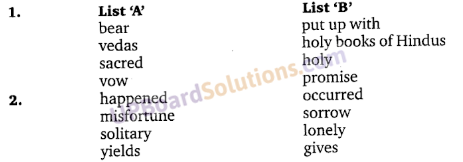
(a) Match the words in List ‘A’ with their meanings in List ‘B’ :
UP Board Solutions for Class 10 English Prose Chapter 1 The Enchanted Pool (C. Rajagopalachari)
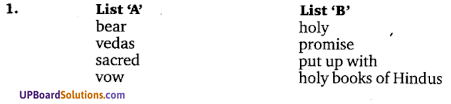
Answer:

UP Board Solutions for Class 10 English Prose Chapter 1 The Enchanted Pool (C. Rajagopalachari)

UP Board Solutions
(b) Fill in the blanks of the following sentences a suitable word selected from the list given
below :

guessed, proud, swifter than, preferred, contained
Answer:

  1. The pool contained clear water.
  2. Yudhishthira preferred Nakula to his other brothers.
  3. When the Yaksha warned Yudhishthira, the latter guessed what had happened to his brothers.
  4. A man who is proud of himself, of his position and wealth is not loved by anybody.
  5. Mind is swifter than the wind.

(c) Fill in the blanks of the following sentences using a suitable phrase selected from the list given
below :
a piece of grassland, feeling of uncertainty and fear, made aware of the danger, calling for punishment, without movement or sound
Answer:
1. When Yudhishthira’s brothers did not return, he was filled with a feeling of uncertainty and fear.
2. His brothers had become a victim to the Yaksha’s words calling for punishment.
3. The pool was surrounded by (UPBoardSolutions.com) a piece of grassland.
4. He saw his brothers lying without movement or sound near the pool.
5. His brothers had been made aware of the danger by the Yaksha.

UP Board Solutions

(d) Use the following phrases in your own sentences :
keep on, wander about, look for, just when, none other than
Answer:

  1. The patient kept on crying of pain whole the night. “
  2. Why are you wandering about in this locality ?
  3. I am looking for my lost mobile.
  4. He reached home just when it started raining heavily.
  5. The person who talked on (UPBoardSolutions.com) phone last night can be none other than your friend.

Hope given UP Board Solutions for Class 10 English Prose Chapter 1 are helpful to complete your homework.

If you have any doubts, please comment below. UP Board Solutions try to provide online tutoring for you.

UP Board Class 9th English Chapter 3 Question Answer The Seven Ages of Man (William Shakespeare).

Class 9 English Poetry Chapter 3 Questions and Answers UP Board The Seven Ages of Man (William Shakespeare).

कक्षा 9 अंग्रेजी पाठ 3 प्रश्न उत्तर

Read the following stanzas given below and answer the questions that follow each :
नीचे दिये हुए निम्नलिखित पद्यांशों को पढ़िये और नीचे दिये हुए प्रश्नों के उत्तर दीजिए—
1. All the World’s a stage,
And all the men and women merely players,
They have their exits and their entrances
And one man in his time plays muny parts,
His acts being seven ages.
Questions.
(i) Why does the poet call this world a huge theatre?
इस संसार को कवि ने क्यों विशाल नाट्यशाला कही है?
(ii) Why do the poet call men and women merely players?
कवि ने पुरुषों एवं महिलाओं को मात्र केवल पात्रे क्यों कहा?
(iii) Identify the figure of speech, ‘All the world’s a stage’.
संसार (दुनिया) एक रंगमंच है में से figure of speech को पहचानिए।
(iv) Name all the stages mentioned here.
यहाँ उल्लेखित सभी चरणों का वर्णन कीजिए
Answers.
(i) Poet call this world huge theatre because men and women who are born in this world
play different roles assigned to them by destiny and God is the spectator of this drama performed by them.
कवि ने इस संसार (दुनिया) को एक विशाल रंगमंच कहा क्योंकि महिलाएं और पुरुष जिन्होंने इस संसार (दुनिया)
में जन्म लिया है वह अपने भाग्य द्वारा मिली भूमिकाओं का निर्वाह करते हैं। उनके द्वारा दर्शित नाट्य को ईश्वर देखता है।
(ii)The poet calls men and women merely players because they do not choose their roles
themselves. They are merely puppets in the hands of God. Their roles are allotted to
them and they can not oppose their roles.
कवि के अनुसार महिलाएं एवं पुरुष केवल पात्र है क्योंकि वह स्वयं अपनी भूमिकाओं का चयन नहीं करते वह
केवल ईश्वर के हाथ की कठपुतली है। जो भूमिकाएँ (कार्य की) निर्वाह करने को दी जाती है वह उसका विरोध
नहीं कर सकते हैं। उनकी भूमिका पूर्व निर्धारित है वे केवल अभिनेत्री व अभिनेता हैं।
(iii) Figure of speech ‘metaphor’.
figure of speech ‘रूपक अलंकार है।
(iv)The poet has mentioned seven (UPBoardSolutions.com) stages-infant, school-going boy, lover, soldier, judge, the
man of age and the dotage of old age.
कवि के अनुसार सात चरण हैं-शैशवावस्था, स्कूली छात्र, प्रेमावस्था, सैनिक एवं न्यायाधीश अन्ततः वृद्धावस्था।

UP Board Solutions

2. At first the infant,
Mewling and puking in the nurse’s arms
And then,the whinning school boy with his satchel
And shining morning face, creaking like snail
Unwillingly to school. And then the lover,
Sighing like a furnace; with woeful ballad
Made to his mistress eyebrow.
Questions.
(i) What are the activities of a sucking baby?
चूषक शिशु के क्रियाकलाप क्या होते हैं?
(ii) Why does a child not what to go to school?
बच्चा स्कूल (विद्यालय) क्यों नहीं जाना चाहता है?
(iii) How does a child go to school?
बच्चा स्कूल (विद्यालय) कैसे जाता है?
(iv) When does a lover feel dejected?
एक प्रेमी अपने को निरुत्साहित कब अनुभव करता है?
Answers:
(i) A sucking-baby weeps, cries, sobs and vomits. It plays in nurse’s arms.
चूषक शिशु रोता, चिल्लाता, सिसकियाँ भरता तथा उल्टी करता है। वह परिचारिका के बांहों में खेलता है।
(ii) A child wants to play more and more, so he/she shows his/her unwillingness to go to
school.
एक बच्चा ज्यादा-ज्यादा खेलना पसन्द करता है इसलिए वह स्कूल जाने में अपनी अनिच्छा दिखाता है।
(iii) While going to school, a child is dressed very well. His face shows brightness. He bears
the burden of bag on his shoulder and goes to school with slow steps.
स्कूल जाते समय, बच्चा अच्छी तरह सज्जित होता है। उसके चेहरे पर चमक दिखाई देती है, अपने कंधों पर अपने
बस्ते का बोझ उठाता है और धीरे-धीरे (UPBoardSolutions.com) कदमों से स्कूल जाता है।
(iv) A lover feels dejected when his beloved shows indifferent attitude for him.
जब एक प्रेमिका अपने प्रेमी के प्रति उदासीनता दर्शाती है, तब प्रेमी अपने को हतोत्साहित अनुभव करता है।

3. Then a soldier,
Full of strange oaths and bearded like the par
Jealous in honour, sudden and quick in quarrel
Seeking the bubble reputation
Even in the Cannon’s mouth,
Questions.
(i) Why does a soldier take strange oaths?
सिपाही (सैनिक) विचित्र शपथ क्यों लेता है?
(ii) What is the appearance of a soldier?
सैनिक की छवि पर प्रकाश डालिए या सैनिक की छवि कैसी होती है?
(iii) Which thing is very dear to the soldier?
किसी सैनिक को क्या चीज बहुत पसन्द है।
(iv) What is the chief aim of soldier’s life?
सैनिक के जीवन का मुख्य उद्देश्य क्या है?
Answers:
(i) While accepting the commission in Army, a soldier takes many oaths indifferent languages.
He swears to show the feelings of patriotism, honour and dedication for his nation.He
swears that he would defend his country at the cost of his life.
जब किसी सैनिक की सेना में नियुक्ति होती है तो सैनिक भिन्न-भिन्न भाषाओं में कई शपथ लेता है। वह देश
के प्रति देशभक्ति, गौरव और समर्पण की भावनाओं की शपथ लेता है, और शपथ लेता है कि अपने जीवन का
बलिदान देकर भी देश की रक्षा करूंगा।
(ii) A Soldier, due to remaining far from his house for a long time, has a rough and shabby
appearance. He keeps dense and rough beard and moustache.
एक लम्बे समय तक अपने घर से दूर रहने के कारण एक सैनिक की छवि रूखी व जीर्ण-शीर्ण दिखाई देती है।
वह रूखी दाढ़ी व घनी मूंछ रखता है।
(iii) A Soldier is very fond of (UPBoardSolutions.com) his honour. He is always ready to defend it. Whenever it comes
to his notice that his honour is being attacked or even fingered at in the least, he becomes
ready to pick up a quarrel.
सैनिक हमेशा अपने गौरव व सम्मान को बचाए रखना चाहता है। किसी भी स्थिति में उसकी रक्षा के लिए समर्पित रहता है
वह अपने देश की रक्षा के लिए लेश-मात्र संकट को सहन नहीं करता। उसको संकट की सूचना प्राप्त
होते ही वह युद्ध के लिए तैयार हो जाता है।
(iv) The chief aim of soldier’s life is to gain name and fame which, very short-lived, is all in all
to him and for which he is ever ready to risk his life.
सैनिक का मुख्य उद्देश्य है कि वह कम समय में नाम एवं ख्याति प्राप्त करना चाहता है। उसके प्रति अपने जीवन
को संकट में डालने के लिए भी हमेशा तत्पर रहता है। वही उसके जीवन का मुख्य लक्ष्य है।

4. And then, the Justice,
In fair round belly with good copon lined,
With eyes severe, and beard of formal cut
Full of wise saws, and modern instances;
And so he plays his part.
Questions.
(i) What sort of life does a judge likes to lead?
जज किस प्रकार का जीवन-यापन पसन्द करते हैं?
(ii) Why does a judge wear the expression of harshness?
जज (न्यायाधीश) क्यों निष्ठुरता के भाव अभिव्यक्त करते हैं?
(iii) What sort of beard does the judge keep?
जज किस प्रकार की दाढ़ी रखते हैं?
(iv) How does a judge convince by his speech?
जज कैसे उसकी वाक्-क्षमता से प्रभावित हुए?
Answers:
(i) A judge is fond of leading a life luxurious and Comforts.
जज विलासी और आरामदायक जीवन-यापन पसन्द करते हैं।
(ii) A judge outwardly wears the expression of harshness and strictness because he tries to show himself an embodiment of discipline in order to impress everyone.
न्यायवेत्ता (जज) अनुशासन की मूर्त रूप से सभी को प्रभावित करना चाहते हैं इसलिए जज बाह्य रूप से कठोर एवं निष्ठुर दिखाई देते हैं।
(iii) A judge keeps beard which is neatly trimmed after conventional pattern.
न्यायवेत्ता पारम्परिक स्वरूप में चलन के अनुसार कटी हुई दाढ़ी रखते हैं।
(iv) By using many wise maxims and common place illustrations, in his speech, a judge convinces.
न्यायवेत्ता विद्वतापूर्ण नीतियों द्वारा जन साधारण स्थानों पर दृष्टांत देकर अपनी वाक्क्षमता से प्रभावित करते हैं।

UP Board Solutions

5. The sirth age shifts
Into the lean and slipper’d pantaloon,
With spectacles on nose and pouch on side;
His youthful hose, well saved, a world too wide
For his shrunk shank and his big manly voice,
Turning again towards childish treble pipes
And whistles in his sound. Last scene of all,
That ends this strange eventful history,
Is second childishness and mere oblivion
Sans teeth, sans eyes; sans taste, sans everything.
Questions.
(i) What happens with a man of age in the sixth stage?
छठे चरण में व्यक्ति के साथ क्या होता है?
(ii) How does a man look like in the sixth stage?
छठे चरण में व्यक्ति किस प्रकार दिखने लगता है?
(iii) How does the voice of the old man change?
वृद्ध व्यक्ति की आवाज में किस प्रकार परिवर्तन आता है?
(iv) Why is the last stage called the second childhood?
अंतिम चरण को दूसरा बचपन क्यों कहा गया है?
Answers:
(i) In the sixth stage, man loses all his charms of his youth. He becomes lean and thin. His eyesight grows weak and he cannot see properly. He loses all his strength of youth. His manly voice also changes. His hands and fingers tremble while doing some work. His legs cannot endure the burden of the body. In this way he becomes invalid in every way.
छठे चरण में व्यक्ति अपने युवावस्था के आकर्षण को खो देता है। वह पतला-दुबला बन जाता है।उसकी आँखों की रोशनी कम हो जाती है और वह ठीक तरह से नहीं देख पाता। वह अपनी युवावस्था की शक्ति को खो देता है। उसकी पुरुषोचित आवाज भी बदल जाती है। उसके हाथ और (UPBoardSolutions.com) उंगलियाँ कोई भी काम करने में काँपने लगती हैं। उसके पैर उसके शरीर का भार (बोझ) उठाने में असमर्थ हो जाते हैं। इसलिए वह हर प्रकार से अक्षम हो जाता है।
(ii) In the sixth stage, the man of age becomes a lean comic figure because he wears slippers, spectacles and a pouch (bag).
छठे चरण में व्यक्ति हास्य का पात्र बन के रह जाता है क्योंकि वह चप्पल, चश्में पहनता है और झोला लेकर चलता है।
(iii) His once such loud manly voice now shrink into the shrill voice of a child, having mumbling and squeaking sounds.
किसी समय की उसकी बुलंद पुरुषोचित आवाज़ सिकुड़कर,एक बच्चे की मिमियाहट में बदल जाती है। हर वक्त अस्पष्ट बोलने लग जाता है।
(iv) The last stage is also called second childhood because all the memory of the past is lost
and all the senses decay and the man then becomes almost nothing-without teeth, without eyes and without taste.
अंतिम चरण को दूसरा बचपन इसलिए कहते हैं क्योंकि वह गुजरे हुऐ वक्त (अतीत) की यादें खो जाती हैं। और उसकी इंद्रियाँ क्षीण हो जाती हैं। बिना दांत, आँख एवं स्वाद वाला व्यक्ति नश्वर हो जाता है।

(A)  SOLVED QUESTION OF TEXT BOOK
Answer the following questions :
निम्नलिखित प्रश्नों के उत्तर दीजिएः 
Question 1.
Explain the difference poet makes between the performance made by actors at normal stage and worldly stage?
किसी अभिनेता द्वारा साधारण रंगमंच और सांसारिक रंगमंच में किये गये प्रदर्शन में, कवि ने क्या भिन्नता दर्शायी है?
Answer:
Poet has describe this world to a stage. But there is a difference. In the ordinary stage (drama), an actor plays one role but here in life stage (drama) he has to play many roles. These are described in seven stages.
कवि ने संसार को एक रंगमंच के रूप में दर्शाया है। साधारण रंगमंच में अभिनेता द्वारा एक ही भूमिका का दर्शन है परन्तु सांसारिक रंगमंच में अभिनेता को बहुत सी भूमिकाओं का दर्शन होता है जिसको की सात चरणों में वर्णित किया है।

UP Board Solutions

Question 2.
What is the second stage played by man?
आदमी दूसरे चरण में क्या भूमिका अदा करता है?
Answer:
In the second stage, he (man) is in the role of the mischievous and unwilling school-boy who goes to school, with his bag, creeping (UPBoardSolutions.com) slowly and reluctantly.
दूसरे चरण में आदमी द्वारा अदा की गई भूमिकाओं का वर्णन है। इस भूमिका में वह शरारती और अनिच्छा से स्कूल जाने लायक हो जाता है वह रोता हुआ अपने बस्ते के साथ स्कूल जाने में आनाकानी करता है।

Question 3.
How does a lover tempts his mistress? ।
कैसे एक प्रेमी अपनी प्रेमिका को लुभाता ( आकर्षित करता ) है?
Answer:
He (lover) plays a role of a youthful lover passionately sighing deep as the blast of furnace and composes tragic verses to the eye of his beloved.
एक प्रेमी-एक प्रेमिका की याद में अनुराग पूर्वक सुलगता हुआ उसके बारे में सोचता है। उसी की याद में भट्टी की तरह गर्म आहें भरता है और उसकी (प्रेमिका) की याद में दुःख भरे गीत लिखता है।

Question 4.
For what do the words ‘good copon lined’ stand? Good copon lines (fattened cocks received as presents).
शब्द का अर्थ बताइए।
Answer:
In words ‘good copon lines’ some crities have read an allusion to the prevalence of Corruption in Elizabethan times. The custom of offering chicken to the magistrates as a tip was common.
उसे एक न्यायवेत्ता के रूप में देखा जा सकता है। एक खाता-पीता, धनवान, मोटा और पैनी दृष्टि वाला पुरुष हमेशा दूसरों को नसीहत देता है और अपनी बुद्धिमता का प्रदर्शन करना चाहता है। उसकी आँखों में गम्भीरता भी है।

(B) APPRECIATING THE POEM

Question 1.
Write down the central idea of the poem.
कविता का केन्द्रीय भाव लिखिए।
Answer:
This world may be compared to a stage and men and women to the actors who have to play their parts in drama. Jaques’ speech about the seven stages of a man’s life is too famous to require any mention here. The world to him is a stage nothing more. Men and women are merely players with their exits and their entrances mechanically regulated movement in anephemeral pageant. The life of a man, as he pictures it, reproduces the condition of the imaginary state of nature. The dramatic function of this maxim is that it serves as a cue for Jaques to launch into his great set piece ‘All the World’s a Stage’ exactly as a casual line can (UPBoardSolutions.com) be cue for a song in a musical comedy. Ingeniously Jaques lines one great common place-the world as a theatre, life as a play with another notion familiar to historians of ideas, the Seven Ages of Man. Man at each stage is anatomised. So we can divide the drama of a man’s life in seven Acts. The come on and go off the stage in his life-time everyman plays different parts.

Question 2.
Name the poet of the poem.
कविता के रचयिता का नाम लिखें।
Answer:
The name of the poet of the poem is William Shakespeare.
कविता के रचिता का नाम William Shakespeare है।

UP Board Solutions

Question 3.
Find out rhyming words in the poem.
इस कविता में तुकान्त शब्दों को बताइए।
Answer:
men-women,
whining-morning,
face-furnace,
side-wide, all rhymes with each other.


The Magic Show Class 6 English Chapter 3 Question Answer UP Board Solutions

UP Board Class 6th English Chapter 3 The Magic Show Questions and Answers

कक्षा 6 अंग्रेजी पाठ 3 के प्रश्न उत्तर

These Solutions are part of UP Board Solutions for Class 6 English. Here we have given UP Board Solutions for Class 6 English Chapter 3 The Magic Show.

The Magic Show

TRANSLATION OF THE LESSON (पाठ का हिन्दी अनुवाद)

Karishma is a………………………………………………………………………….. magic tricks.
हिन्दी अनुवाद – करिश्मा एक छोटी, सुंदर गाँव की लड़की है। वह अपने दादा-दादी के साथ ढोलकपुर नाम के गाँव में रहती है। वह अपनी दादी से बहुत प्यार करती है। एक बार, उसकी प्यारी दादी उसे पास के शहर गाज़ीपुर ले जाती है, जादू का शो देखने।।

(वे हॉल में घुसते हैं।)

करिश्मा : वाह, कितना रंगीन हॉल है ये!
दादी : हाँ, हॉल बहुत बड़ा है और चटकीले रंगों से सजा हुआ है।
करिश्मा : मैं जादू देखने के लिए बहुत उत्साहित हूँ।
दादी : मैं भी।
कृरिश्मा : हे भगवान! उन्होंने बत्तियाँ बन्द कर दीं। मैं देख नहीं पा रही। चारों तरफ अंधेरा है।
दादी : चुप रहो और मंच पर देखो। एक धीमी रोशनी है वहाँ (गणेश वंदना से शो शुरू होता है।)
करिश्मा : दादी देखो, कितने सुंदर कपड़ों में हैं वो।
दादी : हाँ प्रिय। (UPBoardSolutions.com)
करिश्मा : वह बीच में मोटा आदमी कौन है?
दादी : (आदमी की ओर इशारा करते) वो आदमी जो नीली पोशाक पहने है और हाथ में जादू की छड़ी लिए है?
करिश्मा : हाँ दादी ।। दादी : वह जादूगर है। वह जादू के करतब करता है।

(The magician ……………………………………………………….is a magician.)
(हिन्दी अनुवाद – (जादूगर जादू का एक खाली बॉक्स दर्शकों को दिखाता है और कुछ मंत्र बोलता है। लाल, गुलाबी, हरे, पीले, नारंगी रंग के साटन के रिबन और विभिन्न फूलों की पंखुड़ियाँ उसमें से निकलने लगती है।)
करिश्मा : कितना अद्भुत है ये।
दादी : हाँ है तो

UP Board Solutions

(जादूगर करिश्मा को मंच पर बुलाता है और उससे दस रुपये का सिक्का लेता है। वो अपना हाथ बंद करता है, और कुछ मंत्र कहता है। सिक्का गायब हो जाता है।)
करिश्मा : मेरा सिक्का कहाँ है|
जादूगर : (हँसते हुए) कौनसा सिक्का|
करिश्मा : जो मैंने आपको दिया था।
जादूगर : नहीं, तुमने मुझे कोई सिक्का नहीं दिया है। अपनी जेब में ढूंढो।

(आश्चर्यजनक रूप से, उसे सिक्का अपनी जेब (UPBoardSolutions.com) में मिल जाता है। सभी तालिया बजाते हैं। एक के बाद एक, जादूगर कई करतब दिखाता है। लोग मंत्रमुग्ध हो जाते हैं।)
करिश्मा : दादी, कितने अच्छे से वह ये करता है!
दादी : हाँ, तबी तो वो जादूगर है!

EXERCISE (अभ्यास)

Comprehension Questions

Question 1.
Answer the following questions :
Answer:
Question a.
Why did Karishma’s granny take her to the city?
Answer:
Krishma’s granny took her to the city Ghazipur to show her a magic show.

UP Board Solutions

Question b.
How was the magician dressed up?
Answer:
The magician was wearing a blue dress and had a magic stick in his hand.

Question c.
What came out of the empty magic box?
Answer:
Red, pink, green, yellow and orange coloured satin ribbons and petals of different flowers came out of the empty magic box.

Question d.
Who did the magician call to the stage?
Answer:
The magician called Karishma to the stage.

UP Board Solutions

Question e.
Which trick did you like the most and why?
Answer:
The trick I like the most was when the magician made the coin disappear and it turned out to be back in Karishma’s pocket. I liked it the most because it was an unbelievable and hair-raising magic trick.

Word Power

Question 1.
Fill in the blanks with the words given in the box:
UP Board Solutions for Class 6 English Chapter 3 The Magic Show img-1
Answer:

  1. The children left the audience spellbound with their outstanding performance.
  2. My grandmother lives in a village.
  3. There was a magician in my friend’s birthday party.
  4. There are many colourful flowers in the garden.

Language Practice

Question 1.
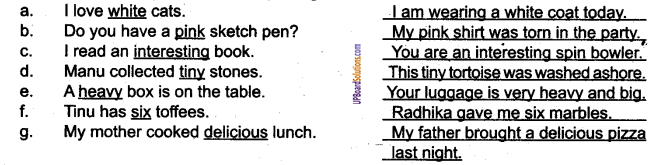
Underline the adjectives in the given sentences and frame sentences of your own with the same adjective in the space given below :
Answer:
UP Board Solutions for Class 6 English Chapter 3 The Magic Show img-2

Activity

UP Board Solutions

Question 1.
Magic Trick
STEP-1 : Think of a number
STEP-2 : Multiply it by 3
STEP-3 : Add 6
STEP-4 : Divide it by3
STEP-5 : Subtract the number chosen in STEP-1 from your answer in STEP-4
Answer:
2

We hope the UP Board Solutions for Class 6 English Chapter 3 The Magic Show help you. If you have any query regarding UP Board Solutions for Class 6 English Chapter 3 The Magic Show, drop a comment below and we will get back to you at the earliest.

UP Board Class 9th English Supplementary Chapter 3 Question Answer Letter to the Children of India (Chacha Nehru).

Class 9 English Supplementary Reader Chapter 3 Questions and Answers UP Board Letter to the Children of India (Chacha Nehru).

कक्षा 9 अंग्रेजी पाठ 3 प्रश्न उत्तर

These Solutions are part of UP Board Solutions for Class 9 English. Here we have given UP Board Solutions for Class 9 English Suplementary Reader Chapter 3 Letter to the Children of India (Chacha Nehru).

(A) SHORT ANSWER TYPE QUESTIONS AND THEIR ANSWERS
Answer the following questions in not more than 25 words each :

Question 1.
What does Pandit Nehru like to do with children?
पं० नेहरू बच्चों के साथ क्या करना पसन्द करते हैं?
Answer:
Pandit Nehru likes being with children and talking to them and even more playing with them.
पं० नेहरू बच्चों के साथ रहना, उनसे बातें करना तथा इससे भी अधिक उनके साथ खेलना पसन्द करते हैं।

UP Board Solutions

Question 2.
Why does Pandit Nehru like being with children?
पं० नेहरू बच्चों के साथ रहना क्यों पसन्द करते हैं?
Answer:
Pandit Nehru likes being with children because for a moment he forgets that he is terribly old among them.
पं० नेहरू बच्चों के साथ रहना इसलिए पसन्द करते हैं (UPBoardSolutions.com) क्योंकि क्षण भर के लिए वे भूल जाते हैं कि वे उनके बीच में अत्यधिक बूढ़े है।

Question 3.
“The world itself is the greatest fairy tale.” What does the word ‘fairy tale’ mean here?
विश्व स्वयं ही सबसे अधिक सुन्दर परियों की कहानी है।’ यहाँ पर परियों की कहानी शब्द का क्या तात्पर्य है?
Answer:
The word ‘fairy tale’ means on account of strange incidents and stories about fairies here.
परियों की कहानी का तात्पर्य परियों के बारे में विचित्र घटनाओं और कहानियों से है।।

Question 4.
How can we make friends with the objects of nature?
हम प्रकृति की वस्तुओं के साथ किस प्रकार मित्रता कर सकते हैं?
Answer:
If we go to the objects of nature affectionately and with friendship, we can make them friends.
यदि हम प्रकृति की वस्तुओं के पास प्रेमपूर्वक एवं मित्रतापूर्वक जायें तो हम उनसे मित्रता कर सकते हैं।

Question 5.
That was much more interesting than many of my talks with the grown ups. What does the word ‘that here refer to?
व्यस्क व्यक्तियों के साथ मेरी बातों की अपेक्षा वह कहीं अधिक रुचिकर था। यहाँ पर वह शब्द क्या सन्दर्भित करता हैं?
Answer:
Pandit Nehru found the children in America, Canada and England very like the children of India. So he made friends and played with them a little. The word ‘that’ refers to the playing with the children of those countries.
पं० नेहरू ने अमेरिका, कनाडा और इंग्लैण्ड में बच्चों को भारत के बच्चों की ही तरह पाया। इसलिए उन्होंने उनके साथ मित्रता की और थोड़ा सा खेले भी। वह शब्द उन (UPBoardSolutions.com) देशों के बच्चों के साथ खेल को सन्दर्भित करता है।

Question 6.
In the sentence ‘I found the children there very like the children here’. Which place do there’ and ‘here’ refer to?
मैंने वहाँ पर बच्चों को यहाँ के बच्चों जैसा पाया।” वाक्य में वहाँ और यहाँ किस स्थान को सन्दर्भित करते हैं?
Answer:
The word ‘there’ refers to the countries of United States of America, Canada and England and ‘here’ stands for India.
‘वहाँ’ शब्द संयुक्त राज्य अमेरिका, कनाडा और इंग्लैण्ड देशों को सन्दर्भित करता है तथा यहाँ’ शब्द भारत के लिए

Question 7.
What do the grown ups imagine about themselves? What is its result?
व्यस्क लोग अपने विषय में क्या कल्पना करते हैं? इसका परिणाम क्या होता है?
Answer:
The grown ups imagine about themselves that they are different from the people of other countries. Its result is that they deliberately make themselves different from others.
वयस्क लोग अपने विषय में कल्पना करते है कि वे दूसरे देशों के लोगों से भिन्न है। इसका परिणाम यह है कि वे जान-बूझकर अपने को दूसरों से भिन्न बना लेते हैं।

Question 8.
What did the children of Japan ask Pandit Nehru to send them?
जापान के बच्चों ने पं० नेहरू से अपने लिए क्या भेजने को कहा?
Answer:
The children of Japan asked Pandit Nehru to send them an elephant.
जापान के बच्चों ने पं० नेहरू से अपने लिए एक हाथी भेजने को कहा।

UP Board Solutions

Question 9.
Where did the elephant come from? How was the elephant sent to Japan?
हाथी कहाँ से आया था? हाथी को जापान किस प्रकार भेजा गया?
Answer:
The elephant came from Mysore and it was sent to Japan by sea.
हाथी मैसूर से आया था तथा इसे समुद्री मार्ग से जापान भेजा गया।

Question 10.
How are children all over the world outwardly different and yet so very like one another?
पूरे विश्व में बच्चे बाह्य रूप से भिन्न तथा फिर भी एक दूसरे से बहुत समान किस प्रकार हैं?
Answer:
Children all over the world outwardly are different as they speak different languages andwear different kinds of clothes. But they are very like one another as they play and quarrel like.
सम्पूर्ण विश्व में बच्चे बाह्य रूप से भिन्न हैं क्योंकि वे भिन्न-भिन्न भाषाएँ बोलते हैं और विभिन्न प्रकार के वस्त्र पहनते हैं किन्तु वे एक दूसरे के बहुत समान हैं क्योंकि वे समान (UPBoardSolutions.com) रूप से खेलते और झगड़ा करते हैं।

Question 11.
Where does Pandit Nehru wish to go with young children?
पं० नेहरू छोटे बच्चों के साथ कहाँ जाना चाहते हैं?
Answer:
Pandit Nehru likes to go to all the nooks and corners of India with young children.
पं० नेहरू छोटे बच्चों के साथ भारत के कोने-कोने में जाना चाहते हैं।

Question 12.
What are the two simple truths that Pandit Nehru talks about in the letter?
वे दो साधारण सत्य क्या हैं जिनके विषय में पं० नेहरू अपने पत्र में बताते हैं?

Answer:
According to Pandit Nehru, there are two suple truths that Nehru talks about in the letter :
(i) If we meet other people in friendly way, they also become friendly.
(ii) If we show our dislike to them, they behave in the same manner.
पं० नेहरू के अनुसार दो साधारण (UPBoardSolutions.com) सत्य जिनके विषय में वे अपने पत्र में बताते हैं, हैं—
(i) यदि हम दूसरे लोगों से मित्रवत् मिलें तो वे भी मित्रवत् हो जाते हैं।
(ii) यदि हम उनके प्रति घृणा प्रदर्शित करते हैं तो वे भी उसी ढंग से व्यवहार करते हैं।

Question 13.
What is sometimes the attitude of the people of one country towards the people of other countries?
कभी-कभी एक देश के लोगों की दृष्टिकोण दूसरे देशों के लोगों के प्रति किस प्रकार का होता है?
Answer:
Sometimes the attitude of the people of one country towards people of other countries is hateful and learful.
कभी-कभी एक देश के लोगों का दृष्टिकोण दूसरे देशों के लोगों के प्रति घृणा एवं भययुक्त होता है।

UP Board Solutions

(B) MULTIPLE CHOICE QUESTIONS
Select the most suitable alternative to complete each of the following statements :
निम्नलिखित कथनों में से प्रत्येक को पूरा करने के लिए सबसे उपयुक्त विकल्प चुनिये—-

(i) Pandit Nehru found the children of U.S.A., Canada and England :
(a) better than the children of India
(b) quite different from the children of India
(c) very like the children of India
(d) worse than the children of India
(ii) Pandit Nehru wanted to go with young children to :
(a) big factories of India
(b) mountains, forests and big rivers of India
(c) great cities of India
(d) big towns of India
Answers:
(i) (c) very like the children of India
(ii) (b) mountains, forests and big rivers of India

(C) Say whether each of the following statements is ‘true’ or ‘false’:
बताइये कि निम्नलिखित कथनों में से प्रत्येक ‘सत्य’ है अथवा ‘असत्य’—
(i) Pandit Nehru loved to talk to children and play with them.
(ii) The children of Japan wrote to Pandit Nehru to send a Bengal tiger.
(iii)Children of different countries are quite different.
(iv) People of one country hate the people of another country because they are afraid of them.
(v) Children should be wiser.
Answers:
(i) T, (ii) F, (iii) F, (iv) T, (v)T.

UP Board Solutions

(D)Look up each of the following words in the dictionary and pick out the meaning in which it is used in the text :
निम्नलिखित शब्दों में से प्रत्येक को शब्दकोश में खोजिए और उनका अर्थ उस प्रसंग में बताइये जिसमें उनका प्रयोग इस पाठ में  हुआ हैं—
moment; surround; deliberately, visit; vast; discover
Answers:
moment                                             a very brief period of time
surround                                            shut in on all sides (चारों ओर से घिरा हुआ)
deliberately                                       intentionally (जानबूझकर)
visit                                                     see (देखना)
visit                                                     huge (विशाल)
discover                                             search (खोजना)

UP Board Class 9th English Chapter 2 Question Answer Kabuliwallah [R.N. Tagore].

Class 9 English Prose Chapter 2 Questions and Answers UP Board Kabuliwallah [R.N. Tagore].

कक्षा 9 अंग्रेजी पाठ 2 प्रश्न उत्तर

These Solutions are part of UP Board Solutions for Class 9 English. Here we have given UP Board Solutions for Class 9 English Prose Chapter 2 (Kabuliwallah) [R.N. Tagore].

(A) PASSAGES FOR COMPREHENSION

Read the following passages and answers the questions given below :
(निम्नलिखित गद्यांशों को पढ़िए और दिये गये प्रश्नों के उत्तर दीजिए)

(a) My five years old daughter Mini cannot live without chattering. I really believe that in all her life she has not wasted a minute in silence. Her mother is often vexed at this, and would stop her prattle, but I would not. To see Mini quiet is unnatural, and I cannot bear it long. So my own talk with her is always lively.
One morning, for instance, when I was in the midst of the seventeenth chapter of my new novel, my little Mini stole into the room, and putting her hand into mine, said, “Father! Ramdayal, the (doorkeeper, calls a Crow know ! He doesn’t know (UPBoardSolutions.com) anything, does he?” Before I could explain to her the differences of language in this world, she was embarked on the full tide of another subject. “What do you think, Father? Bhola says there is an elephant in the clouds. blowing water out of his trunk, and that is why it rains!”

Questions.
1. Write the name of the lesson from which the above passage has been taken.
(उस पाठ का नाम लिखिए जिससे उपरोक्त गद्यांश लिया गया है।)
2. What was troublesome issue of Mini’s mother?
( मिनी की माँ के लिऐ कष्टप्रद विषय क्या था?)
3. What happened when he was hard at his work of the seventeenth chapter of his novel?
(क्या हुआ जब वह अपने उपन्यास के सत्रहवें अध्याय में तल्लीन था?)
4. Who said and what happens when an elephant blowing water out of his trunk?
(किसने कहा और क्या होता है जब हाथी सूंड से पानी फेंकता है?)
5. Find words from the extract which means.
(a) Talkative (b) Cheerful
दिए गए उद्धरण में से शब्दों का अर्थ बताइए।
(a) बातूनी
(b) प्रसन्नचित
Answers:
1. The name of the lesson is “Kabuliwallah”
(पाठ का नाम काबुलीवाला है।)
2. The troublesome issue of Mini’s mother was that she (Mini) was very talkative and never keeps silence for a minute.
(मिनी की माँ का कष्टप्रद विषय यह था कि वह (मिनी) बहुत बातूनी थी और एक पल भी शांत नहीं रहती थी।)
3. When Mini’s father was busy doing the seventeenth chapter of his novel, Mini ran into his room and started asking some irrational questions.
(जब मिनी के पिता अपनी किताब के सत्रहवें (UPBoardSolutions.com) अध्याय को पूरा करने में व्यस्त थे तब मिनी उनके कमरे में दौड़कर आती है और अविवेकी प्रश्न पूछने लगी।)
4. Bhola said, there is an elephant in the clouds blowing water out of his trunks that is why it rains.
(भोला कह रहा था कि आकाश में हाथी सूंड से पानी डालता है उसी से वर्षा होती है।)
5. (a) Chatty (b) Lively
(a) बातूनी (b) प्रसन्नचित्त

UP Board Solutions

(b) The window of my room overlooks the road. The child had seated herself at my feet near my table, and was playing softly, drumming on her knees. I was hard at work on my seventeenth chapter, where Pratap Singh, the hero, had just caught Kanchanlata, the heroine, in his arms, and was about to escape with her by the third (UPBoardSolutions.com) storey window of the castle, when all of a sudden Mini left her play, and ran to the window, crying, “A Kabuliwallah! a Kabuliwallah!” Sure enough in the street below was a Kabuliwallah, passing slowly along. He wore the loose soiled clothing of his people, with a tall turban; there was a bag on his back, and he carried boxes of grapes in his hand.

Questions.
1. Name the author of the lesson from which the above passage has been taken?
(जिस पाठ से उपरोक्त गद्यांश लिया गया है उसके लेखक का नाम लिखें।)
2. Who were going to elope from the third storey window of the castle in the seventeenth chapter of the novel?
(उपन्यास के सत्रहवें अध्याय में हवेली की तीसरी मंजिल से कौन भागने वाला था?)
3. Why suddenly Mini ran to the window?
(मिनी अचानक खिड़की की ओर क्यों भागी?)
4. Who was Kabuliwallah?
(काबुलीवाला कौन था?)
5. Which words from the above passage means as :
(a) Country (b) Shouting
(उपरोक्त गद्यांश में निम्नलिखित शब्दों का अर्थ होता है।)
(a) देश
(b) चिल्लाना
Answers:
1. The name of the author of the lesson is Rabindranath Tagore.
(पाठ के लेखक का नाम रवीन्द्रनाथ टैगोर है।)
2. The characters of the novel Pratap Singh and Kanchanlata were going to elope from the third storey window of the castle.
(उपन्यास के पात्र प्रताप सिंह और कंचनलता हवेली के तीसरे मंजिल से भागने वाले थे।)
3. Mini started shouting Kabuliwallah! Kabuliwallah! as she saw Kabuliwallah going, through a window ran towards it.
(मिनी काबुलीवाले को गुजरते देखकर चिल्लाते हुऐ खिड़की की ओर दौड़ी।)
4. Kabuliwallah was a dry-fruit seller from Kabul.
(काबुलीवाला काबुल का मेवा विक्रेता था।)
5. (a) Nation or native land
(b) Crying
(a) देश (b) चिल्लाना।

(c) One morning, however, not many days later, as I was Leaving the house, I was started to find Mini, seated on a bench near the door, laughing and talking, with the great Kabuliwallah at her feet. In all her life, it appeared; my small daughter had never found so patient a listener, save her father. And already the corner of her little sari was (UPBoardSolutions.com) stuffed with almonds and raisins, the gift of her visitor, “Why did you give her those?”, I said, and taking out an eight-anna bit, I handed it to him. The man accepted the money without demur, and slipped it into his pocket.

Questions.
1. Why Mini’s father was surprised and frightened to see Mini?
(मिनी के पिताजी मिनी को देखकर भयभीत और आश्चर्यचकित क्यों हुए?)
2. Who was calmly listening to Kabuliwallah?
(काबुलीवाला की बातों को शान्ति से कौन सुन रहा था?)
3. Who has filled the corners of little sari with almonds and raisins?
(किसने उसके (मिनी) छोटे से आँचल को बादाम और किशमिश से भर दिया?)
4. Who has received the money without sly? What was the amount?
(किसने बिना संकोच के पैसा प्राप्त किया? वह रकम क्या थी?)
5. Pickout the words from the above passage which means as the same.
(उपरोक्त गद्यांश से शब्दों को चुनिए जिसका अर्थ निम्न के समान हो।)
(a) Reserved
(b) Surprised
Answers:
1. Mini’s father was surprised because he saw that Mini was sitting on the bench near the door, talking and laughing greatly with Kabuliwallah.
(मिनी के पिता को आश्चर्य इसलिए हुआ कि उन्होंने देखा की मिनी दरवाजे के पास बेंच पर बैठकर काबुलीवाले से अनर्गल बातें कर रही है।)
2. Mini was listening calmly to Kabuliwallah.
(मिनी काबुलीवाले की बातों को धैर्य से सुन रही थी।)
3. Kabuliwallah has filled the corner of little sari of Mini with almonds and raisins.
(काबुलीवाले ने मिनी के छोटे आँचल को बादाम व किशमिश से भर दिया था।)
4. Kabuliwallah has accepted the money without hesitation and put it into his pocket.
(काबुलीवाले ने निसंकोच पैसा स्वीकार किया और उसे अपनी जेब में रख लिया।)
5. (a) Patient (b) Startled
(a) धैर्यवान
(b) चौंकाने वाला (वाली)

UP Board Solutions

(d) One morning, a few days before he had made up his mind to go, I was correcting my proof sheets in my study. It was chilly weather. Through the window the rays of the sun touched my feet, and the slight warmth was very welcome. It was almost eight o’clock, and the early pedestrians were returning home, with their heads covered. (UPBoardSolutions.com) All at once, I heard an uproar in the street, and, looking out, saw Rahmat being led away bound between two policemen, and behind them a crowd of curious boys. There were blood-stains on the clothes of the Kabuliwallah, and one of the policemen carried a knife.

Questions.
1. What sort of noise he heard in the lane?
(सड़क पर उसे किस तरह का हल्ला (शोर) सुनाई पड़ा?)
2. Who was arrested by the policemen?
(सिपाहियों ने किस व्यक्ति को गिरफ्तार किया था?)
3. Who stained the clothes of Kabuliwallah?
(काबुलीवाले के कपड़े पर किसके दाग थे?)
4. Write the meaning of these words from the passage.
(गद्यांश से लिए गये इन शब्दों का अर्थ लिखिए)
(a) Uproar
(b) Stains
Answers:
1. He saw that two policemen have arrested Rahmat and a crowd of curious boys were rushing behind them. This was the noise he heard in the lane.
(उसने देखा कि दो पुलिसवाले रहमत को गिरफ्तार किए थे और उत्तेजित लड़कों की भीड़ उसके पीछे दौड़ रही थी।)
2. Kabuliwallah (Rahmat) was arrested by the policemen.
(काबुलीवाले (रहमत) को पुलिसवालों ने गिरफ्तार किया था।)
3. This was the blood-stains on the clothes of the Kabuliwallah.
(काबुलीवाले के कपड़ों पर खून के दाग थे।)
4. (a) Noise (b) Spot
(a) शोर , कोलाहल
(b) दाग , धब्बे

(e) Years had passed ……… married tonight. Years had passed away. It was once more autumn and we had made arrangements for our Mini’s marriage. It was to take place during the Puja Holidays. With Durga returning to Kailas, the light of our home also was to depart to her husband’s house, and leave her father’s in the (UPBoardSolutions.com) shadow.
The morning was bright. After the rains, there was a sense of ablution in the air, and the sun-rays looked like pure gold. So bright were they that they gave a beautiful radiance even to the sordid brick walls of our Calcutta lanes. Since early dawn today the wedding-pipes had been sounding, and at each beat my own heart throbbed. The wail of the tune, Bhairavi, seemed to intensify my pain at the approaching separation. My Mini was to be married tonight.

Questions.
1. Whose marriage arrangements were made?
(किसके विवाह की तैयारियाँ चल रही थीं?)
2. When marriage ceremony of Mini will take place?
(मिनी के वैवाहिक-कार्यक्रम कब सम्पन्न होंगे?)
3. What was the feeling of the father during Mini’s marriage?
(मिनी के विवाह के समय उसके पिता के क्या भाव थे?)
4. Define the meaning of the words from the above passage.
(उपरोक्त गद्यांश से लिए गये शब्दों का अर्थ बताइये।)
(a) Separation (b) Shadow
Answers:
1. The arrangement of Mini’s marriage were being made.
(मिनी के विवाह की तैयारियाँ हो रही थीं।)
2. Marriage ceremony of Mini will take place during Puja Holidays.
(मिनी का वैवाहिक-कार्यक्रम पूजा की छुट्टियों में सम्पन्न होंगे।)
3. He was feeling of separation with his daughter, Mini. Mini who is the light of the house is now going to her husband’s house leaving her father in darkness and loneliness.
(उसके मन में अपनी बेटी से दूर होने के भाव उत्पन्न हो रहे थे। जो कि उसके घर-आँगन की चमक थी। वह अपने पिता की छत्र-छाया को छोड़कर अपने पति के घर जा रही थी।)
4. (a) Kept apart (b) Image
(a) आलग करना
(b) धाया (परछाई)

(f) “There are ceremonies going on,” I said, “and I am busy. Could you perhaps come another day?”
At once he turned to go; but as he reached the door he hesitated, and said, “May I not see the little one, sir, for a moment?” It was his belief that Mini was still the same. He had pictured her running to him as she used to, calling “O Kabuliwallah! Kabuliwallah!” He had imagined too that they would laugh and talk together, just as of old. In fact, in memory of former days he had brought, carefully wrapped up is paper, a few almonds and raisins and grapes, obtained somehow from a countryman, for his own little (UPBoardSolutions.com) fund was dispersed.
I said again, “There is a ceremony in the house, and you will not be able to see any one today.”
The man’s face fell. He looked wistfully at me for a moment, said “Good morning,” and went out. I felt a little sorry and would has called him back, but I found he was returning of his own accord. He came close up to me holding out his offerings and said, “I brought these few things, sir, for the little one. Will you give them to her?”

Questions.
1. Write the name of the lesson of the above passage. Who has authored?
(उस पाठ का नाम लिखिए जिससे उपरोक्त गद्यांश लिया गया है? इसका लेखक कौन है?)
2. Who was willing to see and to whom?
(कौन देखना चाहता था? और किसे?)
3. What picture of Mini Kabuliwallah has collected in his mind?
(मिनी की कैसी तस्वीर का काबुलीवाले ने अपने मस्तिष्क में चित्रण किया?)
4. What were few things, Kabuliwallah has brought for little one?
(वह क्या चीजें थीं जो काबुलीवाला छोटी बच्ची के लिऐ लेकर आया?)
5. Choose the words from the above passage which means the same as below :
(उपरोक्त गद्यांश से शब्दों को चुनिये जिनको अर्थ निम्न के समान हो)
(a) Wedding
(b) Sadly
Answers:
1. The name of the lesson is Kabuliwallah and the author is R.N. Tagore.
(पाठ का नाम ‘काबुलीवाला’ तथा लेखक का नाम ‘रवीन्द्रनाथ टैगोर है।)
2. Kabuliwallah wants to see to Mini.
(काबुलीवाला मिनी को देखना चाहता था।)
3. He seemed to believe that Mini was still the same little girl and should come running to him, calling A Kabuliwallah! Kabuliwallah!
(कदाचित् उसे विश्वास था कि मिनी अब भी पहले की भांति होगी और उसे ‘काबुलावाले, ओ काबुलीवाले’ पुकारते दौड़ती चली आएगी।)
4. Kabuliwallah had brought, carefully wrapped up in paper, these few things almonds, raisins and grapes.
(काबुलीवाला, एक कागज के डोंगे में थोड़े से बादाम-किशमिश एवं अंगूर लेकर आया था।)
5. (a) Wedding (b) Sadly
(a) Nuptial (विवाह-सम्बन्धी) (b) Wistfully (दुःखी होकर)

(B) LONG ANSWERS QUESTIONS AND THEIR ANSWERS

Answer the following questions in not more than 60 words each.

Question 1.
Write about Kabuliwallah’s affection to little one (Mini) in brief.
(मन्नी (मिनी) के प्रति, काबुलीवाले के स्नेह को संक्षेप में लिखिए।)
Answer:
Factually, Kabuliwallah too have one like little girl (Mini) in his home. By hearts he loves her too much. He used to carry a crumpled piece of Paper bearing ink Smeared impression of little hand of his daughter. This is the precious memory of (UPBoardSolutions.com) his daughter year after year when he came all the way to Calcutta (Kolkata) to trade. He sees in Mini the likeness of his own daughter whom he had left behind

वास्तव में, जिस तरह तुम्हारे एक लड़की है उसी तरह देश में, मेरे भी एक लड़की है। मैं (काबुलीवाला) उसे हृदय से प्यार करता हूँ, उसको याद करके मुड़े हुए कागज पर नन्हें हाथों की छाप लिए, कन्या के स्मरण-चिह्न छाती से लगाए हर वर्ष कलकत्ता व्यापार करने आता हूँ। अपनी बेटी का स्मरण कर मैं तुम्हारी मिनी के प्रति निष्ठावान हूँ। यह सुकोमल हृदय मेरे विरह की पीड़ा को शांति प्रदान करता है।

UP Board Solutions

Question 2.
Write down about R.N. Tagore. What he has showed in the story ‘Kabuliwallah’.
(रवीन्द्रनाथ टैगोर के संदर्भ में लिखें और उन्होंने काबुलीवाला कहानी में क्या दर्शाया है।)
Answer:
Rabindranath Tagore was a Bengali poet, writer, dramatist, song writer and painter. He was the first non-European to win the Noble Prize in Literature. Most of Tagore’s prose and poetry has been translated into English and other languages. His writing include over 200 lyrical poems and songs.
Rabindranath Tagore in the story ‘Kabuliwallah’ showed the theme revolves around human relationships, between father and daughter means between the Kabuliwallah and Mini. He showers Mini with fatherly affection. Mini’s mother too shows parental love being protective over her daughter and voicing there concern to Mini’s (UPBoardSolutions.com) father. There is also the pain of separation. Kabuliwallah also leaves his family back home in Afghanistan to earn a living. Specially his little daughter who is about the same age of Mini. Kabuliwallah sees in Mini the likeness of his own daughter. The feeling of solidarity is also portrayed. As a father who is to be separated from his daughter because of her wedding. In some way Kabuliwallah in also facing the pangs of separation from his own daughter.

रवीन्द्रनाथ टैगोर एक बंगाली कवि, लेखक, नाटककार, गीतकार एवं चित्रकार थे। वह पहले गैर यूरोपीय थे जिन्होंने ‘साहित्य’ में ‘नोबेल पुरस्कार प्राप्त किया।
टैगोर के बहुत से गद्यों एवं पद्यों को अंग्रेजी एवं अन्य भाषाओं में अनुवाद किया गया। उनके लेखन में 200 से ज्यादा काव्यात्मक, कविताओं और गीतों को सम्मिलित किया है। रवीन्द्रनाथ टैगोर ने अपनी कहानी काबुलीवाला’ की विषयवस्तु में मानव सम्बन्धों को दर्शाया है। पिता-पुत्री और मिनी व काबुलीवाला जैसे संबंधों का दर्शन है। मिनी के प्रति रक्षात्मक कवच के रूप में पिता का मिनी के लिए स्नेह एवं माता द्वारा अभिभावक जैसा प्यार दर्शाया गया है। | इस कहानी (काबुलीवाला) में वियोग (अलगाव) का दर्द भी देखने को (UPBoardSolutions.com) मिलता है। काबुलीवाला अपने जीविकोपार्जन के लिए अपने परिवार से दूर, जो अफगानिस्तान में रहता है, उसके दर्द एवं करुणामय स्थिति का वर्णन किया है। काबुलीवाला जिसकी बेटी लगभग ‘मिनी’ की अवस्था (आयु) के समान होगी उसको अपनी बेटी एवं मिनी समान दिखाई दे रही है। इस चुनिंदा कहानी में एकता का भी चित्रण किया गया है। जैसा कि मिनी के पिता उसके विवाह के बाद अलगाव (वियोग) का दर्दउसी प्रकार काबुलीवाले का अपनी बेटी से वियोग की करूणामय स्थिति का वर्णन किया है। उसमें भी वियोग की टीस दिखाई देती है।

Question 3.
What was the summery of the story ‘Kabuliwallah’ in brief?
(काबुलीवाला’ कहानी का सारांश संक्षेप में समझाए?)
Answer:
Change is the law of nature. We must be ready to accept change in relationships with passage of time. In childhood one’s perceptions and expectations are different from those in adulthood. Rahmat (Kabuliwallah) a Pathan and Mini a small five year old girl, come together in a strong emotional bonding. Rahmat is arrested for stabbing a man and is imprisoned. Years pass Mini grows up and forgets her old childhood friend. (UPBoardSolutions.com) Even her relationship with her father becomes distant as she grows up. On her wedding day Rahmat appears and is shocked to see grown up Mini. Both find it difficult to revive their past friendship. Rahmat is sadly reminded at this very moment of the fact that his very own daughter too must have grown up, he will have to revive his friendship with her.

परिवर्तन प्रकृति का नियम है। समयानुसार हमें जीवन में होने वाले परिवर्तनों को स्वीकार करना चाहिए। किसी के बचपन की धारणा और आकांक्षाएँ उसकी वयस्कता से भिन्न होती हैं। रहमत एक पठान और मिनी पाँच वर्ष की लड़की जो एक-दूसरे से, भावनाओं के बंधन में बँधे हैं। रहमत को छूरे से प्रहार करने के अपराध में गिरफ्तार कर लिया जाता है और जेल में डाल दिया जाता है। समय व्यतीत होते, मिनी बड़ी (व्यस्क) हो जाती है और अपने बचपन के मित्र को भूल जाती है। यहाँ तक कि अपने बड़े होने पर पिता के संबंधों में भी दूरियाँ बढ़ जाती हैं। मिनी के विवाह के दिन रहमत मिनी को वयस्क देखकर आश्चर्यचकित हो जाता है। पुरानी मित्रता को पुनर्जीवित करना दोनों के लिए कठिन हो जाता है। रहमत अतीत के क्षणों को दुःखी होकर स्मरण करता है कि मेरी अपनी बेटी भी वयस्क हो गई होगी और उससे भी अपनी मित्रता पुनर्जीवित करनी होगी।

Question 4.
What was the reaction of Mini after seeing Kabuliwallah for so many years?
(काबुलीवाले को इतने समयान्तराल के बाद देखने पर मिनी पर क्या प्रतिक्रिया हुई?)
Answer:
Many years had passed and probably everyone forgot Kabuliwallah. Everything has changed with time. Mini also forgot her old friend and now she has grown up and she is getting married. Rahmat returns after a long time to her little friend’s house and he was expecting that she’ll come running towards him shouting Kabuliwallah! O’Kabuliwallah! but when Mini saw Kabuliwallah she doesn’t even identifies him as she had no memory of her childhood friend and hence she also refuses to talk to a stranger.

कई साल गुज़र गए थे और लगभग सभी काबुलीवाले को भूल चुके थे। वक्त के साथ सब कुछ बदल चुका था। मिनी भी अपने पुराने मित्र को भूल चुकी थी। अब वह बड़ी हो चुकी थी और उसकी शादी हो रही थी रहमत बहुत समय बाद अपनी छोटी मित्र के घर आता है और वह इस उम्मीद में रहता है कि (UPBoardSolutions.com) वो काबुलीवाला! काबुलीवाला। चिल्लाते हुए उसके पास आ जाएगी परंतु जबे मिनी काबुलीवाले को देखती है वह उसे पहचान तक नहीं पाती क्योंकि उसे अपने बचपन का कुछ भी याद नहीं और इसलिए वह किसी अंजान से बात करने को भी मना कर देती है।

Question 5.
What similarities does Mini’s father found with Kabuliwallah?
(काबुलीवाले के साथ मिनी के पिता की क्या समानताएँ मिलीं?)
Answer:
After so many years when Mini’s father see Kabuliwallah, he found himself very similar to Rahmat as now he is also feeling the same separation from his daughter who is getting married which Rahmat would have felt when he left his daughter and country. Rahmat tells Mini’s father that she had also a little one like Mini and he brings fruit for Mini by thinking of his own daughter, he also shows the impression of his daughter’s little hand on the paper. All this brought tears in the eyes of Mini’s father as he found no difference between both of them as they both were fathers.

बहुत सालों के बाद मिनी के पिता काबुलीवाले को देखते हैं और वह अपने आप को रहमत के समान पाते हैं क्योंकि अब वो भी अपनी बेटी से बिछड़ने के अलगाव में थे जो अलगाव कभी रहमत ने देखा होगा जब वह अपनी बेटी को देश में छोड़कर आया था। रहमत मिनी के पिता से कहता है उसकी (UPBoardSolutions.com) भी मिनी की ही तरह एक छोटी बेटी है और उसी की याद में वह मिनी के लिए फल लाया करता है। वह एक कागज निकालकर मिनी के पिता को दिखाता है जिसमें उसकी बेटी के नन्हें हाथों के निशान थे यह सब देखकर मिनी के पिता की आँखें भर आती हैं और वह अपने और रहमत में कोई अंतर नहीं देख पाते क्योंकि वह दोनों ही पिता थे।

(C) SHORT ANSWER TYPE QUESTIONS

Answer the following questions in not more than 25 words each.

Question 1.
What was the grave problem of Mini’s mother regarding her daughter?
(मिनी की माँ की अपनी बेटी के लिए गंभीर समस्या क्या थी?)
Answer:
The troublesome issue of Mini’s mothter was that she (Mini) was chatty girl and never keep silence for a minute.

मिनी की माँ के लिए कष्टदायक विषय यह था कि मिनी बहुत बातूनी लड़की थी, वह एक पल भी शान्त (चुप) नहीं रहती थी।

UP Board Solutions

Question 2.
Why Mini quickly rushed to window and to whom she was calling?
(मिनी सहसा खिड़की की ओर क्यों भागी और वो किसको पुकार रही थी?)
Answer:
Mini saw a trader from Kabul on a roadside through the window and rushed towards the window shouting Kabuliwallah! O’Kabuliwallah!
(मिनी ने सड़क से गुज़रते हुए एक काबुल के व्यापारी को देखा और ज़ोर-ज़ोर से पुकारने लगी “काबुलीवाले, ओ काबुलीवाले।”)

Question 3.
Why Mini got frightened to see Kabuliwallah? Where she felt herself safe?
(मिनी काबुलीवाले को देखकर क्यों भयभीत हो गई? उसने कहाँ अपने आपको सुरक्षित समझा?)
Answer:
Mini was under this belief the man, so called Kabuliwallah was carrying a bag had two or three children in it like herself. This blind belief made her frightened. She fled to her mother’s protection and felt herself safe.

मिनी को संशय था कि उस व्यक्ति के पास जो झोला है उसमें उसी की तरह के दो-तीन बच्चे हैं। वह यही
बात सोचकर भयभीत हो गई इसलिए वह अपने को सुरक्षित रखने के लिए अपनी माँ के पास दौड़ी।

Question 4.
When and how Mini met Kabuliwallah very first time?
(मिनी पहली बार काबुलीवाले से कब और कैसे मिली?)
Answer:
When a vendor Kabuliwallah offered her nuts and raisins but she wouldn’t be tempted and clung closer to me and this was the first meeting between Mini and Kabuliwallah.

जब काबुलीवाला अपने झोले से बादाम और किशमिश देने लगा पर वह किसी तरह भी लेने को तैयार नहीं हुई और भयभीत होकर मेरे से लिपट गई इस प्रकार दोनों का प्रथम परिचय हुआ।

Question 5.
What surprised, Mini’s father while leaving the house and what sum of money he has given to the man?
(मिनी के पिता, घर से निकलते समय किस बात से आश्चर्यचकित हुए और कितनी मुद्रा उन्होंने उस आदमी (काबुलीवाले) को दी?)
Answer:
Mini’s father saw his tiny daughter sitting on the bench next to the door and speaking non stop with the Kabuliwallah and listening calmly to him, this surprised her father. He has given eight annas to the man for nuts and raisins.

एक दिन किसी काम से बाहर जाते वक्त मिनी के पिता ने देखा की उनकी बिटिया दरवाजे के पास बैंच पर बैठकर अनर्गल बातें कर रही है और धैर्य के साथ उसकी बातों को सुन रही है। मिनी के पिता ने बादाम और किशमिश के लिए काबुलीवाले को एक अठन्नी दी।

Question 6.
How Mini got fascinated with Kabuliwallah?
(मिनी काबुलीवाले से कैसे सम्मोहित हुई?)
Answer:
Rahmat, the Kabuliwallah, had been coming almost everyday and the two of them became great friends now. They share many jokes which provided them much amusement and they both became very friendly and all this fascinated Mini.

रहमत, काबुलीवाला अब रोज मिनी के घर आने लगा था, वह दोनों अब बहुत अच्छे मित्र बन चुके थे। वह दोनों बहुत हास्य-व्यंग बाँटते थे, जिससे दोनों को बहुत मज़ा आने लगा और दोनों में बहुत घनिष्ठ मित्रता हो गई और इन्हीं सब से मिनी सम्मोहित हो गई।

Question 7.
Define the meaning of a term father-in-law’s house?
(फादर-इन-लॉ’ का घर ( ससुराल) का अर्थ समझाइए।)
Answer:
Here defined father-in-law’s house have double meaning. Bengali girls were commonly familiar with the term ‘in-laws’ house, practically since by birth. But being more modern, they chose not to load their daughter’s mind with precocious thoughts at such a tender age. That is why Mini (little girl) could never fully understand the meaning of (UPBoardSolutions.com) this term. Turning the phrase into a question. When common people use this term as Kabuliwallah used the term for ‘Jail.’ Think of the plight of the unknown creature called father-in-law.

यहाँ पर ‘ससुराल’ शब्द को द्विअर्थीय रूप में व्याख्या की है। बंगाली परिवार की लड़की जन्म से ही ‘ससुराल शब्द से परिचित होती है। किंतु हमारे कुछ आधुनिक ढंग होने के कारण बालिका को ससुराल के सम्बन्ध में परिचित नहीं कराया गया था इसलिए रहमत के अनुरोध को ठीक से नहीं समझ पाती थी। जैसा कि काबुलीवाले के शब्दों में ससुराल का अर्थ ‘जेल खाना’ से है। मिनी ‘ससुर’ नामक अपरिचित जीव की दुरावस्था की कल्पना कर खूब हंसती हैं।

UP Board Solutions

Question 8.
Why Mini’s mother was so shy and nervous particularly about her daughter?
(मिनी की माँ अपनी बेटी के लिए परेशान एवं हैरान क्यों रहती थी?)
Answer:
Mini’s mother was unfortunately a very timid lady. She was under this impression that those people who are rushing towards her house are wrongdoers, e.g., thieves, drunkards, snakes, tigers, an English sailors. Even after all these years of experiences, she could not get rid of her problems or terror, so she was full of doubts about the Kabuliwallah too.

मिनी की माँ दुर्भाग्य से बड़े शंकालु स्वभाव की महिला थी। उसके मन-मस्तिष्क में विचार आता था जो लोग उसके घर की ओर चले आ रहे हैं वे सभी दुष्ट एवं कपटी व्यक्ति हैं। जैसे चोर, शराबी, सांप, बाघ और शोरे नाविक हैं। इतने सारे अनुभव के होते हुए उसे अपनी परेशानियों से छुटकारा नहीं मिला। यहाँ तक कि उसे काबुलीवाले पर
भी संशय था।

Question 9.
In which month of the year Rahmat, the Kabuliwallah used to go his home and in what he get himself busy?
(किस माह में प्रतिवर्ष रहमत, काबुलीवाला अपने देश जाया करता था? और वह किस कार्य में व्यस्त रहता था?)
Answer:
Once in a year in the middle of January, Rahmat the Kabuliwallah, was in the habit of returning to his country. He would be busy, going from house to house collecting his debts.

प्रतिवर्ष जनवरी के मध्य में रहमत, काबुलीवाला अपने देश चला जाता था। उस समय वह अपना सारा उधार रुपया घर-घर जाकर वसूल करने में व्यस्त रहता था।

Question 10.
What sort of noise he heard on the street on one chilly morning? Who had quarrelled with whom?
(किस कंपकंपाती सुबह में उसे सड़क पर जोर का हल्ला (शोर) सुनाई पड़ा? कौन झगड़ा कर रहा था? और किससे?)
Answer:
It was chilly morning, he heard an uproar on the street. He saw that Rahmat being led away in handcuffs by two policemen. After inquiring that I gathered, Rahmat stabbed the man with a knife. Rahmat had quarreled with one of our neighbour. He was charged with murderous assault.

एक कंपकंपाती सुबह, मुझे सड़क पर बड़े जोर का हल्ला (शोर) सुनाई पड़ा। मैंने देखा कि दो सिपाही ‘रहमत को हथकड़ियों में बाँध कर लिए आ रहे थे, पूछताछ करने पर जानकारी मिली कि ‘रहमत’ ने चाकू से हमला कर
एक पड़ोसी को घायल कर दिया है। उस पर हत्या के प्रयास का आरोप है।

Question 11.
Whose marriage arrangements were made and when?
(किसके विवाह की तैयारियाँ की जा रही थी और कब?)
Answer:
It was Mini’s marriage arrangements were made. It was to be solemnized during Puja Holidays.
The light of our home also was to depart to her husband’s house, and leave her father’s in the shadow.
मिनी के विवाह की तैयारियाँ की जा रही थीं और पूजा की छुट्टियों में विवाह सम्पन्न होना तय हुआ था। उसके पिता सोचते हैं कि अब उनके घर की रौनक अपने पति के घर जा रही थी अपने पिता को अंधेरे में छोड़कर।।

Question 12.
What were the arrangements made for the marriage?
(विवाह की क्या-क्या तैयारियाँ हो रही थीं?)
Answer:
As it was the marriage of Mini on that very day everyone was busy with different works. There was no end of hurry and excitements. In the courtyard, the canopy had to be slung on its bamboo pole. The chandeliers were hung on each room and verandah.

क्योंकि आज ही के दिन मिनी का विवाह था और हर कोई अपने अलग-अलग कार्यों में व्यस्त था। जोश का जरा भी कोई अंत नहीं था। आंगन में लकड़ी के पल्लों के सहारे छतरियाँ लग रही थीं। हर कमरे और बारजे में झूमर
लगे हुए थे।

Question 13.
What did Kabuliwallah said to Mini’s father when he offered him money? Describe Rahmat’s nature.
(जब मिनी के पिता काबुलीवाले को पैसे दे रहे थे तो काबुलीवाले ने क्या कहा? काबुलीवाले का स्वभाव बताइए।)
Answer:
When Mini’s father offered money to Kabuliwallah for the nut and raisins, he refused and explained that he brings fruits for Mini in memory of his daughter. This qualifies the quality of love and affection of Rahmat.

मिनी के पिता काबुलीवाले को बादाम और किशमिश के पैसे देने लगते हैं तो वो उनको रोककर कहता है कि अपनी स्वयं की बेटी की याद में मिनी के लिए फल लेकर आता है। यह उसके स्नेह और प्यार के गुण दिखाता है।

Question 14.
What did Kabuliwallah thought after seeing Mini for so many years?
(काबुलीवाले ने मिनी को कई साल बाद देखकर क्या सोचा?)
Answer:
Kabuliwallah saw Mini after so long time that she’s turned into a grown up and being married. He thought that his own daughter who is of same age also would have grown up and was ready for marriage.

काबुलीवाले ने मिनी को इतने वक्त बाद देखा कि वह बड़ी हो गई और शादी करने जा रही है। उसने सोचा की उसकी स्वयं की बेटी जो इसी उम्र की थी वह भी बड़ी हो गई होगी और शादी के लायक हो गई होगी।

(D) OBJECTIVE TYPE QUESTIONS

Question 1.
Complete the following statements with the most suitable choice :
सबसे उपयुक्त विकल्प चुनकर निम्नलिखित कथनों को पूरा कीजिए।

(i) Kabuliwallah belongs to :
(a) Russia
(b) Afghanistan
(c) England

(ii) Which story is authored by R.N. Tagore :
(a) A Golden Bowl
(b) Discovery of India
(c) Kabuliwallah
Answers:
(i) (b) Afghanistan
(ii) (c) Kabuliwallah

UP Board Solutions

Question 2.
Point out the ‘true’ and ‘false’ statements in the following :
निम्नलिखित वाक्यों में ‘सही’ और ‘गलत’ चुनिये

(i) Story of Kabuliwallah is written by R.N. Tagore.
(ii) The name of Kabuliwallah was Abdul in the story.
(iii) The little girl Mini was very talkative.
(iv) Kabuliwallah used to carry clothes and utensils.
(v) Marriage of Mini to be solemnize during poja holidays.
Answers:
(i) True (T)
(ii) False (F)
(iii) True (T)
(iv) False (F)
(v) True (T)

(E) VOCABULARY

Question 1.
Match the words given under Column ‘A’ with their meanings given under Column ‘B’ below.
नीचे दिये गये सूची ‘अ’ के शब्दों का सूची ‘ब’ के अर्थों से मिलान कीजिए।
UP Board Solutions for Class 9 English Prose Chapter 2 Kabuliwallah [R.N. Tagore] image 1
Answers:
UP Board Solutions for Class 9 English Prose Chapter 2 Kabuliwallah [R.N. Tagore] image 2

Question 2.
Fill in the blanks in the following sentences with words given below.
नीचे दिये गए शब्दों की सहायता से निम्नलिखित वाक्यों में रिक्त स्थानों की पूर्ति कीजिए।

January, pedestrians, timid, assault, apparition
(a) Mini’s mother is unfortunately a very ……….. lady.
(b) Once in a year in the middle of ………………., Kabuliwallah returns to his country.
(c) The Kabuliwallah looked a little staggered at the ………..
(d) It was almost eight o’clock and early …………… were returning home.
(e) On a charge of murderous ………….., Rahmat was sentenced to imprisonment.
Answers:
(a) timid
(b) January
(c) apparition
(d) pedestrian
(e) assault.

Question 3.
Give the opposite words of the following :
निम्नलिखित शब्दों के विलोम शब्द लिखिए

timid (डरपोक),
vexed (परेशानी भरा),
unfortunate (दुर्भाग्य),
quaint (आकर्षक),
absurd (मूर्खतापूर्ण)
Answers:
courageous (साहसी),
convenient (सुविधाजनक),
fortunate (भाग्यशाली),
dull (फीका),
rational (विवेकपूर्ण).

UP Board Solutions

Question 4.
Give the synonyms of the following words :
निम्नलिखित शब्दों के समानार्थी शब्द लिखिए

wistfully (दुखी),
sordid (गेंदा),
seldom (कभी-कभी),
intimacy (निकटता),
dread (भयानक)
Answers:
Sad (दुःखी),
Dirty (गंदा),
Rarely (कभी-कभी),
Closeness (आत्मीयता),
Fearful (डरावना).

Question 5.
Find one word for each of the following expression :
निम्नलिखित वाक्यांशों के लिए एक शब्द लिखिए

(i) A long stick with a sharp tip used a weapon. ( )
(ii) Commodities that are offered for sale. ( )
(iii) Person who sells things such as raisins or fruits. ( )
Answers:
(i) Spear
(ii) Merchandise
(iii) Vendor

WORKSHEET

Question 1.
Join together each of the following pair of sentences by means of a relative pronoun.
Relative pronoun का प्रयोग करके नीचे लिखे हुए युग्मों को जोड़कर वाक्य बनाइए।

(who, whom, whose, which, that)
(a) This is the man. I trusted him. – Whom
(b) I am the person. You sent for me. – Who
(c) This is the road. It leads to the station. – Which
(d) He does his best. He should be praised. – That
(e) The thieves were caught. They had stolen cash and jewellery. – That
Answers:
(a) This is the man whom I trusted.
(b) I am the person who you sent for.
(c) This is the road which leads to the station.
(d) He does his best that he should be praised.
(e) The thieves were caught that had stolen cash and jewellery.

Question 2.
Choose the correct verb from the brackets to complete the sentences given below.
दिए गए वाक्यों को पूरा करने के लिए Brackets में से उचित ,Verb form चुनें।

(a) Each apple on the table …………. been cut. (have/has)
(b) Some of the rice ……………. not cooked properly. (is/are)
(c) Many of your sums …………… wrong. (is/are)
(d) Much of the land …………….. lying barren. (is/are)
(e) Neither of them ……………. ill, they both are lying. (is/are)
Answers:
(a) have
(b) is
(c) are
(d) is
(e) is

UP Board Solutions

Question 3.
Complete the spellings of the following words :
निम्नलिखित शब्दों की वर्तनी पूर्ण करिए

v_r_ndah;
q_ _rr_l;
t_m_d;
v_g_ur;
i_te_d_d.
Answers:
verandah; quarrel; timid; vigour; intended.

Question 4.
Write down the noun form of the following verbs.
निम्नलिखित क्रियाओं की संज्ञा लिखिए।

quarrel, laughter, weave, witter, meets.
Answers:
quarrels; laughter; weaver, wit; meeting.

Question 5.
Write down the adverb form of the following adjective.
निम्नलिखित विशेषण की क्रिया-विशेषण लिखिए।

dreadful,
covert,
scarce,
free,
happy.
Answers:
dreadfully;
covertly;
scarcely;
freely;
happily.

Question 6.
Change the following sentences into indirect speech.
निम्नलिखित वाक्यों के indirect speech मे बदलें ।

(a) Our teacher said to us, “Do not make noise while I am away”.
(b) “I haven’t seen you for ages”, Leela said to Sumit.
(c) My father said to my brother, “Pay attention while you are driving”.
Answers:
(a) Our teacher told us that do not make noise when she’s away.
(b) Leela told Sumit she hadn’t seen him for ages.
(c) My father adviced my brother that to pay attention while he was driving.

We hope the UP Board Solutions for Class 9 English Prose Chapter 2 (Kabuliwallah) [R.N. Tagore] help you. If you have any query regarding UP Board Solutions for Class 9 English Prose Chapter 2 (Kabuliwallah) [R.N. Tagore], drop a comment below and we will get back to you at the earliest.