UP Board Class 9th English Chapter 6 Question Answer The Rules of the Road.

Class 9 English Prose Chapter 6 Questions and Answers UP Board The Rules of the Road.

कक्षा 9 अंग्रेजी पाठ 6 प्रश्न उत्तर

These Solutions are part of UP Board Solutions for Class 9 English. Here we have given UP Board Solutions for Class 9 English Prose UP Board Solutions for Class 9 English Prose Chapter 6 The Rules of the Road.

(A) PASSAGES FOR COMPREHENSION

Read the following passages and answer the questions given below :
निम्नलिखित गद्यांशों को पढ़िये और नीचे दिये गये प्रश्नों के उत्तर दीजिए

(a) There is a story of a man who thought he had a right to do what he liked. One day this gentleman was walking along a busy road, spinning his walking stick round and round in his hand and trying to look important. A man walking behind him objected.
“You ought not to spin your walking-stick round and round like that!” he said.
“I am free to do what I like with my walking-stick” argued the gentleman.
“Of course, you are,” said the other (UPBoardSolutions.com) man, “but you ought to know that your freedom ends where my nose begins:”
The story tells us that we can enjoy our rights and freedom only if they do not interfere with other people’s rights and freedoms.

Questions.
1. Write name of the lesson from which the above passage has been taken.
(उस पाठ का नाम लिखिए जिससे उपरोक्त गद्यांश लिया गया है। )
2. What did the man in the above story think about his right?
(उपरोक्त कहानी में व्यक्ति अपने अधिकार के बारे में क्या सोचता था?)
3. How did the man try to look important?
(वह व्यक्ति महत्वपूर्ण दिखने के लिए किस प्रकार प्रयास करता था?)
4. In what words did the other man object to the spinning of the walking-stick?
(टहलने की छड़ी को घुमाने पर दूसरे व्यक्ति ने किन शब्दों में आपत्ति की?)
5. Use the word ‘freedom’ in a sentence of your own.
(अपने वाक्य में ‘freedom’ शब्द का प्रयोग कीजिए।)
Answers:
1. The name of the lesson is “The Rules of the Road’.
(पाठ का नाम ‘The Rules of the Road’ है।)
2. The man in the above story thinks about his right that he is free to do anything he likes.
(उपर्युक्त कहानी में बताया गया, व्यक्ति अपने अधिकार के विषय में सोचता है कि वह जो कुछ चाहे करने के लिए स्वतन्त्र है।)
3. The man was walking along a busy road, spinning his walking-stick round and round in his hand. He was doing so to look important.
(वह आदमी एक व्यस्त सड़क पर अपनी टहलने की छड़ी को अपने हाथ में लेकर चारों ओर घुमाकर टहल रहा था। वह महत्वपूर्ण दिखने के लिए ऐसा कर रहा था।
4. The other man objected and said, “You ought not to spin your walking-stick round and round.”
(दूसरे व्यक्ति ने आपत्ति की और कहा, “आपको अपनी टहलने की छड़ी को चारों ओर नहीं घुमाना चाहिए।)
5. India got freedom in 1947.
(भारत को स्वतंत्रता 1947 में प्राप्त हुई।)

UP Board Solutions

(b) The story tells us that we can enjoy our rights and our freedom only if they do not interfere with other people’s right and freedoms.
There are very few of us, of course, who will argue like the gentleman in the story, that we have a right to go about spinning our walk-in-sticks (UPBoardSolutions.com) in a busy street. We certainly do not interfere on purpose with other people’s freedom. But sometimes we get in other people’s way without knowing it. This happens when we act without thinking or when we disobey rules that we ought to obey.

Questions.
1. Write name of the lesson from which the above passage has been taken.
(उस पाठ का नाम लिखिए जिससे उपरोक्त गद्यांश लिया गया हैं?)
2. What is the moral of the story?
(कहानी का नैतिक आदर्श क्या है?)
3. Why will very few people argue like the gentleman in the story?
(बहुत कम लोग ही कहानी के महाशय की तरह तर्क क्यों करेंगे?)
4. What happens when we disobey rules?
(जब हम नियमों का पालन नहीं करते तो क्या होता है?)
5. Use the word ‘Certainly’ in a sentence of your own.
(अपने वाक्य में ‘Certainly’ शब्द का प्रयोग कीजिए।)
Answers:
1. The name of the lesson is “The Rule of the Road’.
(पाठ का नाम “The Rule of the Road’ है।)
2. The moral of the story is that we can enjoy our rights and freedom only if we do not interfere with other people’s rights and freedom.
(कहानी की नैतिक शिक्षा यह है कि हम अपने अधिकारों और स्वतन्त्रताओं का आनन्द केवल तब ले सकते हैं जब हम दूसरे लोगों के अधिकारों और स्वतन्त्रता में हस्तक्षेप न करें।)
3. Few people will argue like the gentleman in the story because they think wrongly that they have a right to go about spinning their walking-sticks in a busy street. However, they do not interfere with other people’s freedom purposely.
(बहुत कम लोग ही कहानी के महाशय की तरह तर्क करते हैं क्योंकि वे यह गलत सोचते हैं कि उन्हें व्यस्त सड़क | पर अपनी टहलने की छड़ी को इधर-उधर घुमाने का अधिकार है। हालांकि वे दूसरे लोगों की स्वतन्त्रता में जान
बूझकर हस्तक्षेप नहीं करते हैं।)
4. When we disobey rules, we interfere with other people’s rights and freedom.
(जब हम नियमों का पालन नहीं करते तो हम दूसरों के अधिकारों और स्वतंत्रताओं में हस्तक्षेप करते हैं।)
5. I shall certainly help him tomorrow.
(मैं निश्चित रूप से उसकी कल सहायता करूंगा।)

(c) Of course, everybody does not behave in this way. One can see, now and then, examples of a different kind of behaviour. We sometimes notice with pleasure a young man in a bus giving up his seat to an elderly person or to a woman who has got into the bus with a baby in her arms. When a man sitting in a train turns to the person next to him and asks, “May I smoke?” he is giving thought to the convenience of the other person. When two (UPBoardSolutions.com) motorists coming from opposite directions at night dim the lights of their vehicles, they are being helpful to each other. In all such actions we give up a little of our freedom and convenience so that other people may enjoy theirs, and life may run smoothly for all.

Questions.
1. ‘Of course’, everybody does not behave in this way. What way is referred to here?
(‘निश्चय ही प्रत्येक व्यक्ति इस प्रकार का व्यवहार नहीं करता है। यहाँ पर किस प्रकार के व्यवहार का सन्दर्भ है?)
2. When are two motorists helpful to each other?
(दो मोटरगाड़ी चालक एक-दूसरे के सहायक कब होते हैं?)
3. What good thing do we notice in all such actions?
(इस प्रकार के सभी कार्यों में हमें कौन सी अच्छी बातें दिखाई पड़ती है?)
4. What is the result, if people obey “the rules of the road”?
(यदि लोग “सड़क के नियमों का पालन करते हैं तो क्या परिणाम होता है?)
5. Which words in the above passage mean :
(a) joy (b) leaving.
उपरोक्त गद्यांश के किन शब्दों का अर्थ है
(a) joy (b) leaving.
Answers:
1. ‘Of course’, everybody does not behave in this way refers to the way of behaviour of some people who, while travelling in railway trains, do not pay attention to the convenience of other fellow passengers.
(‘निश्चय ही प्रत्येक व्यक्ति इस प्रकार का व्यवहार नहीं करता है। यह कुछ ऐसे लोगों के व्यवहार के तरीकों को सन्दर्भित करता है जो रेलगाड़ियों में यात्रा करते समय अपने सहयात्रियों की सुविधा पर ध्यान नहीं देते।)
2. When two motorists coming from opposite directions at night dim the light of their vehicles, they are being helpful to each other.
(जब रात्रि में विपरीत दिशाओं से आने पर दो मोटर गाड़ी चालक अपने-अपने वाहनों के प्रकाश को धुंधला कर देते हैं तब वे एक-दूसरे के सहायक होते हैं।).
3. In all such actions, the good thing that we notice is that people give up a little of their convenience and freedom for the sake of others.
(इस प्रकार के सभी कार्यों में जोअच्छी बात हमें दिखाई पड़ती है वह यह है कि लोग अपनी स्वतंत्रता और सुविधा का दूसरों के लिए त्याग कर देते है।)
4. If people obey ‘the rules of the road life runs smoothly for all.
(यदि लोग ‘सड़क के नियमों का पालन करते हैं तो सबका जीवन सरलतापूर्वक चलता है।)
5. Joy mean pleasure and leaving means giving up.
Joy का अर्थ pleasure है और a site leaving का अर्थ giving up है।

(d) There are no rules to tell us how we ought to behave or ought not to behave in all matters. But in some matters there are rules that all have to obey. Take for example, the rules of the road. The purpose of these rules is to make the roads safe for everybody. The roads in our cities and towns are getting more and more busy with traffic these days. (UPBoardSolutions.com) All kinds of vehicles, some slow, fast, fill the roads during the greater part of the day. If people disobey traffic rules, accidents happen sooner or later. There are rules for pedestrians as well as for vehicles and every user of the road ought to know the rules.

Questions.
1. Write name of the lesson from which the above passage has been taken.
(उस पाठ का नाम लिखिए जिससे उपरोक्त गद्यांश लिया गया है। )
2. Why are the rules of the road necessary?
(सड़क के नियम आवश्यक क्यों हैं?)
3. What will happen if people do not obey traffic rules?
(यदि लोग यातायात के नियमों का पालन न करें तो क्या होगा?)
4. Why are the roads in our cities getting more and more busy?
(हमारे नगरों में सड़कें अधिक व्यस्त क्यों होती जा रही हैं?)
5. Which words in the above passage mean :
(a) Aim (b) Those who walk on foot.
उपरोक्त गद्यांश में किन शब्दों का अर्थ है
(a) Aim (b) Those who walk on foot.
Answers:
1. The name of the lesson is “The Rules of the Road’.
(पाठ का नाम “The Rules of the Road’ है।)
2. The rules of the road are necessary for the safety of everyone.
(सड़क के नियम प्रत्येक व्यक्ति की सुरक्षा के लिए आवश्यक है। )
3. If people do not obey traffic rules, accidents will happen sooner or later.
(यदि लोग यातायात के नियमों का पालन न करें तो देर या सबेर दुर्घटनाएँ हो जायेंगी।)
4. The roads in our cities are getting more and more busy because all kinds of vehicles fill the roads during the greater part of the day.
(हमारे नगरों में सड़कें अधिक व्यस्त होती जा रही हैं क्योंकि सभी प्रकार की गाड़ियाँ दिन के अधिकांश भाग में सड़कों को भरे हुए रखती हैं।)
5. Aim mean purpose and those who walk on foot means pedestrians
(Aim का अर्थ है purpose और Those who walk on foot का अर्थ है pedestrians पैदल चलने वाले।)

UP Board Solutions

(e) All vehicles should keep to the left and leave the right half of the road free for those coming from the opposite direction. This is the traffic rule in all parts of India. In some countries in the west, however, vehicles have to keep to the right and not to the left. It does not matter whether it is right or left, but everyone should obey the rule. Cyclists should always keep to the edge of the road and not get in the way of other vehicles or of (UPBoardSolutions.com) pedestrians. We often see two or more cyclists riding together side by side right in the middle of the road. Traffic rules do not allow this. Where the road is busy, this will interfere with the flow of traffic and cause accidents. The rule about overtaking is an equally important rule. One vehicle should overtake another vehicle only on the right, because otherwise it may get in the way of the vehicle which is trying to keep to the left.

Questions.
1. Name the lesson from which the above passage has been taken.
(उस पाठ का नाम लिखिए जिससे उपरोक्त गद्यांश लिया गया है।)
2. What is the general traffic rule in all parts of India?
(भारत के सभी भागों में यातायात का सामान्य नियम क्या है? )
3. What is advisable for the cyclists? 
(साइकिल चलाने वालों के लिए राय देने योग्य बात क्या है?)
4. What is not allowed by traffic rules for the cyclists and why?
(यातायात के नियम साइकिल चलाने वालों को किस बात की आज्ञा नहीं देते और क्यों?)
5. What is meant by the term ‘overtaking’ according to traffic rules?
(यातायात नियमों के अनुसार ‘ओवरटेकिंग’ का क्या तात्पर्य है?)
Answers:
1. The name of the lesson is ‘The Rules of the Road’.
(पाठ का नाम “The Rules of the Road’ है। )
2. The general traffic rule in all parts of India is that all vehicle should keep to the left.
(भारत के सभी भागों में यातायात को सामान्य नियम यह है कि बाएं से चलना चाहिए।)
3. The cyclists are advised to be careful about giving signals.
(साइकिल चालकों को सलाह दी जाती है कि वे संकेत देने के बारे में सावधान रहें।)
4. The cyclists are not allowed to be careless about giving signals. The reason is that their carelessness will be dangerous to them as well as to others. (साइकिल चालकों को यह अनुमति नहीं है कि वे संकेत देने के बारे में लापरवाह हो जाएं। इसका कारण यह है कि लापरवाही उनके तथा दूसरों के लिए खतरनाक हो जायेगी।)
5. ‘Overtaking’ means to catch up a vehicle from behind and go forward suddenly.
(‘ओवरटेकिंग’ का तात्पर्य है किसी सवारी को पीछे से पकड़ना तथा अचानक आगे निकल जाना।)

(B) LONG ANSWER TYPE QUESTIONS AND THEIR ANSWERS

Answer the following questions in not more than 60 words each :

Question 1.
What is the story about the gentleman walking along a busy road, spinning his stick? What does the story teach?
(अपनी छड़ी घुमाते हुए व्यस्त सड़क पर चलने वाले महाशय की कहानी क्या है? कहानी हमें क्या नहीं सिखाती है?)
Answer:
There is a story of a man who thought he had right to do what he liked. One day he was walking along a busy road spinning his stick. Another man walking behind him objected to do so. But the gentleman did not agree with him. (UPBoardSolutions.com) He said that he was free to do what he liked. The other man advised him that he ought to know that his freedom ended where his nose began. Thus the story dces not teach us to interfere with other people’s rights and freedom.

यह कहानी एक व्यक्ति के विषय में है जो यह सोचता था कि वह जो चाहे उसे करने का अधिकार है। एक दिन वे व्यस्त सड़क पर अपनी छड़ी को घुमाते हुए टहल रहे थे। उनके पीछे टहलने वाले व्यक्ति ने ऐसा करने पर आपत्ति की लेकिन वे महाशय उससे सहमत नहीं थे। उन्होंने कहा कि वे जो चाहें, करने के लिए स्वतंत्र हैं। दूसरे व्यक्ति ने राय दी कि उन्हें जानना चाहिए कि उनकी स्वतंत्रता वहीं समाप्त हो गयी जहाँ उसकी नाक शुरू हो गयी। इस प्रकार यह कहानी हमें दूसरे लोगों के अधिकारों और स्वतंत्रताओं में हस्तक्षेप करना नहीं सिखाती हैं।

Question 2.
How do people sometimes act without thinking of other people’s convenience? Give a few examples.
(कभी-कभी लोग दूसरे लोगों की सुविधाओं को सोचे बिना किस प्रकार का कार्य करते हैं? कुछ उदाहरण दीजिए।)
Answer:
People, sometimes, act without thinking of other people’s conveniences. These people fail to realise that they are acting without getting any thought to other people’s convenience, when they put up loudspeakers outside their houses. In the same way, while travelling in a railway train, some people do not think of the convenience of other people and begin to discuss loudly India’s foreign policy or begin to smoke while other people do not like such behaviour.

कभी-कभी लोग दूसरों की सुविधाओं को सोचे बिना कार्य करते हैं। जब ये लोग अपने घरों के बाहर लाउडस्पीकर लगाते हैं तो वे लोग यह महसूस नहीं करते कि वे दूसरे लोगों की सुविधा का विचार किये बिना कार्य कर रहे हैं। इसी प्रकार रेलगाड़ी में यात्रा करते समय कुछ लोग दूसरे लोगों की (UPBoardSolutions.com) सुविधा का ध्यान नहीं देते और भारत की विदेश नीति के बारे में जोर-जोर से बहस करने लगते हैं अथवा धूम्रपान करने लगते हैं जबकि दूसरे लोग इस प्रकार का व्यवहार पसन्द नहीं करते।

Question 3.
Some people, on the other hand, are very thoughtful about the convenience of the other people. Give a few examples of this kind of behaviour.
(दूसरी ओर कुछ लोग दूसरों की सुविधा के प्रति बहुत विचारशील होते हैं। इस प्रकार के व्यवहार के कुछ उदाहरण दीजिए।)
Answer:
Generally people act without thinking of other people’s convenience. But everybody does not behave in this way. We sometimes notice with pleasure a young man in a bus giving up his seat to an elderly person or to a woman who has (UPBoardSolutions.com) got in the bus with a baby in her arms. When a man sitting in a train or bus turns to person next and gets permission to smoke. He is giving thought to the convenience the other person.

सामान्यतः लोग दूसरे लोगों की सुविधा को सोचे बिना कार्य करते हैं किन्तु प्रत्येक व्यक्ति इस प्रकार का व्यवहार नहीं करता है। कभी-कभी हम प्रसन्नतापूर्वक देखते हैं कि बस में यात्रा करने वाला एक नवयुवक अपनी सीट किसी अधिक आयु के व्यक्ति को दे रहा होता है या उस स्त्री को दे देता है जो अपनी बांहों में एक बच्चे को लेकर बस में आ जाती है। जब रेलगाड़ी। या बस में बैठा हुआ एक व्यक्ति अपने बराबर बैठे हुए व्यक्ति की ओर मुड़ता है और धूम्रपान करने के लिए उसकी अनुमति । प्राप्त करता है तो वह दूसरे लोगों की सुविधा का ध्यान दे रहा होता है।

Question 4.
Why is it necessary to foll the rules of the road?
(सड़क के नियमों का पालन करना क्यों आवश्यक है?)
Answer:
The rules of the road are most important. They ought to be obeyed-in human life. The purpose of these rules is to make the roads safe for everybody. Now-a-days the traffic has increased very much. All kinds of vehicles, fill the roads during the greater part of the day. Hence it is the duty of all the road users to obey the rules of the road. If people disobey traffic rules, accidents may happen sooner or later. So the rules of the road are most important.

सड़क के नियम बहुत महत्वपूर्ण होते हैं। मानव जीवन में उनका पालन अवश्य किया जाना चाहिए। इन नियमों को उद्देश्य सड़क पर चलने वाले प्रत्येक व्यक्ति के लिए सड़कों को सुरक्षित बनाना है। आजकल यातायात बहुत बढ़ गया है। सब प्रकार की गाड़ियाँ दिन के अधिकांश भाग में सड़कों (UPBoardSolutions.com) को भरे हुए रखती हैं। इसलिए सड़क के नियमों का पालन करना सड़क को प्रयोग करने वाले सभी व्यक्तियों का कर्तव्य है। यदि लोग यातायात के नियमों का उल्लंघन करते हैं तो देर या सबेर दुर्घटनाएँ हो सकती हैं इसलिए सड़क के नियम सबसे अधिक महत्वपूर्ण हैं।

UP Board Solutions

Question 5.
What is the most important rule of the road?
(सड़क की सबसे अधिक महत्वपूर्ण नियम क्या है?)
Answer:
There are certain rules of the road which we should know. The vehicle coming from the right has right of way over the one coming from the left at the round abouts. Drivers of the vehicle should give right signals. The cyclists should always keep to edge of the road. Pedestrians should know the rules of the road so that they may see the right way of vehicles. Above all the most important rule of all is to obey the policeman on duty. His work is very important. Hence we should obey him.

सड़क के कुछ नियम है जिन्हें हमें जानना चाहिए। दाहिनी ओर से आने वाली गाड़ियों को गोल चक्करे पर बायीं ओर से आने वाली गाड़ियों से पहले जाने का अधिकार है। गाड़ियों के चालकों को सही संकेत देनी चाहिए। साइकिल चालकों को सदैव सड़क के किनारे से चलना चाहिए। पैदल चलने (UPBoardSolutions.com) वालों को सड़क के नियमों को जानना चाहिए ताकि वे गाड़ियों की सही दिशा को देख सके। इन सबके अतिरिक्त सबके लिए महत्वपूर्ण नियम ड्यूटी पर तैनात पुलिस के सिपाही के संकेत का पालन करना है। उसका कार्य बहुत महत्वपूर्ण है, इसलिए हमें उसकी आज्ञा माननी चाहिए।

(C) SHORT ANSWER TYPE QUESTIONS AND THEIR ANSWERS

Answer the following questions in not more than 25 words each :

Question 1.
What did the man, spinning the walking-stick, say to the man who objected to his doing s0?
(टहलने की छड़ी घुमाने वाले व्यक्ति ने दूसरे व्यक्ति से क्या कहा जिसने उसके ऐसा करने पर आपत्ति की थी? )
Answer:
The man spinning the walking stick said that he was free to do what he liked with his walking stick.
(टहलने की छड़ी घुमाते हुए व्यक्ति ने कहा कि वे अपनी टहलने की छड़ी से इच्छानुसार कार्य करने के लिए स्वतन्त्र हैं।)

Question 2.
We sometimes get in the way of other people without knowing it. When does this happen?
(हम कभी-कभी अनजाने में दूसरे व्यक्तियों के मार्ग में आ जाते हैं। ऐसा कब होता है?)
Answer:
We some times get in the way of other people without knowing it. This happens when we do
not care for the convenience of other people.
(हम कभी-कभी अनजाने में दूसरे व्यक्तियों के मार्ग में आ जाते हैं। यह लेता है जब हम दूसरे व्यक्तियों की सुविधा की परवाह नहीं करते। )

Question 3.
What do people fail to realise when they put up loudspeakers outside their houses?
(जेब लोग अपने घरों के बाहर लाउडस्पीकर लगा देते हैं तब वे क्या अनुभव नहीं कर पाते?)
Answer:
Generally, people fail to realise that they are acting without any thought for other people’s convenience, when they put loudspeakers outside their houses. (साधारणतया जब लोग अपने घरों के बाहर लाउडस्पीकर लगा देते हैं तो वे इस बात का अनुभव नहीं कर पाते कि वे दूसरे लोगों की सुविधा को सोचे बिना कार्य कर रहे हैं।)

Question 4.
Give an example of want of thought for fellow passengers in trains.
(रेलगाड़ियों में सहयात्रियों के साथ यात्रा करते समय विचार शून्यता का एक उदाहरण दीजिए।)
Answer:
While travelling in a railway train, some people do not think of the convenience of other people. When some people want to sleep on account of being tired, they began to discuss loudly, the India’s Foreign Policy. Some people began to smoke and don’t think of others.
(रेलगाड़ियों में यात्रा करते समय कुछ व्यक्ति दूसरे व्यक्तियों की सुविधा के विषय में नहीं सोचते हैं। जब कुछ लोग थक जाने के कारण सोना चाहते हैं तब वे भारत की विदेश (UPBoardSolutions.com) नीति के विषय में जोर-जोर से वार्तालाप प्रारम्भ कर देते हैं। कुछ व्यक्ति धूम्रपान करना प्रारम्भ कर देते हैं और दूसरों के विषय में नहीं सोचते हैं।)

UP Board Solutions

Question 5.
Why should everybody obey traffic rules?
(प्रत्येक व्यक्ति को यातायात नियमों का पालन क्यों करना चाहिए?)
Answer:
Everybody should obey traffic rules to avoid road accidents. If we do not obey traffic rules, accidents may happen sooner or later.
( प्रत्येक व्यक्ति को सड़क दुर्घटनाओं से बचने के लिए यातायात नियमों का पालन करना चाहिए। यदि हम यातायात नियमों का पालन नहीं करते तो देर या सबेर दुर्घटनाएँ हो सकती है।)

Question 6.
What is the rule for pedestrians?
(पैदल चलने वालों के लिए क्या नियम हैं?)
Answer:
There is an important rule for pedestrians. They should keep to the footpath and leave the middle of the road for vehicles. Where there is no footpath, they must keep close to the edge of the road.
(यहाँ पैदल चलने वालों के लिए एक महत्वपूर्ण नियम है। उन्हें फुटपाथ पर ही चलना चाहिए और सड़क के बीच भाग को गाड़ियों के लिए छोड़ देना चाहिए। जहाँ पर फुटपाथ न हो, वहाँ उन्हें सड़क के किनारे के निकट ही रहना चाहिए।)

Question 7.
What will happen if pedestrians do not obey the rule?
(यदि पैदल चलने वाले नियम का पालन नहीं करेंगे तो क्या होगा?)
Answer:
If pedestrians do not obey the rule, they will cause danger to themselves as well as to others.
(यदि पैदल चलने वाले नियम का पालन नहीं करेंगे तो वे अपने आपको तथा दूसरों को संकट में डाल देंगे।)

Question 8.
What is the traffic rule in all parts of India?
भारत के सभी भागों में यातायात नियम क्या है?
Answer:
In all parts of India there is a traffic rule that all vehicles should keep to the left and leave right half of the road free for those coming from the (UPBoardSolutions.com) opposite direction
(भारत के सभी भागों में यातायात का नियम यह है कि सब गाड़ियों को बायीं ओर से चलना चाहिए और दायें आधे भाग को दूरी दिशा से आने वाली मोटर गाड़ियों के लिए छोड़ देना चाहिए।)

Question 9.
Why are cyclists advised not to ride side by side on the road?
(साइकिल सवारों को एक साथ अगल-बगल न चलने की सलाह क्यों दी जाती है?)
Answer:
Cyclists are advised not to ride side by side on the road because this will interfere with the flow of traffic and cause accidents.
(साइकिल सवारों को एक साथ अगल-बगल न चलने की सलाह इसलिए दी जाती है क्योंकि वहाँ ऐसा करने से यातायात में रुकावट होगी और दुर्घटनाएँ घटित होगी। )

Question 10.
What is the rule about overtaking? Why is it important?
(आगे जा रही मोटर गाड़ियों को पार करने के बारे में क्या नियम है? यह क्यों महत्वपूर्ण हैं?) .
Answer:
The rule about overtaking is important. One vehicle should overtake another vehicle only on the right, otherwise it may get in the way of the vehicle which is trying to keep to the left.
(आगे जा रही मोटर गाड़ियों को पार करने का नियम (UPBoardSolutions.com) महत्वपूर्ण है। जो मोटर गाड़ी दूसरी मोटर गाड़ी से आगे निकलना चाहती है उसे यह केवल दायीं ओर से ही निकलना चाहिए, नहीं तो वह उस गाड़ी के मार्ग में आ सकती है, जो बायीं ओर रहने का प्रयास कर रही है।)

Question 11.
Who has the right of way at roundabouts?
(गोल चक्करों पर पहले मार्ग पाने का अधिकार किसका है?)
Answer:
The vehicle coming from the right of way at roundabouts over the vehicle coming from the left.
(गोल चक्करों पर दायीं ओर से आने वाली गाड़ियों को बायीं ओर से आने वाली गाड़ियों से पहले जाने का अधिकार है। )

Question 12.
Why should all users of road give right signals?
(सड़क का प्रयोग करने वाले सभी व्यक्तियों को उचित संकेत क्यों देना चाहिए?)
Answer:
All users of road should give right signals, so that others on the road may be warned.
(सड़क को प्रयोग करने वाले सभी व्यक्तियों को उचित संकेत इसलिए देना चाहिए ताकि सड़क पर चलने वाले अन्य व्यक्तियों को चेतावनी मिल सके।)

(D) OBJECTINE TYPE QUESTIONS

Question 1.
Complete the following statements with the most suitable choice :
(सबसे उपयुक्त विकल्प चुनकर निम्नलिखित कथनों को पूरा कीजिए)

(i) Drivers of vehicles should never fail :
(a) to give the right signals
(b) to dim the light
(c) to slow down the speed
(d) to stop
(ii) This is the most important rule of all :
(a) that is to obey the policeman on traffic duty
(b) that is to disobey the rules of the road
(c) that is to give right signals
(d) that is to walk in the middle of the road
Answer:
(i) (a) to give the right signals.
(ii) (a) that is to obey the policeman on traffic duty.

UP Board Solutions

Question 2.
Point out the true’ and false’ statements in the following :
निम्नलिखित कथनों में ‘सत्य’ और ‘असत्य कथन बताइए
(i) We should keep to the left in India.
(ii) Pedestrians ought to obey the rules.
(iii) If people disobey traffic rules, accidents happen sooner or later.
(iv) All vehicles should keep to the right.
(v) Drivers of vehicles should never fail to give the right signals.
Answer:
(i) T,
(ii) T,
(iii) T,
(iv) E,
(v) T.

(E) VOCABULARY

Question 1.
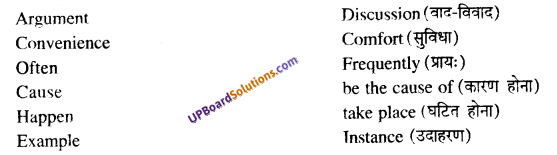
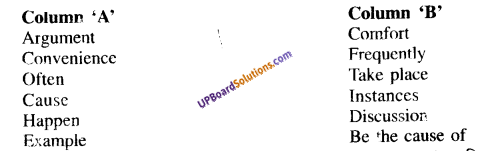
Match the words given below Column ‘A’ with the meanings given below Column ‘B’ below :
(नीचे दिये हुए सूची ‘अ’ के शब्दों का सूची ‘ब’ के अर्थों से मिलान कीजिए)
UP Board Solutions for Class 9 English Prose Chapter 6 The Rules of the Road image 1
Answer:
UP Board Solutions for Class 9 English Prose Chapter 6 The Rules of the Road image 2

Question 2.
Fill in the blanks in the following sentences with the words given below :
निम्नलिखित वाक्यों को नीचे दिये हुए उपयुक्त शब्दों की सहायता से रिक्त स्थानों की पूर्ति कीजिए

careless (लापरवाह ); signal (संकेत); vehicles (वाहत); pedestrians (पदयाती); argue ( तर्क करना )
(i) The road is meant for ……. and the footpath is for…….
(ii) The old lady began to …….
(iii) Drivers of vehicles should never fail to give the right …….
(iv) Cyclists are often ……. about giving signals.
Answer:
(i) Vehicles, pedestrians
(ii) Argue
(ii) Signal
(iv) Careless

Question 3.
Give the antonyms of the following words :
(निम्नलिखित शब्दों के विलोम शब्द लिखिए)
like; freedom; sleep; foreign; careless; right
Answer:
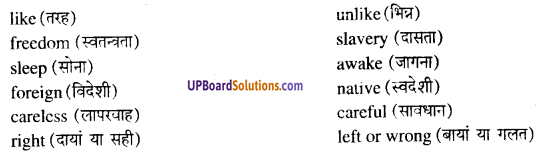
UP Board Solutions for Class 9 English Prose Chapter 6 The Rules of the Road image 3

Question 4.
Give the synonyms of the following words :
निम्नलिखित शब्दों के पर्यायवाची शब्द लिखिए
want; convenicnce; objected; argue; suppose
Answer:

UP Board Solutions for Class 9 English Prose Chapter 6 The Rules of the Road image 4
UP Board Solutions for Class 9 English Prose Chapter 6 The Rules of the Road image 5

Question 5.
Use the following phrases in your own sentences so as to make their meanings clear :
निम्नलिखित मुहावरों के अर्थ स्पष्ट करते हुए अपने वाक्यों में प्रयोग कीजिए
to come across (मिलना ); now and then (कभी – कभी); to get into (पड़ जाना); on purpose (जाना बूझ कर )
Answer:
To come across (मिलना) : He came across me near the park.
Now and then (कभी – कभी) : Now and then, he comes to trouble me with a request for loan.
To get into (पड़ जाना) : She got into trouble by back biting her principal
On purpose (जाना बूझ कर) : We certainly do not interfere on purpose with other persons.

UP Board Solutions

Question 6.
Find one word for each of the following expressions :
(निम्नलिखित वाक्यांशों के लिए एक शब्द बताइये)
(i) A person who walks on foot. ( )
(ii) Those who drive motor vehicles. ( )
Answer:
(i) Pedestrians
(ii) Motorists

WORKSHEET-6

The Conjunction if is generally used to express condition. But condition can also be expressed by the use of unless.

Example :

  • If Kumar does not obey orders, he will be dismissed.
  • Unless Kumar obeys orders, he will be dismissed.

When if and unless clauses refer to future tense, the Present simple form of the Verb is used in the clauses not Verbs with will, shall, etc.
If would, therefore, be wrong to say.
If you will study hard, you will be able to speak English very well soon.
The right sentence would be :
If you study hard, you will be able to speak English very well soon.

Question 1.
Rewrite the following sentences if in place of using :
(If के स्थान पर unless का प्रयोग करते हुए निम्नलिखित वाक्यों को पुनः लिखिए?)
Examples :
The test will be held tomorrow if it does not rain.
The test will be held tomorrow unless it rains.
(i) If you are not hungry, you needn’t eat now.
(ii) If you do not take an autorickshaw, you will be late for the meeting.
Answer:
(i) Unless you are hungry, you needn’t eat now.
(ii) Unless you take an autorickshaw, you will late for the meeting.

Question 2.
Rewrite the following sentences using if in place of unless :
(Unless के स्थान पर if का प्रयोग करते हुए निम्नलिखित वाक्यों को पुनः लिखिए)
(i) I’ll see you at 7 O’clock unless something goes wrong.
(ii) Unless you wear warm clothes, you will feel cold in Delhi.
Answer:
(i) I’ll see you at 7 O’clock if something does not go wrong.
(ii) If you do not wear warm clothes, you will feel cold in Delhi.

Question 3.
Fill in the blanks in the following sentences with the correct tense form of the Verbs given in brackets :
(निम्नलिखित वाक्यों को कोष्ठक में दी हुई क्रियाओं के सही काल रूप की सहायता से रिक्त स्थानों की पूर्ति कीजिए)
(i) He will be ……. a book. (read)
(ii) The train has ……. the platform. (leave)
(iii) My sister ……. a letter. (Write)
(iv) My father ……. to Mumbai yesterday. (go)
Answer:
(i) reading
(ii) left
(iii) has written
(iv) went

Question 4.
Join each pair of following sentences by using the Conjunction given below :
(नीचे दिये हुए conjunctions का प्रयोग करके निम्नलिखित वाक्यों के प्रत्येक जोड़े को जोड़िये)
that; but; or; who; where
(i) Make haste. You will be late.
(ii) The Ginza is a good hotel. It is very expensive.
(iii) The teacher said. The sun is larger than the moon.
(iv) This is the village. I was born here.
(v) The boy got the first prize. He stood first.
Answer:
(i) Make haste or you will be late.
(ii) The Ginza is a good hotel but it is very expensive.
(iii) The teacher said that the sun is larger than the moon.
(iv) This is the village where I was born.
(v) The boy who stood first got the first prize.

Question 5.
Change the follwoing sentences into Indirect Speech :
(निम्नलिखित वाक्यों को Indirect Speech में बदलिये:)
(i) Krishna said to me, “I want to read a paper.”
(ii) Alka said to her sister, “Here, I lived for ten years.”
(iii) The boy said to the doctor, “Give me some medicine for fever.”
(iv) The boys said, “Let us go for a picnic.”
(v) The guard said to the boy, “What are you doing here.”
Answer:
(i) Krishna told me that he wanted to read a paper.
(ii) Alka told her sister that there she had lived for ten years.
(iii) The boys requested the doctor to give him some medicine for fever.
(iv) The boys proposed that they should go for a picnic.
(v) The guard asked the boy what he was doing there.

UP Board Solutions

Question 6.
Change the following sentences into Passive Voice :
निम्नलिखित वाक्यों को Passive Voice में बदलिए
(i) People speak English all over the world.
(ii) Please do it.
(iii) Do you write a letter?
(iv) Who has written this book?
Answer:
(i) English is spoken by people all over the world.”
(ii) You are requested to do it or let it be done.
(iii) Is a letter written by you?
(iv) By whom has this book written?

Question 7.
Complete the spellings of the following words :
निम्नलिखित शब्दों की वर्तनियाँ पूरा कीजिए।
st–y;
ri–t;
fr-ed-m;
for-gn;
of–n
Answer:
story,
right,
freedom,
foreign,
often.

Question 8.
Fill in the blanks with the words given below :
(नीचे दिये हुए शब्दों की सहायता से रिक्त स्थानों की पूर्ति कीजिए।)
otherwise (अन्यथा); disobeyed (आज्ञा का उल्लंघन किया); convenience (सुविधा); caused (उत्पन्न किया); roundabouts (गोल चक्कर)
They should know the rule about right of way at ……. All these rules are meant for the ……. and safety of everyone using the road and they must not be ……. accidents will be ……. sooner or later.
Answer:
They should know the rule about right of way at round abouts. All these rules are meant for the convenience and safety of every one using the road and they must not be disobeyed. Otherwise accidents will be caused sooner or later.

UP Board Solutions

Question 9.
Read the following passage and answer the questions given below it :
(निम्नलिखित गद्यांश को पढ़िये और इसके नीचे दिये हुए प्रश्नों के उत्तर दीजिए)
There is a story of a man who thought he had a right to do what he liked. One day this gentleman was walking along a busy road, spinning his walking-stick round and round in his hand and trying to look important. A man walking behind him objected.
“You ought not to spin your walking-stick round and round like that” he said, “I am free to do what I like with my walking-stick,” argued the gentleman. “Of course, you are” said the other man, ‘but you ought to know that your freedom ends where my nose begins.
The story tells us that we can enjoy our rights and freedom only if they do not interfere with other people’s rights and freedom.

Questions.
(i) What did the man in the above story think about his right?
(कहानी में बताया गया व्यक्ति अपने अधिकार के विषय में क्या सोचता था?)
(ii) How did the man try to look important?
(उस आदमी ने महत्वपूर्ण दिखने के लिए किस प्रकार प्रयत्न किया?)
(iii) How did the other man protest?
(दूसरे आदमी ने किस प्रकार विरोध किया?)
(iv) Where does our freedom end?
(हमारी स्वतन्त्रता कहाँ समाप्त होती है?)
(v) What does the story teach us?
(कहानी से हमें क्या शिक्षा मिलती हैं?)
(vi) Find out the words in the above passage which mean “crowded” and “moving”.
(उपरोक्त गद्यांश में उन शब्दों को खोजिए जिनके अर्थ crowded और moving हैं।)
Answer:
(i) The man in the above story thought about his right that he had a right to do what he liked?
(उपरोक्त कहानी में बताया गया कि व्यक्ति अपने अधिकार के विषय में सोचता है कि वह जो कुछ चाहे करने के लिए स्वतन्त्र हैं।)
(ii) The man tried to look important as he was walking along a busy road spinning his walking stick round and round in his hand.
(वह व्यक्ति महत्वपूर्ण दिखने का प्रयत्न कर रहा था क्योंकि वह एक व्यस्त सड़क पर अपनी टहलने की छड़ी को हाथ में लेकर घुमाते हुए टहल रहा था।)
(iii) The other man protested to do so.
(दूसरे आदमी ने ऐसा करने का विरोध किया।)
(iv) Our freedom ends where my nose begins.
(तुम्हारी स्वतन्त्रता वही समाप्त हो जाती है जहाँ मेरी नाक प्रारम्भ होती है।)
(v) The story teaches us that we can enjoy our rights and freedom only if we do not interfere with other people’s rights and freedom.
(कहानी से हमें यह शिक्षा मिलती है कि हम अपने अधिकारों और स्वतन्त्रता का आनन्द केवल तभी ले सकते हैं जब हम दूसरे लोगों के अधिकारों और स्वतन्त्रता में हस्तक्षेप न करें।)
(vi) Crowded-busy (भीड़युक्त)
Moving-walking (चलते हुए)।

We hope the UP Board Solutions for Class 9 English Prose Chapter 6 The Rules of the Road help you. If you have any query regarding UP Board Solutions for Class 9 English Prose Chapter 6 The Rules of the Road, drop a comment below and we will get back to you at the earliest.


UP Board Class 10th English Supplementary Chapter 1 Question Answer My Greatest Olympic Prize (Jesse Owens).

Class 10 English Supplementary Reader Chapter 3 Questions and Answers UP Board My Greatest Olympic Prize (Jesse Owens).

कक्षा 10 अंग्रेजी पाठ 3 प्रश्न उत्तर

These Solutions are part of UP Board Solutions for Class 10 English. Here we have given UP Board Solutions for Class 10 English Supplementary Reader Chapter 3 My Greatest Olympic Prize (Jesse Owens).

SHORT ANSWER TYPE QUESTIONS

Answer the following questions in about 25 words :

Question 1.
Who was Jesse Owens ? Why did he visit Berlin in the summer of 1936 ? [2012, 13, 14, 16, 17]
(जेसी ओवन्स कौन था ? वह 1936 के ग्रीष्मकाल में बर्लिन क्यों गया ?)
Answer:
Jesse Owens was an American Negro. He visited Berlin in the summer of 1936 to take part in the Olympic Games.
(जेसी ओवन्स अमेरिका का एक (UPBoardSolutions.com) नीग्रो था। वह वर्ष 1936 में ओलम्पिक खेलों में भाग लेने के लिए बर्लिन गया था।)
                                   Or
When and where were Olympic Games being held? [2014]
(ओलम्पिक खेल कब और कहाँ खेले गए थे?)
Answer:
Olympic Games were being held in 1936 in Berlin.
(ओलम्पिक खेल वर्ष 1936 में बर्लिन में खेले गए थे।)

UP Board Solutions

Question 2.
what was Hitler’s Master Race Theory ? [2011, 14, 15]
(हिटलर का श्रेष्ठ प्रजाति का सिद्धान्त क्या था ?)
Answer:
Hitler’s Master Race Theory was that Germans were superior to other races of the world and they were members of a master race—the Aryans.
(हिटलर का श्रेष्ठ प्रजाति का सिद्धान्त यह था कि जर्मन (UPBoardSolutions.com) प्रजाति संसार की अन्य प्रजातियों से श्रेष्ठ है। वे आर्यन प्रजाति से हैं जोकि स्वामित्व का स्थान रखती हैं।)

Question 3.
What was expected of Jesse Owens and why ? [2014]
(जेसी ओवन्स से क्या आशाएँ थीं और क्यों ?)
                                Or
What was the Olympic event that Jesse Owens was expected to win easily? [2013]
(वह ओलंम्पिक की कौन-सी प्रतिस्पर्धा थी जिसे वह आसानी से जीतना चाहता था ?)
Answer:
It was expected of Jesse Owens to win a gold medal in long jump because he had already established a new world record in it only a year before. (जेसी ओवन्स से लम्बी कूद में स्वर्ण पदक प्राप्त करने की आशा की जाती थी, क्योंकि पहले से ही वह इसमें नया विश्व रिकॉर्ड स्थापित कर चुका था।)

Question 4.
What did Jesse Owens think would happen if Luz Long won ?
(जेसी ओवन्स के विचार में लुज लौंग के विजयी होने पर क्या हो जाता ?)
Answer:
Jesse Owens thought that if Luz Long won, it would encourage the Master Race Theory of Hitler and it will be against spirit of Olympic Games. (जेसी ओवन्स के विचार से लुज लौंग के विजयी होने पर हिटलर (UPBoardSolutions.com) के श्रेष्ठ प्रजाति के सिद्धान्त को प्रोत्साहन मिल जाता और यह ओलम्पिक खेलों की भावना के विरुद्ध होता।)

UP Board Solutions

Question 5.
why was Jesse Owens angry? [2011, 15, 17, 18]
(जेसी ओवन्स क्यों क्रोधित था ?)
Answer:
Jesse Owens was angry because he did not like Hitler’s Master Race Theory that the German race was superior to all others. (जेसी ओवन्स इसलिए क्रोधित था क्योंकि वह हिटलर के श्रेष्ठ प्रजाति के सिद्धान्त को पसन्द नहीं करता था कि जर्मन लोग शेष सभी लोगों से श्रेष्ठ ।)

Question 6.
What happened with Jesse Owens on the first of his three qualifying | jumps ?
(तीन निर्णायक कूदों में से पहली कूद में जेसी ओवन्स के साथ क्या हुआ ?)
Answer:
On the first of his three qualifying jumps Jesse Owens leaped from several inches beyond the take off board for a no jump.
(अपनी तीन निर्णायक कूदों में से पहली कूद में जेसी ओवन्स निश्चित निशान से कई इंच आगे से कूदा और उसकी यह कूद निरस्त कर दी गई।)

Question 7.
What might have happened if Jesse Owens had failed to control his anger ?
(यदि जेसी ओवन्स अपने क्रोध पर नियन्त्रण न कर पाता तो क्या होता ?)
Answer:
If Jesse Owens had failed to control his anger, he would not have succeeded to qualify for the finals and won the Gold Medal. (यदि जेसी ओवन्स अपने क्रोध पर नियन्त्रण न कर पाता तो वह निर्णायक कूद तक (UPBoardSolutions.com) पहुँच पाने में सफल न हो पाता तथा स्वर्ण पदक भी न जीत पाता।)

UP Board Solutions

Question 8.
Whose hand did Jesse Owens feel on his shoulder ? What did it signify ? [2015]
(जेसी ओवन्स ने अपने कन्धे पर किसके हाथ को महसूस किया ? यह क्या प्रकट करता था ?)
Answer:
Jesse Owens felt the hand of Luz Long on his shoulder who was the tall German long jumper. It signifies that he did not believe in the Aryan-supremacy business of Hitler.
(जेसी ओवन्स ने अपने कन्धे पर लुज लौंग के हाथ का स्पर्श महसूस किया, जोकि लम्बे कद का तथा लम्बी कूद कूदने वाला जर्मन था। इससे यह प्रकट होता है कि वह हिटलर के आर्यन श्रेष्ठ हैं, के विचार से सहमत नहीं था।)

Question 9.
Who was Luz Long ? In what way did he differ from the other members of his race ?
[2011, 12, 15, 16, 18]
(लुज लौंग कौन था ? वह अपनी प्रजाति के अन्य लोगों से किस प्रकार भिन्न था ?)
Answer:
Luz Long was a German. He differed from other members of his race as he did not believe in the superiority of races. He believed in equality of men.
(लु लौंग एक जर्मन था। वह अपनी प्रजाति के अन्य लोगों (UPBoardSolutions.com) से इस प्रकार भिन्न था कि वह प्रजाति की श्रेष्ठता में विश्वास नहीं करता था। वह समानता में विश्वास रखता था।)

UP Board Solutions

Question 10.
How did Luz Long help Jesse Owens in qualifying for the final jumps ? [2017]
(लुज लौंग ने जेसी ओवन्स को निर्णायक कूद के लिए योग्य घोषित कराने में किस प्रकार सहायता की ?)
                                              Or
How did Luz Long help Jesse Owens to correct the error ?
( भूल सुधारने के लिए लुज लौंग ने जेसी ओवन्स की किस प्रकार सहायता की ?)
Answer:
Luz Long helped Jesse Owens by encouraging and, giving him useful directions. Luz advised him to mark a line a few inches behind the board and aim at making his take off from there.
(लुज लौंग ने प्रोत्साहन और उपयोगी निर्देश देकर जेसी (UPBoardSolutions.com) ओवन्स की सहायता की। उसने उसे प्रारम्भ- बिन्दु से कुछ इंच पहले लाइन खींचने और उसे लक्ष्य बनाकर वहाँ से कूदने की सलाह दी।)

Question 11.
What did Luz Long do on the successfJesse Owens in the finals?
(जेसी ओवन्स के निर्णायक प्रतियोगिताओं में सफल होने पर लुज लौंग ने क्या किया ?)
Answer:
Luz Long gave hearty congratulations to Jesse Owens on his success in the finals. He shook Owens’s hand hard with a true smile.
(जेसी ओवन्स के निर्णायक प्रतियोगिताओं में सफल होने पर लुज लौंग ने उसे हार्दिक बधाई दी। उसने ओवन्स से मुस्कराहट के साथ हाथ मिलाया।)

UP Board Solutions

Question 12.
what kind of friendship did Jesse Owens feel for Luz Long?
(जेसी ओवन्स ने लुजे लौंग के प्रति किस प्रकार की मित्रता का अनुभव किया ?)
Answer:
Jesse Owens felt that his friendship with Luz Long was so valuable and dear that if all of his gold medals and cups were melted, they would not be enough to envelope that friendship.
(जेसी ओवन्स ने अनुभव किया कि लुज लौंग की मित्रता इतनी मूल्यवान (UPBoardSolutions.com) व प्रिय थी कि यदि वह अपने सभी स्वर्ण पदकों और ट्रॉफियों को पिघलाकर उसकी परत इस दोस्ती पर चढ़ाना चाहे, तो वह अपर्याप्त ही होगी।)

Question 13.
LuzLong is said to be a fine example of Coubertin’s ideal. What was Coubertin’s ideal?
(लुज लौंग को कोबर्टिन के आदर्श का सुन्दर उदाहरण माना जाता है। कोबर्टिन का क्या आदर्श था ?)
                         Or
Who was Pierre de Coubertin ? What is the important thing in the Olympic Games ?
[2010, 11, 13]

(पियरे डी कोबर्टिन कौन था ? ओलिम्पिक खेलों में महत्त्वपूर्ण बात क्या है ?)
                        Or
What was Pierre de Coubertin’s statement about the Olympic Games ? (ओलिम्पिक खेलों के विषय में पियरे डी कोबर्टिन का क्या वक्तव्य था ?) [2009, 12, 14, 15, 16]
                        Or
Who was Coubertin and what was his ideal ? [2013, 16]
(कोबर्टिन कौन था? उसका आदर्श क्या था ?)
                       Or
what is the important thing in Olympic Games? [2015, 16, 18]
(ओलिम्पिक खेलों में महत्त्वपूर्ण बात क्या है ?) ।
Answer:
Coubertin’s ideal was that “the important thing in the Olympic Games is not winning but fighting well. Life is not conquering but fighting well.”
(कोबर्टिन का आदर्श यह था कि, “ओलिम्पिक खेलों में जीतना (UPBoardSolutions.com) महत्त्वपूर्ण नहीं है वरन् अच्छी तरह संघर्ष करना महत्त्वपूर्ण है। जीवन जीत का नहीं बल्कि संघर्ष का दूसरा नाम है।”)

Question 14.
Why has Luz Longbeen called a fine example of Coubertin’s ideal? [2012]
(लुज लौंग को कोबर्टिन के आदर्श का श्रेष्ठ उदाहरण क्यों कहा जाता है ?)
Answer:
Luz Long has been called a fine example of Coubertin’s ideal because he believed not in winning but in fighting well. (लुज लौंग को कोबर्टिन के आदर्श का श्रेष्ठ उदाहरण इसलिए कहा जाता है क्योंकि वह खेल को जीतने में विश्वास नहीं करता था अपितु उसे भली प्रकार खेलने में विश्वास करता था।

UP Board Solutions

Question 15.
How does the friendship between Luz Long and Jesse Owens justify
the principles of the Olympic Games ?
(लुज लौंग और जेसी ओवन्स की मित्रता ओलिम्पिक खेलों के सिद्धान्तों को कैसे औचित्य प्रदान करती है ?)
Answer:
The friendship between Luz Long and Jesse Owens broke the barrier of raceism. It justified the ideal that in Olympic Games winning is not important, but taking part and fighting well is important.
(लुज लौंग और जेसी ओवन्स की मित्रता ने नस्लवाद की सीमा तोड़ दी। (UPBoardSolutions.com) उनकी मित्रता ने इस बात को औचित्य प्रदान किया कि ओलिम्पिक खेलों में जीतना महत्त्वपूर्ण नहीं है, बल्कि महत्त्वपूर्ण है भाग लेना तथा उचित संघर्ष करना।)

Question 16.
who was the founder of modern Olympic Games ? [2014, 16]
(आधुनिक ओलिम्पिक खेलों के जन्मदाता कौन थे ?)
Answer:
Pierre de Coubertin was the founder of modern Olympic Games. He was a French Baron and is responsible for the revival of the Olympic Games in 1896.
(पियरे डी कोबर्टिन आधुनिक ओलिम्पिक खेलों के जन्मदाता थे। वह एक फ्रांसीसी बैरन थे और उन्होंने ही सन् 1896 ई० में ओलिम्पिक खेलों को पुनः आरम्भ किया।)

Question 17.
What was Jesse Owens’ greatest Olympic Prize ? How could he achieve it? [2011, 16]
(जेसी ओवन्स को सबसे बड़ा ओलिम्पिक पुरस्कार क्या मिला ? वह इसे कैसे जीत सका ?)
Answer:
Jesse Owens’s greatest Olympic prize was his true friendship with Luz Long. He had formed a real friendship with Luz Long who was a nice man like him. He could achieve it with the real spirit of a sportsman like Luz Long.
(जेसी ओवन्स को लुज लौंग से उसकी सच्ची मित्रता के रूप में सबसे बड़ा ओलिम्पिक पुरस्कार मिला। उसने लुज लौंग के साथ एक सच्ची दोस्ती बनायी थी जो उसी की तरह एक अच्छा व्यक्ति था। वह इसे एक खिलाड़ी के सच्चे उत्साह के साथ जीत सका जैसा कि लुज लौंग में था।)

UP Board Solutions

Question 18.
Give a brief character sketch of Luz Long. [2011]
(लुज लौंग का संक्षिप्त चरित्र-चित्रण कीजिए।)
Answer:
Luz Long was a true sportsman. He believed in equality of men. He helped, encouraged and advised Jesse Owens as true friend.
(लुज लौंग सच्चा स्पोर्ट्समैन था। वह मनुष्यों की समानता में विश्वास करता था। एक सच्चे मित्र के समान उसने जेसी ओवन्स की सहायता की, उसे प्रोत्साहन दिया तथा सलाह दी।)

Question 19.
Whose hand did Jesse Owens feel on his shoulders ? What did it | signify? [2015, 18]
(जेसी ओवन्स ने अपने कन्धों पर किसका हाथ महसूस किया ? यह क्या प्रकट करता था ?)
Answer:
Jesse Owens felt Luz Long’s hand on his shoulder. It signified his true friendship.
(जेसी ओवन्स ने अपने कन्धे पर लुज लौंग का हाथ महसूस किया। (UPBoardSolutions.com) इससे दोनों की पक्की दोस्ती प्रकट होती है।)

MULTIPLE CHOICE TYPE QUESTIONS .

Select the most suitable alternative to complete each of the following statements :

1. Jesse Owens disliked Adolf Hitler because … [2011, 13, 15]
(a) he patronised Luz Long, a rival of Jesse.
(b) he had kept Luz Long hidden from other Olympic athletes.
(c) he advocated the doctrine of the Aryan Supremacy.
(d) he suffered from vanity by organising the Games in Berlin.

2. Jesse Owens could not clear two of the three long-jump trials because he [2012, 13, 14, 15, 16]
(a) was nervous.
(b) was over-confident.
(c) was angry over the ‘master race’ theory of Adolf Hitler.
(d) feared that Luz Long, a German athlete, might beat him at the finals.

UP Board Solutions

3. The important thing in the Olympic Games is …. [2011, 12, 13, 15]
(a) winning
(b) taking part
(c) playing tricks
(d) to give trials

4. The essential thing in life is …….. [2011, 12, 13, 14, 15, 16]
(a) fighting well
(b) conquering
(c) earning money
(d) winning prize

5. Owens did not want Luz Long to win because
(a) he wanted to retain the world record he had set.
(b) that would have added some new support to the Nazis’ Aryan Superiority Theory.
(c) it would disappoint him after long years of training.

6. Jesse Owens was angry because ….. [2011, 16]
(a) he was not allowed to take part in the event.
(b) he had not qualified himself for the event.
(c) Negroes were supposed to be inferior to Aryans.
(d) Germans were not superior to all other races of the world.

UP Board Solutions

7. Jesse Owens was …………
(a) an American Negro.
(b) a great long-distance runner.
(c) a great German sportsman.

8. Olympic Games were held in Berlin in …… [2015]
(a) 1932.
(b) 1936.
(c) 1940
(d) 1930.

9. In the beginning Jesse Owens was a little angry at …………… [2009, 15]
(a) himself.
(b) Luz Long.
(c) Hitler’s ways.
(d) his coach.

10. Jesse Owens, the great Olympian, couldn’t jump properly in the beginning because …….
[2011, 12, 13, 14, 15, 16]
(a) he was in tension.
(b) he didn’t know how to jump properly.
(c) he didn’t want to jump.
(d) he was ill.

11. Hitler believed in the .. [2016]
(a) equality of all races.
(b) superiority of German race.
(c) superiority of English race.

UP Board Solutions

12. Jesse Owens believed that his greatest Olympic Prize was………
(a) the medal he received.
(b) the money he received.
(c) the friendship with Luz Long.

13. Luz Long was a real sportsman because ………………… [2012, 14, 15]
(a) he was tall and well built.
(b) he was a German.
(c) his main object in games was not conquering but fighting well.

14. The Olympic Games in 1936, were held in [2016]
(a) New York
(b) Berlin
(c) Japan
(d) China

UP Board Solutions

TRUE/FALSE STATEMENTS

State whether the following statements are ‘True’ or ‘False’:
1. Olympic Games were held in Paris in 1930.
2. Jesse Owens set the Olympic record of 26 feet 5 inches in the long jump.
3. Luz Long was pleased with his performance.
4. Jesse Owens was disappointed at his performance.
5. Luz Long was jealous of Jesse Owens. [2011, 13, 14, 17]
6. Jesse Owens was an American Negro. [2011, 14, 17, 18]
7. Luz Long was a German and spoke English with a German twist. [2012, 16]
8. Luz Long was an American. [2012, 13, 16, 17, 18]
9. An angry athlete is always a bad sportsman.
10. Jesse Owens and Luz Long had been great friends long before the Olympic Games were held. [2014]
11. Jesse Owens was an admirer of Adolf Hitler. [2013, 14, 17]
12. Luz Long did not believe (UPBoardSolutions.com) in Hitler’s Supremacy Theory.
13. Jesse Owens was a German. [2014, 15, 16, 17]
14. Jesse Owens had an eye on the long-jump. [2014, 18]
15. Jesse Owens was jealous of Luz Long.
16. The 1936 Olympic Games were held in Berlin. [2009, 13, 15, 17, 18]
UP Board Solutions

17. Olympic Games were held in Paris in 1936. [2009, 12]
18. Pierre de Coubertin was the founder of the modern Olympic Games. [2009, 12, 14, 15, 16, 17, 18]
19. Luz Long set the Olympic record for long jumps.
20. An angry athlete is an athlete who will make mistakes.. [2011, 17, 18]
21. Luz Long was proud of his race.
22. The important thing in the Olympic Games is to win. [2014, 16]
23. Luz Long was a German athlete. [2010]
24. Wining is the most important thing in games and sports. ; [2012, 16]
25. Olympic Games were held in London in 1936. [2014]
26. Jesse Owens was an American long-jumper. [2015]
27. Sports should be played with sportsmanship. [2015]
28. The important thing in the Olympic Games to take part in games and show true sportsman spirit. [2015]
29. Jesse Owens helped Luz Long (UPBoardSolutions.com) in qualifying for the final jump.: [2016]
30. In 1936, the Olympic Games were held in America. [2017]
31. The essential thing in life is not conquering but fighting well. [2017]
Answer:
1. F, 2. T, 3. T, 4. F, 5. F, 6. T, 7. T, 8. F, 9. T, 10. F, 11. F, 12. T, 13. F, 14. T, 15. F, 16. T, 17. F. 18. T, 19. T, 20. T, 21. F. 22. F. 23. T. 24. F, 25. F. 26. T, 27. T, 28. T, 29. T, 30.F, 31. T.

Hope given UP Board Solutions for Class 10 English Supplementary Reader Chapter 3 are helpful to complete your homework.

If you have any doubts, please comment below. UP Board Solutions try to provide online tutoring for you.

UP Board Class 9th English Supplementary Chapter 1 Question Answer Gandhi Ji And A Coffee Drinker (G Ramchandran).

Class 9 English Supplementary Reader Chapter 1 Questions and Answers UP Board Gandhi Ji And A Coffee Drinker (G Ramchandran).

कक्षा 9 अंग्रेजी पाठ 1 प्रश्न उत्तर

(A) SHORT ANSWER TYPE QUESTIONS AND THEIR ANSWERS
Answer the following questions in not more than 25 words each :

Question 1.
How did Gandhiji pick up ‘nursing?
गाँधी जी ने सेवा करने का कार्य किस प्रकार सीखा था?
Answer:
When nursing became necessary to Gandhiji in life, he learned it through hard way of experience.
जब गाँधी जी के जीवन में सेवा करने का कार्य आवश्यक (UPBoardSolutions.com) हो गया तो उन्होंने यह कार्य अनुभव के कठिन तरीके से सीखा था।

UP Board Solutions

Question 2.
What did Gandhiji arrange in personally at the Ashram?
गाँधी जी ने आश्रम में व्यक्तिगत रूप से क्या व्यवस्था की थी?
Answer:
Gandhiji arranged the care of the sick in person at the Ashram.
गाँधी जी ने आश्रम में मरीजों की देखभाल की व्यवस्था व्यक्तिगत रूप से की थी।

Question 3
What was the joke especially among the young people in the Ashram?
आश्रम के नवयुवकों में विशेष रूप से क्या मजाक प्रचलित था?
Answer:
It was a joke, especially among young people in the Ashram, that if you wanted to see Gandhiji everyday and talked to him and hear him crack jokes, you had only to be ill and get into bed.
आश्रम के नवयुवकों में विशेष रूप से यह मजाक (UPBoardSolutions.com) प्रचलित था कि यदि तुम्हें प्रतिदिन गाँधी जी से मिलने की इच्छा हो तथा उनसे बातें करना हो और उन्हें मजाक करते हुए सुनना पसन्द ले तो तुम्हारे लिए बीमार होकर बिस्तर पर लेटना ही काफी है।

Question 4
What was Gandhiji’s daily routine at the Ashram?
आश्रम में गाँधी जी का दैनिक कार्य क्या था?
Answer:
Gandhiji visited the sick every day and spent a few minutes at every bed-side. He also saw to things carefully and never failed to crack a joke
or two with the patient.
गाँधी जी प्रतिदिन रोगी के निकट आते थे और प्रत्येक बिस्तर के पास कुछ समय व्यतीत करते थे। वे प्रत्येक वस्तुको ध्यानपूर्वक देखा भी करते थे और रोगी के साथ एक-दो विनोदपूर्ण बात करने से कभी नहीं चूकते थे।

Question 5
What was the young lad fond of? Why did he not get his favourite drink in the Ashram?
नवयुवक किस वस्तु का शौकीन था? उसे आश्रम में अपना मनपंसद पेय क्यों नहीं मिला?
Answer:
The young lad was fond of coffee. He did not get his favourite drink in the Ashram because it was not allowed there.
नवयुवक कॉफी का शौकीन था। उसे आश्रम में अपना मनपसंद पेय इसलिए नहीं मिला क्योंकि वहाँ पर कॉफी पीने की आज्ञा न थी।

Question 6
What was the young lad dreaming of one day lying on his back?
एक दिन अपनी पीठ के बल लेट कर नवयुवक क्या स्वप्न देख रहा था?
Answer:
One day the young lad was lying on his back dreaming for a cup of good coffee.
एक दिन नवयुवक पीठ के बल लेटा हुआ एक प्याली अच्छी कॉफी के लिए स्वप्न देख रहा था।

UP Board Solutions

Question 7
The youngster had a sudden brain-wave. What does the word brain-wave mean here?
लड़के के मस्तिष्क में अचानक ‘ब्रेन-वेब’ हुआ। यहाँ पर ब्रेन-बेव’ शब्द का क्या तात्पर्य है?
Answer:
The word brain-wave means a thought in mind that appears suddenly.
‘ब्रेन-बेव’ शब्द का तात्पर्य एक ऐसे विचार से है जो मस्तिष्क में अचानक उत्पन्न हो जाये।

Question 8
What did the young lad request Gandhiji for?
नवयुवक ने गाँधी जी से किस वस्तु के लिए अनुरोध किया?
Answer:
The young lad requested Gandhiji for a cup of coffee.
नवयवुक ने गाँधी जी से एक प्याली कॉफी के लिए अनुरोध किया।

Question 9
What did Gandhiji promise to send him?
गाँधी जी ने उसको क्या भेजने का वचन दिया?
Answer:
Gandhiji promised to send him a cup of light coffee and warm toast.
गाँधी जी ने उसको एक प्याली हल्की कॉफी और गर्म टोस्ट भेजने का वचन दिया।

Question 10
Why was the young lad surprised?
नवयुवक आश्चर्य में क्यों पड़ गया?
Answer:
When the young lad saw Gandhiji carrying a tray covered with a white khadi napkin, he was surprised.
जब नवयुवक ने गाँधी जी को सफेद खादी के एक रुमाल से ढंकी हुई एक ट्रे को ले आते हुए देखा तो वह आश्चर्य में पड़ गया।

Question 11
What did the boy imagine, lying on his bed?
अपने बिस्तर पर लेटे हुए लड़के ने क्या कल्पना की?
Answer:
The boy imagined that Gandhiji would go to Ba in her kitchen and ask for coffee and toast for him.
लड़के ने कल्पना की कि गाँधी जी बा के पास रसोईघर में जायेंगे और उसके लिए कॉफी और टोस्ट के लिए कहेंगे।

Question 12
Who made the coffee and why?
कॉफी किसने बनायी और क्यों?
Answer:
Gandhiji himself made the coffee because it was an untimely hour and he did not like to rouble Ba as she would be taking rest.
गाँधी जी ने स्वयं कॉफी बनायी क्योंकि वह असमय था और वे बा को कष्ट नहीं देना चाहते थे क्योंकि वे उस समय राम कर रही होंगी।

UP Board Solutions

Question 13
How did the young lad like the coffee?
नवयुवक को कॉफी कैसी लगी?
Answer:
The young lad liked the coffee much because he was habitual to take it.
नवयुवक को कॉफी बहुत पसन्द आयी क्योंकि वह इसे पीने का आदी था।

Question 14
Why was the boy troubled after Gandhiji had gone?
गाँधी जी के जाने के बाद लड़का परेशान क्यों हो गया?
Answer:
The boy was troubled after Gandhiji had gone because his mind’s eye saw him opening thekitchen, lighting the stove, making the coffee and carrying it to him.
गाँधी जी के जाने के बाद लड़का इसलिए परेशान हो (UPBoardSolutions.com) गया क्योंकि उसने कल्पना की आँखों से उन्हें रसोईघर खोलते, स्टोव जलाते, कॉफी बनाते और उसे उसके पास लाते हुए देखा।

(B) MULTIPLE CHOICE ouESTIONS
Select the most suitable alternative to complete each of the following statements :
निम्नलिखित कथनों में से प्रत्येक को पूरा करने के लिए सबसे उपयुक्त विकल्प चुनिए
(A)
(i) Gandhiji was able to nurse the sick well because :
(a) he picked up nursing at a nursing sc
(b) he was interested in nursing
(c) he learned nursing through the hard way of experience
(d) he practised nursing daily
(ii) Gandhiji visited the sick in the Ashram :
(a) every day
(b) every alternate day
(c) whenever he found time
(d) once in a week
(iii) Gandhiji promised the young lad :
(a) a cup of coffee only
(b) warm toast and coffee
(c) coffee and thosai
(d) a cup of tea
(iv) Gandhiji’s cottage was :
(a) in the centre of the Ashram
(b) near the gate of the Ashram
(c) a long way across the road at the other end of the Ashram
(d) in the middle of the Ashram.

(B) Gandhiji prepared the coffee himself because :
(a) only he knew how to prepare good coffee
(b) it was an untimely hour and so he did not want to trouble Ba
(c) he liked to do the work himself
(d) he did not like to tell Ba.
Answers:
(i) (c) he learned nursing through the hard way of experience
(ii) (a) every day
(iii) (b) warm toast and coffee
(iv) (c) a long way across the road at the other end of the Ashram.
(v) (b) it was an untimely hour and so he did not want to trouble Ba.

(C) Say whether each of the following statements is ‘true’ or ‘false’:
बताइये कि निम्नलिखित कयों में से प्रत्येक ‘सत्य’ है अथवा ‘असत्य :
(i) Gandhiji was a first class nurse to the sick.
(ii) Gandhiji picked up nursing at a nursing school.
(iii) In the Ashram all sick persons came directly under Gandhiji’s eye and care.
(iv) The South Indian lad was down with fever.
(v) The lad wished to eat dosai.
(vi) The lad pined for a cup of good coffee.
(vii) Gandhiji got the coffee prepared by Ba.
(viii) Gandhiji himself prepared the coffee.
(ix) Gandhiji sent coffee and toast through an inmate of the Ashram.
(x) The coffee was light but excellent.
Answers:
(i) T, (ii) F, (iii) T, (iv) F, (v) F, (vi) T, (vii) F, (viii) T, (ix) F, (x)T.

UP Board Solutions

(D) Fill in the blanks with missing letters to complete the spelling of the following words :
निम्नलिखित शब्दों की वर्तनी को पूरा करने के लिए लुप्त अक्षरों की सहायता से रिक्त स्थानों की पूर्ति कीजिए—
rec-v-r; c-nsu-t; ex-ell-nt; expe-i-nce; v-s-t; j-k-
Answers:
recover, consult, excellent, experience, visit, joke

Inspiration Helps Class 7 English Chapter 15 Question Answer UP Board Solutions

UP Board Class 7th English Chapter 15 Inspiration Helps Questions and Answers

कक्षा 7 अंग्रेजी पाठ 15 के प्रश्न उत्तर

These Solutions are part of UP Board Solutions for Class 7 English. Here we have given UP Board Solutions for Class 7 English Chapter 15 Inspiration Helps.

Inspiration Helps

TRANSLATION OF THE LESSON (पाठ का हिन्दी अनुवाद)

Rubina lived……………………………….house holdwork.
हिन्दी अनुवाद- रूबीना अपने माता पिता के साथ एक गाँव में रहती थी। उसके पिता एक कारखाने में काम करते थे। वह कक्षा 6 में पढ़ रही थी। वह कक्षा में हमेशा प्रथम आती थी।

एक दिन जब उसके पिता घर वापस आए, वह कमज़ोर महसूस कर रहे थे। उन्होंने अपनी पत्नी से कहा, “मैं एक गंभीर बीमारी से ग्रस्त हूँ, और इस बीमारी का इलाज बहुत महँगा है।” यह सुनकर रूबीना की माँ बहुत दुखी हुई। सबीना के पिता को आराम की आवश्यकता थी, इसलिए उनके स्थान पर उसकी माँ ने कारखाने में काम करना शुरू कर दिया। रूबीना ने स्कूल जाना बंद कर दिया क्योंकि अधिकतर समय उसे अपने (UPBoardSolutions.com) पिता की देखरेख में घर में बिताना होता था। वह अपनी पढ़ाई को लेकर चिंतित थी।

UP Board Solutions

एक दिन कारखाने जाते हुए रास्ते में रूबीना और उसकी माँ को उसकी शिक्षिका मिलीं । शिक्षिका ने स्कूल में रूबीना की अनुपस्थिति का कारण पूछा। रूबीना ने कहा, “मैं स्कूल नही जा रही हूँ क्योंकि मेरे पिता बहुत बीमार हैं और काम करने में असमर्थ हैं।” उसकी माँ ने परिवार की मदद के लिए मिल में काम करना शुरू दिया था और उसे घरेलू काम करने के लिए घर में रहना आवश्यक था।

The teacher said ………………………… their daughter.
हिन्दी अनुवाद- शिक्षिका ने उसकी माँ से कहा, “तुम्हारे परिवार को राष्ट्रीय स्वास्थ्य बीमा योजना’ के अतंर्गत नामांकित होना चाहिए था। अगर ऐसा होता, तो तुम्हारे पति का इलाज इस योजना के अतंर्गत बिना पैसा खर्च किये हो सकता था।” शिक्षिका (UPBoardSolutions.com) ने एक परामर्श और दिया कि सबीना को बालिका आवासीय विद्यालय में दाखिला लेना चाहिए। आवासीय विद्यालय में उसे मुफ्त शिक्षा, भोजन और छात्रावास सुविधा मिलेगी।

रूबीना की माँ ने शिक्षिका की सलाह मानी जिसकी वजह से उनके पति को अच्छा और मुफ्त इलाज मिला और वे शीघ्र ही बीमारी से उभर गए। आवासीय विद्यालय में बिना किसी रूकावट के सबीना अपनी शिक्षा पूरी कर सकी। रूबीना अपनी पढ़ाई में उत्तम भी रही। उसे एक विख्यात मेडिकल कॉलेज में दाखिला मिला। उसे अपनी पढ़ाई करने के लिए छात्रवृति भी मिली।

UP Board Solutions

डॉक्टर बनने के बाद वह एक स्थानीय प्राथमिक स्वास्थ्य केन्द्र से जुड़ गई। बाद में, उसने कारखाना कर्मचारियों के बच्चों के लिए एक स्कूल खोला।।

एक दिन, अपने माता-पिता के साथ रूबीना अपनी उसी शिक्षिका के (UPBoardSolutions.com) पास गई। उन्होंने शिक्षिका को अपना धन्यवाद व्यक्त किया। रूबीन के माता पिता को अपनी बेटी पर गर्व महसूस हुआ।

UP Board Solutions

EXERCISE (अभ्यास)

Comprehension Questions

Question 1.
Answer the following questions:
Answer:
Question a.
Where did Rubina’s father (UPBoardSolutions.com) work?
Answer:
Rubina’s father worked in a factory.

UP Board Solutions

Question b.
Why was Rubina worried?
Answer:
Rubina was worried about her studies because she had stopped going to school in order to take care of her father and house.

Question c.
Why did Rubina stop going to school?
Answer:
Rubina stopped going to school as most (UPBoardSolutions.com) of the time she had to stay at home to take care of her father.

Question d.
What do you understand by “Rashtriya Swasthya Beema Yojna”?
Answer:
It is a scheme of medical insurance for poor families in which the goverment helps them to enjoy the benefits of health insurance in times of diseases or medical emergencies.

UP Board Solutions

Question e.
What was the advice given to Rubina by her teacher?
Answer:
The teacher advised Rubina to join the (UPBoardSolutions.com) girl’s boarding school where she would get free education, food and hostel facility.

Question f.
What did Rubina do for her village after completing her studies?
Answer:
Rubina joined a local Primary Health Centre and later on, she opened a school for children of the factory workers.

Question 2.
Who said these words and to whom:
Answer:
Question a.
“I am suffering from some serious disease.”
Answer:
Rubina’s father to her mother

UP Board Solutions

Question b.
“Your family must have been enrolled (UPBoardSolutions.com) in ‘Rashtriya Swasthya Beema Yojna’.”
Answer:
Teacher to Rubina’s mother

Question c.
“Rubina should join the girls boarding school.”
Answer:
Teacher to Rubina’s mother

Question d.
“I am not going to school because my father is very sick.”
Answer:
Rubina to her teacher (UPBoardSolutions.com)

UP Board Solutions

Word Power

Question 1.
Fill in the blanks with appropriate words given in the box:
UP Board Solutions for Class 7 English Chapter 15 Inspiration Helps 1a
Answer:
a. Pooja wants to excel in studies.
b. Ravi is lagging behind in studies due to his poor health.
c. My heart is full of gratitude for your support.
d. Shweta overcame the hurdle by passing the entrance exam.
e. The mother accompanied her (UPBoardSolutions.com) son to the shop.
f. The teacher enrolled my name for the sports competition.

UP Board Solutions

Language Practice

Question 1.
Add ‘can/could’ and make questions:
Example– Rubina could come first in the class.
Could Rubina come first in the class?
Answer:
Question a.
Her mother could work (UPBoardSolutions.com) in the factory.
Answer:
Could her mother work in the factory?

Question b.
Her father could recover his health.
Answer:
Could her father recover his health?

UP Board Solutions

Question c.
Rubina could take admission in the medical college.
Answer:
Could Rubina take admission (UPBoardSolutions.com) in the medical college?

Question d.
Rubina can open the school for factory worker’s children.
Answer:
Can Rubina open the school for factory workers’ children?

Question e.
Her father can get the free treatment in a hospital.
Answer:
Can her father get the free treatment in a hospital?

UP Board Solutions

Question f.
Rubina can join a local Primary Health Centre.
Answer:
Can Rubina join a local Primary (UPBoardSolutions.com) Health Centre?

Activity                 Note: Do it yourself.

We hope the UP Board Solutions for Class 7 English Chapter 15 Inspiration Helps help you. If you have any query regarding UP Board Solutions for Class 7 English Chapter 15 Inspiration Helps, drop a comment below and we will get back to you at the earliest.
Sanjay the Brave Boy Class 7 English Chapter 3 Question Answer UP Board Solutions

UP Board Class 7th English Chapter 3 Sanjay the Brave Boy Questions and Answers

कक्षा 7 अंग्रेजी पाठ 3 के प्रश्न उत्तर

These Solutions are part of UP Board Solutions for Class 7 English. Here we have given UP Board Solutions for Class 7 English Chapter 3 Sanjay the Brave Boy.

Sanjay the Brave Boy

TRANSLATION OF THE LESSON (पाठ का हिन्दी अनुवाद)

Sanjay was …………………………………….I’II go.
हिन्दी अनुवाद- संजय कक्षा 7 का छात्र था। वह अपने माता-पिता के साथ शांतिपुर गाँव में रहता था। उसने एक दुर्घटना में एक टाँग खो दी थी। उसे हमेशा महसूस होता था कि सभी उसकी टाँग की तरफ देखते थे और उसकें चलने के तरीके पर हँसते थे। इसलिए वह हमेशा लोगों से बचने का प्रयत्न करता था।
(एक सुबह जब संजय नहीं जागा, तो उसकी माँ ने उसे उठायो ।)

UP Board Solutions

माँ – उठो संजय! तुम्हे देर हो रही है।
संजय – माँ, मैं स्कूल नहीं जाना चाहता हूँ।
माँ – क्यों संजय?
संजय – मैं उपेक्षित महसूस करता हूँ, मेरे सहपाठी मेरा साथ पसंद (UPBoardSolutions.com) नहीं करते।
माँ – मेरे प्यारे बच्चे, तुम एक हिम्मत वाले लड़के हो। अपना दिल न दुखाओ। तुम्हारे अन्दर बहुत से अच्छे गुण हैं। एक दिन ऐसा आएगा जब सभी तुम्हारी प्रशंसा करेंगे।
संजय – (बेमन से) ठीक है माँ। मैं जाऊँगा।

Sanjay walked…………………………………. things will change.
हिन्दी अनुवाद- संजय स्कूल की तरफ धीरे-धीरे चलने लगा। उसने जैसे ही स्कूल में प्रवेश किया, वह लड़खड़ाया और गिर गया। उसने देखा की बच्चे उसे घूर रहे थे। अचानक वे ठहाके मारकर हँसने लगे। उसने दयनीय महसूस किया। उसे अपनी माँ के शब्द याद आए। उसने अपना सिर ऊपर उठाया और प्रसन्नता से कक्षा में चला गया।

मध्यावकाश के दौरान उसने अमित से बात करने का प्रयास किया जो उसके साथ ही बैठा था। उसने कहा, “तुम्हारी घड़ी बहुत अच्छी है अमित”, परन्तु अमित विपिन की तरफ मुड़ गया। अमित ने उसे न सुनने का ढोंग किया। संजय अमित के और पास आया ताकि अमित उसे आसानी से सुन सके।

UP Board Solutions

संजय – अमित, तुम्हारा पसंदीदा खेल कौनसा है? क्या तुम्हें तैराकी पसंद है?
अमित – (बिना उसकी तरफ देखे) हाँ, मुझे तैराकी पसंद है। (UPBoardSolutions.com)
संजय – मुझे भी तैराकी पसंद है। (अचानक सबने बात करना बंद कर दिया और उसकी तरफ देखने लगे।)
अरूण – (आश्चर्य से) क्या तुम तैराकी करना जानते हो? (सभी विद्यार्थी हँसने लगे।)। संजस बहुत निराश हुआ। उस दिन जैसे ही वह घर पहुँचा, उसकी माँ समझ गई कि कुछ गलत हुआ है।
माँ – क्या हुआ बेटा? तुम इतने परेशान क्यों हो?
संजय – मैं स्कूल कभी नहीं जाऊँगा। विद्यार्थी (UPBoardSolutions.com) मेरे साथ मैत्रीपूर्ण नही हैं। वे मेरे साथ कुछ बाँटते भी नहीं।
माँ – बेटा परेशान न हो। उनके साथ मैत्रीपूर्ण रहो और बहुत जल्द हालात बदल जाएँगे।

The next morning…………………………………. everyone’s favourite.
हिन्दी अनुवाद- अगली सुबह जब संजय स्कूल जा रहा था, तो उसने स्कूल के पास की नहर में एक लड़की को डूबते देखा। उसने तत्काल ही अपनी बैसाखी लड़की को दी। लड़की ने उसे पकड़ा। पानी का बहाव बहुत तेज़ था। संजय ने लड़की का हाथ मजबूती से पकड़ लिया। थोड़ी और मशक्कत के बाद वह लड़की को किनारे तक खींच पाया। संजय आश्चर्यचकित हो गया जब उसने उस लड़की का चेहरा देखा जिसे उसने बचाया था। वह अमित की बहन रीता थी। तब तक बहुत से लोग इकट्ठा हो चुके थे। सभी संजय की तारीफ कर रहे थे।

UP Board Solutions

अगले दिन जब वह स्कूल पहुँचा, विद्यार्थी एक कतार में खड़े थे और उसके लिए तालियाँ बजा रहे थे। हर विद्यार्थी उससे बात करना और हाथ मिलाना चाहता था। इस बीच, अमित उसके पास आया और बोला
अमित – मैं क्षमा माँगता हूँ, कृपया मुझे दुर्व्यवहार के लिए माफ कर दो।
संजय – ठीक है तुम मेरे मित्र हो खेद (UPBoardSolutions.com) महसूस न करो|

सुबह की प्रार्थना के समय, स्कूल के प्रधानाचार्य ने संजय को मंच पर बुलाया। संजय विश्वासपूर्वक मंच की तरफ आगे बढ़ा, प्रधनाचार्य से वर्ष का ‘बहादुरी पुरस्कार’ लेने। अब संजय सभी का चहेता है।

EXERCISE (अभ्यास)

Comprehension Questions

Question 1.
Answer the following questions:
Answer:
Question a.
Why did Sanjay always try to avoid people?
Answer:
Sanjay always felt that everyone looked (UPBoardSolutions.com) at his leg and laughed at the way he walked. So, he tried to avoid people.

Question b.
How did mother help Sanjay in building up his self-confidence?
Answer:
Mother asked Sanjay not to lose heart and be friendly with all. She made him hope for a day when everyone would praise him.

UP Board Solutions

Question c.
What did Sanjay do when he saw a girl drowning in the canal?
Answer:
Sanjay offered his crutch to the drowning girl and caught her hand tightly. After trying hard, he pulled her to the bank.

Question d.
How did the students behave with Sanjay after he rescued Rita?
Answer:
The students stood in queue and clapped (UPBoardSolutions.com) for him. Every student wanted to talk and shake hands with Sanjay.

Question 2.
Who said these and to whom:
Answer:
a. “You are getting late.” – Mother said to Saniay
b. “I will never go to school again.” – Sanjay to his mother
c. “Please forgive me for my misbehaviour.” – Amit to Sanjay

UP Board Solutions

Word Power

Question 1.
Fill in the blanks with the words given in the box:
UP Board Solutions for Class 7 English Chapter 3 Sanjay the Brave Boy img-1
Answer:
a. The teacher does not like misbehaviour in the classroom.
b. The army rescued many people affected by flood.
c. Ritu was astonished to see the beauty of the place
d. Ritesh entered confidently in the room for the interview.
e. There was a long queue of vehicles (UPBoardSolutions.com) on the road.

Question 2.
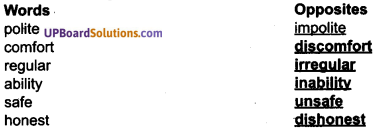
un-, im-, dis., ir-are added before some words to form their opposites.
These are called prefixes.
Rewrite the following words with appropriate prefixes:
Answer:
UP Board Solutions for Class 7 English Chapter 3 Sanjay the Brave Boy img-2

UP Board Solutions

Language Practice

Question 1.
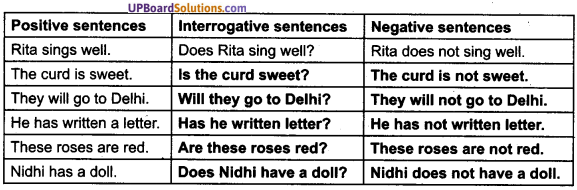
Write the negative and interrogative (UPBoardSolutions.com) sentences of the given positive sentences. One is done for you:
Answer:
UP Board Solutions for Class 7 English Chapter 3 Sanjay the Brave Boy img-3

Activity               Note: Do it yourself.

We hope the UP Board Solutions for Class 7 English Chapter 3 Sanjay the Brave Boy help you. If you have any query regarding UP Board Solutions for Class 7 English Chapter 3 Sanjay the Brave Boy, drop a comment below and we will get back to you at the earliest.