CBSE Sample Papers for Class 10 Maths Paper 7

These Sample papers are part of CBSE Sample Papers for Class 10 Maths. Here we have given CBSE Sample Papers for Class 10 Maths Paper 7.

CBSE Sample Papers for Class 10 Maths Paper 7

Board CBSE
Class X
Subject Maths
Sample Paper Set Paper 7
Category CBSE Sample Papers

Students who are going to appear for CBSE Class 10 Examinations are advised to practice the CBSE sample papers given here which is designed as per the latest Syllabus and marking scheme as prescribed by the CBSE is given here. Paper 7 of Solved CBSE Sample Paper for Class 10 Maths is given below with free pdf download solutions.

Time allowed: 3 Hours
Maximum Marks: 80

General Instructions

  • All questions are compulsory.
  • The question paper consists of 30 questions divided into four sections A, B, C and D.
  • Section A contains 6 questions of 1 mark each. Section B contains 6 questions of 2 marks each. Section C contains 10 questions of 3 marks each. Section D contains 8 questions of 4 marks each,
  •  There is no overall choice. However, an internal choice has been provided in four questions of 3 marks each and three questions of 4 marks each. You have to attempt only one of the alternatives in all such questions.
  • Use of calculators is not permitted.

Section-A

Question 1.
What type of decimal expansion does a rational number has? How can you distinguish it from decimal expansion of irrational numbers?

Question 2.
Coordinates of P and Q are (4,-3) and (-1, 7). What is the abscissa of a point R on the line segment PQ such that [latex]\frac { PR }{ PQ } [/latex] = [latex]\frac { 3 }{ 5 } [/latex] ? (NTSE 2012)

Question 3.
For what value of k will k + 9, 2k – 1 and 2k + 7 are the consecutive terms of an A.P. ?

Question 4.
For the equation 3×2 + px + 3 = 0, if one of the roots is the square of the other then find p. (NTSE 2014-2015)

Question 5.
Find the value of sin (45° + θ) – cos (45° – θ)

Question 6.
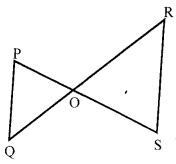
In Fig., if PQ || RS, prove that ∆ POQ ~ ∆ SOR
CBSE Sample Papers for Class 10 Maths Paper 7 img 1

Section-B

Question 7.
When 2256 is divided by 17 then find the remainder.

Question 8.
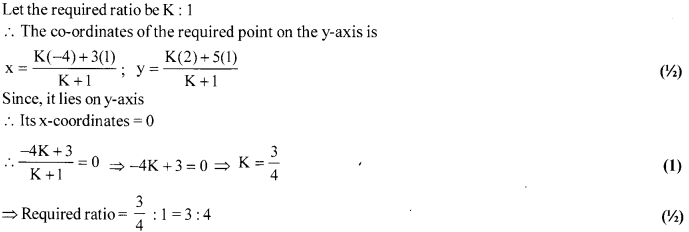
In what ratio, the line segment joining the points (3,5) & (-4,2) is divided byy-axis?

Question 9.
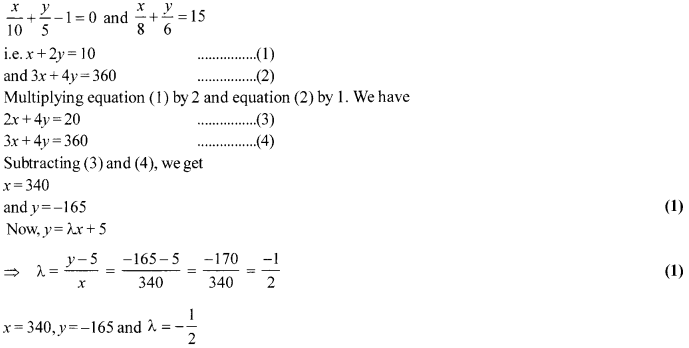
Find the solution of the pair equations [latex s=2]\frac { x }{ 10 } [/latex] + [latex s=2]\frac { y }{ 5 } [/latex] – 1= 0 and [latex s=2]\frac { x }{ 8 } [/latex] + [latex s=2]\frac { y }{ 6 } [/latex] = 15. Hence, find λ, if y = λx + 5.

Question 10.
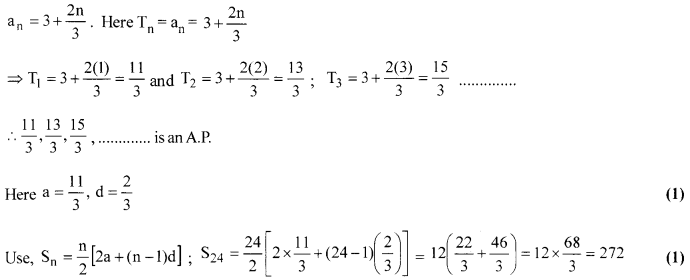
Find the sum of first 24 terms of the sequence whose nth term is an = 3+[latex s=2]\frac { 2n }{ 3 } [/latex]

Question 11.
A girl calculates that the probability of her winning the first prize in a lottery is 0.08. If6000 tickets are sold,

Question 12.
A book containing 100 pages is opened at random. Find the probability that a doublet page is found.

Section-C

Question 13.
Show that any positive odd integer is of the form 8q ± 1 and 8q ± 3, where q is some integer.

Question 14.
If a and 8 are the zeroes of the quadratic polynomial f(x) = ax2 + bx + c then evaluate [latex]\frac { { \alpha }^{ 2 } }{ { \beta }^{ 2 } } +\frac { { \beta }^{ 2 } }{ { \alpha }^{ 2 } } [/latex]

Question 15.
In the given fig, BD ⊥ AC and CE ⊥ AB. Prove that
(i) ∆AEC ~ ∆ADB
(ii) [latex s=2]\frac { CA }{ AB } [/latex] = [latex s=2]\frac { CE }{ DB } [/latex]
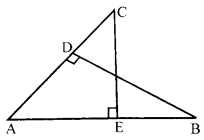
CBSE Sample Papers for Class 10 Maths Paper 7 img 2
OR
In the given fig, [latex s=2]\frac { OA }{ OC } [/latex] = [latex s=2]\frac { OD }{ OB } [/latex] prove that ∠A = ∠C and ∠B = ∠D
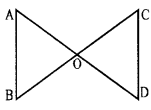
CBSE Sample Papers for Class 10 Maths Paper 7 img 3

Question 16.
Prove that the area of a triangle with vertices (t, t – 2), (t + 2, t + 2) and (t + 3, t) is independent of t.
OR
The three vertices of a parallelogram, taken in order, are (1, -2), (3,6) and (5,10). Find the coordinates of its fourth vertex .

Question 17.
In the given figure, PA and PB are tangents to the circle from an external point P. CD is another tangent touching the circle at Q. If PA = 12 cm, QC = QD = 3 cm, then find PC + PD.
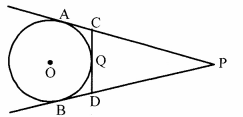
CBSE Sample Papers for Class 10 Maths Paper 7 img 4

Question 18.
Calculate the mean of the following frequency distribution :

CBSE Sample Papers for Class 10 Maths Paper 7 img 5

Question 19.
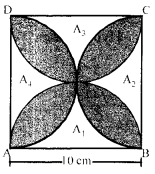
In figure, ABCD is a square of side 10 cm and semicircles are drawn with each side of the square as diameter. Find area of the shaded region.
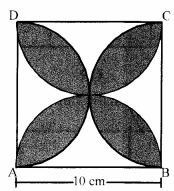
CBSE Sample Papers for Class 10 Maths Paper 7 img 6

Question 20.
A lending library has a fixed charge for the first three days and an additional charge for each day thereafter. Roohi paid ₹ 27 for a book kept for seven days, while Shushama paid₹ 21 for the book she kept for five days. What is the fixed charge?

Question 21.
Without using trigonometric tables, prove that:- tan7° tan 23° tan 60° tan 67° tan 83° = [latex]\sqrt { 3 } [/latex]
OR
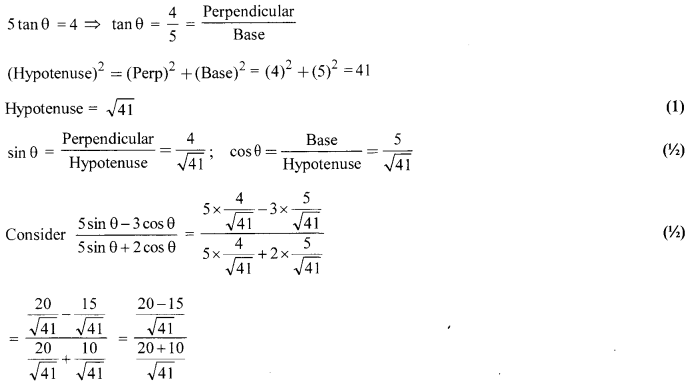
If 5 tan θ = 4, then find the value of [latex s=2]\frac { 5\sin { \theta } -3\cos { \theta } }{ 5\sin { \theta } +2\cos { \theta } } [/latex]

Question 22.
A copper rod of diameter 1cm and length 8 cm, is drawn into a wire of length 18 m of uniform thickness. Find the thickness of wire.
OR
If a solid piece of iron in the form of a cuboid of dimensions 49 cm × 33 cm × 24 cm, is moulded to form a solid sphere. Find the radius of the sphere

Section-D

Question 23.
In a right triangle, prove that the square of the hypoten’use is equal to the sum of the squares of the other two sides.
OR
In a triangle, if the square of one side is equal to the sum of the squares of the other two sides, then prove that the angle opposite to the first side is a right angle.

Question 24.
What is the value of x if
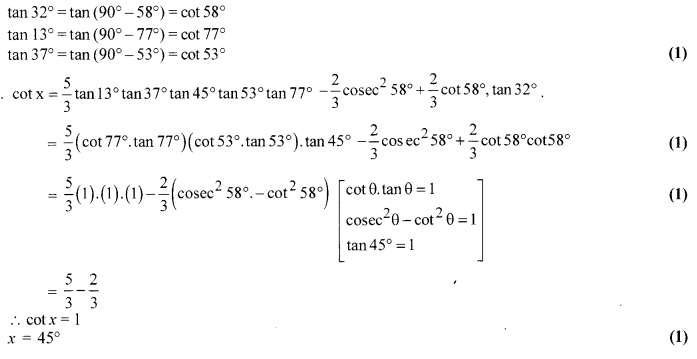
cot x = [latex s=2]\frac { 5 }{ 3 } [/latex] tan 130 tan 37° tan 45 ° tan 53° tan 77° -[latex s=2]\frac { 2 }{ 3 } [/latex] cosec2 58° + [latex s=2]\frac { 2 }{ 3 } [/latex] cot 58° tan 32°.

Question 25.
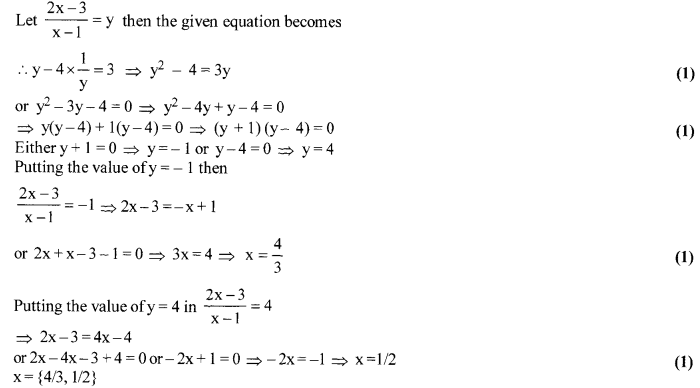
Solve the equation: [latex s=2]\left( \frac { 2x-3 }{ x-1 } \right) -4\left( \frac { x-1 }{ 2x-3 } \right) [/latex] = 3 x ≠ 1, 3/2

Question 26.
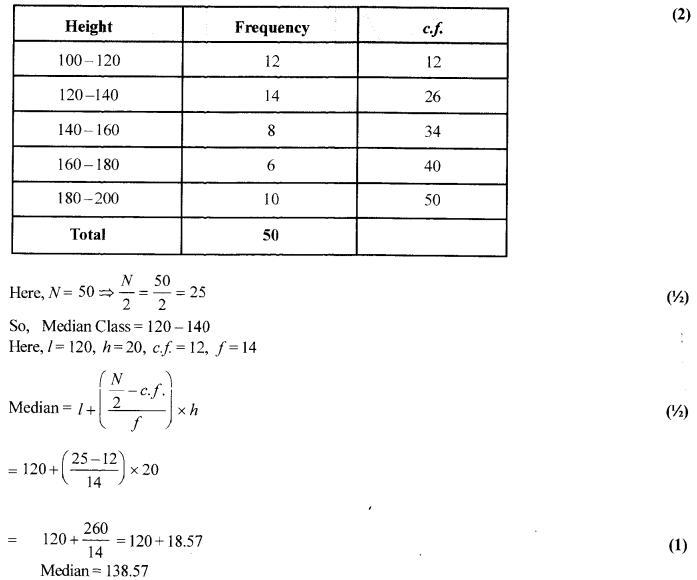
Find the median of the following data :

CBSE Sample Papers for Class 10 Maths Paper 7 img 7

OR
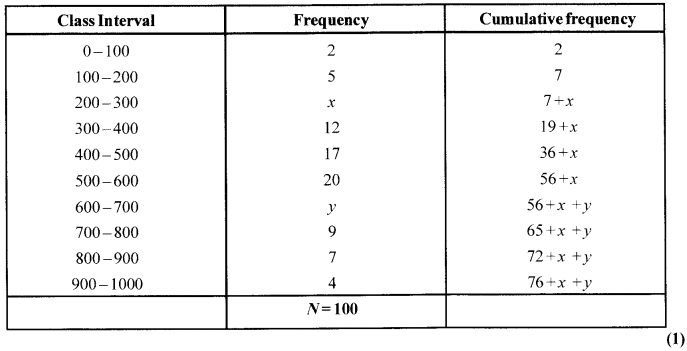
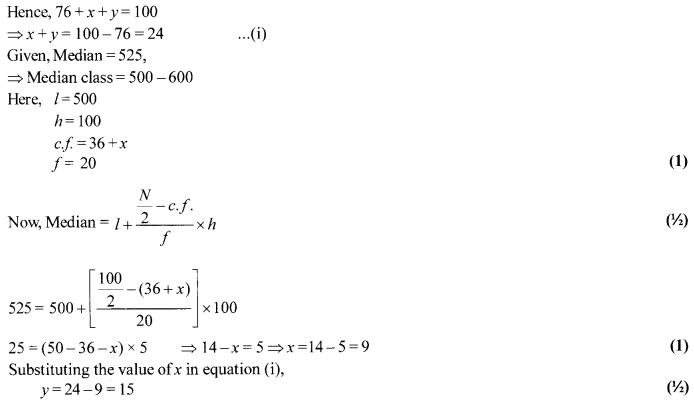
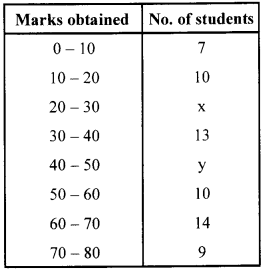
The median ofthe following data is 525. Find the values of* and y if the total frequency is 100.

CBSE Sample Papers for Class 10 Maths Paper 7 img 8

Question 27.
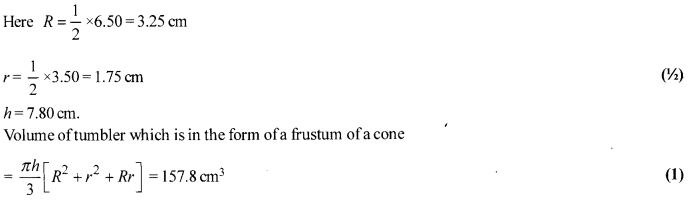
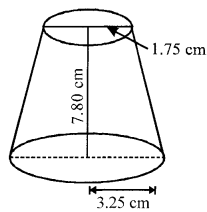
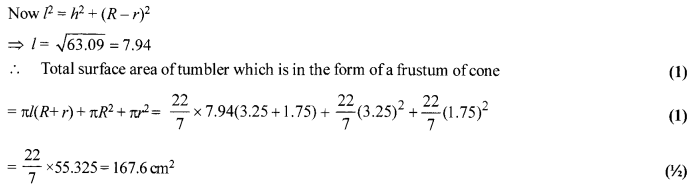
Find the volume and total surface area of a tumbler in the form of a frustum of a cone, if the diameter of the ends are 6.50 cm and 3.50 cm and the perpendicular height ofthe tumbler is 7.80 cm.

Question 28.
Draw a circle of radius 4 cm. Draw two tangents to the circle inclined at an angle of 60° to each other.

Question 29.
If the ratio ofthe sum ofthe first n terms oftwoA.Ps is (7n+ 1): (4n + 27), then find the ratio of their 9th terms.

Question 30.
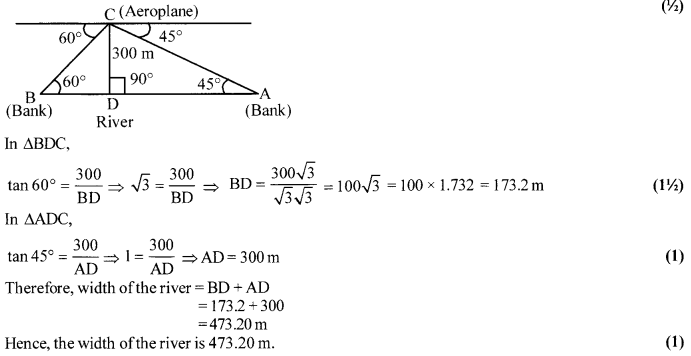
An aeroplane is flying at a height of 300 m above the ground. Flying at this height, the angles of depression from the aeroplane of two points on both banks of a river in opposite directions are 45° and
60° respectively. Find the width ofthe river. [Use [latex]\sqrt { 3 } [/latex] = 1.732]
OR
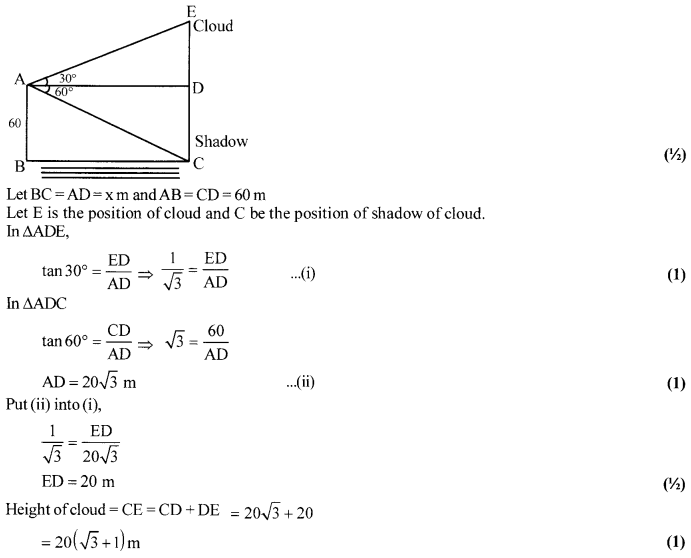
The angle of elevation of a cloud from a point 60 m above the surface ofthe water of a lake is 30° and the angle of depression of its shadow in water of lake is 60°. Find the height ofthe cloud from the surface of water.

Solutions
Section-A

Solution 1.
A rational number is either terminating or non-terminating repeating.
An irrational number is non-terminating and non-repeating. (1)

Solution 2.
P (4, -3) and Q (-1,7)
PR: RQ = 3:2
4 × 2 + (-1) × 3
Abscissa = [latex s=2]\frac { 4\times 2+(-1)\times 3 }{ 3+2 } [/latex]= 1 (1)

Solution 3.
Given k + 9,2k – 1 and 2k + 7 are in AP.
∴ 2(2k – 1) = (k + 9)+(2k + 7) [By Arithmetic mean] (1/2)
⇒ 4k-2 = 3k+16 ⇒ k=18 (1/2)

Solution 4.
α + α2 = [latex s=2]\frac { -p }{ 3 } [/latex] ………..(i)
α3 = [latex s=2]\frac { 3 }{ 3 } [/latex] = 1 =>(α- l)(α3+ α+ 1) = 0 ⇒ α = 1
∴ p= – 6 (∵From (i)) (1)

Solution 5.
Given that
sin (45° + θ) – cos (45° – θ) = cos [90° – (45° + θ)] – cos (45° – θ) [∵ cos (90° – θ) = sin θ]
= cos (45° – θ) – cos (45° – θ) = 0 (1)

Solution 6.
PQ || RS (Given)
So, ∠P = ∠S (Alternate angles)
and ∠Q=∠R (1/2)
Also, ∠POQ = ∠ SOR (Vertically opposite angles)
Therefore, ∆POQ ~ ∆SOR (AAA similarity criterion) (1/2)

Section-B

Solution 7.
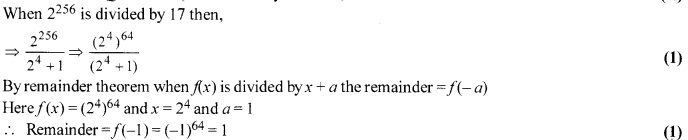
CBSE Sample Papers for Class 10 Maths Paper 7 img 9

Solution 8.
CBSE Sample Papers for Class 10 Maths Paper 7 img 10

Solution 9.
CBSE Sample Papers for Class 10 Maths Paper 7 img 11

Solution 10.
CBSE Sample Papers for Class 10 Maths Paper 7 img 12

Solution 11.
P (winning) = 0.08
Total tickets sold = 6000
Let the number of tickets she bought be x, then probability of winning =[latex s=2]\frac { x }{ 6000 } [/latex] (1)
⇒[latex s=2]\frac { x }{ 6000 } [/latex] = 0.08 ⇒ x = 6000 × 0.08 ⇒ x = 480 (1)
Thus the girl bought 480 tickets.

Solution 12.
S= {1,2,3, ,100} (1/2)
n(S)= 100
E ={ 11,22,33,44, 55,66,77, 88,99} (1)
n(E) = 9
∴P(E) = [latex s=2]\frac { 9 }{ 100 } [/latex] (1/2)

Section-C

Solution 13.
Let a and b be two positive integers where a is odd.
Applying division lemma a = 8q + r where 0 < r < 8
So, r can take any of the values 0, 1,2,3,4,5,6,7
Therefore, a= 8q, 8q + 1, 8q + 2, 8q + 3, 8q + 4,
8q + 5, 8q + 6, 8q + 7 (1)
Since, a is odd.
Therefore, a cannot take values 8q, 8q + 2, 8q + 4, 8q + 6 since they can expressed as multiples of 2.
So, a will take values 8q+ 1,8q + 3, 8q + 5, 8q + 7. (1)
Also, 8q + 5 = 8q + 8 – 3 = 8 (q + 1) – 3 = 8q’ — 3
where q’ = q + 1, 8q + 7 = 8q + 8 – 1 =8q’- 1
So, every positive odd integer is of the form 8q ± 1, 8q ± 3. (1)

Solution 14.
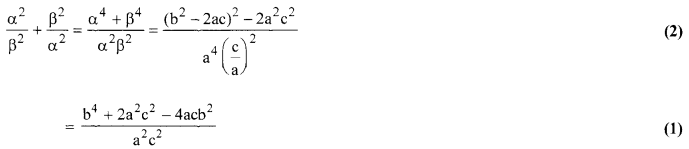
CBSE Sample Papers for Class 10 Maths Paper 7 img 13

Solution 15.
Given: In the fig., BD ⊥ AC and CE ⊥AB
To prove: (i) ∆AEC ~ ∆ADB
(ii) [latex s=2]\frac { CA }{ AB } [/latex] = [latex s=2]\frac { CE }{ DB } [/latex] (1)
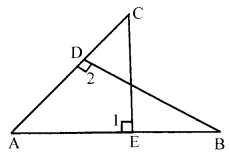
CBSE Sample Papers for Class 10 Maths Paper 7 img 14
Proof (i) In ∆AEC and ∆ADB
∠1 = ∠2 (each 90°)
∠A = ∠A (common)
∴ ∆AEC ~ ∆ADB (by AArule)
(ii) ∆AEC ~ ∆ADB
[latex s=2]\frac { CA }{ AB } [/latex] = [latex s=2]\frac { CE }{ DB } [/latex] (∵ Angles are similar ∴ corresponding sides are proportional) (1)
Hence proved
OR
[latex s=2]\frac { OA }{ OC } [/latex] = [latex s=2]\frac { OD }{ OB } [/latex]
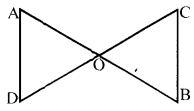
CBSE Sample Papers for Class 10 Maths Paper 7 img 15
To prove: ∠A = ∠C and ∠B = ∠D (1)
Proof: In ∆AOD and ∆BOC
[latex s=2]\frac { OA }{ OC } [/latex] = [latex s=2]\frac { OD }{ OB } [/latex] (Given)
and ∠AOD = ∠BOC (Vertically opposite angles)
∴ ∆AOD ~ ∆BOC (by SAS) (1)
∴ ∠A = ∠C and ∠B = ∠D (C.P.C.T.) (1)

Solution 16.
Let A (t, t – 2), B (t + 2, t + 2) and C (t + 3, t) be the vertices of the given triangle. (1/2)
Since the area of the triangle having vertices (x1, y1), (x2, y2) and(x3, y3)

CBSE Sample Papers for Class 10 Maths Paper 7 img 16
Therefore, the area of the triangle with specified vertices is independent of t. (1/2)
OR
Let fourth vertex be D (a, b)
Let the diagonals AC and BD intersect at E,
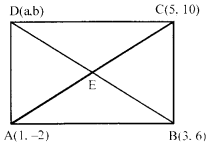
CBSE Sample Papers for Class 10 Maths Paper 7 img 17
We know that the diagonals of a parallelogram bisect each other.
∴ E is the mid-point of AC as well as that ofBD.
mid-point of AC is
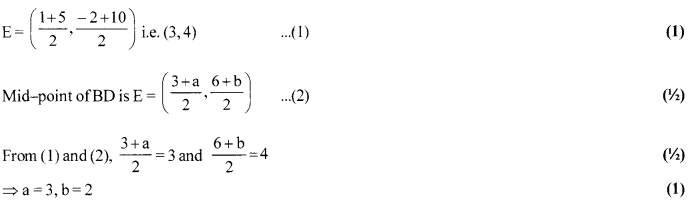
CBSE Sample Papers for Class 10 Maths Paper 7 img 18
Hence, The fourth vertex of the given parallelogram is D (3,2). (1)

Solution 17.
Given : PA and PB are tangents to the circle from an external point P. CD is another tangent at Q. PA= 12 cm, QC = QD = 3 cm
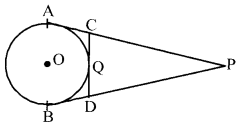
CBSE Sample Papers for Class 10 Maths Paper 7 img 19
To find: PC + PD (1/2)
Proof: PA = PC + AC
12 = PC+ 3
[∵ QC = AC = 3 cm, tangents from external point to a circle are equal in length]
PC = 9 cm …(i) (1)
Similarly, BD = QD = 3 cm
and PB = PA =12 cm (1/2)
PB = PD + BD
12 = PD +3
PD = 9 cm
Now, PC + PD = 9 + 9 = 18 cm (1)

Solution 18.
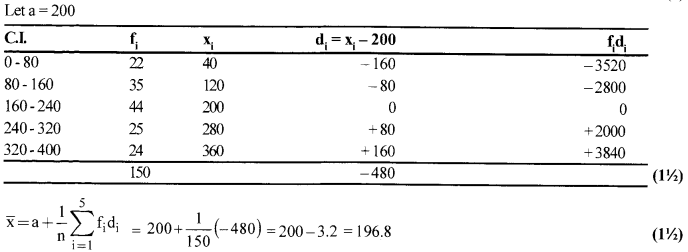
CBSE Sample Papers for Class 10 Maths Paper 7 img 20

Solution 19.
We mark the area of unshaded regions as A1,A2A3 and A4 as shown in the figure.
Area of the shaded region = Area of the square ABCD – Area of the unshaded portion (A1+A2+A3+ A4).
CBSE Sample Papers for Class 10 Maths Paper 7 img 21
Area of unshaded region A1+A3= Area of square ABQD – Area of semi circle on BC as diameter- Area of semi-circle on AD as diameter.

CBSE Sample Papers for Class 10 Maths Paper 7 img 22
Similarly, area of unshaded region A2 – A4 = Area of square ABCD – Area of the semi-circles on diameter AB and DC
So, Area A2+A4 = 102 -2× [latex s=2]\frac { \pi \times { 5 }^{ 2 } }{ 2 } [/latex] =100-25π.
So,Area A1 + A2 + A3 + A4 = 200-50π.
Area of the shaded region = Area of square ABCD – Area (A1 + A2 + A3 + A4) (1)
= 102-(200-50π)
= (100-200 + 50 π)sq. cm.
= 50 π -100 = 50 (π – 2) sq. cm.
= 50 (3.14-2)= 50 × 1.14 = 57 cm2. (1)

Solution 20.
x = F ixed charge
y = Additional charge for each day
x + 4y = 27 …(i)
x + 2y = 21 …(ii) (1)
⇒ (x + 4y)-(x+ 2y) = 27-21 => 2y = 6 ⇒y = 3 (1)
∵ x + 2y=21 =>orx + 2(3) = 21 ⇒ x= ₹ 15 (1)

Solution 21.
L.H.S.
= tan 7° tan 23° tan 60° tan 67° tan 83°= tan 7° tan 83° tan 23° tan 67° tan 60° (1)
= tan 7° cot 7° tan 23° cot 23° tan 60°(1)

CBSE Sample Papers for Class 10 Maths Paper 7 img 23
OR
CBSE Sample Papers for Class 10 Maths Paper 7 img 24
CBSE Sample Papers for Class 10 Maths Paper 7 img 25

Solution 22.
Volume of rod = πr2h = π × (1/2)2 × (8) = 2πcm3 ….(i) (1)
Length of wire of same volume = 18m = 1800 cm.
Let ‘r’ be the radius of cross-section of wire (1/2)
∴ Volume = πr2h
Volume of wire = πr2 × 1800 ….(ii)
From (i) & (ii), πr2 × 1800 = 2π
r2 = 2/1800 =>r2= 1/900 =>r=1/30cm. (1)
Thickness of wire = diameter of cross-section = 2r = 2 × [latex s=2]\frac { 1 }{ 30 } [/latex] = [latex s=2]\frac { 1 }{ 15 } [/latex] = 0.067 cm (approximately) (1/2)
OR
Given, dimensions of the cuboid
= 49 cm x 33 cm x 24 cm
Now, volume of the cuboid
= 49x33x24 = 38808 cm3
Let the radius of the sphere is r, then (1/2)
Volume of the sphere = [latex s=2]\frac { 4 }{ 3 } [/latex]πr3 (1/2)
According to the given condition
Volume of the sphere = Volume of the cuboid (1/2)

CBSE Sample Papers for Class 10 Maths Paper 7 img 26

Section-D

Solution 23.
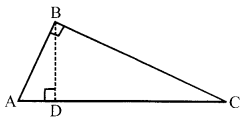
Given: A triangle ABC in which ZB = 90°.
CBSE Sample Papers for Class 10 Maths Paper 7 img 27
To prove : ACsup>2 = ABsup>2 + BCsup>2 or (Hypotenuse)sup>2 = (Base)sup>2 + (Perpendicular)sup>2
Construction : From B, drawBD⊥ AC. (1)
Proof: Since BD ⊥AC.
∴∆ADB ~ ∆ABC
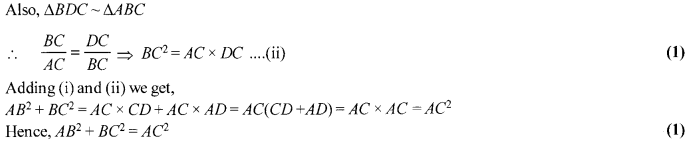
∴[latex s=2]\frac { AD }{ AB } [/latex] = [latex s=2]\frac { AB }{ AC } [/latex] ⇒AB2 =AC ×AD …(i) (1)
CBSE Sample Papers for Class 10 Maths Paper 7 img 28
OR
CBSE Sample Papers for Class 10 Maths Paper 7 img 29

Solution 24.
CBSE Sample Papers for Class 10 Maths Paper 7 img 30

Solution 25.
CBSE Sample Papers for Class 10 Maths Paper 7 img 31

Solution 26.
CBSE Sample Papers for Class 10 Maths Paper 7 img 32
OR
CBSE Sample Papers for Class 10 Maths Paper 7 img 33
CBSE Sample Papers for Class 10 Maths Paper 7 img 34

Solution 27.
CBSE Sample Papers for Class 10 Maths Paper 7 img 35
CBSE Sample Papers for Class 10 Maths Paper 7 img 36
CBSE Sample Papers for Class 10 Maths Paper 7 img 37

Solution 28.
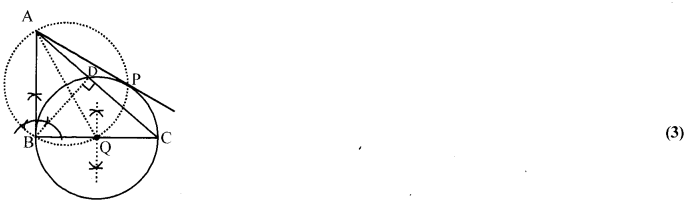
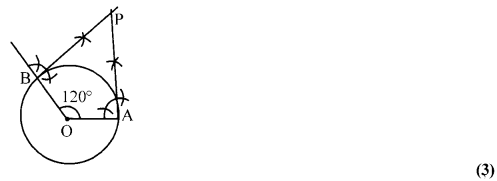
Steps of construction:
1. Draw a circle of radius 4 cm, with O as centre.
2. Take a pointAon the circumference ofthe circle andjoin OA. Draw a perpendicular to OA at A.
3. Draw a radius OB, making an angle of 120° with OA.
4. Draw a perpendicular to OB at B. Suppose these perpendiculars intersect at P.
CBSE Sample Papers for Class 10 Maths Paper 7 img 38
Here, PA and PB are two tangents drawn to the circle inclined at an angle of 60° to each other.
Justification
The construction can be justified by proving that
∠APB = 60°.
∠OAP = 90° (By Construction)
∠OBP = 90° (By Construction)
∠AOB=120° (By Construction)
The sum of all interior angles of a quadrilateral is 360°,.
∠OAP + ∠AOB + ∠OBP + ∠APB = 360° .
⇒ 90°+120°+ 90° +∠APB = 360° (1)
⇒ ∠APB = 60°

Solution 29.
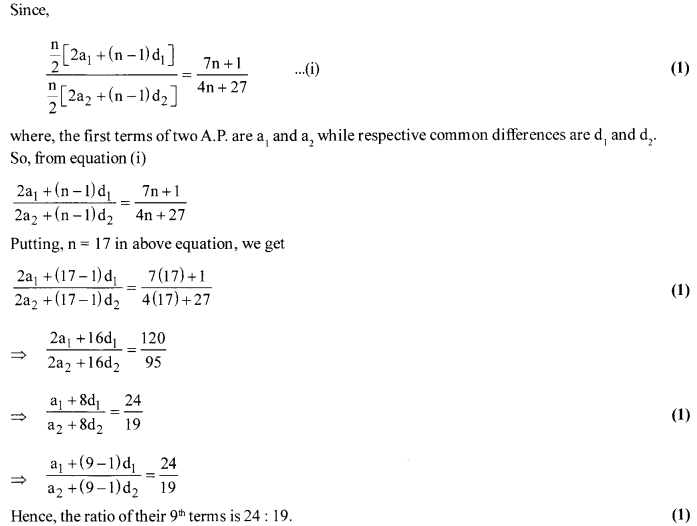
CBSE Sample Papers for Class 10 Maths Paper 7 img 39

Solution 30.
CBSE Sample Papers for Class 10 Maths Paper 7 img 40
OR
CBSE Sample Papers for Class 10 Maths Paper 7 img 41

We hope the CBSE Sample Papers for Class 10 Maths paper 7 help you. If you have any query regarding CBSE Sample Papers for Class 10 Maths paper 7, drop a comment below and we will get back to you at the earliest.
CBSE Sample Papers for Class 10 Maths Paper 6

These Sample papers are part of CBSE Sample Papers for Class 10 Maths. Here we have given CBSE Sample Papers for Class 10 Maths Paper 6.

CBSE Sample Papers for Class 10 Maths Paper 6

Board CBSE
Class X
Subject Maths
Sample Paper Set Paper 6
Category CBSE Sample Papers

Students who are going to appear for CBSE Class 10 Examinations are advised to practice the CBSE sample papers given here which is designed as per the latest Syllabus and marking scheme as prescribed by the CBSE is given here. Paper 6 of Solved CBSE Sample Paper for Class 10 Maths is given below with free pdf download solutions.

Time allowed: 3 Hours
Maximum Marks: 80

General Instructions

  • All questions are compulsory.
  • The question paper consists of 30 questions divided into four sections A, B, C andD.
  • Section A contains 6 questions of 1 mark each. Section B contains 6 questions of 2 marks each. Section C contains 10 questions of 3 marks each. Section D contains 8 questions of 4 marks each,
  •  There is no overall choice. However, an internal choice has been provided in four questions of 3 marks each and three questions of 4 marks each. You have to attempt only one of the alternatives in all such questions.
  • Use of calculators is not permitted.

Section-A

Question 1.
Explain why 3 × 5 × 7 + 7 is composite number.

Question 2.
If sin A = [latex]\frac { 1 }{ \sqrt { 2 } } [/latex] and tan B = 1. Prove that sin (A+ B) = 1, where A, B are acute angles.

Question 3.
In Fig. DE || BC. HAD = x, DB = x – 2,AE=x +2 and EC = x – 1, find the value ofx.
CBSE Sample Papers for Class 10 Maths Paper 6 img 1

Question 4.
Find the distance of origin from the point P(3, -2). (NTSE2012)

Question 5.
Find the 9th term from the end (towards the first term) ofthe AP. 5,9,13,……, 185

Question 6.
Find the discriminant ofthe quadratic equation 3[latex]\sqrt { 3 } [/latex]x2 +10x + [latex]\sqrt { 3 } [/latex] = 0

Section-B

Question 7.
Show that 5- [latex]\sqrt { 3 } [/latex] is not irrational.

Question 8.
Cards marked with numbers 13,14,15,…….., 60 are placed in a box and mixed thoroughly. One card is
drawn at random from the box. Find the probability that the number on drawn card is
(i) divisible by 5
(ii) a number which is a perfect square

Question 9.
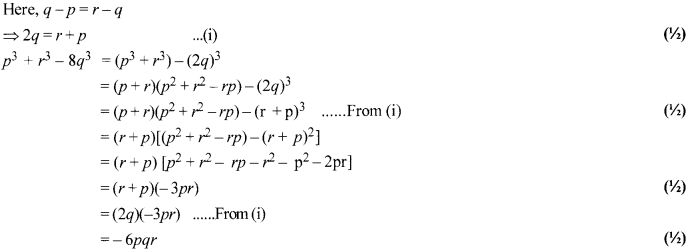
If p, q, r are in A.P. then find the value of p3 +r3 – 8q3.

Question 10.
For all real values of c, the pair of equations
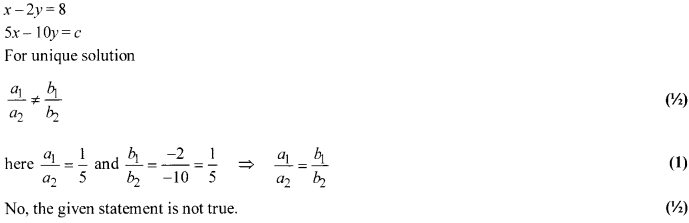
x – 2y = 8
5x- 10y = c
have a unique solution. Justify whether it is true or false.

Question 11.
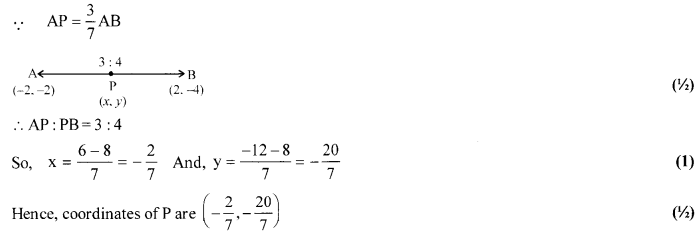
If the coordinates of points A and B are (-2, -2) and (2, -4) respectively, find the coordinates of P such that AP= [latex s=2]\frac { 3 }{ 7 } [/latex]AB, where Plies on the line segment AB.

Question 12.
A piggy bank contains hundred 50p coins, fifty ₹ 1 coins, twenty ₹ 2 coins and ten ₹ 5 coins. If it is equally likely that one of the coins will fall out when the bank is turned upside down, what is the probability that the coin (i) will be a 50 p coin ? (ii) will not be a ₹ 5 coin?

Section-C

Question 13.
Show that any positive odd integer is of the form 6q – 1 or 6q + 5, where q is some integer.

Question 14.
What must be subtracted from x3 – 6x2 – 15x + 80, so that the result is exactly divisible by x2 + x— 12.

Question 15.
If a cos θ + b sinθ = m and a sin θ – b cosθ = n, prove that a2 + b2 = m2 + n2
OR
If x = r sin A cos C, y = r sin A sin C, z = r cos A, Prove that : r2 = x2+ y2+ z2

Question 16.
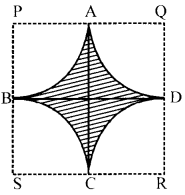
Calculate the area of the shaded portion.
The quadrants shown in the figure are each of radius 7 cm. [Take π = [latex s=2]\frac { 22 }{ 7 } [/latex]]
CBSE Sample Papers for Class 10 Maths Paper 6 img 2

Question 17.
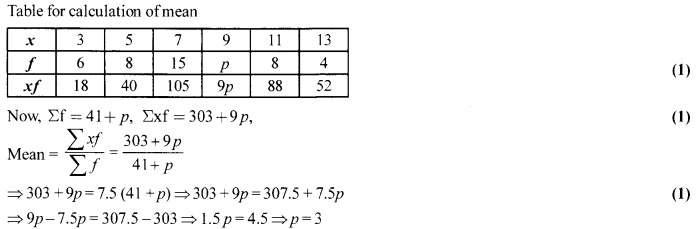
If mean of the following frequency distribution is 7.5, then find the value of p.
CBSE Sample Papers for Class 10 Maths Paper 6 img 3

Question 18.
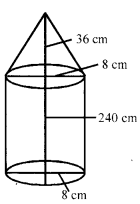
An iron pillar has some part in the form of a right circular cylinder and remaining in the form of a right circular cone. The radius of the base of each cone and cylinder is 8 cm. The cylindrical part is 240 cm high and the conical part is 36 cm high. Find the weight of the Pillar if one cubic cm. of iron weights 7.8 gms.
OR
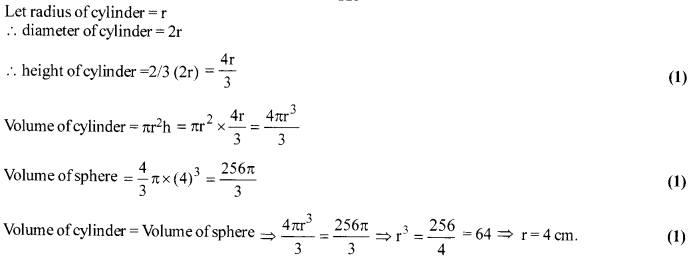
A cylinder whose height is two-third of its diameter has the same volume as a sphere of radius 4 cm. Calculate the radius of the base of the cylinder.

Question 19.
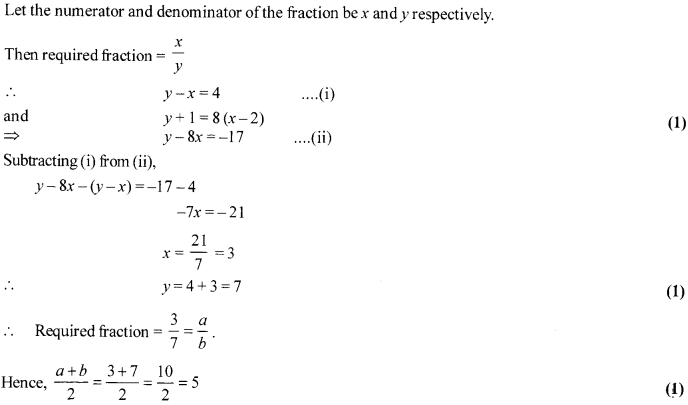
The numerator of a fraction is 4 less than the denominator. If the numerator is decreased by 2 and the denominator is increased by 1, then the denominator is eight times the numerator. The fraction is [latex s=2]\frac { a }{ b } [/latex] . Find [latex s=2]\frac { a+b }{ 2 } [/latex]

Question 20.
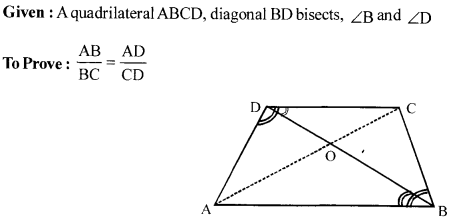
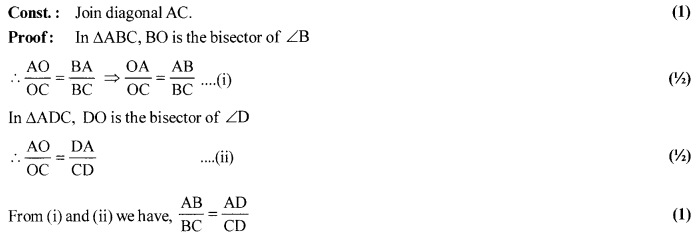
If the diagonal BD of a quadrilateral ABCD bisects both ∠B and ∠D then show that [latex s=2]\frac { AB }{ BC } [/latex] = [latex s=2]\frac { AD }{ CD } [/latex]
OR
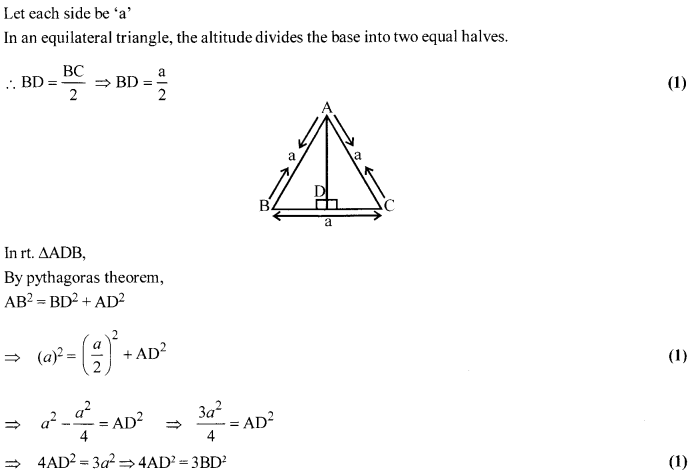
In an equilateral triangle ABC, AD is drawn perpendicular to BC. Prove that 4 AD2 = 3BD2

Question 21.
Find the values ofk so that the area of the triangle with vertices (1, -1), (-4,2k) and (-k, -5) is 24 sq. units.
OR
If the point P (x, y) is equidistant from the points A (a + b, b – a) and B (a – b, a + b). Prove that bx = ay.

Question 22.
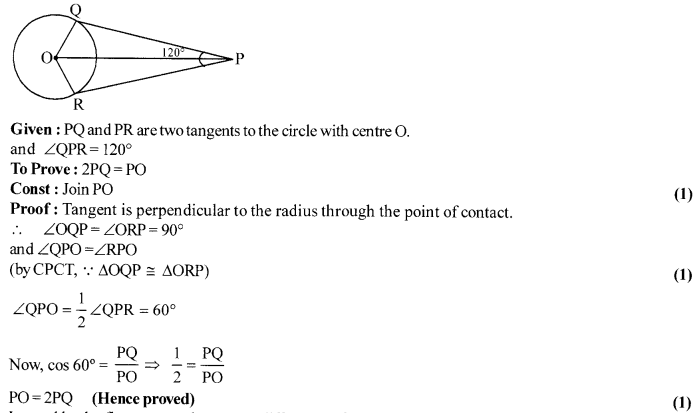
If from an external point P of a circle with centre 0, two tangents PQ and PR are drawn such that ∠QPR =120°, prove that 2PQ = PO.

Section-D

Question 23.
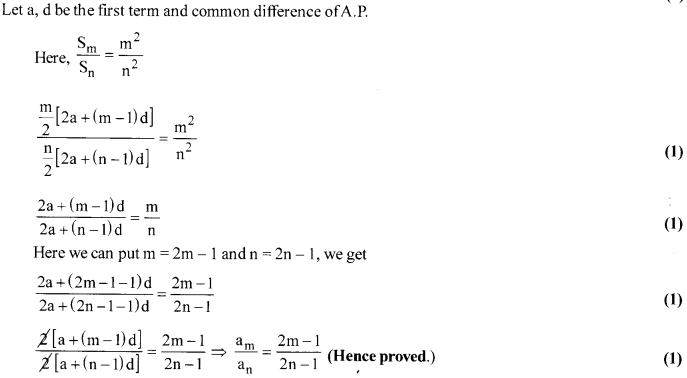
The ratio of the sums of first m and first n terms of an A.P. is m2: n2. Show that the ratio of its mth and nth terms is (2m -1): (2n – 1).

Question 24.
If the areas of two similar triangles are equal, prove that they are congruent.
OR
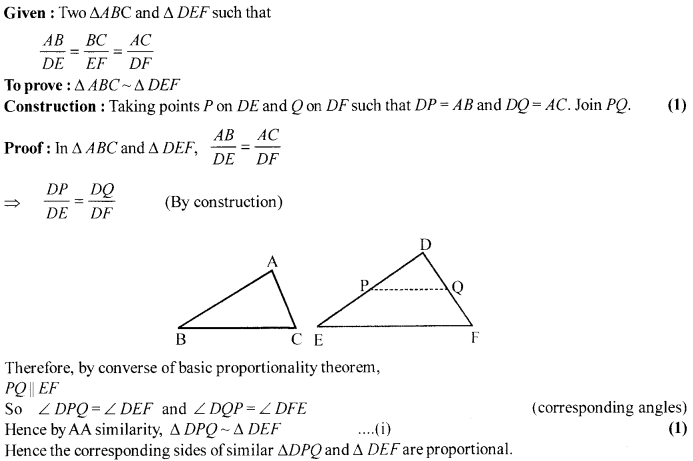
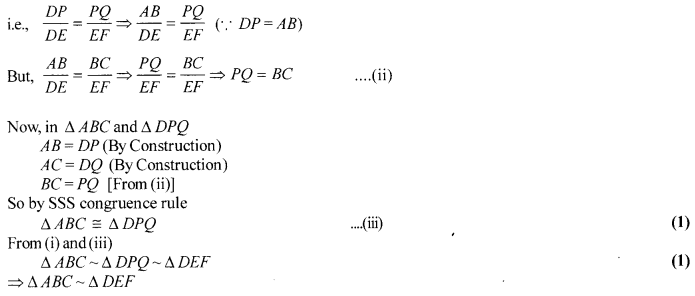
If the corresponding sides of two triangles are proportional (i.e., in the same ratio), then prove that their corresponding angles are equal and hence the two triangles are similar.

Question 25.
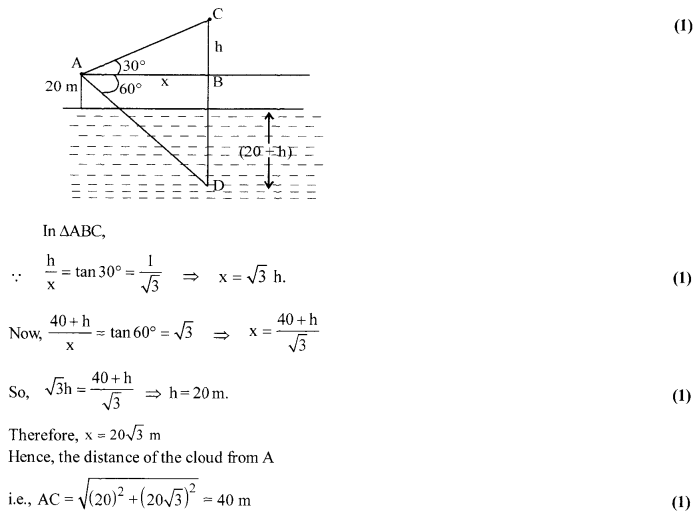
At a point A, 20 metres above the level of water in a lake, the angle of elevation of a cloud is 30°. The angle of depression of the reflection of the cloud in the lake, at A is 60°. Find the distance of the cloud from A.
OR
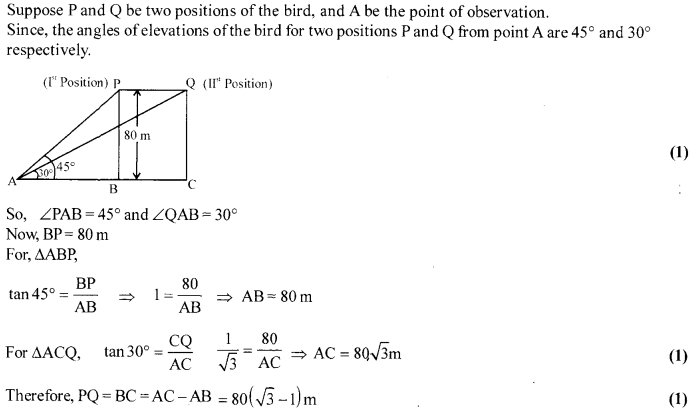
A bird is sitting on the top of a 80 m high tree. From a point on the ground, the angle of elevation of the bird is 45°. The bird flies away horizontally in such a way that it remained at a constant height from the ground. After 2 seconds, the angle of elevation of the bird from the same point is 30°. Find the speed of flying of the bird.
(Take [latex]\sqrt { 3 } [/latex] =1.732)

Question 26.
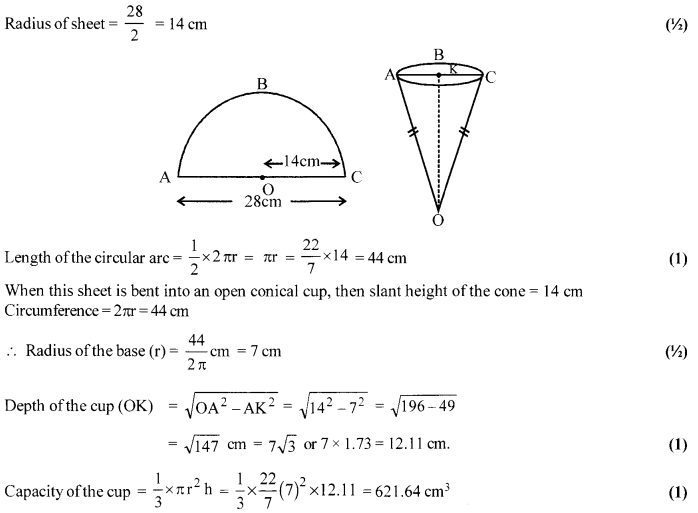
A semicircular sheet of metal of diameter 28 cm is bent into an open conical cup. Find the depth and capacity of the cup.

Question 27.
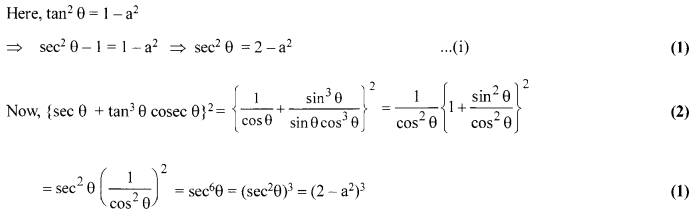
If θ be an acute angle such that tan2 θ = 1 – a2, then find the value of {sec θ + tan3 θ cosec θ}2

Question 28.
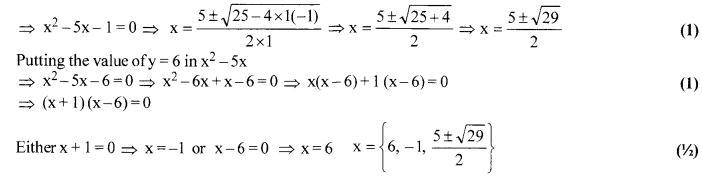
Solve the quadratic equation (x2 – 5x)2 – 7(x2 – 5x) + 6 = 0.

Question 29.
Construct a triangle with sides 5 cm, 5.5 cm and 6.5 cm. Now construct another triangle, whose sides are [latex s=2]\frac { 3 }{ 5 } [/latex] times the corresponding sides of the given triangle.

Question 30.
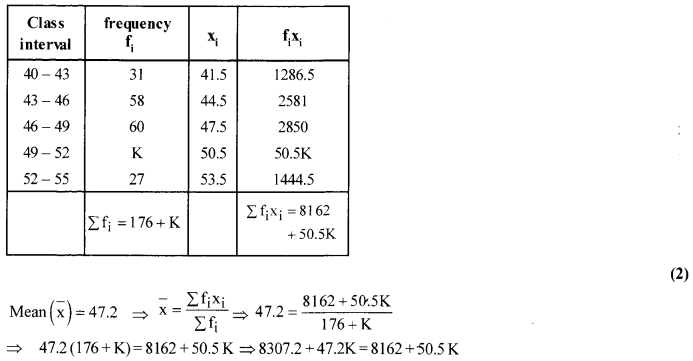
Following table gives the ages in years of militants operating in a certain area of a country:
CBSE Sample Papers for Class 10 Maths Paper 6 img 4
If mean of the above distribution is 47.2, find how many militants in the age groups 49-52 are active in the area?
OR
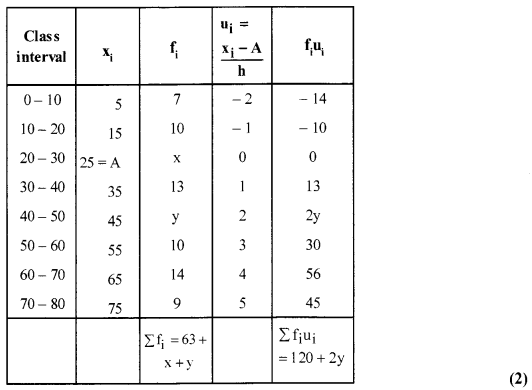
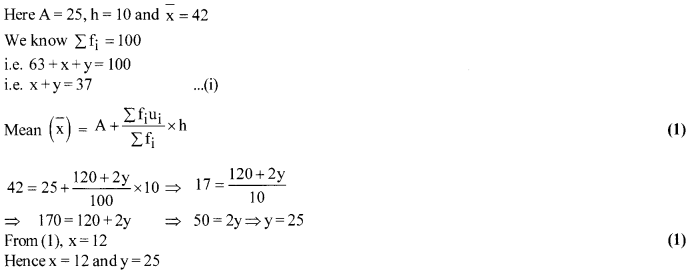
One hundred students took an examination. Compute values ofx and y from the following data if mean is 42.
CBSE Sample Papers for Class 10 Maths Paper 6 img 5

Solutions
Section-A

Solution 1.
3 × 5 ×7+7 = 7 (3 × 5 + 1) = 7 (16), which has more than two factors.
∴ It is a composite number. (1)

Solution 2.
sinA= [latex s=2]\frac { 1 }{ \sqrt { 2 } } [/latex] ⇒ A=45°

and tan B = 1 ⇒ B = 45° (1/2)
∴ sin (A + B) = sin (45° + 45°) ⇒ sin 90° = 1 Hence Proved. (1/2)

Solution 3.
In ∆ABC, we have DE || BC
∴ [latex s=2]\frac { AD }{ DB } [/latex] = [latex s=2]\frac { AE }{ EC } [/latex] By Thale’s Theorem] (1/2)

⇒ [latex s=2]\frac { x }{ x-2 } [/latex] = [latex s=2]\frac { x+2 }{ x-1 } [/latex]
⇒x(x-1) = (x-2)(x +2) ⇒ x2 – x = x2 – 4 ⇒x = 4 (1/2)

Solution 4.
Distance = [latex]\sqrt { { (0-3) }^{ 2 }+{ (0+2) }^{ 2 } } =\sqrt { 9+4 } =\sqrt { 13 } [/latex] (1)

Solution 5.
Common difference of the AP = d = 9 – 5 = 4
Last term of the AP = l= 185 (1/2)
Since the nth term from the end of an AP is given by l – (n – 1 )d.
So, the 9th term from the end is = 185 – (9 – 1)4 = 185 – 32= 153 (1/2)

Solution 6.
D = b2 – 4ac = (10)2 – 4(3[latex]\sqrt { 3 } [/latex] )([latex]\sqrt { 3 } [/latex]) = 100 – 36 = 64 (1)

Section-B

Solution 7.
If 5 – [latex]\sqrt { 3 } [/latex] is not irrational.
Let 5 – [latex]\sqrt { 3 } [/latex] = [latex s=2]\frac { p }{ q } [/latex] [p and q are integers, q ≠ 0] (1/2)
⇒[latex s=2]\frac { 5q-p }{ q } [/latex] = [latex]\sqrt { 3 } [/latex] ⇒ [latex s=2]\frac { 5q-p }{ 3 } [/latex] is rational number  (1)
So, [latex]\sqrt { 3 } [/latex] should be rational.
But [latex]\sqrt { 3 } [/latex] is irrational, it cannot be equal to rational number, Hence 5 -[latex]\sqrt { 3 } [/latex] is irrational. (1/2)

Solution 8.
Total no. of cards = 60-12 = 48
Numbers are 13,14,15,16,……….,60.
(i) Numbers divisible by 5 are 15, 20,25, 30, 35, 40, 45, 50, 55, 60. (1/2)
∴ Favourable outcomes = 10
∴ P(no. is divisible by 5) = [latex s=2]\frac { 10 }{ 48 } [/latex] = [latex s=2]\frac { 5 }{ 24 } [/latex] (1/2)
(ii) Perfect square numbers are 16,25,36,49 (1/2)
∴ Ptperfect square) = [latex s=2]\frac { 4 }{ 48 } [/latex] = [latex s=2]\frac { 1 }{ 12 } [/latex] (1/2)

Solution 9.
CBSE Sample Papers for Class 10 Maths Paper 6 img 6

Solution 10.
CBSE Sample Papers for Class 10 Maths Paper 6 img 7

Solution 11.
CBSE Sample Papers for Class 10 Maths Paper 6 img 8

Solution 12.
Number of 50 p coins = 100
Number of ₹ 1 coins = 50
Number of ₹ 2 coins = 20
Number of ₹ 5 coins = 10
Total number of coins = 180 (1/2)
Then (i) P (50 p coin) = [latex s=2]\frac { 100 }{ 180 } [/latex] = [latex s=2]\frac { 5 }{ 9 } [/latex]
(ii) P (not a ₹ 5 coin) = 1 – P (a ₹ 5 coin) (1/2)
= 1- [latex s=2]\frac { 10 }{ 180 } [/latex] = 1- [latex s=2]\frac { 1 }{ 18 } [/latex] = [latex s=2]\frac { 17 }{ 18 } [/latex] (1)

Section-C

Solution 13.
Let a be any positive integer and b = 6
Then by Euclid’s algorithm, a = bq + r, o < r < b (1/2)
Wehavea = 6q+r   …(1)
Since 0 ≤ r < 6, So, r = 0,1,2,3,4,5
∴ From(1), forr = 0, a = 6q
forr = 1, a = 6q + 1
forr = 2, a = 6q + 2
forr = 3, a = 6q + 3
forr = 4, a = 6q + 4
forr = 5, a = 6q + 5   (1/2)
Since 6q is divisible by 2,
∴ 6q is even. (1)
6q + 1 is not divisible by 2. So, 6q + 1 l is odd.
6q + 2 is divisible by 2
∴ 6q + 2 is even. (1)
6q + 3 is not divisible by 2. So, 6q + 3 is odd.
6q + 4 is divisible by 2.
∴ 6q + 4 is even.
6q + 5 is not divisible by 2. So, 6q + 5 is odd. (1/2)
So, we see that 6q, 6q + 2, 6q + 4 are even. Since the number which are not divisible by 2 are odd integer.
∴ 6q +1, 6q + 3, 6q + 5 are odd integer. Hence any positive odd integer is ofthe form 6q + 1, or 6q + 3, or 6q + 5, where q is some integer. (1/2)

Solution 14.
Let (ax + b) be subtracted from given polynomial p(x), so that it is exactly divisible by x2 + x – 12 Then, .
q (x) = x3-6x2 – 15x + 80 – (ax + b)
= x3 -6x2 – (15 + a)x + (80 -b) (1/2)
∵ Dividend = Divisor × quotient + remainder (A)
But remainder will be zero.
∴ Dividend = Divisor x quotient
q (x) = (x2 + x – 12) x quotient
∴q(x) = x3-6x2-(15+a)x + (80 – b) (1/2)
Also, x(x2 +x- 12)-7(x2 +x- 12)
= x3 + x2 – 7x2 – 12x – 7x + 84
= x3 – 6x2 – 19x + 84 (1)
Hence, x3 – 6x2 – 19x + 84 = x3 – 6x2 – (15 + a)x + (80 – b)
– 15 – a = – 19 ⇒ a = + 4 and 80 – b = 84 ⇒ b = – 4 (1)
Hence, ifinp (x) we subtracted 4x – 4 = (ax + b), then it is exactly divisible by x2 + x – 12

Solution 15.
m = a cos θ + b sin θ
(m)2= (a cos θ + b sin θ)2
m2 = a2 cos2 θ + bs2 sin2θ + 2ab cos θ sin θ …(i) (1)
also, n = a sin θ – b cos θ ;
(n)2 = (a sin θ – b cos θ)2
n2 = a2sin2 θ + b2 cos2 θ – 2ab cos θ sin θ …(ii) (1)
On adding equation (i) and (ii), we get
m2 + n2 = a2 cos2 θ + b2 sin2 θ + a2 sin2 θ + b2 cos2 θ
= 2(cos2 θ + sin2 θ) + b2(sin2θ + cos2 θ) (1)
m2 + n2 = a2 + b2
Hence proved.
OR
x = r sin A cos C, y = r sin A sin C and z = r cos A
x2+ y2+ z2 = r2sin2A cos2C + =(r2 sin2A ) (cos2C + sin2C) +r2 cos2A  (1)
= r2 sin2 A(1) + r2 cos2(1/2)
= r2(sin2 A + cos2 A) =r2 Hence Proved. (1/2)

Solution 16.
Draw square PQRS as shown in the figure given below.
Here PQ= QR = PS= RS = 14 cm (1)
Area of the shaded portion = Area of the square PQRS – Area of four equal quadrants (1)
= 14 × 14 – 4 × [latex s=2]\frac { 1 }{ 4 } [/latex]π × (7)2 =196 – [latex s=2]\frac { 22 }{ 7 } [/latex] 7 ×7
= 196-154 =42 cm2
CBSE Sample Papers for Class 10 Maths Paper 6 img 9

Solution 17.
CBSE Sample Papers for Class 10 Maths Paper 6 img 10

Solution 18.
V of cylindrical part = π(8)2 (240) = 64π × 240 (1/2)
V of conical part = [latex s=2]\frac { 1 }{ 3 } [/latex]π × 64 × 36 =64π(12) (1/2)
CBSE Sample Papers for Class 10 Maths Paper 6 img 11
Total volume of iron = 64π(240 + 12) = 64×[latex s=2]\frac { 22 }{ 7 } [/latex] ×252 = 64 × 22× 36 cm3 (1)
∴ Total weight ofpillar = (64) (22) (36) × 7.8 = 395366.4 gms = 395.3664 kg (1)
OR
CBSE Sample Papers for Class 10 Maths Paper 6 img 12

Solution 19.
CBSE Sample Papers for Class 10 Maths Paper 6 img 13

Solution 20.
CBSE Sample Papers for Class 10 Maths Paper 6 img 14
CBSE Sample Papers for Class 10 Maths Paper 6 img 15
OR
CBSE Sample Papers for Class 10 Maths Paper 6 img 16

Solution 21.
∵ Area of the triangle = 24 sq. units (1)
∴[latex s=2]\frac { 1 }{ 2 } [/latex][1(2k + 5)-4(-5 + 1)-k(-1-2k)] = 24
So, 2k2 + 3k- 27 = 0 ⇒ (2k + 9) (k – 3) = 0
After solving we get k = 3, -[latex s=2]\frac { 9 }{ 2 } [/latex] (1)
OR
The point P (x, y) is equidistant form the points A (a + b, b – a) and B (a – b, a + b)
∴ PA= PB
⇒ [latex]\sqrt { { (a+b-x) }^{ 2 }+{ (b-a-y) }^{ 2 } } =\sqrt { { (a-b-x) }^{ 2 }+{ (a+b-y) }^{ 2 } } [/latex] (1/2)
⇒ (a + b – x)2 + (b – a – y)2 = (a – b – x)2 + (a + b – y)2 (1/2)
⇒ (a + b – x)2 – (a – b – x)2 = (a + b – y)2 – (b – a – y)2 (1/2)
⇒ (a + b-x + a-b-x) (a + b-x-a + b + x) = (a + b-y + b-a-y) (a + b-y-b+ a + y) (1/2)
⇒ (2a-2x)(2b) = (2b-2y)(2a)
⇒ (a – x) b = (b – y) a
⇒ ab – bx = ab – ay ⇒ bx = ay (1)

Solution 22.
CBSE Sample Papers for Class 10 Maths Paper 6 img 17

Section-D

Solution 23.
CBSE Sample Papers for Class 10 Maths Paper 6 img 18

Solution 24.
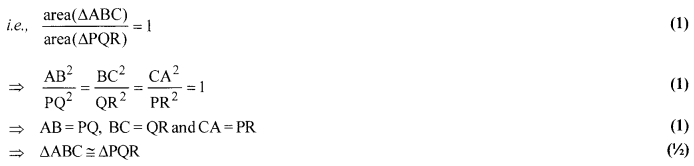
Let ∆ABC ~ ∆PQR and .
area (∆ABC) = area (∆PQR) (Given) (1/2)
CBSE Sample Papers for Class 10 Maths Paper 6 img 19
OR
CBSE Sample Papers for Class 10 Maths Paper 6 img 20
CBSE Sample Papers for Class 10 Maths Paper 6 img 21

Solution 25.
CBSE Sample Papers for Class 10 Maths Paper 6 img 22
OR
CBSE Sample Papers for Class 10 Maths Paper 6 img 23
CBSE Sample Papers for Class 10 Maths Paper 6 img 24

Solution 26.
CBSE Sample Papers for Class 10 Maths Paper 6 img 25

Solution 27.
CBSE Sample Papers for Class 10 Maths Paper 6 img 26

Solution 28.
CBSE Sample Papers for Class 10 Maths Paper 6 img 27
CBSE Sample Papers for Class 10 Maths Paper 6 img 28

Solution 29.
CBSE Sample Papers for Class 10 Maths Paper 6 img 29
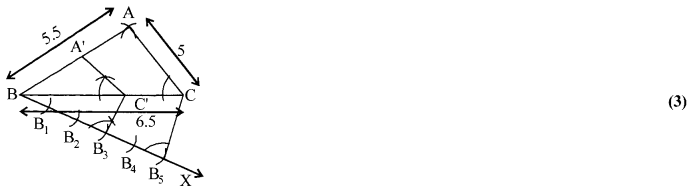
Steps of construction
1. Draw a line segment BC = 6.5 cm.
2. Take B as centre and mark an arc of length 5.5 cm above BC.
3. Similarly, take C as centre and cut an arc above BC of length 5 cm which cuts previous arc at point A.
4. Join AB and AC. Therequired triangle is formed i.e., ∆ABC
5. Draw a ray BX below BC.
6. Mark equal arcs B1, B2, B3, B4 and B5 on BX such that BB1 = B1B2 = B2B3 = B3B4 = B4B5.
7. Join B5C and draw a line || to B5C from point B3 which cuts BC at C’.
8. Drawaline||toACfromC’whichcutsAB at A’. (1)
9. Now, ∆A’BC’ is the required triangle.

Solution 30.
CBSE Sample Papers for Class 10 Maths Paper 6 img 30
CBSE Sample Papers for Class 10 Maths Paper 6 img 31
OR
CBSE Sample Papers for Class 10 Maths Paper 6 img 32
CBSE Sample Papers for Class 10 Maths Paper 6 img 33

We hope the CBSE Sample Papers for Class 10 Maths paper 6 help you. If you have any query regarding CBSE Sample Papers for Class 10 Maths paper 6, drop a comment below and we will get back to you at the earliest.
UP Board Solutions for Class 11 English Translation Chapter 15 Agreement of Subject and Verb

UP Board Solutions for Class 11 English Translation Chapter 15 Agreement of Subject and Verb

These Solutions are part of UP Board Solutions for Class 11 English. Here we have given UP Board Solutions for Class 11 English Translation Chapter 15 Agreement of Subject and Verb.

Exercise 33

1. My brother as well as friends was invited to the feast.
2. None of the news is good.
3. Every boy and girl was eager to sing.
4. Pity as well as justice make a man great.
5. You as well as I have performed our duty.
6. The army was marching towards the enemy.
7. This is the shop which was highly damaged by fire.
8. Everyone of you is suitable for this post.
9. Where are your spectacles ?
10.Ten thousand rupees is a good salary.
11. Either he or his friends have deceived you.
12. All the thieves with their chief have run away.
13. The committee has elected its president.
14. Not only the doctor but also the compounder went on trying to save the patient.
15. Honey and ghee is a good medicine.

We hope the UP Board Solutions for Class 11 English Translation Chapter 15 Agreement of Subject and Verb help you. If you have any query regarding UP Board Solutions for Class 11 English Translation Chapter 15 Agreement of Subject and Verb, drop a comment below and we will get back to you at the earliest.
CBSE Sample Papers for Class 10 Maths Paper 5

These Sample papers are part of CBSE Sample Papers for Class 10 Maths. Here we have given CBSE Sample Papers for Class 10 Maths Paper 5.

CBSE Sample Papers for Class 10 Maths Paper 5

Board CBSE
Class X
Subject Maths
Sample Paper Set Paper 5
Category CBSE Sample Papers

Students who are going to appear for CBSE Class 10 Examinations are advised to practice the CBSE sample papers given here which is designed as per the latest Syllabus and marking scheme as prescribed by the CBSE is given here. Paper 5 of Solved CBSE Sample Paper for Class 10 Maths is given below with free pdf download solutions.

Time allowed: 3 Hours
Maximum Marks: 80

General Instructions

  • All questions are compulsory.
  • The question paper consists of 30 questions divided into four sections A, B, C andD.
  • Section A contains 6 questions of 1 mark each. Section B contains 6 questions of 2 marks each. Section C contains 10 questions of 3 marks each. Section D contains 8 questions of 4 marks each,
  • There is no overall choice. However, an internal choice has been provided in four questions of 3 marks each and three questions of 4 marks each. You have to attempt only one of the alternatives in all such questions.
  • Use of calculators is not permitted.

Section-A

Question 1.
Can the number 6n, n being number, end with the digit 5? Give reasons.

Question 2.
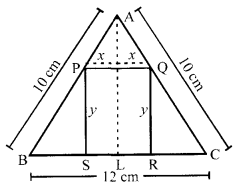
ABC is an isosceles triangle in which AB = AC = 10 cm. BC = 12 cm. PQRS is a rectangle inside the
isosceles triangle. Given PQ = SR = 2x cm and PS = QR = y cm. Prove that xb = 6 – [latex s=2]\frac { 3y }{ 4 } [/latex]

Question 3.
Find the middle term oftheA.P. 6,13,20,……..,216.

Question 4.
Represent in the form of quadratic equation : (x – 3) (2x + 1) = x (x + 5).

Question 5.
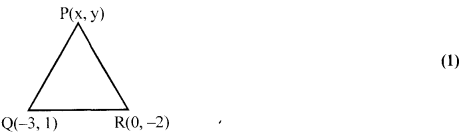
Find the third vertex of a triangle, iftwoofits vertices are at (-3, 1) and (0,-2) and the centroid is at the origin.

Question 6.
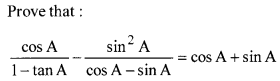
Prove: [latex s=2]\frac { \sin ^{ 4 }{ \theta } -\cos ^{ 4 }{ \theta } }{ \sin ^{ 2 }{ \theta } -\cos ^{ 2 }{ \theta } } [/latex] = 1

Section-B

Question 7.
Use Euclid’s algorithm to find the HCF of 6812 and 289 f6.

Question 8.
Find the relation between x and y if the points A(x, y), B (-5,7) and C (-4,5) are collinear.

Question 9.
From a normal pack of cards, a card is drawn at random, find the probability of getting a jack or a king.

Question 10.
Find the value of K for which the system of equations has no solution.
3x +y = 1; (2k – 1)x + (k – 1)y = (2k + 1)

Question 11.
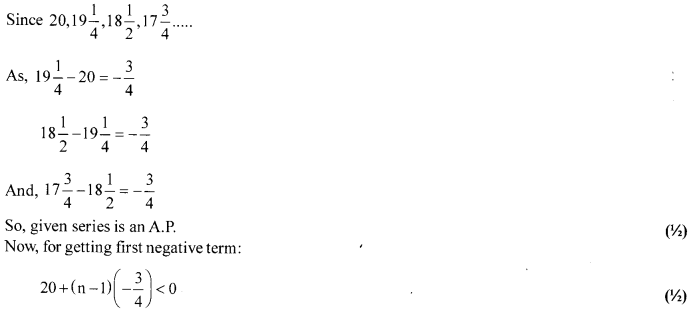
Which term of the progression 20, 19 [latex s=2]\frac { 1 }{ 4 } [/latex],18[latex s=2]\frac { 1 }{ 2 } [/latex],17 [latex s=2]\frac { 3 }{ 4 } [/latex],…… is the first negative term?

Question 12.
In a single throw of two dice, find the probability of getting a sum of 10.

Section-C

Question 13.
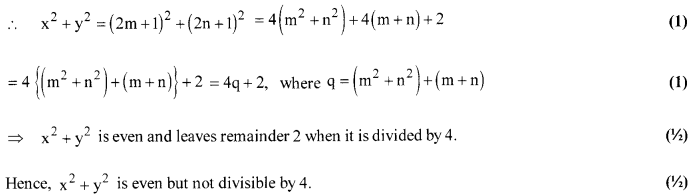
Prove that if x and y are odd positive integers, then x2 + y2 is even but not divisible by 4.

Question 14.
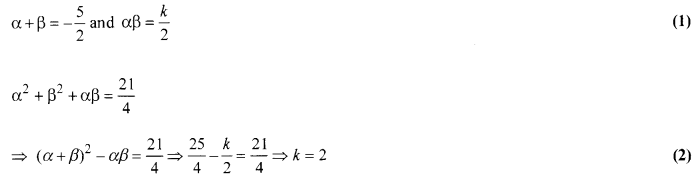
If a, B are the roots of the polynomials^) = 2x2 + 5x + k satisfying the relation α2 + β2 + αβ = [latex s=2]\frac { 21 }{ 4 } [/latex], then find the value of k for this to be possible.

Question 15.
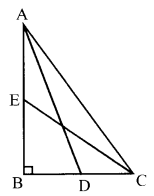
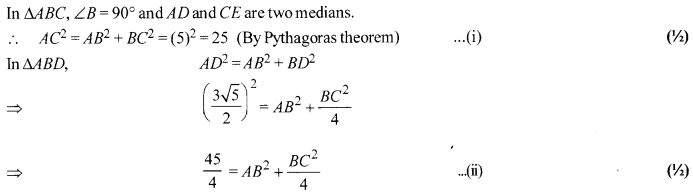
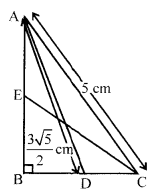
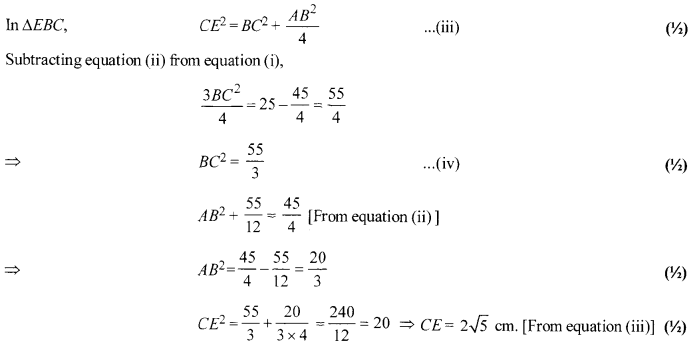
In the figure, ABC is a right triangle, right angled at B. AD and CE are two medians drawn from A and C
respectively. If AC= 5 cm and AD = [latex s=2]\frac { 3\sqrt { 5 } }{ 2 } [/latex] cm, find the length of CE.
CBSE Sample Papers for Class 10 Maths Paper 5 img 1

OR
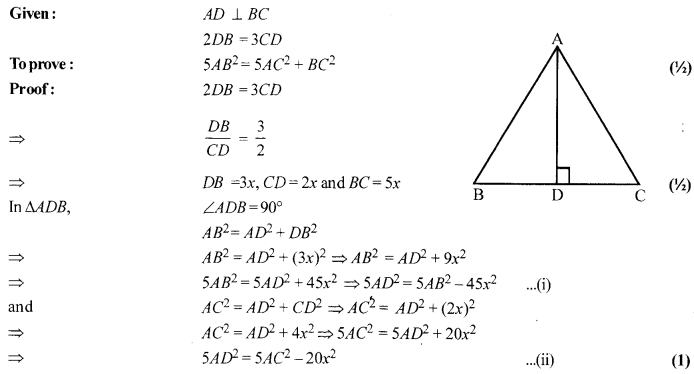
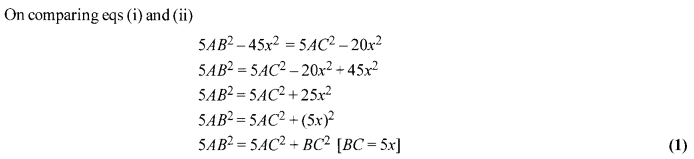
In ∆ABC, AD⊥BC and point D lies on BC such that 2DB = 3CD. Prove that 5AB2 = 5AC2 + BC2

Question 16.
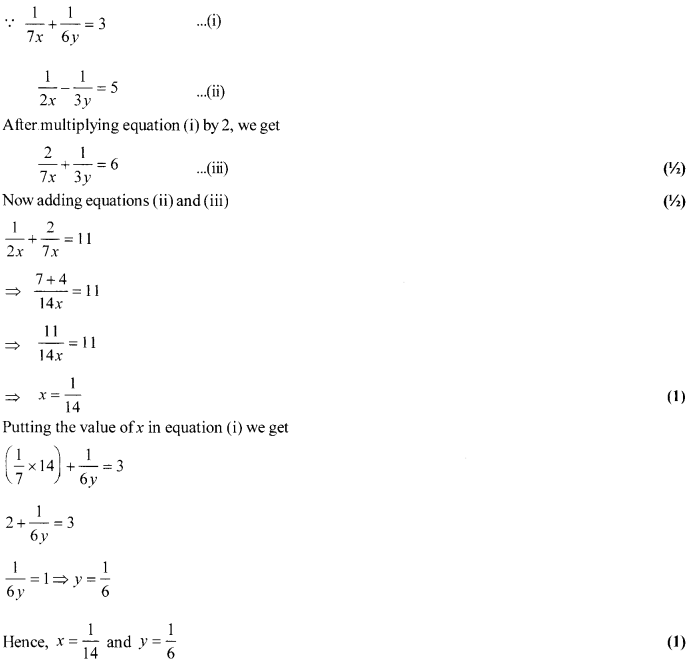
Solve the following equations: [latex s=2]\frac { 1 }{ 7x } +\frac { 1 }{ 6y } [/latex] = 3, [latex s=2]\frac { 1 }{ 2x } -\frac { 1 }{ 3y } [/latex] = 5

Question 17.
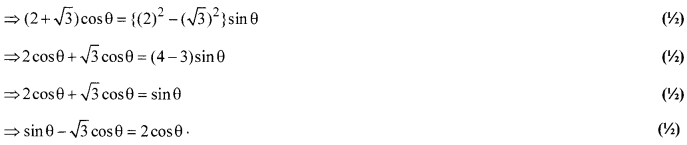
If cos θ +[latex]\sqrt { 3 } [/latex] sinθ = 2sinθ . Show that sin θ – [latex]\sqrt { 3 } [/latex]cos θ = 2cos θ.
OR
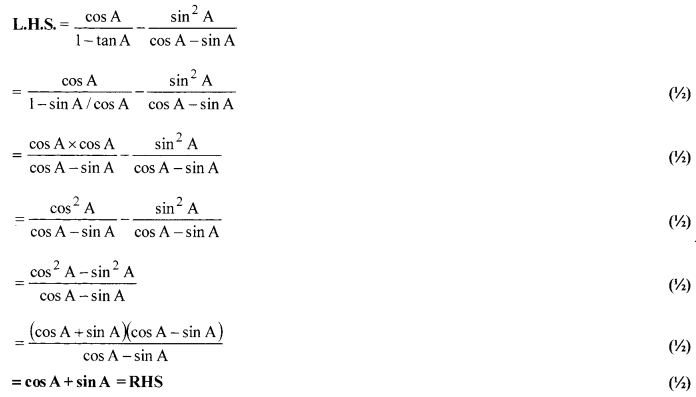
CBSE Sample Papers for Class 10 Maths Paper 5 img 2

Question 18.
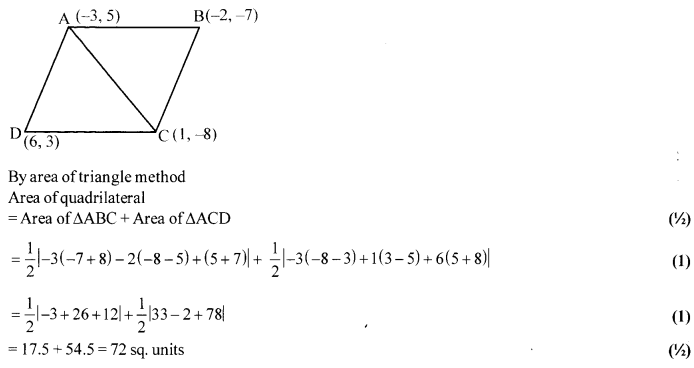
If A (-1,-1), B (-1,4), C (5,4) andD (5,-1) are the vertices of a quadrilateral ABCD, find its area.
OR
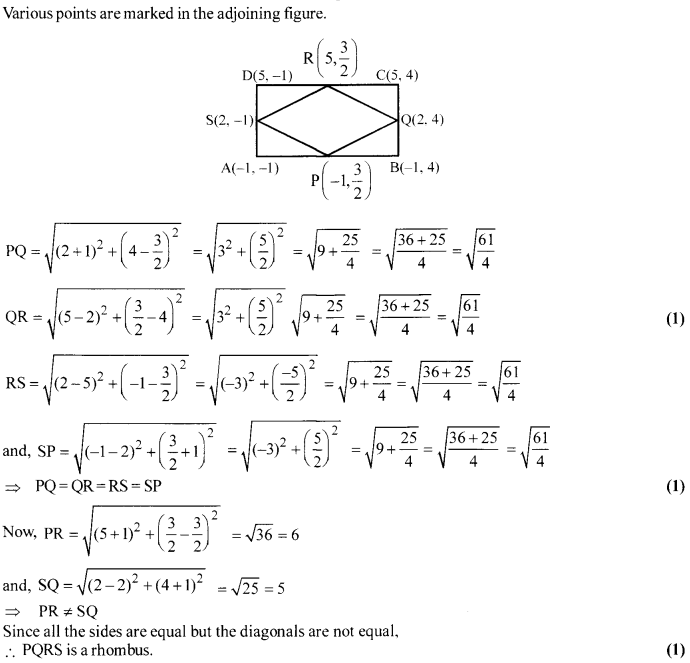
ABCD is a rectangle formed by the points A(-l, -1), B(- 1,4), C(5, 4) and D(5, – 1). P, Q, R and S are the mid-points of AB, BC, CD and DA, respectively. Is the quadrilateral PQRS a square? a rectangle? or a rhombus? Justify your answer.

Question 19.
A boy is cycling such that the wheels of the cycle are making 140 revolutions per minute. If the diameter of the wheel is 60 cm, calculate the speed per hour with which the boy is cycling.

Question 20.
The numbers 5, 7, 10, 12, 2x-8, 2x+ 10, 35, 41, 42, 50 are arranged in ascending order. Iftheir median is 25 then find the value of x.

Question 21.
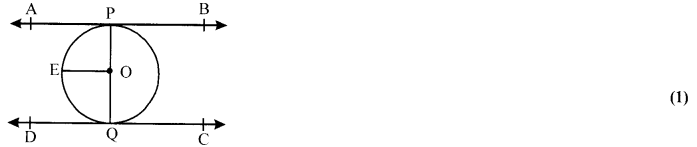
Prove that the line segment joining the points of contact of two parallel tangents of a circle, passes through its centre.

Question 22.
A well of diameter 4 m is dug 14 m deep. The earth taken out is spread evenly all around the well to form a 40 cm high embankment. Find the width of the embankment.
OR
A sphere of diameter 12.6 cm is melted and recast into a right circular cone of height 25.2 cm. Find the diameter of the base of the cone.

Section-D

Question 23.
Prove that (sin A + cosec A)2 + (cos A + sec A)2 = 7 + tan2 A + cot2 A.

Question 24.
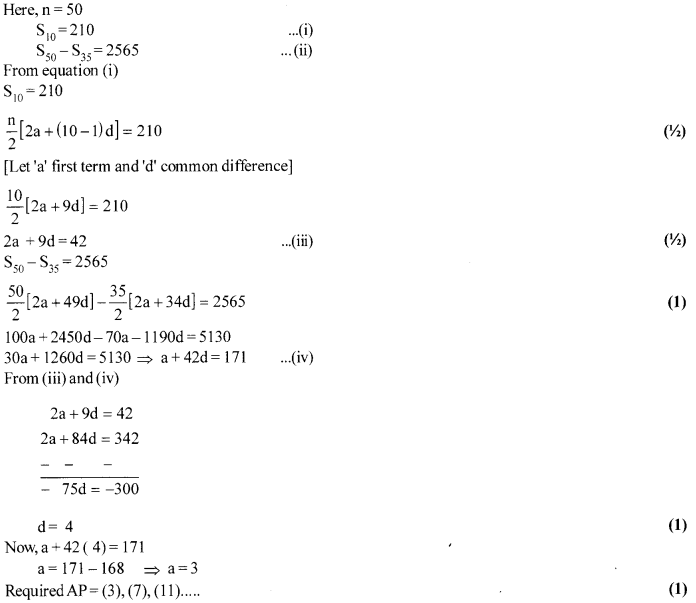
In an AP of 50 terms, the sum of first 10 terms is 210 and the sum of its last 15 terms is 2565. Find the A.P.

Question 25.
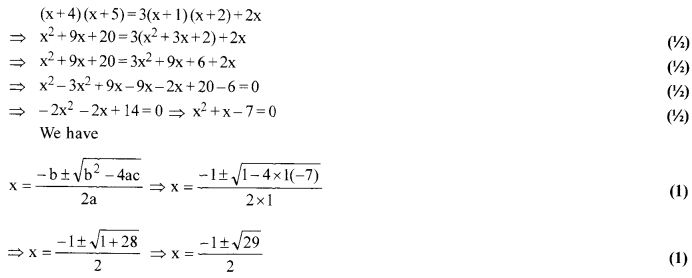
Solve the equation by using qudratic formula : (x + 4) (x + 5) = 3(x + 1) (x + 2) + 2x
OR
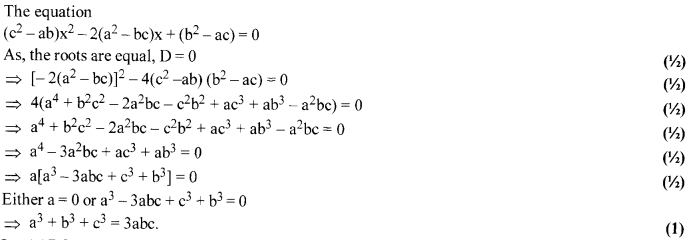
If the roots of the equation (c2 – ab) x2 – 2(a2 – bc) x + (b2 – ac) = 0 are equal, prove that either a = 0 or a3 + b3 + c3 = 3abc

Question 26.
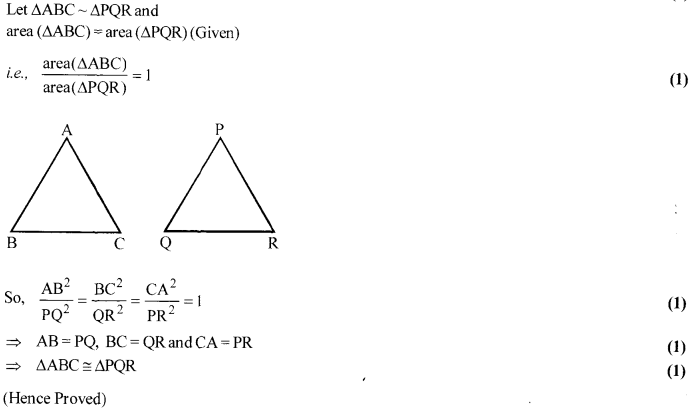
If the areas of two similar triangles are equal, prove that they are congruent.
OR
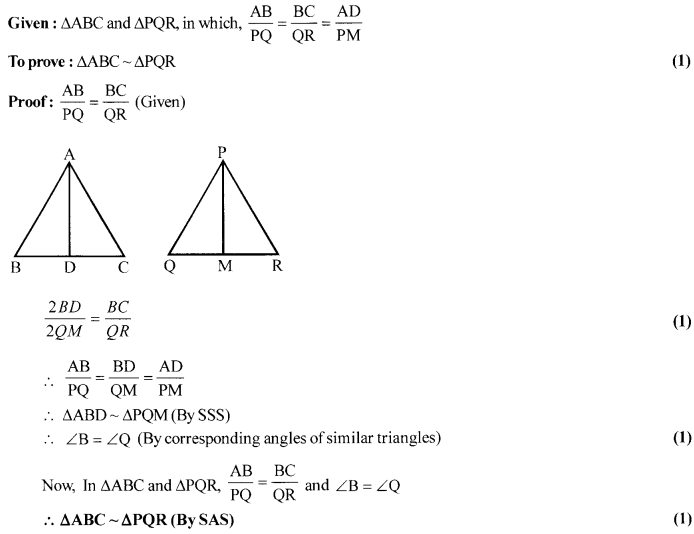
Sides AB and BC and median AD of a triangle ABC are respectively proportional to sides PQ and QR and median PM of triangle PQR. Prove that ∆ABC ~ ∆PQR

Question 27.
The angle of elevation of the top of a tower at a distance of 120 m from a point A on the ground is 45°. If the angle of elevation of the top of a flagstaff fixed at the top of the tower, at A is 60°, then find the height
ofthe flagstaff. [Use [latex]\sqrt { 3 } [/latex] = 1.73]
OR
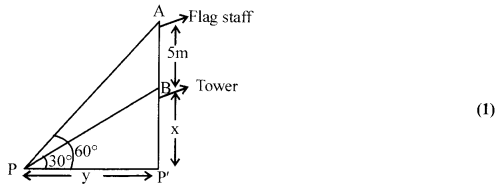
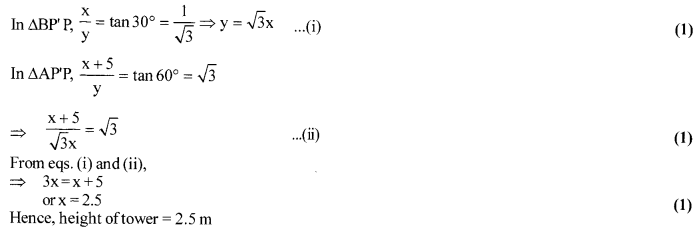
From a point P on the ground the angle of elevation ofthe top of a tower is 30° and that of the top of a flag staff fixed on the top of the tower, is 60°. If the length ofthe flag staff is 5m, find the height of the tower.

Question 28.
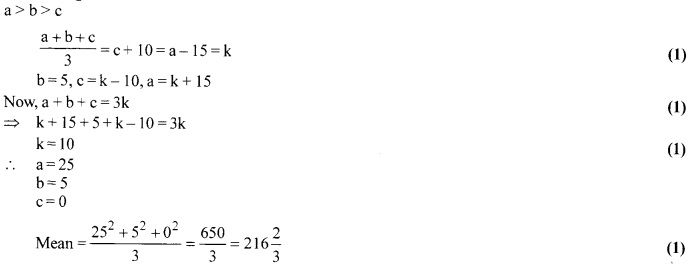
The mean of three positive numbers is 10 more than the smallest ofthe numbers and 15 less than the largest of the three. If the median of the three numbers is 5, then find the means of squares of the numbers.(NTSE 2016)

Question 29.
Draw a right triangle ABC in which AB = 6 cm, BC = 8 cm and ∠B = 90°. Draw BD perpendicular from B on AC and draw a circle passing through the points B, C and D. Construct tangents from A to this circle.

Question 30.
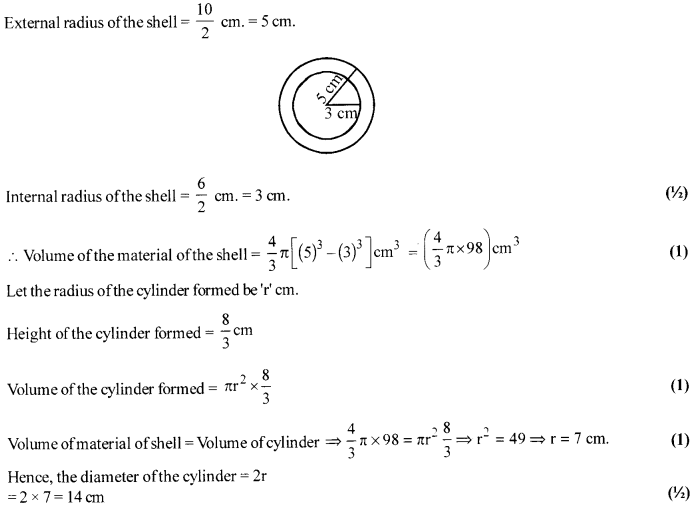
The diameter ofthe internal and external surfaces of a hollow spherical shell are 6 cm and 10 cm, respectively.
Ifit is melted and recast into a solid cylinder of length 2[latex s=2]\frac { 3 }{ 2 } [/latex] cm. Find the diameter ofthe cylinder.

Solutions
Section-A

Solution 1.
If 6n ends with 5, then it must have 5 as a factor. Prime factor of 6n are 2 and 3.
∴ 6n = (2 × 3)n = 2n × 3n
The fundamental theorem of arithmetic, the prime factorization of every composite numbers is unique.
∴ 6n can never end with 5. (1)

Solution 2.
CBSE Sample Papers for Class 10 Maths Paper 5 img 3
CBSE Sample Papers for Class 10 Maths Paper 5 img 4

Solution 3.
The given A.P. is 6, 13, 20, ………..,216
Here, d = 7, a = 6
an = a + (n-1)d
∴216 = 6 + (n- 1) × 7 ⇒n = 31
CBSE Sample Papers for Class 10 Maths Paper 5 img 5
∴a16= 6+ 15 × 7 = 111 (1)

Solution 4.
(x-3)(2x+l)-x(x + 5)
2x2 – 5x – 3 = x2 + 5x
x2 – 10x – 3 = 0 (1)

Solution 5.
Let th e third vertex of the triangle PQR be given by P (x, y).
By definition of centroid of a triangle, we have [latex s=2]\frac { -3+0+x }{ 3 } [/latex] = 0 [∵The centroid is at the origin]
and [latex s=2]\frac { 1-2+y }{ 3 } [/latex] = 0
From above : x = 3 and y = 1
CBSE Sample Papers for Class 10 Maths Paper 5 img 6
∴ The required third vertex is (3,1)

Solution 6.
Expressing sin4θ -cos4θ as (sin2θ)2 – (cos2θ)2
⇒ sin4 θ -cos4 θ
= (sin2θ -cos2θ). (sin2θ + cos2θ)
Now, we know that sin2θ + cos2θ = 1
∴ [latex s=2]\frac { \sin ^{ 4 }{ \theta } -\cos ^{ 4 }{ \theta } }{ \sin ^{ 2 }{ \theta } -\cos ^{ 2 }{ \theta } } [/latex] = 1 = R.H.S. (Hence Proved) (1)

Section-B

Solution 7.
Since, 28916 > 6812, we apply division lemma to 28916 and 6812, to get
28916 = 6812 × 4+1668
6812=1668 × 4+140 (1/2)
1668= 140 × 11 + 128
140= 128 × 1 + 12 (1/2)
128= 12 × 10 + 8
12= 8 × 1 +4 (1/2)
8 =4 × 2 + 0
The remainder has became zero. Now our procedure stops. At this stage the divisor is 4. So the HCF(6812,28916) is 4. (1/2)

Solution 8.
By ar (∆ABC) = 0 for collinear points A, B and C.
∴x(7 – 5)-5(5 – y)-4(y – 7) = 0 (1)
So, 2x – 25 +5y – 4y + 28 = 0 (1/2)
Hence, 2x + y + 3 = 0 (1/2)

Solution 9.
n(S) = 52, n(E) = 4 + 4 = 8 (1)
P(E) = [latex s=2]\frac { n(E) }{ n(S) } [/latex] = [latex s=2]\frac { 8 }{ 52 } [/latex] = [latex s=2]\frac { 2 }{ 13 } [/latex] (1)

Solution 10.
CBSE Sample Papers for Class 10 Maths Paper 5 img 7

Solution 11.
CBSE Sample Papers for Class 10 Maths Paper 5 img 8

Solution 12.
n(S) = 6x 6= 36, E = {(4,6), (5,5), (6,4)} n(E) = 3
n(E) = 3 (1)
P(E) = [latex s=2]\frac { n(E) }{ n(S) } [/latex] = [latex s=2]\frac { 3}{ 36 } [/latex] = [latex s=2]\frac { 1 }{ 12 } [/latex] (1)

Section-C

Solution 13.
We know that any odd positive integer is of the form 2q + 1 for some whole number q.
So, let x = 2m + 1 and y = 2n + 1 for some whole number m and n.
CBSE Sample Papers for Class 10 Maths Paper 5 img 9

Solution 14.
CBSE Sample Papers for Class 10 Maths Paper 5 img 10

Solution 15.
CBSE Sample Papers for Class 10 Maths Paper 5 img 11
CBSE Sample Papers for Class 10 Maths Paper 5 img 12
CBSE Sample Papers for Class 10 Maths Paper 5 img 13
OR
CBSE Sample Papers for Class 10 Maths Paper 5 img 14
CBSE Sample Papers for Class 10 Maths Paper 5 img 15

Solution 16.
CBSE Sample Papers for Class 10 Maths Paper 5 img 16

Solution 17.
CBSE Sample Papers for Class 10 Maths Paper 5 img 17
CBSE Sample Papers for Class 10 Maths Paper 5 img 18
OR
CBSE Sample Papers for Class 10 Maths Paper 5 img 19

Solution 18.
CBSE Sample Papers for Class 10 Maths Paper 5 img 20
OR
CBSE Sample Papers for Class 10 Maths Paper 5 img 21

Solution 19.
CBSE Sample Papers for Class 10 Maths Paper 5 img 22

Solution 20.
N= 10 (even).
Median = [latex s=2]\frac { 1 }{ 2 } [/latex] (5th obs. + th obs.) (1)
= [latex s=2]\frac { 1 }{ 2 } [/latex] (2x – 8 + 2x+ 10) =2x+1 (1)
2x+1=25 ⇒ x=12. (1)

Solution 21.
Given : Tangents AB and DC are parallel
To Prove : PQ passing through centre O
Const: DrawEO || AB
CBSE Sample Papers for Class 10 Maths Paper 5 img 23

Proof :AB || DC
Sum of the angles on the same side of transversal is 180°
∠APO + ∠EOP=180° ⇒ ∠EOP= 180°-90° =90° (1)
Similarly, ∠EOQ = 90°
∴ ∠EOP + ∠EOQ = 90° + 90° = 180°
∴ PQ is a straight line
Elence PQ passing through the centre O. (1)

Solution 22.
CBSE Sample Papers for Class 10 Maths Paper 5 img 24
CBSE Sample Papers for Class 10 Maths Paper 5 img 25

Section-D

Solution 23.
L.H.S. = (sinA + cosec A)2 + (cos A + sec A)2
= sin2 A + cosec2 A + 2 + cos2 A + sec2 A + 2 (2)
= 5 + 1 + cot2 A + 1 + tan2 A (1)
= 7 + cot2 A + tan2 A = R.H.S. (1)

Solution 24.
CBSE Sample Papers for Class 10 Maths Paper 5 img 26

Solution 25.
CBSE Sample Papers for Class 10 Maths Paper 5 img 27
OR
CBSE Sample Papers for Class 10 Maths Paper 5 img 28

Solution 26.
CBSE Sample Papers for Class 10 Maths Paper 5 img 29
OR
CBSE Sample Papers for Class 10 Maths Paper 5 img 30

Solution 27.
CBSE Sample Papers for Class 10 Maths Paper 5 img 32

OR
CBSE Sample Papers for Class 10 Maths Paper 5 img 33

Solution 28.
CBSE Sample Papers for Class 10 Maths Paper 5 img 34

Solution 29.
CBSE Sample Papers for Class 10 Maths Paper 5 img 35
Steps:
(i) Draw AABC and perpendicular BD on AC
(ii) Draw a circle with BC as a diameter.
(iii) Circle passing through B, C and D.
(iv) Let Q be the mid point of BC. Join AQ.
(v) Draw a circle with AQ as diameter. This circle cuts the previous circle at point P and B.
(vi) Now, join AP and AB are desired tangents drawn from A to the circle passing through B, C
and D. (1)

Solution 30.
CBSE Sample Papers for Class 10 Maths Paper 5 img 36

We hope the CBSE Sample Papers for Class 10 Maths paper 5 help you. If you have any query regarding CBSE Sample Papers for Class 10 Maths paper 5, drop a comment below and we will get back to you at the earliest.

UP Board Solutions for Class 7 Maths Chapter 11 वृत्त

UP Board Solutions for Class 7 Maths Chapter 11 वृत्त

These Solutions are part of UP Board Solutions for Class 7 Maths. Here we have given UP Board Solutions for Class 7 Maths Chapter 11 वृत्त.
अभ्यास 11 (a)

प्रश्न 1.
पाश्र्व चित्र में Oवृत्त का केन्द्र है। निम्नलिखित कथनों (UPBoardSolutions.com) में सत्य/असत्य कथनों को बताइएः
UP Board Solutions for Class 7 Maths Chapter 11 वृत्त 1
(i) रेखाखंड AB जीवा है। (✓)
(ii) QF त्रिज्या है। (✗)
(iii) OD त्रिज्या है। (✓)
(iv) PC जीवा है। (✗)

UP Board Solutions

प्रश्न 2.
अर्धवृत्त में बने कोण की माप होती है।
(i) 30°
(ii) 60°
(iii) 180°
(iv) 90° (✓)

प्रश्न 3.
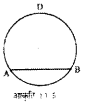
आकृति 11.5 के अनुसार अपनी अभ्यास पुस्तिका पर एक (UPBoardSolutions.com) आकृति खींचकर उसके दीर्घ वृत्तखंड को छायांकित कीजिए।
UP Board Solutions for Class 7 Maths Chapter 11 वृत्त 2
उत्तर :
चित्र में दीर्घ वृत्तखंड ADB है।

प्रश्न 4.
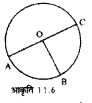
आकृति 11.6 में 0 वृत्त का केन्द्र है। आकृति में निर्मित किन्हीं दी त्रिज्यखंडों के नाम लिखिए।
UP Board Solutions for Class 7 Maths Chapter 11 वृत्त 3
उत्तर :
चित्र में निर्मित्त दो त्रिज्यखंड OAB तथा OBC है।

UP Board Solutions

प्रश्न 5.
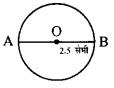
2.5 सेमी त्रिज्या का एक वृत्त खींचिए जिसका केन्द्र 0 (UPBoardSolutions.com) है। इस वृत्त को दो अर्द्धवृत्तों में विभक्त कीजिए।
UP Board Solutions for Class 7 Maths Chapter 11 वृत्त 4
रचना – सर्वप्रथम 0 को केन्द्र मानकर 2.5 सेमी त्रिज्या का एक वृत्त खींचा। AP वृत्त का व्यास AB खींचा, जिससे वृत्त दो भागों में विभक्त होगा।

UP Board Solutions

प्रश्न 6.
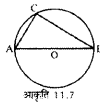
आकृति 11.7 में 0 वृत्त का केन्द्र है। ∠ACB कितने अंश का है? अपने उत्तर के पक्ष में कारण बताइए।
UP Board Solutions for Class 7 Maths Chapter 11 वृत्त 5
उत्तर :
चूँकि अर्द्धवृत्त में बना कोण समकोण होता है,
अतः ∠ACB = 90°

अभ्यास 11 (b)

प्रश्न 1.
अर्द्धवृत्त का अंशमाप होता है। (UPBoardSolutions.com)
(i) 45°
(ii) 90°
(iii) 180°
(iv) 360°
उत्तर :
(iii) 180°

प्रश्न 2.
किसी वृत्त में यदि उसके किसी लघुचाप का (UPBoardSolutions.com) अंशमाप 70° है, तो उसके दीर्घचाप का अंशमाप कितना होगा?
हल :
लघुचाप का अंशमाप = 70°
दीर्घचाप का अंशमाप = 360° – 70° = 290°

UP Board Solutions

प्रश्न 3.
किसी चाप द्वारा केन्द्र पर अन्तरित कोण तथा उसके द्वारा वृत्त के शेष भाग पर स्थित किसी बिन्दु पर अन्तरित कोण में क्या सम्बन्ध होता है?
उत्तर :
किसी चाप द्वारा केन्द्र पर अन्तरित कोण उसके द्वारा वृत्त के (UPBoardSolutions.com) शेष भाग पर स्थित किसी बिन्दु पर अन्तरित कोण का दो गुना होता है।

प्रश्न 4.
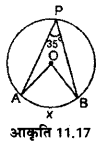
आकृति 11.17 में 0 वृत्त का केन्द्र है। चाप AXB को अंशमाप बताइए।
UP Board Solutions for Class 7 Maths Chapter 11 वृत्त 6
हल :
∠APB = 35°
चाप AXB का अंशमाप = ∠ AOB
= 2 ∠ APB
= 2 × 35° = 70°

UP Board Solutions

प्रश्न 5.
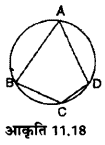
आकृति 11.18 में लधुचाप BCD एवं दीर्घचाप BAD (UPBoardSolutions.com) के अन्तर्गत कोणों के नाम बताइए।
UP Board Solutions for Class 7 Maths Chapter 11 वृत्त 7
हल :
लघुचाप BCD के अन्तर्गत कोण = ∠ BCD
दीर्घचाप BAD के अन्तर्गत कोण = ∠ BAD

UP Board Solutions

प्रश्न 6.
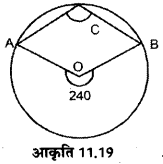
आकृति 11.19 में o वृत्त का केन्द्र है। A, C और B वृत (UPBoardSolutions.com) पर तीन बिन्दु है, तथा ∠AOB को प्रतिवर्ती कोण = 240° है तो ACB का मान ज्ञात कीजिए।
हल :
UP Board Solutions for Class 7 Maths Chapter 11 वृत्त 8
∠ACB = [latex]\frac { 1 }{ 2 }[/latex] ∠ AOB
∴ ∠ACB = [latex]\frac { 1 }{ 2 }[/latex] × 240 = 120°

UP Board Solutions

अभ्यास 11 (c)

प्रश्न 1.
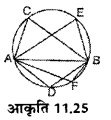
आकृति 11.25 में एक ही वृत्तखंड में बने कोणों (UPBoardSolutions.com) के नाम लिखिए।”
हल :
UP Board Solutions for Class 7 Maths Chapter 11 वृत्त 9
∠ ACB और ∠ AEB एक ही वृत्तखंड में बने दीर्घ कोण हैं तथा ∠ADB और ∠AFB एक ही वृत्तखंड में बने लघुकोण हैं।

UP Board Solutions

प्रश्न 2.
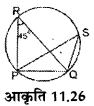
आकृति 11.26 मे बने कोण PRQ=45°, तो ∠PSQ का मान बताइए।
हल :
UP Board Solutions for Class 7 Maths Chapter 11 वृत्त 10
चूँकि एक ही वृत्तखंड में बने (UPBoardSolutions.com) कोण बराबर होते हैं।
अतः ∠ PSQ = ∠ PRQ = 45°

UP Board Solutions

प्रश्न 3.
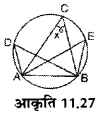
आकृति 11.27 में यदि ∠ACB=x, तो ∠ADB एवं ∠AEB के मान बताइए।
हल :
UP Board Solutions for Class 7 Maths Chapter 11 वृत्त 11
चूंकि एक ही वृत्तखंड में बने कोण बराबर होते हैं। अतः
∠ ADB = ∠ ACB = x°
∠AEB = ∠ ACB = x°

UP Board Solutions

प्रश्न 4.
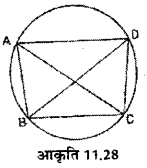
आकृति 11.28 में बने कोणों के सम्बन्ध में निम्नलिखित (UPBoardSolutions.com) कथनों में सत्य/असत्य कथनों को छाँटिएः
उत्तर :
UP Board Solutions for Class 7 Maths Chapter 11 वृत्त 12
(i) ∠BDC   = ∠BAC   – सत्य
(ii) ∠BDC  = ∠BCA  – असत्य
(iii) ∠ACB = ∠ADB  – सत्य
(iv) ∠BDA = ∠CDB  – असत्य
(v) ∠ACD   = ∠DBA  – सत्य

UP Board Solutions

प्रश्न 5.
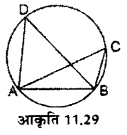
आकृति 11.29 में ∠ACB के बराबर निम्नलिखित (UPBoardSolutions.com) में से कौन-सा कोण है?
(i) ∠ABD
(ii) ∠ADB
(iii) ∠DBC
(iv) ∠BAD
UP Board Solutions for Class 7 Maths Chapter 11 वृत्त 13
उत्तर :
(ii)
∠ADB

UP Board Solutions

दक्षता अभ्यास – 11

प्रश्न 1.
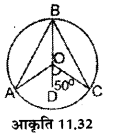
आकृति 11.32 में वृत्त को केन्द्र 0 है। रेखा BOD, ∠AOC की समद्विभाजक है, (UPBoardSolutions.com) तथा ∠COD=50°, तो ∠ABC की माप होगीः
(i) 50°
(ii) 25°
(iii) 100°
(iv) 120°
UP Board Solutions for Class 7 Maths Chapter 11 वृत्त 14
हल :
∠ AOC = 2 ∠ COD= 2 × 50° = 100°
∴ ∠ ABC = [latex]\frac { x }{ 12 }[/latex] ∠ AOC = [latex]\frac { x }{ 12 }[/latex] × 100° = 50° (i)

UP Board Solutions

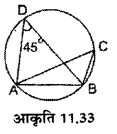
प्रश्न 2.
आकृति 11.33 में AB वृत्त की जीवा है बिन्दु C तथा D (UPBoardSolutions.com) वृत्त पर हैं। यदि ∠ADB = 45° तो ∠ACB की माप होगीः
(i) 90°
(ii) 135°
(iii) 45०
(iv) 223°
UP Board Solutions for Class 7 Maths Chapter 11 वृत्त 15
हल :
∠ ACB =∠ ADB = 45° (iii)

UP Board Solutions

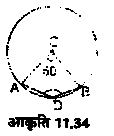
प्रश्न 3.
आकृति 11.34 में बिन्दु 0 वृत्त का केन्द्र है और ∠AOB = 60°, (UPBoardSolutions.com) तो ∠ADB की माप होगीः
(i) 120°
(ii) 150°
(iii) 140°
(iv) 30°
UP Board Solutions for Class 7 Maths Chapter 11 वृत्त 16
हल :
वृहत्त कोण AOB = 360° -∠ AOB = 360° – 60° = 300°
∴ ∠ ADB = [latex]\frac { 1 }{ 2 }[/latex] × बृहत AOB = [latex]\frac { 1 }{ 2 }[/latex] × 300° = 150° (ii)

UP Board Solutions

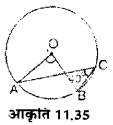
प्रश्न 4.
आकृति 11.35 में बिन्दू 0 वृत्त का एक केन्द्र है। इस पर तीन बिन्दु A, B तथा C हैं। (UPBoardSolutions.com) यदि ∠ACB = 40° तो ∠AOB की माप होगीः
(i) 20°
(ii) 40°
(iii) 60°
(iv) 80°
UP Board Solutions for Class 7 Maths Chapter 11 वृत्त 17
हल :
∠AOB = 2 ∠ ACB = 2 × 40° = 80° (iv)

UP Board Solutions

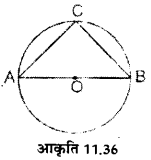
प्रश्न 5.
आकृति 11.36 में बिन्दु 0 वृत्त का एक केन्द्र है। वृत्त की दो समान जीवाए AC और BC खींची गई हैं। (UPBoardSolutions.com) ∠ABC का मान ज्ञात कीजिए।
हल :
UP Board Solutions for Class 7 Maths Chapter 11 वृत्त 18
चूँकि अर्द्धवृत्त का कोण समकोण होता है ∠ACB = 90°
प्रश्नानुसार, AC = BC4∠ CAB = ∠ABC
∠CAB + ∠ABC + ∠ ACB = 180°
∠ABC + ∠ABC + 90° = 180°
∠ ABC = 180° – 90° = 90°
∠ABC = [latex]\frac { { 90 }^{ \circ } }{ 2 } [/latex] = 45०

UP Board Solutions

प्रश्न 6.
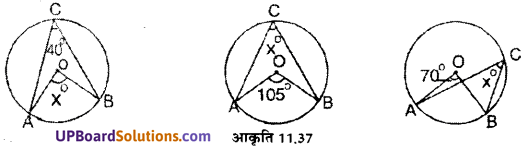
निम्नांकित वृत्तों में प्रत्येक का केन्द्र 0 है। प्रत्येक में x का (UPBoardSolutions.com) मान ज्ञात कीजिए।
UP Board Solutions for Class 7 Maths Chapter 11 वृत्त 19
हलः
(i) x° = ∠AOB = 2 ∠ACB = 2 × 40° = 80°
(ii) x° = ∠ACB = 1/2 ∠AOB = [latex]\frac { 1 }{ 2 }[/latex] × 105° = 52.5°
(iii) x° = ∠ACB = 1/2 ∠AOB = [latex]\frac { 1 }{ 2 }[/latex] × 70° = 35°

UP Board Solutions

प्रश्न 7.
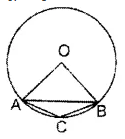
वृत्त की एक जीवा की लम्बाई उसकी त्रिज्या के बराबर है। (UPBoardSolutions.com) इस जीवा द्वारा लघु वृत्तखंड पर अन्तरित कोण ज्ञात कीजिए।
हल :
चूंकि वृत्त की जीवा AB वृत्त की त्रिज्या के बराबर है। अत: ∆OAB समबाहु त्रिभुज होगा तथा तीनों कोण बराबर होंगे।
UP Board Solutions for Class 7 Maths Chapter 11 वृत्त 20a
∠OAB +∠OBA+∠AOB = 180°
∠AOB +∠AOB +∠AOB = 180°
3∠AOB = 180°
∠AOB = [latex]\frac { { 180 }^{ \circ } }{ 3 } [/latex] = 60°
बृहत्त कोण AOB = 360° – ∠ AOB = 360° – 60° = 300° (UPBoardSolutions.com)
∠ACB = 3 बृहत्त ∠AOB = [latex]\frac { 1 }{ 2 }[/latex] × 300° = 150°
अतः लघु वृत्तखंड पर अन्तरित कोण = 150°

UP Board Solutions

प्रश्न 8.
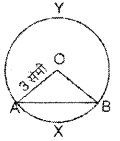
3.0 सेमी त्रिज्या का एक वृत्त खींचिए। इस वृत्त की:एक जीवा । खींचकर वृत्त को दो वृतखंडों में विभक्त कीजिए।
हल :
UP Board Solutions for Class 7 Maths Chapter 11 वृत्त 21
सर्वप्रथम सेमी त्रिज्या लेकर परकार की सहायता से एक (UPBoardSolutions.com) वृत्त खींचा। किसी भी लम्बाई की एक जीवा AB खींची। अत: वृत्त, दीर्घ वृत्तखंड AYB तथा लघु वृत्तखंडे AXB में विभाजित हो गया।

प्रश्न 9.
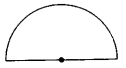
अर्द्धवृत्त किसे कहते हैं? चित्र बनाकर स्पष्ट कीजिए।
उत्तर :
UP Board Solutions for Class 7 Maths Chapter 11 वृत्त 22
वृत्त के आधे भाग को अर्द्धवृत्त कहते हैं।

UP Board Solutions

प्रश्न 10.
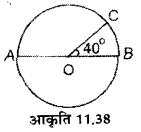
आकृति 11.38 में बिन्दु 0 वृत्त का केन्द्र हैं। AOB (UPBoardSolutions.com) वृत्त का व्यास है और ∠COB=40°। ज्ञात कीजिए:

(i) दीर्घचाप BC का अंशमाप
(ii) दीर्घचाप AC को अंशमाप
(iii) लघुचाप AC का अंशमाप
(iv) अर्द्धवृत्त ACB का अंशमाप।
UP Board Solutions for Class 7 Maths Chapter 11 वृत्त 23

हल :

(i) दीर्घचाप BC का अंशमाप = 360° – 40° = 320°
(ii) दीर्घचाप AC का अंशमाप = 360° – 140° = 220°
(iii) लघुचाप AC का अंशमाप = 360°-220° = 140°
(iv) अर्धवृत्त ACB का अंशमाप = 180°

UP Board Solutions

प्रश्न 11.
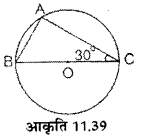
आकृति 11.39 में 0 वृत्त का केन्द्र है। इसके अन्तर्गत एक (UPBoardSolutions.com) AABC बना है यदि ∠ACB= 30° तो ∠A और ∠B ज्ञात कीजिए।
UP Board Solutions for Class 7 Maths Chapter 11 वृत्त 24
हल :
चूँकि अर्द्धवृत्त का (UPBoardSolutions.com) कोण समकोण होता है।
अतः ∠A = 90°
∠ACB + ∠ BAC + ∠ABC = 180°
30° + 90° + ∠ABC = 180°
120° + ∠ABC = 180°
∠ABC = 180° – 120° = 60°

प्रश्न 12.
वृत्त की एक जीवा की लम्बाई उसकी त्रिज्या के बराबर है। (UPBoardSolutions.com) इस जीवा द्वारा दीर्घ वृत्तखंड पर अन्तरित कोण ज्ञात कीजिए।
हल :
UP Board Solutions for Class 7 Maths Chapter 11 वृत्त 25
चूंकि वृत्त की जीवा AB वृत्त की त्रिज्या के बराबर है। (UPBoardSolutions.com) अत: ∆OAB समबाहु त्रिभुज होगा तथा तीनों कोण बराबर होंगे।
∠AOB = 60°
अतः दीर्घ वृतखंड पर अन्तरित कोण = [latex]\frac { 1 }{ 2 }[/latex] x 60° = 30°

UP Board Solutions

प्रश्न 13.
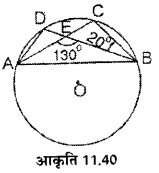
आकृति 11.40 में 0 वृत्त का केन्द्र है। ∠AEB= 130° और ∠EBC=20°, तो ∠BDA का मान ज्ञात कीजिए।
हल :
UP Board Solutions for Class 7 Maths Chapter 11 वृत्त 26
∠ AEB +∠ BEC = 180°
130° +∠ BEC = 180°
∠ BEC = 180° – 130° = 50°
∆ BEC में, 2 ECB +∠ BEC +∠ EBC = 180°
∠ ECB + 50° +20° = 180° (UPBoardSolutions.com)
∠ACB =∠ ECB = 180° – 70° = 110°
∠ BDA =∠ ACB = 110°

UP Board Solutions

प्रश्न 14.
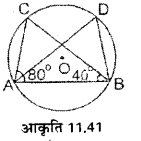
आकृति 11.41 में 0 वृत्त को केन्द्र है। (UPBoardSolutions.com) ∠ABC=40° और ∠CAB= 80°, तो ∠ADB का मान ज्ञात कीजिए।
UP Board Solutions for Class 7 Maths Chapter 11 वृत्त 27
हल :
∆ABC में,
∠ ABC + ∠CAB +∠ ACB = 180°
40° + 80° + 2 ACB = 180°
120° + 2 ACB = 180°
∠ ACB = 180° – 120° = 60°

UP Board Solutions

प्रश्न 15.
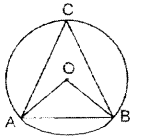
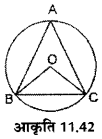
आकृति 11.42 में 0 वृत्त का केन्द्र है तथा AABC एक समबाहु त्रिभुज है ∠BOC का मान ज्ञात कीजिए।
हल :
UP Board Solutions for Class 7 Maths Chapter 11 वृत्त 28
चूँकि A ABC एक समबाहु त्रिभुज है। (UPBoardSolutions.com) अतः त्रिभुज के तीनों कोण बराबर होंगे।
∴ ∠ BAC = [latex]\frac { { 180 }^{ \circ } }{ 3 } [/latex] = 60°
∠ BOC = 2 ∠ BAC = 2 × 60° = 120°

प्रश्न 16.
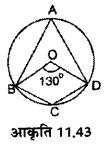
आकृति 11.43 में 0 वृत्त का केन्द्र है और ∠BOD=130°, ∠BCD का माप ज्ञात कीजिए।
हल :
UP Board Solutions for Class 7 Maths Chapter 11 वृत्त 29
अधिक कोण ∠ BOD = 130°
वृहत कोण ∠ BOD = 360° – 130° = 230°
∠ BCD = 1/2 ∠ BOD (UPBoardSolutions.com)
= [latex]\frac { 1 }{ 2 }[/latex] × 230° = 115°

UP Board Solutions

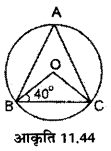
प्रश्न 17.
आकृति 11.44 में 0 वृत्त का केन्द्र है। (UPBoardSolutions.com) ∠OBC=40°, तो ∠BAC का माप ज्ञात कीजिए।
हल :
UP Board Solutions for Class 7 Maths Chapter 11 वृत्त 30
A OBC में ∠OCB = ∠OBC= 40°
∠ OBC +∠OCB +∠ BOC = 180°
40° + 40° +∠ BOC = 180°
80° +∠ BOC = 180° (UPBoardSolutions.com)
∠ BOC = 180° – 80° = 100°
∠ BAC = [latex]\frac { 1 }{ 2 }[/latex] ∠ BOC
= [latex]\frac { 1 }{ 2 }[/latex] × 100° = 50°

We hope the UP Board Solutions for Class 7 Maths Chapter 11 वृत्त help you. If you have any query regarding UP Board Solutions for Class 7 Maths Chapter 11 वृत्त, drop a comment below and we will get back to you at the earliest.