UP Board Class 10th English Supplementary Chapter 1 Question Answer The Judgement-Seat of Vikramaditya (Sister Nivedita).

Class 10 English Supplementary Reader Chapter 2 Questions and Answers UP Board The Judgement-Seat of Vikramaditya (Sister Nivedita).

कक्षा 10 अंग्रेजी पाठ 2 प्रश्न उत्तर

These Solutions are part of UP Board Solutions for Class 10 English. Here we have given UP Board Solutions for Class 10 English Supplementary Reader Chapter 2 The Judgement-Seat of Vikramaditya (Sister Nivedita).

SHORT ANSWER TYPE QUESTIONS

Answer the following questions in about 25 words :

Question 1.
Do we know anything definite about Vikramaditya ? If so, what ?
(क्या हम विक्रमादित्य के विषय में कोई बात निश्चित रूप से जानते हैं ? यदि जानते हैं, तो वह क्या है ?)
Answer:
We do not know anything definite about Vikramaditya. The only thing that we are sure about him is that he was a lover of justice and learning.
(हम विक्रमादित्य के विषय में कोई बात निश्चित रूप से नहीं जानते। केवल एक बात जो उनके बारे में निश्चित है, वह यह है कि वे न्याय और ज्ञान के प्रेमी थे।)

Question 2.
why did the guilty tremble before Vikramaditya ? [2009, 11, 12, 13, 14, 15]
(विक्रमादित्य के सामने अपराधी क्यों काँपने लगते थे ?)
Answer:
The guilty trembled before Vikramaditya because they knew that his eyes would look straight into their guilt and punish them.
(राजा विक्रमादित्य के सामने आकर (UPBoardSolutions.com) अपराधी इसलिए काँपने लगते थे, क्योंकि वे जानते थे कि राजा की आँखें उनके अपराध को पहचान लेंगी और उनको दण्ड मिलेगा।)

Question 3.
What happened to the palace and the fortress of Vikramaditya after  his death ?। [2011, 12, 14, 18]
(विक्रमादित्य की मृत्यु के बाद उसके महल तथा किले का क्या हुआ ?)
Answer:
After the death of Vikramaditya his palace and fortress were ruined with passage of time. The ruins were covered with grass and dust. (विक्रमादित्य की मृत्यु के बाद उसका महल और किला दोनों नष्ट हो गये और खण्ड़हर घास और मिट्टी में दब गये।)

UP Board Solutions

Question 4.
What did the village-boys find in the pastures ? [2013, 15, 17]
(गाँव के लड़कों ने चरागाह में क्या पाया ?)
Answer:
The village-boys used to go to a nearby pastures with their cattle. The village-boys found a green mound in the pasture just like a judgement-seat.
(गाँव के लड़के पास के एक चरागाह में अपने पशुओं के साथ जाया करते थे। गाँव के लड़कों को चरागाह में एक हरा-भरा टीला मिला जो न्यायाधीश के सिंहासन जैसा प्रतीत होता था।)

Question 5.
What did the village-boy say to his friends after sitting on the green | mound? What did his friends do?
(गाँव के लड़के ने उस हरे-भरे टीले पर बैठकर अपने मित्रों से क्या कहा ? उसके मित्रों ने क्या किया ?)
Answer:
After sitting on the green mound the village-boy said to his friends, “I will be the judge. You can bring all your cases before me and I will have trials.” His friends soon brought cases before him for decision.
(उस हरे-भरे टीले पर बैठने के बाद उस ग्रामीण-लड़के (UPBoardSolutions.com) ने अपने मित्रों से कहा, “मैं न्यायाधीश हूँ। तुम अपने मुकदमे मेरे पास लाओ और मैं न्याय करूंगा।” उसके मित्र शीघ्र ही निर्णय के लिए उसके सामने अपने मुकदमे लाये।)

Question 6.
What changes did the village-boys notice in the boy who sat on the mound? [2012, 15, 16, 17]
(गाँव के लड़कों ने टीले पर बैठने वाले लड़के में क्या परिवर्तन देखे ?)
Answer:
The village-boys noticed that the boy who sat on the mound had become serious and grave. His tone and manners were impressive.
(गाँव के लड़कों ने देखा कि टीले पर बैठने वाला लड़का एकदम शान्त और गम्भीर हो गया था। उसका स्वर और बातचीत का ढंग प्रभावशाली था।)

Question 7.
Why did the grown-up men and women put their disputes before the cowherd boy ? How did the boy satisfy them ?
(बड़े स्त्री-पुरुष अपने झगड़ों को ग्वाले के सामने क्यों रखते थे? वह उन्हें कैसे सन्तुष्ट करता था?)
Answer:
The grown-up men and women put their disputes before the cowherd boy for justice. He settled them wisely and satisfied them. (बड़े स्त्री-पुरुष अपने झगड़ों को ग्वाले के सामने न्याय के लिए रखते थे। वह उन्हें निपटाता था और उन्हें सन्तुष्ट कर देता था।)

UP Board Solutions

Question 8.
What guess did the king of Ujjain make about the boy ? (उस लड़के के विषय में उज्जैन के राजा ने क्या अनुमान लगाया ?) [2011]
Answer:
The king of Ujjain guessed about the boy that he must have sat on the judgement-seat of Vikramaditya because he was doing perfect justice.
(उज्जैन के राजा ने यह अनुमान लगाया कि वह लड़का (UPBoardSolutions.com) विक्रमादित्य के न्याय-सिंहासन पर बैठा होगा क्योंकि वह एकदम सही निर्णय दे रहा था।)

Question 9.
what did the king decide to do ?
(राजा ने क्या करने का निश्चय किया?)
                   Or
Why did the king of Ujjain want to sit on the judgement-seat of Vikramaditya ? [2013, 16]
उज्जैन का राजा विक्रमादित्य के न्याय सिंहासन पर क्यों बैठना चाहता था ?)
Answer:
The king decided to dig out the judgement-seat and bring it to Ujjain. Then he would sit on it and deliver judgements.
(राजा ने यह निश्चय किया कि वह खुदाई कराकर न्याय-सिंहासन को प्राप्त करेगा और उसे उज्जैन लाएगा, फिर उस पर बैठेगा तथा न्याय करेगा।)

Question 10.
What did the first angel ask the king when he was about to sit on the throne ? [2018]
(जब राजा उस सिंहासन पर बैठने ही वाला था तो पहले देवदूत ने उससे क्या पूछा ?)
Answer:
When the king was about to sit on the throne the first angel asked him if he never desired to rule over kingdoms that were not his own and if he thought himself worthy to sit on the throne.
(जब राजा उस सिंहासन पर बैठने ही वाला था तो पहले (UPBoardSolutions.com) देवदूत ने उससे पूछा, “क्या तुमने ऐसे राज्यों पर शासन करने की इच्छा नहीं की जो तुम्हारे नहीं थे ? क्या तुम स्वयं को इस सिंहासन पर बैठने के योग्य समझने हो ?”)

UP Board Solutions

Question 11.
Why could the king of Ujjain not sit on the judgement-seat of Vikramaditya ?
(विक्रमादित्य के न्याय-सिंहासन पर उज्जैन का राजा क्यों नहीं बैठ सका ?)
Answer:
The king of Ujjain could not sit on the judgement-seat of Vikramaditya because he was not perfectly pure in heart and as such not worthy of it.
(विक्रमादित्य के न्याय-सिंहासन पर उज्जैन का राजा इसलिए नहीं बैठ सका, क्योंकि उसका हृदय शुद्ध नहीं था और इस तरह उसके योग्य नहीं था।)

Question 12.
What qualities were needed to make the king worthy to sit on the throne of Vikramaditya ?
(विक्रमादित्य के सिंहासन पर बैठने योग्य बनने के लिए राजा को किन गुणों की आवश्यकता थी ?)
Answer:
The following qualities were needed to make the king worthy to sit on the throne of
Vikramaditya :

  1. a desire not to rule over kingdoms that were not his own,
  2. a pure heart like a child,
  3. a desire not to possess the riches of others and life full of justice.

(विक्रमादित्य के सिंहासन पर बैठने योग्य बनने के लिए राजा को निम्नलिखित गुणों की आवश्यकता थी–

  1. ऐसे राज्यों पर राज्य न करने की इच्छा जो उसके नहीं थे,
  2. बच्चे के समाने पवित्र हृदय,
  3. दूसरों का धन न हड़पने की इच्छा और न्यायसंगत जीवन।)

UP Board Solutions

Question 13.
What qualities did the last angel want the king to have in order to be worthy of sitting on the throne? What did the last angel do then ?
(अन्तिम देवदूत उस सिंहासन पर बैठने के योग्य बनने के लिए राजा में किन गुणों को चाहता था ? तब अन्तिम देवदूत ने क्या किया ?)
Answer:
The last angel wanted the king to have pure heart like a child in order to be worthy of sitting on the throne which the king did not have. Then the last angel flew up into the sky bearing the throne (UPBoardSolutions.com) upon his head.
(अन्तिम देवदत उस सिंहासन पर बैठने के योग्य बनने के लिए राजा में बच्चे के समान पवित्र हृदय चाहता था। ऐसा हृदय राजा के पास नहीं था। तब अन्तिम देवदूत सिंहासन को अपने सिर पर रखकर आसमान में उड़ गया।)

Question 14.
Why did the judgement-seat of Vikramaditya disappear from the earth ?
(विक्रमादित्य का न्याय-सिंहासन इस पृथ्वी से क्यों लुप्त हो गया ?) [2012, 16,17]
Answer:
The judgement-seat of Vikramaditya disappeared from the earth because no other king was able to match Vikramaditya in the matter of justice.
(विक्रमादित्य का न्याय-सिंहासन इस पृथ्वी से इसलिए लुप्त हो गया, क्योंकि कोई भी राजा न्याय के मामले में विक्रमादित्य के समान योग्य नहीं था।)

Question 15.
who was vikramaditya ? why is vikramaditya called the greatest | judge in history ? [2009, 11, 14]
(विक्रमादित्य कौन था ? विक्रमादित्य को ‘इतिहास का सबसे बड़ा न्यायाधीश’ क्यों कहते हैं ?)
                                  Or
Who is called ‘the greatest judge in history ? Why did the guilty tremble before him ? [2009]
( इतिहास में सबसे बड़ा न्यायाधीश’ कौन है ? अपराधी उसके सामने क्यों काँप जाता था ?)
                                  Or
Why is Vikramaditya said to be the greatest judge in history?
(इतिहास में विक्रमादित्य को सबसे बड़ा न्यायाधीश क्यों कहा गया है ?) [2015, 16, 17]
Answer:
Vikramaditya was the king of Ujjain. He is called the greatest judge in history because he always gave perfect justice to his people. Guilty persons trembled to come to him.
(विक्रमादित्य उज्जैन का राजा था। उसको इतिहास का सबसे (UPBoardSolutions.com) बड़ा न्यायाधीश इसलिए कहते हैं क्योंकि उसने सदैव अपनी प्रजा को पूरा न्याय प्रदान किया। दोषी लोग उनके सामने आने पर काँपते थे।)

UP Board Solutions

Question 16.
What was the special quality of vikramaditya ? [2017]
(राजा विक्रमादित्य का विशेष गुण क्या था ?)
Answer:
The special quality of king Vikramaditya was that he always gave perfect judgement and the guilty trembled to come to him.
(राजा विक्रमादित्य का विशेष गुण यह था कि वह सदैव सही निर्णय देता था। दोषी उनके सामने आने पर काँपते थे।)

Question 17.
why was king Vikramaditya so famous ? [2011, 12, 16]
(राजा विक्रमादित्य इतने प्रसिद्ध क्यों थे ?)
                             Or
Why was King Vikramaditya praised by the people or one and all ? [2013, 14, 15, 16, 17]
(राजा विक्रमादित्य की सभी के द्वारा प्रशंसा क्यों की जाती थी ?)
Answer:
King Vikramaditya was famous (or was prised by all) for his justice. He gave perfect justice to his people.
(राजा विक्रमादित्य न्याय के लिए प्रसिद्ध थे। वे अपनी प्रजा को सही और पूर्ण न्याय देते थे।)

Question 18.
“Have you never desired to possess the riches of others ………?” Who said this and why ?
(“क्या तुमने कभी दूसरों का धन लेने की इच्छा नहीं की……?” यह किसने कहा और क्यों ?)
Answer:
Another angel asked this question because the king wanted to sit on the judgement-seat of Vikramaditya. (यह प्रश्न दूसरे देवदूत ने पूछा क्योंकि राजा विक्रमादित्य के सिंहासन पर बैठना चाहता था।)

Question 19.
There is a sentence, And at these words the angel flew up into the sky.” What does these words refer to here?
(एक वाक्य है, “इन शब्दों पर देवदूत आकाश में उड़ गया,” यहाँ “These words’ नामक शब्द किस प्रसंग को बताते हैं ?)
Answer:
Here these words’ refers to the words of the king, “No, I am not worthy.”
(यहाँ ये शब्द राजा के इन शब्दों के प्रसंग (UPBoardSolutions.com) में है-“नहीं, मैं योग्य नहीं हूँ।”)

UP Board Solutions

Question 20.
what did the last angel say to the king ?
(अन्तिम देवदूत ने राजा से क्या कहा ?)
Answer:
The last angel said to the king, “Are you then, perfectly pure in heart, 0 king? Is your heart as pure as that of a little child? If so, you are indeed worthy to sit on his seat.”
(अन्तिम देवदूत ने राजा से कहा, “तब क्या तुम पूर्णरूप से मन से पवित्र हो? क्या तुम्हारा हृदय इतना ही शुद्ध है। जितना एक छोटे बच्चे का? यदि ऐसा है तब तुम वास्तव में इस सिंहासन पर बैठने योग्य हो।’)।

Question 21.
when and where did the last angel fly and to what result ?
(अन्तिम देवदूत कब और कहाँ उड़ गया और क्या परिणाम हुआ ?)
Answer:
When the king said ‘No’, the last angel flew into the sky and took away the slab on his head.
(जब राजा ने कहा ‘नहीं’, तब अन्तिम देवदूत (UPBoardSolutions.com) आकाश में उड़ गया और उस पत्थर की शिला को भी अपने सिर पर रख कर ले गया।)

Question 22.
What happened when the king tried again to sit on the , judgement-seat ?
( जब राजा ने पुनः सिंहासन पर बैठने की कोशिश की तब क्या हुआ ?) Ans. When ever the king tried to occupy the throne, he was questioned by an angel and he had to withdraw. (जब भी राजा ने सिंहासन पर बैठने की चेष्टा की, देवदूत के द्वारा प्रश्न पूछे गए और उसे पीछे हटना पड़ा।)

Question 23.
How many stone angels supported the seat ?
(पत्थर के कितने देवदूत सिंहासन को अपने ऊपर टिकाए हुए थे ?)
Answer:
Twenty-five stone angels supported the seat. । (पच्चीस पत्थर के देवदूत सिंहासन को अपने ऊपर टिकाए हुए थे।)

UP Board Solutions

Question 24.
What happened on the fourth day ?
(चौथे दिन क्या हुआ ?)
Answer:
On the fourth day also the same thing happened. The another fairy asked the king a question. The king answered in negative. So that angel also flew away.
(चौथे दिन भी वही बात हुई, दूसरे देवदूत ने राजा (UPBoardSolutions.com) से प्रश्न किया, राजा का उत्तर ‘ना’ में था। अत: वह देवदूत भी उड़ गया।)

Question 25.
Who was Vikramaditya? Where did he reign? [2014, 15] 
Answer:
Vikramaditya was a king famous for his justice. He reigned over Ujjain.
(विक्रमादित्य अपने न्याय के लिए प्रसिद्ध एक राजा था। वह उज्जैन पर शासन करता था।)

Question 26.
Where did King Vikramaditya reign? What did he decide to do? [2018]
(राजा विक्रमादित्य कहाँ शासन करता था? उसने क्या करने का निश्चय किया?)
Ans.
King Vikramaditya reigned over Ujjain. He decided to do justice.
(राजा विक्रमादित्य उज्जैन पर शासन करता था। उसने न्याय करने का निश्चय किया।)

UP Board Solutions

Question 27.
What do we know definitely about king Vikramaditya ? [2015, 18]
(हम विक्रमादित्य के बारे में क्या निश्चित रूप से क्या जानते हैं?)
Answer:
We do not know anything definite about Vikramaditya except his learning and justice.
(सिवाय न्याय तथा विद्वता के हम विक्रमादित्य (UPBoardSolutions.com) के बारे में कोई निश्चित बात नहीं जानते हैं।)

UP Board Solutions

MULTIPLE CHOICE TYPE QUESTIONS

Select the most suitable alternative to complete each of the following statements :

1. Vikram Samvat’ owes its origin to ………… [2011, 12, 14, 16]
(a) Lord Buddha.
(b) Ashoka.
(c) Vikramaditya.

2. Vikramaditya is famous for his …. [2012, 16, 17, 18]
(a) wisdom.
(b) justice.
(c) honesty.
(d) love for his subject.

3. The labourers dug out a block of marble slab supported on the hands and wings of stone-angels numbering ……….. [2009, 13]
(a) a dozen.
(b) twenty.
(c) twenty-five.
(d) thirty-one.

4. The judgement-seat of Vikramaditya was made of … [2013, 14, 16, 18]
(a) gold.
(b) silver.
(c) iron.
(d) stone.

UP Board Solutions

5. When the king of Ujjain was making his first attempt to sit on the throne of Vikramaditya ………..
(a) his judges and priests warned him against doing so.
(b) the shephered boy stood in his way and stopped him from going to the throne.
(c) one of the angels told him to purify himself to be worthy to sit on it and
flew away.

6. The king of Ujjain could not occupy the throne because ………… [2011, 12, 14, 15]
(a) he was not as just as Vikramaditya.
(b) his heart was not as pure as that of a little child. 
(c) he had desired to possess the riches of others.

7. The angel asked the king to go and fast aid pray for three days so that [2015]
(a) somebody else could try to ascend the throne.
(b) no one might occupy it.
(c) the king might purify himself and be worthy to sit on the throne.

8. The shepherd-boy sitting on the mound looked changed because he [2011]
(a) listened to the complaints.
(b) was no ordinary boy.
(c) got the spirit of knowledge and justice.
(d) had to decide the disputes.

9. The guilty trembled before Vikramaditya because [2011, 12, 14, 16, 17, 18]
(a) he was very cruel.
(b) he was unjust.
(c) he was intelligent enough to know their guilt.
(d) he looked very fearful.

UP Board Solutions

10. The king could not sit on the judgement-seat of Vikramaditya because [2012, 14, 16, 17, 18]
(a) he was afraid of the cowherd boy.
(b) every day he was pushed aside by an angel.
(c) he thought himself to be unworthy of it.
(d) he wanted to be a just king.

11. The last angel did not allow the king to sit on the judgement-seat of Vikramaditya because
(a) the king had not completed his prayer.
(b) the angel was not in a good mood.
(c) the king had come before the right time.
(d) the king’s heart was not as pure as that of a child.

12. When the mound was dug deep, the king found ……. [2009, 11, 16]
(a) seven jars full of gold coins.
(b) skeletons of dead soldiers.
(c) rare musical instruments.
(d) the judgement-seat of Vikramaditya. 

13. The judgement-seat of Vikramaditya was found …..
(a) in the jungle.
(b) in the river.
(c) deep under the mound.

14. Vikramaditya was never deceived because ……….. [2014, 15]
(a) he was the king.
(b) he would see straight into guilt of guilty persons.
(c) he was a magician.

15. The angels took the judgement-seat to ………... [2011, 13, 14, 15, 16, 17]
(a) the sky
(b) another kingdom.
(c) the sea
(d) the hell

UP Board Solutions

16. The judgement-seat of Vikramaditya was found in ………. [2011, 13, 14, 15, 16, 17, 18]
(a) Indore.
(b) Delhi.
(c) Ujjain.
(d) Bhopal.

17. In due course of time, the palace and the fortress of Vikramaditya were ……………. [2015]
(a) ruined
(b) decorated
(c) rebuilt
(d) lost.

18. At last the labourers found a slab of black marble supported on the hands and wings of …………… [2015]
(a) thirty-five stone angels.
(b) twenty-five stone angels.
(c) twenty-one stone angels.
(d) twenty-seven stone angels.

TRUE/FALSE STATEMENTS

State whether the following statements are ‘True’ or ‘False’:
1. Vikramaditya always punished the wrong/innocent man. [2011, 13, 14, 16, 17, 18]
2. Vikramaditya loved justice and learning. [2014, 15, 16]
3. King Vikramaditya did not love justice and learning. [2011, 12, 14]
4. Vikramaditya was the king of Ujjain. [2011, 16]
5. The famous judgement-seat (UPBoardSolutions.com) of Vikramaditya, as dug out of a mound, was supported on the hands of twenty-four stone angles.
6. The judgement-seat of Vikramaditya was lying buried in the pasture.
7. After the death of Vikramaditya, the people of Ujjain, in due course of time, forgot him.
8. The first angel asked the king of Ujjain if he was worthy to sit on the judgement-seat of Vikramaditya.
9. The judgement-seat of Vikramaditya did not disappear from the earth
10. After observing three days’ prayer and fasting the king ascended the throne. [2011]
11.Vikram Samvat owes its origin to Vikramaditya. (2011, 12, 16, 17, 18] 12.
12.The beautiful palace of Vikramaditya stands even today in Ujjain. [2010, 12, 13, 14, 15, 17, 18]
13. When the shepherd-boy sat on the mound the spirit of knowledge and justice would come to him.
14. Vikramaditya was never deceived. [2009, 11, 15, 17]
15. Vikramaditya never failed in getting at the culprit.
UP Board Solutions
16. It is said that Vikramaditya was not the greatest judge in history. [2018]
17. The angel flew up into the sky bearing the slab upon his head.
18. The cowherd boy sat on the mound and became grave and serious.
19. The king of Ujjain, at last, sat on the throne of Vikramaditya. [2011, 14]
20. No one knows the name of Vikramaditya in India. [2009, 18]
21. The last angel allowed the king of Ujjain to sit on the judgement-seat of | Vikramaditya. [2009, 18]
22. We all are unfamiliar with the name of Vikramaditya. [2010, 16]
23. Vikramaditya is famous for his justice. [2011, 13, 16, 17]
24. The guilty trembled coming before him.
25. Many boys gathered to play near the ruin of the palace of Vikramaditya
which became a pasture land afterwards.
26. One boy sat on the mound and declared him a doctor.
27. The king of Ujjain ordered to dig under the mound.
28. The king prayed and fasted for 5 days.
29. The last angel was pleased with the king of Ujjain and let him sit on the Judgement-seat of Vikramaditya.
30. The Judgement-seat of Vikramaditya was a slab of white marble. [2012, 15, 16]
31. The Judgement-seat of Vikramaditya was supported on the hands and wings of twenty-five stone angles. [2012, 15, 18]
32. Vikramaditya loved experiments. [2012, 14]
UP Board Solutions

33. When the boy jumped down from his seat, he was quite different from other boys. [2014]
34. Vikramaditya always punished innocents. [2014]
35. Vikramaditya loved injustice. [2014, 18]
36. The judgement-seat of Vikramaditya was supported on the hands and wings of twenty-five stone angels. [2015]
37. King Vikramaditya did justice. [2015]
38. The beautiful palace of (UPBoardSolutions.com) Vikramaditya stood in Delhi. [2016]
39. The judgement-seat of Vikramaditya was lying buried in the pasture. [2017]
Answer:
1. T, 2. T, 3. F, 4. T, 5. F, 6. T, 7. T, 8. T, 9. F, 10. F, 11. T, 12. F, 13. T, 14. T, 15. T, 16. F, 17. T, 18. T, 19. F, 20. F, 21. F. 22. F, 23. T, 24. T, 25. T, 26. F, 27. T, 28. F, 29. F, 30. F, 31. T, 32. F, 33. F, 34. F, 35. F, 36. T, 37. T, 38. F, 39. T.

Hope given UP Board Solutions for Class 10 English Supplementary Reader Chapter 2 are helpful to complete your homework.

If you have any doubts, please comment below. UP Board Solutions try to provide online tutoring for you.
UP Board Solutions for Class 6 Hindi Chapter 8 भारत के महान चिकित्सक (महान व्यक्तिव)

UP Board Solutions for Class 6 Hindi Chapter 8 भारत के महान चिकित्सक (सश्रत,चरक) (महान व्यक्तिव)

These Solutions are part of UP Board Solutions for Class 6 Hindi. Here we have given UP Board Solutions for Class 6 Hindi Chapter 8 भारत के महान चिकित्सक (महान व्यक्तिव)

पाठ का सारांश

आयु सम्बन्धी ज्ञान (वेद) को आयुर्वेद कहते हैं। आयुर्वेद सम्बन्धी सिद्धांतों का संकलन ऋषियों द्वारा संहिताओं में हुआ है। सुश्रुत संहिता शल्य तंत्र प्रधान तथा चरक संहिता काय चिकित्सा प्रधान ग्रंथ है। इनके लेखक सुश्रुत और चरक हैं।

सुश्रुत – छह सौ वर्ष ईसा पूर्व में जन्मे सुश्रुत आज भी ‘प्लास्टिक सर्जरी’ के जनक माने जाते हैं। इन्होंने वैद्यक और शल्य चिकित्सा का ज्ञान वाराणसी में दिवोदास धन्वंतरि के आश्रम में प्राप्त किया। ये मूत्र नलिका से पत्थर निकालने, टूटी हड्डी को जोड़ने और मोतियाबिंद की शल्यचिकित्सा में दक्ष थे। ऑपरेशन से पहले कीटाणु मारने के लिए उपकरण गर्म करना और बीमार को नशीला द्रव पिलाना आज भी मान्य है। सुश्रुत ने अपने शिष्यों से कहा था, “अच्छा वैद्य वही है, जो सिद्धांत और अभ्यास दोनों में पारंगत हो।” सुश्रुत ने अपनी सुश्रुत संहिता में 101 उपकरणों की सूची दी है। आज भी उनके समान यंत्र वर्तमान चिकित्सक प्रयोग में लाते हैं।

चरक – चरक ने आयुर्वेद चिकित्सा के क्षेत्र में शरीर विज्ञान, निदान शास्त्र और भ्रूण विज्ञान पर चरक संहिता लिखी, जो आज भी चिकित्सा जगत् में सम्मानित है। ये सम्भवतः नागवंश में पैदा हुए और पश्चिमोत्तर प्रदेश के रहने वाले थे। चरके पहले चिकित्सक थे, जिन्होंने पाचन प्रक्रिया और शरीर प्रतिरक्षा की अवधारणा दी। इनके अनुसार शरीर में वात, पित्त (UPBoardSolutions.com) और कफ के कारण दोष उत्पन्न हो जाता है। इन्होंने स्पष्ट किया कि एक शरीर दूसरे से भिन्न होता है। शरीर के तीनों दोष असन्तुलित होने से बीमारी पैदा हो जाती है। इन दोषों के सन्तुलन के लिए इन्होंने दवाइयाँ बनाईं।

चरक को शरीर में जीवाणुओं की उपस्थिति का ज्ञान था। चरक ने आनुवंशिकी के सम्बन्ध में मान्यता दी कि बच्चों में आनुवंशिक दोष जैसे- अन्धेपन, लँगड़ेपन जैसी विकलांगता माता-पिता की कमी के कारण नहीं, बल्कि डिंबाणु या शुक्राणु की त्रुटि के कारण होती है। यह मान्यता आज भी मान्य है। चरक ने दाँतों सहित शरीर में तीन सौ साठ हड्डियों का होना बताया। इन्होंने शरीर रचना और भिन्न अंगों का अध्ययन किया और धमनियों में विकार आना बीमारी का कारण बताया।

UP Board Solutions

अभ्यास

प्रश्न 1.
सुश्रुत ने पीड़ित यात्री की किस प्रकार चिकित्सा की?
उत्तर :
सुश्रुत ने पीड़ित यात्री की चिकित्सा निम्न प्रकार की –

  1. पीड़ित यात्री को साफ-सुथरे कमरे में ले गए और दवा मिला पानी मुँह धोने के लिए दिया।
  2. फिर उन्होंने एक गिलास में कुछ द्रव्य यात्री को पीने के लिए दिया और शल्य चिकित्सा की तैयारी करने लगे।
  3. फिर उन्होंने एक बड़े पत्ता से यात्री की नाक नापी। (UPBoardSolutions.com)
  4. फिर एक चाकू और चिमटी लेकर उसे आग की लौ पर गरम किया। उसी गर्म चाकू से उन्होंने यात्री के गाल से कुछ माँस काटा।
  5. इसके बाद गाल पर पट्टी बाँधकर बड़ी सावधानी से यात्री की नाक में दो नलिकाएँ डाली। गाल से कटा हुआ माँस और दवाइयाँ नाक पर लगाकर उसे पुनः आकार दे दिया, फिर नाक पर मुँघची व लाल चंदन का महीन बुरादा छिड़क कर हल्दी का रस लगा दिया और पट्टी बाँध दी।

प्रश्न 2.
सुश्रुत किस प्रकार की शल्य चिकित्सा में दक्ष थे?
उत्तर :
सुश्रुत को प्लास्टिक सर्जरी का जनक माना जाता है। वे मूत्र नलिका से पत्थर निकालने, टूटी हड्डियों को जोड़ने व मोतियाबिंद की शल्य चिकित्सा में दक्ष थे।

UP Board Solutions

प्रश्न 3.
सुश्रुत ने अपने शिष्यों से क्या कहा?
उत्तर :
“अच्छा वैद्य वही है, जो सिद्धांत और अभ्यास दोनों में पारंगत हो।”

प्रश्न 4.
आयुर्वेद’ किसे कहते हैं?
उत्तर :
आयु सम्बन्धी ज्ञान (वेद) को आयुर्वेद कहते हैं।

प्रश्न 5.
चरक ने आनुवंशिकी के सम्बन्ध में क्या मान्यता दी थी?
उत्तर :
चरक ने आनुवंशिकी के सम्बन्ध में यह मान्यता दी थी- “बच्चों में आनुवंशिक दोष जैसे अन्धेपन, लँगड़ेपन जैसी विकलांगता माता-पिता की कमी के कारण नहीं, बल्कि डिंबाणु या शुक्राणु की कमी के कारण होती है।”

प्रश्न 6.
सुश्रुत और चरक ने किन ग्रन्थों की रचना की? ये किस क्षेत्र में उपयोगी हैं?
उत्तर :
सुश्रुत ने सुश्रुत संहिता और चरक ने चरक संहिता की रचना की। सुश्रुत संहिता शल्य तंत्र प्रधान और चरक संहिता काय चिकित्सा प्रधान ग्रंथ है।

प्रश्न 7.
सुश्रुत को प्लास्टिक सर्जरी का जनक क्यों कहा जाता है?
उत्तर :
आज से ढाई हजार वर्ष पूर्व सुश्रुत ने जो किया था उसी (UPBoardSolutions.com) का विकसित रूप आज प्लास्टिक सर्जरी है। अतः सुश्रुत को प्लास्टिक सर्जरी का जनक कहा जाता है।

UP Board Solutions

प्रश्न 8.
नीचे लिखे वाक्यों पर सही (✓) अथवा गलत (✗) का चिह्न लगाइए (चिह्न लगाकर) –

(क) सुश्रुत एक सफल राजनीतिज्ञ थे। (✗)
(ख) सुश्रुत को प्लास्टिक सर्जरी का जनक कहा जाता है। (✓)
(ग) चरक को शरीर में जीवाणुओं की उपस्थिति का ज्ञान था। (✓)
(घ) चरक जादू से मरीजों की चिकित्सा किया करते थे। (✗)

प्रश्न 9.
सही विकल्प चुनिए (सही विकल्प चुनकर)

चरक ने शरीर में दाँतों सहित हड्डियों की संख्या –
(ग) तीन सौ साठ बताई।

सुश्रुत ने ऑपरेशन के पहले उपकरण को गर्म करने को कहा, जिससे –

(क) कीटाणु समाप्त हो जाएँ।
नोट – प्रश्न 10, 11, 12 तथा 13 विद्यार्थी अपने शिक्षक/शिक्षिका की सहायता से स्वयं करें।

UP Board Solutions

We hope the UP Board Solutions for Class 6 Hindi Chapter 8 भारत के महान चिकित्सक (महान व्यक्तिव) help you. If you have any query regarding UP Board Solutions for Class 6 Hindi Chapter 8 भारत के महान चिकित्सक (महान व्यक्तिव), drop a comment below and we will get back to you at the earliest.

Yes, We Can Class 6 English Chapter 15 Question Answer UP Board Solutions

UP Board Class 6th English Chapter 15 Yes, We Can Questions and Answers

कक्षा 6 अंग्रेजी पाठ 15 के प्रश्न उत्तर

These Solutions are part of UP Board Solutions for Class 6 English. Here we have given UP Board Solutions for Class 6 English Chapter 15 Yes, We Can.

Yes, We Can

TRANSLATION OF THE LESSON (पाठ का हिन्दी अनुवाद)

Veena and Shalu……………………………. was amputated.
हिन्दी अनुवाद – वीना और शालू अच्छी दोस्त हैं। दोनों अगले महीने स्कूल में होने वाली खेल रैली में भाग लेने के लिए उत्साहित हैं। वीना एक अच्छी बैडमिंटन खिलाड़ी है जबकि शालू दौड़ में अच्छी है। शालू थोड़ी चिन्तित है क्योंकि उसके पैर में चोट है जो आने वाले कार्यक्रम में उसके प्रदर्शन की चिन्ता का कारण है।
वीना : तुम चिन्तित (UPBoardSolutions.com) क्यों हो?
शालू : वीना, मैं खेल रैली में भाग लेना चाहती हूँ। परन्तु मेरी टाँग में चोट लगने के कारण मै आश्वस्त नहीं हूँ कि मैं उसमें भाग ले पाऊँगी या नहीं।
वीना : प्रिय मित्र, परेशान न हो। क्या तुमने प्रसिद्ध पर्वतारोही अरूणिमा सिन्हा का नाम नहीं सुना?
शालू : नहीं मैंने नाम नहीं सुना।।
वीना : वह राष्ट्रीय स्तर की वॉलीबॉल खिलाड़ी थी। कुछ लुटेरों ने उन्हें चलती ट्रेन से बाहर धक्का दे दिया। वह बुरी तरह से जख्मी हो गई और उसकी एक टाँग काटनी पड़ी।

UP Board Solutions

Oh! It’s……………………………….the spirit.
शालू : ओह! बड़े दुख की बात है।
वीना : इस बावजूद भी, वे दुनिया में सर्वोच्च शिखरों पर चढ़ी और हमें गर्व महसूस कराया।
शालू : अद्भुत! ऐसा साहस होना चाहिए।
वीना : न सिर्फ वो, बल्कि भारत कुमार (एक पैरा तैराक), सुधा चद्रन (भरतनाट्यम नर्तकी) भी विकलागंता के । बावजूद अपने-अपने क्षेत्रों में प्रसिद्ध हुए।
शालू : ये सच में बहुत साहसी और आत्म-विश्वास से भरे लोग हैं।
वीना : हाँ, तुम्हें इनसे प्रेरणा लेनी (UPBoardSolutions.com) चाहिए। तुम खेलों में अच्छी हो। तुम्हें सिर्फ आवश्यकता है अपना आत्मविश्वास बढ़ाने की।
शालू : तुम सही कहती हो। अब मैं भाग लँगी और अपनी तरफ से सबसे अच्छा करूँगी।
वीना : ये हुई मेरी अच्छी दोस्त। हम सबके कुछ विशेष गुण हैं। हमें स्वयं पर विश्वास होना चाहिए।
शालू : निश्चित रूप से। मैं खूब मेहनत करूँगी अपना सबसे बेहतरीन प्रदर्शन देने के लिए।
वीना : इसलिए प्रिय, “हमेशा कहा मैं कर सकती हैं, कभी न कहो मैं नहीं कर सकती है”।
शालू : मैं कर सकती हूँ।
वीना : ये हुई न बात|

EXERCISE (अभ्यास)

Comprehension Questions

Question 1.
Answer the following questions :
Answer:
Question a.
Which event was going to be held in the school?
Answer:
A sports rally was going to be held in the school, next month.

UP Board Solutions

Question b.
Why was Shalu upset?
Answer:
Shalu was upset because she had injured her leg. She was worried about her performance in the event.

Question c.
Who inspired Shalu to take part in the sports rally and how?
Answer:
Shalu’s friend Veena inspired her to take part in the spirts rally. She gave examples of some famous people who achieved great success in their field, in spite of their disabilities. It gave a lot of courrage and confidence to Shalu.

Question d.
How did Shalu feel at the end of the story and what did she say?
Answer:
Shalu was very confident in taking part in (UPBoardSolutions.com) the event and give her best. She said that she would work had.

Question e.
What lesson do you learn from the story?
Answer:
The lesson teaches us that we must not feel diacourage by any injury or disability, We must focus on our ability and work hard to get success in it.

Question 2.
Write T for true and ‘F’ for false statements:
Answer:
a. Shalu is good at racing.  –  (T)
b. Veena is a good badminton player.  –  (T)
c. Arunima Sinha is a basketball player.  –  (F)
d. Bharat Kumar is a para swimmer.  –  (T)
e. We all have some special qualities  –  (T)

UP Board Solutions

Word Power

Question 1.
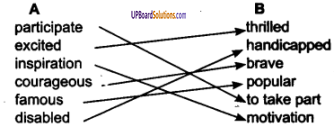
Match the words of list ‘A’ with their meaning given in list ‘B’:
Answer:
UP Board Solutions for Class 6 English Chapter 15 Yes, We Can img-1

Question 2.
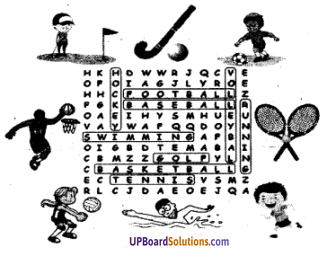
Look at the pictures and encircle the games in the crossword puzzle:
Answer:
UP Board Solutions for Class 6 English Chapter 15 Yes, We Can img-2
Language Practice

Question 1.
Write short answers for the questions given below:
Answer:
Can a crow fly?    Yes, it can.
Can a dog ride a bicycle?    No. it can’t.
Can a rat run?    Yes it can.
Can a whale crawl?    Yes, it cant.
Can a monkey swing?    Yes, it can.
Canacat swim?    Yes, it can.
Can a fox fiy?    Yes, it can.
Can a frog hop?    Yes, it can.

UP Board Solutions

Activity

Question 1.
What can you do? What can’t you do? Write 3 answer for each question.
Answer:

  • I can jump highs.
  • I can swim in the pool.
  • I can’t stay up all night.
  • I can make sandwiches.
  • I can’t bungee jump.
  • I can’t inside a dark room.

Question 2.
Look at the picture and complete the sentence with can/can’t and a verb.
Answer:

  1. He can’t walk
  2. It can hop.
  3. She can write.
  4. He can’t swim.
  5. They can sing.
  6. She can play.
  7. He can’t see.
  8. They can fly.

Question 3.
Answer the following questions-
Answer:
Can a bird sing?    Yes
Can a snake jump?    No
Cana horse run?    Yes
Can a fish swim?    Yes
Can a elephant fly?    No

UP Board Solutions

Question 4.
Frame questions and answer then:
Answer:
MOTHER/YOUR/CAN/DRAW
Can your mother draw?
yes, my mother can draw very well.
CANT GRANDPARENTS/GUTTAR/PLAY / THE/YOUR
Can your grandmother play the guitar?
No, they cannot play the guitar

We hope the UP Board Solutions for Class 6 English Chapter 15 Yes, We Can help you. If you have any query regarding UP Board Solutions for Class 6 English Chapter 15 Yes, We Can, drop a comment below and we will get back to you at the earliest.

Mahatma Gandhi Class 7 English Chapter 8 Question Answer UP Board Solutions

UP Board Class 7th English Chapter 8 Mahatma Gandhi Questions and Answers

कक्षा 7 अंग्रेजी पाठ 8 के प्रश्न उत्तर

These Solutions are part of UP Board Solutions for Class 7 English. Here we have given UP Board Solutions for Class 7 English Chapter 8  Mahatma Gandhi.

Mahatma Gandhi

TRANSLATION OF THE LESSON (पाठ का हिन्दी अनुवाद)

In India we…………………………………… his parents.
हिन्दी अनुवाद- भारत में हमें महात्मा गाँधी को ‘बापू’ या ‘राष्ट्रपिता’ के नाम से बुलाते हैं। उनका पूरा नाम मोहनदास करमचंद गाँधी था। वे 2 अक्टूबर 1869 में गुजरात के काठियावाड़ में पोरबन्दर में पैदा हुए। उनके पिता का नाम करमचंद गाँधी था। उनकी माता का नाम पुतलीबाई था। उनकी पत्नी कस्तूरबा गाँधी थीं। गाँधी जी एक साधारण आदमी का जीवन जीते थे और स्वयं को विलासिताओं से दूर रखते थे। वे बचपन से ही बहुत ईमानदार (UPBoardSolutions.com) और सच्चे थे। एक बार उन्होंने श्रवण कुमार की कहानी सुनी। श्रवण अपने बूढे और अंधे माता-पिता को बाँस पर टंगी टोकरियों में लेकर जाता था। उसकी अपने बूढे माता-पिता के प्रति भक्ति ने गाँधीजी पर गहरा प्रभाव डाला। उन्होंने श्रवण की तरह बनकर अपने माता-पिता की सेवा करने का निश्चय किया।

UP Board Solutions

In India we………………………………… his parents.
हिन्दी अनुवाद – कानून की डिग्री प्राप्त करने वे इंग्लैण्ड गए । डिग्री प्राप्त करने के बाद 1893 में वे भारत आए। वे अपने देशवासियों को विदेशी शासन के द्वारा पीड़ित होता देखकर आहत हुए। इसलिए उन्होंने अपना पूरा जीवन गरीबों के उत्थान के लिए और ब्रिटिश राज के चगुंल से अपने देश को स्वतंत्र कराने में समर्पित किया। उन्होंने ब्रिटिश सरकार के विरुद्ध स्वतंत्रता आंदोलन का नेतृत्व किया और ‘सत्याग्रह’, ‘असहयोग आंदालन’, ‘डांडी नमक यात्रा’, ‘भारत छोड़ों आंदोलन’ और ‘सविनय अवज्ञा आंदोलन’ की शुरूआत की। अन्ततः, भारत 15 अगस्त 1947 को स्वतंत्र हुआ।

महात्मा गाँधी अपने अंहिसा के सिद्धांतों से सारी दुनिया में जाने जाते हैं। उन्होंने एक संत की जीवन जिया और वे समाज में फैले सभी तरह के अन्याय और असमानता के विरुद्ध थे। वे रामराज्य की स्थापना करना चाहते थे। रामराज्य से उनका अर्थ ईश्वर (UPBoardSolutions.com) का साम्राज्य था। उनके लिए राम और रहीम एक समान ईश्वर थे। देश के प्रति उनके महान योगदान के लिए भारतीय उनको ‘राष्ट्र के पिता’ या ‘बापू’ कहते हैं। उनकी हत्या 30 जनवरी, 1948 में नत्थूराम गोड्से के द्वारा हुई। तभी से, 30 जनवरी शहीद दिवस के रूप में भारत में मनाया जाता है।

UP Board Solutions

EXERCISE (अभ्यास)

Comprehension Questions

Question 1.
Answer the following questions:
Answer:
Question a.
What was Gandhiji’s full name?
Answer:
Gandhiji’s full name was Mohandas (UPBoardSolutions.com) Karamchand Gandhi.

Question b.
When and where was Gandhiji born?
Answer:
Gandhiji was born on 2nd October, 1869 at Porbandar in Kathiawad.

UP Board Solutions

Question c.
Write the main qualities of Gandhiji’s character.
Answer:
Gandhiji was honest and truthful from his childhood. He led a saintly life. He is know for his principle of non-violence all over the world.

Question d.
Why was Gandhiji restless?
Answer:
Gandhiji was restless to see his countrymen (UPBoardSolutions.com) suffering under foreign rule.

Question e.
Whose story inspired Gandhiji to serve his parents?
Answer:
The story of Shravana Kumar inspired Gandhiji to serve his parents.

UP Board Solutions

Question f.
Why do we call Gandhiji as ‘Father of the Nation’?
Answer:
For his great contribution to the freedom (UPBoardSolutions.com) of our country, we call Gandhiji as ‘Father of the Nation’.

Question g.
Who assassinated Gandhiji and when?
Answer:
Nathuram Godse assassinated Gandhiji on 30th January, 1948.

UP Board Solutions

Question 2.
Write ‘T’ for true statements (UPBoardSolutions.com) and ‘F’ for false statements :
Answer:
a. Mahatma Gandhi was born on 2nd November 1869.       (✓)
b. His mother’s name  was Shantibai.                                        (✗)
c. He was honest and truthful since his childhood.                (✓)
d. 30th January is celebrated as Martyr’s Day in India.         (✓)

Word Power

Question 1.
Write the opposites of the following words :
Answer:
honest – dishonest
kind    unkind
poor – rich
equal – unequal
justice – injustice
dark – light
happiness – unhappiness
necessary – unnecessary

UP Board Solutions

Language Practice

Question 1.
Match the suffix with the (UPBoardSolutions.com) root word to make a new word:
Answer:
UP Board Solutions for Class 7 English Chapter 8  Mahatma Gandhi img-1

UP Board Solutions

Question 2.
Using the table frame questions, write the suitable ‘Yes’ or ‘No’ answers below them :
UP Board Solutions for Class 7 English Chapter 8  Mahatma Gandhi img-2
Answer:
a. Does a bird fly? – Yes, it does
b. Does a cat fly? – No, it doesn’t
c. Do birds fly? (UPBoardSolutions.com) – Yes, they do
d. Do cats fly? – No, they don’t.
e. Does a frog fly? – No, it doesn’t
f. Do frogs fly? – No, it doesn’t

Acitivity         Note: Do it yourself.

We hope the UP Board Solutions for Class 7 English Chapter 8  Mahatma Gandhi help you. If you have any query regarding UP Board Solutions for Class 7 English Chapter 8  Mahatma Gandhi, drop a comment below and we will get back to you at the earliest.

Netaji Subhash Chandra Bose Class 6 English Chapter 14 Question Answer UP Board Solutions

UP Board Class 6th English Chapter 14 Netaji Subhash Chandra Bose Questions and Answers

कक्षा 6 अंग्रेजी पाठ 14 के प्रश्न उत्तर

These Solutions are part of UP Board Solutions for Class 6 English. Here we have given UP Board Solutions for Class 6 English Chapter 14 Netaji Subhash Chandra Bose.

Netaji Subhash Chandra Bose

TRANSLATION OF THE LESSON (पाठ का हिन्दी अनुवाद)

Subash Chandra……………………………….freedom movement.
हिन्दी अनुवाद – सुभाष चंद्र बोस एक महान स्वतंत्रता सेनानी थे। उन्हें ‘नेताजी’ के नाम से जाना जाता था। वह 23 जनवरी, 1897 में कटक (ओडिशा) में एक हिन्दु परिवार में पैदा हुए। उनके पिता का नाम जानकीनाथ बोस और माता का नाम प्रभावती देवी था। वे स्कूल में एक बहुत प्रतिभाशाली छात्र थे। उन्होंने अपना स्कूल कटक में पूरा किया, कक्षा 10 कलकत्ता (अब कोलकाता) और स्नातक 1918 में कलकत्ता विश्वविद्यालय में पूरा किया।

बाद में उनके पिता ने उन्हें भारतीय सिविल सर्विस की परीक्षा देने वेफ लिए इग्लैण्ड भेजा। वे पास हो गए और नौकरी में लग गए, परन्तु जल्द ही उन्होंने भारतीय सिविल सर्विस से इस्तीफा (UPBoardSolutions.com) दे दिया और स्वतंत्रता आंदोलन में भाग लेने के लिए भारत वापस आ गए।

UP Board Solutions

He was very………………………………ever lasting inspiration.
हिन्दी अनुवाद – वे राष्ट्रवादी देशबन्धु चितरंजन दास, उनके राजनैतिक गुरु, से बहुत प्रभावित हुए। उन्होंने लोगों को स्वतंत्रता संघर्ष से जुड़ने के लिए अभिप्रेरित किया। ‘स्वराज’ नामक अखबार से सुभाष चंद्र बोस ने ब्रिटिश राज का दृढ़ता से विरोध किया। वे सिंगापुर चले गए और अपनी स्वयं की “आजाद हिंन्द फौज” का गठन किया। उन्होंने अपनी फौज को दिल्ली चलो” और “जय हिन्द” का नारा दिया। उन्होंने अपने महान शब्दों, “तुम मुझे खून दो, और मैं तुम्हे आजादी दूंगा” के द्वारा अपनी सेना को प्रेरित किया, अपनी मातृभूमि को ब्रिटिश राज से स्वतंत्र करवाने के लिए।

ऐसा माना जाता है कि विमान हादसे में 1945 में ताईवान (UPBoardSolutions.com) में नेताजी की मृत्यु हो गई, परन्तु इनकी मौत का रहस्य आज तक अनसुलझा है। एक स्थायी प्रेरणा के रूप में नेताजी हर भारतीय के दिल में जीवित रहेंगे।

EXERCISE (अभ्यास)

Comprehension Questions

Question 1.
Answer the following questions :
Answer:
Question a.
Which Indian freedom fighter is known as Netaji?
Answer:
Subash Chandra Bose is known as ‘Netaji’

UP Board Solutions

Question b.
When and where was Subhash Chandra Bose born?
Answer:
Subash Chandra Bose was born on 23rd January, 1897, in a Hindu family in Cuttack (Odisha).

Question c.
Why did Subhash Chandra Bose resign from the Indian Civil Services?
Answer:
Subash Chandra Bose wanted to participate actively in the freedom movement of India therefore he resigned from the Indian Civil Services and returned of India.

Question d.
Who was the political guru of Subhash Chandra Bose?
Answer:
Deshbandhu Chitranjan Das was Bose’s political guru.

Question e.
What does INA stand for?
Answer:
INA stands for Indian National Army’.

UP Board Solutions

Question f.
Write the slogans given by Subhash Chandra Bose.
Answer:
Popular slogans given by Subash Chandra Bose were- “Delhi Chalo”, “Jai Hind” and “Give me blood and I will give you freedom”.

Question 2.
Write T for true and F for false statements:
Answer:
a. Subhash Chandra Bose was a great freedom fighter.  –  (T)
b. He completed his schooling in Japan.  –  (F)
c. He did not resign from the Indian Civil Services.  –  (F)
d. He did not want to participate in the freedom movement.  –  (F)
e. He formed the Indian National Congress.  –  (F)

Word Power

Question 1.
Fill in the blanks with the words given in the box:
UP Board Solutions for Class 6 English Chapter 14 Netaji Subhash Chandra Bose img-1
Answer:
a. Neha is a brilliant student.
b. The mystery of the ghost was solved by the teacher.
c. Rajni will participate in a quiz competition at the national level.
d. Subhash Chandra Bose was very much influenced by Chitranjan Das.
e. Many great leaders sacrificed their lives for the freedom of their country.

UP Board Solutions

Language Practice

Question 1.
Fill in the blanks with adjectives given in the books which is opposite in meaning to the underlined adjectives. One is done for you.
Answer:
a. A shallow pool is not deep.
b. The parcel is heavy, but the letter is light.
c. Rock is hard, but wool is soft.
d. I wear my watch on the right wrist not on the left.
e. The scissor is sharp but the knife is blunt.
f. Ashok’s glass is empty, but Mary’s glass is full.
g. Sona is absent today, but Rajat is present.
h. The roads in Haryana are broad, not narrow.

Let’s Know More
Do it yourself.

UP Board Solutions

Activity
Do it yourself.

We hope the UP Board Solutions for Class 6 English Chapter 14 Netaji Subhash Chandra Bose help you. If you have any query regarding UP Board Solutions for Class 6 English Chapter 14 Netaji Subhash Chandra Bose, drop a comment below and we will get back to you at the earliest.