Class 11 English Chapter 4 Question Answer UP Board The Kite Maker

UP Board Class 11th English Prose Chapter 4 Questions and Answers

कक्षा 11 अंग्रेजी पाठ 4 के प्रश्न उत्तर

These Solutions are part of UP Board Solutions for Class 11 English. Here we have given UP Board Solutions for Class 11 English Prose Chapter 4 The Kite Maker.

LESSON at a Glance
It is a story of an old man-Mahmood who was a kite maker. There was a time when grown ups flew kites from the maidans. There was a good deal of betting in it and money frequently changed hands. Kite-flying was then the sport of kings. Mahmood, the kite maker had been well known throughout the city in the prime of his life. At the request of the Nawab, he had once made a very special kind of kite. It consisted of a series of small, very light paper discs, trailing on a thin bamboo frame. The discs decreasing in size from head to tail gave the kite the appearance of a crawling serpent.

Yes, these were leisurely days. But the Nawab had died years ago. Kite makers, like poets once had their patrons. Mahmood, when grew old had none. The children who had bought kites from him ten years ago were now adults struggling for a living. They did not have time for the old man and his memories. Mahmood had grown old like banyan tree, his hands gnarled and twisted like the roots of the tree.

The old kite maker was sad though he still made kites for his own amusement and as playthings for his grandson, Ali. Not many people bought kites these days. Adults hated kites and children preferred movies. Moreover, there were left hardly any open spaces for flying kites.

But still he could find some happiness out of his grandson, the old man made kites for Ali. Ali was like the young mimosa planted at the end of their courtyard. Mahmood thought that in two years, both Ali and the tree would acquire the strength and confidence that are characteristics of youth.

But the old man did not live long to see his grandson grow with the young mimosa and passed away silently leaving his playful grandson in bewilderment.

पाठ का हिन्दी अनुवाद

1.An ancient banyan ……… hollowed-out cheek.

गली रामनाथ नामक सड़क पर एक पुरानी मस्जिद की दरारों में उगा हुआ एक बरगद का पुराना अकेला पेड़ था और छोटे अली की पतंग इसकी शाखाओं में फंस गई।

वह लड़का, नंगे पैर फटी हुई कमीज पहने हुए उस तंग गली के गोल पत्थरों पर दौड़ता हुआ उस स्थान पर पहुँचा जहाँ उसके दादा अपने पीछे के आँगन में धूप में सपने में ऊँघते हुए बैठे थे।

‘दादाजी !’ लड़का चिल्लाया, पतंग चली गई।

बूढ़ा आदमी झटके के साथ अपने सपने से जागा और अपना सिर उठाकर दाढ़ी दिखाई जो सफेद होती यदि उसने इसे मेहँदी की पत्तियों से लाल न रँगा होता।

उसने पूछा कि क्या डोर टूट गई, ‘मैं जानता हूँ कि पतंग की डोर वैसी नहीं है जैसी होनी चाहिए।’ ‘नहीं दादाजी, पतंग बरगद के पेड़ में फंस गई।’

वह बूढ़ा आदमी मुस्कराया, ‘मेरे बच्चे, तुम्हें अभी यह सीखना है कि ठीक प्रकार से पतंग कैसे उड़ाई जाए और मैं इतना बूढ़ा हो गया हूँ कि तुम्हें सिखा नहीं सकता, यह बड़ी दया की बात है। लेकिन तुम्हें दूसरी पतंग मिल जाएगी।’ उसने अभी-अभी बाँस, कागज और पतले सिल्क से एक नई पतंग बनाई है और यह सूखने के लिए धूप में पड़ी है। यह हल्की गुलाबी रंग की पतंग थी जिसमें एक छोटी हरी पूँछ लगी थी। बूढ़े आदमी ने यह पतंग अली को दे दी और वह लड़का अपने पंजों पर खड़ा हो गया और उसने अपने दादाजी के गड्ढेदार (पोपले) गाल चूमे।

2. I will not …. in the district.

मैं इसे नहीं खोऊँगा।” उसने कहा, “यह पतंग चिड़िया के समान उड़ेगी।”

और वह मुड़ा और कूदता हुआ आँगन से बाहर भाग गया।

बूढ़ा आदमी धूप में बैठो सपना देखता रहा। उसकी पतंग की दुकान समाप्त हो गई थी और दुकान तथा उसका सामान वर्षों पहले एक कबाड़ी को बेच दिया गया था, किन्तु अपने मनोरंजन के लिए तथा अपने पोते के लिए खिलौने के रूप में वह अब भी पतंगें बनाता था। इन दिनों बहुत अधिक लोग पतंग नहीं खरीदते थे। प्रौढ़ व्यक्ति उनसे घृणा करते थे और बच्चे अपना धन सिनेमा में खर्च करना पसन्द करते थे। इसके अतिरिक्त पतंग उड़ाने के लिए खुले स्थान बहुत कम रह गए थे। जो मैदान पुराने किले की दीवारों से नदी के किनारे तक फैले हुए थे वे नगर के बसने से समाप्त हो गए थे।

किन्तु बूढ़े आदमी को वह समय याद था जब बड़ी आयु के लोग मैदानों में पतंगें उड़ाते थे और बड़े-बड़े पेंच लड़ाते थे। पतंगें आकाश में इधर-उधर घूमती थीं और झटके से ऊपर-नीचे आती-जाती थीं। एक-दूसरे से पेंच लड़ते थे, जब तक उनमें से एक पतंग कट न जाए। फिर कटी हुई स्वतन्त्र पतंग आकाश में गायब हो जाती थी, काफी शर्ते भी लगती थीं और बार-बार धन का आदान-प्रदान होता था।

उस समय पतंग उड़ाना राजाओं का खेल था। बूढ़े व्यक्ति को याद था कि नवाब कैसे अपने सेवकों के साथ नदी के किनारे आकर इस अच्छे खेल में भाग लेता था। उन दिनों खाली समय सुन्दर नाचती हुई कागज की पट्टी अर्थात् पतंग के साथ बिताया जाता था। अब प्रत्येक व्यक्ति को जल्दी है, मशीन की तरह वह जल्दी में है और पतंग जैसी नाजुक वस्तुएँ तथा दिवा स्वप्नों को पैरों के नीचे कुचल दिया गया है।

पतंगें बनाने वाला महमूद अपने प्रारम्भिक जीवन स्तर में नगर में खूब प्रसिद्ध था। उसकी कुछ बड़ी-बड़ी पतंगें तीन या चार रुपये में बिकती थीं। एक बार नवाब की प्रार्थना पर उसने एक ऐसी विशेष पतंग बनाई जो जिले (क्षेत्र) में पहले कभी नहीं देखी गई थी।

3. It consisted of……. like the veena.

इसमें बहुत-सी छोटी हल्के कागज की डिस्कें थीं जो बाँस के एक ढाँचे से लटक रही थीं। प्रत्येक डिस्क के सिरे पर सन्तुलन बनाने के लिए उसने घास की एक टहनी बाँध दी थी। सबसे पहली डिस्क की सतह कुछ ढालदार थी। उस पर एक अद्भुत भद्दा चेहरा बना हुआ था जिसमें शीशे की दो आँखें थीं। सिर से पूँछ की ओर डिस्क का आकार घटता जा रहा था और इससे पतंग की शक्ल एक रेंगते हुए साँप जैसी बन गई। इस भारी और भद्दी योजना को जमीन से उठाने में बड़े कौशल की आवश्यकता थी और केवल महमूद ही इसका प्रबन्ध कर सकता था।

इस साँप जैसी पतंग के विषय में, जिसे महमूद ने बनाया था, लोगों ने सुन रखा था और यह खबर फैल गई कि इसमें कोई पारलौकिक शक्ति है। लोगों की भारी भीड़ मैदान में नवाब की मौजूदगी में इसकी पहली सार्वजनिक उड़ाने को देखने के लिए इकट्ठी हो गई। पहली कोशिश में यह धरती से नहीं उठी। डिस्क में ऐसी आवाज हुई मानो यह उठना नहीं चाहती और सूर्य का प्रतिबिम्ब आँखों में लगे छोटे शीशों में आ गया और पतंग शिकायत करती हुई सजीव प्राणी लगने लगी।

फिर सीधी ओर से हवा चली और साँप जैसी पतंग आकाश में ऊँची उड़ गई, ऐंठती हुई ऊपर उठ गई और सूर्य इसकी आँखों में अब भी चमक रहा था। जब यह बहुत ऊँची चली गई, तब इसने डोरी को बहुत तेजी से खींचा और महमूद के युवा पुत्रों को चरखी से उसकी सहायता करनी पड़ी, फिर भी पतंग डोरी को खींचती रही मानो इसने स्वतन्त्र होने और अपनी मौज का जीवन बिताने का निश्चय कर लिया हो।

फिर यह घटना घटी कि अचानक डोरी टूट गई। पतंग सूर्य की ओर भागने लगी, तब तक भागती रही जब तक यह दिखनी बन्द न हो गई। फिर यह कभी नहीं मिली और महमुद को बाद में यह आश्चर्य हुआ कि क्या उसने पतंग के रूप में इतनी स्पष्ट और जीवित वस्तु बनाई थी। उसने इसके समान फिर दूसरी पतंग नहीं बनाई। किन्तु इसके स्थान पर उसने नवाब को संगीत वाली पतंग भेट की जिसकी आवाज वीणा के समान थी।

4. Yes, those were ……… last leaves.

हाँ, वे दिन आराम से बिताने वाले दिन थे, लेकिन नवाब की कई वर्ष पूर्व मृत्यु हो गई थी। उसके वंशज उतने गरीब थे जितना स्वयं महमूद। एक समय कवियों के समान पतंग बनाने वालों के भी संरक्षक होते थे, महमूद का कोई नहीं था। किसी ने उससे उसके नाम अथवा व्यापार के विषय में नहीं पूछा, क्योंकि गली में और अनेक व्यक्ति थे और कोई अपने पड़ोसी के विषय में चिन्तित नहीं होता था।

जब वह युवा था और बीमार पड़ा उसके पड़ोस का प्रत्येक व्यक्ति उसके स्वास्थ्य के विषय में पूछने आता था। अब जबकि उसका अन्त निकट है कोई भी उससे मिलने नहीं आता। उसके अधिकांश पुराने साथी मर गए हैं। उसके पुत्र बड़े हो गए हैं। उनमें से एक स्थानीय गैराज में काम करता था, दूसरा पाकिस्तान में रह गया था जो वहाँ विभाजन के समय से है।

जो बच्चे उससे दस वर्ष पहले पतंग खरीदते थे अब प्रौढ़ व्यक्ति हो गए हैं और अपनी आजीविका के लिए संघर्ष कर रहे हैं। उनके पास उस बूढ़े आदमी तथा उसकी बातें याद करने का समय ही नहीं है। इस तेजी से बदलते हुए प्रतियोगिता वाले संसार में बड़े होकर उन्होंने उस पतंग वाले को उतने ही बे-मन से देखा जितना वे बरगद के पेड़ को बे-मन से देखते थे।

ये दोनों (महमूद और बरगद के पेड़) ऐसी स्थायी वस्तुएँ हो गई थीं जो उनके इर्द-गिर्द रहने वाले आम लोगों के लाभ अथवा सम्बन्ध की वस्तुएँ नहीं थीं। अब लोग उस बरगद के पेड़ के नीचे अपनी समस्याओं और योजनाओं पर विचार करने के लिए इकट्ठे नहीं होते थे। केवल गर्मियों में कुछ व्यक्ति धूप से बचने के लिए उसके नीचे बैठ जाते थे।

लेकिन फिर भी उसका एक पोता था। यह अच्छा था कि उसका पुत्र निकट ही काम करता था और वह तथा उसकी पुत्रवधू महमूद के घर में ही रहते थे। उसे यह देखकर प्रसन्नता होती थी कि वह लड़का जाड़ों में धूप में खेलता था। उसकी आँखों के सामने ही एक छोटे पौधे की परवरिश के समान ही यह युवा हुआ और प्रतिदिन फला-फूला।

वृक्षों तथा मनुष्यों में बहुत समानता है। वे एक ही रफ्तार से बढ़ते हैं यदि उन्हें हानि न पहुँचाई जाए, भूखा न रखा जाए या काटा न जाए। अपनी युवावस्था में वे आकर्षक प्राणी होते हैं और बुढ़ापे में वे थोड़ा-सा झुके हुए। वे याद रखते हैं, वे अपनी कठोर लेकिन आसानी से टूटने वाली भुजाएँ धूप में फैलाते हैं और दु:खभरी साँस के साथ अपनी अन्तिम पत्तियाँ गिराते हैं अर्थात् मर जाते हैं।

5. Mahmood was take……the blue sky.

महमूद बरगद के पेड़ के समान था। उसके हाथ पुराने पेड़ की जड़ों के समान ऐंठे हुए थे। अली एक छोटे छुईमुई के पौधे के समान था जिसे आँगन के सिरे पर लगा दिया गया हो। दो वर्ष में वह भी और यह पौधा भी शक्ति और विश्वास प्राप्त कर लेंगे जो जवानी के लक्षण हैं।

सड़क पर आवाजें और धीमी हो गईं और महमूद को आश्चर्य हुआ कि क्या वह सोने वाला और स्वप्न देखने वाला था जैसा कि वह बहुधा सुन्दर शक्तिशाली पतंग का स्वप्न देखा करता था जो हिन्दुओं के महान् सफेद पक्षी गरुड़ से मिलती-जुलती होती थी जो भगवान् विष्णु की प्रसिद्ध सवारी है।

वह छोटे अली के लिए एक अद्भुत नई पतंग बनाना चाहेगा। उसके पास लड़के को देने के लिए और कुछ, है भी तो नहीं।

उसने दूर से आती हुई अली की आवाज को सुना, किन्तु यह अनुभव नहीं किया कि लड़का बुला रहा है। आवाज बहुत दूर से आती मालूम पड़ रही थी।

अली आँगन के दरवाजे पर था और पूछ रहा था कि क्या उसकी माँ बाजार से अभी लौटी है या नहीं। जब महमूद ने उत्तर नहीं दिया तब लड़का आगे आया और उसने अपने प्रश्न को दोहराया। धूप उस व्यक्ति के सिर पर तिरछी पड़ रही थी और एक सफेद छोटी तितली उसकी लटकी हुई दाढ़ी पर बैठी हुई थी। महमूद चुप था और जब अली ने अपना छोटा भूरा हाथ बूढ़े व्यक्ति के कन्धे पर रखा तो उसे उत्तर नहीं मिला। लड़के ने इतनी धीमी आवाज सुनी जितनी उसकी जेब में पत्थरों के रगड़ने से होगी (महमूद मर गया)

अचानक डरा हुआ अली मुड़ा और दरवाजे की ओर चला और फिर अपनी माँ के लिए चिल्लाता हुआ सड़क पर दौड़ गया। बरगद के पेड़ में हवा के अचानक झोंके में उसकी फटी हुई पतंग उठ गई तथा हवा में उड़ गई और उस भारी व्यस्त नगर से दूर नीले आकाश में चली गई।

Understanding the Text

Explanations
Explain one of the following passages with reference to the context:
1. Not many people ……… river-banks.
Reference: These lines have been taken from the lesson ‘The Kite Maker’ written by Ruskin Bond.
[ N.B. : The above reference will be used for all explanations of this lesson. ]

Context : In these lines the writer describes the story of a famous kite maker Mahmood. In his young age the business of kite flying flourished but nowadays nobody takes interest in flying the kites.

Explanation : In these lines Mahmood remembers his old time. So, the writer how much interest and pleasure the people took in flying the kites. He further described that not many people bought kites these days. Adults had disdained them and children spent their money for the pictures. The fields were not more for flying kites. Most of the maidans which had stretched from the old fort walls to the river-bank were covered by the people for their residents and farming.

2. But the old man ……..changed hands.

Context : In this lesson the writer describes the story of a famous kite maker, Mahmood. His young age was full of fun and pleasure. He was the most famous kite maker. So, many people came to him. When he became old, the people had no interest in flying kite. So, he had to pass his old age sitting idle.

Explanation : In these lines Mahmood remembers the old time. So, the writer describes how much interest and pleasure the people took in flying the kite. Kite flying was the hobby of so many people. They gathered in open spaces and flew kites. There were great battles with high betting. Two rivals flew the kite. Each of them tried to tangle his kite with that of the other and to cut the string of his kite. Thus the winning rival got money.

3.The discs …… could manage it.

Context : In this lesson the writer describes the story of a famous kite maker, Mahmood. His kites were very famous and even the Nawab was very fond of flying kites.

Explanation : In these lines the writer describes a very special kind of kite which Mahmood made on the request of Nawab. It was popular by the name of ‘Dragon Kite’. In it there was a series of small, light paper discs, trailing on a thin bamboo frame. The size of the discs was not equal. The uppermost disc was the biggest and the lowest disc the smallest. Thus, the kite looked like a crawling serpent. It was so heavy and complicated that only Mahmood could fly it. In the sun light it was shining like a dragon and hence it was known as dragon kite.

4. And then it happened ……..sound like veena.

Context: The writer describes a very special kind of kite known as dragon kite made by Mahmood. The kite was very heavy and looked like a crawling serpent. In the sun-light it looked like a dragon. It was so complicated that only Mahmood could manage it. Now the dragon kite began to soar higher and higher.

Explanation : In these lines the writer explains the power of dragon kite. The kite pulled and looked as if it wanted to be free. All of a sudden the twine of the kite broke and the kite went on higher and higher and soon it disappeared forever. Mahmood also wondered on the construction and power of this kite. After this Mahmood never made such a kite. He only made a kite which produced sound like veena. He presented this kite to Nawab.

5. When he was younger ……… at the time of partition.

Context : In his early life Mahmood was known as the best kite maker. He was respected everywhere and by all. But after the death of Nawab no one took interest in kite-flying. People were busy in earning their bread and butter.

Explanation: In these lines the writer compares the life of Mahmood in his young age and old age. When Mahmood was younger, he had many friends. His well-wishers and neighbours used to come to ask about his health whenever he was sick. But now in his old age no one comes to him. Many of his friends have died. His sons also had grown up and they are also busy in their own occupations. So, Mahmood has no child to play with. Thus, his life has become deserted and he was very sad.

6. The children who ……. banyan tree.

Context: In this lesson the writer compares the youth of Mahmood with his old age. In his youth, many children came to Mahmood. Whenever he fell ill, many people came to ask for his health. But now he has grown old and nobody comes to him.

Explanation: In these lines the writer says why people do not come to him in his old age. The children who bought kites from Mahmood, have now become young. They are now busy earning their livelihood. They are facing struggles in their life. They have no time to come to Mahmood and ask for his well being. They have no attachment, affection or sympathy either with Mahmood or with the banyan tree under which they used to play in their young age.

7. Both were taken ………fierce sun.           [Imp.]

Context: Mahmood, who was a famous kite maker in his young age, has now grown old. He recalls the days of his young age when many people and children came to him to buy his kites. He had so many well-wishers also. But now many of his friends have died and children have no interest in flying kites. So, Mahmood is grieving over his old age.

Explanation : In these lines the writer makes it clear that there has been a great change in the attitude of people since Mahmood was young. Now, the people are very busy. They have no time to sit under the banyan tree for a long time to gossip and discuss their problems. Mahmood as well as the banyan tree has no importance for the common people. Both are like the things which are fixed permanently at one place and can do no good to others. Only during summer few people sit under the banyan tree to protect themselves from the heat.

8. There is a great ……. last leaves.

Context: Mahmood was a famous kite maker. But now he has become old. So, the people do not come to him so often as they used to come in his young age. Mahmood had a grandson named Ali, and he was glad to watch the boy playing and growing. under his eyes.

Explanation: In these lines the writer compares trees with men. He says that there is a great similarity between them. Both of them grow slowly if they are not hurt in any way and are supplied with proper food. When they are young, they look very bright. But as they advance in their age, they bend and become weak. In old age the limbs of men and the branches of trees become hard and can easily be broken. Ultimately they die.

9. Mahmood was like …… characteristics of youth.          [M. Imp.)

Context: Here, the writer says that trees and men both grow slowly if they are not hurt. When they are young they look very bright. But as they advance in their age, they bend and become weak. In the old age the limbs of men and the branches of the trees become hard and can easily be broken.

Explanation : Mahmood has become very old and Ali is very young. So, the writer makes a comparison between Mahmood and banyan tree and Ali and mimosa. He says that the twisted hands of Mahmood are like the roots of banyan tree. Ali is like a young mimosa plant and he will get strength and confindence as he grows. These are the characteristics of youth.

10. Suddenly afraid…….. into the blue sky.                       [Imp.]

Context: Mahmood was feeling sleepy and dreamy as usual. But in reality the end of his life had approached nearer. He could not hear even the question of his son Ali and he was quite silent. Ali put his small hand on Mahmood’s soldier and heard only a faint sound like rubbing of marbles.

Explanation : Ali was afraid when Mahmood did not answer, he ran into the street crying for his mother. The writer ends the story hereby saying that a sudden gust of wind came and lifted the torn kite from the tree and carried it away into the sky far from the noisy city. This description resembles the liberation of soul from torn and worn out body and its final journey to Heaven.

Short Answer Type Questions

Answer the following questions in not more than 30 words :

Question 1.
How did Ali lose his kite?
(अली ने अपनी पतंग कैसे खो दी ?)
Answer:
Ali’s kite was caught in the branches of a banyan tree.
(अली की पतंग एक बरगद के पेड़ की शाखाओं में फंस गई थी।)

Question 2.
What complaint did Ali make to his grandfather in the lesson ‘The Kite Maker ?
(The Kite Maker’ नामक पाठ में अली ने अपने दादा से क्या शिकायत की ?)
Answer:
Ali’s grandfather made a kite for him which was caught in the branches of a banyan tree. Ali complained to his grandfather that his kite was stuck in the banyan tree.
(अली के दादा ने उसके लिए एक पतंग बनाई थी जो एक बरगद के पेड़ की शाखाओं में फंस गई थी। अली ने अपने दादा जी से शिकायत की कि उसकी पतंग बरगद के पेड़ में अटक गई है।)

Question 3.
What did the old man say when he heard that Ali had lost his kite ?
(जब बूढ़े आदमी को पता लगा कि अली की पतंग खो गई है, तब उसने क्या कहा ?)
Answer:
When the old man heard that Ali had lost his kite, he told Ali that he had yet to learn how to fly a kite.
(जबे बूढ़े व्यक्ति को पता लगा कि अली की पतंग खो गई है, तब उसने अली को केवल यह कहा कि उसे अभी सीखना है कि पतंग कैसे उड़ाई जाए।)

Question 4.
Could Ali get another kite from his grandfather? what was it like ?
(क्या अली अपने दादाजी से दूसरी पतंग प्राप्त कर सका ? यह किसके समान थी ?)
Answer:
Yes, Ali could get another kite from his grandfather. It was a pink kite with a small green snake like tail.
(हाँ, अली को अपने दादाजी से दूसरी पतंग मिल गई। यह एक गुलाबी पतंग थी जिसमें एक छोटी हरी पूँछ थी और यह एक साँप के समान थी।)

Question 5.
Why did the little boy kiss his grandfather and what promise did he make to him ?
(छोटे लड़के ने अपने दादा को क्यों चूमा और उससे क्या वायदा किया ?)
Answer:
Ali got a new kite from his grandfather. So, he kissed him. He promised that he would not lose it.
(अली को अपने दादाजी से एक नई पतंग मिल गई। इसलिए उसने उन्हें चूमा। उसने वायदा किया कि वह उसे खोएगा नहीं।)

Question 6.
Why did the old man continue to make kites even when his shop was no longer there ?
(बूढ़े आदमी ने पतंग बनाना क्यों जारी रखा जबकि उसकी दुकान भी समाप्त हो गई थी ?)
Answer:
The old man continued to make kites for his own amusement and as playthings for his grandson.
(बूढ़े आदमी ने अपने मनोरंजन के लिए तथा अपने पोते के खेलने के लिए पतंग बनाना जारी रखा।)

Question 7.
why did many people not buy kites ?
(बहुत से आदमी पतंग क्यों नहीं खरीदते थे ?)
Answer:
The grown up people had no time for flying kites. They hated it. The children spent money on seeing films. So, many people did not buy the kites.
(बड़ी आयु के लोगों के पास पतंग उड़ाने का समय नहीं था। वे इससे घृणा करते थे। बच्चे अपना धन फिल्म देखने में खर्च करते थे। इसलिए, अधिकांश व्यक्ति पतंगें नहीं खरीदते थे।)

Question 8.
How were the great battles fought in kite-flying?
(पतंग उड़ाने में बड़ी-बड़ी लड़ाइयाँ कैसे लड़ी जाती थीं ?)
Answer:
There were at least two rivals. Each of them tried to tangle his kite with the other. The man who could cut the string of another’s kite was the winner. There was a lot of betting also in it.
(दो प्रतिद्वन्द्वी होते थे। उनमें से प्रत्येक दूसरे की पतंग में पेंच लड़ाने की कोशिश करता था। वह व्यक्ति जो दूसरे की पतंग की डोरी काट देता था वह जीतता था। इसमें काफी बड़ी शर्त भी लगती थी।)

Question 9.
What time did the old man remember ? Give some of the peculiarities of the time he remembered.
(बूढ़े व्यक्ति को कौन-सा समय याद था ? जो समय उसे याद था उसकी कुछ विशेषताएँ बताइए।)
Answer:
The old man remembered the days of Nawab. The people were very fond of flying kites. Great battles with betting were fought in kite flying.
(बूढ़े व्यक्ति को नवाब के दिन याद थे। उस समय लोग पतंग उड़ाने के शौकीन थे। शर्त के साथ पतंग उड़ाने की लड़ाइयाँ लड़ी जाती थीं।)

Question 10.
who was Mahmood why was he popular throughout the city?
(महमूद कौन था ? वह पूरे नगर में क्यों प्रसिद्ध था ?)
Answer:
Mahmood was a kite maker. He was popular throughout the city for good and pretty kite making.
(महमूद पतंग बनाने वाला था। वह अच्छी और सुन्दर पतंग बनाने के लिए पूरे नगर में प्रसिद्ध था।)

Question 11.
Describe the special features of the kite Mahmood had once made at the request of the Nawab.
(उस पतंग की कुछ विशेषताएँ बताइए जो महमूद ने नवाब की प्रार्थना पर बनाई थी।)
Or
Describe the characteristic features of the ‘dragon kite’made by Mahmood.
(महमूद के द्वारा बनाई गई ड्रेगन पतंग की कुछ विशेषताएँ लिखिए।)
Answer:
Dragon kite was a clumsy plan. This kite was like a crawling serpent. It had some coloured discs, a fantastic painted face and two eyes made of mirror. A small twig was tied to it to keep it balanced.
(यह एक भद्दी योजना थी। यह पतंग एक रेंगते हुए साँप के समान थी। इसमें कुछ रंगीन डिस्कें थीं, एक अद्भुत चेहरा जिसमें दो शीशे की आँखें लगी थीं, पेण्ट हो रहा था। इसे सन्तुलित रखने के लिए घास की टहनी इससे बँधी हुई थीं।)

Question 12.
why was the name ‘dragon kite given to the kite that Mahmood had made for the Nawab ?
(जो पतंग महमूद ने नवाब के लिए बनाई उसका नाम ड्रेगन पतंग क्यों पड़ा ?)
Answer:
The kite made for the Nawab was like a moving serpent. So it was given the name of dragon kite’.
(जो पतंग नवाब के लिए बनाई गई थी वह एक उड़ते हुए साँप के समान थी। इसलिए उसका नाम ड्रेगन पतंग पड़ गया था।)

Question 13.
Did the dragon kite’ really possess supernatural power ? Was it a success or a failure ? Give the details to justify your answer.
(क्या ड्रेगन पतंग में वास्तव में अलौकिक शक्ति थी ? क्या वह सफल हुई या असफल ? विस्तार से अपने उत्तर की पुष्टि कीजिए।)
Answer:
The ‘dragon kite’ did not possess supernatural power. It was too heavy to fly and to be controlled. So it was a failure.
(ड्रेगन पतंग’ में अलौकिक शक्ति नहीं थी। यह इतनी भारी थी कि न तो इसे उड़ाया जा सकता था और न नियन्त्रित किया जा सकता था। इसलिए यह असफल रही।)

Question 14.
What happened finally to the ‘dragon kite’ ?
(अन्त में ड्रेगन पतंग का क्या हुआ ?)
Answer:
In the end dragon kite pulled off the string and vanished into the sky.
(अन्त में ड्रेगन पतंग की डोरी टूट गई और यह आकाश में अदृश्य हो गई।)

Question 15.
What was the other kite like which Mahmood presented to Nawab ? Why did he not make another kite like the ‘dragon kite’?
(दूसरी पतंग जो महमूद ने नवाब को भेंट की किसके समान थी ? उसने ड्रेगन पतंग जैसी दूसरी पतंग क्यों नहीं बनाई ?)
Answer:
The other kite which Mahmood presented to Nawab was a musical kite. It made a sound like the Veena. Dragon kite was not a success. So, he did not make another kite like this.
(दूसरी पतंग जो महमूद ने नवाब को उपहार में दी, वह संगीत वाली पतंग थी जिसमें वीणा की-सी आवाज निकलती थी। ड्रेगन पतंग सफल नहीं हुई। इस कारण उसने उस जैसी दूसरी पतंग नहीं बनाई।)

Question 16.
What differences does the writer describe between the days when Mahmood was young and now when he was old ?
(लेखक महमूद की युवावस्था तथा बुढ़ापे के समय के बीच अन्तर का क्या वर्णन करता है ?)
Answer:
Those were the days of leisure, fun and kite flying, Mahmood was respected. But now in his old age people have no leisure, no fun and no kite flying. Mahmood is also not respected.
(वे फुरसत, प्रसन्नता एवं पतंग उड़ाने के दिन थे। महमूद को सम्मान किया जाता था। किन्तु अब बुढ़ापे में लोगों को न फुरसत है, न हँसी मजाक है और न पतंग उड़ाना। महमूद का सम्मान भी नहीं होता है।)

Question 17.
Why did no one visit Mahmood now when he was old and his life was coming to an end?
(अब महमूद के पास कोई भी व्यक्ति क्यों नहीं आता जबकि वह बूढ़ा हो गया है और उसके जीवन का अन्त होने वाला है ?)
Answer:
Now the people had no interest in flying kites. Mahmood had closed down his shop also. Most of his old friends had died. So, no one visited Mahmood.
(अब लोगों को पतंग उड़ाने में रुचि नहीं थी। महमूद ने अपनी दुकान भी बन्द कर दी थी। उसके अधिकांश मित्र मर चुके थे। इसलिए महमूद से मिलने कोई नहीं आता था।)

Question 18.
What sort of attitude did people have for the old kite-maker ? Give reasons which contributed to that indifference
(बूढ़े पतंग बनाने वाले के प्रति लोगों का किस प्रकार का व्यवहार था? इस अरुचि के कारण बताइए।)
Answer:
The people had an attitude of indifference for the old man. They had no interest in flying the kite. Moreover, all were busy in their business.
(लोगों के व्यवहार बूढ़े के प्रति अरुचिकर थे। लोगों को पतंग उड़ाने में रुचि नहीं थी। इसके अतिरिक्त सभी अपने व्यापार में व्यस्त थे।)

Question 19.
What was that which gave some relief to the kite-maker now when he was old and people hardly visited him ?
(वह कौन-सी बात थी जिसने पतंग बनाने वाले को कुछ आराम दिया, जब वह बूढ़ा हो गया था और लोग मुश्किल से ही उससे मिलने आते थे ?)
Or
What was the source of Mahmood’s happiness in his old age ?
(बुढ़ापे में महमूद की खुशी का क्या स्रोत था?)
Answer:
Past memories of his life and his little grandson Ali gave him some relief when he was old.
(जब वह बूढ़ा हो गया था, उसके जीवन की पुरानी यादें और उसका छोटा पोता अली उसे कुछ आराम देते थे।)

Question 20.
In what way does the writer compare men with trees ?
(लेखक मनुष्य और वृक्षों की तुलना किस प्रकार करता है ?)
Or
How does the writer, Ruskin Bond, show that there is a great affinity between trees and men ?
(लेखक, रस्किन बॉण्ड, किस प्रकार यह प्रदर्शित करता है कि वृक्षों तथा मनुष्यों में बहुत समानता है ?)
Or
What is common between men and trees ?
(मनुष्यों और वृक्षों में क्या समानता है?)
Answer:
The writer says that both, men and trees, grow at the same pace if they are not hurt or starved. In their young age both look charming and active. In their old age both stoop a little, grow weak and die.
(लेखक कहता है कि मनुष्य और वृक्ष दोनों ही एक रफ्तार से बढ़ते हैं यदि उन्हें हानि न पहुँचाई जाए और भूखा न मारा जाए। अपनी युवावस्था में दोनों सुन्दर और चुस्त दिखाई देते हैं। बुढ़ापे में दोनों थोड़े-से झुक जाते हैं और मर जाते हैं।)

Question 21.
The writer describes Mahmood and Ali in two different ways. Can you find out what they are and how rightly they describe the two characters ?
(लेखक महमूद और अली का दो भिन्न ढंग से वर्णन करता है। क्या आप बता सकते हैं कि वे क्या हैं। और कितनी अच्छी प्रकार से वे दोनों पात्रों का वर्णन करते हैं ?)
Answer:
The writer compares Mahmood to a banyan tree and his twisted hands to the roots of banyan. Ali is described as a young mimosa plant. He will get strength and confidence as he grows.
(लेखक महमूद की तुलना बरगद के पेड़ से और उसकी ऐंठी हुई भुजाओं की तुलना बरगद की जड़ों से करता है। इसी प्रकार वह अली को छोटा छुई-मुई का पौधा बताता है। वह ज्यों-ज्यों बढ़ेगा त्यों-त्यों शक्ति और विश्वास प्राप्त कर लेगा।)

Question 22.
Could Mahmood realise before hand that he was soon going to die ? What facts in the story give you this idea ?
(क्या महमूद ने पहले से यह अनुभव कर लिया था कि वह शीघ्र ही मर जाएगा ? कहानी में कौन-से तथ्य आपको ऐसा बताते हैं ?)
Answer:
Yes, Mahmood could realise before hand that he was soon going to die. He dreamt that his kite resembled Garuda, the steed of Hindu God Vishnu.
(हाँ, महमूद को पहले से आभास हो गया था कि वह जल्दी ही मर जाएगा। उसने सपना देखा कि उसकी पतंग गरुड़ के समान है जो विष्णु भगवान् की सवारी है।)

Question 23.
What happened to the torn kite in the banyan tree ? Why does the writer end the story with this description ?
(बरगद के पेड़ में फटी हुई पतंग का क्या हुआ ? लेखक ने कहानी का अन्त इस वर्णन के साथ क्यों किया ?)
Answer:
The torn kite in the banyan tree was blown away in the sky by a gust of wind and disappeared. In the same way Mahmood also left for his heavenly abode. So, the writer also ends the story with this description.
(बरगद के पेड़ में फटी हुई पतंग को हवा का झोंका आकाश में उड़ाकर ले गया और पतंग गायब हो गई। इसी प्रकार महमूद भी स्वर्ग सिधार गया। इसी कारण लेखक ने भी इस कहानी का अन्त यहीं कर दिया।)

Question 24.
What is the feeling created in us by this story?
(इस कहानी से हमारे मन में क्या भावना उत्पन्न होती है ?)
Answer:
By this story the feeling of pathos and sympathy for Mahmood is created in us. Moreover, we feel that man also is like a kite to fly away forever at any time.
(इस कहानी से हमारे मन में महमूद के प्रति दुःख और सहानुभूति की भावना पैदा होती है। इसके अतिरिक्त हम यह भी अनुभव करते हैं कि मनुष्य भी. एक पतंग के समान है जो किसी भी समय इस संसार से जा सकता है और फिर कभी नहीं आएगा।)

Question 25.
what made Mahmood happy and enthusiastic in his youth ?
(कौन-सी बात ने महमूद को उसकी युवावस्था में प्रसन्न और उत्साही बनाया ?)
Answer:
The popularity of Mahmood as a kite maker made him happy and enthusiastic in his youth.
(पतंग निर्माता के रूप में महमूद की प्रसिद्धि ने उसे युवावस्था में प्रसन्न और उत्साही बना दिया।)

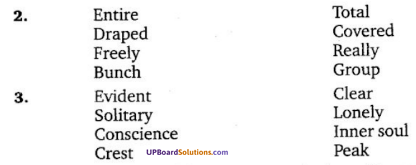
Vocabulary

Choose the most appropriate word or phrase that best completes the sentence:

1. The discs, decreasing in size from head to tail, gave the kite the appearance of a crawling
(a) monkey
(b) serpent
(c) ant
(d) worm
Answers:
(b) serpent

2. A large crowd ……. on the maidan to watch its first public launching in the presence of the Nawab.
(a) gathered
(b) collected
(c) stood
(d) assembled
Answers:
(a) gathered

3. When he was younger, and had fallen sick, everyone in the neighbourhood had come to ask after his (a) health
(b) wealth
(c) well-being
(d) treatment
Answers:
(a) health

4. No longer did people gather under the banyan tree to….. their problems and their plans.
(a) discuss
(b) argue
(c) solve
(d) sort out
Answers:
(a) discuss

5. It was good that his son worked close by, and he and the daughter-in-law could live in …
(a) Nawab’s house
(b) their own house
(c) Mahmood’s house
(d) a rented house
Answers:
(c) Mahmood’s house

6. There is a great affinity….. trees and men.
(a) in
(b) with
(c) among
(d) between
Answers:
(d) between

7. In two years both he and the tree would acquire the strength and …. that are characteristics of youth.
(a) power
(b) confidence
(c) satisfaction
(d) prosperity
Answers:
(b) confidence

8. The boy heard a ….. sound, like the rubbing of marbles in his pocket.
(a) dim
(b) faint
(c) slow
(d) high
Answers:
(b) faint

9. Mahmood ……..a wonderful kite.
(a) made
(b) manufactured
(c) prepared
(d) constructed
Answers:
(a) made

10. Moreover, there were few open ….. left for flying kites.
(a) spaces
(b) regions
(c) rivers
(d) valleys
Answers:
(a) spaces

11. The old man remained …….in the sun.
(a) drinking
(b) dressing
(c) drifting
(d) dreaming
Answers:
(d) dreaming

12. In those days there was time to spend an …… hour with a gay, dancing strip of paper.
(a) busy
(b) in ept
(c) cheerful
(d) idle
Answers:
(d) idle

13. Suddenly afraid, Ali turned and moved to the door, and then ran down the street…… his mother.
(a) speaking about
(b) shouting for
(c) telling for
(d) calling
Answers:
(b) shouting for

14. The twine ……. the kite-leapt away towards the sun.
(a) cracked
(b) smashed
(c) lapsed
(d) snapped
Answers:
(c) lapsed

15. Mahmood had been well-known throughout the city in the ….. of his life
(a) early
(b) late
(c) prime
(d) old
Answers:
(c) prime

We hope the UP Board Solutions for Class 11 English Prose Chapter 4 The Kite Maker help you. If you have any query regarding UP Board Solutions for Class 11 English Prose Chapter 4 The Kite Maker,drop a comment below and we will get back to you at the earliest.


Class 11 English Chapter 3 Question Answer UP Board Drought

UP Board Class 11th English Short Stories Chapter 3 Questions and Answers

कक्षा 11 अंग्रेजी पाठ 3 के प्रश्न उत्तर

These Solutions are part of UP Board Solutions for Class 11 English. Here we have given UP Board Solutions for Class 11 English Short Stories Chapter 3 Drought.

STORY at a Glance
The story ‘Drought takes place in the village called Kashipur. There was a landlord named Shibu Babu who was a cruel man. Gafur was a weaver who served Shibu Babu. Amina was Gafur’s daughter and Mahesh was his bull whom he loved most. One year there was drought. The month of May was going to be ended yet there was no hope of rain and no clouds in the sky. There was no grass anywhere and the tanks had dried up. Gafur had nothing to feed his bull on. He had become so weak that his ribs could be counted. Gafur tied him in the sun lest the bull should enter anybody’s field. Even Gafur’s daughter could not prepare anything for eating because she had nothing in the house to prepare food.

It was very hot in June. Gafur started in search of any work. But he got no work. When he returned home, he could get neither food nor water. He was so much angry with his daughter that he slapped her. The girl said nothing. She took up the pitcher and went to bring the water. But she could not get water anywhere. In the meantime a servant of the landlord came to call him and said to him, “If you do not come with me, I shall drag you to the landlord.” Gafur had to go. The landlord was very angry with him because Mahesh had spoiled her flowers and had wounded his daughter.

In the meantime Gafur heard a shriek of his daughter. He saw that the girl was lying on the ground. The pitcher had dropped down her head and Mahesh was sucking up the water. Gafur thought that Mahesh had pushed his daughter. So he struck hard on the bull’s head. The animal died on the spot.

At midnight Gafur left his village and started to Fulbere with his daughter to get some work in the Jute Mill at Fulbere. Before his departure he went near the tree where he used to tie his bull with the rope. He wept bitterly to remember Mahesh.

कहानी पर एक दृष्टि

‘Drought नामक कहानी काशीपुर नामक गाँव में घटित होती है। वहाँ शिब्बू बाबू नाम का एक जमींदार था जो बहुत अत्याचारी व्यक्ति था। गफूर एक जुलाहा था जो शिब्बू बाबू के यहाँ नौकरी करता था। अमीना गफूर की बेटी थी और महेश उसका बैल था जिसे वह सबसे अधिक प्यार करता था। एक वर्ष सूखा पड़ा। मई मास समाप्त होने को था, फिर भी बारिश की या आकाश में बादलों की कोई आशा नहीं थी। कहीं भी घास का नामोनिशान नहीं था और तालाब भी सूख गये थे। गफूर के पास अपने बैल को खिलाने के लिए कुछ भी नहीं था। वह इतना कमजोर हो गया था कि उसकी पसलियाँ गिनी जा सकती थीं। गफूर ने उसे धूप में बाँध दिया था कहीं वह किसी के खेत में घुस न जाए। गफूर की पुत्री भी खाने के लिए कुछ न बना सकी क्योंकि घर में खाना पकाने को कुछ भी नहीं था।

जून के महीने में भयंकर गर्मी थी। गफूर काम की तलाश में गया किन्तु उसे काम नहीं मिला। जब वह घर लौटकर आया तो उसे न खाना मिला और न पानी। वह अपनी बेटी पर इतना नाराज हुआ कि उसे थप्पड़ मार दिया। लड़की कुछ नहीं बोली-और घड़ा उठाकर पानी लेने चली गई। किन्तु उसे कहीं भी पानी नहीं मिला।

इतने में ही जमींदार का एक नौकर उसे बुलाने आया और उसने बताया कि यदि वह उसके साथ नहीं चलेगा। तब उसे घसीटकर ले जाया जाएगा। गफूर को जाना ही पड़ा। जमींदार उस पर बहुत नाराज हुआ, क्योंकि गफूर के बैल ने जमींदार के फूलों को नष्ट कर दिया था और उसकी लड़की को घायल कर दिया था। इसी बीच गफूर ने लड़की की चीख सुनी। उसने देखा कि लड़की जमीन पर गिरी पड़ी है। घड़ा उसके सिर से गिर गया है। महेश बिखरे हुए पानी को पी रहा है। गफूर ने अपने हल के सिरे से महेश के झुके हुए सिर पर चोट की। इससे बैल वहीं पर मर गया।

आधी रात के समय गफूर ने अपना गाँव छोड़ दिया और अपनी लड़की को लेकर फुलबेरी चला गया। उसे आशा थी कि वहाँ उसे पटसन के कारखाने में नौकरी मिल जाएगी। चलने से पहले वह उस वृक्ष के पास गया जहाँ महेश को रस्सी से बाँधा जाता था। वह महेश को याद करके बहुत रोया।

Short Answer Type Questions

Answer one of the following questions in not more then 30 words:

Question 1.
who was Gafur ? What was the name of his daughter and his bull?
(गफूर कौन थी ? उसकी बेटी और बैल का क्या नाम था ?)
Answer:
Gafur was a poor weaver. Amina was his daughter and Mahesh was his bull.
(गफूर एक गरीब जुलाहा था। अमीना उसकी बेटी और महेश उसका बैल था।)

Question 2.
who was Mahesh ? How did Gafur feed him ?           [Imp.]
(महेश कौन था ? गफूर उसे किस प्रकार खाना देता था ?)
Answer:
Mahesh was the bull of Gafur. Gafur got some straw from the landlord for tilling his land. He fed his bull on this straw.
(महेश गफूर का बैल था। गफूर को जमींदार की जमीन जोतने के लिए कुछ भूसा मिल जाता था। उसी को वह
महेश को खाने के लिए देता था।)

Question 3.
What warning did Tarakaratna give to Gafur regarding Mahesh and what was his reply ?
(महेश के सम्बन्ध में तारकरन ने गफूर को क्या चेतावनी दी और उसका क्या उत्तर था ?)
Answer:
Tarakaratna warned Gafur that the landlord would flay him alive if the bull died. Gafur replied that he was suffering from fever. He would not let the bull go alone to graze because the paddies were still lying in the fields. So he might enter anybody’s field.
(तारकरत्न ने गफूर को चेतावनी दी कि जमींदार उसकी खाल खींच लेगा यदि उसका बैल मर गया। गफूर ने उत्तर दिया कि उसे बुखार आ रहा है। वह बैल को अकेले नहीं चरने देगा, क्योंकि खेतों में अभी धान पड़ा है। इसलिए वह किसी के खेत में घुस सकता है।)

Question 4.
what made Tarakaratma leave hurriedly ?
(तारकरत्न जल्दी क्यों चला गया ?)
Answer:
Tarakaratna had a bundle of rice and fruits in his hand. When the bull saw it, he moved towards him to eat it. Tarakaratna feared that the bull would attack him with his horns. So he left hurriedly.
(तारकरत्न के हाथ में चावल और फलों की एक पोटली थी। जब बैल ने इसे देखा तो वह उसे खाने के लिए उसकी ओर मुड़ा। तारकरल को भय था कि बैल अपने सींगों से उस पर आक्रमण करेगा। इसलिए वह जल्दी से चला गया।)

Question 5.
What for did Gafur come to Banshi’s shop secretly ?        [M. Imp.]
(गफूर छिपकैर बंसी की दुकान पर क्यों आया ?)
Answer:
Gafur wanted to bring his bull from the police pen. He needed a rupee for it. So he went to Banshi’s shop secretly to borrow a rupee from him.
(गफूर को पुलिस के कांजीघर से अपना बैल छुड़ाना था। उसे इसके लिए एक रुपये की आवश्यकता थी। इसलिए वह बंसी की दुकान पर एक रुपया उधार लेने के लिए चुपचाप गया।)

Question 6.
In spite of being very poor Gafur threw away a ten rupee note, why ?
(गरीब होने के बावजूद गफूर ने दस का नोट फेंक दिया. क्यों ?)
Or
Why did Gafur not accept the ten rupee note from the butcher ?       [Imp.]
(गफूर ने कसाई से दस रुपए का नोट लेने से मना क्यों कर दिया?)
Answer:
Gafur was very poor. But he loved his bull very much. So he could not bear his separation. So when the purchaser came, he threw away the ten rupee note at him.
(गफूर बहुत गरीब था। लेकिन वह अपने बैल को बहुत प्यार करता था। इसलिए वह उसका वियोग सहन नहीं कर सका। जब खरीददार आया तब उसने दस रुपये का नोट उस पर फेंक दिया।)

Question 7.
who was Amina ? Who slapped her and why?
(अमीना कौन थी ? उसे थप्पड़ किसने मारा और क्यों ?)
Answer:
Amina was the daughter of Gafur. Gafur scolded and slapped her because he was very hungry and Amina could not give him food.
(अमीना गफूर की पुत्री थी। गफूर ने उसे थप्पड़ मारा, क्योंकि वह भूखा था और अमीना उसे खाना नहीं दे सकी।)

Question 8.
Gafur loses his self-control for the second time’. when and why ?
(‘गफूर दूसरी बार अपना आत्म-नियन्त्रण खो देता है।’ कब और क्यों ?)
Answer:
The messenger of the landlord asked Gafur to go to the landlord at once and said, “It’s master’s order to drag you to him and give you a good thrashing.” Gafur could not bear it. So he lost his self-control and said that he was not a slave and he Would not go.
(जमींदार के दूत ने गफूर से तुरन्त जमींदार के पास जाने को कहा तथा यह भी कहा, “मालिक की आज्ञा है। कि तेरी खूब पिटाई करू और खींचकर ले जाऊँ।” गफूर इसे सहन नहीं कर सका। उसने पुन: आत्म-नियन्त्रण खो दिया और कह दिया कि मैं गुलाम नही हूँ और मैं नहीं जाऊँगा।)

Question 9.
why did Gafur kill the bull ?         [M. Imp.]
(गफूर ने बैल को क्यों मार डाला ?)
Or
Who killed Mahesh and why ?
(महेश को किसने मारा और क्यों ?)
Answer:
Gafur killed Mahesh (bull) because he doubted that Mahesh had attacked his daughter Amina.
(गफूर ने महेश (बैल) को मारा क्योंकि उसे यह सन्देह था कि महेश ने उसकी पुत्री अमीना पर
आक्रमण किया है।)

Question 10.
Amina, dear, comelet’s go.” who says these words and why?          [Imp.]
(‘‘प्रिय अमीना, आओ. अब हम चलें।” यह शब्द कौन कहता है और क्यों ?)
Answer:
Gafur says these words. He is afraid that he would not be able to pay the penalty to the landlord. So he decides to leave the city.
(यह शब्द गफूर कहता है। उसे भय है कि वह जमींदार को जुर्माना नहीं चुका पाएगा। अत: उसने नगर को छोड़ने का निश्चय कर लिया।)

Question 11.
What did Gafur ask God to do ?            [M. Imp.]
(गफूर ने भगवान् से क्या करने को कहा ?)
Answer:
Gafur asked God never to forgive the landlord who neither let his bull eat the grass nor drink the water.
(गफूर ने भगवान् से कहा कि जमींदार को कभी क्षमा न करना जिसने उसके बैल को न तो घास खाने दी और न पानी पीने दिया।)

Question 12.
what would have happened if it had been a good year ?
(यदि वह सुखद वर्ष होता तो क्या होता ?)
Answer:
If it had been a good year, there would have been no tragedy.
(यदि यह एक सुखद वर्ष होता तो कोई दुर्घटना नहीं होती।)

Question 13.
What do you think of the title ? Suggest any other that may suit it.
(कहानी के शीर्षक के विषय में आप क्या सोचते हैं ? इसके लिए कोई दूसरा उपयुक्त शीर्षक सुझाइए।)
Answer:
The title ‘Drought’ of this story is quite appropriate. The whole story centres round the drought and its after effects. All the tragedy was due to drought. Another suitable title may be “Cruelty of the Landlord.”
( Drought’ इस कहानी के लिए पूरी तरह उपयुक्त शीर्षक है। पूरी कहानी सूखे और उसके प्रभाव के चारों और घूमती नजर आती है। समस्त दु:खद घटनाएँ इसी सूखे के कारण हुईं। इस कहानी के लिए दूसरा उपयुक्त शीर्षक हो सकता है-“जमींदार की निर्दयता।”)

Question 14.
Describe the helplessness of Gafur in sustaining his family
(अपने परिवार के भरण-पोषण में गफूर की असहायता का वर्णन कीजिए।)
Answer:
Gafur became helpless to sustain his family because there was nothing to eat for himself and his only girl, Amina. And there was nothing to feed his bull on. This was caused by drought. He started to search for any work but got no work.
(गफूर अपने परिवार का भरण-पोषण करने में असहाय हो गया था क्योंकि स्वयं के तथा अपनी इकलौती बेटी अमीना को खाने के लिए कुछ नहीं था और अपने बैल के खिलाने के लिए भी कुछ नहीं था। यह सूखा के कारण था। वह किसी काम की तलाश में भी गया लेकिन उसे काम नहीं मिला।)

Question 15.
How unfair was the landlord to Gafur ? What did it result in ?
(जमींदार गफूर के प्रति कितना अन्यायी था? इसका क्या परिणाम हुआ ?)
Answer:
Landlord was very unfair to Gafur. He did not give Gafur straw for his bull at the time of drought, he did not allow him to take water from the tank and was very rude. It resulted in the death of bull.
(जमींदारे गफूर के प्रति बहुत अन्यायी था। उसने सूखे के समय गफूर को बैल के लिए भूसा नहीं दिया, उसने उसे तालाब से पानी नहीं लेने दिया और अत्यन्त अभद्र था। इसको परिणाम हुआ बैल की मृत्यु।)

Question 16.
How did the drought affect the village Kashipur? Comment in the light of the story Drought ? [Imp.]
(काशीपुर गाँव को सूखे ने कैसे प्रभावित किया? ‘सूखा’ नामक कहानी के प्रकाश में विवेचना कीजिए।)
Answer:
One year in Kashipur in the month of May there was a fearful drought. There was no hope of rain. Tanks had dried up. There was no grass and no water in the village. The animals were starving.
(एक वर्ष काशीपुर में मई के महीने में भयंकर सूखा पड़ा। बारिश की कोई आशा नहीं थी। तालाब सूख गए थे। गाँव में न कहीं घास थी और न पानी। पशु भूख से मर रहे थे।)

We hope the UP Board Solutions for Class 11 English Short Stories Chapter 3 Drought help you. If you have any query regarding UP Board Solutions for Class 11 English Short Stories Chapter 3 Drought,drop a comment below and we will get back to you at the earliest.

Mr. Garbage and Mrs. Polythene Class 7 English Chapter 4 Question Answer UP Board Solutions

UP Board Class 7th English Chapter 4 Mr. Garbage and Mrs. Polythene Questions and Answers

कक्षा 7 अंग्रेजी पाठ 4 के प्रश्न उत्तर

These Solutions are part of UP Board Solutions for Class 7 English. Here we have given UP Board Solutions for Class 7 English Chapter 4 Mr. Garbage and Mrs. Polythene.

Mr. Garbage and Mrs. Polythene

TRANSLATION OF THE LESSON (पाठ का हिन्दी अनुवाद)

(Agirl…………………………………. who is that?
हिन्दी अनुवाद- (एक लड़की कूड़े-करकट के ढेर से बात कर रही थी ।)
लड़की : तुम कौन हो? तुम्हारी बदबू बहुत बुरी है। मैं बीमार (UPBoardSolutions.com) पड़ सकती हूँ।
श्री गारबेज : मैं श्री गारबेज हूँ। मैं प्रत्येक स्थान पर पाया जाता हूँ।
लड़की : तुम बदसूरत दिखते हो। तुम किससे बने हो?
श्री गारबेज : मैं सब्जियों के छिलकों, पुराने और फटे हुए कपड़ों, जूतों, बरतनों, कागज तथा जो भी वस्तुएँ जिन्हें तुम बेकार समझ कर फेंकते हो, उनसे बना हूँ।
लड़की : श्री गारबेज तुम कहाँ रहते हो?
श्री गारबेज : कूड़ादान मेरा घर है। तुम मुझे एक गड्ढे में डाल सकते हो और उसे ढक सकते हो।
लड़की : तब, आप यहाँ क्यों हैं?
श्री गारबेज : मैं यहाँ हूँ क्योंकि लोग मुझे जहाँ चाहते हैं फेंक देते हैं। यदि वे मुझे गड्ढे में डाल दें और ढक दें, तो मैं उनके लिए उपयोगी बन सकता हूँ।
लड़की : यह कैसे संभव है?
श्री गारबेज : वहाँ मैं मिट्टी के साथ मिलकर खाद बन सकता हूँ जो तुम्हारे लिए अच्छी फसलें उगाने में मदद करता
लड़की : यह अच्छा है। परन्तु वह कौन है? (UPBoardSolutions.com)

UP Board Solutions

Mr. Garbage………………………..to live in.
हिन्दी अनुवाद- श्री गारबेज : वह श्रीमति पॉलीथीन है।
लड़की : श्रीमति पॉलीथीन! वह बहुत सुन्दर दिखती है।
श्री गारबेज : प्यारे बच्चे, कोई सन्देह नहीं कि वह बहुत अच्छी और उपयोगी है। (UPBoardSolutions.com) परन्तु क्या तुम जानती हो कि इसे यदि पशु निगल जाए तो वे मर जाते हैं? वह मनुष्य की सबसे खतरनाक दुश्मन है।
लड़की : किस तरीके से?
श्री गारबेज : क्योंकि वह प्लास्टिक से बनी है। जैसा कि मैंने तुम्हें बताया मैं मिट्टी में मिल सकता हूँ, परन्तु प्लास्टिक कभी भी मिट्टी में नहीं मिलती। वह मिट्टी में लंबे समय तक ऐसी ही रहती है।
लड़की : कितने समय तक?

UP Board Solutions
श्री गारबेज : लगभग हमेशा
लड़की : परन्तु श्री गारबेज, प्लास्टिक तो हर जगह है। हम प्लास्टिक से बनी बहुत सी वस्तुएं प्रयोग करते हैं। जैसे-खिलौने, बर्तन, कम्प्यूटर, कपड़े, बैग, आदि।
श्री गारबेज : तुम सही कहती हो। लोग इसे प्रयोग करते हैं क्योंकि प्लास्टिक किसी भी आकार में ढाली जा सकती है, और वह आसानी से टूटती भी नहीं। परन्तु याद रखो, वह पर्यावरण के लिए अच्छी नहीं है।
लड़की : ठीक है, मैं इसे याद रखेंगी और अपने परिवारजनों (UPBoardSolutions.com) और पड़ोसियों को भी प्लास्टिक का प्रयोग बंद करने को कहूँगी|
श्री गारबेज : अच्छा है। फिर हमारी पृथ्वी रहने के लिए एक साफ और स्वस्थ स्थान बन जाएगी

UP Board Solutions

EXERCISE (अभ्यास)

Comprehension Questions
Question 1.
Answer the following questions:
Answer:
Question a.
List the items you throw in the dustbin as garbage.
Answer:
Vegetable peels, broken items, torn clothes, used (UPBoardSolutions.com) papers, pensil shavings, wrappers, packing papers, etc.

Question b.
What are the items generally thrown as garbage which can be reused or recycled?
Answer:
Unused papers, metal items, toys, bags, clothes, etc.

UP Board Solutions

Question c.
How does garbage get mixed with soil and become useful for us?
Answer:
If the garbage is thrown in a pit and the (UPBoardSolutions.com) pit is covered with soil, the garbage mixes with soil. It turns into useful manure which is used to grow rich crops for our food.

Question d.
What happens to the animals when they swallow polythene bags?
Answer:
When animals swallow polythene bags, they choke and die.

Question e.
How is polythene dangerous for us?
Answer:
Polythene is not good for environment. It does not mix with soil just like normal garbage. It stays in the soil forever and creates pollution everywhere.

UP Board Solutions

Question 2.
Choose the correct option to complete (UPBoardSolutions.com) the following sentences:
Answer:
i. The garbage should be thrown in dustbins.
a. in dustbins
b. here and there
c. in the classroom

ii. Garbage is made of useless things.
a. useful things
b. useless things
c. fresh things

iii. We should not use polythene (UPBoardSolutions.com) because it cannot be destroyed.
a. is a useless thing
b. looks very pretty
c. cannot be destroyed

UP Board Solutions

Word Power

Question 1.
Fill in the blanks with the appropriate words given in the box:
UP Board Solutions for Class 7 English Chapter 4 Mr. Garbage and Mrs. Polythene img-1
Answer:
a. I tried to swallow the tablet with water.
b. Farmers add manure to the soil.
c. The potter moulded the (UPBoardSolutions.com) clay into a pot.
d. A heap of newspapers is lying on the table.

Question 2.
Some items are given in the box. Separate them into biodegradable (which get mixed with the soil) and non-biodegradable (which do not get mixed with the soil) items.
UP Board Solutions for Class 7 English Chapter 4 Mr. Garbage and Mrs. Polythene img-2
Answer:
UP Board Solutions for Class 7 English Chapter 4 Mr. Garbage and Mrs. Polythene img-3
UP Board Solutions for Class 7 English Chapter 4 Mr. Garbage and Mrs. Polythene img-4

UP Board Solutions

Question 3.
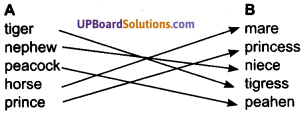
Match the masculine gender (UPBoardSolutions.com) given in column ‘A’ with its feminine gender given in
column ‘B’:
Answer:
UP Board Solutions for Class 7 English Chapter 4 Mr. Garbage and Mrs. Polythene img-5

Language Practice

Question 1.
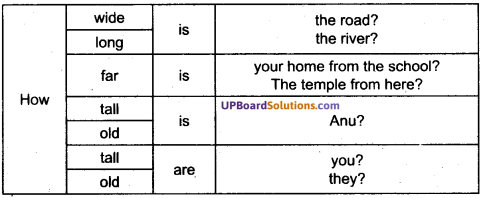
Make questions beginning with ‘how’, using the following table:
UP Board Solutions for Class 7 English Chapter 4 Mr. Garbage and Mrs. Polythene img-6
Answer:
— How wide is the road?
 How wide is the river?
— How long is the road?
— How long is the river?
—How far is your home (UPBoardSolutions.com) from the school?
— How far is the temple from here?
— How tall is Anu?
— How old is Anu?
— How tall are you?
— How old are you?
— How tall are they?
— How old are they?

Activity       Note: Do it yourself.

We hope the UP Board Solutions for Class 7 English Chapter 4 Mr. Garbage and Mrs. Polythene help you. If you have any query regarding UP Board Solutions for Class 7 English Chapter 4 Mr. Garbage and Mrs. Polythene, drop a comment below and we will get back to you at the earliest.

UP Board Class 10th English Chapter 2 Question Answer A Letter to God (G.L. Fuentes).

Class 10 English Prose Chapter 2 Questions and Answers UP Board A Letter to God (G.L. Fuentes).

कक्षा 10 अंग्रेजी पाठ 2 प्रश्न उत्तर

These Solutions are part of UP Board Solutions for Class 10 English. Here we have given UP Board Solutions for Class 10 English Prose Chapter 2 A Letter to God (G.L. Fuentes).

Comprehension Questions On Paragraphs

In the examination paper, there are asked only two questions from each paragraph. Given below are some more questions for extra practice. Read the following passages and answer the questions put there upon :

(1) The only thing, the ……………..was fresh and sweet. [From para 1 & 2]

Question.
1. Who was Lencho ? What did he think about the earth ?
(लेंचो कौन था? उसने पृथ्वी के विषय में क्या सोचा ?)
2. What were the boys doing? Why did the woman call them ?
(लड़के क्या कर रहे थे ? उसे स्त्री ने उन्हें क्यों बुलाया ?) ।
3. What made Lencho predict a rainfall? Did his prediction prove to be true ?
(किस बात से लेंचो ने वर्षा की भविष्यवाणी की ? क्या उसकी भविष्यवाणी सही सिद्ध हुई ?)
Answer:
1. Lencho was a farmer. He thought that the earth needed a shower.
(लेंचो एक किसान था। उसने सोचा कि पृथ्वी को बारिश की आवश्यकता है।)
2. The older boys were working in (UPBoardSolutions.com) the field. The smaller ones were playing near
the house. The woman called them for dinner. (बड़े लड़के खेत में काम कर रहे थे। छोटे लड़के मकान के पास खेल रहे थे। स्त्री ने उन्हें रात्रि के
भोजन के लिए बुलाया।)
3. Clouds in the North-East made Lencho predict a rainfall. Yes, his prediction
proved to be true. (उत्तर-पूर्व दिशा में बादलों के कारण लेंचो ने वर्षा की भविष्यवाणी की। हाँ, उसकी भविष्यवाणी सही सिद्ध हुई।)

UP Board Solutions

(2) The man went out ……………….. said to his sons. [From para 4 [2009, 11, 14, 15]]

Question.
1. Why did Lencho went out in the rain?
(लेंचो बारिश में बाहर क्यों गया?)
2. Identify the person who said the following:
(उसे व्यक्ति को पहचानिए, जिसने निम्नलिखित वाक्य बोले )
“It’s really getting bad now”…… “I hope it passes quickly.” what is he talking about ?
(वह किसके विषय में बातें कर रहा है ?)
3. Why did he look satisfied ?
(वह सन्तुष्ट क्यों दिख रहा था ?)
4. What have hailstones been compared to?
(ओलों की तुलना किससे की गयी है ?)
5. How did the hailstones affect Lencho’s fields’ ?
(ओलों ने लेंचो के खेतों को कैसे प्रभावित किया ?)
Answer:
1. Lencho went out in the rain to have the felling of rain on his body.
(लेंचो अपने शरीर पर बारिश का अनुभव प्राप्त करने के लिए बाहर बारिश में गया।)
2. The person is Lencho. He is talking about hailstones.
(यह व्यक्ति लेंचो है। वह ओलावृष्टि के विषय में बात कर रहा है।)
3. Lencho looked satisfied on account of rain which his cornfield badly needed.
(लेंचो वर्षा हो जाने के कारण सन्तुष्ट दिख रहा है जिसकी उसके अनाज के खेत को अत्यधिक आवश्यकता थी।)
4. Hailstones have been compared to new silver coins.
(ओलों की तुलना नये चाँदी के सिक्कों से की गयी है।)
5. The hailstones affected Lencho’s field badly. The corn was totally destroyed.
(ओलों ने लेंचों के खेत पर बुरा प्रभाव डाला। अनाज पूर्णत: (UPBoardSolutions.com) बरबाद हो गया।)

UP Board Solutions

(3) “It’s really getting………….. have no corn…”[From pura 4, 5 [2014]]

Question.
Write the name of the lesson from which the above passage has been taken. Who is the writer of this lesson?
(उपर्युक्त गद्यांश जिस पाठ से लिया गया है उसका नाम लिखिए। इस पाठ के लेखक कौन हैं?)
2. why was Lencho’s soul filled with sadness ?
(लेंचो का मन दुःख से क्यों भर गया ?)
Answers :
1. The above passage has been taken from the lesson A Letter to God. The writer of this lesson is G.L. Fuentes.
(उपर्युक्त गद्यांश A Letter to God (UPBoardSolutions.com) नामक पाठ से लिया गया है। इसके लेखक G.L. Fuentes
2. The hailstones affected Lencho’s field badly. The corn was totally destroyed.So Lencho’s soul was filled with sadness.
(ओलों ने लेंचों के खेत पर बुरा प्रभाव डाला। अनाज पूर्णतः बरबाद हो गया। अतः लेंचो का मन दु:खे से भर गया।)

(4) All through the night…………….. because the hail storm….”[From para 5 [2010, 12, 15, 18]

Question.
What was Lencho’s problem ? What was his only hope ?
(लेंचो की क्या समस्या थी ? उसकी एकमात्र आशा क्या थी ?)
2. What did Lencho think of all through the night?
(पूरी रात लेंचों ने क्या सोचा ?)
3. What had Lencho learn about God?
(लेंचो ने भगवान् के विषय में क्या सीखा था ?)
4. Why would Lencho’s family go hungry? What help did he want ?
(लेंचो का परिवार भूखा क्यों मरेगा ? वह क्या सहायता चाहता था ?)
5. Quote the words which tell you that Lencho was a hard working man?
उन शब्दों को बताओ जो आपको बताते हैं कि लेंचो एक परिश्रमी व्यक्ति था ?
6. Why has Lencho been compared to an ox?
(लेंचो की तुलना एक बैल से क्यों की गयी है ?)
7. What did Lencho write in the letter to God ?
(लेंचो ने भगवान् को अपने पत्र में क्या लिखा ?)
                         Or
What help did Lencho want from God and why
(लेंचो भगवान से क्या सहायता चाहता था और क्यों ?)
Answer:
1. Lencho’s only problem was the total loss of his crops by hailstorm. His only hope was the help of God.
(लेंचो की एकमात्र समस्या ओलावृष्टि से उसकी फसल की पूर्ण हानि थी। उसकी एकमात्र आशा
भगवान् की सहायता थी।)
2. Lencho thought of all through the night only of his one hope ‘the help of God’.
(पूरी रात लेंचो ने केवल अपनी एक आशा के विषय में सोचा ‘भगवान से सहायता)
3. Lencho had learn about God that His eyes (UPBoardSolutions.com) see everything even in one’s
conscience. (लेंचो ने भगवान् के विषय में सीखा था कि उसकी आँखें प्रत्येक वस्तु को देख लेती हैं, किसी की अन्तरात्मा की बात को भी।)
4. Lencho’s family would go hungry because his crop was totally destroyed. He wanted 100 pesos to sow seeds.
(लेंचो का परिवार भूखा मर जाता क्योंकि उसकी फसल पूरी तरह नष्ट हो गई थी। वह बीज बोने के | लिए सौ पीसोज़ चाहता था।)

UP Board Solutions
5. ‘Lencho was an ox of a man’. These words show that Lencho was a hard working man.
(दिए हुए शब्द बताते हैं कि लेंचो एक परिश्रमी व्यक्ति था।)
6. Lencho has been compared to an ox as he worked like an animal in the fields.
(लेंचो की तुलना बैल से की गयी है क्योकि वह अपने खेतों में एक पशु के समान कार्य करता था।)
7. Lencho wrote in his letter to God that he had badly needed one hundred pesos to sow his fields again and for his family to live.
(लेंचो ने भगवान् को अपने पत्र में लिखा कि उसे अपने खेतों को दोबारा बोने के लिए व परिवार पालने के लिए सौ पीसोज़ की अत्यन्त आवश्यकता है।)
                                            Or
Lencho wanted from God one hundred pesos to sow his fields again and for his family to live.
(लेंचो भगवान से अपने खेतों को दोबारा बोने के लिए व परिवार पालने के लिए सौ पीसोज़ चाहता था।)

(5) He wrote “To God” ……………………. correspondence with God!”[From para 5]

Question.
1. who laughed heartily and why?
(जोर से कौन हँसा और क्यों?)
2. Point out the qualities of postmaster as described in the passage.
(डाकपाल के वे गुण बताइए जिनका गद्यांश में वर्णन किया गया है।)
3. why was the postmaster surprised ? What did he wish for?
(डाकपाल को आश्चर्य क्यों हुआ? उसने क्या इच्छा की?)
Answer:
1. The postman laughed heartily because (UPBoardSolutions.com) he saw the letter addressed “To God” for the first time in his career.
(डाकिया जोर से हँसा क्योकि भगवान् के पते वाला पत्र उसने अपने सेवाकाल में पहली बार देखा था।)
2. The qualities of a postmaster described in the passage are that he was a fat and amiable fellow.
(गद्यांश में वर्णित डाकपाल के गुण हैं कि वह मोटा और मिलनसार व्यक्ति था।)
3. The postmaster was surprised at the faith of the letter-writer in God. He wished the same faith for himself.
(पत्र-लेखक के भगवान् पर विश्वास की बात पर डाकपाल को आश्चर्य हुआ। उसने भी अपने लिए ऐसे ही विश्वास की इच्छा की।)

(6) one of the employees………………….. ‘an act of charity’. [From para 5 & 6]

UP Board Solutions

Question.
What did the postman do when he saw the letter addressed to God? What was the postmaster’s reaction when he saw it ?
(जब डाकिए ने भगवान के पते वाला पत्र देखा तब उसने क्या किया? जब डाकपाल ने इसे देखा तब उसकी क्या प्रतिक्रिया थी?)
2. Why did the postmaster decide to answer the letter addressed to God ? Was it easy to do so?
(डाकपाल ने भगवान के पते वाले पत्र का उत्तर देने का निश्चय क्यों किया ? क्या ऐसा करना आसान था ?)
3. In the words ‘But he stuck to his resolution’ the word ‘resolution’ means :
(इन शब्दों ‘But he stuck to his resolution’ में से resolution का अर्थ है )

  1. formal expression of opinion by an official meeting.
  2. solving of doubt, problem, question
  3. firm decision.

Point out which one is the most suitable.
(सबसे उपयुक्त का चयन कीजिए।)
4. What did the postmaster do to answer the letter ?
(पत्र का उत्तर देने के लिए डाकपाल ने क्या किया?)
Answer:
1. When the postman saw the letter addressed to God, he laughed heartily.Seeing it the postmaster also broke out laughing but soon he became serious.
(जब डाकिए ने भगवान के पते वाला पत्र देखा तब वह खुलकर हँसी। इसे देखकर डाकपाल भी हँस पड़ा किन्तु शीघ्र ही वह गम्भीर हो गया।)
2. The postmaster decided to answer the letter addressed (UPBoardSolutions.com) to God not to shake the writer’s faith in God. No, it was not easy to do so.
(डाकपाल ने लेखक के भगवान् में विश्वास को बनाये रखने के लिए भगवान के पते वाले पत्र का उत्तर देने का निश्चय किया। नहीं, ऐसा करना आसान नहीं था।)
3. The word ‘resolution’ means firm decision’ and it is most suitable.
(‘resolution’ शब्द का अर्थ ‘firm decision’ है, जो कि सर्वाधिक उपयुक्त है।)
4. To answer the letter the postmaster collected some money from his employees and friends. He himself gave part of his salary.
(पत्र का उत्तर देने के लिए डाकपाल ने अपने कर्मचारियों तथा मित्रों से धन इकट्ठा किया। उसने स्वयं भी अपने वेतन का एक भाग दिया।)

(7) So, in order to shake ……….of his office. [From para 6 & 7 [2011, 15]]

UP Board Solutions
Question.
1. Who was collecting the hundred pesos and why?
(सौ पीसोज़ कौन इकट्टे कर रहा था और क्यों ?)
2.How much money was put in the envelope ? Who was the envelope addressed to ?
(लिफाफे में कितना धन रखा गया ? लिफाफे पर किसका पता लिखा गया ?)
3. Why did Lencho go to the post-office next day? What happened there ?
(अगले दिन लेंचो डाकखाने क्यों गया ? वहाँ क्या हुआ ?)
4. Why did the postmaster decide to answer the letter addressed to God ?
(डाकपाल ने भगवान के पते वाले पत्र का उत्तर देने का निश्चय क्यों किया?)
5. How did the postmaster collect the money to be sent to Lencho?
(डाकपाल ने लेंचो को भेजने के लिए धन कैसे इकट्ठा किया ?)
6. Who handed the letter to Lencho? What were the feelings of the postmaster when the letter was being handed to Lencho?
(लेंचो को पत्र किसने दिया ? जब लेंचो को पत्र दिया जा रहा था तब डाकपाल के क्या विचार थे ?)
7. Why was Lencho angry?
(लेंचो नाराज क्यों था?)
Answer:
1.The postmaster was collecting the hundred pesos to send to Lencho.
(डाकपाल लेंचो के पास भेजने के लिए सौ पीसोज़ इकट्टे कर रहा था।)
2. The postmaster put a little more than fifty pesos in the envelope. The envelope was addressed to Lencho.
(डाकपाल ने पचास से कुछ अधिक पीसोज़ लिफाफे में रख दिये। लिफाफे पर लेंचो का पता लिखा।)
3. The next day Lencho went to the post-office if there was a letter for him. The postman handed him a letter.
(दूसरे दिन लेंचो डाकखाने गया कि उसके लिए वहाँ कोई पत्र तो नहीं आया था। डाकिये ने उसे एक पत्र दिया।)
4. The postmaster decided to answer the letter addressed to God not to shake the writer’s faith in God.
(डाकपाल ने भगवान् के पते वाले पत्र का उत्तर देने का निश्चय पत्र लिखने वाले के भगवान में विश्वास को न डगमगाने के लिए किया।) ।
5. The postmaster collected the money to be sent to Lencho from his employees and friends. He himself gave a part of his salary.
(डाकपाल ने लेंचो को भेजने के लिए अपने कर्मचारियों तथा मित्रों से धन इकट्ठा किया। उसने स्वयं भी अपने वेतन का कुछ भाग दिया।)
6. Postman himself handed the letter to Lencho. The postmaster (UPBoardSolutions.com) was experiencing the contentment of a man who had performed a good deed.
(डाकिये ने स्वयं लेंचो को पत्र दिया। डाकपाल उस सन्तोष का अनुभव कर रहा था जो नेक काम
करने वाले व्यक्ति का होता है।)
7. Lencho was angry because the money was short.
(लेंचो नाराज था क्योंकि पैसा कम था।)

(8) Lencho showed not the ………. bunch of crooks. ILencho.” [From para 7 & 8 [2009, 12, 18]]

Question.
1. Why did Lencho not show any surprise on seeing the money ? Why did he
become angry? (धन को देखकर लेंचो ने तनिक भी आश्चर्य क्यों नहीं दिखाया ? वह नाराज क्यों हो गया ?)
2. Why did Lencho ask for paper and ink ? How did he affix a stamp to the envelope?
(लेंचो ने कागज और स्याही क्यों माँगी ? उसने लिफाफे पर टिकट कैसे लगाया ?)
3. How much money did Lencho get?
(लेंचो को कितना धन मिला ?)
4. Why did Lencho request God not to send money through the mail ?
(लेंचो ने भगवान् से यह प्रार्थना क्यों की कि वह धन डाक से न भेजे ?)
Answer:
1. Due to his confidence Lencho did not show any surprise on seeing the money.He became angry because the money was short.
(अपने विश्वास के कारण लेंचो ने धन को देखकर तनिक भी आश्चर्य नहीं दिखाया। वह नाराज हो गया क्योंकि धन कम था।)
2. Lencho asked for paper and ink to write a letter to God. He licked the stamp and affixed it to the envelope with a blow of fist.
(लेंचो ने कागज और स्याही भगवान् को पत्र लिखने के लिए माँगी। उसने टिकट को जीभ से गीला किया और लिफाफे पर मुट्ठी की चोट से चिपका दिया।)
3. Lencho got only seventy pesos.
(लेंचो को केवल सत्तर पीसोज़ मिले।)
4. Lencho requested God not to send money through the mail because post office employees were a bunch of crooks.
(लेंचो ने भगवान् से प्रार्थना की कि वह उसे धन डाक से न भेजें क्योंकि डाकघर के कर्मचारी धोखेबाजों का एक समूह हैं।)।

UP Board Solutions

LONG ANSWER TYPE QUESTIONS

Answer the following questions in about 60 words :

Question 1.
Give briefly the story of A Letter to God’. What did the post master do ?
(A Letter to God’ पाठ की कहानी का संक्षेप में वर्णन कीजिए। डाकपाल ने क्या किया?)
Answer:
Lencho was a poor farmer. Once the hailstorm destroyed his harvest. He had firm faith in God. So he wrote a letter to God, asking Him to send him money. The postmaster saw this letter. He decided to help Lencho. He collected some money with the help of his employees. He put it inside an envelope. When Lencho came to the post-office to check his mail, the envelope was delivered to him. Lencho opened it and took out the money. He found that it was less than he had asked for. He became angry. He wrote another letter to God to send him the rest of money, but not through mail because the post-office employees were a bunch of crooks.
(लेंचो एक गरीब किसान था। एक बार ओलों ने उसकी फसल नष्ट कर दी। उसे ईश्वर में अटूट विश्वास था। उसने ईश्वर को एक पत्र लिखा कि वे उसे धन भेज दें। डाकपाल ने यह पत्र देखा। उसने लेंचो की सहायता करने का निश्चय किया। उसने अपने कर्मचारियों की सहायता से कुछ धन एकत्रित किया। वह धन उसने एक लिफाफे में रख दिया। जब लेंचो डाकघर में अपनी डाक देखने आया, तब यह लिफाफा उसे दे। (UPBoardSolutions.com) दिया गया। लेंचो ने लिफाफा खोला और धन बाहर निकाल लिया। उसने देखा कि उसमें जो धन था, वह उससे कम था जितना उसने ईश्वर से माँगा था। वह नाराज हो गया। उसने ईश्वर को एक दूसरा पत्र लिखा कि वे शेष धन भी उसे भेज दें, परन्तु उसने इस बार धन डाक से न भेजने को कहा, क्योंकि डाक कर्मचारीगण धोखेबाजों का समूह हैं।)

Question 2.
Describe the falling of the rain and the damage it caused in the lesson A Letter to God’.
(A Letter to God’ पाठ में वर्षा तथा उससे होने वाली क्षति का वर्णन कीजिए।)
                                      Or
How did the hailstones affect Lencho’s fields ? What was his single hope? [2018]
(ओलों ने लेंचो के खेतों को कैसे प्रभावित किया? उसकी एकमात्र आशा क्या थी?)
Answer:
Lencho, a poor farmer needed a shower badly in his fields. He was sure that it would rain as he had seen clouds in the North-East. One day big drops of rain began to fall. Lencho went out and was very happy as the raindrops amounted to coins. His fields will yield rich crops due to these raindrops. But suddenly a strong wind began to blow and along with the rain very large hailstones began to fall. The smaller boys ran out to collect hailstones which appeared like frozen pearls. For an hour the hail rained everywhere including Lencho’s corn field. The field was white as if covered with salt. The flowers were gone from the plants. The corn was totally destroyed. Lencho’s soul was filled with sadness. His single hope was-help from God. So he asked God for money.
(लेंचो नामक गरीब किसान को अपने खेतों में वर्षा की अत्यन्त आवश्यकता थी। एक दिन वर्षा की बड़ी-बड़ी बूंदें गिरनी शुरू हो गयीं। लेंचो घर से बाहर आया और वह इतना प्रसन्न हुआ कि उसे वर्षा की बूंदें सिक्कों के समान लग रही थीं। वर्षा की इन बूंदों के कारण ही उसके खेत अच्छी फसल देंगे। अचानक तेज आँधी चलने लगी और आँधी के साथ बड़े-बड़े ओले भी गिरने लगे। छोटे बच्चे घर से बाहर आकर ओले एकत्र करने लगे जो उनको जमे हुए मोती जैसे लग रहे थे। ये ओले एक घण्टे तक लेंचो के मक्का के खेत सहित चारों ओर गिरते रहे। पूरा खेत सफेद था जैसे कि नमक से ढका हुआ हो। ओलों ने उसके पौधों (UPBoardSolutions.com) के सभी फूल तोड़ डाले थे। फसल पूरी तरह से नष्ट हो चुकी थी। लेंचो का मन दु:खी हो उठा।) उनकी एकमात्र आशा थी—ईश्वरीय मदद। अत: उसने भगवान् से धन माँगा।।

UP Board Solutions

Question 3.
who was I Lencho ? Why did he write a letter to God? who received the letter and what did he do ? [2009, 10, 11, 14, 15, 17]
(लेंचो कौन था ? उसने भगवान् को पत्र क्यों लिखा ? पत्र किसने प्राप्त किया व उसने उसका क्या किया ?)
                                         Or
what was Lencho’s worry? what help did he seek from God? [2013]
(लेंचो की परेशानी क्या थी ? उसने ईश्वर से क्या सहायता माँगी ?)
                                         Or
What circumstances forced Lencho to seek help from God ? [2009, 11, 14, 17]
(किन परिस्थितियों ने लेंचो को भगवान् से सहायता लेने के लिए विवश कर दिया ?)
                                         Or
What did Lencho write to God? Who received this letter and what did he do?
(लेंचो ने भगवान को क्या लिखा ? पत्र किसने प्राप्त किया वे उसने उसका क्या किया?)
Answer:
Lencho was a hard-working farmer with a large family. Once the much needed and pleasant rain was followed by very large hailstones and the corn standing in Lencho’s field was totally destroyed. Nothing was left for the poor Lencho and his family. So, he wrote a letter to God, asking Him for one hundred pesos in order to sow his field again and live until the new crops came. The letter was received by a postman. The postmaster also read it and was moved. He collected seventy pesos and sent it to Lencho.
(लेंचो बड़े परिवार वाला एक परिश्रमी किसान था। एक बार वर्षा, जिसकी अत्यधिक आवश्यकता थी और जो मनभावन भी थी, अपने साथ बड़े-बड़े ओले भी लायी, जिससे लेंचो के खेत में खड़ी फसल पूर्णतया नष्ट हो गई। लेंचो के गरीब परिवार के लिए कुछ भी नहीं बचा। अंतः उसनें ईश्वर को एक पत्र लिखकर सौ पीसोज़ भेज देने की प्रार्थना की जिससे वह दोबारा अपने खेत बो सके तथा अगली फसल आने तक अपना निर्वाह कर सके। पत्र एक डाकिये को मिला। डाकपाल ने भी उसे पढ़ा। उसने सत्तर पीसोज़ एकत्रित किए और लेंचो को भेज दिए।)

UP Board Solutions

Question 4.
what kind of people were the post-office employees ? Was Lencho justified in calling them a bunch of crooks ?
(डाकघर के कर्मचारी किस प्रकार के व्यक्ति थे ? क्या लेंचो का उनको ‘धोखेबाजों का एक समूह कहना उपयुक्त था ?)
                                          Or
How did the post-office employees and postmaster help Lencho? How did Lencho react to their help?
(डाकखाने के कर्मचारियों और डाकपाल ने लेंचो की सहायता कैसे की? उनकी सहायता के प्रति लेंचो की प्रतिक्रिया क्या थी ?)
Answer:
Post-office employees were nice and generous. They laughed when they saw Lencho’s letter addressed to God. But soon they became s
ed to God. But soon they became serious because they were impressed by Lencho’s faith in God. They decided to send him some money. They collected 70 pesos and sent it to Lencho. When Lencho opened the envelope he found in it only 70 pesos whereas he had asked God for 100 pesos. He thought the post-office people had taken away 30 pesos from the envelope. So he called them bunch of crooks’. He was not justified in calling them crooks. But it only shows his firm faith in God and his innocence.
(डाकघर के कर्मचारी अच्छे व उदार थे। पत्र पाकर शीघ्र ही वे हँसे (UPBoardSolutions.com) जब उन्होंने लेंचो का ईश्वर को सम्बोधित पत्र देखा। परन्तु लेंचो के ईश्वर में अटूट विश्वास को देखकर वे प्रभावित हुए तथा शीघ्र ही गम्भीर हो गये। उन्होंने कुछ धन उसे भेजने का निर्णय किया। उन्होंने सत्तर पीसोज जुटाकर लेंचो को भेज दिए। जब लेंचो ने लिफाफा खोला तो उसे ईश्वर से माँगे गये सौ पीसोज़ की जगह मात्र सत्तर पीसोज़ मिले। उसे लगा कि डाक कर्मचारियों ने लिफाफे से शेष तीस पीसोज़ निकाल लिये हैं। इसी कारण उसने उन्हें ‘धोखेबाजों का समूह’ कहा। उनको ‘धोखेबाजों का समूह’ कहा जाना न्यायोचित नहीं था। लेकिन उसका ऐसा कहना केवल उसके ईश्वर में अटूट विश्वास तथा उसकी मासूमियत को प्रदर्शित करता है।)

Question 5.
Write a character sketch of the postmaster on the basis of the lesson, A Letter to God’. Give reasons for your liking. [2012, 14, 16]
नामक पाठ के आधार पर डाकपाल का चरित्र-चित्रण कीजिए। अपनी पसन्द के कारण भी लिखिए।)
Answer:
The best part of the postmaster’s character emerges when he opens the envelope. He decides to send some money to the letter writer so that his faith in God is maintained. He asks for money from his employees, he himself gives a part of his salary, and several of his friends join him in the ‘act of charity’. He puts the whole money in an envelope addressed to Lencho and with it a letter containing only a single letter as signature-God. This shows that the postmaster loves to perform good deeds and finds contentment from it. Thus, he is an amiable and large hearted fellow.
(डाकपाल के चरित्र का सर्वोत्तम भाग तब स्पष्ट होता है, जब वह पत्र वाले लिफाफे को खोलता है। उसने निश्चय किया कि पत्र-लेखक के भगवान् में विश्वास को बनाये रखने के लिए उसे कुछ धन अवश्य भेजना चाहिए। वह स्वयं अपने वेतन का कुछ भाग देता है तथा कुछ धन अपने कर्मचारियों व मित्रों से दान कार्य के लिए लेकर लेंचो को एक लिफाफे में रखकर ‘God’ की ओर से प्रेषित कर देता है। उसका यह कार्य दर्शाता है कि (UPBoardSolutions.com) डाकपाल अच्छे कार्य करने वाला एक उदार व्यक्ति है, जिसे इस प्रकार के कार्यों से सन्तुष्टि प्राप्त होती है। इस प्रकार वह एक मिलनसार और उदार हृदय वाला व्यक्ति है।)

UP Board Solutions

Question 6.
Give a character sketch of Lencho ? [2011, 15, 17, 18].
(लेंचो का संक्षिप्त चरित्र-चित्रण कीजिए।)
Answer:
Lencho is the main character of the story ‘A letter to God’.
1. A poor man : Lencho is a poor farmer. But one year his crop was completely destroyed by hailstones. Nobody helped him. He was helpless and sad.
2. Firm faith in God : Lencho had firm faith in God. He believed that God would help him in misery. He would not let him die in hunger.
3. Simple and innocent : Lencho was very simple and innocent. He wrote a letter to God and requested to send him 100 pesos. He did not know that it was impossible. He was not surprised to have an envelope with money. He believed that it was from God.
(लेंचो ‘भगवान को पत्र’ नामक कहानी का मुख्य पात्र है।
1. एक गरीब व्यक्ति-लेंचो एक गरीब किसान है। किन्तु एक वर्ष ओलों के द्वारा उसकी फसल पूरी तरह नष्ट हो गई। किसी ने उसकी सहायता नहीं की। वह असहाय और दु:खी था।
2. भगवान् में अटल विश्वास-लेंचो को भगवान में पक्का विश्वास था। उसे विश्वास था कि संकट में भगवान् अवश्य ही उसकी सहायता करेंगे। वे उसे भूख से नहीं मरने देंगे।
3. साधारण और नादान : लेंचो बहुत ही सीधा-सादा और नादान था। (UPBoardSolutions.com) उसने भगवान् को पत्र लिखा और प्रार्थना की कि मुझे एक सौ पीसोज़ भेज दो। वह नहीं जानता था कि यह असम्भव है। रुपयों का लिफाफा प्राप्त करके उसे आश्चर्य भी नहीं हुआ। उसे विश्वास था कि यह लिफाफा भगवान् ने ही भेजा है।)

SHORT ANSWER TYPE QUESTIONS

Answer the following questions in about 25 words:
Question 1.
where was the house’ located ? why do you think it is called the house and not a house ?
(“The house’ कहाँ स्थित था ? आपके विचार में इसे ‘the house’ क्यों कहा गया, a house क्यों नहीं कहा गया ? )
                    Or
Where was Lencho’s house situated ?
(लेंचो का मकान कहाँ स्थित था ?)
Answer:
The house (Lencho’s house) was located on the top of a low hill. It is called ‘the house’because it was the only house in the whole valley. (मकान [लेंचो को मकान] एक नीची पहाड़ी की चोटी पर स्थित था। इसे the house कहा गया है क्योंकि पूरी घाटी में यही अकेला मकान था।) .

UP Board Solutions

Question 2.
Now we’re really going to get some water, woman.” Is Lencho sure that it is going to rain ? Give a reason for your answer.
(‘प्रिये, अब सचमुच हमें कुछ पानी प्राप्त होगा।” क्या लेंचो को विश्वास है कि वर्षा होने वाली है ? अपने उत्तर की पुष्टि के लिए एक कारण दीजिए।)
Answer:
Yes, Lencho is sure that it is going to rain because he has been looking at the sky since morning. The thick clouds in the north-east sky made the rain sure.
(हाँ, लेंचो को विश्वास है कि वर्षा होने वाली है, क्योंकि वह सुबह से ही आसमान की ओर ताक रहा था। उत्तर-पूरब में आए बादलों ने वर्षा की आगमन निश्चित कर दिया था।)

Question 3.
what happened at the meal time?
(खाने के समय क्या हुआ ?)
Answer:
At meal time big drops of rain began to fall.
(खाने के समय बारिश की बड़ी-बड़ी बूंदें गिरने लगीं।)

Question 4.
what objects does Lencho call new coins? why does he call them so ?
(किन वस्तुओं को लेंचो नये सिक्के कहता है ? वह उन्हें ऐसा क्यों कहता है ?)
                               Or
How did Lencho feel when it began to rain ?
(जब बारिश आरम्भ हुई तब लेंचो ने कैसा अनुभव किया ?)
Answer:
Lencho calls the raindrops new coins. The raindrops would enrich the harvest. He will get more money by selling it. So the raindrops have been called new coins.
(लेंचो बारिश की बूंदों को नये सिक्के कहता है। बारिश की बूंदें (UPBoardSolutions.com) फसल को अच्छा बनाएँगी। इसे बेचकर उसे अधिक धन मिलेगा। इसी कारण वर्षा की बूंदों को नये सिक्के कहा गया है।)

UP Board Solutions

Question 5.
How long did the hall rain ?
(ओले कितनी देर तक बरसे ?)
Answer:
The hail rained for an hour.
(ओले एक घण्टे तक बरसे।)

Question 6.
What was the effect of the hailstorm ? | (तूफान का क्या प्रभाव हुआ ?)
            Or
What damage did the hailstorm do ?
(तूफान ने क्या नुकसान किया ?)
Answer:
The hailstorm completely damaged the crops in Lencho’s fields. The corn was totally destroyed. The flowers had also fallen from the plants. (तूफान ने लेंचो के खेतों में फसल को पूरी तरह नष्ट कर दिया। अनाज पूर्ण रूप से नष्ट हो गया। फूल भी। पौधों से गिर गये।)

Question 7.
why was Lencho sad? what was his only hope ?
(लेंचो क्यों उदास था ? उसकी एकमात्र आशा क्या थी ?)
                           Or
Why did Lencho ask God for money ? [2012]
(लेंचो ने भगवान से धन क्यों माँगा ?) ।
                          Or
Why did Lencho need help from God ? [2015]
(लेंचो को भगवान से सहायता की आवश्यकता क्यों थी ?)
Answer:
The rain with large hailstorm had ruined Lencho’s field of ripe corn. So he was sad. His only hope was—help from God. So he asked God for money.
(वर्षा और ओलों ने लेंचो के खेत में खड़ी पकी फसल को (UPBoardSolutions.com) नष्ट कर दिया था। इस कारण वह उदास था। उसकी एकमात्र आशा थी—ईश्वरीय मदद। अतः उसने भगवान से धन माँगा।)

UP Board Solutions

Question 8.
why did the postmaster laugh at Lencho’s letter? [2011]
(लेंचो के पत्र पर डाकपाल क्यों हँसा?)
Answer:
The postmaster laughed at Lencho’s letter because it was addressed to God.
(लेंचो के पत्र परे डाकपाल इसलिए हँसा क्योंकि इस पर भगवान् का पता लिखा था।)

Question 9.
When did Lencho receive the letter ? why did he become angry ? [2014]
(लेंचो को पत्र कब मिला ? वह नाराज क्यों हुआ?)
Answer:
Lencho received the letter on the following Sunday when he went to the post-office. He became angry because he received only seventy pesos instead of one hundred.
(लेंचो को पत्र अगले रविवार को मिला जब वह डाकखाने गया। वह इस कारण नाराज हुआ, क्योंकि उसे एक सौ पीसोज़ के स्थान पर केवल सत्तर पीसोज़ प्राप्त हुए।)

UP Board Solutions

Question 10.
why should the postmaster have not allowed Lencho’s letter to God to remain unanswered ?
(डाकपाल को लेंचो के द्वारा भगवान् को लिखे पत्र को बिना उत्तर के क्यों नहीं रहने देना चाहिए था ?)
Answer:
It would have been injustice to Lencho if the postmaster had allowed his letter to God to remain unanswered because it would have shaken his faith in God.
(यह लेंचो के प्रति अन्याय होता यदि भगवान् के नाम उसका (UPBoardSolutions.com) पत्र बिना उत्तर के रहने दिया जाता, क्योंकि इससे उसकी भगवान् में विश्वास डगमगा जाता।)

Question 11.
why did Lencho describe the post-office employees as a bunch of crooks’ ? Were they really a bunch of crooks ? [2008, 11]
(लेंचो ने डाकखाने के कर्मचारियों को ‘धोखेबाजों का समूह’ क्यों कहा? क्या वे धोखेबाजों का समूह थे ?)
Answer:
When Lencho opened the envelope, he found only 70 pesos instead of 100. He doubted that the post-office employees had taken out 30 pesos. So, he called them a bunch of crooks’. But really they were not a bunch of crooks.
(जब लेंचो ने लिफाफा खोला तब उसे 100 के बजाए 70 पीसोज़ मिले। उसे सन्देह हुआ कि डाकखाने के कर्मचारियों ने 30 पीसोज़ निकाल लिये। इसलिए उसने उन्हें ‘धोखेबाजों का समूह’ कहा। किन्तु वास्तव में वे ‘धोखेबाजों का समूह’ नहीं थे।)

UP Board Solutions

Question 12.
How would you describe the post-office employees ?
(आप डाकघर के कर्मचारियों का वर्णन कैसे करेंगे ?)
Answer:
The post-office employees were kind, generous and honest people. They helped a farmer in his need. They did not disappoint a person with utmost faith in God.
(डाकघर के कर्मचारी दयालु, उदार और ईमानदार लोग थे। उन्होंने एक किसान की उसकी आवश्यकता के समय सहायता की। उन्होंने भगवान् में अटूट विश्वास रखने वाले व्यक्ति को निराश नहीं किया।)

Question 13.
The postmaster was :
(a) kind, (b) generous, (c) fun-loving, (d) a good worker, (e) hardworking
Give an example in support of your answer.
(डाकपाल था-(a) दयालु, (b) उदार, (c) विनोदप्रिय, (d) एक अच्छा कर्मचारी, (e) परिश्रमी। अपने उत्तर की पुष्टि में एक उदाहरण दीजिए।)
Answer:
The postmaster realized the need of Lencho. So he was kind. He collected money for him. He himself gave a part of his salary. So he was generous. When he read Lencho’s letter, he laughed heartily. So he was fun-loving.
(डाकपाल ने लेंचो की आवश्यकता को अनुभव किया। इसलिए वह दयालु था। उसने उसके लिए धन इकट्ठा किया। उसने स्वयं भी अपने वेतन का एक भाग दिया। अत: वह उदार था। जब उसने लेंचो का पत्र पढ़ा, तब वह दिल खोलकर हँसा। (UPBoardSolutions.com) अत: वह विनोदप्रिय था।)

UP Board Solutions

Question 14.
Find out the meaning of this saying, “Give a dog a bad name and | hang it.” Who in this story has a bad name ?
(इस कहावत का अर्थ बताइए कि, “पहले किसी कुत्ते को बुरा नाम (पागल) कहो और फिर उसे मार दो।” इस कहानी में बुरा नाम किसे मिला ?)
Answer:
The dog is always faithful. Due to mistake, we sometimes feel that he is unfaithful and we condemn him. The postmaster, though generous, was mistaken by Lencho as a crook. (कुत्ता सदैव एक वफादार पशु है। कभी-कभी गलती से हम उसे अनिष्ठावान समझकर उसका तिरस्कार कर देते हैं। ठीक ऐसे ही, यद्यपि डाकपाल उदार व्यक्ति था, फिर भी लेंचो ने उसको धोखेबाज समझा।)

Question 15.
Describe the view that could be seen from the house,
(The house’ से दिखने वाले दृश्य का वर्णन कीजिए।)
Answer:
The view could be seen from the house was beautiful. One could, in the valley, see the river and the field of ripe corn dotted with flowers. It promised a good harvest.
(मकान से दिखाई देने वाला दृश्य सुन्दर था। घाटी में बहती हुई नदी व फूलों की छतरी से आच्छादित पके हुए अनाज के खेत देखे जा सकते थे। ये अच्छी फसल का शुभ संकेत थे।)

Question 16.
Why did Lencho go out when it started raining?
(जब वर्षा शुरू हुई लेंचो घर के बाहर क्यों गया ?)
Answer:
Lencho’s field needed rain. So when it started raining he was very happy. In his joy, he went out of the house. He wanted to feel the rain on his body too.
(लेंचो के खेत को पानी की जरूरत थी। अतः जब वर्षा होने लगी, वह बड़ा प्रसन्न हुआ। इस खुशी में वह घर से बाहर निकल गया। वह वर्षा का आनन्द अपने शरीर पर भी अनुभव करना चाहता था।)।

UP Board Solutions

Question 17.
What did Lencho think throughout the night?
(लेंचो रात भर क्या सोचता रहा ?)
Answer:
Throughout the night, Lencho thought only about the help from God. He learnt that God’s eyes see everything even what is deep in one’s conscience.
(लेंचो रात भर केवल ईश्वरीय सहायता के विषय में सोचता रहा। उसे मालूम था कि भगवान् की आँखें सब कुछ देख सकती हैं, यहाँ तक कि आदमी के अन्तर्मन की बात को भी।)

Question 18.
What did Lencho write in his letter to God ? How did he place it in the mail? [2015]
(लेंचो ने भगवान् को अपने पत्र में क्या लिखा ? उसने इसे किस प्रकार प्रेषित किया ?)
Answer:
Lencho wrote in his letter to God that he badly needed one hundred pesos to sow his fields again and for his family to live until the crop. He went to town, placed a stamp on the envelope and dropped it into the mailbox at the post-office.
(लेंचो ने भगवान् को अपने पत्र में लिखा कि उसे अपने खेतों को दोबारा (UPBoardSolutions.com) बोने के लिए वे फसल के आने तक अपना परिवार पालने के लिए सौ पीसोज़ की अत्यन्त आवश्यकता है। वह शहर गया, लिफाफे पर टिकट लगाया तथा इसे पोस्ट-ऑफिस के लैटरबॉक्स में डाल दिया।)

Question 19.
How did the postmaster collect money for Lencho ?
(डाकपाल ने लेंचो के लिए धन कैसे एकत्रित किया ?)
Answer:
The postmaster collected some money from his employees. He himself gave a part of his salary. He also made several of the friends to contribute for the noble cause.

(डाकपाल ने अपने कर्मचारियों से कुछ धन इकट्ठा किया। उसने अपने वेतन का कुछ हिस्सा दिया। उसने अपने कई मित्रों से भी इस पुण्य कार्य के लिए सहयोग लिया।)

Question 20.
How much money did Lencho need and how much money did he receive? [2012, 15, 17]
(लेंचो को कितना धन चाहिए था और उसे कितना धन प्राप्त हुआ ?) ।
Answer:
Lencho needed hundred pesos to sow his field and to live until the next crop. He received only seventy pesos.
(लेंचो को सौ पीसोज़ चाहिए थे जिससे वह अपने खेत में फसल बो सके तथा अगली फसल आने तक अपना निर्वाह कर सके। उसे केवल सत्तर पीसोज़ प्राप्त हुए।)

UP Board Solutions

Question 21.
what did Lencho write in his second letter to God? [2011]
(लेंचो ने अपने दूसरे पत्र में भगवान् को क्या लिखा ?)
                           Or
Why did Lencho not want the money to be sent by mail? [2016]
(इस बार लेंचो क्यों चाहता था कि उसे धन डाक से न भेजा जाए ?)
Answer:
Lencho wrote to God to send him the rest of money as he needed it badly. But he requested God not to send the money this time through mail because the post-office employees were dishonest.
(लेंचो ने भगवान् को लिखा कि उसे धन की अति आवश्यकता है; (UPBoardSolutions.com) अत: वह उसे शेष धन भी भेज दे। लेकिन उसने भगवान् से अनुरोध किया कि इस बार धन डाक से न भेजे क्योंकि डाक के कर्मचारी ईमानदार नहीं थे।)

Question 22.
what type of man was Lencho ? What were his main problems? [2015]
लेंचो कैसा आदमी था ? उसकी मुख्य समस्याएँ क्या थीं ?)
                            Or
Who was Lencho? What was his main problem ? [2016]
Answer:
Lencho was a simple and hard-working farmer. He had firm faith in God. He loved his family. He knew how to write and read. His main problem was of money.
(लेंचो सादा और मेहनती किसान था। उसका भगवान् में अटूट विश्वास था। उसे अपने परिवार से प्यार था। उसे लिखना तथा पढ़ना भी आता था। उसकी मुख्य समस्या धन की थी।) ।

UP Board Solutions

Question 23.
Why was Lencho annoyed with the postal employees ?
                           Or
Why was Lencho displeased when he received only seventy pesos? [2017]
(जब लेंचों ने केवल सत्तर पीसोज प्राप्त किए, वह अप्रसन्न क्यों था?)
Answer:
Lencho was annoyed with the postal employees because he doubted that they had taken out the money from the envelope. (लेंचो डाककर्मियों से इस कारण नाराज था क्योंकि उसे सन्देह था कि उन्होंने लिफाफे में से धन निकाल

Question 24.
Why did the postman go to his boss laughing heartily ? [2016]
(डाकिया खुलकर हँसता हुआ अपने बॉस के पास क्यों गया ?)
Answer:
The postman went to his boss laughing heartily because he had seen a letter addressed to God first time in his career.
(डाकिया अपने बॉस के पास इसलिए हँसता हुआ गया क्योंकि उसने अपने पूरे सेवाकाल में पहली बार ऐसा

Vocabulary  

(a) Match the words in List ‘A’ with their nearest meaning in List ‘B’:
UP Board Solutions for Class 10 English Prose Chapter 2 A Letter to God (G.L. Fuentes)

Answer:
UP Board Solutions for Class 10 English Prose Chapter 2 A Letter to God (G.L. Fuentes)

UP Board Solutions for Class 10 English Prose Chapter 2 A Letter to God (G.L. Fuentes)

UP Board Solutions

(b) Fill in the blanks with proper words from those given below :
1. Words: a bunch of crooks, heartily, correspondence, salary
Answer:

  1. The postmaster also laughed heartily.
  2. The government servants get their salary on the first day of each month.
  3. Lencho wanted to make correspondence with God.
  4. Nowadays you can easily find a bunch of crooks everywhere.

2. Words : conscience, daybreak, denied, licking
Answer:

  1. The birds chatter to welcome the daybreak.
  2. All of his friends denied to help him.
  3. The patient was licking his lips.
  4. Always do whatever your conscience says.

(c) Use the following phrases in your own sentences so as to make their meanings clear :
to pass quickly, an ox of a man, a bunch of crooks, dotted with, ask for
Answer:

  1. It went on raining and did not pass quickly.
  2. He works so hard that people call him an ox of a man.
  3. We go on pilgrimage. But we find (UPBoardSolutions.com) a bunch of crooks near every temple.
  4. The maidans of the Ganga are dotted with trees here and there.
  5. The beggars prefer to ask for money instead of flour.

Hope given UP Board Solutions for Class 10 English Prose Chapter 2 are helpful to complete your homework.

If you have any doubts, please comment below. UP Board Solutions try to provide online tutoring for you.

The Story of A Bicycle Class 6 English Chapter 10 Question Answer UP Board Solutions

UP Board Class 6th English Chapter 10 The Story of A Bicycle Questions and Answers

कक्षा 6 अंग्रेजी पाठ 10 के प्रश्न उत्तर

These Solutions are part of UP Board Solutions for Class 6 English. Here we have given UP Board Solutions for Class 6 English Chapter 10 The Story of A Bicycle.

The Story of A Bicycle

TRANSLATION OF THE LESSON (पाठ का हिन्दी अनुवाद)

The bicycle is…………………………..long reds.
हिन्दी अनुवाद – साइकिल भारत में बहुत लोकप्रिय है। बूढ़े और जवान, दूधवाला, अखबार बेचने वाला लड़का, डाकिया और फेरीवाला सभी इसका प्रयोग एक स्थान से दूसरे स्थान पर जाने के लिए करते हैं। बहुत से शिक्षित नौजवान पर्यावरण की चिंता करके साइकिल को प्रयोग करते हैं। पहली साइकिल 1816 में एक जर्मन ने बनाई थी। वह लकड़ी से बनी थी। साइकिल सवार सीट पर बैठता और अपने पैरों से ज़मीन को धक्का मारकर उसे चलाता। इंग्लैण्ड में इस मशीन को ‘हॉबी हॉर्स’ कहते थे। एक स्कॉटिश आदमी मैकमिलन ने हॉबी हॉर्स में सुधार किया। उसने इसमें पैडले लगाए जो पिछले पहिए से लम्बी छड़ियों से जुड़े हुए थे।

UP Board Solutions

In 1861…………………………………….pollution free.
हिन्दी अनुवाद – एक फ्रेंच आदमी ने 1861 में एक बेहतर मशीन बनाई। उसका नाम था ‘बोनशेकर’ क्योंकि उसके लकड़ी के पहिए ऊबड़-खाबड़ सवारी देते थे। जल्द ही रबड़ के (UPBoardSolutions.com) पहिए लगाए गए और तब इस मशीन का नाम साइकिल पड़ा। आधुनिक साइकिल एक अमेरिकी हैरी लॉसन ने 1879 में बनाई। वह पिछले पहिए से जुड़ी एक चेन से चलती थी।

साइकिल आम आदमी की सदियों से साथी रही है। इसे ईंधन की आवश्यकता नहीं होती। यह कहीं खड़ी करना भी आसान है। यह सवार के शरीर को स्वस्थ और सुडौल रखती है। साइकिल का उपयोग करना पर्यावरण के लिए भी अच्छा है क्योंकि इससे वातावरण शोर मुक्त और प्रदूषण मुक्त रहता है।

EXERCISE (अभ्यास)

Comprehension Questions

Question 1.
Answer the following questions :
Answer:
Question a.
When was the first bicycle built?
Answer:
The first bicycle was built in 1816.

UP Board Solutions

Question b.
Who improved the ‘Hobby Horse’?
Answer:
A Scotsman named Macmillan improved the ‘Hobby Horse’.

Question c.
Why was the bicycle called the ‘boneshaker’?
Answer:
The bicycle was called the ‘boneshaker’ because its wooden wheels gave a rough ride.

Question d.
When was the modern bicycle built and by whom?
Answer:
The modern bicycle was built in 1879 by an American Harry Lawson.

Question e.
How can you say that bicycle is eco-friendly?
Answer:
Bicycle does not use any fuel to run (UPBoardSolutions.com) therefore using it does not produce any smoke or harmful gases in the atmosphere. Hence, it is eco-friendly.

UP Board Solutions

Word Power

Question 1.
Fill in the blanks with the words given in the box :
UP Board Solutions for Class 6 English Chapter 10 The Story of A Bicycle img-1
Answer:
a. Trees help in keeping our environment clean.
b. Books are our good companion.
c. Educated people can bring change in society.
d. Riding bicycle is a very good exercise.
e. Sachin Tendulkar is a very popular cricketer.
f. Use of cloth bags is eco-friendly.

Language Practice

Question 1.
Frame questions using the table given below :
Answer:

  1. Whose book is this?
  2. Whose shirt is this?
  3. Whose bicycle is that?
  4. Whose books are these?
  5. Whose shirts are these?
  6. Whose bicycles are those?

Note : Many such questions can be framed using this table.

UP Board Solutions

Activity
Look at the picture given in texbook:
Rohan writes to ……………………………. Rohan
UP Board Solutions for Class 6 English Chapter 10 The Story of A Bicycle img-2

Let’s Have Fun
Riddles- Do it yourself.

Think and Write

UP Board Solutions

How can we save our environment?
Answer:
We can save our environment by using bicycles for short distances, car-pooling, stopping the use of polythene bags, planting more trees, etc.

We hope the UP Board Solutions for Class 6 English Chapter 10 The Story of A Bicycle help you. If you have any query regarding UP Board Solutions for Class 6 English Chapter 10 The Story of A Bicycle, drop a comment below and we will get back to you at the earliest.