Class 9 English Prose Chapter 5 Questions and Answers UP Board Plants also Breathe and Feel (Sir Jagdish Chandra Bose).
कक्षा 9 अंग्रेजी पाठ 5 प्रश्न उत्तर
These Solutions are part of UP Board Solutions for Class 9 English. Here we have given UP Board Solutions for Class 9 English Prose Chapter 5 Plants also Breathe and Feel (Sir Jagdish Chandra Bose).
(A) PASSAGES FOR COMPREHENSION
Read the following passages and answer the questions given below :
(निम्नलिखित गद्यांशों को पढ़िये और नीचे दिये गये प्रश्नों के उत्तर दीजिए)
(a) It was an event that surprised the scientific world. It was an undreamed of thing. Here was a man who had built a unique instrument-an instrument that could measure the growth of plants. Here was a man who had proved with this wonderful machine that plants have hearts and can feel. The machine showed that plants have sight and a sense which tells them (UPBoardSolutions.com) that a stranger is approaching.
“Your instrument is a wonderful thing,” said the great man who had come to the Paris Congress of Science, 1900. They were amazed as the inventor showed them how to use the machine.
Questions.
1. Write name of the lesson from which the above passage has been taken.
(उस पाठ का नाम लिखिए जिससे उपरोक्त गद्यांश लिया गया है।)
2. Name the event that surprised the scientific world.
(उस घटना का नाम लिखिए जिसने विज्ञान की दुनियाँ को आश्चर्य में डाल दिया।)
3. This was a unique instrument because
(यह एक अद्वितीय यन्त्र था क्योंकि ………..)
4. The instrument revealed some new facts. They were,…………….
(यन्त्र से कुछ नये तथ्य सामने आये। वे थे ………..)
5. Find words from the above passage which mean :
(i) Rare (ii) Coming near
(उपरोक्त गद्यांश से उन शब्दों को खोजिए जिनके अर्थ हैं)
(i) दुर्लभ, अद्वितीय
(ii) पास पहुँच रहा।
Answers:
1. The name of the lesson is ‘Plants Also Breathe and Feel’.
(पाठ का नाम ‘Plants Also Breathe and Feel’ (पौधे भी साँस लेते हैं और अनुभव भी करते हैं) है।)
2. It was the invention of an instrument named ‘Crescograph’ which could measure the growth of the plants.
(यह क्रेस्कोग्राफ नामक यंत्र की खोज थी जो पौधों के विकास को नाप सकती थी।)
3. (i) It could measure the growth of the plants.
(यह पौधों के विकास को नाप सकती थी।)
(ii) It showed that the plants have hearts and can feel.
(इसने यह प्रदर्शित किया कि पौधों में हृदय होता है और वे अनुभव कर सकते है।)
4. That the plants could feel and sense that a stranger is approaching towards them.
(कि वे पौधे अनुभव करते हैं तथा उनमें यह चेतना है कि कोई अपरिचित उनकी ओर आ रहा है।)
5. (i) Rare-unique (दुर्लभ, अद्वितीय),
(ii) Coming near-approaching (पास पहुँच रहा).

(b) A three year struggle began between Bose and the government in which he was victorious. An Indian, in those days of British rule, usually received two-thirds of the salary paid is a European Professor. Bose’s appointment was a temporary one, so he was given only half thrave jo w Europiun Bose was not the man to take this quietly. (UPBoardSolutions.com) He felt that people who did the same amount und sume kind of work should be paid the same salary whatever race they belonged to. It is worth reneinbering that discoveries do not come from the faithful followers and yes-men of science, they come fruit the dousters and the rebels. Bose was by nature, a rebel.
Questions.
1. Name the author of the lesson from which the above passage has been lakóla
(इस पाठ का नाम तथा लेखक का नाम लिखिए जिससे उपरोक्त गद्यांश लिया गया है।)
2. Who was victorious in the struggle?
(संघर्ष में किसकी जीत हुई?)
3. Something is responsible for discovery. What is it?
(आविष्कार के लिए कोई वस्तु उत्तरदायी है। वह क्या है?)
4. Explain “Yes-man of science.”
(व्याख्या कीजिए “विज्ञान का खुशामदी।)
5. Which words in the above passage mean as :
(i) Winner (ii) Fight
(उपरोक्त गद्यांश के किन शब्दों का तात्पर्य है)
(i) विजेता (ii) संघर्ष
Answers:
1. The name of the lesson is ‘Plants Also Brathe and Feel’ and its author Sir Jagdish Chandra Bose.
(पाठ का नाम ‘Plants Also Brathe and Feel’ (पौधे भी साँस लेते हैं और अनुभव करते हैं) है तथा इसके लेखक जगदीश चन्द्र बोस हैं।)
2. Mr. Bose was victorious in the struggle.
(संघर्ष में बोस की जीत हुई।)
3. Doubt is the mother of invention. It is the doubters and not ‘Yes-men’ of science, who make discoveries.
(सन्देह आविष्कार की जननी है। शंका करने वाले तथा विज्ञान की खुशामद न करने वाले ही आविष्कार करते हैं।)
4. The people who follow the set beliefs of science blindly are the ‘yes-men’ of science. They never try to question any such belief.
(जो लोग विज्ञान के निर्धारित विश्वासों का आँख बन्द करके अनुसरण करते है वे विज्ञान के खुशामदी लोग है। इस प्रकार के किसी विश्वास पर कभी भी प्रश्न करने का प्रयास नहीं करते हैं।)
5. (i) Winner-victorious (विजेता)
(ii) Fight-struggle (संघर्ष).
(c) He realized that there was similarity in the behaviour of lifeless and living things. It was however, not easy to convince others. People hold on to their old beliefs and do not like to change them. Bose suggested that the animal, vegetable and mineral kindgoms were one and had a great deal in common. He said that plants and metals had a life of their own and could become ‘tired’, ‘depressed’, or ‘happy! People laughed at (UPBoardSolutions.com) him. They did not take him seriously. Bose knew he was right and proved it. To begin with he designed and built a machine which recorded his findings with maximum exactness. This Das the ‘Crescography !
Questions.
1. Name the lesson from which the above passage has been taken.
(उस पाठ का नाम लिखिए जिससे उपरोक्त गद्यांश लिया गया है।)
2. People laughed at Bose because …
(लोग बोस की हंसी उड़ाते थे क्योंकि ……………..)
3. What are three facts about plant and metal life?
(पौधे तथा धातु जीवन के तीन तथ्य क्या है?)
4. Bose suggested that
(बोस ने सुझाव दिया कि ……)
5. Pick out the words from the above passage which mean the same as :
(i) Name the machine under reference.
(ii) Equality
(उपरोक्त गद्यांश में से ऐसे शब्दों को छांटिये जिनका समान तात्पर्य है:)
(i) संदर्भित मशीन का नाम लिखिए।
(ii) ईक्वलिटी
Answers:
1. The name of the lesson is ‘Plants Also Breath and Feel’.
(पाठ का नाम ‘Plants Also Breath and Feel’ (पौधे भी साँस लेते हैं और अनुभव भी करते हैं।)
2. His ideas were opposite of the old beliefs.
(उनके विचार पुराने विश्वासों के विपरीत थे।)
3. These are that they could become (i) tired, (ii) depressed and (iii) happy.
(ये हैं कि वे)
(i) थक जाते हैं,
(ii) निराश हो जाते हैं और
(iii) प्रसन्न हो जाते हैं।
4. The animal, vegetable and mineral kingdoms were one and had a great deal in common.
(पशु, वनस्पति तथा खनिज पदार्थ एक हैं तथा इनमें काफी समानता है।)
5. (i) It is ‘Crescograph’ (केस्कोग्राफ है )
(ii) Equality-similarity ( समानता )
(d) The story of this great scientist will not be complete without some mention of his concern for India and her people. He had a deep faith in the intelligence of his country men. Bose was certain that they were as capable of doing great things to-day as their ancestors had done in the past. In an address at a convocation of the University of Mysore in November, 1927, Sir Jagdish Chandra Bose spoke about India’s glory in the past and (UPBoardSolutions.com) declared that it was action and not idleness that was responsible for that glory. He believed that there could be no happiness for a single person unless it had been won for all. And this great scientist wanted his countrymen to have undying hope and faith in the future.
Questions.
1. Name of the lesson from which the above passage has been taken. Who is the author?
(उस पाठ का नाम लिखिए जिससे उपरोक्त गद्यांश लिया गया है। इसके लेखक कौन हैं?)
2. Who had a deep faith in the intelligence of his countrymen?
(अपने देशवासियों की बुद्धिमत्ता में किसे गहरा विश्वास था?)
3. Where did he address in November, 1927?
(उन्होंने नवम्बर, 1927 में कहाँ भाषण दिया?)
4. What did he want his countrymen?
(वह अपने देशवासियों को कैसा देखना चाहते थे?)
5. Write the adjectives of
(i) Glory ……….
(ii) Action ….
(i) Glory ……….. (ii) Action ……….. के विशेषण लिखिए।
Answers:
1. The name of the lesson is ‘Plants Also Breathe and Feel’. The author of the lesson is Sir Jagdish Chandra Bose.
(पाठ का नाम ‘Plants Also Breathe And Feel’ है। इस पाठ के लेखक सर जगदीश जन्द्र बोस हैं।)
2. Mr. Bose had a deep faith in the intelligence of his country men.
(बोस को अपने देशवासियों की बुद्धिमत्ता में गहरा विश्वास था।)
3. Mr. Bose addressed at a convocation of Mysore University in November, 1927.
(बोस ने मैसूर विश्वविद्यालय के दीक्षान्त समारोह में नवम्बर, 1927 में भाषण दिया था।)
4. Mr. Bose wanted his countrymen to have undying hope and faith in future.
(बोस अपने देशवासियों को भविष्य के प्रति पूर्ण आस्था और अटूट विश्वास की भावना रखने वाला देखना चाहते थे।)
5. (i) Glory-Glorious ( गौरवशाली)
(i) Action—Active (क्रियाशाली)
(B) LONG ANSWER TYPE QUESTIONS AND THEIR ANSWERS
Answer the following questions in not more than 60 words each :
Questions 1.
Write about ‘Crescograph’ in brief.
(क्रेस्कोग्राफ के विषय में संक्षेप में लिखिए।)
Answer:
Jagdish Chandra Bose was a great scientist. He invented a unique machine named ‘Crescograph’. It was the amazing instrument which records the growth of plants. It showed that blants have hearts and are capable of feeling. It also indicated that plants have a keen sight and react o rays of light and wireless (UPBoardSolutions.com) waves.
जगदीश चन्द्र बोस एक महान वैज्ञानिक थे। उन्होंने क्रेस्कोग्राफ नामक एक अद्वितीय मशीन की खोज की। यह एक आश्चर्यजनक यन्त्र था जो पौधों के विकास को नाप सकता है। इसने यह प्रदर्शित किया कि पौधों में हृदय होता है और वे महसूस करने की क्षमता रखते हैं। इससे यह भी संकेत मिलता था कि पौधों में पैनी दृष्टि होती है और वे बेतार तरंगों और प्रकाश की किरणों पर प्रतिक्रिया करते हैं।
Questions 2.
What discovery did Bose make? What thought was responsible for Bose’s discovery?
(बोस ने कौन-सा आविष्कार किया? बोस के आविष्कार के लिए कौन-सा विचार उत्तरदायी था?)
Answer:
Jagdish Chandra Bose was a great Scientist. He thought that there was a similarity in the behaviour of both plants and living things. They could also become ‘tired’, ‘depressed’ or ‘happy’. This was contrary to the common belief. So people laughed at him. But Bose wanted to prove the truth of his belief. He invented a machine called Crescograph. This machine could measure the growth of plants. It showed that the plants were capable of feeling. They reacted to manures, noise and other stimuli. It also showed that plants had a keen sense of sight. They had a special sense with which they knew that a stranger was coming.
जगदीश चन्द्र बोस एक महान वैज्ञानिक थे। उन्होंने सोचा कि पौधों तथा सजीव वस्तुओं दोनों के व्यवहार में समानता है। वे भी थके हुए, निराश अथवा प्रसन्न हो सकते थे। यह जनसाधारण के विश्वास के विपरीत था। इसीलिए लोगों ने उनका उपहास किया किन्तु बोस अपने विश्वास के सत्य को सिद्ध करना चाहते थे। उन्होंने एक मशीन का आविष्कार किया जिसे क्रेस्कोग्राफ कहते हैं। यह मशीन पौधों के विकास को (UPBoardSolutions.com) दर्ज कर सकती थी। इसने प्रदर्शित किया कि पौधे अनुभव करने की क्षमता रखते हैं। वे खाद, शोर तथा अन्य प्रेरक तत्वों के प्रति प्रतिक्रिया व्यक्त करते हैं। इन्होंने यह भी प्रदर्शित किया कि पौधों में दृष्टि की तीव्र चेतना होती है। उनके पास एक विशेष चेतना होती है जिससे उन्हें मालूम हो जाता है कि कोई अपरिचित आ रहा है।
Questions 3.
Who was Jagdish Chandra Bose? How did he show his love for India and her people?
(जगदीश चन्द्र बोस कौन थे? उन्होंने भारत तथा उसके लोगों के प्रति अपना प्रेम किस प्रकार प्रदर्शित किया?)
Answer:
Jagdish Chandra Bose was born in 1858 in a village of Bengal. He was a great scientist. He was proud of his country. He had a deep faith in the intelligence of his countrymen. Very often he reminded his countrymen of India’s past glory. He believed that modern day Indians are also capable of doing great things.
In 1927, Sir Jagdish Chandra Bose delivered the convocation address of the University of Mysore. Here he said that the great actions of our ancestors brought India’s great glory in the past. The modern India, according to him, can also become great if we lead a life of action and not of idieness. He wanted his countrymen to have undying hope and faith in the future.
जगदीश चन्द्र बोस का जन्म बंगाल के गाँव में 1858 में हुआ था। वे एक महान वैज्ञानिक थे। उन्हें अपने देश पर गर्व या। उन्हें अपने देशवासियों की बुद्धि में गहरा विश्वास था। वे प्रायः अपने देशवासियों को भारत के प्राचीन गौरव की याद दिलाते। रहते थे। उनका विश्वास था कि आधुनिक भारतीय (UPBoardSolutions.com) भी कुछ महान कार्य करने में सक्षम है। 1927 में सर जगदीश चन्द्र बोस ने मैसूर विश्वविद्यालय के दीक्षान्त समारोह में भाषण दिया। यहाँ उन्होंने कहा कि प्राचीन काल में हमारे पूर्वजों के महान कार्यों ने भारत को महान गौरव प्रदान किया था। उनके अनुसार, यदि हम कर्म का जीवन बितायें न कि आलस्य का तो आधुनिक भारत भी महान बन सकता है। वे चाहते थे कि उनके देशवासी भविष्य में अटूट आशा तथा वेश्वास रखें।
(C) SHORT ANSWER TYPE QUESTIONS AND THEIR ANSWERS
Answer the following questions in not more than 25 words each :
Questions 1.
Which was the great event that surprised the scientific world?
(वह कौन सी महान घटना थी जिसने विज्ञान की दुनिया को आश्चर्यचकित कर दिया?)
Answer:
The great event that surprised the scientific world was invention of a unique instrument that could measure the growth of plants.
(वह महान घटना जिसने विज्ञान की दुनिया को आश्चर्यचकित कर दिया एक ऐसे अद्वितीय यन्त्र की खोज थी जो पौधे के विकास को नाप सकता था।)
Questions 2.
Who built that unique instrument? What did he prove with the help of this machine?
(उस अद्वितीय यन्त्र को किसने बनाया? उन्होंने इस मशीन की सहायता से क्या सिद्ध किया?)
Answer:
Jagdish Chandra Bose built that instrument. He proved with the help of this machine that plants have hearts and can feel.
(उस यन्त्र को जगदीश चन्द्र बोस ने बनाया। उन्होंने इस मशीन की सहायता से सिद्ध कर दिया कि पौधों में हृदय होत है और वे अनुभव कर सकते हैं। )
Questions 3.
What was the name of the instrument? How was the machine unique and wonderful?
(उस यन्त्र का नाम क्या था? वह मशीन किस प्रकार अद्वितीय और आश्चर्यचकित थी?)
Answer:
The name of the instrument was ‘Crescograph’. The machine was unique and wonderful because it showed that plants have sight and a sense.
(उस यन्त्र का नाम क्रेस्कोग्राफ था। वह मशीन अद्वितीय और आश्चर्यजनक थी क्योंकि इस मशीन ने यह प्रदर्शित कर दिया कि पौधों में दृष्टि और चेतना होता है।)
Questions 4.
In which century was the machine built?
(वह मशीन किस शताब्दी में बनायी गयी?)
Answer:
In the nineteenth century the machine was built.
(इस मशीन को उन्नीसवीं शताब्दी में बनाया गया।)
Questions 5.
What did the great men in the Paris Conference of Science say about the machine?
(पेरिस के विज्ञान सम्मेलन में महान पुरुषों ने मशीन के विषय में क्या कहा?)
Answer:
The greatmen in the Paris Conference of Science asked where it was made.
(पेरिस के विज्ञान सम्मेलन में महान पुरुषों ने पूछा कि इस मशीन का आविष्कार कहाँ हुआ था? )
Questions 6.
Why were they more amazed when they came to know that it was build in India?
(जब उन्हें पता चला कि मशीन भारत में बनी थी तो उन्हें अधिक आश्चर्य क्यों हुआ?)
Answer:
They were more amazed when they came to know that it was built in India because in the nineteenth century India was well known for greatness in the fields of the fine arts, literature and philosophy. In the field of science, it was a wonderful thing.
(उन्हें अधिक आश्चर्य तब हुआ जब उन्हें पता चला (UPBoardSolutions.com) कि मशीन भारत में बनी थी क्योंकि उन्नीसवीं शताब्दी में भारत ललित कला, साहित्य एवं दर्शन के क्षेत्र में महानता के लिए प्रसिद्ध था। विज्ञान के क्षेत्र यह महान आविष्कार आश्चर्यजनक था।)
Questions 7.
When and where was Bose born? How did he make a name for himself and his country?
(बोस का जन्म कब और कहाँ हुआ था? उन्होंने अपने तथा अपने देश के लिए किस प्रकार नाम कमाया?)
Answer:
Bose was born in 1858 of a village in Bengal. He made a name for himself and his country being appointed as Professor of Physics in Presidency College at Calcutta.
(बोस का जन्म 1858 में बंगाल के एक गाँव में हुआ था। (UPBoardSolutions.com) उन्होंने कलकत्ता के प्रेसीडेन्सी कॉलेज में भौतिक विज्ञान के प्रोफेसर के रूप में नियुक्त होकर अपने तथा अपने देश के लिए नाम कमाया।)
Questions 8.
Why did a three year struggle begin between Bose and the government? Who was victorious?
(बोस तथा सरकार के बीच तीन वर्षीय संघर्ष क्यों आरम्भ हुआ? विजयी कौन हुआ? )
Answer:
In those days, an Indian of British rule usually received two third of salary paid to a European Professor. So a three year struggle began between Bose and the government. Bose was victorious.
(उन दिनों अंग्रेजी शासन में एक भारतीय को सामान्यतः एक यूरोपीय प्रोफेसर को दिये जाने वाले वेतन का दो तिहाई मिलता था। इसलिए बोस और सरकार के बीच में त्रिवर्षीय संघर्ष प्रारम्भ हुआ। इसमें बोस विजयी रहे।)
Questions 9.
“Bose refused to touch any part of his salary for three years.” Give two reasons for it.
(बोस ने तीन वर्षों तक अपने वेतन का कोई भाग छूने से इन्कार कर दिया। इसके लिए दो कारण लिखिए। )
Answer:
Bose refused to touch any part of his salary for three years because he denied racial
discrimination as an Indian received two third of salary paid to a European professor. Secondly he was a man of self respect. He felt insulted in getting less pay.
(बोस ने तीन वर्षों तक अपने वेतन का कोई भाग छूने से इन्कार कर दिया क्योंकि उन्होंने जातिगत भेदभाव को अस्वीकार कर दिया क्योंकि एक भारतीय को एक यूरोपीय प्रोफेसर (UPBoardSolutions.com) को दिये जाने वाले वेतन का दो तिहाई मिलता था। दूसरा, वे स्वाभिमानी व्यक्ति थे। वे कम वेतन प्राप्त करने में अपने को अपमानित महसूस करते थे। )
Questions 10.
What discovery did Bose make?
(बोस ने कौन-सा आविष्कार किया? )
Answer:
Bose found that his wireless-receiver showed sings of tiredness, after it had been in use for some time. Then he noted that after being rested it got back its power in some strange way. This was the discovery that Bose made.
(बोस ने पाया कि उनका वायरलेस रिसीवर कुछ समय तक प्रयोग में रहने के बाद थकान के संकेत प्रदर्शित करता था। तब उन्होंने गौर किया कि कुछ समय बाद अजीब तरीके से उसकी शक्ति वापस आ जाती थी। बोस ने जो आविष्कार किया वह यहीं था। )
Questions 11.
What thought was responsible for Bose’s discovery?
(बोस के आविष्कार के लिए कौन-सा विचार उत्तरदायी था? )
Answer:
While working on his wireless-receiver Bose thought why the receiver showed signs of tiredness. Another thought that come to his mind was how the wireless-receiver got back its power after being rested for some time. This kind of thought was responsible for Bose’s discovery.
(वायरलेस रिसीवर पर काम करते समय बोस ने सोचा कि रिसीवर थकान के संकेत क्यों प्रदर्शित करता था। दूसरी विचार जो उनके मस्तिष्क में आया वह यह था कि वायरलेस (UPBoardSolutions.com) रिसीवर कुछ समय आराम करने के बाद अपनी शक्ति वापस कैसे प्राप्त कर लेता था। बोस के आविष्कार के लिए इस प्रकार का विचार उत्तरदायी था। )
Questions 12.
Why did people laugh at Bose? How did he prove that he was right?
(लोगों ने बोस का उपहास क्यों किया? उन्होंने कैसे सिद्ध किया कि वे सही थे? )
Answer:
People laughed at Bose as they did not believe when Bose said that plants and metals had a life of their own and could become ‘tired’ ‘depressed’ or happy’.
(लोगों ने बोस का उपहास इसलिए किया क्योंकि जब बोस ने कहा कि पौधों और धातुओं को भी अपना एक जीवन होता है और वे थके हुए, ‘दुःखी’ अथवा ‘प्रसन्न हो सकते थे, तब उन्हें विश्वास नहीं हुआ। )
Questions 13.
What was responsible for India’s glory in the past?
(प्राचीन काल में भारत के गौरव के लिए कौन सी वस्तु उत्तरदायी थी?)
Answer:
According to Bose action was responsible for India’s glory in the past. People in India believed in action but not in idleness in the past.
(बोस के अनुसार प्राचीन काल में भारत के गौरव के लिए कर्म उत्तरदायी था। प्राचीन काल में भारत में लोग कर्म में विश्वास करते थे न कि आलस्य में।।)
Questions 14.
Mention the names of the three scientists referred to in the lesson.
(पाठ में सन्दर्भित तीन वैज्ञानिकों के नाम का उल्लेख कीजिए। )
Answer:
The name of three scientists referred to in the lesson are Jagdish Chandra Bose, Galileo and Newton.
(पाठ में सन्दर्भित तीन वैज्ञानिक जगदीश चन्द्र बोस, गैलीलियो तथा न्यूटन हैं।)
(D) OBJECTIVEYPE QUTIONS
Questions 1.
Complete the following statements with the most suitable choice :
सबसे उपयुक्त विकल्प चुनकर निम्नलिखित कथनों को पूरा कीजिए :
(i) Jagdish Chandra Bose was a famous :
(a) doctor
(b) teacher
(c) scientist
(d) industrialist
(ii) Jagdish Chandra Bose was born in Bengal in :
(a) 1858
(b) 1885
(c) 1865
(d) 1880
Answer:
(i) (c) scientist,
(ii) (a) 1958.
Questions 2.
Point out the true’ and false statements in the following :
निम्नलिखित कथनों में ‘सत्य’ और ‘असत्य’ बताइये
(i) J. C. Bose did not attend Paris Congress of Science in 1900.
(ii) J. C. Bose invented a machine.
(iii) J. C. Bose was an American scientist.
(iv) ‘Crescograph’ was invented by J. C. Bose.
Answer:
(i) F,
(ii) T,
(iii) E,
(iv) T.
(E) VOCABULARY
Questions 1.
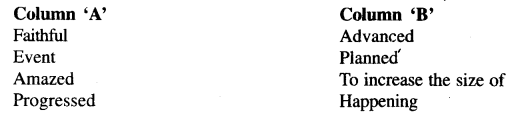
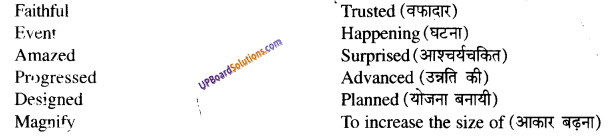
Match the words given under Column ‘A’ with the meanings given under Column ‘B’ below :
(नीचे दिये हुए सूची ‘अ’ के शब्दों का सूची ‘ब’ के अर्थों से मिलान कीजिए:)
Answer:

Questions 2.
Fill in the blanks in the following sentences with the words given below :
(नीचे दिये हुए उपयुक्त शब्दों की सहायता से निम्नलिखित वाक्यों में रिक्त स्थानों की पूर्ति कीजिए)
Proved (सिद्धकर दिया) ;
unique ( अद्वितीय);
measure (नापना) ;
straggle (संघर्ष) ;
inventor (आविष्कारक) ;
(a) Bose built a ……….. instrument named Crescograph.
(b) Crescograph could ……….. the growth of plants.
(c) Edison was a great ……….. of America.
(d) After many years the accounts of his journey were ……….. true.
(e) A three year ……….. began between Bose and the government in which he was victorious.
Answer:
(a) unique
(b) measure
(c) inventor
(d) proved
(e) struggle
Questions 3.
Give the opposite words of the following :
(निम्नलिखित शब्दों के विलोम शब्द लिखिए)
temporary; appointed; victory; maximum; action
Answer:
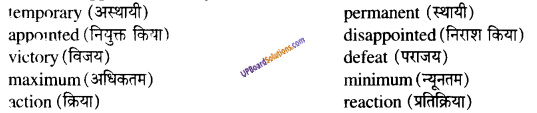
Questions 4.
Give the synonyms of the following words :
(निम्नलिखित शब्दों के समानार्थी शब्द लिखिए)
unique (अद्वितीय); depressed (दुःखी ); growth (वृद्धि ); ancestors (पूर्वज); glory (गौरव); event (घटना)
Answer:
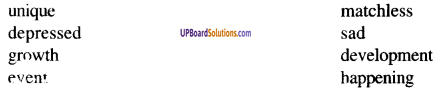
Questions 5.
Find one word for each of the following expressions :
(निम्नलिखित वाक्यांशों के लिए एक शब्द बताइए)
(i) The maker of a new thing. ( )
(ii) Finding out a thing which is already in existence. ( )
(iii) To increase the size of.. ( )
Answer:
(i) inventor,
(ii) discovery,
(iii) magnify.
WORKSHEET-5
RELATIVE PRONOUNS
Relative or Adjectival clauses qualify the Nouns that go before them. Such clauses answer the questions which person? or which thing?
Relative clauses are usually introduced by the relative pronouns. Who, which, that, whom, who or whom is used to refer to persons, which to things and animals, and that to things and animals as well as, sometimes, to persons. Whom is rarely used in spoken English. It is used in formal written English.
Questions 1.
Fill in the blanks in the following sentences using who, which or that, whichever is suitable.
(who, which या that, whichever का प्रयोग करके निम्नलिखित वाक्यों में रिक्त स्थानों की पूर्ति कीजिए)
(i) I am looking for someone ………. buys old furniture.
(ii) I want to sell a few old pieces ……….. may be valuable.
(iii) The time ……….. is lost for ever.
(iv) The dogs ………. bark seldom bite.
(v) All ……….. shines is not gold.
(vi) This is the man ………. helped me yesterday.
Answer:
(i) who
(ii) which
(iii) that
(iv) which/who
(v) that
(vi) who.
Questions 2.
Combine the following pairs of sentences into one sentence using who, which or that which is suitable. One sentence is done for you as an example :
(who, which या that जो उपयुक्त हो, का प्रयोग करके निम्नलिखित वाक्य-युग्मों को जोड़करे एक वाक्य बनाइये। उदाहरण के लिए पहले वाक्य का प्रयोग आपके लिए किया गया है:)
Example :
(i) Registered letters/get special attention.
Letters, that are registered, get special attention.
(ii) The young man is the school captain. He was here a little while ago.
(iii) You borrowed a book from me. You have not returned it.
(iv) A car is parked in front of the bank. The car belongs to Mrs. Arora.
Answer:
(i) The young man, who was here a little while ago, is the school captain.
(iii) You borrowed a book from me that you have not returned.
(iv) A car, which belongs to Mrs. Arora, is parked in front of the bank.
Questions 3.
The bold words in the following passage are either Nouns or Adjectives. Read the passage and change these words, if necessary, from Nouns into Adjectives or from Adjectives into Nouns.
(निम्नलिखित गद्यांश में मोटे छपे शब्द या तो संज्ञा हैं या विशेषण। गद्यांश को पढ़िये और यदि आवश्यक हो तो Nouns को Adjectives में या Adjectives को Nouns में बदलिए।)
The road was full of rocky and path was stony. We had to force our tiredness muscles to move. This was more than we were capability of. But (UPBoardSolutions.com) we knew that soon we would be victorious. Our escape from the depths of the Cave was drama. Soon we knew we would get the glorious that we wanted.
Answer:
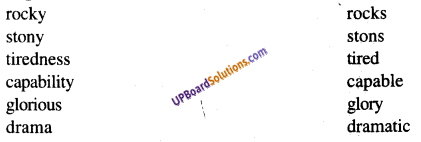
Questions 4.
Write down the Noun forms of the following Verbs :
(निम्नलिखित क्रियाओं के संज्ञा रूप लिखिए)
Answer:
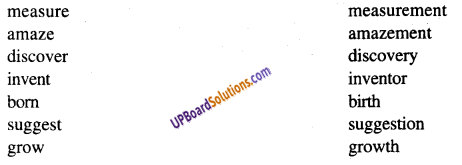
Questions 5.
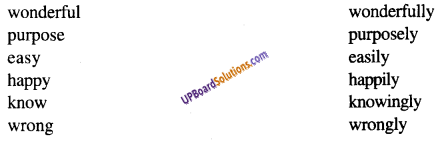
Make Adverbs from the following words :
(निम्नलिखित शब्दों से क्रिया विशेषण बनाइए)
wonderful, purpose; easy, happy, know, wrong
Answer:
Questions 6.
Complete the spellings of the following words :
(निम्नलिखित शब्दों की वर्तनी पूरी कीजिए)
Wo–d;
r-g-rd;
d-s-gn,
bel–f,
e–nt
Answer:
wound,
regard,
design,
belief,
event
Questions 7.
Fill in the blanks in the following sentences with the correct form of the Verbs given in the brackets :
(निम्नलिखित वाक्यों को कोष्ठक में दी गयी क्रियाओं के सही रूप लिखकर रिक्त स्थानों की पूर्ति कीजिए)
(i) The sun ……….. in the East. (rise)
(ii) He does not ……….. to school regularly. (come)
(iii) Jagdish Chandra Bose ……….. born in 1858 in Bengal. (is)
(iv) Bose ……….. to touch any part of his salary for three years. (refuse)
Answer:
(i) rises
(ii) come
(ii) was
(iv) refused
Questions 8.
Use the following pairs of words in your own sentences showing clearly the difference in their meanings :
(निम्नलिखित शब्द-युग्मों के अन्तर स्पष्ट करते हुए उनको अपने वाक्यों में प्रयोग कीजिए)
sight, cite; maid; made
cite (उदाहरण देना) : Can you cite a few lines from Milton? s
sight (आँख की ज्योति) : Milton lost his eye sight in the middle of his age.
Imaid(अविवाहित) : There is a maid servant in my house.
made (बनाया) : He made me happy.
Questions 9.
Fill in the following spaces with appropriate information from the text :
(पाठ्य-पुस्तक से सही सूचना की सहायता से निम्नलिखित स्थानों को भरिये)
THE CRESCOGRAPH
The Crescograph is an instrument which ………………. it was built by……….. in ………….. Bose’s theory was that ………… So, he built the Crescograph to ……….. which proved that ….
The Crescograph is an instrument which records the growth of plants. It was built by Jagdish Chandra Bose in 1900. Bose’s theory was that plants (UPBoardSolutions.com) have heart and can feel. So he built the Crescograph to magnify the movement of plant tissues ten thousand times. It was a unique machine which proved that he was not wrong.
We hope the UP Board Solutions for Class 9 English Prose Chapter 5 Plants also Breathe and Feel (Sir Jagdish Chandra Bose) help you. If you have any query regarding UP Board Solutions for Class 9 English Prose Chapter 5 Plants also Breathe and Feel (Sir Jagdish Chandra Bose), drop a comment below and we will get back to you at the earliest.