UP Board Class 9th English Chapter 3 Question Answer Playing The Game (Arthur Mee) [Adapted].

Class 9 English Prose Chapter 3 Questions and Answers UP Board Playing The Game (Arthur Mee) [Adapted].

कक्षा 9 अंग्रेजी पाठ 3 प्रश्न उत्तर

These Solutions are part of UP Board Solutions for Class 9 English. Here we have given UP Board Solutions for Class 9 English Prose Chapter 3 Playing The Game (Arthur Mee) [Adapted].

(A) PASSAGES FOR COMPREHENSION

Read the following passages and answer the questions given below :
निम्नलिखित गद्यांशों को पढ़िए और नीचे दिये गये प्रश्नों के उत्तर दीजिए

(a) Alam’s mother came to the gate to see him of “Good bye, Alando your best, “she called out. “I shall try, Mummy,” answered Alan and waving his hand, he ran out of the gate and up the road. Do his best! of course he would. For Alan was playing in the school cricket match and was mightily proud of being chosen to play. He had practised (UPBoardSolutions.com) bowling with his father for weeks now, and Daddy said he was shaping well. Daddy was nearly as excited as Alan over the match and he promised that if Alan’s side won he would buy him a bicycle.

Questions.
1. Why did Alan’s mother came to the gate? What did she say to him?
(ऐलन की माँ फाटक पर क्यों आयी? उसने ऐलन से क्या कहा? )
2. What was Alan mightily proud of?
(ऐलन को किस बात पर बहुत अधिक गर्व था?)
3. How did Alan react to his mother’s advice in his mind?
(ऐलन ने अपनी माँ की सलाह पर प्रतिक्रिया अपने मस्तिष्क में किस प्रकार की?)
4. What would the father do if Alan’s side won the match?
(यदि ऐलने की टीम मैच जीती तो उसके पिताजी क्या करते?)
5. Name the lesson from which the above passage has been taken. Who is the author?
(उस पाठ का नाम लिखिए जिससे उपरोक्त गद्यांश लिया गया है। इसका लेखक कौन है?)
Answers:
1. Alan’s mother came to the gate to see him off. She said, “Good bye” and called out to do his best.
(ऐलन की माँ उसको विदा करने के लिए फाटक पर आयी। वह बोली “शुभ विदा’ और पूरा प्रयास करने को कहा।)
2. Alan was mightily proud of being chosen to play in the school cricket match.
(ऐलन को अपने विद्यालय के क्रिकेट मैच में खेलने के लिए चुने जाने पर बहुत अधिक गर्व था।)
3. Alan reacted his mother’s advice in his mind that he would try to win the match.
(ऐलन ने अपनी माँ की सलाह पर अपने मस्तिष्क में प्रतिक्रिया की कि वह मैच जीत लेगा।)
4. Alan’s father promised to buy a bicycle if Alan’s side won the match.
(ऐलन के पिता ने वचन दिया था कि यदि ऐलन की टीम विजयी होगी तो वह उसके लिए एक साइकिल खरीद देंगे।)
5. The name of the lesson is ‘Playing the Game’ and the author is Arthur Mee.
(पाठ का नाम ‘प्लेइंग द फेम’ तथा लेखक का नाम आर्थर मी है।)

UP Board Solutions

(b) On his way to the sports ground, Alan had to pass the little three cornered meadow and as he reached it, he saw a very old man leaning heavily on his stick. As Alan passed, the old man called out to him.
“Can I help you?” asked Alam kindlh, going up to him.
The old man, in a thin, cracked voice requested Alan to let him take his arm. He said, “This road is so hilly and the wind is almost too much.”

Questions .
1. What did Alan see on his way to the sports ground?
(खेल के मैदान को जाते समय ऐलन ने रास्ते में क्या देखा? )
2. When did the old man call out to Alan?
(बूढ़े आदमी ने ऐलन को कब पुकारा?)
3. What did Alan say to the old man?
(ऐलन ने बूढ़े आदमी से क्या कहा?)
4. What was the condition of the old man?
(बूढ़े आदमी की दशा क्या थी?)
5. Name the lesson from which the above passage has been taken. Who is the author?
(उस पाठ का नाम लिखिए जिससे उपरोक्त गद्यांश लिया गया है। इसके लेखक कौन हैं?)
Answers:
1. Alan saw an old man on his way to the sports ground.
(खेल के मैदान को जाते समय ऐलन ने रास्ते में एक बूढ़े आदमी को देखा।)
2. As Alan passed the old man called out to Alar..
(ज्योंही ऐलन गुजरा, उस बूढ़े आदमी ने ऐलन को पुकारा।)
3. Alan said if he could help the old man.
(ऐलन ने कहा कि क्या वह बूढ़े आदमी की सहायता कर सकता है?)
4. The old man was very weak and unable to walk without help.
(बूढ़ा आदमी बहुत कमजोर था तथा बिना सहायता के चलने योग्य नहीं था।)
5. The name of the lesson is “Playing The Game” and the author is Arthur Mee.
(पाठ का नाम ‘प्लेइंग दि गेम’ है तथा इसके लेखक आर्थर मी हैं।)

(c) “Bra00, Alam,” he said, batting his listle son on the back. “But Dadav…….” began Alam. But his father interrupted him.
“It is all right, old man,” he said, “You see, I came up behind that policeman and he told me what had happened. So I knew you were playing the game although it was not on the cricket pitch. So I went back to the market-place and bought the bicycle I promised you. It is a beauty. And, Alan, we are proud of you, your mother and I.”

Questions .
1. Why did the father pat Alan on the back?
(ऐलन के पिता ने उसकी पीठ क्यों थपथपाई?)
2. “But Daddy” began Alan, what did Alan wish to say?
(किन्तु पिताजी” ऐलन ने बोलना प्रारम्भ किया। ऐलन क्या कहना चाहता था?)
3. What did the policeman say?
(पुलिसमैन ने क्या कहा?)
4. How was Alan playing the game?
(ऐलन खेल किस प्रकार खेल रहा था?)
5. Write name of the lesson from which the above passage has been taken. Who is the author?
(उस पाठ का नाम लिखिए जिससे उपरोक्त गद्यांश लिया गया है। इसके लेखक कौन हैं?)
Answers:
1. The father patted Alan on the back because he had helped an old man.
(ऐलन के पिता ने उसकी पीठ थपथपाई क्योंकि उसने एक बूढ़े आदमी की सहायता की थी।)
2. Alan wished to say that he had not played in the match.
(ऐलन कहना चाहता था कि उसने मैच में नहीं खेला है।)
3. The policeman told Alan’s father what had happened?
(पुलिसमैन ने ऐलन के पिता को वह सब बता दिया जो कुछ घटित हुआ था।)
4. Alan was playing the game not on the cricket pitch but he was helping an old man on the way.
(ऐलन क्रिकेट के मैदान में खेल नहीं खेल रहा था किन्तु वह रास्ते में एक बूढ़े आदमी की सहायता कर रहा था।)
5. The name of the lesson is ‘Playing the Game’ and the author is Arthur Mee.
(पाठ का नाम ‘प्लेइंग द गेम’ तथा लेखक आर्थर मी हैं।)

(B) LONG ANSWERTYPE QUESTIONS AND THEIR ANSWERS

Answer the following questions in not more than 60 words each :

Question 1 .
What was Alan mightily proud of? Why was he eager to do his best? What had he done for it?
(ऐलन को बहुत अधिक गर्व किस बात का था? वह सबसे अच्छा करने के लिए क्यों उत्सुक था? इसके लिए उसने क्या किया था?)
Answers:
Alan was chosen to play in the school cricket match. He was mightily proud of it. He had practised bowling with his father for weeks. He was a (UPBoardSolutions.com) good bowler. His father said that he was shaping well. His father was as excited as Alan over the match. So he promised that if Alan’s side won the match he would buy him a bicycle.

ऐलन स्कूल के क्रिकेट मैच में खेलने के लिए चुन लिया गया था। इस पर उसे बहुत अधिक गर्व था। वह अपने पिता के साथ, कई सप्ताह तक अच्छी तरह गेंद फेकने का अभ्यास कर चुका था। वह एक अच्छा गेंदबाज था। उसके पिता का कहना था कि वह गेंद को अच्छी तरह से फेंकता है। उसके पिता मैच के लिए उतने ही उत्तेजित थे जितना कि ऐलन। इसलिए उन्होंने वचन दिया था कि यदि ऐलन की टीम विजयी होगी तो वह उसके लिए साइकिल खरीद देगें।

Question 2 .
Describe the old man in brief. How did Alan help him? What was the result?
(बूढ़े आदमी का वर्णन संक्षेप में कीजिए। ऐलन ने उसकी सहायता किस प्रकार की? उसका परिणाम क्या हुआ?)
Answers:
When Alan was going to play cricket match, he saw an old man on the way. He was leaning heavily on his stick. He was weak and deaf. The road was so hilly that he could not walk easily on the way. So he requested Alan to help him. Alan helped him as he knew that he would easily make up what time he had lost by running. The old man was (UPBoardSolutions.com) walking so slowly that five minutes had gone before they were half way up the road. Suddenly the old mad stumbled and fell heavily on the way up the ground. After sometime, a policeman came there and promised to help the old man. Now Alan ran as fast as he could but he arrived late and could not play the match.

जब ऐलन क्रिकेट मैच खेलने जा रहा था, तो उसने रास्ते में एक बूढ़े आदमी को देखा। वह अपने डण्डे पर बोझ डाले हुआ था। वह कमजोर तथा बहरा था। सड़क इतनी पथरीली थी कि वह रास्ते में आसानी से नहीं चल सकता था इसलिए उसने ऐलन से अपनी सहायता करने के लिए प्रार्थना की। ऐलन ने उसकी सहायता की क्योंकि वह जानता था कि उसका जितना समय नष्ट हुआ है उसे वह दौड़कर सरलता से पूरा कर लेगा। बूढ़ा आदमी इतना धीरे-धीरे चल रहा था कि सड़क पर आधी दूर जाने से पहले ही पाँच मिनट बीत गये। वृद्ध व्यक्ति ने अचानक ठोकर खायी और जोर से जमीन पर गिर पड़ा। कुछ समय बाद एक पुलिसमैन वहाँ आया और बूढ़े आदमी की सहायता करने का वचन दिया। अब ऐलन उतना तेज भागा जितना वह भाग सकता था फिर भी वह देरी से पहुंचा और मैच नहीं खेल सका।

UP Board Solutions

Question 3 .
Alan was playing the game although it was not on the cricket pitch. What game was Alan playing? How did he play it?
(ऐलन खेल खेल रहा था, यद्यपि यह कार्य क्रिकेट के मैदान पर नहीं हो रहा था। ऐलन कौन-सा खेल खेल रहा था? उसने इसे किस प्रकार खेला?)
Answers:
Alan was chosen to play in the school cricket match. So he was much excited. He wanted to do his best in the match. But he could not play as he reached late. Actually, he was playing an other game. When he was going to play ground, he met an old and weak man on the way. He was unable to walk on the road as it was hilly and the wind was too much for him. The old man asked Alan to help him. Alan helped him as he knew that he would be able to (UPBoardSolutions.com) recover the time by running. But the old man was moving slowly. Suddenly, he stumbled and fell on the ground. Thus there was no way out except to help the poor man. At last a policeman came there and promised Alan to help him. Now Alan ran as he could but all was in vain. Although he could not play on the cricket pitch, yet he was playing the game of helping an old man.

ऐलन स्कूल के क्रिकेट मैच में खेलने के लिए चुन लिया गया था इसलिए वह बहुत अधिक उत्तेजित था। वह मैच में अपना पूरा प्रयास करना चाहता था किन्तु वह नहीं खेल सका क्योंकि वह देर से पहुंचा था। वास्तव में वह एक दूसरा खेल खेल रहा था। रास्ते में उसे एक बूढ़ा और कमजोर व्यक्ति मिला। वह सड़क पर चलने में असमर्थ था क्योंकि सड़क पथरीली थी और हवा उसके लिए बहुत ज्यादा थीं। बूढ़े आदमी ने ऐलन से अपनी सहायता करने के लिए कहा। ऐलन ने उसकी सहायता की क्योंकि वह जानता था कि वह उतने समय को दौड़कर पूरा कर लेगा किन्तु बूढ़ा आदमी बहुत धीरे-धीरे चल रहा था। अचानक उसे ठोकर लगी और वह जमीन पर गिर पड़ा। इस प्रकार बूढ़े आदमी की सहायता करने के अलावा उसके सामने कोई रास्ता नहीं था। अन्त में एक पुलिसमैन वहाँ आया (UPBoardSolutions.com) और उसने ऐलन से बूढ़े आदमी की सहायता करने का वचन दिया। अब ऐलन जितना तेज भाग सकता था, भागा किन्तु सब व्यर्थ था। । यद्यपि वह क्रिकेट के मैदान में नहीं खेला था फिर भी वह एक बूढ़े आदमी की सहायता करने का खेल खेल रहा था।

(C) SHORT ANSWER TYPE QUESTIONS AND THEIR ANSWERS

Answer the following questions in not more than 25 words each :

Question 1 .
What did Alan’s mother say to him when she came to the gate to bid him goodbye?
(जब ऐलन की माँ उसे दरवाजे पर ‘शुभ विदा’ कहने आयी तो उसने ऐलन से क्या कहा?)
Answers:
When Alan’s mother came to the gate to bid him good bye she said to him to do his best?
जब ऐलन की माँ उसे दरवाजे पर ‘शुभ विदा कहने आयी तो उसने उसे सर्वश्रेष्ठ करने के लिए कहा।

Question 2 .
What had Alan practised for weeks with his father? What did his father say about him?
(ऐलन ने अपने पिता के साथ कई सप्ताह तक किस चीज का अभ्यास किया था? उसके पिता उसके बारे में क्या कहते थे?)
Answers:
Alan had practised bowling with his father for weeks. His father told him that he was shaping well. His father was excited over the match.
ऐलन ने अपने पिता के साथ कई सप्ताह तक अच्छी तरह (UPBoardSolutions.com) से गेंद फेंकने का अभ्यास किया था। उसके पिता उससे कहते थे कि वह गेंद को अच्छी तरह से फेंकता है। उसके पिता मैच के लिए उत्तेजित थे।

Question 3 .
What did Alan’s father promise him to give?
(ऐलन के पिता ने उसे क्या देने का वचन दिया था?)
Answers:
Alan’s father promised him that if Alan’s side won the match, he would buy him a bicycle.’
(ऐलन के पिता ने वचन दिया था कि यदि ऐलन की टीम विजयी होगी तो वह उसके लिए साइकिल खरीद देगें।)

Question 4 .
Why did the old man fall down?”
(बूढ़ा आदमी क्यों गिर पड़ा?)
Answers:
The old man stumbled over a loose paving stone and fell heavily on the ground.
(बूढ़े आदमी को रास्ते के पत्थर से ठोकर लग गयी और वह जोर से जमीन पर गिर पड़ा।)

Question 5 .
Why was Alan happy at last?
(अन्त में ऐलन प्रसन्न क्यों था?)
Answers:
Alan was happy at last because a jolly-looking policeman came there. He was ready to help the old man.
(अन्त में ऐलन प्रसन्नं इसलिए था क्योंकि वहाँ एक प्रसन्नचित्त पुलिसमैन आ गया। वह बूढ़े आदमी की सहायता करने के लिए तैयार था।)

Question 6 .
What did the policeman say to Alan?
(पुलिसमैन ने ऐलन से क्या कहा?)
Answers:
The policeman said to Alan that he would see that gentleman home.
(पुलिसमैन ने ऐलन से कहा कि वह उस भद्र व्यक्ति को घर पहुँचा देगा।)

Question 7 .
When did he reach the sports ground?
(वह खेल के मैदान पर कब पहुँचा?)
Answers:
When Alan reached the sports ground, the game had started. He was late.
(जब ऐलन खेल के मैदान पर पहुँचा तो खेल प्रारम्भ हो चुका था। उसे देर हो गयी थी।)

Question 8 .
Why was he late for the match?
(मैच के लिए उसे देर क्यों हो गयी?)
Answers:
Alan was late for the match because he had helped an old man on the way.
(मैच के लिए उसे देर इसलिए हो गयी क्योंकि उसने रास्ते में एक बूढ़े आदमी की सहायता की थी।)

UP Board Solutions

Question 9 .
Alan made his way slowly home. Why?
(ऐलन धीरे-धीरे घर को चल दिया। क्यों?)
Answers:
Alan made his way slowly home because another boy named Harold Banks was playing in his place.
(ऐलन धीरे-धीरे अपने घर को चल दिया क्योंकि हैरोल्ड बैंक्स नामक दूसरा लड़का उसके स्थान पर खेल रहा था।)

Question 10 .
How did the boys cheer him in the classroom the next morning?
(दूसरे दिन सुबह कक्षा में लड़कों ने उसके लिए जय ध्वनि किस प्रकार की?)
Answers:
The boys gave Alan three loud cheers next morning for they too had learned about his kind act.
(दूसरे दिन सुबह लड़कों ने ऐलन के लिए तीन बार जय ध्वनि की क्योंकि उनको भी उसके दयापूर्ण कार्य के बारे में मालूम पड़ गया था।)

(D) OBJECTIVE TYPE QUESTIONS

Question 1 .
Complete the following statements with the most suitable choice :
(सबसे उपयुक्त विकल्प चुनकर निम्नलिखित कथनों को पूरा कीजिए)

(i) Alan’s father would not buy him a bicycle if :
(a) his team lost the match
(b) he did not reach the field in time
(c) he did not play well in the match
(d) he won the match

(ii) Alan was choosen to play in the match because he :
(a) was a good batsman
(b) was a good bowler
(c) had practised well with his father
(d) was a good student

(iii) Alan saw a very old man near :
(a) the sports ground
(b) his house
(c) a grassy land
(d) the school

(iv) Alan told the old man that he was going to play the cricket match and that he must not be late. The old man did not say anything because :
(a) he was certainly deaf
(b) perhaps he thought Alan would leave him alone
(c) Alan spoke in a whisper

(v) Alan was not permitted to play in the match because :
(a) he had helped the old man
(b) the teacher had selected a better boy for the team
(c) he was late
(d) he had cheated the policeman
Answers:
(i) (a) his team lost the match
(ii) (b) was a good bowler.
(iii) (c) a grassy land.
(iv) (a) he was certainly deaf.
(v) (c) he was late

UP Board Solutions

Question 2 .
Point out the ‘true’ and ‘false’ statements in the following :
(निम्नलिखित कथनों में ‘सत्य’ और ‘असत्य’ बताइए)

(i) Alan’s father promised that if his side won, he would buy him a bicycle.
(ii) Alan did not help the old man.
(iii) The game had not started when Alan arrived.
(iv) Alan turned away and made his way slowly home.
(v) Alan’s parents were proud of him.
Answers:
(i) T
(ii) F
(iii) F
(iv) T
(v) T

(E) VOCABULARY

Question 1 .
Match the words given under Column ‘A’ with the meanings given under Column ‘B’ below.
(नीचे दिये गये सूची ‘अ’ के शब्दों की सूची ‘ब’ के अर्थों से मिलान कीजिए)
UP Board Solutions for Class 9 English Prose Chapter 3 Playing The Game (Arthur Mee) [Adapted] image 1
Answer:
UP Board Solutions for Class 9 English Prose Chapter 3 Playing The Game (Arthur Mee) [Adapted] image 2

Question 2 .
Find out the words from the text which have the following expressions. The first letter of each word is given as a hint :
(निम्नलिखित वाक्यांशों के लिए एक शब्द लिखिए। प्रत्येक शब्द का पहला अक्षर संकेत के रूप में दिया हुआ है)

(a) Strike the foot with something and almost fall. (S……….)
(b) To do something regularly in order to become skilful. (P…………. )
(c) Rest in bending position for support. (L………… )
(d) Break in upon a person speaking something. ( I ……. )
(e) To move something to and fro. (W………)
Answer:
(a) Stumbled
(b) Practice
(c) Leaning
(d) Interrupt
(e) Waving

Question 3 .
Give the opposite words of the following :
(निम्नलिखित शब्दों के विलोम शब्द लिखिए)

proud; thin; lost; right; buy; up
Answer:
UP Board Solutions for Class 9 English Prose Chapter 3 Playing The Game (Arthur Mee) [Adapted] image 3

Question 4 .
Give the synonyms of the following words :
निम्नलिखित शब्दों के समानार्थी शब्द लिखिए
chosen (चुना हुआ); reach (पहुँचना); fortunately (भाग्यवश), answer (उत्तर देना); stare (एकटक देखना)
Answer:
UP Board Solutions for Class 9 English Prose Chapter 3 Playing The Game (Arthur Mee) [Adapted] image 4

Question 5 .
Fill in the blanks in the following sentences with the suitable words given below :
नीचे दिये गये शब्दों की सहायता से निम्नलिखित वाक्यों में रिक्त स्थानों की पूर्ति कीजिए

try; loose; answer; chosen; obliged
(a) ………. my question correctly.
(b) Alan was …… to play in the school cricket match.
(c) Please, …… to understand me.
(d) I am highly …… to you.
(e) My shirt is ……
Answer:
(a) answer
(b) chosen
(c) try
(d) obliged
(e) loose

UP Board Solutions

Question 6 .
Use the following phrases in sentences of your own so as to make their meanings clear :
निम्नलिखित मुहावरों को अपने वाक्यों में प्रयोग कीजिए ताकि उनका अर्थ स्पष्ट हो जाय

to see off (विदा करना); of course (वास्तव में); at last (अन्त में); set off (चल पड़ा); of no use (अनुपयोगी);

To see off (विदा करना): I went to the station to see off my sister.
Of course (वास्तव में) : Of course, Alan would do his best in the match.
At last (अन्त में ) : At last, he won the match.
Set off (चल पड़ा) : They have set off on a journey round the world.
Of no use ((अनुपयोगी) : Some guide books are of no use.
On way to (रास्ते मे) : On his way to the play ground, Alan had to pass a meadow.

WORKSHEET-3

Question 1 .
Combine the following pairs of sentences into one sentence by using conjunction ‘that’. First has been done for you.
(Conjunction ‘that’ का प्रयोग करके निम्नलिखित के जोड़ों को जोड़कर एक वाक्य बनाइये। पहला आपके लिए किया हुआ है।)

Example :
(i) (a) Raju would help us.
(b) We hope so.
We hope that Raju would help us.

(ii) (a) Our school team would win the match easily. ,
(b) We knew it.

(iii) (a) You are well.
(b) I trust so.

(iv) (a) I would pass.
(b) I was sure of this.

(v) (a) He had left the child on the road.
(b) He forgot this.
Answer:
(ii) We knew that our school team would win the match easily.
(iii) I trust that you are well.
(iv) I was sure that I would pass.
(v) He forgot that he had left the child on the road.

Question 2 .
Combine the following pairs of sentences into one sentence by using conjunction ‘what’.
First has been done for you. Mark that ‘something’ and ‘that’ have been removed.
(Conjunction ‘What’ का प्रयोग करके निम्नलिखित वाक्यों के जोड़ों को जोड़कर एक वाक्य बनाइये। पहला आपके लिए किया हुआ है। ध्यान दीजिए कि ‘Something’ और ‘that’ को हटा दिया गया है।)

Example :
(i) (a) He had done something.
(b) I know that..
I know what he had done.

(ii) (a) He means something.
(b) I understand that.

(iii) (a) Something is worrying her.
(b) I know that.

(iv) (a) Something had gone wrong with the car.
(b) I can’t remember that.

(v) (a) Something made you laugh.
(b) I do not know that.

(vi) (a) You said to me something.
(b) I remember quite clearly.
Answer:
(ii) I under stand what he means.
(iii) I know what is worrying her.
(iv) I can not remember what had gone wrong with the car.
(v) I do not know what made you laugh.
(vi) I remember quite clearly what you said to me.

UP Board Solutions

Question 3 .
Change the following sentences into Indirect Speech, using the introductory Verbs given in the brackets. Two have been done for you :
(कोष्ठक में दी हुई introductory क्रिया का प्रयोग करके निम्नलिखित वाक्यों को Indirect Speech में बदलिए)

Examples
(i) “Go away”, he said to her. (ordered)
He ordered her to go away.
(ii) He said to me, “Please don’t make the floor dirty.” (requested)
He requested me not to make the floor dirty.
(iii) He said to me, “Don’t read my letter aloud.” (asked)
(iv) “Do the work again, the teacher said to him. (ordered)
(v) The old man said to Alan, “Please, help me.” (requested)
(vi) The Principal said to them, “Do not make a noise in the hall.” (told)
(vii) He said to his friend, “Don’t be cruel to the dog.” (begged)
(viii) He said to his son, “Don’t play on the road. (advised)
(ix) “Don’t sit on that chair, “he said to the boy.” (ordered)
(x) “Write to me soon,” she said to me. (begged)
Answer:
(iii) He asked me not to read his letter aloud.
(iv) The teacher ordered him to do the work again.
(v) The old man requested Alan to help him.
(vi) The Principal told them not to make a noise in the hall.
(vii) He begged his friend not to be cruel to the dog.
(viii) He advised his son, play on the road.
(ix) He advised the boy not to sit on that chair.
(x) She begged me to write to her soon.

Question 4 .
Fill in the blanks in the following sentences with the phrases given below :
(नीचे दिये हुए मुहावरों का प्रयोग करके निम्नलिखित वाक्यों में रिक्त स्थानों की पूर्ति कीजिए)

of no use (अनुपयोगी); bit his lip (ओंठ काट लिया); proud of (गर्व); make up (पूरा करना); at last (अन्त में); set off (प्रारम्भ कर दीया)
(a) When he came to know that the job had been given to someone else, he ……..
(b) I am …………. my, country.
(c) Ganga Gomti express is running late. But it will……. the last time.
(d) He made three attempts. And ….. he was selected for the medical course.
(e) He …….. on his journey with a few books in his bag.
(f) These guide books are …….
Answer:
(a) bit his lip.
(b) proud of
(c) make up
(d) at last
(e) set off
(f) of no use.

Question 5 .
Fill in the blanks in the following sentences with the suitable prepositions given below :
(नीचे दिये हुए निम्नलिखित वाक्यों में उपयुक्त prepositions की सहायता से रिक्त स्थानों की पूर्ति कीजिए)

in; on; to; of; for
(a) Waving his hand, he ran out…….. the gate.
(b) Alan was playing ……. the school cricket match.
(c) Suddenly, the old man stumbled over a loose paving-stone and fell heavily……. he ground.
(d) When Alan saw a policeman coming, he could have shouted ……. joy.
(e) So I went back to the market place and bought the bicycle I promised you.
Answer:
(a) of,
(b) in,
(c) on,
(d) for,
(e) to.

Question 6 .
Make Adjectives from the following Nouns :
निम्नलिखित संज्ञाओं को विशेषण बनाइये

pride; beauty; wonder; mystery
Answer:
Proud, beautiful, wonderful, mysterious.

UP Board Solutions

Question 7 .
Use the following pairs of words in your own sentences so as to make the difference clear in their meanings :
निम्नलिखित शब्द-युग्मों को अपने वाक्यों में प्रयोग कीजिए जिससे उनके अर्थों का अन्तर स्पष्ट हो जाय

Gait (फाटक) ; Week (चाल) ;Weak (सप्ताह) ; One (कमजौर) ; Won (एक) ; Bye (जीत लिया ) ; By (बिदा ) ; Know (जानना) ; No (नहीं) .

Gait (फाटक) : He is famous for his gait.
Week (चाल) : He came here last week.
Weak (सप्ताह) : He is weak in English
One (कमजौर) : One should do one’s duty regularly.
Won (एक) : Alan’s father promised that if Alan’s side won, he would buy a cycle.
Bye (जीत लिया ) : Alan’s mother called out Alan good bye and advised him to do his best.
By (बिदा ) : He will come here by the morning train.
Know (जानना) : He knows me well.
No (नहीं) : There is no boy in the class.

Question 8 .
Imagine that you are the weak, old man in the story. Write a letter to your grandson telling him in six or seven sentences what happened to you when you fell down in the meadow.
(कल्पना करो कि कहानी में तुम एक कमजोर और बूढ़े आदमी हो। अपने पौत्र को छः सात वाक्यों में यह बताते हुए पत्र लिखो कि जब तुम चरागाह में गिर पड़े तब तुम्हारे साथ क्या घटित हुआ।)

45/5, Zero Road
Allahabad
Dated 30. 5. 20…

My dear grandson Raju,
Yesterday, I was coming from the market. You know, I am an old man of sixty years. I was tired and not feeling well. The road was billy and the wind was too much for me. Suddenly, I stumbled over a loose paving stone and felt on the ground. A boy who was going to play a cricket match helped me. He was very kind gentle. gentle. God might bless him.

Yours
R.P. Singh

Place :  Allahabad
Dated : 30. 5. 20…

We hope the UP Board Solutions for Class 9 English Prose Chapter 3 Playing The Game (Arthur Mee) [Adapted] help you. If you have any query regarding UP Board Solutions for Class 9 English Prose Chapter 3 Playing The Game (Arthur Mee) [Adapted], drop a comment below and we will get back to you at the earliest.
I Love Nature Class 7 English Chapter 17 Question Answer UP Board Solutions

UP Board Class 7th English Chapter 17 I Love Nature. Questions and Answers

कक्षा 7 अंग्रेजी पाठ 17 के प्रश्न उत्तर

These Solutions are part of UP Board Solutions for Class 7 English. Here we have given UP Board Solutions for Class 7 English Chapter 17 I Love Nature.

I Love Nature

TRANSLATION OF THE LESSON (पाठ का हिन्दी अनुवाद)

I love the ………………………………………………. the trees.
हिन्दी अनुवाद- मुझे पक्षियों की आवाज़ प्रिय है।
अतः भोर के समय,
मुझे पिल्लों की आवाज़ अच्छी लगती है।
ठीक उनके जन्म लेने के बाद की।
मुझे फूलों की सुगंध प्रिय है,
और मधुमक्खियों से प्राप्त शहद का (UPBoardSolutions.com) स्वाद भी,
मुझे प्रिय है वो आवाज़ जो बहती हवा बनाती है,
जब वह पेड़ों के अन्दर से बहती है।

UP Board Solutions

I love the……………………………………… in my hand.
हिन्दी अनुवाद- मुझे प्रिय है जिस प्रकार से आकाश दिखता है,
एक उजले और धूपदार दिन में,
और जब बरसातें भी होती हैं।
मुझे स्लेटी के विभिन्न रंग प्रिय हैं।
मुझे महासागर की सुगंध प्रिय है।
रेत परे लहरों की आवाज़ भी,
मुझे समुद्र की सीपियों को (UPBoardSolutions.com) छूना प्रिय है और
जैसे वे मेरे हाथ से दिखती हैं वह भी।

UP Board Solutions

And when the …………………………………….I love.
हिन्दी अनुवाद- और जब सूर्य चला जाता है, मुझे प्रिय है।
चाँद जो इतना उज्जवल चमकता है,
मुझे प्रिय है झीगुरों की आवाज़ और
दूसरे रात के जीवों की आवाज़।
इसलिए जब मैं सोने के लिए लेटता हूँ,
मैं ऊपर रहने वाले ईश्वर का धन्यवाद करता हूँ
उन सभी प्राकृतिक चीज़ों और दूसरी चीज़ों के लिए,
उन सभी चीजों के लिए जो मुझे प्रिय हैं।

UP Board Solutions

EXERCISE (अभ्यास)

Comprehension Questions

Question 1.
Answer the following questions:
Answer:
Question a.
What is the poem about?
Answer:
The poem is about the poet’s love for nature and all things around him.

Question b.
How does the poet express (UPBoardSolutions.com) his love for nature in the first stanza?
Answer:
The poet says that he loves the sounds produced by birds and the sounds made by puppies, early in the morning, just after they are born.

UP Board Solutions

Question c.
Which shade does the poet love during rain?
Answer:
The poet loves all the shade of the grey during the rain.

Question d.
What are the things that the poet loves at night?
Answer:
The poet loves the sounds made by (UPBoardSolutions.com) crickets and other creatures that are active during the night.

Question e.
List the things whose sounds are enjoyed by the poet?
Answer:
The poet likes the sound of:

  1. puppies after they are born.
  2. wind blowing through trees.
  3. waves upon the sand.
  4. crickets and other night creatures.

UP Board Solutions

Question f.
Whom does the poet thank when he lay down to sleep?
Answer:
The poet thanks the lord when he lay down to sleep.

UP Board Solutions

Word Power

Question 1.
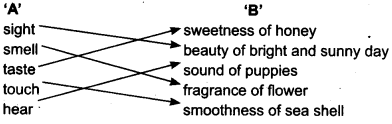
Read the poem carefully and match (UPBoardSolutions.com) the senses in column ‘A’ with the connecting functions or activity in column ‘B’:
Answer:
UP Board Solutions for Class 7 English Chapter 17 I Love Nature 1
Activity            Note: Do it yourself.

We hope the UP Board Solutions for Class 7 English Chapter 17 I Love Nature help you. If you have any query regarding UP Board Solutions for Class 7 English Chapter 17 I Love Nature, drop a comment below and we will get back to you at the earliest.

Class 11 English Chapter 1 Question Answer UP Board My Struggle for an Education

UP Board Class 11th English Prose Chapter 1 Questions and Answers

कक्षा 11 अंग्रेजी पाठ 1 के प्रश्न उत्तर

These Solutions are part of UP Board Solutions for Class 11 English. Here we have given UP Board Solutions for Class 11 English Prose Chapter 1 My Struggle for an Education.

LESSON at a Glance
The writer was a Negro (coloured man). His early life was full of difficulties and hardships. He began working in a coal mine. It was here that he overheard about Normal and Agricultural Institute. The author felt an urge to join this institute. His mother reluctantly permitted him for it whereas his brother John helped him as much as he could.

Finally, he started for Hampton with just a few clothes in a bag and a little money. Taking lift in cars and wagons he reached the city of Richmond only about eighty two miles away from Hampton. Here, he had all sorts of difficulties and had to spend his night under a sidewalk. But he was not the least discouraged.

The next day, he got a job of unloading cargo from a ship to make some money. He worked in the ship for a number of days to save some money. When he had enough money to reach Hampton, he resumed his journey.
He reached Hampton and presented himself before the head teacher for assignment to a class. The teacher asked him to sweep a recitation room which he did in a very lous way and quite thoroughly. The head teacher was so pleased with his work that she allowed him to join the institute. It was one of the happiest day of the author’s life.

पाठ का हिन्दी अनुवाद 

1. One day …….. great deal.

एक दिन, जब मैं कोयले की खान में काम कर रहा था, तब मुझे खान में काम करने वाले दो मजदूरों की बात को छिपकर सुनने का अवसर मिला जो वर्जीनिया के किसी स्थान पर नीग्रो के एक बड़े स्कूल के विषय में बातें कर रहे थे। यह पहला अवसर था जब मैंने किसी ऐसे स्कूल या कॉलेज के विषय में सुना था जो हमारे नगर के नीग्रो के छोटे स्कूल से कहीं अधिक आकर्षक था।

जब वे स्कूल का वर्णन कर रहे थे, तब मुझे ऐसा लगा कि यह पृथ्वी का सबसे महान् स्थान होगा। उस समय मुझे स्वर्ग में भी इतने आकर्षण प्रतीत नहीं हुए जितने कि वर्जीनिया के उस हैम्पटन नॉर्मल एवं एग्रीकल्चरल इन्स्टीट्यूट में हुए, जिसके विषय में ये व्यक्ति बातें कर रहे थे। मैंने तुरन्त उस स्कूल में जाने का निश्चय किया, यद्यपि मुझे यह भी पता नहीं था कि यह कहाँ और कितने मील दूर है या मैं वहाँ कैसे पहुँचूँगा। लगातार मुझे एक ही अभिलाषा प्रेरित कर रही थी कि मैं हैम्पटन में जाऊँ। दिन-रात यह विचार मेरे मन में रहा।

सन् 1872 के पतझड़ के मौसम में मैंने वहाँ जाने का निश्चय किया। मेरी माताजी इस गम्भीर भय से दु:खी थीं कि मैं एक ऐसे कार्य को करने जा रहा हूँ जो असम्भव है। कुछ भी हो मेरी माँ ने बे-मन से मुझे जाने की स्वीकृति दे दी। मेरे पास बहुत थोड़ा धन था जिससे मैं कपड़े खरीदें और यात्रा के लिए व्यय करूं। मेरे भाई जॉन ने जितनी सहायती वह कर सकता था की, किन्तु वास्तव में वह काफी नहीं थी।

2. Finally the great ………….. over my head.

वह महान् दिन आ गया और मैं हैम्पटन के लिए चल पड़ा। मेरे पास एक छोटा सस्ता थैला था जिसमें कुछ कपड़े थे जो मैं प्राप्त कर सका। उस समय मेरी माताजी बीमार और कमजोर थीं। मुझे यह आशा नहीं थी कि मैं पुनः उनसे मिल पाऊँगा और इसलिए हमारा वियोग दुःखदायी था, किन्तु फिर भी वह पूरे समय बहादुर बनी रहीं।

माल्डेन से हैम्पटन की दूरी लगभग पाँच सौ मील है। कभी पैदल चलकर, कभी घोड़ागाड़ी या कारों से लिफ्ट लेकर किसी प्रकार कई दिनों के बाद मैं वर्जीनिया के नगर रिचमंड में पहुँचा जो हैम्पटन से लगभग 82 मील दूर है। जब मैं वहाँ पहुँचा तब बहुत थका हुआ, भूखा और गन्दा था और रात काफी बीत चुकी थी। इससे पहले मैं इतने बड़े शहर में कभी नहीं गया था, इस कारण मेरी परेशानी और बढ़ गई। जब मैं रिचमंड पहुँचा तब मेरे पास बिल्कुल धन नहीं था। उस स्थान पर मेरी जान-पहचान का एक भी व्यक्ति नहीं था और नगर के रास्तों से अनभिज्ञ होने के कारण मैं नहीं जान सका कि कहाँ जाऊँ। कई स्थानों पर मैंने रहने के स्थान के विषय में पूछा, लेकिन वे सब पैसा चाहते थे जो मेरे पास नहीं था और अधिक अच्छी बात समझ में न आने के कारण मैं सड़कों पर घूमता रहा।

मैं आधी रात के बाद तक सड़कों पर चक्कर काटता रहा। अन्त में, मैं इतना थक गया था कि और अधिक नहीं चल सकता था। मैं थका हुआ था, भूखा था और सभी कुछ होते हुए भी मैं हतोत्साहित नहीं था। जब मैं शारीरिक रूप से अत्यधिक थक गया, तब मैं सड़क के एक ऐसे किनारे पर आ गया जहाँ फुटपाथ का चबूतरा कुछ उठा हुआ था। कुछ क्षण मैंने प्रतीक्षा की जब तक मुझे यह विश्वास नहीं हो गया कि इधर से जाने वाला कोई व्यक्ति मुझे देखेगा नहीं, तब मैं रेंगकर चबूतरे के नीचे पहुँच गया और रात बिताने के लिए। धरती पर लेट गया और कपड़ों के थैले को तकिये के स्थान पर लगा लिया। लगभग पूरी रात मैंने ऐसा सुना मानो राह चलने वालों के पैर मेरे सिर पर पड़ रहे हों।

3. The next morning …….. what was in me.

दूसरे दिन प्रात:काल मैंने स्वयं को कुछ तरोताजा पाया, किन्तु मैं अत्यन्त भूखा था। ज्यों ही इतना प्रकाश हो गया कि मैं अपने चारों ओर की वस्तुएँ देख सकें, मैंने देखा कि पास में एक बड़ा जहाज था। ऐसा लगा कि इसमें से कच्चा लोहा उतारा जा रहा है। मैं तुरन्त जहाज के पास गया और मैंने जहाज के कप्तान से प्रार्थना । की कि वह मुझे जहाज से सामान उतारने में सहायता करने की स्वीकृति दे दे ताकि मैं भोजन के लिए कुछ धन प्राप्त कर सकें। कप्तान, जो एक अंग्रेज था और दयालु हृदय वाला व्यक्ति मालूम पड़ता था, सहमत हो। गया। अपने नाश्ते के लिए धन कमाने के लिए मैंने काफी समय तक कार्य किया और जैसा कि मुझे अब भी याद है, ऐसा मालूम पड़ता है कि मैंने इससे अच्छा नाश्ता पहले कभी नहीं खाया था।

मेरे कार्य ने कप्तान को इतना प्रसन्न कर दिया कि उसने मुझसे कहा कि मैं थोड़ी मजदूरी प्रतिदिन करता रहूँ। ऐसा करने के लिए मैं बहुत प्रसन्न था। मैंने कई दिनों तक इस जहाज पर कार्य किया। अपनी थोड़ी-सी मजदूरी से भोजन खरीदने के बाद मेरे पास हैम्पटन जाने के लिए अधिक पैसे नहीं बचते थे। हर प्रकार से बचत करने के लिए मैंने चबूतरे पर सोना जारी रखा।

जब हैम्पटन पहुँचने के लिए मैंने काफी धन बचा लिया, तो जहाज के कप्तान को उसकी दया के लिए। धन्यवाद दिया और फिर चल पड़ा। बिना किसी असाधारण घटना के मैं हैम्पटन पहुँच गया। मेरे पास अपनी शिक्षा आरम्भ करने के लिए पूरे पचास सैण्ट फालतू थे। इस बड़ी तीन मंजिल की ईंटों की बनी हुई इमारत पर पहली दृष्टि पड़ते ही मुझे ऐसा लगा कि इस स्थान तक पहुँचने में जो परेशानियाँ उठानी पड़ीं उन सभी का मुझे इनाम मिल गया है। इस भवन के दृश्य ने मुझे नया जीवन प्रदान किया।

हैम्पटन स्कूल के प्रांगण में पहुँचने के तुरन्त बाद कक्षा में प्रवेश के लिए कोई कार्य प्राप्त करने के लिए मैं मुख्य अध्यापिका के समक्ष प्रस्तुत हुआ। इतने समय तक बिना भोजन, स्नान और कपड़े न बदलने के कारण। वास्तव में मैं उन पर बहुत अनुकूल प्रभाव नहीं डाल सका। मैंने तुरन्त पहचान लिया कि उनके मस्तिष्क में मुझे प्रवेश देने के लिए सन्देह था। कुछ समय तक उन्होंने मुझे प्रवेश देने के लिए न तो मना ही किया और न मेरे पक्ष में कोई निर्णय लिया। मैं उनके पीछे-पीछे फिरता रहा और अपनी योग्यता के अनुसार हर प्रकार से उन्हें प्रभावित करता रहा। इसी बीच मैंने उन्हें अन्य विद्यार्थियों को प्रवेश देते हुए देखा और इससे मेरी परेशानी और बढ़ गई। मेरे हृदय में तीव्र इच्छा थी कि मुझे भी यदि अपनी योग्यता दिखाने का एक अवसर मिल जाए, तो मैं भी उन विद्यार्थियों के समान ही अच्छा कार्य करके दिखा सकता हूँ।

4. After some hours ………..Lever passed.

कुछ घण्टे गुजरने के बाद मुख्य अध्यापिका ने मुझसे कहा, “बगल के संगीत के कमरे में सफाई की आवश्यकता है। झाडू लो और इसे साफ करो।”

मुझे ऐसा लगा मानो अब मुझे अवसर मिल गया है। मैंने किसी आदेश को पहले कभी इतनी प्रसन्नता से स्वीकार नहीं किया था।

मैंने संगीत कक्ष में तीन बार झाडू लगाई फिर मैंने झाड़ने का कपड़ा उठाया और चार बार पोंछा लगाया। दीवारों पर लगा लकड़ी का सामान, प्रत्येक बेंच, मेज, डेस्क सभी को चार बार झाड़न से साफ किया। प्रत्येक फर्नीचर को हटाया और कमरे की सभी अलमारियों तथा कोनों को पूर्ण रूप से साफ किया। मेरा यह विचार था कि काफी हद तक मेरा भविष्य उस प्रभाव पर निर्भर करता है जो कमरे को साफ करके अपनी अध्यापिका पर छोडूंगा। जब मैंने अपना कार्य पूरा कर लिया तब मैंने मुख्य अध्यापिका को बताया। वह अमेरिका के उत्तरी राज्यों में रहने वाली एक महिला थी जो जानती थी कि धूल कहाँ हो सकती है। वह कमरे में गई और फर्श तथा अलमारियों का निरीक्षण किया। फिर उसने रूमाल निकाला और दीवारों से लगीं लकड़ी की वस्तुओं पर, मेज तथा बैंचों पर इसे रगड़ा। जब उसे फर्श या किसी फर्नीचर पर धूल का एक कण भी नहीं मिला तब उसने धीरे से कहा, “मेरा विचार है कि तुम्हें भी इस विद्यालय में प्रवेश मिलना चाहिए।”

उस समय मैं इस पृथ्वी पर सबसे प्रसन्न व्यक्तियों में से एक था। कमरे में झाडू लगाना मेरी विद्यालय की परीक्षा थी। तब से मैंने अनेक परीक्षाएँ पास की हैं, किन्तु मैंने सदा यह अनुभव किया कि यह सर्वोत्तम परीक्षा थी जो मैंने पास की।

Understanding the Text

Explanations
Explain one of the following passages with reference to the context :

1. As they went on. ……… me day and night.

Reference: These lines have been taken from the lesson ‘My Struggle for an Education’ written by Booker T. Washington.

(N.B.: The above reference will be used for all explanations of this lesson.]

Context : One day the writer heard two miners talking about a great school in Virginia. He says that very first time he had heard about a school which was more attractive than the Negro school of his town.

Explanation : So he thought that it must be the greatest place on earth. He had realized that this school had more attraction than Heaven. So he decided at once to go to that school, although he did not know where it was, how far it was and how to reach there. All the twenty-four hours he remained thinking to reach Hampton.

2. In the fall of 1872…….. a great deal. [M. Imp.)

Context : One day the writer heard two miners talking about a great school in Virginia. He thought that it must be the greatest place on earth. So, he decided at once to go to that school, although he did not know where it was.

Explanation: The writer made up his mind to go to that school in the fall of 1872. But his mother was afraid that he would not be able to achieve his goal. Yet she allowed him to go half-heartedly. The author had very little money with him for travelling expenses and for buying other necessary items. Anyhow his brother John helped him with some money.

3. I had only a ……… through it all.

Context : The writer had a keen desire to go to Hampton for education. He was a person with little means but he was determined to proceed to Hampton. Finally the day of his departure came.

Explanation : The writer says that he had only a few things to take with him like his clothes which he put into a cheap school bag. He further says that his mother was so weak and in so poor health that he did not hope her to survive for long. For this reason he had to leave her with a heavy heart. But his mother faced the parting with courage and showed no sign of sadness.

4. I had never been ……. walked the streets.

Context: The writer reached the city of Richmond at night by begging rides both in wagons and in cars. It took him number of days to reach here. At this time he was tired, hungry and in dirty clothes.

Explanation: The writer was a quite stranger in Richmond. He had never come before in a large city and he had no money. So he was much worried. Nobody was known to him there. He was quite unfamiliar with the ways of the city. He wanted to stay somewhere and eat food. But wherever he went everybody wanted money and he had no money to give. So, he went on walking on the streets.

5. I must have walked ………….over my head. [M. Imp.)

Context: The writer started his journey to Hampton for getting good education. He had to travel a very long distance on foot because he was short of money. At one point he was completely exhausted.

Explanation: The writer reached Richmond but he had no money. He was so tired that he had no energy to walk any more. He was hungry also. But he did not lose courage. Then he came to a place where the sidewalk was considerably elevated. So, he crept under the sidewalk and laid down there. He could not sleep well because he heard the tramp of feet of the passers-by over his head the whole night.

6. My work pleased ………… under the sidewalk.

Context: Anyhow the writer reached Richmond on his way to Hampton. He had no money and no acquaintance there. So, he slept under a sidewalk. In the morning he saw that he was near a ship. So, he went to its captain and requested him to allow him to work on the ship for sometime. The captain allowed him. .

Explanation: In this passage the writer says that he worked very sincerely on the ship. The captain of the ship was very pleased with him. So, the writer continued working for a few days more. He earned some money. But major portion of it was spent on food. The money which the writer could save was not enough to reach Hampton, so he slept under the sidewalk and saved money to reach Hampton.

7. Without any unusual …………….me new life.

Context: The writer was very much eager to reach the Hampton Institute. He had no more money and no acquaintance there. Yet he started. On the way he faced many difficulties. He had to work on a ship as a labourer to earn money. Thus he reached Hampton.

Explanation: The writer reached Hampton safe and sound and he had also fifty cents with him to begin his education. When he saw the Hampton Institute he was most happy. The school building was three storeyed and it was made of bricks. Seeing this grand building the writer forgot all the troubles of the journey to Hampton. The sight of the school gave him a new life and vigour. Thus he faced all the troubles boldly and succeeded in getting his aim fulfilled.

8. For sometime she …………… my worthiness.

Context: The writer worked on a ship and saved money to reach Hampton. When he reached Hampton, he was very much delighted to see the grand three storeyed brick school building. Then he presented himself before the head teacher for assignment to a class.

Explanation : The writer stood before the head teacher seeking admission in her school. But soon he guessed that his dirty appearance made no favourable impression upon her. She doubted whether it would be wise to admit him as a student. But the writer did not lose his heart. He tried his best to please her by his patience and good manners. He had some hope also to get admission because the head teacher had not yet refused him openly.

9. In the meantime ………………what was in me.

Context: Seeing the dirty appearance of the writer the head teacher was in a great ase. She could neither allow him admission nor could refuse him. But the writer did not lose heart. He tried his best to please her by his patience and good manners.

Explanation : At the same time the writer saw that the head teacher was admitting other students who were not better than he in his own opinion. Seeing this he became restless but did not lose heart. He was confident that he would prove himself a more worthy student than others only if he got a chance. So he waited for his turn patiently for some time and ultimately got a chance.

10. I was one of …………ever passed.

Context : The writer dusted and cleaned the room again and again. When he was satisfied, he reported to the head teacher. She inspected everything very minutely and was very happy. She said to Washington, “Now you will get admission in this institution.”

Explanation : Nice sweeping of the room pleased the head teacher and she allowed him to take admission. The ambition of the writer was fulfilled. He thought that he was the happiest person on the earth. Sweeping of the room was the most thrilling examination for him. His sincerity and devotion to his duty convinced the head teacher, so much that she decided that she would be right in giving him admission.

Short Answer Type Questions

Answer the following questions in not more than 30 words each :

Question 1.
Who were talking about an unusually good school ? Where did the writer hear them ?
(एक असाधारण अच्छे स्कूल के विषय में कौन व्यक्ति बातचीत कर रहे थे ? लेखक ने उन्हें कहाँ सुना?)
Answer:
Two miners were talking about an unusually good school. The writer heard them in a coal mine.
(खान खोदने वाले दो मजदूर एक असाधारण अच्छे स्कूल के विषय में बात कर रहे थे। लेखक ने उन्हें एक कोयले की खान में सुना।)

Question 2.
What was the full name of the school ?
(विद्यालय का पूरा नाम क्या था ?)
Or
The author had heard of a great school for the coloured people. What was the full name of the school and where was it situated ?
(लेखक ने नीग्रो के लिए एक बड़े स्कूल के बारे में सुन रखा था। स्कूल का पूरा नाम क्या था और यह कहाँ स्थित था ?)
Answer:
The full name of the school was Hampton Normal and Agricultural Institute. It was situated at Hampton in Virginia.
(विद्यालय का पूरा नाम हैम्पटन नॉर्मल तथा एग्रीकल्चरल इन्स्टीट्यूट था। यह वर्जीनिया में हैम्पटन में स्थित था।)

Question 3.
what inspired Booker T. Washington to go to Hampton Institute ?
(बूकर टी० वाशिंगटन को हैम्पटन इन्स्टीट्यूट में जाने के लिए किस बात ने प्रेरित किया ?)
Or
How was the author of the lesson ‘My Struggle for an Education’ motivated to join the school?
(My Struggle for an Education पाठ का लेखक स्कूल में प्रवेश लेने के लिए कैसे प्रेरित हुआ ?)
Answer:
The conversation of two miners about an unusually good institute at Hampton inspired Booker
T. Washington to go to Hampton Institute.
(हैम्पटन में एक असाधारण रूप से एक अच्छे इन्स्टीट्यूट के विषय में खान के दो मजदूरों की बातचीत ने . बूकर टी० वाशिंगटन को हैम्पटन इन्स्टीट्यूटे जाने के लिए प्रेरित किया।)

Question 4.
Why did the school appear to the writer to be the greatest place on earth?
(लेखक को यह विद्यालय पृथ्वी पर सबसे महान् स्थान क्यों लगा ?)
Answer:
The school appeared to the writer to be the greatest place on earth because there were more attractions for him than heaven. The miners were speaking very highly about that pretentious school.
(लेखक को यह विद्यालय इस पृथ्वी पर सबसे महान् स्थान इसलिए लगा, क्योंकि यहाँ उसके लिए स्वर्ग से भी अधिक आकर्षण थे। खान के मजदूर इस आकर्षक विद्यालय की बहुत प्रशंसा कर रहे थे।)

Question 5.
What fear did the author’s mother have ?
Or
What was the author’s mother afraid of ?
(लेखक की माँ को किस बात का भय था ?)
Answer:
The author’s mother was afraid that he would not be able to achieve his goal.
(लेखक की माँ को यह भय था कि वह अपने उद्देश्य को प्राप्त नहीं कर सकेगा।)

Question 6.
why was the author sad on leaving his mother?
(लेखक अपनी माँ को छोड़ते हुए दु:खी क्यों था ?)
Answer:
The author’s mother was very weak and sick. He had no hope of seeing her again. So, he was very sad on leaving her.
(लेखक की माँ बहुत कमजोर और बीमार थी। उसे उससे दोबारा मिलने की कोई आशा न थी। इसीलिए उसे छोड़ते हुए वह बहुत दु:खी था।)

Question 7.
“She, however, was very brave through it all.” what does the word ‘brave signify here ?
(दिए हुए वाक्य में ‘brave’ शब्द क्या प्रदर्शित करता है ?)
Answer:
The word ‘brave’ signifies that the author’s mother was very bold, courageous and patient enough. (‘Brave’ शब्द यह प्रदर्शित करता है कि लेखक की माँ बहुत बहादुर, साहसी तथा काफी धैर्यशाली थी।)

Question 8.
what problems did the author face when he reached Richmond ?
(रिचमंड पहुँचकर लेखक ने किन समस्याओं का सामना किया ?)
Answer:
When the author reached Richmond, he was tired, hungry and dirty. He had no money and knew nobody there. He did not know the city ways also.
(जब लेखक रिचमंड पहुँचा तब वह थका हुआ, भूखा और गन्दा था। उसके पास बिल्कुल धन नहीं था और न किसी व्यक्ति को जानता था। वह नगर के रास्तों से भी परिचित नहीं था।)

Question 9.
How did the writer reach Richmond?
(लेखक रिचमंड कैसे पहुँचा ?)
Or
How and when did the writer reach Richmond ?
(लेखक कैसे और कब रिचमंड पहुँचा ?)
Or
What did Booker do to help himself to reach Hampton ?
(हैम्पटन पहुँचने के लिए बूकर ने स्वयं की सहायता के लिए क्या किया ?)
Answer:
The writer travelled some distance on foot and some distance by begging lifts in wagons and cars. Thus, he reached Richmond very late in the night.
(लेखक ने कुछ दूरी पैदल चलकर तय की और कुछ दूरी घोड़ागाड़ी तथा कारों में लिफ्ट माँगकर तय की। इस प्रकार वह रिचमंड रात को देर से पहुँचा।)

Question 10.
How did the author earn and save money in Richmond ?
(लेखक ने रिचमंड में धन कैसे कमाया और कैसे बचाया ?)
Answer:
By working on a ship as a labourer the author earned money. For saving money he continued to sleep under the sidewalk.
(लेखक ने जहाज पर मजदूर के रूप में कार्य करके धन कमाया। धन को बचाने के लिए वह सड़क के किनारे पटरी पर सोता रहा।)

Question 11.
How did the writer feel to see the school building?
(विद्यालय भवन को देखकर लेखक ने कैसा अनुभव किया ?)
Or
What gave a new life to the writer ?
(कौन-सी वस्तु ने लेखक को नवजीवन प्रदान किया ?)
Answer:
The grand building and beautiful sight of the school gave a new life to the writer.
(विद्यालय के भव्य भवन एवं सुन्दर दृश्य ने लेखक को नया जीवन प्रदान किया।)

Question 12.
Why could the writer not make a favourable impression upon the head teacher ?
(मुख्य अध्यापिका पर लेखक अच्छा प्रभाव क्यों नहीं डाल सका ?)
Answer:
The writer could not make a good impression upon the head teacher because he was not looking smart. He was tired, hungry and in dirty clothes.
(लेखक मुख्य अध्यापिका पर अच्छा प्रभाव इस कारण न डाल सका, क्योंकि वह चुस्त दिखाई नहीं दे रहा था। वह थका हुआ, भूखा तथा गन्दे कपड़े पहने हुए था।)

Question 13.
what did the head teacher ask him to do ? why ?
(मुख्य अध्यापिका ने उससे क्या करने को कहा ? क्यों ?)
Answer:
The head teacher asked him to sweep the recitation room to judge his suitability for admission.
(मुख्य अध्यापिका ने प्रवेश के लिए उसकी योग्यता को आँकने के लिए उससे संगीत कक्ष को साफ करने के लिए कहा।)

Question 14.
Never did Ireceive an order with more delight.’ which order Booker T. Washington is referring to ?
(‘मैंने कोई भी आदेश इससे अधिक प्रसन्नता से प्राप्त नहीं किया। बूकर टी० वाशिंगटन यहाँ कौन-से आदेश की ओर संकेत कर रहा है ?)
Answer:
Booker T. Washington is referring to the order of sweeping the recitation room given by the head teacher. (बूकर टी० वाशिंगटन यहाँ मुख्य अध्यापिका द्वारा दिए गए संगीत कक्ष को साफ करने के आदेश की ओर संकेत कर रहा है।)

Question 15.
why did the writer receive the order with great delight?
(लेखक ने इस आदेश को प्रसन्नता से क्यों स्वीकार किया ?)
Answer:
The writer received the order with great delight because he thought that it was a golden opportunity to impress the head teacher and to get admission.
(लेखक ने इस आदेश को बड़ी प्रसन्नता से स्वीकार किया, क्योंकि उसने सोचा कि यह मुख्य अध्यापिका को प्रभावित करने तथा प्रवेश पाने का सुनहरा अवसर है।)

Question 16.
Why was the writer delighted when the head teacher asked him to sweep the room ?
(जब मुख्य अध्यापिका ने लेखक से कमरे में झाडू लगाने के लिए कहा तो वह क्यों प्रसन्न हुआ ?)
Answer:
The writer was delighted when the head teacher asked him to sweep the room because he thought that it was a golden opportunity to impress the head teacher and to get admission.
(जब मुख्य अध्यापिका ने लेखक से कमरे में झाड़ लगाने के लिए कहा तो वह बहुत प्रसन्न हुआ, क्योंकि उसने सोचा कि यह मुख्य अध्यापिका को प्रभावित करने तथा प्रवेश पाने का सुनहरा अवसर है।)

Question 17.
what did the teacher do when the author had done his duties ?
(जब लेखक ने अपना कार्य पूरा कर लिया तब अध्यापिका ने क्या किया ?)
Or
How did the head teacher inspect the room ?
(मुख्य अध्यापिका ने कमरे का निरीक्षण कैसे किया ?)
Answer:
When the author had done his duties, the head teacher inspected every corner of the room. She rubbed the handkerchief at several places. But she did not find even a single particle of dust anywhere.
(जब लेखक ने अपना कार्य पूरा कर लिया तब मुख्य अध्यापिका ने कमरे के प्रत्येक कोने को देखा। उसने अपने रूमाल से कई स्थानों पर रगड़ा। किन्तु उसे कहीं धूल का एक कण भी नहीं मिला।)

Question 18.
What exactly was his college examination and why ?
(वास्तव में उसके लिए विद्यालय की परीक्षा क्या थी और क्यों ?)
Or
Why does the writer call the sweeping of the room as the best of all examinations he had passed in his life ?
(लेखक कमरे की सफाई को उन परीक्षाओं में सबसे अच्छी परीक्षा क्यों कहता है जो उसने अपने जीवन में उत्तीर्ण की हैं ?)
Answer:
The sweeping of the recitation room was the college examination for the writer because success in it meant his admission in the college.
(संगीत कक्ष में झाड़ लगाना लेखक के लिए विद्यालय की परीक्षा थी, क्योंकि उसकी इस परीक्षा में सफलता को अर्थ था—विद्यालय में प्रवेश।)

Question 19.
How did the teacher test the suitability of Booker to admit him as a student?
(अध्यापिका ने बूकर को विद्यार्थी के रूप में प्रवेश देने की योग्यता की परीक्षा कैसे ली ?)
Answer:
The teacher gave him the test of sweeping the recitation room which was a ” menial work. Booker passed it easily and proved his suitability for admission.
(अध्यापिका ने उसकी संगीत कक्ष को साफ करने की परीक्षा ली जो एक छोटा कार्य था, किन्तु बूकर ने इसे सफलतापूर्वक पास कर लिया और प्रवेश के लिए अपनी उपयुक्तता को सिद्ध कर दिया।)

Question 20.
How can you say that the author of the lesson ‘My Struggle for an Education is a man of perseverance ? Give examples in support of your answer.
(आप कैसे कह सकते हैं कि My Struggle for an Education पाठ का लेखक बहुत धैर्यशाली व्यक्ति था ? अपने उत्तर की पुष्टि में उदाहरण दीजिए।)
Answer:
No doubt the author of the lesson faced all the difficulties boldly and did not lose courage. He started with a very little money, faced many difficulties in the way and faced the strict behaviour of the head teacher and succeeded. These examples show that he was a man of perseverance.
(नि:सन्देह रूप से इस पाठ के लेखक ने सारी परेशानियों का मुकाबला बहादुरी से किया और हिम्मत नहीं हारा। वह बहुत थोड़ा धन लेकर चला, रास्ते में बहुत-सी परेशानियों का मुकाबला किया और मुख्य
अध्यापिका के कठोर स्वभाव का मुकाबला किया और सफल हुआ। ये उदाहरण बताते हैं कि वह धैर्यशाली व्यक्ति था )

Question 21.
What did the author, Booker T. Washington, ask the captain?
(लेखक बूकर टी० वाशिंगटन ने जहाज के कैप्टन से क्या पूछा?)
Answer:
The author, Booker T. Washington, asked the captain to permit him to help unload the vessel in order to get money for food.
(लेखक बूकर टी० वाशिंगटन ने जहाज के कैप्टन से जहाज से सामान उतारने में सहायता की स्वीकृति के लिए पूछा ताकि वह भोजन के लिए धन प्राप्त कर सके।)

Vocabulary

Choose the most appropriate word or phrase that best completes the sentence:

1. The ….. from Maiden to Hampton is about five hundred miles.
(a) area
(b) distance
(c) unity
(d) difference
Answer:
(b) distance

2. In the fall of 1872, I ….. to make an effort to get there.
(a) planned
(b) determined
(c) decided
(d) made up my mind.
Answer:
(b) determined

3. I had not a single ….. in the place; and being unused to city ways, I did not know where to go.
(a) friend
(b) known person
(C) relation
(d) acquaintance
Answer:
(d) acquaintance

4. I must have walked the streets till after….
(a) mid-day
(b) mid-night
(c) late evening
(d) early morning
Answer:
(b) mid-night

5. The next morning I found myself somewhat refreshed, but I was extremely …….
(a) hungry
(b) excited
(c) thirsty
(d) emotional
Answer:
(a) hungry

6. When I was through, I ……. to the head teacher.
(a) reported
(b) went
(c) said
(d) came
Answer:
(a)
reported

7. I was one of the happiest.. on earth.
(a) sherry
(b) souls
(c) shay
(d) sheaf
Answer:
(b)
souls

8. Finally the ……… day came, and I started for Hampton.
(a) mentioned
(b) great
(c) final
(d) stated
Answer:
(b) great

9. I had the feeling that in a large measure my future depended upon the impression, I made upon the teacher in the ………of the room.
(a) washing
(b) cleaning
(c) dusting
(d) sweeping
Answer:
(b) cleaning

10. I continued to ……….. about her, and to impress her in all the ways I could with my worthiness.
(a) linger
(b) cling
(c) dodge
(d) shout
Answer:
(a) linger

11. I was on fire constantly with one ………. and that was to go to Hampton.
(a) wish
(b) desire
(c) ambition
(d) motive
Answer:
(c) ambition

12. My work pleased the captain so well that he told me I could …….. Working for the small amount per day.
(a) continue
(b) stop
(c) deny
(d) like
Answer:
(a) continue

13. The sight of the school was ……..
(a) engaging
(b) inspiring
(c) attracting
(d) inviting
Answer:
(c) attracting

14. Take the broom and ……..it.
(a) sweep
(b) brush
(c) scrub
(d) clean
Answer:
(a) sweep

15. The …… recitation room needs sweeping.
(a) good-looking
(b) attractive
(c) dirty
(d) adjoining
Answer:
(b) attractive

16. The …….. of that room was my college examination.
(a) looking
(b) locking
(c) sweeping
(d) washing
Answer:
(c) sweeping

We hope the UP Board Solutions for Class 11 English Prose Chapter 1 My Struggle for an Education help you. If you have any query regarding UP Board Solutions for Class 11 English Prose Chapter 1 My Struggle for an Education, drop a comment below and we will get back to you at the earliest.

UP Board Class 10th English Chapter 2 Question Answer The Psalm of Life (H. W. Long fellow).

Class 10 English Poetry Chapter 2 Questions and Answers UP Board The Psalm of Life (H. W. Long fellow).

कक्षा 10 अंग्रेजी पाठ 2 प्रश्न उत्तर

These Solutions are part of UP Board Solutions for Class 10 English. Here we have given UP Board Solutions for Class 10 English Poetry Chapter 2 The Psalm of Life (H. W. Long fellow).

Comprehension Questions 

In the examination paper, there are asked only two questions from each paragraph. Given below are some more questions for extra practice.

Read the following stanzas and answer the questions put there upon:

(1) Life is real!  Life is earnest ……….. Is not spoken of the soul. [2009, 10, 14]

Question .
1. What is life and what is not its goal ? |
(जीवन क्या है और क्या जीवन का लक्ष्य नहीं है ?)
                     Or
What does the poet say about life ?
(जीवन के विषय में कवि क्या कहता है ?)
                    Or
What is the meaning of life according to the poet ?
(कवि के अनुसार जीवन का क्या अर्थ है?)
                   Or
What is the message of the poet that he gives in this stanza ?
(कवि इस पद्यांश में क्या सन्देश देना चाहता है ?)
2. What was not spoken of the soul ?
(आत्मा के विषय में क्या नहीं कहा गया था ?)
                 Or
How is soul different from body ?
(आत्मा शरीर से किस प्रकार भिन्न है ?)
3. What are the qualities of life ?
(जीवन के क्या गुण हैं?)
4. What does the poet mean by saying Dust thou art, to dust returnest’ ?
(Dust thou art, to dust returnest’ कथन से कवि का क्या तात्पर्य है ?)
5. What are the views of the poet about the body and the soul ?
(शरीर और आत्मा के विषय में कवि के क्या विचार हैं ?)
                  Or
What does the poet say about human ‘body’ and ‘soul ?.
(‘शरीर’ और ‘आत्मा’ के विषय में कवि क्या कहता है ?)
                  Or
How is the soul different from the body?
(आत्मा, शरीर से किस प्रकार भिन्न है ?)
6. What does the word ‘dust stand for in the third line of the stanza ? How does dust return to
the ‘dust’ ?
(पद्यांश की तीसरी पंक्ति में ‘dust’ किसके लिए प्रयोग हुआ है ? dust ‘dust’ में कैसे मिल जाती है ?)
7. Write the name of the poet who has composed the poem from which the above noted stanza has been chosen.
(उस कवि का नाम लिखो जिसने यह कविता लिखी है जिससे ऊपर लिखी पद्यांश चुना गया है।)
8. Point out the rhyming words used in the stanza.
(इस पद्यांश में से समान तुक वाले शब्द छाँटिए।)

UP Board Solutions
Answer:
1. Life is not simply birth and (UPBoardSolutions.com) death. Life is a reality and should be taken very seriously. Only death is not its goal.
(जीवन मात्र जन्म-मृत्यु ही नहीं है। जीवन एक वास्तविकता है और हमें इसे गम्भीरता से जीना चाहिए। केवल मृत्यु ही इसका लक्ष्य नहीं है।)
2. ‘Dust thou art, to dust returnest’ was not spoken of the soul. Soul is immortal. It
neither originates from dust (body) nor it returns (dies) to dust like our body.
(Dust thou art, to dust returnest’ आत्मा के विषय में नहीं बोला गया था। आत्मा अमर है।
यह हमारे शरीर की भाँति न तो मिट्टी से उत्पन्न होती है और न ही मिट्टी में मिलती है।)
3. Life is real and earnest.
(जीवन वास्तविक है और कुछ प्राप्त करने के लिए है।)
4. The poet means that our body is made of dust and will mix in the dust.
(कवि का तात्पर्य है कि हमारा शरीर मिट्टी का बना है और मिट्टी में ही मिल जाएगा।)
5. The poet says that our body is made of dust and after death mixes in the dust. But soul is not made of dust. It never dies because it is immortal.
(कवि कहता है कि हमारा शरीर मिट्टी का बना है और मृत्यु (UPBoardSolutions.com) के बाद मिट्टी में ही मिल जाता है, किन्तु आत्मा मिट्टी की नहीं बनी है। यह कभी नहीं मरती है, क्योंकि यह अमर है।)
6. Dust stands for five elements :

  1. earth,
  2. water,
  3. sky,
  4. air and
  5. fire.

After death these five elements mix in their own.
(मिट्टी का तात्पर्य पाँच तत्त्वों से है-

  1. मिट्टी,
  2. जल,
  3. आकाश,
  4. वायु तथा
  5. अग्नि।

UP Board Solutions

मृत्यु के बाद यह पाँचों तत्त्व अपने-अपने में मिल जाते हैं।)
7. H.W. Longfellow has composed the poem “The Psalm of Life’from which the above noted stanza has been chosen.
(H.W. Long fellow ने ‘The Psalm of Life’ नामक कविता लिखी है जिससे यह पद्यांश चुना गया है।).
8. The rhyming words are: earnest and returnest, goal and soul.

(2) Not enjoyment, ……………………….further than today. [2010, 11, 13, 15]

Question .
From which poem has the above stanza been taken ? Who has composed this poem ?
(उपर्युक्त पद्यांश किस कविता से लिया गया है ? इसके रचयिता कौन हैं ?)
2. What does the poet say in the first two lines of the stanza ?
(इस पद्यांश की प्रथम दो पंक्तियों में कवि क्या कहता है?) ,
                        Or
What does the poet say about enjoyment and sorrow ?
(कवि ने आनन्दं और दु:ख के बारे में क्या कहा है ?)

UP Board Solutions
3. What do you understand by the following expressions :
(निम्नलिखित अभिव्यक्तियों से आपका क्या तात्पर्य है 🙂
(a) destined end,
(b) farther than today.
4. What is the purpose or aim of our life ?
(हमारे जीवन का क्या उद्देश्य अथवा लक्ष्य है ?)
5. What is the meaning of ‘destined in the second line ?
(दूसरी पंक्ति में ‘destined’ शब्द का क्या अर्थ है ?)
6. What is the (UPBoardSolutions.com) advice of the poet to young men in the above stanza ?
(उपर्युक्त पद्यांश में कवि नवयुवकों को क्या सलाह देता है ?)
                           Or
How should we act for better tomorrow ?
(हमें सुनहरे कल के लिए कैसे कार्य करने चाहिए ?)
7.
How should we act in our life ?
(हमें अपने जीवन में कैसे काम करना चाहिए ?)
                         Or
What should we do to progress in life?
(जीवन में उन्नति करने के लिए हमें क्या करना चाहिए ?)
8. How do generally people live their lives ?
(सामान्यत: व्यक्ति अपना जीवन कैसे जीते हैं ?)
Answer:
1. The above stanza has been taken (UPBoardSolutions.com) from the poem ‘The Psalm of Life’. The composer of this poem is ‘H.W. Longfellow’.
(उपर्युक्त पद्यांश “The Psalm of Life’ नामक कविता से लिया गया है। इसके रचयिता H.W. | Long fellow हैं।)।
2. In the first two lines of the stanza the poet says, “The purpose of our life is not only to
enjoy or be sad.”
(इस पद्यांश की प्रथम दो पंक्तियों में कवि कहता है, “हमारे जीवन का उद्देश्य केवल आनन्द मनाना या दु:खी होना नहीं है।)
3.
(a) ‘destined end means fated or preordained course of life.
(b) ‘farther than today’ means in a better position than today.
(इन अभिव्यक्तियों का क्रमश: अर्थ है-
(a) भाग्य में निश्चित जीवनचर्या तथा
(b) कल का जीवन आज से अच्छा होना।)
4. The purpose of our life is to act for our future betterment.
(हमारे जीवन का उद्देश्य भावी जीवन को उत्तम बनाने का है।)
5. ‘Destined’ means written in fate. (Destined’ का अर्थ है-भाग्य में लिखा हुआ।)
6. The poet advises the young men not to depend on fate but to act for a better tomorrow.
(कवि नवयुवकों को सलाह देता है (UPBoardSolutions.com) कि वे भाग्य के भरोसे न रहें बल्कि सुनहरे कल के लिए कार्य करें।)
7. We should act in our life to make future better.
(हमें अपने भविष्य को अधिक अच्छा बनाने के लिए जीवन में काम करना चाहिए।)
                          Or
We should act to progress in life.
(जीवन में उन्नति करने के लिए हमें काम करना चाहिए।)।
8. Generally the people enjoy their life or feel sorrow.
(सामान्यत: व्यक्ति या तो जीवन का आनन्द लेते हैं या दुःख का अनुभव करते हैं।)

UP Board Solutions

(3) In the world’s broad………………heroin the strife! [2006, 08, 11, 15]

Question .
1. What has the world been compared to in the given stanza ? What is meant by the word ‘bivouac’ ?
(प्रस्तुत पद्यांश में संसार की तुलना किससे की गयी है ? ‘bivouac’ शब्द का क्या अर्थ है ?)
                       Or
What is this world like according to the poet ?
(लेखक के अनुसार यह संसार किसके समान है ?)
2. What does the poet want us to do?
(कवि हमसे क्या कराना चाहता है ?)
                        Or
What piece of advice has the poet given in this stanza ?
(इस पद्यांश के द्वारा कवि क्या सलाह देना चाहता है?)
3. How can we become a hero?
(हम वीर कैसे बन सकते हैं ?) |
4. What does the poet not want to be?
(कवि क्या बनना नहीं चाहता है ?) :
Answer:
1. The world has been compared to a broad field of battle. Bivouac means temporary camping ground.
(संसार की तुलना युद्ध के बड़े मैदान (UPBoardSolutions.com) से की गयी है। ‘Bivouac’ का अर्थ है अस्थायी पड़ाव।)
2. The poet advises us to face the struggle of life like a brave person.
(कवि शिक्षा देता है कि हम जीवन के संघर्ष का मुकाबला एक बहादुर व्यक्ति के समान करें।)
3. We can become a hero by facing the struggle of life bravely.
(हम जीवन के संघर्ष को बहादुरी से मुकाबला करके वीर बन सकते हैं।)
4. The poet wants not to be like dumb, driven cattle.
(कवि गूंगे भेड़-बकरियों के समान बनना नहीं चाहता है।)

UP Board Solutions

(4) Let us, then, be …………………..labour and to wait. [2009, 12, 15, 18]

Question .
1. What does the poet mean by the phrase ‘be up and doing’? What do the words heart and fate’ mean here?
(कवि का ‘be up and doing’ नामक वाक्यांश से क्या तात्पर्य है ? Heart तथा fate शब्दों का यहाँ क्या तात्पर्य है ?)
                                      Or
What does the poet mean by the words, with a heart for any fate’?
(“With a heart for any fate’ शब्दों से कवि का क्या तात्पर्य है ?)
2. What should we pursue and then what shall we get ? What should we learn according to the poet ? What should we wait ?
(हमें किस बात में लगे रहना चाहिए और तब हमें क्या प्राप्त होगा ? कवि के अनुसार हमें क्या | सीखना चाहिए? हमें किस बात की प्रतीक्षा करनी चाहिए ?)
                                       Or
What do we learn from the above stanza ?
(हम उपर्युक्त पद्यांश से क्या सीखते हैं ?)
                                       Or
What advice does the poet give us in the above stanza ?
(उपर्युक्त पद्यांश में कवि हमें क्या सलाह देता है ?) (हमें क्या सीखना चाहिए?)
                                      Or
What does the poet mean by ‘learn to labour and to wait ?
(‘मेहनत करना और प्रतीक्षा करना सीखो’ इस वाक्यांश से कवि का क्या आशय है ?)
3. Point out the rhyming words in the stanza.
(पद्यांश से समान तुक वाले शब्द छाँटिए।)
Answer:
1. By this phrase the poet means that we (UPBoardSolutions.com) should be busy in doing work. The word ‘heart’ means courage and the word ‘fate’ means result. |(इस वाक्यांश से कवि का तात्पर्य है कि हमें कार्य करने में व्यस्त रहना चाहिए। heart शब्द का अर्थ ‘साहस’ है तथा fate शब्द का अर्थ ‘परिणाम’ है।)
                                     Or
The poet means by the phrase ‘with a heart for any fate’ that we should continue working with courage without thinking about its result.
(इस वाक्यांश से कवि का तात्पर्य है कि हमें परिणाम के विषय में बिना सोचे साहस के साथ काम करते रहना चाहिए।)
2. We should pursue our work and then we shall get success in our work. According to the poet we should learn to work hard and wait for its result.
(हमें अपने कार्य में लगे रहना चाहिए और तब हम अपने कार्य में सफलता प्राप्त करेंगे। कवि के अनुसार हमें परिश्रम करना और फल की प्रतीक्षा करना सीखना चाहिए।)
3. Rhyming words are: doing and pursuing, fate and wait.

UP Board Solutions

APPRECIATION OF THE POEM

Question 1.
What should be the aim of our life ?
(हमारे जीवन का लक्ष्य क्या होना चाहिए ?)
Answer:
The aim of our life should be to work for our future betterment.
(अपने भावी जीवन को उत्तम बनाना हमारे (UPBoardSolutions.com) जीवन का लक्ष्य होना चाहिए।)

Question 2.
what do the people hold about life?
(व्यक्ति जीवन के विषय में क्या विचारधारा रखते हैं ?)
Answer:
The people hold that life is an empty dream. We don’t know when we shall die. (लोग सोचते हैं कि जीवन एक कोरी कल्पना है। हमें नहीं पता कि हम कब मर जाएँगे।)

Question 3.
What does the poet think about life ?
(कवि जीवन के विषय में क्या सोचता है ?)
Answer:
The poet thinks that life is real and has a definite aim.
(कवि सोचता है कि जीवन वास्तविक है और इसका निश्चित लक्ष्य है।)

UP Board Solutions

Question 4.
How can we make our life wholesome, useful and successful ?
(हम अपने जीवन को सुन्दर, लाभदायक और सफल कैसे बना सकते हैं ?)
Answer:
We can make our life wholesome, useful and successful by doing useful works continuously.
(लगातार लाभदायक कार्यों को करने से ही (UPBoardSolutions.com) हम अपने जीवन को सुन्दर, लाभदायक और सफल बना सकते हैं।)

Question 5.
what is said about body and soul?
(शरीर और आत्मा के विषय में क्या कहा गया है ?)
Answer:
Body is mortal. It is made of dust. After death it mixes in the dust. But soul never dies. It is immortal.
(शरीर नश्वर है। यह मिट्टी का बना हुआ है। मृत्यु के बाद यह मिट्टी में ही मिल जाता है। किन्तु आत्मा कभी नहीं मरती। यह अमर है।)

UP Board Solutions

Question 6.
Why does the poet warn us against the way of living of sheep and goats ?
(कवि हमें भेड़-बकरियों के रहने के ढंग के विरुद्ध क्यों चेतावनी देता है?)
Answer:
The sheep and goats are dumb. They are driven this way or that. So the poet warns us not to behave in this way under any circumstances. But we should use our intelligence in doing any work.
(भेड़-बकरियाँ पूँगी होती हैं। उन्हें इधर-उधर हाँको (UPBoardSolutions.com) जाता है। इसलिए कवि हमें सचेत करता है कि हमें परिस्थितियों के द्वारा इस प्रकार व्यवहार नहीं करना चाहिए। किन्तु हमें किसी भी कार्य को करने में अपनी बुद्धि का प्रयोग करना चाहिए।)

CENTRAL IDEA OF THE POEM

[2009, 11, 12, 14, 15, 16, 17, 18]
The poet H. W. Longfellow imparts a high moral in this poem. He says that life is a reality and should be taken quite seriously. Life is full of struggle and difficulties and is like a battlefield. We should face it bravely. To achieve our goals in life we should be patient and hard working.
(कवि H.W. Longfellow इस कविता में एक महान् शिक्षा प्रदान करता (UPBoardSolutions.com) है। वह कहता है कि जीवन एक वास्तविकता है और इसे हमें गम्भीरता से समझना चाहिए। जीवन संघर्षों और कठिनाइयों से भरा हुआ है। और एक युद्ध-क्षेत्र के समान है। हमें इसका मुकाबला वीरता से करना चाहिए। अपने जीवन के लक्ष्यों को प्राप्त करने के लिए हमें धैर्यशाली और परिश्रमी होना चाहिए।)

UP Board Solutions

ADVICE OF THE POET

This poem preaches us a high moral. The poet teaches us to work with a spirit of courage. He says that we should be busy in useful works. We should make our life wholesome, useful and successful. The poet advises the young men that they should always be busy in doing noble deeds. They should make their life wholesome, useful and successful. If all the young men are sincere, country will progress. (यह कविता हमें एक उच्च आचरण का उपदेश देती है। कवि हमें साहस की भावना से कार्य करने की शिक्षा देता है। वह कहता है कि हमें (UPBoardSolutions.com) लाभदायक कार्यों में व्यस्त रहना चाहिए। हमें अपना जीवन हितकर, लाभदायक और सफल बनाना चाहिए। कवि नवयुवकों को शिक्षा देता है कि उन्हें सदा श्रेष्ठ कार्य करने में व्यस्त रहना चाहिए। उन्हें अपने जीवन को सुन्दर, लाभदायक तथा सफल बनाना चाहिए। यदि सभी नवयुवक ईमानदार होंगे तब देश उन्नति करेगा।)

Hope given UP Board Solutions for Class 10 English poetry Chapter 2 are helpful to complete your homework.

If you have any doubts, please comment below. UP Board Solutions try to provide online tutoring for you.

Class 11 English Chapter 7 Question Answer UP Board On an African River

UP Board Class 11th English Prose Chapter 7 Questions and Answers

कक्षा 11 अंग्रेजी पाठ 7 के प्रश्न उत्तर

These Solutions are part of UP Board Solutions for Class 11 English. Here we have given UP Board Solutions for Class 11 English Prose Chapter 7 On an African River.

LESSON at a Glance
This essay is an experience of the author’s personal life when he was sailing with his family and a fellow explorer named Oswell in the April of 1851 to a hill station. The wildlife in South Africa is in plenty and the author has experienced it very closely. The river Chobe, discovered by the author, flows in South Africa and is a natural habitat of dangerous creatures like hippos and crocodiles. Except some ill natured ones, the hippos are less furious than crocodiles until they are disturbed. Crocodiles of the river are so much daring that they carry off calves and seize even cows. The essay also hints at the superstitions of people in some tribes when they are bitter or water splashed over them by the reptile’s tail.

पाठ का हिन्दी अनुवाद

1. on the 11th ……. one of them.

11 नवम्बर, 1853 को मैं चोब (Chobe) नदी पर, जो जाम्बेजी (Zambezi) में बहती है, एक नाव में सवार हुआ। प्रधान यह देखने के लिए कि विदाई के समय सभी ठीक-ठाक है, नदी पर आए। उन्होंने मुझे अपनी डोंगी (एक लम्बी सँकरी नाव) भी उधार दे दी थी और चूंकि यह उन नावों से चौड़ी थी जिन्हें मैं पहले प्रयोग किया करता था। इसलिए मैं आराम से इसमें इधर-उधर मुड़
सकता था।

चोब नदी में दरियाई घोड़े (hippos) बड़ी संख्या में घूमते-फिरते हैं। इनमें से कुछ बड़ी आयु के वे नर होते हैं जिन्हें पशुओं के झुण्ड में से भगा दिया जाता है और वे स्वभाव से चिड़चिड़े हो जाते हैं और इतने जिद्दी स्वभाव के हो जाते हैं कि वे प्रत्येक उस नाव पर आक्रमण करते हैं जो उनके पास से गुजरती है। पशुओं का झुण्ड कभी खतरनाक नहीं होता केवल उस समय को छोड़कर जब कोई नाव इनके झुण्ड के बीच से उस समय गुजरे जब यह सभी पशु सोए हुए हों। उस समय इनमें से कुछ भय के कारण नाव पर वार कर सकते हैं। इससे बचने के लिए यात्री को सलाह दी जाती है कि वे दिन के समय नाव को किनारे के पास और रात को नदी के बीचो-बीच चलाएँ।

नियमानुसार दरियाई घोड़े जब किसी मनुष्य को देखते हैं तब भाग जाते हैं। अकेले नर पशु उस हाथी के समान बहुत खतरनाक होते हैं जिसे झुण्ड से निकाल दिया गया हो। इस समय हमने एक ऐसी नाव को देखा जिसे इन पशुओं में से किसी एक ने पिछले पैर के एक धक्के से टुकड़े-टुकड़े कर दिया था।

2. I was told …….. does at other Times.

मेरे साथियों ने मुझे बताया कि यदि हमारी नाव पर आक्रमण किया जाए तब यह उचित होगा कि हम नदी की तली में डुबकी लगा लें और कुछ सेकण्ड तक वही रुके रहें। ऐसा मालूम होता है कि हिप्पो किसी नाव को तोड़ने के बाद सदा सतह पर मनुष्यों की तलाश करता है और यदि उसे कोई नहीं दिखाई देता तब वह जल्दी ही वहाँ से आगे चला जाता है। इन कुँआरों (bachelors) में से एक, जैसा कि झुण्ड में से निकाले हुए दरियाई घोड़ों को बहुधा कहा जाता है, वास्तव में अपनी माँद से निकला और अपना सिर नीचे की ओर रखकर, काफी तेज गति से हमारे उन साथियों के पीछे दौड़ा जो वहाँ से गुजर रहे थे।

कोई भी व्यक्ति एक झुण्ड में पशुओं की संख्या नहीं बता सकता क्योंकि वे लगभग सदा पानी के नीचे छिपे रहते हैं। किन्तु क्योंकि प्रत्येक चंद मिनटों के बाद साँस लेने के लिए उन्हें ऊपर आना पड़ता है तब वह झुण्ड बड़ा दिखाई पड़ता है।

बच्चे जब बहुत छोटे होते हैं तब वे अपनी माँ की गर्दन का सहारा लेते हैं और बड़े सिर के ऊपर उठा हुआ एक छोटा सिर जल्दी से सतह पर दिखाई पड़ता है। यह जानते हुए कि उसका बच्चा पानी के अंदर अधिक देर तक प्रतीक्षा नहीं कर सकता, बच्चे की माँ, जब तक वह बच्चे की देखभाल करती है, अन्य अवसरों की अपेक्षा अधिक बार सतह पर आती है।

3. The number of crocodiles…… out of the tribe.

मगरमच्छों की संख्या बहुत अधिक होती है और इस नदी में वे अन्य नदियों की अपेक्षा अधिक क्रूर होते हैं। बहुत से बच्चे खतरे के होते हुए भी जब वे पानी के लिए नीचे जाते हैं और जब कि वहाँ उन्हें थोड़ी देर खेलना चाहिए किन्तु प्रतिवर्ष वे बहुत से मगरमच्छों के द्वारा ले जाए जाते हैं। बहुत-से बछड़े भी खोए जाते हैं। और ऐसा तो बहुत कम होता है कि अनेक गायें तैरें और कोई भी न पकड़ी जाए। देशवासियों के द्वारा यह कहा जाता है कि मगरमच्छ अपनी पूंछ से अपने शिकार पर वार करता है और फिर वह उसे घसीटकर डंबो देता है। जब मगरमच्छ अपने शिकार की तलाश में पानी में लेटा हुआ होता है तब उसका शरीर दिखाई नहीं देता।

मैं भय से काँपे बिना नहीं रह सका जब मैंने अपने एक बेचारे साथी को किसी के द्वारा पकड़ा हुआ तथा नीचे ले जाता हुआ देखा और अपने अन्य साथियों को इन नदियों के आर-पार तैरते हुए देखा। फिर भी उस बेचारे साथी ने अपनी बुद्धि से काम लिया जैसा कि खतरे में होने पर सभी देशवासी करते हैं। उसके पास एक छोटा चौकोर खुरदरी भाला था। जब उसे तली तक घसीट लिया गया तब उसने कंधे के पीछे से मगरमच्छ पर एक आघात किया। दर्द के कारण पीछे मुड़कर उस जन्तु ने उसे छोड़ दिया और वह बाहर आ गया और उसकी जंघा परे उस रेंगने वाले जन्तु के दाँतों के गहरे निशान थे।

यहाँ जनता के मन में उन व्यक्तियों के प्रति कोई दुर्भावना नहीं होती जो ऐसे साहसी कार्य करते हैं। किन्तु कुछ जातियों या वर्गों में यदि किसी व्यक्ति को इस प्रकार दाँतों से काट लिया जाता है या उस रेंगने वाले जन्तु की पूँछ से उसके ऊपर पानी भी छिड़क दिया जाता है, तब उसे जाति या वर्ग से निष्कासित कर दिया जाता

4. One night, we …… out of confinement.

एक रात्रि को हम किसी एक स्थान पर सोए जहाँ से मगरमच्छ के दो बच्चे तभी बाहर आए थे। जब हम नदी के पास आए तब हमने अनेक छोटे मगरमच्छों को देखा जो रेतीले किनारों पर अपने बड़े मगरमच्छों की संगति में धूप सेक रहे थे। अत: यह उनका वह.समय मालूम पड़ता है जब वे अपने घोंसलों से बाहर आते हैं। इन निर्जन घोंसलों में से एक घोंसले में हमने आग लगाई। यह घोंसले सारी जगह में टूटे हुए खोल के साथ फैले हुए थे।

एक स्थान पर हमने एक घोंसले में से साठ अण्डे निकाले। ये अण्डे लगभग क़लहंस नामक पक्षी के अण्डों के आकार के थे और सफेद खोल को दबाने पर वह थोड़ा-सा झुक जाता था। पानी से घोंसले की दूरी लगभग दस फुट थी और वहाँ ऐसे चिह्न थे जिससे पता लगता था कि पूर्व के वर्षों में इस स्थान को घोंसले बनाने के स्थान के रूप में प्रयोग किया गया था। पानी से घोंसले तक एक चौड़ा रास्ता जाता था। मेरे साथियों के द्वारा यह कहा जाता था कि मादा अण्डे देने के बाद उन्हें ढक देती थी और छोड़ देती थी। फिर वह अपने बच्चों को जेल (अर्थात् घोंसला) से मुक्त कराने के लिए लौटती थी।

5. Fish is the chief …… never forgotten.

मगरमच्छ का मुख्य भोजन छोटी और बड़ी दोनों प्रकार की मछलियाँ हैं और इन्हें पकड़ने में चौड़ी चमड़े की परत से ढकी हुई उनकी पूँछ अधिक सहायता करती है। कभी-कभी कोई मगरमच्छ दूसरे किनारे से किसी व्यक्ति को पानी में देखकर नदी के पास आश्चर्यजनक रफ्तार से दौड़ता है। इस रफ्तार का पता उन छोटी ऊँची लहरों से लगता था जो रफ्तार के कारण पानी की सतह पर बनती थी। वास्तव में यह लहर मगरमच्छ के तली में तेज गति से चलने के कारण बनती है।

अपने शिकार को पकड़ने के लिए वे मुश्किल से ही पानी को छोड़ते हैं, किन्तु वे बहुधा नदी का आनन्द लेने के लिए दिन में बाहर आते हैं। एक बार एक छोटे जन्तु ने जो लगभग तीन फुट लम्बा था, मेरे पैर पर पानी का छींटा मारा और मुझे दूसरी दिशा में तेजी से दौड़ा दिया। किन्तु ऐसा असाधारण होता है, क्योंकि मैंने ऐसा मामला कभी नहीं सुना। मगरमच्छ जब भोजन की तलाश में लगे होते हैं तब वे प्रकाश से दूर रहते हैं। वे मछली का शिकार मुख्यत: रात में करते हैं और जब खाते हैं तब जोर का चबाने जैसा शोर करते हैं जो यदि एक बार सुन लिया जाए तब कभी भी भूला नहीं जा सकता।

Understanding the Text

Explanations
Explain one of the following passages with reference to the context :
1. Among these are ……… canoe in terror.
Or
The herd is never ……. stream by night.
Reference: These lines have been taken from the lesson ‘On an African Rives’ written by David Livingston.
[ N.B. : The above reference will be used for all explanations of this lesson. ]

Context: In this lesson the writer describes his personal experiences of wildlife in South Africa. He sailed to a hill station with his family and a fellow explorer named Oswell in April, 1851.

Explanation : In these lines the writer tells us that hippos generally live together in a herd and herd is never dangerous to man. But if a canoe passes through their midst, when they are sleeping they become dangerous and may attack the canoe. So, the travellers are advised that they should always direct the boat near the bank during day time and in the middle of the river in the night. Generally hippos run away to see a man. But if a hippo is turned out of its herd it becomes violent like an elephant. The writer saw a boat which was broken into pieces by any one of the hippos by striking its hind foot against it again and again.

2. One cannot tell…… to be large.

Context : Hippos are generally not dangerous. But if a male elderly hippo is turned out of its herd, it becomes irritating. Sometimes we may pass through the herd of hippos when they are sleeping, in such a condition they may attack upon us.

Explanation : It cannot be said exactly how many hippos are there in a herd. They are always hidden under the water and come up after every few minutes when they want to breathe. So by counting their heads only, their number can be told. If the heads are seen coming up for a long time, it means that there are large number of animals in that herd. Then they can be counted by their heads.

3. The young, when very ……… does at other times.

Context: The hippos are always hidden under the water and they come up after every few minutes when they want to breathe. So by counting their heads only, their number can be told.

Explanation : In this passage the writer tells us about the young and its mother and how she looks after her young. The young animal, when very little, stands on the neck of his mother. Soon the small head above the large comes on the surface of water and .. both the little and the mother breathe. The mother comes more often to the surface when she knows that her calf cannot wait so long under the water. She does it again and again after short intervals till her young one is under her care.

4. The number ……. be seen.

Context: The wildlife in South Africa is in plenty and the author has experienced it very closely. The river Chobe, discovered by the author, flows in South Africa and is a natural habitat of dangerous creatures like hippos and crocodiles. Except some ill-natured ones, the hippos are less furious than crocodiles until they are disturbed.

Explanation: In this passage the writer comes to the second type of animals which are found in this river. These are crocodiles. The number of crocodiles in this river is far greater and they are more dangerous than hippos. Many children when they go down for water are carried off by the crocodiles. The crocodiles of the river are so much daring that they carry off calves and seize even cows. The crocodiles attack their prey with their tail, then they pulp him in and drown him. When the crocodiles are watching for prey, they cannot be seen because at that time they lie in the water.

5. Fish is the chief ……. at the bottom.

Context: The river Chobe, discovered by the author, flows in South Africa and is a natural habitat of dangerous creatures like hippos and crocodiles. Except some ill natured ones, the hippos are less furious than crocodiles until they are disturbed. Crocodiles of the river are so much daring that they carry off calves and seize even Cows.

Explanation : In these lines the writer tells us about the food of crocodiles and how they attack a man. The chief food of crocodile is fish-either large or small. The crocodiles have broad scaly tails and with the help of their tails they catch fish. When a crocodile sees a man on the other bank of the river, he runs atonce at a very high speed at the bottom of the river. So his body is not seen on the surface of water. But his speedy motion inside the water makes small waves on the surface and this is the indication that a crocodile is coming at a high speed inside the water.

6. They seldom …….. never forgotten.

Context: The river Chobe, discovered by the author, flows in South Africa and is a natural habitat of dangerous creatures like hippos and crocodiles. Except some ill-natured ones, the hippos are less furious-than crocodiles until they are disturbed. Crocodiles of the river are so much daring that they carry off calves and seize even cows. The main food of crocodiles is fish.

Explanation: In these lines the writer tells us some interesting facts about crocodiles. The crocodiles do not leave water for catching their prey. Their main prey is fish. When they are in search of food, they remain away from light. Mainly they do fishing at night. But when they eat the prey, they make a loud chewing noise. It is so loud and typical that it can not be forgotten if once heard. The crocodiles often come out in the day to enjoy a pleasure of river. The writer describes one very rare but interesting experience. A small crocodile, about three feet long, once made a splash of water at his feet and the writer at once rushed in another direction. But such case was never heard before.

Short Answer Type Questions

Answer the following questions in not more than 30 words :

Question 1.
What do you know about Chobe ?
(आप चोब के विषय में क्या जानते हैं ?)
Answer:
Chobe is a river flowing into the Zambezi.Big animals like hippos and crocodiles live in this river.
(चोब एक नदी है जो जाम्बेजी में बहती है। बड़े-बड़े जानवर जैसे दरियाई घोड़े और मगरमच्छ इसमें रहते हैं।)

Question 2.
Who sailed in Chobe and who accompanied him?
(चोब नदी में किसने यात्रा की और उसके साथ कौन था ?)
Answer:
The writer of this lesson David Livingston sailed in Chobe with his family. Another explorer Oswell accompanied him.
(इस पाठ के लेखक डेविड लिविंग्स्टन ने अपने परिवार के साथ चोब नदी की यात्रा की। एक दूसरी अन्वेषक ओसवैल भी उनके साथ था।)

Question 3.
What type of creatures live in river Chobe ?
(चोब नदी में किस प्रकार के जीव-जन्तु रहते हैं ?)
Answer:
In Chobe dangerous creatures like hippos and crocodiles live.
(चोब नदी में दरियाई घोड़े तथा मगरमच्छ जैसे खतरनाक जीव-जन्तु रहते हैं।)

Question 4.
who lent his canoe and to whom ?
(अपनी डोंगी किसने और किसको उधार दी ?)
Answer:
The Chief of David Livingston lent his canoe to David Livingston.
(डेविड लिविंग्स्टन के चीफ ने अपनी डोंगी डेविड लिविंग्स्टन को उधार दी।)

Question 5.
When is a herd of hippos dangerous and why ?
(दरियाई घोड़ों का झुण्ड कब खतरनाक होता है और क्यों ?)
Answer:
A herd of hippos is dangerous when a canoe passes into the midst of it when all are asleep. They become dangerous because they are disturbed in their sleep.
(दरियाई घोड़ों का झुण्ड उस समय खतरनाक होता है जब कोई उस समय उनके बीच से गुजरे, जब ये सभी सोए हुए हों। ये इसलिए खतरनाक हो जाते हैं क्योंकि इनकी नींद खराब होती है।)

Question 6.
what advice is given to the traveller to avoid the attack ?
(आक्रमण से बचने के लिए यात्री को क्या सलाह दी जाती है ?)
Answer:
To avoid the attack the traveller is advised to steer always near the bank in day time and in the middle of the stream in the night.
(यात्री को सलाह दी जाती है कि आक्रमण से बचने के लिए हमेशा दिन के समय नाव को किनारे के पास चलाएँ और रात्रि में नदी के बीच में।)

Question 7.
What does a hippo do after breaking a canoe ?
(डोंगी को तोड़ने के बाद दरियाई घोड़ा क्या करता है ?)
Answer:
After breaking a canoe, a hippo looks on the surface for the people and if he sees none, he soon runs away.
(डोंगी को तोड़ने के बाद दरियाई घोड़ा कुछ देर सतह पर लोगों को देखता है और जब कोई नहीं दिखाई देता, तब वह शीघ्र ही भाग जाता है।)

Question 8.
when is the herd supposed to be large ?          [Imp.]
(झुण्ड को बड़ा कब माना जाता है ?)
Answer:
The animals come up to breathe every few minutes. If the heads keep coming up all the time, the herd is supposed to be large.
(पशुओं को हर कुछ मिनट बाद साँस लेने के लिए ऊपर आना पड़ता है। यदि सिर सारे समय ऊपर आते रहें तब यह माना जाता है कि झुण्ड बड़ा है।)

Question 9.
How do the crocodiles do their hunting or catch their prey?         [Imp.]
(मगरमच्छ अपना शिकार कैसे करते हैं ?)
Answer:
A crocodile attacks its victim with its tail, then he pulls its victim in and drowns him.
(एक मगरमच्छ अपने शिकार पर अपनी पूँछ से आक्रमण करता है, फिर यह अपने शिकार को पानी में खींच लेता है और उसे डुबो देता है।)

Question 10.
Describe the incident which made the author fearful.
(उस घटना का वर्णन कीजिए जिसने लेखक को भयभीत कर दिया।)
Answer:
One day author’s men were swimming across these streams. Suddenly he saw one of his men caught by something and taken below. This incident made the author fearful.
(एक दिन लेखक के आदमी नदी में तैर रहे थे। अचानक उसने देखा कि किसी ने उसके एक आदमी को पकड़ लिया और उसे पानी में नीचे ले गया। इस घटना ने लेखक को भयभीत कर दिया।)

Question 11.
How did the fellow escape from the crocodile?
(वह व्यक्ति मगरमच्छ से कैसे बचा ?)
Answer:
That fellow kept his wits about him and gave the crocodile a stab behind the shoulder with his pointed spear. Starting back in pain, the crocodile left him.
(उस व्यक्ति ने अपने होश-हवास ठीक रखे और कंधे के पीछे से मगरमच्छ पर अपने भाले से जोर का वार किया। दर्द से पीछे मुड़कर मगर ने उस व्यक्ति को छोड़ दिया।)

Question 12.
Describe the different behaviour in some tribes towards the man who is attacked by a reptile.
(कुछ जातियों में उस व्यक्ति के साथ होने वाले व्यवहार का वर्णन कीजिए जिस पर पानी के पशु के द्वारा आक्रमण किया गया हो।)
Answer:
In some tribes if a man is bitten, or if he has even had water splashed over him by the reptile’s tail, he is driven out of the tribe.
(कुछ जातियों में यदि किसी व्यक्ति को काट लिया जाए या उसके ऊपर पानी के जीव की पूँछ से पानी भी छिड़क दिया जाए, तब उस व्यक्ति को जाति से निकाल दिया जाता है।)

Question 13.
How does the mother crocodile behave after laying the eggs ?
(अण्डे देने के बाद मादा मगरमच्छ कैसा व्यवहार करती है ?)
Answer:
After laying the eggs, the mother crocodile covers them up and leaves them. She returns afterward to help the young come out of confinement.
(अण्डे देने के बाद मादा मगरमच्छ उन्हें ढक देती है और छोड़ देती है। बाद में वह अण्डों में से निकलने में बच्चों की सहायता के लिए आती है।)

Question 14.
What is the chief food of crocodiles ? How do they catch it ?
(मगरमच्छ का मुख्य भोजन क्या है? वे इसे कैसे पकड़ते हैं ?)
Answer:
The chief food of crocodiles is fish. The crocodiles have broad scaly tails. They take help of their tales in catching the fish.
(मगरमच्छ को मुख्य भोजन मछली है। मगरमच्छ की चौड़ी परतदार पूँछ होती है। मछली को पकड़ने में वह अपनी पूँछ की सहायता लेता है।)

Question 15.
What is remarkable about crocodile’s speed when it sees a man in the water ?
(मगरमच्छ की रफ्तार के विषय में क्या उल्लेखनीय बात है जब वह किसी व्यक्ति को पानी में देखता है ?)
Answer:
When a crocodile sees a man in water, it rushes across the stream with a wonderful speed. Its speed is judged by the high ripple it makes on the surface.
(जब कोई मगरमच्छ किसी व्यक्ति को पानी में देखता है, तब यह आश्चर्यजनक रफ्तार से दौड़ता है। इसकी रफ्तार का अनुमान उन छोटी-छोटी लहरों से लगाया जाता है जो इसके पानी में दौड़ने से सतह पर बनती हैं।)

Question 16.
why does the author call the attack on him by a small crocodile ‘unusual’ ?
(लेखक अपने ऊपर छोटे मगरमच्छ द्वारा किए हुए आक्रमण को असाधारण क्यों बताता है ?)
Answer:
Once a small crocodile, about three feet long, made a dash at the author’s feet and caused him to rush quickly in another direction. The author calls it unusual because he had never heard of a similar case. (एक बार एक छोटे मगरमच्छ ने जो लगभग तीन फुट लम्बा था, लेखक के पैर पर धक्का मारा, जिससे लेखक दूसरी दिशा में भागा। लेखक इसे एक असाधारण घटना कहता है, क्योंकि उसने ऐसी घटना पहले कभी नहीं सुनी थी।)

Vocabulary

Choose the most appropriate word or phrase that best completes the sentence :

1. As a rule, hippos flee when they see a ……….
(a) hunter
(b) tiger
(c) man
(d) soldier
Answers:
(c) man

2. Lair means …..
(a) a person who tells a lie
(b) a person who is sleeping
(c) a resting place of animals
(d) a resting place of men
Answers:
(c) a resting place of animals

3. Hippos require to come up every few ………. to breathe.
(a) minutes
(b) seconds
(c) hours
(d) moments.
Answers:
(a) minutes

4. The young, when very little, take their stand on the neck of the ………..
(a) father
(b) companion
(c) mother
(d) fellow
Answers:
(c) mother

5. The number of crocodiles is very great and in this river they are more …… than in some others.
(a) helpful
(b) meek
(C) savage
(d) humble
Answers:
(C) savage

6. The crocodile is said by the natives to strike the victim with its ………
(a) leg
(b) tail
(c) head
(d) mouth
Answers:
(b) tail

7. Here, the people have ……. towards persons who have met with such an adventure.
(a) no ill feelings
(b) ill feelings
(c) good feelings
(d) no good feelings
Answers:
(a) no ill feelings

8. The ripple, of course, is caused by the …….. rapid motion at the bottom.
(a) man’s
(b) herd’s
(c) hippo’s
(d) crocodile’s
Answers:
(d) crocodile’s

We hope the UP Board Solutions for Class 11 English Prose Chapter 7 On an African River help you. If you have any query regarding UP Board Solutions for Class 11 English Prose Chapter 7 On an African River, drop a comment below and we will get back to you at the earliest.